干旱区地理 ›› 2026, Vol. 49 ›› Issue (7): 1385-1394.doi: 10.12118/j.issn.1000-6060.2025.343 cstr: 32274.14.ALG2025343
王紫洋1( ), 夏咏1(), 王福红1,2, 丁宁1, 吕毅1, 苏泽琛3
收稿日期:2025-06-12
修回日期:2025-07-02
出版日期:2026-07-25
发布日期:2026-07-07
通讯作者:
夏咏(1971-),男,博士,教授,主要从事农业经济管理与区域经济等方面的研究. E-mail: x0991y@163.com作者简介:王紫洋(2000-),女,博士研究生,主要从事农业资源经济研究. E-mail: wsqy113@163.com
基金资助:
WANG Ziyang1(), XIA Yong1(), WANG Fuhong1,2, DING Ning1, LYU Yi1, SU Zechen3
Received:2025-06-12
Revised:2025-07-02
Published:2026-07-25
Online:2026-07-07
摘要:
耕地作为干旱区绿洲农业发展的基础性资源,明晰耕地利用生态效率演变规律对区域社会经济发展及生态保护具有重要意义。基于2014—2021年新疆85个县域耕地利用数据,采用超效率SBM模型、莫兰指数(Moran’s I)、固定效应模型等方法测度分析了新疆耕地利用生态效率时空演化规律及其驱动因素。结果表明:(1) 2014—2021年新疆耕地利用生态效率总体处于较低水平,但呈现波动中上升态势,增长了17.02%。(2) 新疆耕地利用生态效率空间分布高-高集聚区呈现由“双核集聚”向“点状分散”的变化特征,低-低集聚区呈现集聚-扩散-集聚的变化特征。(3) 水土协调比例、农业专业化服务、人均农业产值、机械化水平、地膜覆盖率等是影响新疆耕地利用生态效率变化的重要因素。未来新疆各县域耕地利用生态效率的提升应注重水资源、生产技术、经济水平等各个因素之间的协调,推动耕地产能的提升同时减少耕地利用的负向外部性。
王紫洋, 夏咏, 王福红, 丁宁, 吕毅, 苏泽琛. 新疆县域耕地利用生态效率时空演变及驱动因素[J]. 干旱区地理, 2026, 49(7): 1385-1394.
WANG Ziyang, XIA Yong, WANG Fuhong, DING Ning, LYU Yi, SU Zechen. Spatiotemporal evolution and driving factors of ecological efficiency of cultivated land use in counties of Xinjiang[J]. Arid Land Geography, 2026, 49(7): 1385-1394.
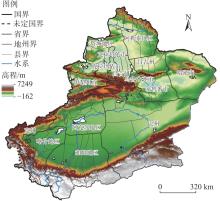
图1
研究区示意图 注:基于自然资源部标准地图服务网站审图号为GS(2019)1822号的标准地图制作,底图边界无修改。克州、巴州、昌吉州、伊犁州直、博州分别为克孜勒苏柯尔克孜自治州、巴音郭楞蒙古自治州、昌吉回族自治州、伊犁哈萨克自治州直属县市、博尔塔拉蒙古自治州的简称。白色部分为新疆生产建设兵团县域。下同。"
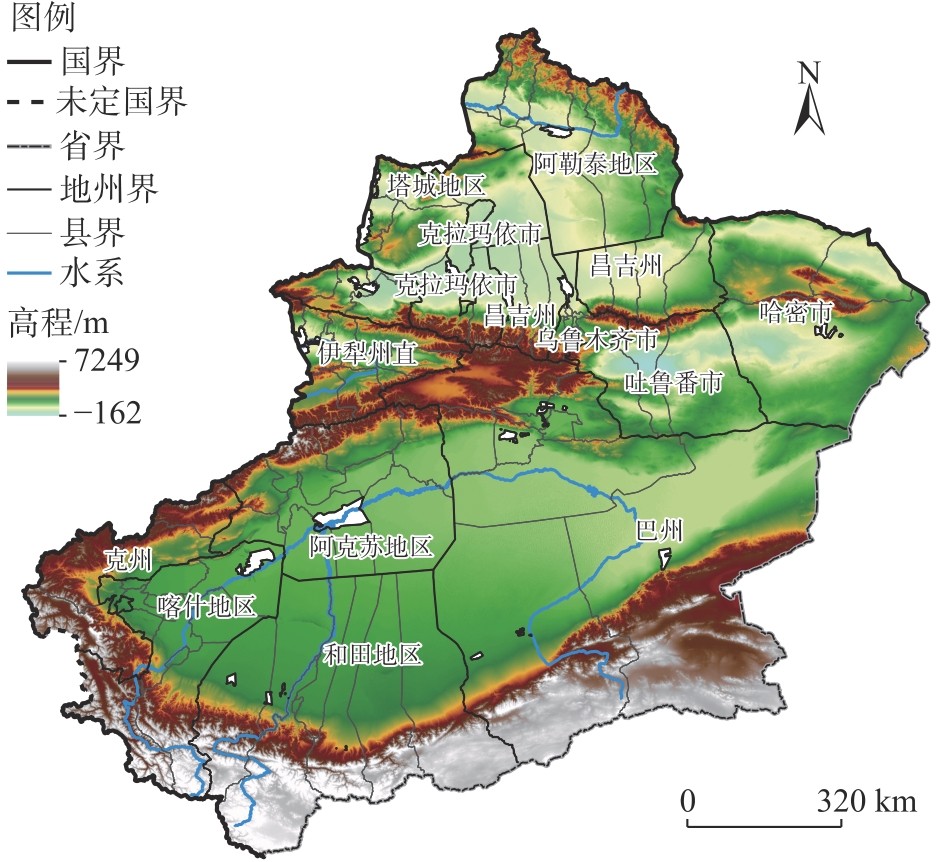
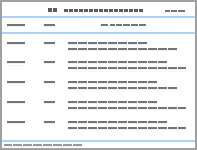
表1
耕地利用生态效率评价指标体系"
| 指标类别 | 指标名称 | 指标释义 |
|---|---|---|
| 投入指标 | 土地投入 | 耕地面积/hm2 |
| 劳动力投入 | 从事农业人员/人 | |
| 农机投入 | 农业机械总动力/kW | |
| 化肥投入 | 化肥施用折纯量/t | |
| 期望产出指标 | 农业产值 | 农业总产值/104元 |
| 粮食产量 | 粮食总产量/t | |
| 非期望产出指标 | 碳排放 | 耕地利用碳排放量/t |
表2
耕地利用生态效率影响因素指标选取"
| 变量类型 | 解释变量 | 指标释义 |
|---|---|---|
| 自然资源禀赋 | 水土协调比例(X1) | 水域面积与耕地面积之比 |
| 农业科技创新 | 农业专业化服务(X2) | 专业化服务产值与农林牧渔业总产值之比 |
| 机械化水平(X3) | 机械总动力与农作物播种面积之比/kW·hm-2 | |
| 农业基础设施 | 地膜覆盖率(X4) | 地膜覆盖面积与农作物播种面积之比 |
| 农业种植收益 | 人均农业产值(X5) | 农业总产值与乡村人口之比/104元·人-1 |
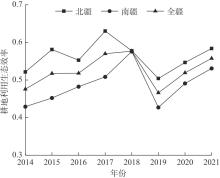
图2
2014—2021年新疆耕地利用生态效率变化趋势"
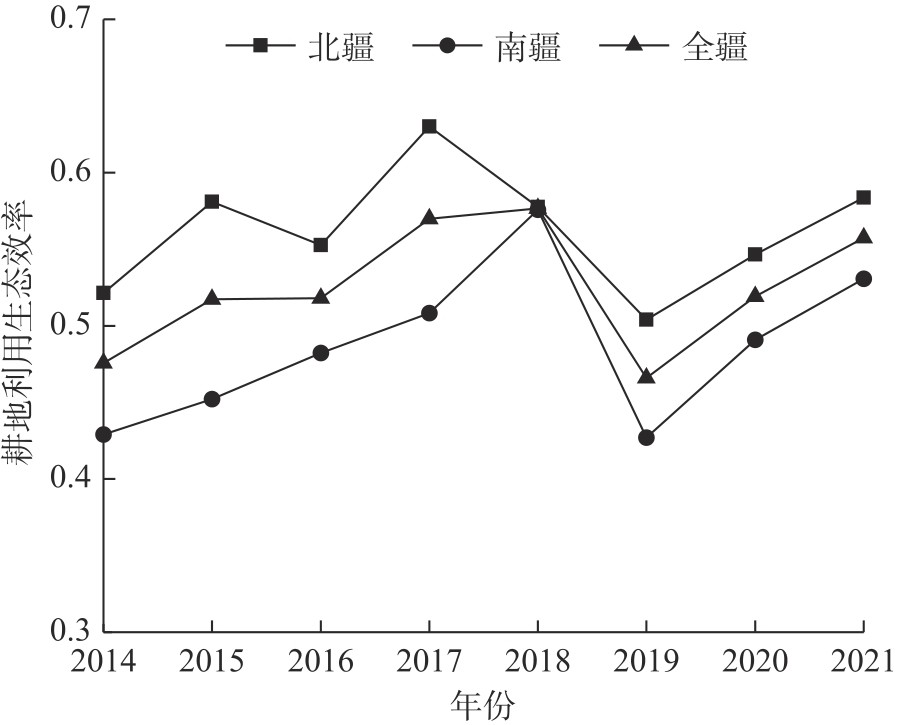
表3
2014—2021年新疆耕地利用生态效率全局莫兰指数(全局Moran’s I)"
| 年份 | 全局Moran’s I | Z值 |
|---|---|---|
| 2014 | 0.076** | 2.276 |
| 2015 | 0.174*** | 4.831 |
| 2016 | 0.122*** | 3.484 |
| 2017 | 0.171*** | 4.756 |
| 2018 | 0.013 | 0.679 |
| 2019 | 0.079** | 2.374 |
| 2020 | 0.100** | 2.942 |
| 2021 | 0.151*** | 4.195 |
图3
2014—2021年新疆耕地利用生态效率的LISA聚类"
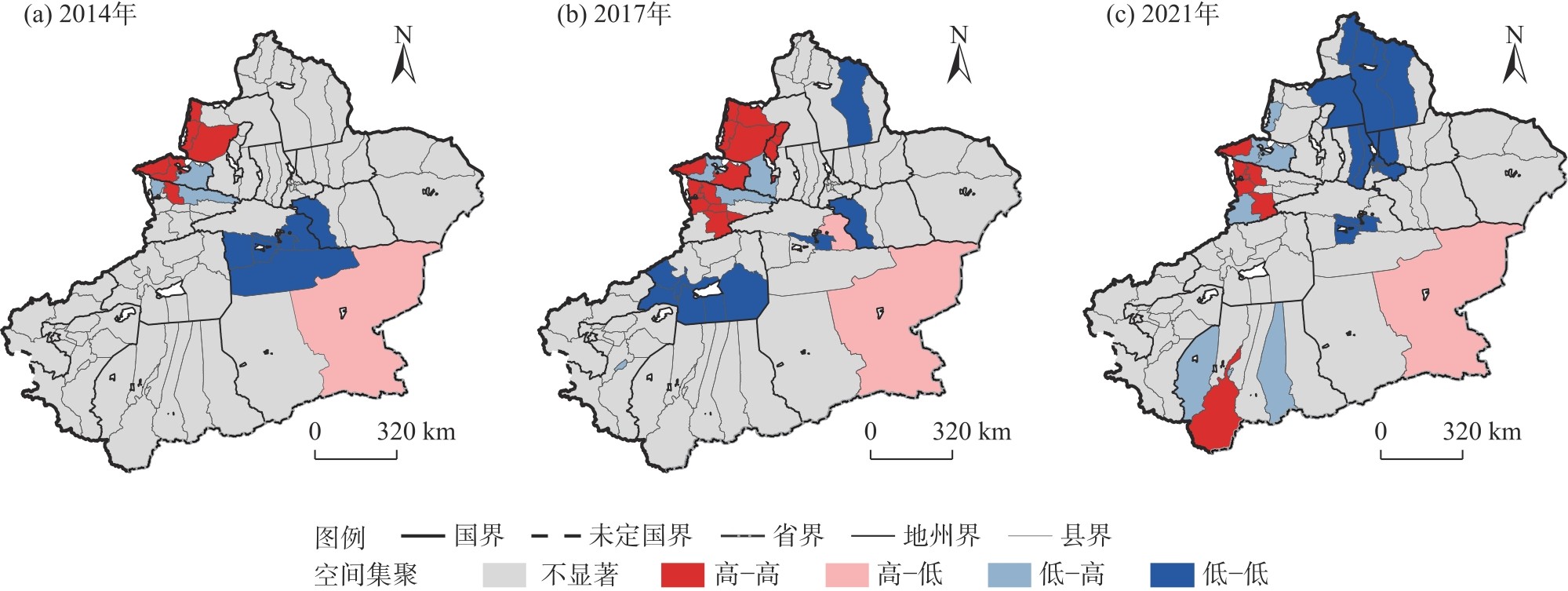
表4
新疆耕地利用生态效率影响因素回归结果"
| 变量名称 | 系数 | 标准误差 | T值 | P值 |
|---|---|---|---|---|
| 水土协调比例 | 0.295 | 0.157 | 1.880 | 0.061 |
| 农业专业化服务 | 0.048 | 0.022 | 2.160 | 0.031 |
| 机械化水平 | -0.129 | 0.062 | -2.080 | 0.038 |
| 地膜覆盖率 | -0.186 | 0.094 | -1.970 | 0.049 |
| 人均农业产值 | 0.033 | 0.010 | 3.380 | 0.001 |
| 常数项 | 0.759 | 0.134 | 5.640 | 0.000 |
| 地区固定效应 | 控制 | |||
| 年份固定效应 | 控制 | |||
| R2 | 0.116 | |||
| [1] | 冯起, 尹鑫卫, 朱猛, 等. 统筹推进西北地区盐碱地综合治理利用: 现状、挑战与对策建议[J]. 中国科学院院刊, 2024, 39(12): 2060-2073. |
| [Feng Qi, Yin Xinwei, Zhu Meng, et al. Overall promotion of integrated management and utilization of saline-alkali land in northwest China: Conditions, challenges, and recommendations[J]. Bulletin of Chinese Academy of Sciences, 2024, 39(12): 2060-2073.] | |
| [2] | Wang J Y, Su D, Wu Q, et al. Study on eco-efficiency of cultivated land utilization based on the improvement of ecosystem services and emergy analysis[J]. Science of the Total Environment, 2023, 882: 163489, doi: 10.1016/j.scitotenv.2023.163489. |
| [3] |
王福红, 夏咏. 干旱区主要农作物生产时空格局演化及影响因素分析——以新疆地区为例[J]. 干旱区地理, 2025, 48(3): 444-454.
doi: 10.12118/j.issn.1000-6060.2024.201 |
|
[Wang Fuhong, Xia Yong. Spatio-temporal pattern evolution and influencing factors of main cropsproduction in arid region: A case of Xinjiang[J]. Arid Land Geography, 2025, 48(3): 444-454.]
doi: 10.12118/j.issn.1000-6060.2024.201 |
|
| [4] |
丁建丽, 王飞. 干旱区大尺度土壤盐度信息环境建模: 以新疆天山南北中低海拔冲积平原为例[J]. 地理学报, 2017, 72(1): 64-78.
doi: 10.11821/dlxb201701006 |
|
[Ding Jianli, Wang Fei. Environmental modeling of large-scale soil salinity informationin an arid region: A case study of the low and middle altitude alluvial plain north and south of the Tianshan Mountains, Xinjiang[J]. Acta Geographica Sinica, 2017, 72(1): 64-78.]
doi: 10.11821/dlxb201701006 |
|
| [5] | Yang B, Wang Z Q, Zou L, et al. Exploring the eco-efficiency of cultivated land utilization and its influencing factors in China’s Yangtze River Economic Belt, 2001—2018[J]. Journal of Environmental Management, 2021, 294: 112939, doi: 10.1016/j.jenvman.2021.112939. |
| [6] | 张红梅, 宋戈. 黑龙江垦区耕地利用生态效率及其内部协调性[J]. 华中农业大学学报(社会科学版), 2019(4): 160-168, 178. |
| [Zhang Hongmei, Song Ge. Eco-efficiency of cultivated land use and the internal coordinationin Heilongjiang reclamation area[J]. Journal of Huazhong Agricultural University (Social Sciences Edition), 2019(4): 160-168, 178.] | |
| [7] | 吕添贵, 付舒斐, 胡晗, 等. 农业绿色转型约束下耕地利用生态效率时空分异特征及空间效应[J]. 水土保持研究, 2024, 31(1): 269-279, 289. |
| [Lü Tiangui, Fu Shufei, Hu Han, et al. Spatiotemporal differentiation characteristics and spatial effects of ecological efficiency of cultivated land use based on the constraints of agricultural green transformation[J]. Research of Soil and Water Conservation, 2024, 31(1): 269-279, 289.] | |
| [8] | 吴诗嫚, 丁如, 匡兵, 等. 土地综合整治对耕地利用生态效率的影响研究——基于农户微观数据的实证分析[J]. 中国土地科学, 2023, 37(11): 95-105. |
| [Wu Shiman, Ding Ru, Kuang Bing, et al. Impact of comprehensive land consolidation on ecological efficiency of cultivated land use: Empirical analysis based on the microsurvey data of farmers[J]. China Land Science, 2023, 37(11): 95-105.] | |
| [9] |
文高辉, 刘蒙罢, 胡贤辉, 等. 洞庭湖平原耕地利用生态效率空间相关性与空间效应[J]. 地理科学, 2022, 42(6): 1102-1112.
doi: 10.13249/j.cnki.sgs.2022.06.016 |
| [Wen Gaohui, Liu Mengba, Hu Xianhui, et al. Spatial correlation and spatial effect of cultivated land use ecological efficiency in the Dongting Lake Plain[J]. Geographical Science, 2022, 42(6): 1102-1112.] | |
| [10] | 李继霞, 王华春, 樊骋琳. “双碳”目标下中国耕地利用生态效率的区域差异、动态演进及收敛性[J]. 华中农业大学学报(社会科学版), 2023(5): 167-181. |
| [Li Jixia, Wang Huachun, Fan Chenglin. Regional differences dynamic evolution and convergence of ecological efficiency of cultivated land use in China under the dual carbon target[J]. Journal of Huazhong Agricultural University (Social Sciences Edition), 2023(5): 167-181.] | |
| [11] | 杨和平, 李红波. 农业新质生产力对耕地利用生态效率的影响——以长江经济带为例[J]. 中国土地科学, 2024, 38(11): 94-104. |
| [Yang Heping, Li Hongbo. Impact of agricultural new quality productivity on ecological efficiency of cultivated land use: A case study of the Yangtze River Economic Belt[J]. China Land Science, 2024, 38(11): 94-104.] | |
| [12] | 周爱群, 陈彩虹. 耕地利用生态效率的时空演变及影响因素研究[J]. 经济问题, 2023(12): 95-101. |
| [Zhou Aiqun, Chen Caihong. Temporal and spatial evolution and influencing factors of ecological efficiency of cultivated land use[J]. On Economic Problems, 2023(12): 95-101.] | |
| [13] | 刘蒙罢, 张安录, 文高辉. 长江中下游粮食主产区耕地利用生态效率时空格局与演变趋势[J]. 中国土地科学, 2021, 35(2): 50-60. |
| [Liu Mengba, Zhang Anlu, Wen Gaohui. Temporal and spatial pattern and evolution trend of cultivated land use ecological efficiency in the main grain producing areas in the lower Yangtze region[J]. China Land Science, 2021, 35(2): 50-60.] | |
| [14] |
王良健, 李辉. 中国耕地利用效率及其影响因素的区域差异——基于281个市的面板数据与随机前沿生产函数方法[J]. 地理研究, 2014, 33(11): 1995-2004.
doi: 10.11821/dlyj201411001 |
| [Wang Liangjian, Li Hui. Cultivated land use efficiency and the regional characteristics of its influencing factors in China: By using a panel data of 281 prefectural cities and the stochastic frontier production function[J]. Geographical Research, 2014, 33(11): 1995-2004.] | |
| [15] | 刘沙沙, 蒲金芳, 张蚌蚌, 等. 基于动态网络二阶段DEA模型的洞庭湖区耕地利用效率研究[J]. 中国农业大学学报, 2022, 27(12): 257-269. |
| [Liu Shasha, Pu Jinfang, Zhang Bangbang, et al. Cultivated landutilization efficiency in Dongting Lake area: Based on a dynamic network two-stage DEA model[J]. Journal of China Agricultural University, 2022, 27(12): 257-269.] | |
| [16] | 陈丹玲, 卢新海, 匡兵. 基于随机森林的耕地利用效率测度模型构建及其应用[J]. 自然资源学报, 2019, 34(6): 1331-1344. |
|
[Chen Danling, Lu Xinhai, Kuang Bing. Measurement of cultivated land utilization efficiency: Construction and application of random forest[J]. Journal of Natural Resources, 2019, 34(6): 1331-1344.]
doi: 10.31497/zrzyxb.20190618 |
|
| [17] | 马林燕, 张仁慧, 潘子纯, 等. 中国省际耕地利用生态效率时空格局演变及影响因素分析——基于2000—2019年面板数据[J]. 中国土地科学, 2022, 36(3): 74-85. |
| [Ma Linyan, Zhang Renhui, Pan Zichun, et al. Analysis of the evolution and influencing factors of temporal and spatial pattern of eco-efficiency of cultivated land use among provinces in China: Based on panel data from 2000 to 2019[J]. China Land Science, 2022, 36(3): 74-85.] | |
| [18] |
Huang K P, Tang W, Zhou F M, et al. Agricultural productive services and ecological efficiency of cultivated land use: Evidence from Hunan Province, China[J]. Polish Journal of Environmental Studies, 2024, 33: 5127-5140.
doi: 10.15244/pjoes/182907 |
| [19] | 薛选登, 谢宇. 黄河流域粮食主产区耕地利用生态效率时空差异与空间收敛——来自60个地级市的经验证据[J]. 中国农业资源与区划, 2024, 45(4): 52-65. |
| [Xue Xuandeng, Xie Yu. The spatial-temporal differences and cpatial convergence of ecological efficiency in cultivated land utilization in the main grain-producing areas of the Yellow River Basin: Evidence from 60 prefecture-level cities[J]. Chinese Journal of Agricultural Resources and Regional Planning, 2024, 45(4): 52-65.] | |
| [20] | 胡贤辉, 蔺思琪, 何庆, 等. 耕地细碎化、耕地经营规模对农户耕地利用生态效率的影响——以常德市为例[J]. 中国土地科学, 2023, 37(4): 95-106. |
| [Hu Xianhui, Lin Siqi, He Qing, et al. Effects of cultivated land fragmentation and cultivated land operation scale on ecological efficiency of famers’ cultivated land use: A case study of Changde City[J]. China Land Science, 2023, 37(4): 95-106.] | |
| [21] | 朱文娟, 孙华. 江苏省县域耕地利用生态效率时空动态性及驱动机制[J]. 长江流域资源与环境, 2024, 33(4): 784-798. |
| [Zhu Wenjuan, Sun Hua. Spatio-temporal dynamics and driving mechanism of cultivated land use eco-efficiency at county scale in Jiangsu Province[J]. Resources and Environment in the Yangtze Basin, 2024, 33(4): 784-798.] | |
| [22] | 杨欣, 杜梦晴, 肖豪立, 等. 湖北省县域新型城镇化与耕地利用生态效率时空耦合关系研究[J]. 长江流域资源与环境, 2024, 33(10): 2180-2190. |
| [Yang Xin, Du Mengqing, Xiao Haoli, et al. Coupling relationship between new-type urbanization and farmland utilization eco-efficiency at county-level in Hubei Province[J]. Resources and Environment in the Yangtze Basin, 2024, 33(10): 2180-2190.] | |
| [23] | 阿曼妮萨·库尔班, 满苏尔·沙比提, 艾克旦·依萨克, 等. 近19年新疆阿克苏河流域耕地利用时空演变特征[J]. 中国水土保持科学(中英文), 2022, 20(3): 72-80. |
| [Kuerban Amannisa, Shabit Mansuer, Yisake Aikedan, et al. Spatiotemporal evolution of arable land use in Aksu River Basin, Xinjiang in recent 19 years[J]. Science of Soil and Water Conservation, 2022, 20(3): 72-80.] | |
| [24] |
吕宁, 国语, 彭琴, 等. 新疆耕地利用碳源/汇效应时空演变特征及其贡献因子[J]. 干旱区研究, 2025, 42(1): 179-190.
doi: 10.13866/j.azr.2025.01.16 |
|
[Lü Ning, Guo Yu, Peng Qin, et al. Spatiotemporal evolution characteristics and contributing factors of the carbon effect in cultivated land use in Xinjiang[J]. Arid Zone Research, 2025, 42(1): 179-190.]
doi: 10.13866/j.azr.2025.01.16 |
|
| [25] | 各文克, 王浩阳, 李奇峰, 等. 新疆耕地景观细碎化演变特征及驱动因素[J]. 水土保持研究, 2025, 32(3): 260-269. |
| [Ge Wenke, Wang Haoyang, Li Qifeng, et al. Evolution characteristics and driving factors of farmland landscape fragmentation in Xinjiang[J]. Research of Soil and Water Conservation, 2025, 32(3): 260-269.] | |
| [26] |
李亮亮, 夏咏, 王福红, 等. 新疆甜瓜生产格局及其贡献因素分析[J]. 干旱区地理, 2025, 48(9): 1567-1577.
doi: 10.12118/j.issn.1000-6060.2024.631 |
|
[Li Liangliang, Xia Yong, Wang Fuhong, et al. Analysis of muskmelon production pattern and its contributing factors in Xinjiang[J]. Arid Land Geography, 2025, 48(9): 1567-1577.]
doi: 10.12118/j.issn.1000-6060.2024.631 |
|
| [27] | 王鹏程, 张利国, 陆汝成. “边境-粮食-生态”安全视域下耕地利用生态效率演变特征与机制——以中越边境地区为例[J]. 生态学报, 2024, 44(11): 4637-4649. |
| [Wang Pengcheng, Zhang Liguo, Lu Rucheng. Evolution characteristics and mechanism of cultivated land use eco-efficiency from the triple-security perspective in China-Vietnam border area[J]. Acta Ecologica Sinica, 2024, 44(11): 4637-4649.] | |
| [28] | 李波, 张俊飚, 李海鹏. 中国农业碳排放时空特征及影响因素分解[J]. 中国人口·资源与环境, 2011, 21(8): 80-86. |
| [Li Bo, Zhang Junbiao, Li Haipeng. Research on spatial-temporal characteristics and affecting factors decomposition of agricultural carbon emission in China[J]. China Population, Resources and Environment, 2011, 21(8): 80-86.] | |
| [29] |
Tone K. A slacks-based measure of efficiency in data envelopment analysis[J]. European Journal of Operational Research, 2001, 130: 498-509.
doi: 10.1016/S0377-2217(99)00407-5 |
| [30] | 官卫华, 江璇. 国内外耕地保护补偿实践及其启示[J]. 规划师, 2021, 37(13): 80-86, 94. |
| [Guan Weihua, Jiang Xuan. Practice and inspiration of farmland compensation at home and abroad[J]. Planners, 2021, 37(13): 80-86, 94.] | |
| [31] | 和田地区融媒体中心. 和田戈壁沙漠设施农业蓬勃兴起[EB/OL]. [2025-01-05]. https://mp.weixin.qq.com/s/thb0bCbnVEICjntUQGoVAw. |
| [Hotan Regional Media Convergence Center. Facility agriculture has flourished in the gobi desert region of Hotan[EB/OL]. [2025-01-05]. https://mp.weixin.qq.com/s/thb0bCbnVEICjntUQGoVAw.] | |
| [32] | 石志恒, 符越. 社会化服务对农户农药减量行为的影响——基于服务专业化维度的考察[J]. 中国农业资源与区划, 2023, 44(3): 130-142. |
| [Shi Zhiheng, Fu Yue. Influnce of socialized service on framers pesticide reduction behavior: Investigation based on the dimension of service specialization[J]. Chinese Journal of Agricultural Resources and Regional Planning, 2023, 44(3): 130-142.] | |
| [33] | 刘成坤, 汪乐, 孟静静. 农业机械化影响农业生态效率的理论分析及实证检验[J]. 中国生态农业学报(中英文), 2025, 33(6): 1219-1234. |
| [Liu Chengkun, Wang Le, Meng Jingjing. Theoretical analysis and empirical testing of the impact of agricultural mechanization on agricultural eco-efficiency[J]. Chinese Journal of Eco-Agriculture, 2025, 33(6): 1219-1234.] | |
| [34] | 杜美玲, 祝宏辉, 尹小君. 农业机械化对农业生态效率的影响研究[J]. 农业现代化研究, 2023, 44(6): 1082-1092. |
| [Du Meiling, Zhu Honghui, Yin Xiaojun. Study on the impact of agricultural mechanization on agricultural ecological efficiency[J]. Research of Agricultural Modernization, 2023, 44(6): 1082-1092.] | |
| [35] | 王永静, 陈增增. 天山北坡经济带农业生态效率评价及提升路径研究——基于Super-SBM模型和Global-Malmquist指数[J]. 生态经济, 2020, 36(2): 111-117. |
| [Wang Yongjing, Chen Zengzeng. Study on agricultural ecology efficiency evaluation and improvement path of economic belt on the north slope of Tianshan Mountains: Based on the Super-SBM and Global-Malmquist index[J]. Ecological Economy, 2020, 36(2): 111-117.] | |
| [36] | 韩佳敏, 孟梅. “双碳”目标下新疆耕地利用生态效率时空演变特征及原因分析[J]. 中国农机化学报, 2025, 46(2): 287-294. |
| [Han Jiamin, Meng Mei. Analysis on characteristics and causes of spatial and temporal evolution of cropland utilization eco-efficiency in Xinjiang under the “dual-carbon” target[J]. Journal of Chinese Agricultural Mechanization, 2025, 46(2): 287-294.] | |
| [37] |
焦岩, 闫峰, 卢琦, 等. 西北干旱区绿洲时空变化及驱动力[J]. 应用生态学报, 2024, 35(8): 2206-2216.
doi: 10.13287/j.1001-9332.202408.025 |
|
[Jiao Yan, Yan Feng, Lu Qi, et al. Spatiotemporal variation and driving factors of oases in the arid region of northwest China[J]. Chinese Journal of Applied Ecology, 2024, 35(8): 2206-2216.]
doi: 10.13287/j.1001-9332.202408.025 |
|
| [38] |
杜辰, 刘涛, 黄大全, 等. 中国空间规划耕地保护指标分配和优化——以2006—2020年省级土地利用总体规划为例[J]. 自然资源学报, 2023, 38(5): 1240-1261.
doi: 10.31497/zrzyxb.20230509 |
|
[Du Chen, Liu Tao, Huang Daquan, et al. The allocation and optimization of the area of cultivated land reserved in China’s spatial planning: Taking the 2006—2020 provincial overall plans for land utilization as example[J]. Journal of Natural Resources, 2023, 38(5): 1240-1261.]
doi: 10.31497/zrzyxb.20230509 |
|
| [39] | 谷琴, 渠丽萍. “双碳”背景下河南省耕地绿色利用效率时空变化及影响因素研究[J]. 资源开发与市场, 2025, 41(8): 1142-1149. |
| [Gu Qin, Qu Liping. Research on spatio-temporal variation and influencing factors of green utilization efficiency of cultivated land in Henan Province under the “dual carbon” background[J]. Resource Development & Market, 2025, 41(8): 1142-1149.] |
| [1] | 陈先林, 闫志远, 刘全明, 张圣微. 1958—2023年内蒙古植被干旱时空特征与驱动因素分析[J]. 干旱区地理, 2026, 49(7): 1323-1335. |
| [2] | 周莹洁, 陈浩. 丝绸之路中国段生态系统服务时空演变机制及其非线性阈值[J]. 干旱区地理, 2026, 49(7): 1445-1456. |
| [3] | 李文君, 张维梅. 中国数字经济与共同富裕的耦合协调关系及时空演进趋势[J]. 干旱区地理, 2026, 49(7): 1481-1492. |
| [4] | 陈亚宁, 朱成刚, 李稚, 方功焕. 新疆高质量发展的水资源潜力挖掘分析[J]. 干旱区地理, 2026, 49(6): 1101-1107. |
| [5] | 付伟, 王煜承, 崔龙芳, 陈建成. 中国西部地区城乡居民食物消费碳排放差异与驱动因素分析[J]. 干旱区地理, 2026, 49(5): 1026-1038. |
| [6] | 刘潇, 张新焕, 陈洋, 闫海龙. “乡镇-县域-绿洲”视角下新疆城乡融合的空间条件测度研究[J]. 干旱区地理, 2026, 49(5): 1039-1051. |
| [7] | 白洋, 赵平, 李永峰, 陈明珠, 孙艺玥. 新疆地质旅游空间协同区划研究[J]. 干旱区地理, 2026, 49(5): 1074-1086. |
| [8] | 何家豪, 侯光良, 敖民, 唐中华, 石洪飞. 基于MaxEnt的青藏高原细石器人群时空分布演变研究[J]. 干旱区地理, 2026, 49(5): 987-997. |
| [9] | 卢雅焱, 封甜, 杨兆萍, 韩芳, 贾莹莹. 中国省域新质生产力与旅游高质量发展适配度时空演变及障碍因子研究[J]. 干旱区地理, 2026, 49(4): 643-655. |
| [10] | 关靖云, 孙之阳, 徐晓亮, 程乙峰, 宋贝贝, 房瑞莹. 气候变化背景下中国新疆与中亚五国旅游气候舒适度时空演变分析[J]. 干旱区地理, 2026, 49(4): 697-712. |
| [11] | 陈文宣, 陈钰, 王生隆. 黄河流域农业碳排放时空演化特征及其影响因素分析[J]. 干旱区地理, 2026, 49(4): 713-726. |
| [12] | 郝晓燕, 李玥蓉, 吴月. 黄河流域物流业全要素碳生产率测度及影响因素——基于能源禀赋差异视角[J]. 干旱区地理, 2026, 49(4): 756-768. |
| [13] | 刘法建, 梁婉欣, 黄超群, 李松渊, 张博涵. 中国旅游新质生产力发展时空演化特征与驱动因素[J]. 干旱区地理, 2026, 49(3): 429-439. |
| [14] | 朱怡婷, 梁桂仙, 周春山, 辛龙, 李金雪. 新疆文旅新质生产力发展时空演变特征与驱动因素[J]. 干旱区地理, 2026, 49(1): 128-139. |
| [15] | 阿力木·艾尔肯, 李如琦, 努尔扎提·阿卜杜柯尤木, 玛依热·艾海提, 希热娜依·铁里瓦尔地. 1961—2022年新疆南部降雨和极端降雨特征[J]. 干旱区地理, 2026, 49(1): 13-22. |
|
||