干旱区地理 ›› 2026, Vol. 49 ›› Issue (5): 987-997.doi: 10.12118/j.issn.1000-6060.2025.235 cstr: 32274.14.ALG2025235
何家豪1( ), 侯光良1,2(), 敖民1, 唐中华1, 石洪飞1
收稿日期:2025-04-28
修回日期:2025-06-04
出版日期:2026-05-25
发布日期:2026-05-25
通讯作者:
侯光良(1972-),男,博士,教授,主要从事环境变化与人类适应研究. E-mail: hgl20@163.com作者简介:何家豪(1997-),男,硕士研究生,主要从事环境变化与人类适应研究. E-mail: jiahao025@163.com
基金资助:
HE Jiahao1(), HOU Guangliang1,2(), AO Min1, TANG Zhonghua1, SHI Hongfei1
Received:2025-04-28
Revised:2025-06-04
Published:2026-05-25
Online:2026-05-25
摘要:
青藏高原的极端环境对人类生存构成了巨大挑战,而古人类在青藏高原的生存一直是学界关注的焦点。细石器作为青藏高原分布最广且最具代表性的史前人类遗存之一,是史前高原人群的生产生活方式的重要体现物,有着特殊的研究价值与意义。以细石器主要分布的旧石器末期(15—6 ka BP)作为研究时期,以细石器遗址点作为分布点,结合环境因素,运用最大熵模型(MaxEnt)对青藏高原细石器人群的分布范围进行模拟预测。结果表明:(1) 15—14 ka BP:适生区主要分布于青藏高原东部边缘、四川西部及雅鲁藏布江河谷地带。(2) 14—12 ka BP:适生区主要沿河湟谷地至西藏北部(简称藏北)一线以及雅鲁藏布江上游地区分布。相较于前一阶段明显扩大,藏北、青海南部(简称青南)地区扩张最为显著。(3) 12—10 ka BP:除雅鲁藏布江上游及藏北地区适生区较为稳定外,其他地区的适生区均有大面积缩小,青南、河湟谷地地区尤为明显。(4) 10—8 ka BP:受全新世大暖期影响,青藏高原部分地区适生面积快速扩张,东北部尤为明显。但藏北地区的适生面积却有大幅度缩小。(5) 8—6 ka BP:除青海湖-河湟谷地外,其他地区的高度适生区均有较大程度萎缩,但总体分布范围变化不大。而低度适生区有一定的增长,超过10%。总的来说,各区域在不同时期变化较大,但总体适生区面积相对稳定。不同于以往对单个遗址点的分析探究,本研究采用最大熵模型进行多点位的综合系统探究,为青藏高原人类活动研究提供新思路。
何家豪, 侯光良, 敖民, 唐中华, 石洪飞. 基于MaxEnt的青藏高原细石器人群时空分布演变研究[J]. 干旱区地理, 2026, 49(5): 987-997.
HE Jiahao, HOU Guangliang, AO Min, TANG Zhonghua, SHI Hongfei. Spatiotemporal distribution evolution of the microlithic populations on the Qinghai-Xizang Plateau based on MaxEnt[J]. Arid Land Geography, 2026, 49(5): 987-997.
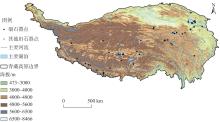
图1
研究区概况及遗址点分布 注:基于自然资源部标准地图服务网站审图号为GS(2020)4619号的标准地图制作,底图边界无修改。下同。"
表1
本文所用遗址点信息"
| 遗址点 | 经度/°E | 纬度/°N | 距今年代/ka BP | 方法 | 遗址点 | 经度/°E | 纬度/°N | 距今年代/ka BP | 方法 |
|---|---|---|---|---|---|---|---|---|---|
| 马法木湖[ | 81.91 | 30.83 | 全新世早期 | 类型学 | 各听[ | 89.36 | 31.58 | 新旧石器过渡期 | 类型学 |
| 帕也真沟[ | 79.99 | 30.83 | 全新世早期 | 类型学 | 参雄尕朔[ | 96.02 | 33.48 | 8—7 | AMS14C |
| 戳错龙湖西岸[ | 85.08 | 29.00 | 全新世早期 | 类型学 | 角考[ | 95.95 | 33.76 | 8—7 | 类型学 |
| 定日苏热[ | 80.98 | 30.69 | 新旧石器过渡期 | 类型学 | 尕琼[ | 95.98 | 33.77 | 8—7 | 类型学 |
| 热角[ | 79.06 | 33.50 | 新旧石器过渡期 | 类型学 | 西琼达[ | 96.05 | 33.80 | 8—7 | 类型学 |
| 贡崩[ | 87.21 | 29.32 | 新旧石器过渡期 | 类型学 | 古沃达[ | 95.93 | 33.73 | 8—7 | 类型学 |
| 江西沟1号(JXG1)[ | 100.35 | 36.57 | 14.6±0.4 | AMS14C | 垄[ | 83.74 | 29.87 | 8.9—7.3 | 类型学 |
| 十火塘(10HTHS1)[ | 100.87 | 36.86 | 12.4±0.2 | AMS14C | 嘎加拉地[ | 83.75 | 29.87 | 8.9—7.3 | 类型学 |
| 尕海1号(GH1)[ | 100.68 | 36.86 | 11.2±0.1 | AMS14C | 年扎合(NZH)[ | 98.80 | 34.82 | 8.5 | OSL |
| 铜线3号(BWC3)[ | 100.75 | 36.87 | 12.1±0.3 | AMS14C | 雅江上游诸石器点(UYT sites)[ | 83.26 | 30.05 | 6.6 | OSL |
| 铜线4号(BWC4)[ | 100.75 | 36.88 | 5.5±0.1 | AMS14C | |||||
| 151(YWY1)[ | 100.49 | 36.58 | 8.6±0.1 | AMS14C | 多格则[ | 87.05 | 31.83 | 新旧石器过渡期 | 类型学 |
| 湖东种羊场(HZYC1)[ | 100.87 | 36.66 | 13.0±0.2 | AMS14C | 扎布[ | 81.00 | 33.33 | 新旧石器过渡期 | 类型学 |
| 拉乙亥[ | 100.70 | 35.95 | 6.7±0.09 | AMS14C | 西大滩2号[ | 94.15 | 35.69 | 9.2—6.4 | AMS14C |
| 野牛沟1号[ | 94.25 | 35.88 | 7.5±0.04 | AMS14C | 羊曲西(YQX)[ | 100.11 | 35.55 | 5.3±0.2 | AMS14C |
| 野牛沟2号[ | 94.23 | 35.87 | 7.4±0.04 | AMS14C | 仲巴县北[ | 84.03 | 29.78 | ≥4 | 类型学 |
| 尼阿底3号[ | 88.80 | 31.47 | 11—10 | AMS14C | 冬给措纳3号[ | 98.51 | 35.35 | 5.4—5.0 | AMS14C |
| 黑马河1号(HMH1)[ | 99.77 | 36.76 | 13.1±0.2 | AMS14C | 雅曲雅土[ | 89.35 | 33.00 | 新石器早期 | 类型学 |
| 黑马河3号(HMH3)[ | 99.74 | 36.78 | 8.4±0.1 | AMS14C | 错尼[ | 87.33 | 34.66 | 新石器早期 | 类型学 |
| 达玉台[ | 100.71 | 35.96 | 新石器早期 | 类型学 | 东果滩[ | 100.20 | 35.64 | 7.6—6.2 | AMS14C |
| 塘甘木大桥北[ | 92.16 | 33.75 | 新石器早期 | 类型学 | 羊圈台[ | 100.14 | 35.52 | 8—7 | 类型学 |
| 错那湖东南[ | 91.52 | 32.00 | 新石器早期 | 类型学 | 扎陵湖[ | 97.29 | 35.01 | 7.2 | 类型学 |
| 措则村[ | 91.94 | 31.50 | 新石器早期 | 类型学 | 下大武1号 | 99.26 | 35.00 | 11.2±0.07 | 碳屑 |
| 色林错[ | 89.23 | 31.51 | 13.6±0.2 | AMS14C | 黄藏寺 | 100.19 | 38.22 | 7.9±0.5 | OSL |
| 戈木错盆地[ | 86.08 | 33.75 | 新旧石器过渡期 | 类型学 | 代曲(DQ) | 96.47 | 33.86 | 9.3—8.1 | AMS14C |
| 炉霍虾拉沱[ | 100.74 | 31.30 | 13.5±0.3 | AMS14C | 老大桥 | 95.83 | 34.03 | 11 | OSL |
| 珠洛勒[ | 88.50 | 31.38 | 新旧石器过渡期 | 类型学 | 邦布 | 97.17 | 33.05 | 新旧石器过渡期 | 类型学 |
| 罗马松[ | 88.55 | 31.56 | 新旧石器过渡期 | 类型学 | 江西沟2号 | 100.37 | 36.57 | 8.2—8.0,5.6—5.4 | AMS14C |
| 亚司[ | 89.06 | 30.55 | 新旧石器过渡期 | 类型学 | 牛头山南 | 97.54 | 34.89 | 7.2 | 类型学 |
| 邱桑[ | 90.96 | 29.97 | 13—12, 8.4—7.4 | 类型学 | 鄂陵湖 | 97.88 | 35.05 | 7.2 | 类型学 |
| 亚里[ | 86.12 | 28.41 | 中石器或更晚 | 类型学 | 沙隆卡 | 102.00 | 36.01 | 8.5—7.3 | OSL |
| 羊圈[ | 86.16 | 28.60 | 中石器或更晚 | 类型学 |
表2
具体预建模环境因子信息"
| 符号 | 变量 | 符号 | 变量 |
|---|---|---|---|
| bio1 | 年平均气温/℃ | bio16 | 最潮湿季度 降水量/mm |
| bio2 | 平均昼夜范围 | ||
| bio3 | 等温指数 | bio17 | 最干旱季度 降水量/mm |
| bio4 | 温度季节性指数 (标准偏差×100%) | ||
| bio18 | 最热季度 降水量/mm | ||
| bio5 | 最热月份最高温度/℃ | ||
| bio6 | 最冷月份最高温度/℃ | bio19 | 最冷季度 降水量/mm |
| bio7 | 温度年范围(bio5-bio6)/℃ | ||
| bio8 | 最潮湿地区平均温度/℃ | river distance | 距河流距离/km |
| bio9 | 最干旱地区平均温度/℃ | FVC | 植被覆盖度 |
| bio10 | 最热季度平均温度/℃ | soil type | 土壤类型 |
| bio11 | 最冷季度平均温度/℃ | land-use type | 土地类型 |
| bio12 | 年降水量/mm | altitude | 海拔/m |
| bio13 | 最湿润月份降水量/mm | slope | 坡度/(°) |
| bio14 | 最干旱月份降水量/mm | slope orientation | 坡向 |
| bio15 | 降水季节性变异系数 |
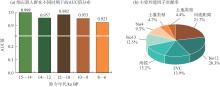
图2
细石器人群在不同时期下的AUC分布及主要环境因子贡献率 注:AUC为曲线下面积,是体现模型结果可信度的量化指标;bio4为温度季节性指数;bio12为年降水量;bio13为最湿润月份降水量;FVC为植被覆盖度。"
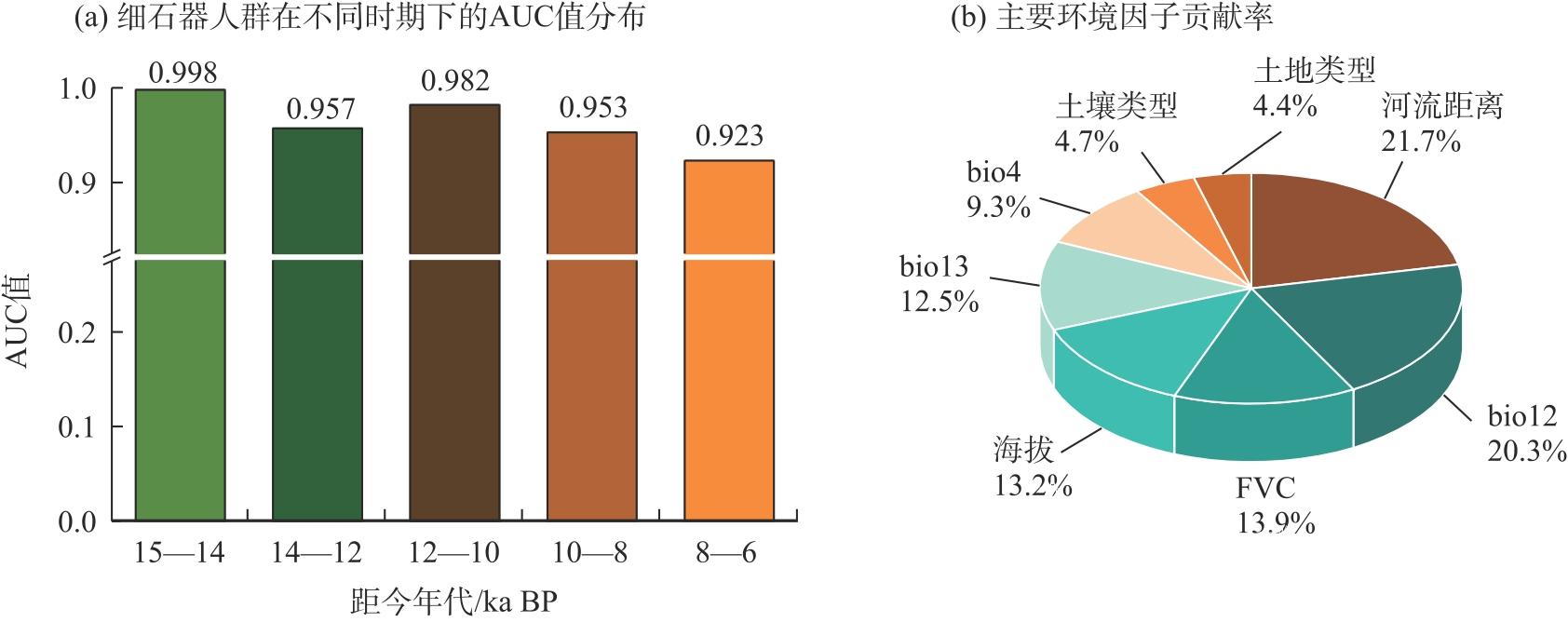
图3
基于15—6 ka BP环境条件下的细石器人群潜在分布"
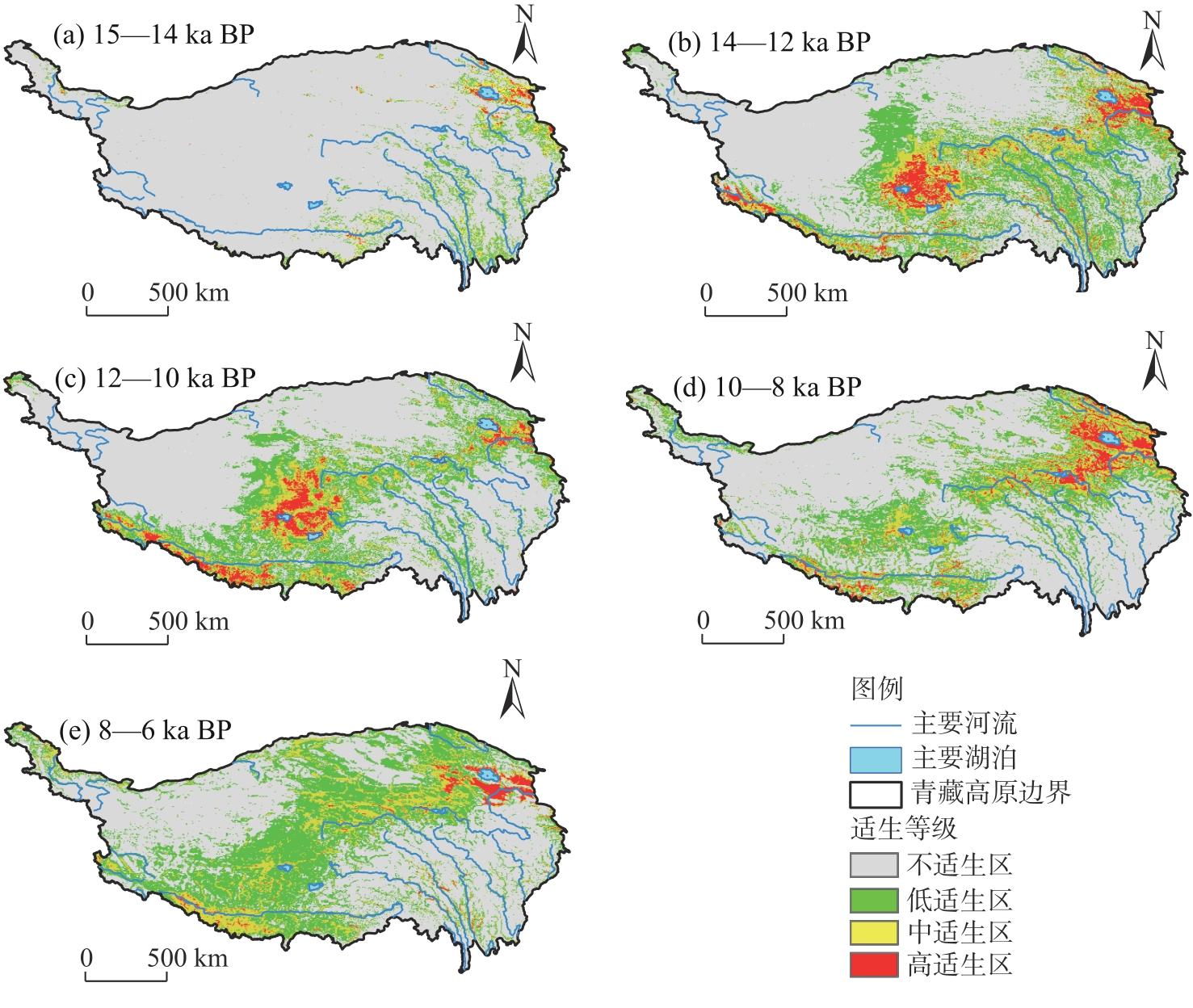
表3
15—6 ka BP细石器人群潜在分布面积变化"
| 距今年代/ka BP | 高度适生区 | 中度适生区 | 低度适生区 | 不适生区 |
|---|---|---|---|---|
| 15—14 | 2.021 | 8.994 | 15.725 | 219.419 |
| 14—12 | 15.070 | 30.051 | 62.156 | 138.856 |
| 12—10 | 11.686 | 21.978 | 56.824 | 155.661 |
| 10—8 | 12.325 | 24.268 | 53.241 | 156.293 |
| 8—6 | 6.334 | 28.324 | 81.712 | 129.760 |
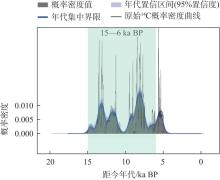
图4
青藏高原AMS14C年代密度分析"
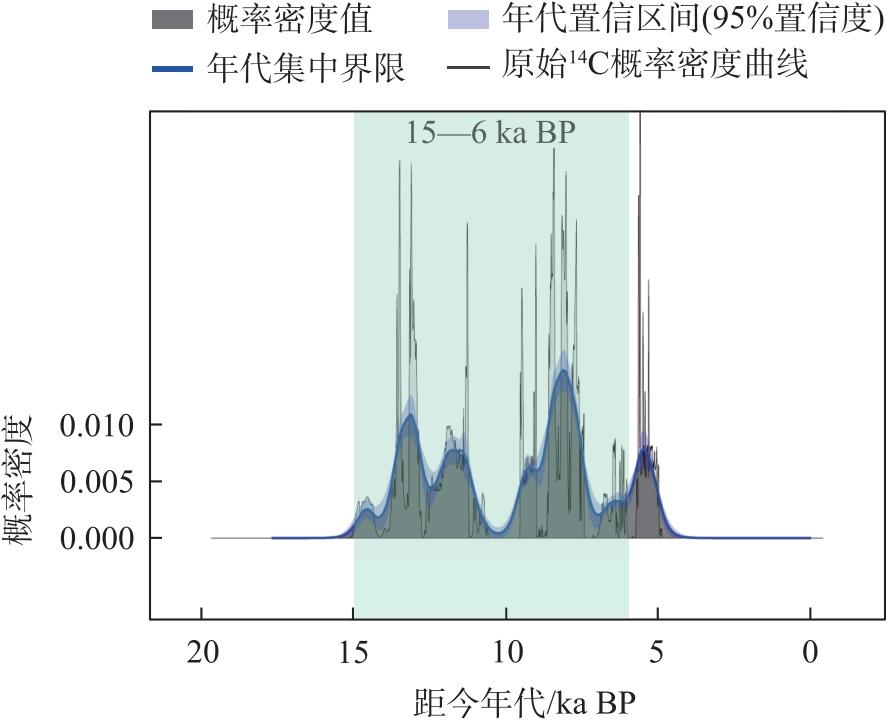
图5
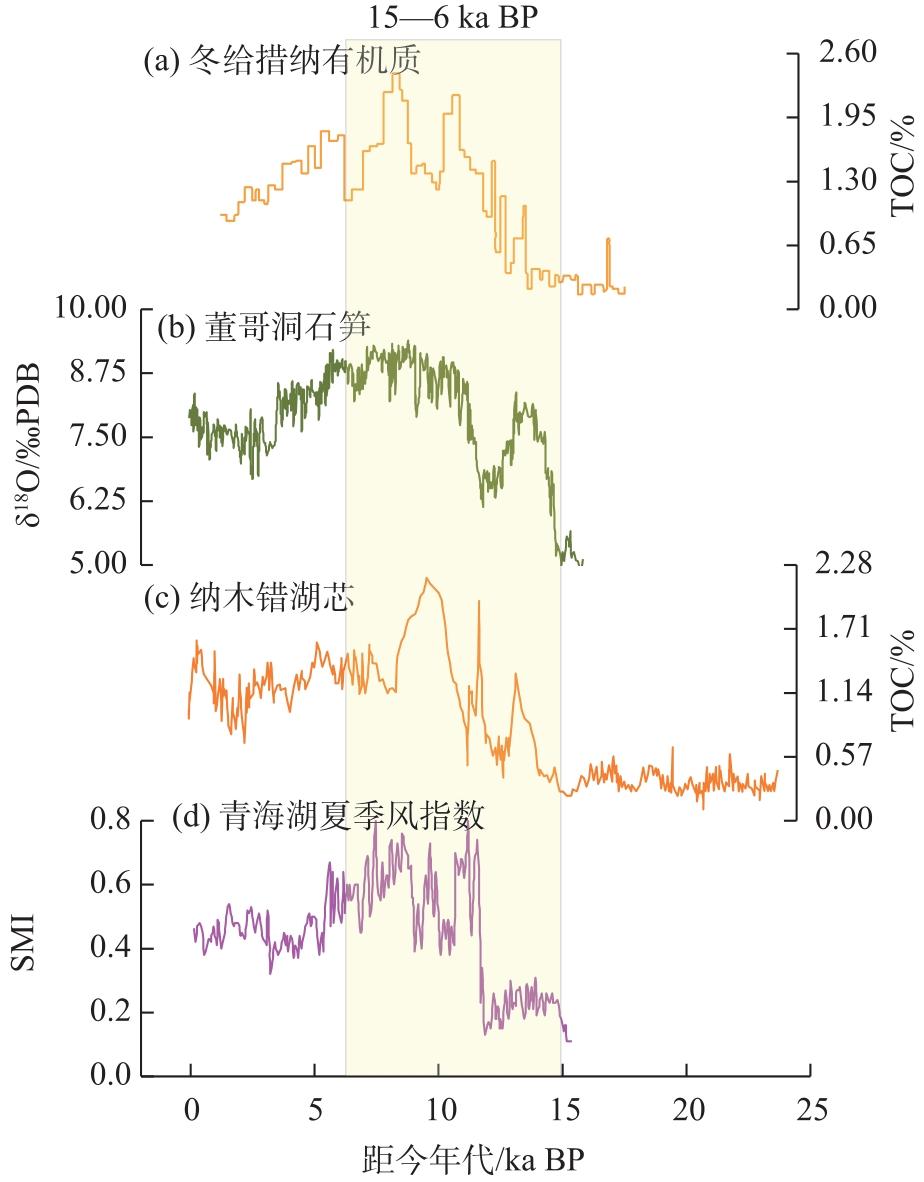
末次冰期以来青藏高原气候变化与TOC指数集成曲线[47-50] 注:TOC为有机质含量;δ18O为氧同位素含量;PDB为在碳酸盐矿物下的同位素百分比;SMI为气候湿润指数。"
| [1] |
靳英帅, 张晓凌, 何伟, 等. 自然地理分区视角下的青藏高原细石叶技术遗存[J]. 地理科学, 2023, 43(6): 961-971.
doi: 10.13249/j.cnki.sgs.2023.06.003 |
|
[Jin Yingshuai, Zhang Xiaoling, He Wei, et al. The microblade technology on the Qinghai-Xizang Plateau from the perspective of geographical regionalization[J]. Scientia Geographica Sinica, 2023, 43(6): 961-971.]
doi: 10.13249/j.cnki.sgs.2023.06.003 |
|
| [2] | 兰措卓玛. 青藏高原旧石器-历史时期交流路线的重建及演变研究[D]. 西宁: 青海师范大学, 2021. |
| [Lancuo Zhuoma. Reconstruction and evolutionary history of communication route on the Qinghai-Xizang Plateau during the palaeolithic to historical time period[D]. Xining: Qinghai Normal University, 2021.] | |
| [3] | 贾兰坡. 中国细石器的特征和它的传统、起源与分布[J]. 古脊椎动物与古人类, 1978(2): 137-143, 159-161. |
| [Jia Lanpo. Characteristics of Chinese microlithic and its tradition, origin and distribution[J]. Vertebrata Palasiatica, 1978(2): 137-143, 159-161.] | |
| [4] | 邱中郎. 青藏高原旧石器的发现[J]. 古脊椎动物学报, 1958, 2(2): 26-27. |
| [Qiu Zhonglang. Discovery of paleolithic in Qinghai-Xizang Plateau[J]. Journal of Vertebrata Palasiatica, 1958, 2(2): 26-27.] | |
| [5] |
Zhang X L, Jin Y S, He W, et al. A consideration of the spatiotemporal distribution of microblade industries on the Tibetan Plateau[J]. Quaternary International, 2020, 559: 165-173.
doi: 10.1016/j.quaint.2020.04.039 |
| [6] | 刘泽纯, 王富葆, 蒋赞初, 等. 西藏高原马法木湖东北岸等三个地点的细石器[J]. 南京大学学报(哲学, 人文科学, 社会科学), 1981(4): 87-90. |
| [Liu Zechun, Wang Fubao, Jiang Zanchu, et al. Microliths from three sites on the northeast bank of Mafamu Lake in Xizang Plateau[J]. Journal of Nanjing University (Philosophy, Humanities, Social Sciences Edition), 1981(4): 87-90.] | |
| [7] | 张森水. 西藏定日新发现的旧石器, 珠穆朗玛峰地区科学考察报告(1966—1968): 第四纪地质[M]. 北京: 科学出版社, 1976: 105-109. |
| [Zhang Senshui. Newly paleolithic discovered in Dingri, Xizang, scientific investigation report of Mount Qomolangma area (1966—1968): Quaternary geology[M]. Beijing: Science Press, 1976: 105-109.] | |
| [8] | 房迎三, 王富葆, 汤惠生. 西藏打制石器的新材料[C]// 中国古生物学会. 第九届中国古脊椎动物学学术年会论文集. 南宁: 海洋出版社, 2004: 221-232. |
| [Fang Yingsan, Wang Fubao, Tang Huisheng. New materials for stone tools in Xizang[C]// Chinese Palaeontological Society. Proceedings of the Ninth Annual Symposium of Chinese Palaevertebrates. Nanning: Ocean Press, 2004: 221-232.] | |
| [9] | Brantingham P J, Gao X, Olsen W H, et al. A short chronology for the peopling of the Tibetan Plateau[J]. Development Quaternary Sciences, 2007, 9(7): 129-150. |
| [10] |
Rhode D, Brantingham P J, Perreault C, et al. Mind the gaps: Testing for hiatuses in regional radiocarbon date sequences[J]. Journal of Archaeological Science, 2014, 52: 567-577.
doi: 10.1016/j.jas.2014.02.022 |
| [11] | 盖培, 王国道. 黄河上游拉乙亥中石器时代遗址发掘报告[J]. 人类学学报, 1983(1): 49-59, 116. |
| [Gai pei, Wang Guodao. Excavation report of the middle stone age site in Layihai, upper Yellow River[J]. Acta Anthropologica Sinica, 1983(1): 49-59, 116.] | |
| [12] | 汤惠生, 周春林, 李一全, 等. 青海昆仑山山口发现的细石器考古新材料[J]. 科学通报, 2013, 58(3): 247-253. |
| [Tang Huisheng, Zhou Chunlin, Li Yiquan, et al. New microlithic archaeological materials found in the Kunlun Mountain pass, Qinghai[J]. Science Bulletin, 2013, 58(3): 247-253.] | |
| [13] | 靳英帅, 张晓凌, 王社江, 等. 青藏高原腹地发现最早细石叶技术遗址[J]. 中国科学: 地球科学, 2024, 54(5): 1588-1601. |
| [Jin Yingshuai, Zhang Xiaoling, Wang Shejiang, et al. The earliest evidence for a microblade adaptation in the remote, high altitude regions of the Tibetan Plateau[J]. Science China Earth Sciences, 2024, 54(5): 1588-1601.] | |
| [14] | 侯光良, 许长军, 曹广超, 等. 青藏高原末次冰消期-全新世中期人类扩张的时空模拟[J]. 第四纪研究, 2017, 37(4): 709-720. |
| [Hou Guangliang, Xu Changjun, Cao Guangchao, et al. The spatial temporal simulation of mankind expansion on the Tibetan Plateau during Last Deglaciation-Middle Holocene[J]. Quaternary Sciences, 2017, 37(4): 709-720.] | |
| [15] | 吴瑞婵, 甘淑, 于丽君, 等. 最大熵模型的巴基斯坦遗址预测分布研究[J]. 测绘科学, 2021, 46(3): 96-103. |
| [Wu Ruichan, Gan Shu, Yu Lijun, et al. The study of predictive distribution of Pakistani sites based on MaxEnt model[J]. Science of Surveying and Mapping, 2021, 46(3): 96-103.] | |
| [16] |
侯光良, 曹广超, 鄂崇毅, 等. 青藏高原海拔4000 m区域人类活动的新证据[J]. 地理学报, 2016, 71(7): 1231-1240.
doi: 10.11821/dlxb201607011 |
|
[Hou Guangliang, Cao Guangchao, E Chongyi, et al. New evidence of human activities at an altitude of 4000 meters area of Qinghai-Xizang Plateau[J]. Acta Geographica Sinica, 2016, 71(7): 1231-1240.]
doi: 10.11821/dlxb201607011 |
|
| [17] |
Madsen D B, Ma H Z, Brantingham P J, et al. The late upper paleolithic occupation of the northern Tibetan Plateau margin[J]. Journal of Archaeological Science, 2006, 33(10): 1433-1444.
doi: 10.1016/j.jas.2006.01.017 |
| [18] | 王国道, 刘国宁. 青海龙羊峡达玉台遗址的打制石器[J]. 考古, 1984(7): 577-581. |
| [Wang Guodao, Liu Guoning. Stone tools from the Dayutai site at Longyangxia, Qinghai[J]. Archaeology, 1984(7): 577-581.] | |
| [19] | 西藏自治区文物局, 四川大学考古系, 陕西省考古研究所. 青藏铁路西藏段田野考古报告[M]. 北京: 科学出版社, 2005: 187-266. |
| [Bureau of Cultural Relics of Xizang Autonomous Region, Department of Archaeology Sichuan University, Shaanxi Provincial Institute of Archaeology. Field archaeological report on the Xizang section of the Qinghai-Xizang railway[M]. Beijing: Science Press, 2005: 187-266.] | |
| [20] | 袁宝印, 黄慰文, 章典. 藏北高原晚更新世人类活动的新证据[J]. 科学通报, 2007(13): 1567-1571. |
| [Yuan Baoyin, Huang Weiwen, Zhang Dian. New evidence of human activities in the Late Pleistocene of the northern Tibetan Plateau[J]. Science Bulletin, 2007(13): 1567-1571.] | |
| [21] | 王永, 王军, 纪占胜, 等. 藏北羌塘中部戈木错盆地石制品的初步研究[J]. 地质通报, 2009, 28(9): 1330-1334. |
| [Wang Yong, Wang Jun, Ji Zhansheng, et al. Preliminary study of stone products in the Gemucuo Basin, central Qiangtang, northern Xizang[J]. Geology Bulletin, 2009, 28(9): 1330-1334.] | |
| [22] | 石硕. 从旧石器晚期文化遗存看黄河流域人群向川西高原的迁徙[J]. 西藏研究, 2003(2): 33-39. |
| [Shi Shuo. From the Late Paleolithic cultural relics, the migration of people from the Yellow River Basin to the western Sichuan Plateau is observed[J]. Tibet Studies, 2003(2): 33-39.] | |
| [23] | 安志敏, 尹泽生, 李炳元. 藏北申扎、双湖的旧石器和细石器[J]. 考古, 1979(6): 481-491, 494, 577-581. |
| [An Zhimin, Yin Zesheng, Li Bingyuan. Paleolithic and microlithic in Shenzha and Shuanghu, northern Xizang[J]. Archaeology, 1979(6): 481-491, 494, 577-581.] | |
| [24] |
Meyer M C, Aldenderfer M S, Wang Z, et al. Permanent human occupation of the central Tibetan Plateau in Early Holocene[J]. Science, 2017, 355(6320): 64-67.
doi: 10.1126/science.aag0357 pmid: 28059763 |
| [25] | 戴尔俭. 西藏聂拉木县发现的石器[J]. 考古, 1972(1): 43-44, 47. |
| [Dai Erjian. Stones found in Nyalam County, Xizang[J]. Archaeology, 1972(1): 43-44, 47.] | |
| [26] | 钱方, 吴锡浩, 黄慰文. 藏北高原各听石器初步观察[J]. 人类学学报, 1988(1): 75-83, 104. |
| [Qian Fang, Wu Xihao, Huang Weiwen. Preliminary observations of various aural stone implements in the northern Tibetan Plateau[J]. Acta Anthropologica Sinica, 1988(1): 75-83, 104.] | |
| [27] | 韩芳, 蔡林海, 杜玮, 等. 青南高原登额曲流域的细石叶工艺[J]. 人类学学报, 2018, 37(1): 53-69. |
| [Han Fang, Cai Linhai, Du Wei, et al. A study on the microblade technology from the Deng’equ valley in south Qinghai Plateau[J]. Acta Anthropologica Sinica, 2018, 37(1): 53-69.] | |
| [28] | 李拓宇, 伍永秋, 杜世松, 等. 青藏高原西南部仲巴地区细石器人类活动的时代探讨[J]. 北京师范大学学报(自然科学版), 2016, 52(1): 91-96. |
| [Li Tuoyu, Wu Yongqiu, Du Shisong, et al. Age of microlith human activities in Zhongba area, southwestern margin of Qinghai-Xizang Plateau[J]. Journal of Beijing Normal University (Natural Science Edition), 2016, 52(1): 91-96.] | |
| [29] |
Hudson A M, Olsen J W, Quade J, et al. A regional record of expanded Holocene wetlands and prehistoric human occupation from paleo wetland deposits of the western Yarlung Tsangpo valley, southern Tibetan Plateau[J]. Quaternary Research, 2016, 86(1): 13-33.
doi: 10.1017/j.yqres.2016.04.001 |
| [30] | 刘泽纯, 王富葆, 蒋赞初, 等. 西藏高原多格则与扎布地点的旧石器——兼论高原古环境对石器文化分布的影响[J]. 考古, 1986(4): 289-299, 384-388. |
| [Liu Zechun, Wang Fubao, Jiang Zanchu, et al. Paleolithic sites at Duogeze and Zhabu on the Xizang Plateau: With a discussion on the influence of plateau paleoenvironment on the distribution of lithic cultures[J]. Archaeology, 1986(4): 289-299, 384-388.] | |
| [31] |
Brantingham P J, Gao X, Madsen D B, et al. Late occupation of the high-elevation northern Tibetan Plateau based on cosmogenic luminescence, and radio carbon ages[J]. Geoarchaeology, 2013, 28(5): 413-431.
doi: 10.1002/gea.2013.28.issue-5 |
| [32] |
Chen F H, Dong G H, Zhang D J, et al. Agriculture facilitated permanent human occupation of the Tibetan Plateau after 3600 BP[J]. Science, 2014, 20: 320-337.
doi: 10.1126/science.20.505.320 |
| [33] | 李永宪, 霍巍. 西藏仲巴县城北石器地点[J]. 考古, 1994(7): 577-586. |
| [Li Yongxian, Huo Wei. Northern stone site of Zhongba County, Xizang[J]. Archaeology, 1994(7): 577-586.] | |
| [34] | 陈宥成, 侯光良, 高靖易, 等. 青藏高原冬给措纳湖畔新发现的细石器及其同周边地区的技术关系[J]. 人类学学报, 2021, 40(1): 28-39. |
| [Chen Youcheng, Hou Guangliang, Gao Jingyi, et al. A new microblade assemblage from Dongjicuona lakeside in the Qinghai-Tibet Plateau and its technological relationship with adjacent areas[J]. Acta Anthropologica Sinica, 2021, 40(1): 28-39.] | |
| [35] | 张森水. 西藏细石器新资料. 西藏古生物[M]. 北京: 科学出版社, 1982: 68-77. |
| [Zhang Senshui. New data of Xizang microlithic. Xizang Paleontology[M]. Beijing: Science Press, 1982: 68-77.] | |
| [36] | Han F, Meng Q, Lü H L, et al. Intensive use of northeastern Qinghai-Xizang Plateau during the Middle Holocene new excavation of a base camp, Dongguotan site[J]. Archaeological Research in Asia, 2024, 39: 129-136. |
| [37] | 国家文物局. 中国文物地图集: 青海分册[M]. 北京: 文物出版社, 1996, 81-90. |
| [State Administration of Cultural Heritage. Atlas of Chinese cultural relics: Qinghai[M]. Beijing: Cultural Relics Press, 1996: 81-90.] | |
| [38] | 秦锋, 赵艳, 曹现勇. 利用机器学习方法重建末次冰盛期以来青藏高原植被变化[J]. 中国科学: 地球科学, 2022, 52(4): 697-713. |
| [Qin Feng, Zhao Yan, Cao Xianyong. Biome reconstruction on the Tibetan Plateau since the Last Glacial Maximum using a machine learning method[J]. Science China Earth Sciences, 2022, 52(4): 697-713.] | |
| [39] |
李文华, 李生宇, 徐新文, 等. 基于 MaxEnt模型预测气候变化下准噶尔沙蒿(Artemisia Songarica)在新疆的潜在分布[J]. 干旱区地理, 2025, 48(9): 1578-1588.
doi: 10.12118/j.issn.1000-6060.2024.657 |
|
[Li Wenhua, Li Shengyu, Xu Xinwen, et al. Predicting the potential distribution of Artemisia Songarica in Xinjiang under climate change based on the MaxEnt model[J]. Arid Land Geography, 2025, 48(9): 1578-1588.
doi: 10.12118/j.issn.1000-6060.2024.657 |
|
| [40] | 杨志红, 姚檀栋, 皇翠兰, 等. 古里雅冰芯中的新仙女木期事件记录[J]. 科学通报, 1997, 42(18): 1975-1978. |
| [Yang Zhihong, Yao Tandong, Huang Cuilan, et al. Records of the Neo-Andromedary events in the Guriya ice core[J]. Science Bulletin, 1997, 42(18): 1975-1978.] | |
| [41] |
陈发虎, 刘峰文, 张东菊, 等. 史前时代人类向青藏高原扩散的过程与动力[J]. 自然杂志, 2016, 38(4): 235-240.
doi: 10.3969/j.issn.0253-9608.2016.04.001 |
|
[Chen Fahu, Liu Fengwen, Zhang Dongju, et al. The process and driving force for peopling the Tibetan Plateau during prehistoric periods[J]. Chinese Journal of Nature, 2016, 38(4): 235-240.]
doi: 10.3969/j.issn.0253-9608.2016.04.001 |
|
| [42] | 侯光良, 赖忠平, 孙永娟, 等. 全新世大暖期对青藏高原东北缘人类活动的影响[J]. 干旱区地理, 2013, 36(6): 971-978. |
| [Hou Guangliang, Lai Zhongping, Sun Yongjuan, et al. Impact of the Holocene climatic optimum on human activities in the northeastern margin of the Qinghai-Tibetan Plateau[J]. Arid Land Geography, 2013, 36(6): 971-978.] | |
| [43] | 葛俊逸, 张晓凌, 王社江, 等. 尼阿底遗址新的测年结果表明过去-45 ka BP古人类间歇地占据青藏高原腹地[J]. 中国科学:地球科学, 2024, 54(2): 550-572. |
|
[Ge Junyi, Zhang Xiaoling, Wang Shejiang, et al. New dating indicates intermittent human occupation of the Nwya Devu paleolithic site on the high-altitude central Tibetan Plateau during the past 45,000 years[J]. Science China Earth Sciences, 2024, 54(2): 550-572.]
doi: 10.1007/s11430-010-4121-x |
|
| [44] | 沈吉. 末次盛冰期以来中国湖泊时空演变及驱动机制研究综述: 来自湖泊沉积的证据[J]. 科学通报, 2012, 57(34): 3228-3242. |
| [Shen Ji. Spatiotemporal variations of Chinese lakes and their driving mechanisms since the Last Glacial Maximum: A review and synthesis of lacustrine sediment archives[J]. Chinese Science Bullin, 2012, 57(34): 3228-3242.] | |
| [45] | 沈志忠. 青藏高原史前农业起源与发展研究[J]. 中国农史, 2011, 30(3): 13-22. |
| [Shen Zhizhong. Studies on the origin and development of agriculture on the Qinghai-Xizang Plateau in the prehistoric period[J]. Agricultural History of China, 2011, 30(3): 13-22.] | |
| [46] |
Alley R, Mayewski P, Sowers T, et al. Holocene climatic instability: A prominent, wide spread event 8200 yr ago[J]. Geology, 1997, 25: 483-486.
doi: 10.1130/0091-7613(1997)025<0483:HCIAPW>2.3.CO;2 |
| [47] | Aichner B Herzschuh, U, Wilkes H, et al. Ecological development of lake Donggi Cona, north-eastern Tibetan Plateau, since the late glacial on basis of organic geochemical proxies and non-pollen palynomorphs[J]. Palaeogeography, Palaeoclimatology, Palaeoecology, 2012, 313: 140-149. |
| [48] | Zhu L P, lü X M, Wang J B, et al. Climate change on the Tibetan Plateau in response to shifting atmospheric circulation since the LGM[J]. Scientific Reports, 2015, 5(1): 313-318. |
| [49] |
Schlutz F, Lehmkuhl F. Holocene climatic change and the nomadic anthropocene in eastern Xizang: Palynological and geomorphological results from the Nianbaoyeze Mountains[J]. Quaternary Science Reviews, 2009, 28: 1449-1471.
doi: 10.1016/j.quascirev.2009.01.009 |
| [50] |
An Z S, Colman S M, Zhou W J, et al. Interplay between the westerlies and Asian monsoon recorded in Lake Qinghai sediments since 32 ka[J]. Scientific Reports, 2012, 2(8): 619-626.
doi: 10.1038/srep00619 |
| [51] | 丛禄. 青藏高原全新世湖泊演化与其湖岸风成沉积物相关性研究[D]. 北京: 中国科学院大学, 2021. |
| [Cong Lu. The research of correlation relationship between evolution of typical lakes and lakeside’s aeolian sediments within Qinghai-Xizang Plateau[D]. Beijing: University of Chinese Academy of Sciences, 2021.] | |
| [52] |
Brantingham P J, Gao X. Peopling of the north Tibetan Plateau[J]. World Archaeology, 2006, 38(3): 387-414.
doi: 10.1080/00438240600813301 |
| [53] | 陈淳. 最佳觅食模式与农业起源研究[J]. 农业考古, 1994(3): 31-38. |
| [Chen Chun. Study on the best foraging pattern and the origin of agriculture[J]. Agricultural Archaeology, 1994(3): 31-38.] | |
| [54] | 施雅风, 李吉均, 李炳元. 青藏高原晚新生代隆升与环境变化[M]. 广州: 广东科技出版社, 1998: 37-45. |
| [Shi Yafeng, Li Jijun, Li Bingyuan. Late Cenozoic uplift and environmental change of Qinghai-Xizang Plateau[M]. Guangzhou: Guangdong Science and Technology Press, 1998: 37-45.] |
| [1] | 卢雅焱, 封甜, 杨兆萍, 韩芳, 贾莹莹. 中国省域新质生产力与旅游高质量发展适配度时空演变及障碍因子研究[J]. 干旱区地理, 2026, 49(4): 643-655. |
| [2] | 关靖云, 孙之阳, 徐晓亮, 程乙峰, 宋贝贝, 房瑞莹. 气候变化背景下中国新疆与中亚五国旅游气候舒适度时空演变分析[J]. 干旱区地理, 2026, 49(4): 697-712. |
| [3] | 陈文宣, 陈钰, 王生隆. 黄河流域农业碳排放时空演化特征及其影响因素分析[J]. 干旱区地理, 2026, 49(4): 713-726. |
| [4] | 张璐, 周秉荣, 颜玉倩, 曹晓云, 马有绚. 西风-夏季风协同作用对青藏高原夏季降水的影响研究[J]. 干旱区地理, 2026, 49(2): 332-342. |
| [5] | 朱怡婷, 梁桂仙, 周春山, 辛龙, 李金雪. 新疆文旅新质生产力发展时空演变特征与驱动因素[J]. 干旱区地理, 2026, 49(1): 128-139. |
| [6] | 于志翔, 于晓晶, 陈诗永, 李霞, 梅桢. 2000—2023年天山北坡城市群冬季大气污染事件时空演变特征[J]. 干旱区地理, 2026, 49(1): 35-46. |
| [7] | 王晓菲, 邳华伟, 李思思. 青藏高原土壤风蚀潜力时空特征及驱动因素分析[J]. 干旱区地理, 2025, 48(9): 1589-1599. |
| [8] | 张毅明, 汤宇磊, 冯俊波. 基于随机森林模型的青藏高原冰川预测及分析[J]. 干旱区地理, 2025, 48(8): 1342-1352. |
| [9] | 石卓达, 杨宏伟. 旅游经济高质量发展测度及影响因素分析——以新疆为例[J]. 干旱区地理, 2025, 48(7): 1233-1242. |
| [10] | 苗颖凤, 原野, 周正伟, 赵嘉瑜, 郭宇茜. 汾渭平原农作物种植结构时空格局演变特征研究[J]. 干旱区地理, 2025, 48(6): 995-1005. |
| [11] | 卢晗, 曾永年, 王盼成. 青藏高原东北部实际蒸散发时空变化特征及影响因素[J]. 干旱区地理, 2025, 48(5): 753-764. |
| [12] | 吴双梅, 周冬梅, 马静, 朱小燕, 张军, 江晶, DONG Qinghan. 不同气候情景下环县柠条锦鸡儿分布及土壤碳储量特征[J]. 干旱区地理, 2025, 48(5): 812-824. |
| [13] | 王彦闻, 杨欢, 涂佩玥, 丁昊, 荆莹, 何超. 天山北坡经济带城市扩张对生境质量的影响[J]. 干旱区地理, 2025, 48(12): 2232-2246. |
| [14] | 王生霞, 李茂兰, 刘芮廷. 旅游业效率与城镇化耦合协调度的时空演变及障碍因素分析——以“一带一路”核心段为例[J]. 干旱区地理, 2025, 48(11): 2053-2061. |
| [15] | 张晓东, 马风华, 赵志鹏, 武丹, 马玉学, 吉卫波, 公亮. 宁夏中部荒漠草原防沙治沙区NDVI时空演化特征及其对气候因素的响应[J]. 干旱区地理, 2025, 48(10): 1804-1814. |
|
||

