干旱区地理 ›› 2025, Vol. 48 ›› Issue (6): 1115-1126.doi: 10.12118/j.issn.1000-6060.2024.552 cstr: 32274.14.ALG2024552
李智( ), 苏洋(), 舒芹
收稿日期:2024-09-13
修回日期:2024-12-10
出版日期:2025-06-25
发布日期:2025-06-18
通讯作者:
苏洋(1987-),男,博士,副教授,主要从事生态经济理论研究. E-mail: suyang@xjau.edu.cn作者简介:李智(1998-),女,硕士研究生,主要从事生态产品理论研究. E-mail: lizhi199898@163.com
基金资助:
LI Zhi(), SU Yang(), SHU Qin
Received:2024-09-13
Revised:2024-12-10
Published:2025-06-25
Online:2025-06-18
摘要: 准确识别生态系统服务供给与需求的空间特征,划定生态管理分区,对指导区域生态系统管理和恢复具有重要意义。聚焦于西北整体生态系统,从水-能源-粮食协同发展角度,量化了2000—2022年西北地区产水服务、固碳服务、粮食的供给和需求的空间匹配特征,依据供需匹配盈余情况和可持续特征划定生态管理分区。结果表明:(1) 西北地区各项生态系统服务供需空间匹配状况不同,产水、粮食服务的供需呈波动上升态势或维持稳定;固碳服务需求增长,供给和供需比均为下降态势,供需匹配逐渐失衡。(2) 粮食生产服务多为可持续发展型,产水服务、固碳服务多为不可持续型。(3) 分类管理生态分区,兼顾自然和人类福祉,提升生态系统服务供给。研究结果可为西北地区基础资源合理配置、生态系统服务精准管理提供科学参考。
李智, 苏洋, 舒芹. 基于生态系统服务供需匹配的西北地区生态管理分区[J]. 干旱区地理, 2025, 48(6): 1115-1126.
LI Zhi, SU Yang, SHU Qin. Static-dynamic matching of ecosystem service supply and demand and ecological management zoning in northwest China[J]. Arid Land Geography, 2025, 48(6): 1115-1126.
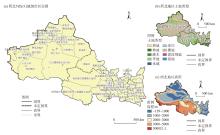
图1
西北区域概况图 注:基于自然资源部标准地图服务网站审图号为GS(2022)4307号的标准地图制作,底图边界无修改。下同。"
表1
数据来源"
| 数据类型 | 空间分辨率 | 数据来源 |
|---|---|---|
| 土地利用数据 | 30 m | 杨杰、黄昕教授发布的中国30 m土地利用数据集( |
| 归一化植被指数(NDVI) | 1 km | NASA地球数据MOD13A3数据集( |
| 高程 | 500 m | 全球海陆数据库(GEBCO)( |
| 夜间灯光数据 | 500 m | 文献[ |
| 气象数据 | 1 km | 国家青藏高原科学数据中心 |
| 土壤数据 | 1 km | 世界土壤数据库(HWSD) |
| 人口密度 | 1 km | LandScan数据集( |
| GDP数据 | 1 km | 资源环境科学与数据中心 |
| 社会经济数据 | - | 研究区相关统计年鉴、水资源公报、中国能源统计年鉴 |
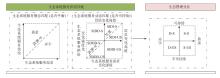
图2
生态系统服务供需匹配与生态管理分区示意图 注:SIDI-S为供给增长大于需求增长-可持续型;SIDI-US为供给增长小于需求增长-不可持续型;SIDD-S为供给增加需求减少-可持续型;SDDD-S为供给减少小于需求减少-可持续型;SDDD-US为供给减少大于需求减少-不可持续型;SDDI-US为供给减少和需求增加-不可持续型;S-S为生态系统盈余-可持续型;S-US为生态系统盈余-不可持续型;D-S为生态系统赤字-可持续型;D-US为生态系统赤字-不可持续型。下同。"
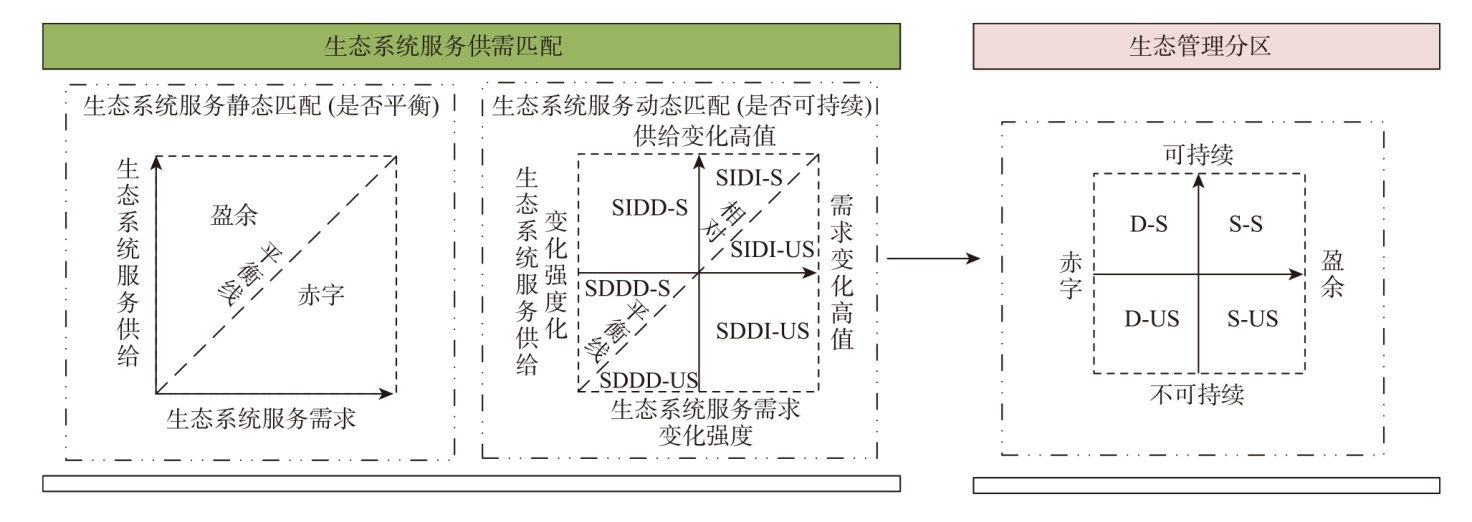
表2
2000—2020年西北地区生态系统服务供需演变"
| 年份 | 产水服务 | 固碳服务 | 粮食服务 | ||||||||
|---|---|---|---|---|---|---|---|---|---|---|---|
| 供给/m3·hm-2 | 需求/m3·hm-2 | 供需指数 | 供给/t·hm-2 | 需求/t·hm-2 | 供需指数 | 供给/t·hm-2 | 需求/t·hm-2 | 供需指数 | |||
| 2000 | 656.86 | 260.78 | 0.72 | 39.33 | 1.03 | 0.95 | 0.10 | 0.04 | 0.43 | ||
| 2005 | 820.14 | 269.85 | 0.75 | 39.61 | 1.25 | 0.94 | 0.11 | 0.03 | 0.57 | ||
| 2010 | 832.72 | 275.52 | 0.75 | 40.02 | 3.21 | 0.85 | 0.13 | 0.03 | 0.63 | ||
| 2015 | 622.54 | 291.27 | 0.68 | 40.14 | 3.21 | 0.85 | 0.15 | 0.03 | 0.67 | ||
| 2020 | 815.37 | 282.17 | 0.74 | 39.86 | 5.25 | 0.77 | 0.16 | 0.03 | 0.68 | ||
图3
2000—2020年西北地区生态系统服务供给服务特征"

图4
2000—2020年西北地区生态系统服务需求服务特征"
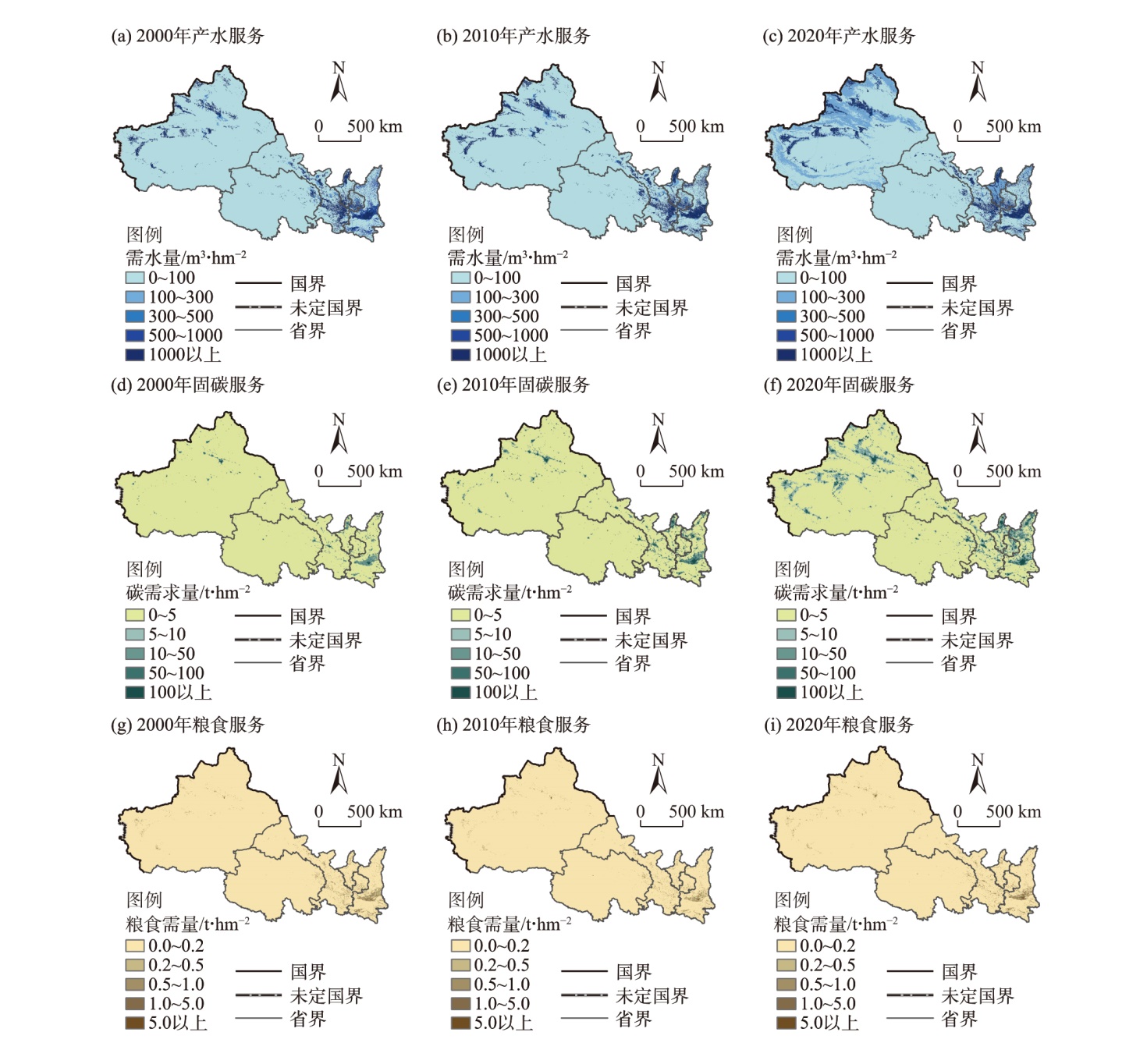
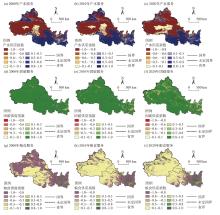
图5
2000—2020年西北地区生态系统服务供需指数"

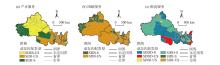
图6
2000—2020年西北地区生态系统服务动态空间匹配"
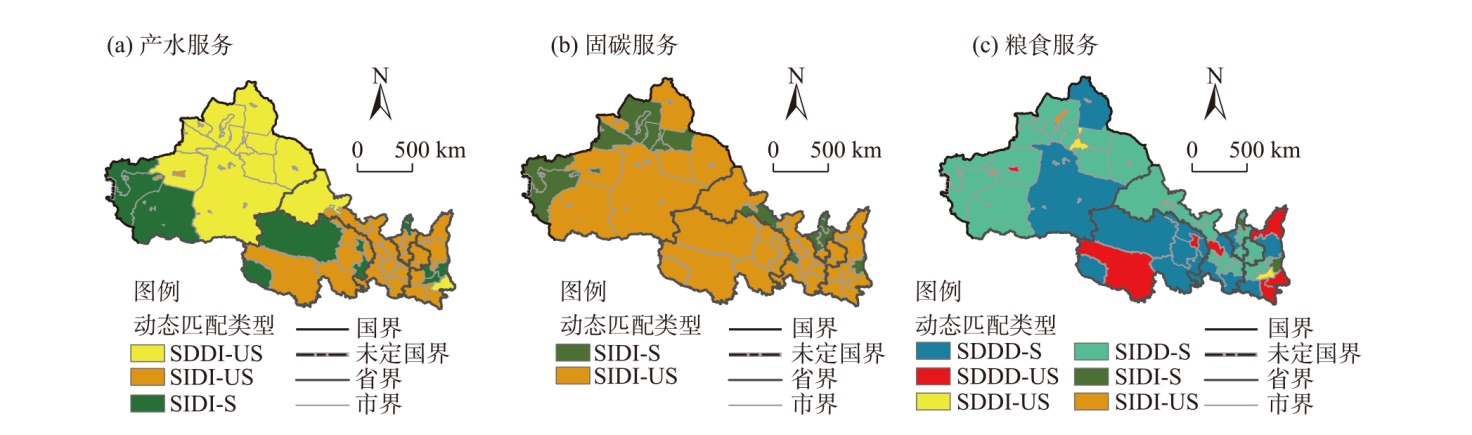
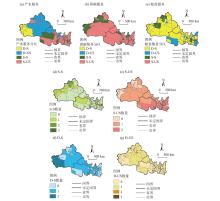
图7
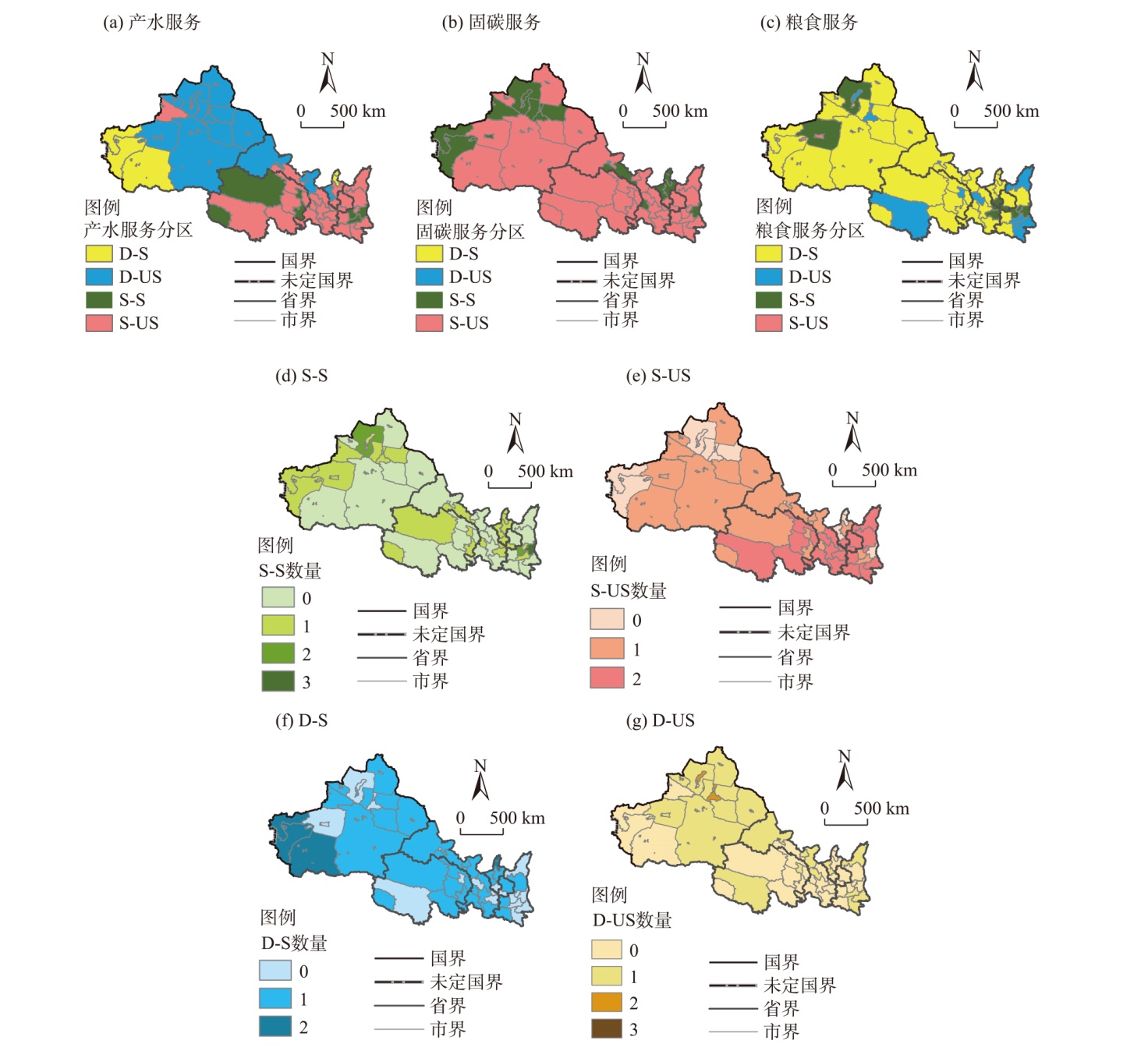
西北地区生态管理分区及不同分区类型下的数目"
| [1] | Costanza R, D’Arge R, De Groot R, et al. The value of the world’s ecosystem services and natural capital[J]. Nature, 1997, 387(6630): 253-260. |
| [2] | Yin D, Yu H, Shi Y, et al. Matching supply and demand for ecosystem services in the Yellow River Basin, China: A perspective of the water-energy-food nexus[J]. Journal of Cleaner Production, 2023, 384: 135469, doi: 10.1016/j.jclepro.2022.135469C:\https:\doi.org\10.1016\j.jclepro.2022.135469. |
| [3] | 张立伟, 傅伯杰. 生态系统服务制图研究进展[J]. 生态学报, 2014, 34(2): 316-325. |
| [Zhang Liwei, Fu Bojie. The progress in ecosystem services mapping: A review[J]. Acta Ecological Sincia, 2014, 34(2): 316-325. ] | |
| [4] |
马琳, 刘浩, 彭建, 等. 生态系统服务供给和需求研究进展[J]. 地理学报, 2017, 72(7): 1277-1289.
doi: 10.11821/dlxb201707012 |
|
[Ma Lin, Liu Hao, Peng Jian, et al. A review of ecosystem services supply and demand[J]. Acta Geographica Sinica, 2017, 72(7): 1277-1289. ]
doi: 10.11821/dlxb201707012 |
|
| [5] | Xu L X, Yang D W, Wu T H, et al. An ecosystem services zoning framework for the permafrost regions of China[J]. Advances in Climate Change Research, 2019, 10(2): 92-98. |
| [6] |
刘雨婷, 覃盟琳, 欧阳慧婷, 等. 基于生态系统服务供需平衡的国土空间资源配置优化[J]. 自然资源学报, 2024, 39(6): 1358-1383.
doi: 10.31497/zrzyxb.20240607 |
|
[Liu Yuting, Qin Menglin, Ouyang Huiting, et al. The optimization of territorial spatial resources allocation based on the balance of supply and demand of ecosystem services[J]. Journal of Natural Resources, 2024, 39(6): 1358-1383. ]
doi: 10.31497/zrzyxb.20240607 |
|
| [7] | 李成, 赵洁. 长三角城市群生态系统服务供需格局与影响因素研究[J]. 生态经济, 2022, 38(9): 160-169, 187. |
| [Li Cheng, Zhao Jie. Research on spatiotemporal pattern and influencing factors of supply-demand matching in the Yangtze River Delta urban agglomeration[J]. Ecological Economy, 2022, 38(9): 160-169, 187. ] | |
| [8] | 安志英, 孙才志, 郝帅. 我国东北生态系统服务供需匹配关系——基于水-能源-粮食纽带视角[J]. 生态学报, 2024, 44(10): 4170-4186. |
| [An Zhiying, Sun Caizhi, Hao Shuai. Matching relationship between supply and demand of ecosystem services from the perspective of water-energy-food nexus in northeast China[J]. Acta Ecological Sincia, 2024, 44(10): 4170-4186. ] | |
| [9] | Teng Y, Chen G, Su M, et al. Ecological management zoning based on static and dynamic matching characteristics of ecosystem services supply and demand in the Guangdong-Hong Kong-Macao Greater Bay Area[J]. Journal of Cleaner Production, 2024, 448: 141599, doi: 10.1016/j.jclepro.2024.141599C:\https:\doi.org\10.1016\j.jclepro.2024.141599. |
| [10] |
管青春, 郝晋珉, 许月卿, 等. 基于生态系统服务供需关系的农业生态管理分区[J]. 资源科学, 2019, 41(7): 1359-1373.
doi: 10.18402/resci.2019.07.16 |
|
[Guan Qingchun, Hao Jinmin, Xu Yueqing, et al. Zoning of agroecological management based on the relationship between supply and demand of ecosystem services[J]. Resources Science, 2019, 41(7): 1359-1373. ]
doi: 10.18402/resci.2019.07.16 |
|
| [11] | Campagne C S, Roche P, Müller F, et al. Ten years of ecosystem services matrix: Review of a (r)evolution[J]. One Ecosystem, 2020, 5: e51103, doi: 10.3897/oneeco.5.e51103C:\https:\doi.org\10.3897\oneeco.5.e51103. |
| [12] |
苏伯儒, 刘某承. 基于生态系统服务权衡的生态系统管理策略研究进展[J]. 自然资源学报, 2023, 38(7): 1848-1862.
doi: 10.31497/zrzyxb.20230714 |
|
[Su Boru, Liu Moucheng. Research progress in ecosystem management strategiesbased on ecosystem services trade-offs[J]. Journal of Natural Resources, 2023, 38(7): 1848-1862. ]
doi: 10.31497/zrzyxb.20230714 |
|
| [13] | Zhao Y, Wang N, Luo Y, et al. Quantification of ecosystem services supply-demand and the impact of demographic change on cultural services in Shenzhen, China[J]. Journal of Environmental Management, 2022, 304: 114280, doi: 10.1016/j.jenvman.2021.114280C:\https:\doi.org\10.1016\j.jenvman.2021.114280. |
| [14] |
熊昕莹, 孟梅. 基于生态系统服务供需关系及空间流动的新疆生态管理分区与优化策略[J]. 应用生态学报, 2023, 34(8): 2237-2248.
doi: 10.13287/j.1001-9332.202308.023 |
|
[Xiong Xinying, Meng Mei. Regionalization and optimization strategy of ecological management in Xinjiang, China based on supply-demand relationship and spatial flow of ecosystem services[J]. Chinese Journal of Applied Ecology, 2023, 34(8): 2237-2248. ]
doi: 10.13287/j.1001-9332.202308.023 |
|
| [15] | 李潇飞, 龚健, 叶菁, 等. 生态系统服务权衡协同下的甘肃省生态功能分区优化[J/OL]. 干旱区地理. [2025-01-16]. . |
| [Li Xiaofei, Gong Jian, Ye Jing, et al. Optimization of ecological function zoning in Gansu Province under the trade-offs and synergies of ecosystem services[J/OL]. Arid Land Geography. [2025-01-16]. http://kns.cnki.net/kcms/detail/65.1103.X.20241106.1557.001.html] | |
| [16] | Sun R, Jin X, Han B, et al. Does scale matter? Analysis and measurement of ecosystem service supply and demand status based on ecological unit[J]. Environmental Impact Assessment Review, 2022, 95: 106785, doi: 10.1016/j.eiar.2022.106785C:\https:\doi.org\10.1016\j.eiar.2022.106785. |
| [17] |
刘春芳, 王韦婷, 刘立程, 等. 西北地区县域生态系统服务的供需匹配——以甘肃古浪县为例[J]. 自然资源学报, 2020, 35(9): 2177-2190.
doi: 10.31497/zrzyxb.20200911 |
|
[Liu Chunfang, Wang Weiting, Liu Licheng, et al. Supply-demand matching of county ecosystem services in northwest China: A case study of Gulang County[J]. Journal of Natural Resources, 2020, 35(9): 2177-2190. ]
doi: 10.31497/zrzyxb.20200911 |
|
| [18] |
朱瑷嫒, 殷颂葵, 刘琼慧. 中国西北地区农业生态效率时空分异及影响因素研究[J]. 干旱区地理, 2024, 47(7): 1210-1219.
doi: 10.12118/j.issn.1000-6060.2023.604 |
|
[Zhu Aiyuan, Yin Songkui, Liu Qionghui. Spatial and temporal differentiation and influencing factors of agricultural ecological efficiency in northwest China[J]. Arid Land Geography, 2024, 47(7): 1210-1219. ]
doi: 10.12118/j.issn.1000-6060.2023.604 |
|
| [19] | 马泽钰, 李鹏, 肖列, 等. 青海省生态修复关键区识别及修复分区划分[J]. 水土保持学报, 2024, 38(3): 252-265. |
| [Ma Zeyu, Li Peng, Xiao Lie, et al. Identification of key areas for ecological restoration and division of restoration zones in Qinghai Province[J]. Journal of Soil and Water Conservation, 2024, 38(3): 252-265. ] | |
| [20] |
岳文泽, 侯丽, 夏皓轩, 等. 基于生态系统服务供需平衡的宁夏固原生态修复分区与优化策略[J]. 应用生态学报, 2022, 33(1): 149-158.
doi: 10.13287/j.1001-9332.202112.024 |
|
[Yue Wenze, Hou Li, Xia Haoxuan, et al. Territorially ecological restoration zoning and optimization strategy in Guyuan City of Ningxia, China: Based on the balance of ecosystem service supply and demand[J]. Chinese Journal of Applied Ecology, 2022, 33(1): 149-158. ]
doi: 10.13287/j.1001-9332.202112.024 |
|
| [21] |
张春悦, 白永平, 杨雪荻, 等. 多情景模拟下宁夏平原生态系统服务簇识别研究[J]. 地理研究, 2022, 41(12): 3364-3382.
doi: 10.11821/dlyj020220289 |
| [Zhang Chunyue, Bai Yongping, Yang Xuedi, et al. Identification of ecosystem service bundles in Ningxia Plain under multi-scenario simulation[J]. Geographical Research, 2022, 41(12): 3364-3382. ] | |
| [22] |
孙才志, 魏亚琼, 赵良仕. 干旱区水-能源-粮食纽带系统协同演化——以中国西北地区为例[J]. 自然资源学报, 2022, 37(2): 320-333.
doi: 10.31497/zrzyxb.20220204 |
|
[Sun Caizhi, Wei Yaqiong, Zhao Liangshi. Co-evolution of water-energy-food nexus in arid areas: Take northwest China as an example[J]. Journal of Natural Resources, 2022, 37(2): 320-333. ]
doi: 10.31497/zrzyxb.20220204 |
|
| [23] | Chen Z, Yu B L, Yang C S, et al. An extended time-series (2000—2018) of global NPP-VIIRS-like nighttime light data from a cross-sensor calibration[J]. Earth System Science Data Discussions, 2020, 13(3): 889-906. |
| [24] | 周波, 许源溪, 冯田. 成渝城市群碳平衡空间分异与优化对策[J]. 长江流域资源与环境, 2024, 33(8): 1650-1662. |
| [Zhou Bo, Xu Yuanxi, Feng Tian. Spatial differentiation of carbon balance and optimization countermeasures in Chengdu-Chongqing urban agglomeration[J]. Resources and Environment in the Yangtze Basin, 2024, 33(8): 1650-1662. ] | |
| [25] | 赵先超, 彭竞霄, 胡艺觉, 等. 基于夜间灯光数据的湖南省县域碳排放时空格局及影响因素研究[J]. 生态科学, 2022, 41(1): 91-99. |
| [Zhao Xianchao, Peng Jingxiao, Hu Yijue, et al. Spatial-temporal pattern and influence factors of county carbon emissions in Hunan Province based on nightlight data[J]. Ecological Science, 2022, 41(1): 91-99. ] | |
| [26] | Ma S, Smailes M, Zheng H, et al. Who is vulnerable to ecosystem service change? Reconciling locally disaggregated ecosystem service supply and demand[J]. Ecological Economics, 2019, 157: 312-320. |
| [27] | 陈宁, 辛存林, 唐道斌, 等. 中国西北地区多情景土地利用优化与碳储量评估[J]. 环境科学, 2023, 44(8): 4655-4665. |
| [Chen Ning, Xin Cunlin, Tang Daobin, et al. Multi-scenario land use optimization and carbon storage assessment in northwest China[J]. Environmental Science, 2023, 44(8): 4655-4665. ] | |
| [28] |
李秀花, 吴纯渊. 中国西北五省区水资源利用的协调性分析[J]. 干旱区地理, 2022, 45(1): 9-16.
doi: 10.12118/j.issn.1000–6060.2021.075 |
|
[Li Xiuhua, Wu Chunyuan. Coordination of water resources utilization in the five provinces of northwest China[J]. Arid Land Geography, 2022, 45(1): 9-16. ]
doi: 10.12118/j.issn.1000–6060.2021.075 |
|
| [29] | 冯起, 白光祖, 李宗省, 等. 加快构建西北地区生态保护新格局[J]. 中国科学院院刊, 2022, 37(10): 1457-1470. |
| [Feng Qi, Bai Guangzu, Li Zongsheng, et al. Accelerating the construction of a new pattern of ecological protection in northwest China[J]. Bulletin of the Chinese Academy of Sciences, 2022, 37(10): 1457-1470. ] | |
| [30] | 陕西省人民政府. 陕西省国土空间规划(2021—2035年)[EB/OL]. [2024-06-21]. http://www.shaanxi.gov.cn/zfxxgk/fdzdgknr/ghxx/gtzygh/202406/P020240622343901996974. |
| [Shaanxi Provincial People’s Government.Shaanxi Province land space planning (2021—2035)[EB/OL]. [2024-06-21]. http://www.shaanxi.gov.cn/zfxxgk/fdzdgknr/ghxx/gtzygh/202406P020240622343901996974.] | |
| [31] | 青海省人民政府. 青海省国土空间规划(2021—2035年)[EB/OL]. [2024-05-27].http://www.qinghai.gov.cn/zwgk/system/2024/05/27/030045305.shtml. |
| [Qinghai Provincial People’s Government. Spatial planning of Qinghai Province land (2021—2035)[EB/OL]. [2024-05-27]. http://www.qinghai.gov.cn/zwgk/system/2024/05/27/030045305.shtml.] |
| [1] | 李炳坤, 张晓克, 骆占斌, 马静, 杨永均, 陈浮. 基于“水-能源-粮食”关系的生态系统服务供需匹配研究——以天山北坡城市群为例[J]. 干旱区地理, 2025, 48(4): 571-585. |
| [2] | 李潇飞, 龚健, 叶菁, 方鸿嘉, 张世镇, 林家胜. 生态系统服务权衡协同下的甘肃省生态功能分区优化[J]. 干旱区地理, 2025, 48(3): 467-479. |
| [3] | 超宝, 赵媛媛, 武海岩, 李媛, 苏宁. 2000—2020年蒙古高原生态系统服务及其对气候因子的响应[J]. 干旱区地理, 2024, 47(9): 1577-1586. |
| [4] | 张鑫, 张丹, 张广森, 宋玫. 关中平原城市群生态系统服务时空特征及生态功能区划分[J]. 干旱区地理, 2024, 47(9): 1587-1595. |
| [5] | 朱瑷嫒, 殷颂葵, 刘琼慧. 中国西北地区农业生态效率时空分异及影响因素研究[J]. 干旱区地理, 2024, 47(7): 1210-1219. |
| [6] | 侯晋星, 潘换换, 杜自强, 武志涛, 张红. 山西黄河流域水生态系统服务时空分析[J]. 干旱区地理, 2024, 47(6): 1047-1060. |
| [7] | 胡瑞媛, 畅建霞, 郭爱军, 王义民. 塔里木河干流生态系统变化与生态效益分析[J]. 干旱区地理, 2024, 47(4): 622-633. |
| [8] | 孟宪文, 曹君, 薛占金. 黄土高原矿区生态系统服务价值的时空变化——以平朔矿区为例[J]. 干旱区地理, 2024, 47(3): 455-464. |
| [9] | 白洋, 谭李娜, 刘晓燕, 路雯. 高铁开通对西北地区旅游经济的影响效应及其融合路径[J]. 干旱区地理, 2024, 47(12): 2124-2134. |
| [10] | 张艳, 李骏南, 潘博华. 基于PLUS模型的黄河流域生态系统服务评价及多情景预测——以陕西段为例[J]. 干旱区地理, 2024, 47(11): 1935-1946. |
| [11] | 黄秋淞, 何浩. 耦合生态系统服务和景观连通性的环塔里木盆地绿洲区生态安全格局研究[J]. 干旱区地理, 2024, 47(10): 1745-1754. |
| [12] | 胡飞鹏, 赵军, 孙紫云, 刘坚, 托瑞. 石羊河流域生态系统服务相互作用的时空变化及驱动机制研究[J]. 干旱区地理, 2024, 47(10): 1755-1766. |
| [13] | 施金里, 徐丽萍, 李晓航, 高志玉, 席芸芸, 李智慧. 南疆县域生态-经济协调性评估及可持续发展分区[J]. 干旱区地理, 2024, 47(10): 1794-1804. |
| [14] | 彭娅, 王娟娟, 王珊珊, 田柳兰, 刘婕, 毋兆鹏. 生态安全视角下乌鲁木齐市土地利用冲突时空格局演变分析[J]. 干旱区地理, 2024, 47(1): 81-92. |
| [15] | 李洪庆,杨瑀,张俊红. 雅鲁藏布江山南宽谷流域生态安全格局构建[J]. 干旱区地理, 2023, 46(9): 1503-1513. |
|
||

