Arid Land Geography ›› 2026, Vol. 49 ›› Issue (8): 1614-1625.doi: 10.12118/j.issn.1000-6060.2025.568
• Ecology and Environment • Previous Articles Next Articles
WANG Shengjun1( ), ZHANG Haoyan2,3,4(), MAO Long1, QIU Xiaoyi1, TAO Zhuolin1, ZHAO Sha2,3, XIE Yaowen2,3,4
Received:2025-10-01
Revised:2025-11-10
Online:2026-08-25
Published:2026-08-21
Contact:
ZHANG Haoyan
E-mail:wangshengjun2025@163.com;zhhaoyan2023@lzu.edu.cn
WANG Shengjun, ZHANG Haoyan, MAO Long, QIU Xiaoyi, TAO Zhuolin, ZHAO Sha, XIE Yaowen. Impacts of climatic factors and human activities on vegetation dynamics in Gansu Province from 2001 to 2023[J].Arid Land Geography, 2026, 49(8): 1614-1625.
Fig. 1
Schematic diagram of the study area"
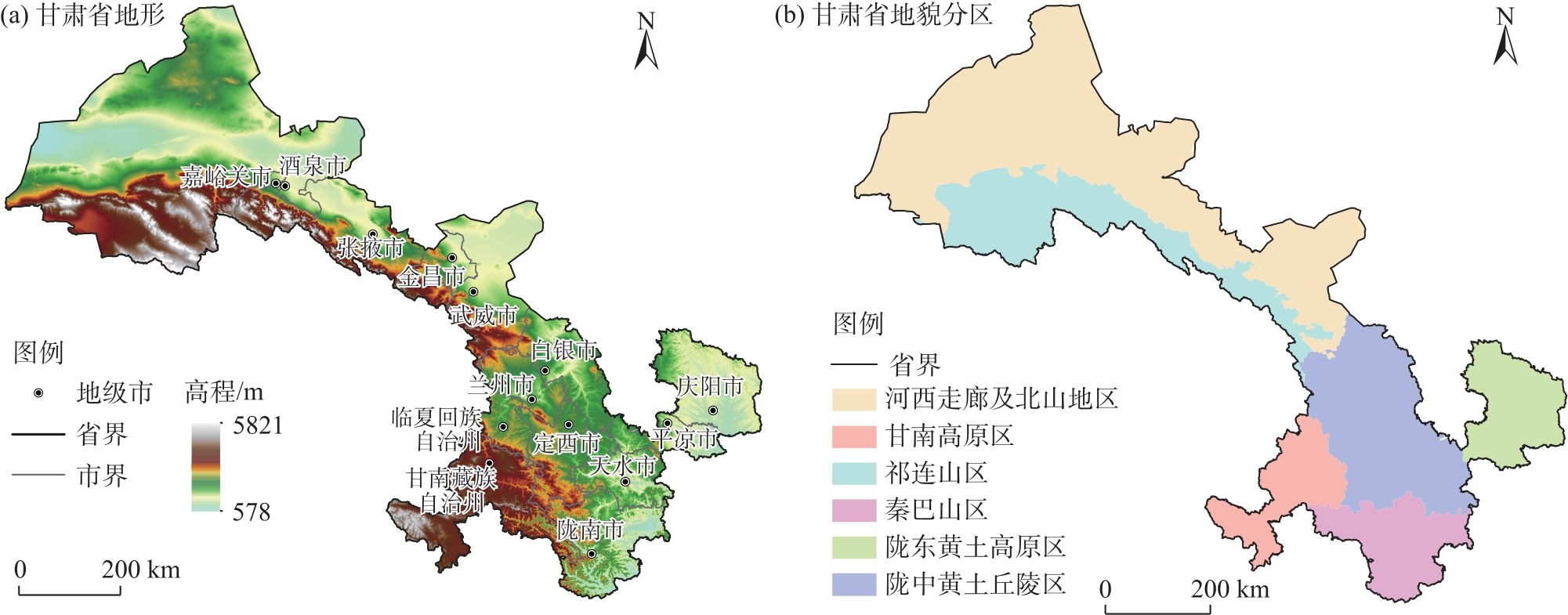
Fig. 2
S-G filtering results of the EVI from 2001 to 2023"
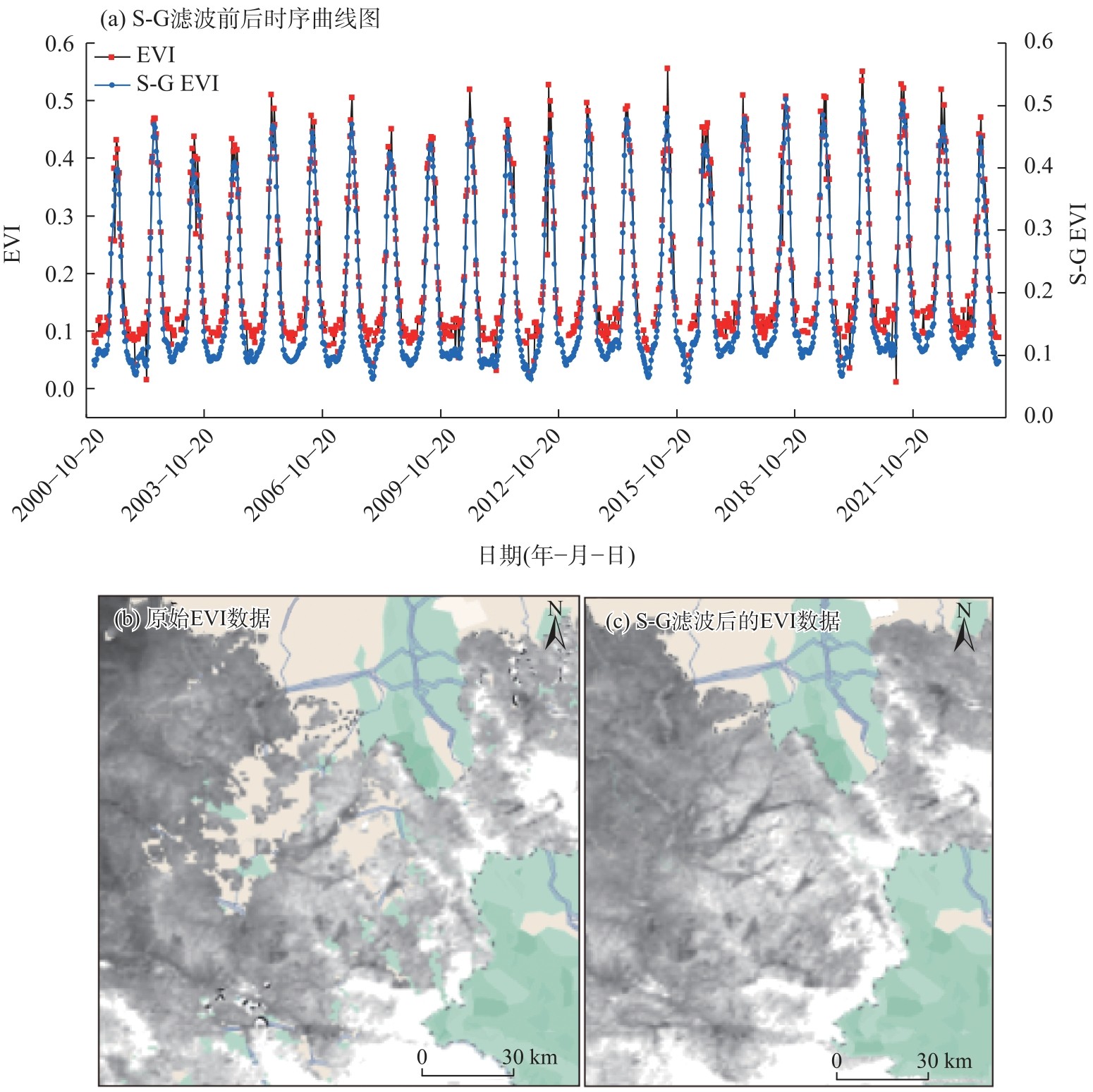
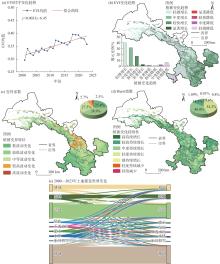
Fig. 3
Spatiotemporal characteristics of vegetation and land use change in Gansu Province"

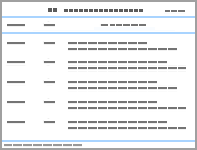
Tab. 1
Land cover type transition matrix of Gansu Province from 2001 to 2023 /km2"
| 土地覆盖类型 | 耕地 | 森林 | 灌木 | 草地 | 水体 | 冰川积雪 | 裸地 | 不透水面 | 湿地 | 合计 | 流出合计 |
|---|---|---|---|---|---|---|---|---|---|---|---|
| 耕地 | 41850.13 | 1877.55 | 10.01 | 14143.65 | 37.32 | 0.00 | 128.18 | 319.27 | 0.11 | 58366.22 | 16516.09 |
| 森林 | 241.30 | 33880.02 | 227.81 | 151.37 | 0.30 | 0.00 | 0.01 | 0.62 | 0.01 | 34501.44 | 621.42 |
| 灌木 | 29.74 | 370.01 | 760.37 | 505.84 | 0.07 | 0.00 | 0.04 | 0.00 | 0.03 | 1666.1 | 905.73 |
| 草地 | 8740.76 | 4459.10 | 288.78 | 128333.48 | 126.18 | 3.40 | 5034.43 | 122.64 | 34.34 | 147143.1 | 18809.63 |
| 水体 | 19.11 | 0.75 | 0.00 | 42.43 | 422.81 | 1.72 | 32.98 | 7.85 | 0.04 | 527.69 | 104.88 |
| 冰川积雪 | 0.00 | 0.03 | 0.00 | 4.23 | 13.44 | 783.98 | 224.84 | 0.00 | 0.00 | 1026.52 | 242.54 |
| 裸地 | 1796.62 | 1.37 | 0.16 | 8786.81 | 68.08 | 94.07 | 170931.97 | 28.61 | 0.03 | 181707.70 | 10775.75 |
| 不透水面 | 1.50 | 0.01 | 0.00 | 0.25 | 7.88 | 0.00 | 0.12 | 457.07 | 0.00 | 466.83 | 9.76 |
| 湿地 | 0.06 | 2.32 | 0.00 | 51.54 | 2.47 | 0.00 | 0.00 | 0.00 | 23.95 | 80.34 | 56.39 |
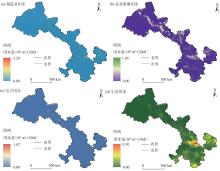
Fig. 4
Spatial distributions of water resources utilization in Gansu Province"
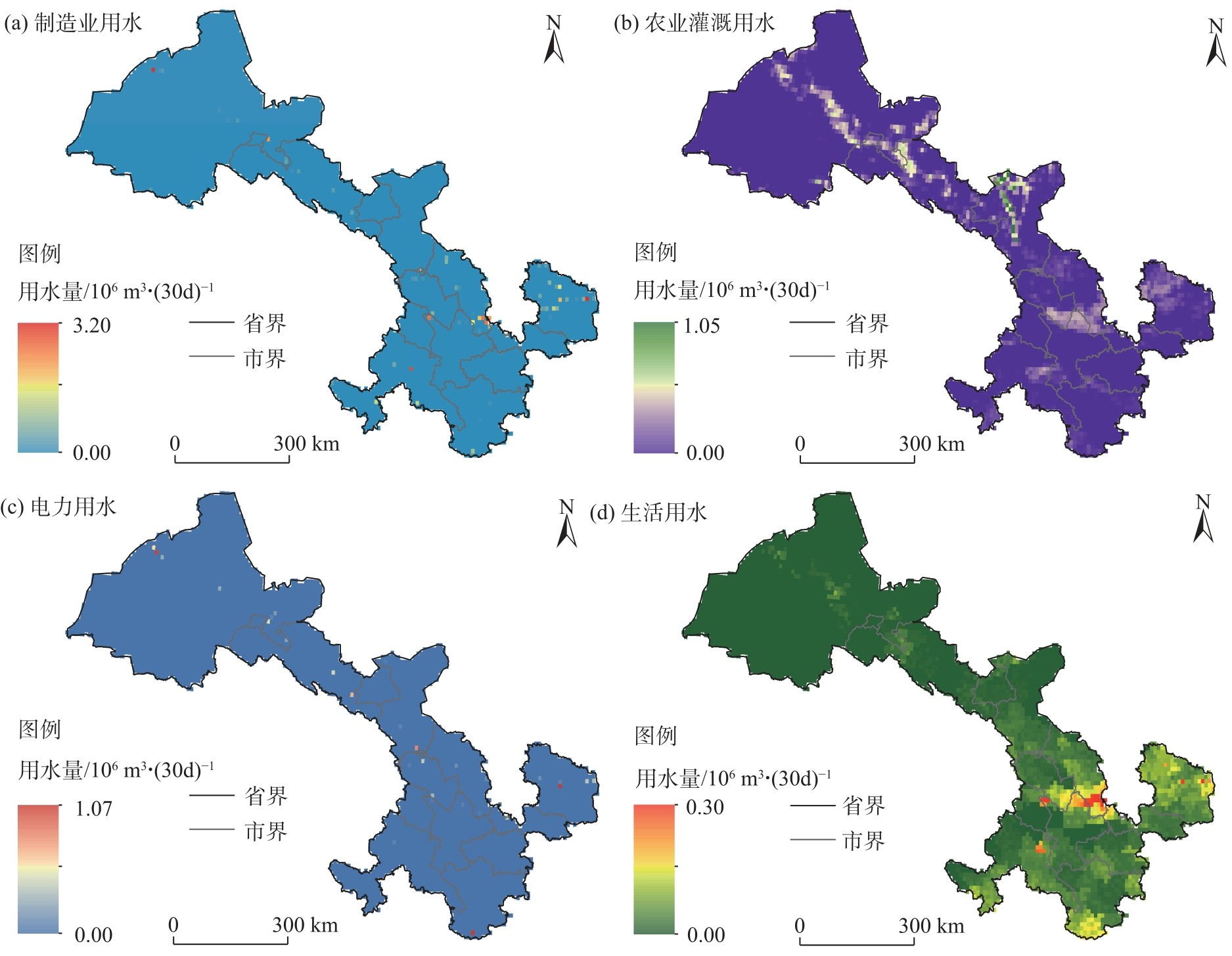
Fig. 5
Spatial distributions of partial correlation coefficients and significance test of vegetation coverage in Gansu Province with climate factors"
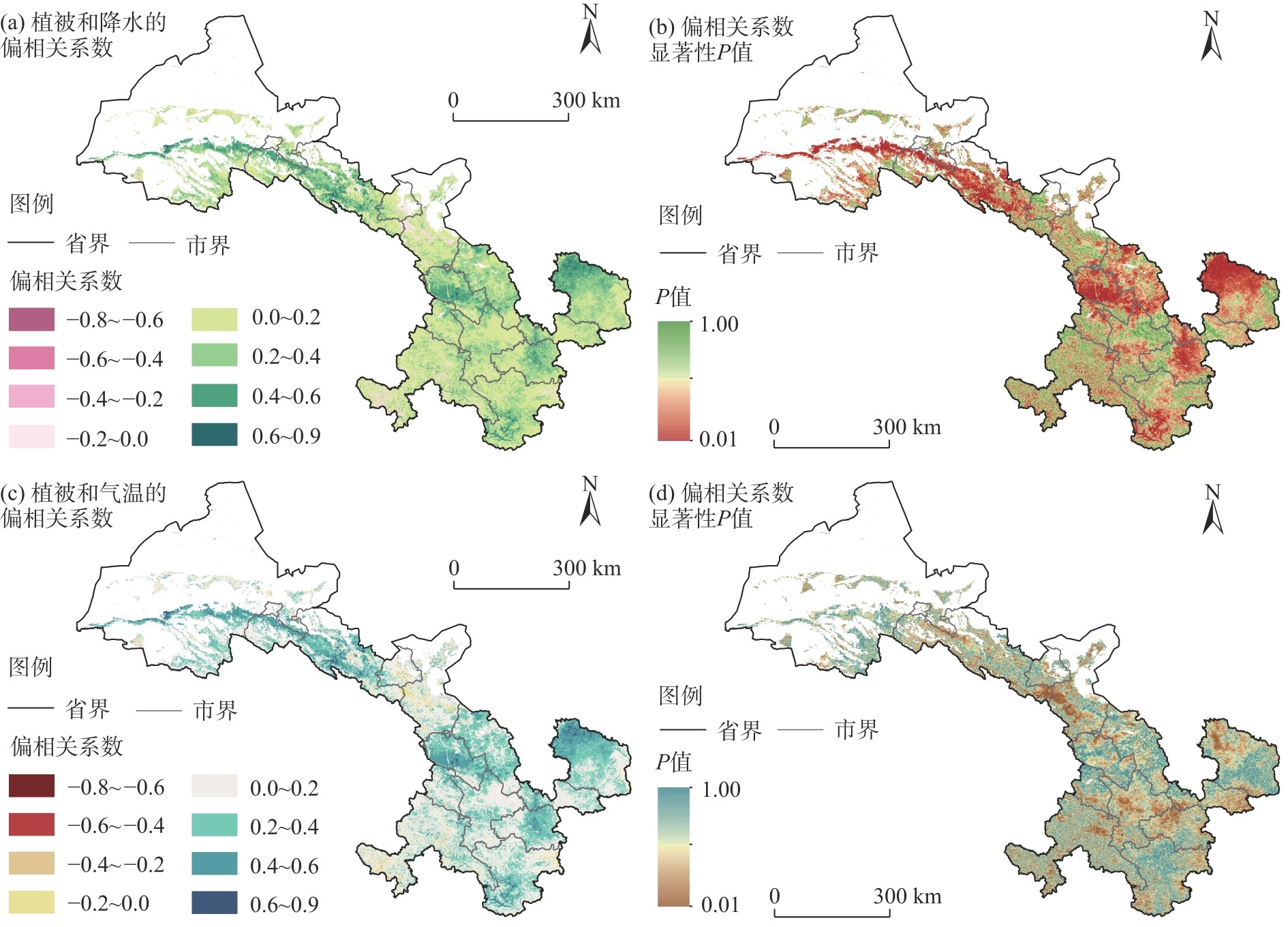
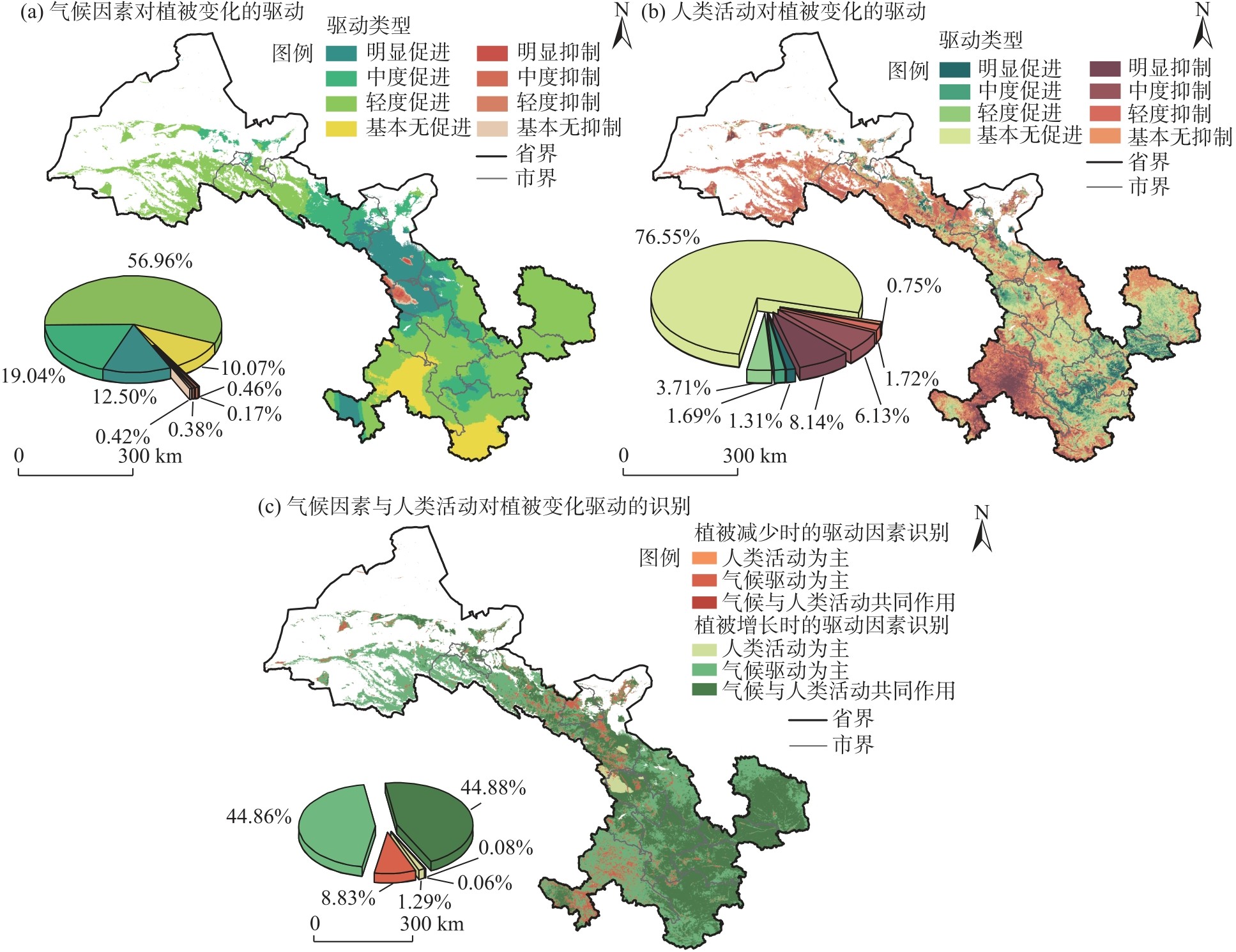
Fig. 6
Identification of the driving factors of vegetation changes due to climate factors and human activities"
| [1] |
Aguirre-Gutiérrez J, Rifai S W, Deng X J, et al. Canopy functional trait variation across Earth’s tropical forests[J]. Nature, 2025, 641: 129-136.
doi: 10.1038/s41586-025-08663-2 |
| [2] |
Chen J Y, Qiu B, Chakraborty T C, et al. Contrasting effects of urbanization on vegetation between the global south and global north[J]. Nature Sustainability, 2025, 8: 373-384.
doi: 10.1038/s41893-025-01520-0 |
| [3] | Shi S Q, Yang P Q, Vrieling A, et al. Vegetation optimal temperature modulates global vegetation season onset shifts in response to warming climate[J]. Communications Earth & Environment, 2025, 6(1): 1-9. |
| [4] | Dong L X, Wang X F. Inconsistent influence of temperature, precipitation, and CO2 variations on the plateau alpine vegetation carbon flux[J]. Climate and Atmospheric Science, 2025, 8(1): 1-17. |
| [5] |
Ji F K, Xi G L, Xie Y W, et al. Estimating grassland carrying capacity in the source area of Nujiang River and Selinco Lake, Tibetan Plateau (2001—2020) based on multisource remote sensing[J]. Remote Sensing, 2024, 16(20): 3790-3814.
doi: 10.3390/rs16203790 |
| [6] |
Liu Y Y, Xie Y W, Guo Z C, et al. Effects of climate variability and human activities on vegetation dynamics across the Qinghai-Tibet Plateau from 1982 to 2020[J]. Remote Sensing, 2023, 15(20): 4988-5005.
doi: 10.3390/rs15204988 |
| [7] |
Huang H X, Xi G L, Ji F K, et al. Spatial and temporal variation in vegetation cover and its response to topography in the Selinco Region of the Qinghai-Tibet Plateau[J]. Remote Sensing, 2023, 15(16): 4101-4119.
doi: 10.3390/rs15164101 |
| [8] |
Wang J, Xie Y W, Wang X Y, et al. Driving factors of recent vegetation changes in Hexi Region, northwest China based on a new classification framework[J]. Remote Sensing, 2020, 12(11): 1758-1769.
doi: 10.3390/rs12111758 |
| [9] | 胡文可, 刘维忠, 彭亚萍. 草原生态恢复工程下新疆草原植被覆盖动态及其对生态系统服务的约束效应[J]. 水土保持学报, 2025, 39(3): 202-214, 223. |
| [Hu Wenke, Liu Weizhong, Peng Yaping. Vegetation cover dynamics of Xinjiang grassland under grassland ecological restoration project and its constraining effects on ecosystem services[J]. Journal of Soil and Water Conservation, 2025, 39(3): 202-214, 223.] | |
| [10] |
殷菲, 白冰, 黄鹏程, 等. 气候和人类活动对黄河干流甘肃段NDVI变化的影响[J]. 干旱气象, 2024, 42(6): 934-943.
doi: 10.11755/j.issn.1006-7639-2024-06-0934 |
| [Yin Fei, Bai Bing, Huang Pengcheng, et al. Impact of climate and human activities on NDVI change in Gansu section of the Yellow River main stream[J]. Journal of Arid Meteorology, 2024, 42(6): 934-943.] | |
| [11] | 刘星宇, 张美玲, 马子茗. 甘肃省1981—2020年植被覆盖度时空变化特征及气候因子分析[J]. 环境科学, 2025, 46(12): 7831-7840. |
| [Liu Xingyu, Zhang Meiling, Ma Ziming. Spatiotemporal changes in vegetation cover and analysis of climatic factors in Gansu Province from 1981 to 2020[J]. Environmental Science, 2025, 46(12): 7831-7840.] | |
| [12] | 戴晓爱, 马佳欣, 唐艺菱, 等. 甘肃省植被时空动态变化及其归因分析[J]. 生态环境学报, 2024, 33(8): 1163-1173. |
| [Dai Xiaoai, Ma Jiaxin, Tang Yiling, et al. Spatio-temporal dynamics and attribution analysis of vegetation in Gansu Province[J]. Ecology and Environmental Sciences, 2024, 33(8): 1163-1173.] | |
| [13] | 路建兵, 鞠珂, 廖伟斌. 2000—2020年甘肃省植被覆盖特征及其对气候变化和人类活动的响应[J]. 中国沙漠, 2023, 43(4): 118-127. |
| [Lu Jianbin, Ju Ke, Liao Weibin. Variation in NDVI and its response to climate change and human activities in Gansu Province during 2000—2020[J]. Journal of Desert Research, 2023, 43(4): 118-127.] | |
| [14] | 张军, 陶华旸, 李文杰, 等. 甘肃省草地生态系统时空变化特征[J]. 草业科学, 2022, 39(6): 1106-1114. |
| [Zhang Jun, Tao Huayang, Li Wenjie, et al. Spatial change of grassland ecosystem in Gansu Province[J]. Pratacultural Science, 2022, 39(6): 1106-1114.] | |
| [15] | 吕泳洁, 丁文广, 邓喆, 等. 基于地理探测器的甘肃省植被覆盖时空变化及驱动力分析[J]. 地球环境学报, 2022, 13(2): 185-195. |
| [Lü Yongjie, Ding Wenguang, Deng Zhe, et al. Spatiotemporal variation of vegetation cover and its driving forces in Gansu Province based on geodetector[J]. Journal of Earth Environment, 2022, 13(2): 185-195.] | |
| [16] | 柳明星, 刘建红, 马敏飞, 等. 近20年甘肃省临夏州植被覆盖度的时空变化及其影响因素[J]. 西北大学学报(自然科学版), 2022, 52(2): 169-180. |
| [Liu Mingxing, Liu Jianhong, Ma Minfei, et al. Spatio-temporal changes and influence factors of fractional vegetation coverage during the past 20 years in Linxia Prefecture of Gansu Province[J]. Journal of Northwest University (Natural Science Edition), 2022, 52(2): 169-180.] | |
| [17] |
崔丹丹, 张耀南, 陈广庭. 2001—2010年甘肃省植被覆盖的时空变化[J]. 中国沙漠, 2014, 34(4): 1161-1166.
doi: 10.7522/j.issn.1000-694X.2014.00065 |
|
[Cui Dandan, Zhang Yaonan, Chen Guangting. Spatial and temporal of NDVI in Gansu, China during 2001—2010 based on remote sensing[J]. Journal of Desert Research, 2014, 34(4): 1161-1166.]
doi: 10.7522/j.issn.1000-694X.2014.00065 |
|
| [18] | 王川, 王丽莎, 张勇勇, 等. 2000—2020年祁连山植被净初级生产力时空变化及其驱动因素[J]. 生态学报, 2023, 43(23): 9710-9720. |
| [Wang Chuan, Wang Lisha, Zhang Yongyong, et al. Spatiotemporal change and driving factors of net primary productivity in Qilian Mountains from 2000 to 2020[J]. Acta Ecologica Sinica, 2023, 43(23): 9710-9720.] | |
| [19] | 丁文广, 魏银丽, 杨军梅, 等. 甘肃省中部干旱区植被恢复对土壤养分变化的影响研究[J]. 干旱区资源与环境, 2012, 26(1): 159-163. |
| [Ding Wenguang, Wei Yinli, Yang Junmei, et al. Effects of vegetation rehabilitation on soil nutrient variation in central arid region of Gansu Province[J]. Journal of Arid Land Resources and Environment, 2012, 26(1): 159-163.] | |
| [20] | 张韬略, 姜亮亮, 刘冰, 等. 中国植被对气候变化的敏感性定量分析[J]. 生态学报, 2025, 45(5): 1-12. |
| [Zhang Taolue, Jiang Liangliang, Liu Bing, et al. Quantitative analysis of vegetation sensitivity to climate change in China[J]. Acta Ecologica Sinica, 2025, 45(5): 1-12.] | |
| [21] |
金凯, 王飞, 韩剑桥, 等. 1982—2015年中国气候变化和人类活动对植被NDVI变化的影响[J]. 地理学报, 2020, 75(5): 961-974.
doi: 10.11821/dlxb202005006 |
| [Jin Kai, Wang Fei, Han Jianqiao, et al. Contribution of climatic change and human activities to vegetation NDVI change over China during 1982—2015[J]. Acta Geographica Sinica, 2020, 75(5): 961-974.] | |
| [22] |
王建邦, 赵军, 李传华, 等. 2001—2015年中国植被覆盖人为影响的时空格局[J]. 地理学报, 2019, 74(3): 504-519.
doi: 10.11821/dlxb201903008 |
|
[Wang Jianbang, Zhao Jun, Li Chuanhua, et al. The spatial-temporal patterns of the impact of human activities on vegetation coverage in China from 2001 to 2015[J]. Acta Geographica Sinica, 2019, 74(3): 504-519.]
doi: 10.11821/dlxb201903008 |
|
| [23] |
Huete A, Didan K, Miura T, et al. Overview of the radiometric and biophysical performance of the MODIS vegetation indices[J]. Remote Sensing of Environment, 2002, 83(1-2): 195-213.
doi: 10.1016/S0034-4257(02)00096-2 |
| [24] |
Savitzky A, Golay M. Smoothing and differentiation of data by simplified least squares procedures[J]. Analytical Chemistry, 1964, 36(8): 1627-1639.
doi: 10.1021/ac60214a047 |
| [25] | 罗爽, 刘会玉, 龚海波. 1982—2018年中国植被覆盖变化非线性趋势及其格局分析[J]. 生态学报, 2022, 42(20): 8331-8342. |
| [Luo Shuang, Liu Huiyu, Gong Haibo. Nonlinear trends and spatial pattern analysis of vegetation cover change in China from 1982 to 2018[J]. Acta Ecologica Sinica, 2022, 42(20): 8331-8342.] | |
| [26] | 李传华, 朱同斌, 周敏, 等. 河西走廊植被净初级生产力时空变化及其影响因子研究[J]. 生态学报, 2021, 41(5): 1931-1943. |
| [Li Chuanhua, Zhu Tongbin, Zhou Min, et al. Temporal and spatial change of net primary productivity of vegetation and its determinants in Hexi Corridor[J]. Acta Ecologica Sinica, 2021, 41(5): 1931-1943.] | |
| [27] | 解晗, 同小娟, 李俊, 等. 2000—2018年黄河流域生长季植被指数变化及其对气候因子的响应[J]. 生态学报, 2022, 42(11): 4536-4549. |
| [Xie Han, Tong Xiaojuan, Li Jun, et al. Changes of NDVI and EVI and their responses to climatic variables in the Yellow River Basin during the growing season of 2000—2018[J]. Acta Ecologica Sinica, 2022, 42(11): 4536-4549.] | |
| [28] |
申子傲, 吴静, 李纯斌. 2000—2020年河西内陆河流域植被覆盖时空变化特征及其驱动力[J]. 中国沙漠, 2024, 44(3): 119-127.
doi: 10.7522/j.issn.1000-694X.2023.00180 |
|
[Shen Zi’ao, Wu Jing, Li Chunbin. Temporal and spatial changes of vegetation cover and its driving forces in the Hexi inland river basin from 2000 to 2020[J]. Journal of Desert Research, 2024, 44(3): 119-127.]
doi: 10.7522/j.issn.1000-694X.2023.00180 |
|
| [29] |
Hurst H E. The long-term storage capacity of reservoirs[J]. Transactions of the American Society of Civil Engineers, 1951, 116(1): 770-799.
doi: 10.1061/TACEAT.0006518 |
| [30] | 吕雅淑, 杨涵, 卡木然·买买提艾力, 等. 气候变化与人类活动对天山北坡经济带植被覆盖度的协同影响[J]. 环境科学, 2026, 47(3): 1754-1766. |
| [Lü Yashu, Yang Han, Maimaitiaili Kamuran, et al. Synergistic impact of climate change and human activities on vegetation coverage in the northern slope economic belt of the Tianshan Mountains[J]. Environmental Science, 2026, 47(3): 1754-1766.] | |
| [31] | 于惠, 吴玉锋, 金毅, 等. 河西干旱区植被覆盖度时空格局分析[J]. 草业科学, 2019, 36(3): 623-631. |
| [Yu Hui, Wu Yufeng, Jin Yi, et al. Analysis of the spatio-temporal patterns of vegetation fractional coverage in the Hexi arid area[J]. Pratacultural Science, 2019, 36(3): 623-631.] | |
| [32] |
刘一丹, 姚晓军, 李宗省, 等. 气候变化和土地利用覆盖变化对河西地区植被净初级生产力的影响[J]. 干旱区研究, 2024, 41(1): 169-180.
doi: 10.13866/j.azr.2024.01.16 |
|
[Liu Yidan, Yao Xiaojun, Li Zongxing, et al. Impacts of climate change and land use/cover change on the net primary productivity of vegetation in Hexi region, northwest China[J]. Arid Zone Research, 2024, 41(1): 169-180.]
doi: 10.13866/j.azr.2024.01.16 |
|
| [33] | 祁兰兰, 苏敬华, 王敏, 等. 2001—2021年甘肃省植被NDVI时空演变及其对气候变化与人类活动的响应[J/OL]. 环境科学. [2026-01-09]. https://doi.org/10.13227/j.hjkx.202505042. |
| [Qi Lanlan, Su Jinghua, Wang Min, et al. Response of vegetation spatiotemporal evolution to climate change and human activities in Gansu Province from 2001 to 2021[J/OL]. Environmental Science. [2026-01-09]. https://doi.org/10.13227/j.hjkx.202505042.] | |
| [34] |
郑三君, 马建民, 周星, 等. 甘肃省植被叶面积指数时空演变与水热驱动机制[J]. 干旱区研究, 2026, 43(2): 338-349.
doi: 10.13866/j.azr.2026.02.11 |
| [Zheng Sanjun, Ma Jianmin, Zhou Xing, et al. Spatiotemporal evolution of the leaf area index and hydrothermal driving mechanisms in Gansu Province[J]. Arid Zone Research, 2026, 43(2): 338-349.] | |
| [35] |
何国兴, 韩天虎, 柳小妮, 等. 甘肃省草地植被NDVI时空变化特征及驱动因素研究[J]. 草地学报, 2021, 29(5): 1004-1013.
doi: 10.11733/j.issn.1007-0435.2021.05.017 |
|
[He Guoxing, Han Tianhu, Liu Xiaoni, et al. Spatio-temporal variation and the driving factors of NDVI of grassland vegetation in Gansu Province[J]. Acta Agrestia Sinica, 2021, 29(5): 1004-1013.]
doi: 10.11733/j.issn.1007-0435.2021.05.017 |
|
| [36] | 郭昆明, 邱天, 宗乐丽, 等. 河西地区NDVI变化及其对气温和降水的响应[J]. 测绘科学, 2021, 46(4): 83-89. |
| [Guo Kunming, Qiu Tian, Zong Leli, et al. Change of NDVI in Hexi region and its response to temperature and precipitation[J]. Science of Surveying and Mapping, 2021, 46(4): 83-89.] | |
| [37] |
张娟, 姚晓军, 李净, 等. 基于多源遥感数据的甘肃省农业干旱研究[J]. 干旱区地理, 2023, 46(1): 11-22.
doi: 10.12118/j.issn.1000-6060.2022.165 |
|
[Zhang Juan, Yao Xiaojun, Li Jing, et al. Agricultural drought research based on multi-source remote sensing data in Gansu Province[J]. Arid Land Geography, 2023, 46(1): 11-22.]
doi: 10.12118/j.issn.1000-6060.2022.165 |
|
| [38] |
杨晓玲, 丁文魁, 周华, 等. 石羊河流域归一化植被指数变化及其驱动因子分析[J]. 干旱区地理, 2024, 47(10): 1735-1744.
doi: 10.12118/j.issn.1000-6060.2024.036 |
|
[Yang Xiaoling, Ding Wenkui, Zhou Hua, et al. Normalized difference vegetation index change and its driving factors in Shiyang River Basin[J]. Arid Land Geography, 2024, 47(10): 1735-1744.]
doi: 10.12118/j.issn.1000-6060.2024.036 |
|
||

