Arid Land Geography ›› 2026, Vol. 49 ›› Issue (11): 2361-2375.doi: 10.12118/j.issn.1000-6060.2025.755
• Urban Geography • Previous Articles Next Articles
LI Yuhan( ), ZHOU Zhongxue(), WANG Yan, Rukeya REHEMAN
Received:2025-12-09
Revised:2026-02-01
Online:2026-11-25
Published:2026-11-13
Contact:
ZHOU Zhongxue
E-mail:lyhan@snnu.edu.cn;zhouzhx@snnu.edu.cn
LI Yuhan, ZHOU Zhongxue, WANG Yan, Rukeya REHEMAN. Impact pathways of ecosystem service supply and demand on human well-being in the Guanzhong Plain urban agglomeration[J].Arid Land Geography, 2026, 49(11): 2361-2375.
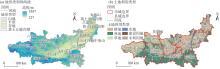
Fig. 1
Overview of the study area"
Tab. 1
Data sources"
| 数据类型 | 数据名称 | 分辨率 | 年份 | 数据源 |
|---|---|---|---|---|
| 环境数据 | 土地利用数据 | 30 m | 2000—2022 | 遥感信息处理研究所( |
| 数字高程模型(DEM) | 1 km | 2000—2022 | 地理空间数据云( | |
| 行政边界 | - | 2022 | 资源环境科学与数据平台( | |
| CO2排放量 | 1 km | 2000—2022 | 全球环境研究中心( 全球大气研究排放数据库( | |
| PM2.5浓度 | 1 km | 2000—2022 | 广域环境智能实验室( | |
| 气象数据(年平均降水量、年平均气温、年平均蒸散发量) | 1 km | 2000—2022 | 国家地理系统科学数据中心( | |
| 叶面积指数(LAI) | 500 m | 2003—2022 | 美国国家航空航天局( | |
| 归一化植被指数(NDVI) | 1 km | 2000—2022 | 美国国家航空航天局( | |
| 净初级生产力(NPP) | 1 km | 2000—2022 | 美国国家航空航天局( | |
| 土壤类型 | 1 km | 2000—2022 | 国际应用系统分析研究所( | |
| 路网 | - | 2000—2022 | 全国地理信息资源目录服务系统( | |
| 人口数据 | 人口密度 | 1 km | 2000—2022 | 美国橡树岭国家实验室( |
| 社会经济数据 | 农业、医疗、教育等数据 | 区县 | 2000—2022 | 各市、区县级逐年统计年鉴、国民经济和社会发展统计公报、水资源公报 |
Tab. 2
Assessment system for human well-being in urban agglomerations"
| 维度层 | 功能层 | 功能层权重 | 对应可持续发展目标 | 本地化指标 | 指标性质 | 指标层权重 |
|---|---|---|---|---|---|---|
| 收入与物质福祉 | 基本收入 | 0.340 | SDG1.1 | 城镇居民人均可支配收入/元·人-1 | + | 0.226 |
| SDG1.1 | 农村居民人均可支配收入/元·人-1 | + | 0.293 | |||
| SDG8.1 | 人均GDP/元·人-1 | + | 0.482 | |||
| 基本物质 | 0.660 | SDG2.1 | 人均粮食产量/t·人-1 | + | 0.029 | |
| SDG2.1 | 人均水果产量/t·人-1 | + | 0.112 | |||
| SDG2.1 | 人均蔬菜总产量/t·人-1 | + | 0.113 | |||
| SDG2.1 | 人均肉类总产量/t·人-1 | + | 0.050 | |||
| SDG11.1 | 综合人均居住面积/m2·人-1 | + | 0.020 | |||
| SDG2.a | 每公顷农业机械平均功率/kW·hm-2 | + | 0.384 | |||
| SDG7.1 | 燃气普及率/% | + | 0.013 | |||
| SDG6.1 | 用水普及率/% | + | 0.005 | |||
| SDG6.1 | 人均生活用水量/t·人-1 | + | 0.017 | |||
| SDG9.1 | 铁路密度/m·km-2 | + | 0.155 | |||
| SDG9.1 | 高速公路密度/m·km-2 | + | 0.102 | |||
| 安全与健康福祉 | 安全 | 0.623 | SDG2.4 | 人均耕地面积/hm2·人-1 | + | 0.121 |
| SDG6.2 | 人均水资源供给量/t·人-1 | + | 0.344 | |||
| SDG6.3 | 污水处理率/% | + | 0.075 | |||
| SDG12.5 | 生活垃圾无害化处理率/% | + | 0.034 | |||
| SDG11.6 | PM2.5浓度/μg·m-3 | - | 0.061 | |||
| SDG15.1 | 森林覆盖率/% | + | 0.332 | |||
| SDG3.6 | 交通事故数/起 | - | 0.033 | |||
| 健康 | 0.377 | SDG3.b | 万人拥有床位数/床 | + | 0.433 | |
| SDG3.c | 万人拥有卫生技术人员数/人 | + | 0.567 | |||
| 社会与文化福祉 | 社会关系 | 0.098 | SDG8.5 | 城镇登记失业率/% | - | 0.068 |
| SDG10.4 | 城乡收入差距 | - | 0.002 | |||
| SDG1.3 | 社会保障和就业支出占比/% | + | 0.354 | |||
| SDG11.7 | 万人拥有公园数/个 | + | 0.464 | |||
| SDG11.7 | 人均公园绿地面积/m2·人-1 | + | 0.067 | |||
| SDG15.1 | 建城区绿化覆盖率/% | + | 0.045 | |||
| 文化 | 0.338 | SDG4.c | 普通小学每位教师负担学生数/人 | - | 0.007 | |
| SDG4.c | 普通中学每位教师负担学生数/人 | - | 0.001 | |||
| SDG4.1 | 初中升高中升学率/% | + | 0.044 | |||
| SDG4.3 | 每万人拥有高等学校在校学生数/人 | + | 0.411 | |||
| SDG4.7 | 万人拥有公共图书馆数量/个 | + | 0.363 | |||
| SDG4.7 | 每百人公共图书馆藏书/册 | + | 0.175 | |||
| 科技 | 0.564 | SDG9.5 | 研究人员数/人 | + | 0.234 | |
| SDG9.5 | R&D经费支出/103元 | + | 0.366 | |||
| SDG9.5 | 专利授权数/个 | + | 0.400 |
Tab. 3
Ecosystem service supply per unit area from 2000 to 2022"
| 生态系统服务 | 2000年 | 2005年 | 2010年 | 2015年 | 2022年 |
|---|---|---|---|---|---|
| 生境质量 | 0.60 | 0.59 | 0.59 | 0.59 | 0.59 |
| 产水/102 mm | 3.8 | 4.0 | 4.3 | 3.9 | 4.2 |
| 食物生产/102 t | 1.7 | 2.1 | 3.1 | 3.9 | 3.8 |
| 固碳/106 t | 5.4 | 6.9 | 7.7 | 8.8 | 8.8 |
| PM2.5净化/103 kg | 3.4 | 4.6 | 4.8 | 4.6 | 3.7 |
| 休闲娱乐/105 m2 | 4.6 | 4.5 | 4.7 | 4.7 | 4.7 |
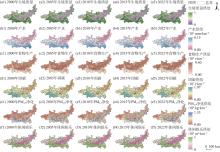
Fig. 2
Spatiotemporal dynamics of ecosystem service supply in the Guanzhong Plain urban agglomeration from 2000 to 2022"
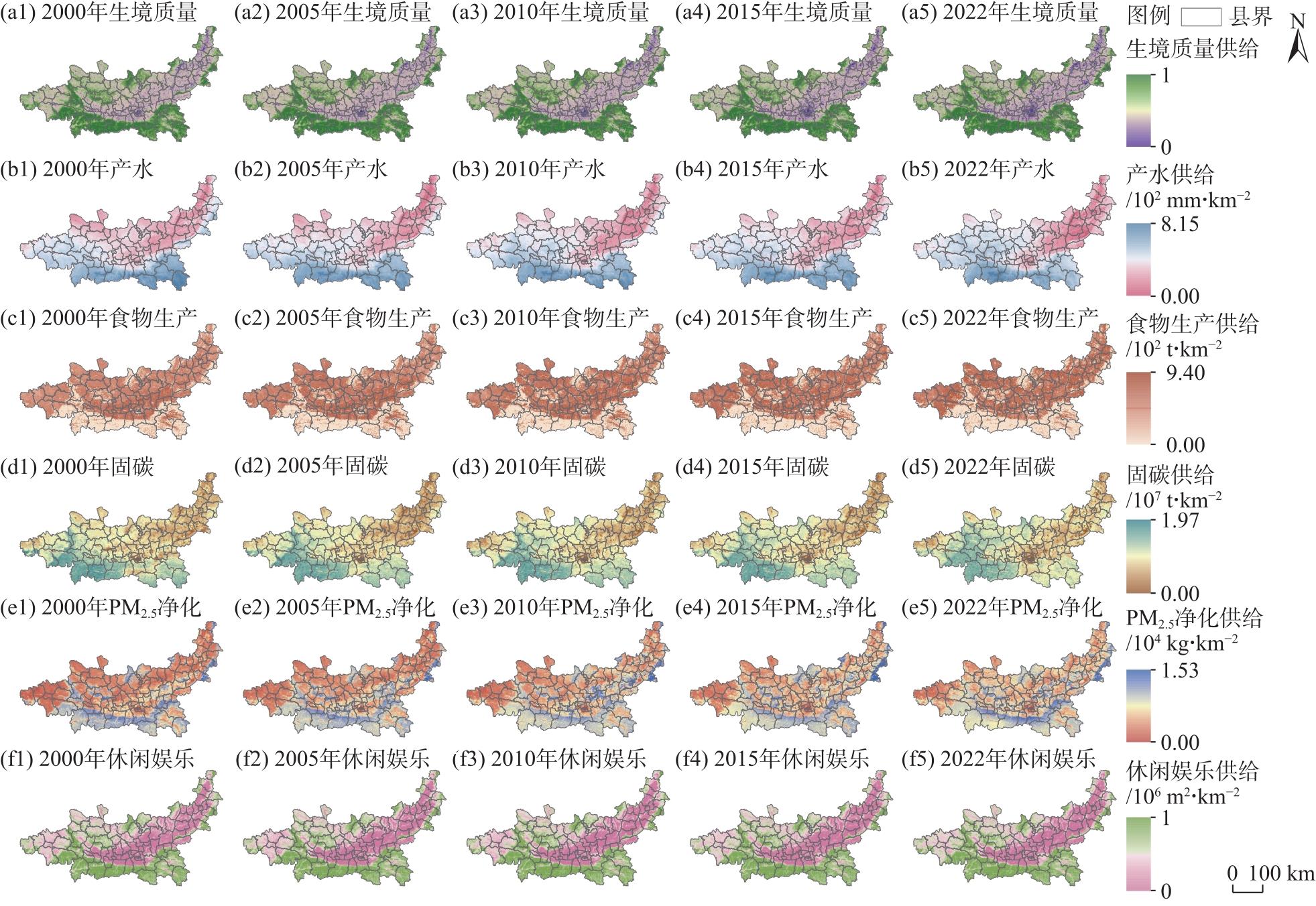
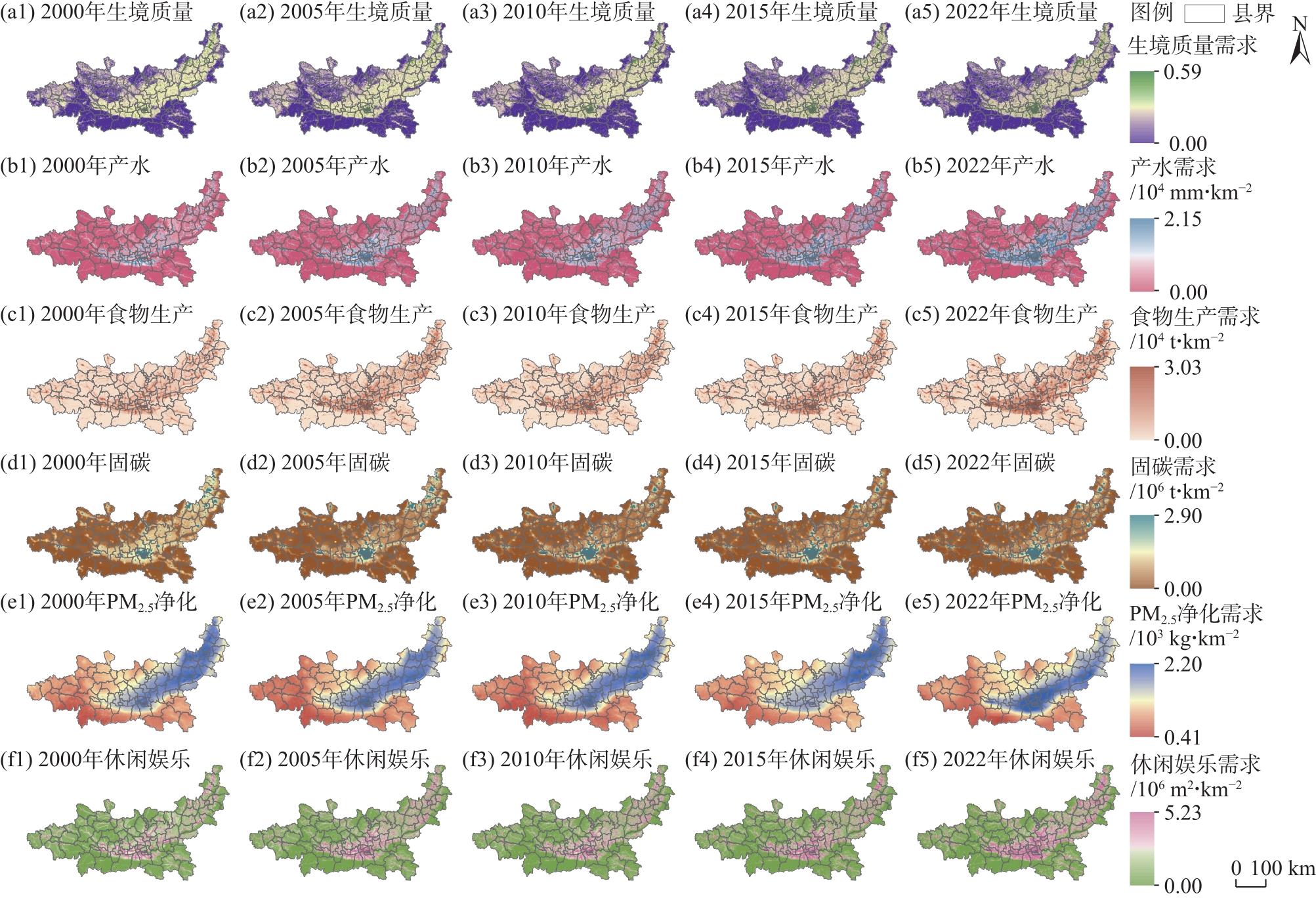
Fig. 3
Spatiotemporal dynamics of ecosystem service demand in the Guanzhong Plain urban agglomeration from 2000 to 2022"
Tab. 4
Ecosystem service demand per unit area from 2000 to 2022"
| 生态系统服务 | 2000年 | 2005年 | 2010年 | 2015年 | 2022年 |
|---|---|---|---|---|---|
| 生境质量 | 0.13 | 0.13 | 0.14 | 0.14 | 0.14 |
| 产水/10 mm | 4.3 | 4.4 | 5.2 | 5.5 | 5.8 |
| 食物生产/10 t | 8.1 | 7.7 | 7.3 | 7.6 | 8.8 |
| 固碳/102 t | 2.6 | 3.8 | 5.2 | 6.0 | 7.2 |
| PM2.5净化/103 kg | 1.1 | 1.3 | 1.2 | 1.1 | 0.7 |
| 休闲娱乐/104 m2 | 1.4 | 1.5 | 1.5 | 1.5 | 1.6 |
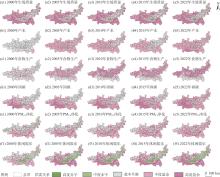
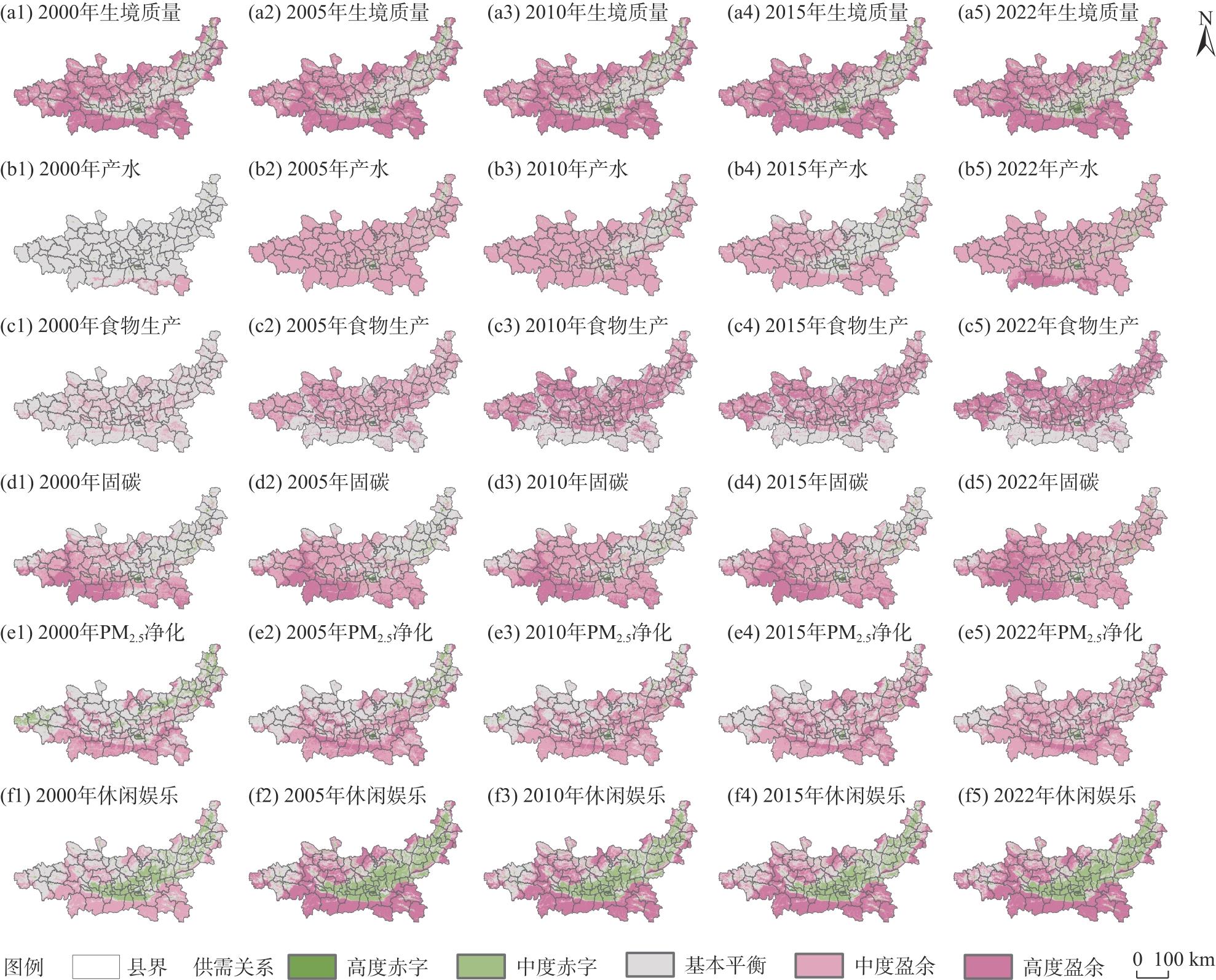
Fig. 4
Spatiotemporal dynamics of ecosystem service supply-demand relationships in the Guanzhong Plain urban agglomeration from 2000 to 2022"
Tab. 5
Area proportions of ecosystem service supply-demand matching types in the Guanzhong Plain urban agglomeration /%"
| 生态系统服务 | 2000年 | 2022年 | |||||
|---|---|---|---|---|---|---|---|
| 赤字比例 | 平衡比例 | 盈余比例 | 赤字比例 | 平衡比例 | 盈余比例 | ||
| 生境质量 | 3.50 | 25.41 | 71.09 | 6.41 | 25.46 | 68.13 | |
| 产水 | 1.52 | 92.98 | 5.50 | 3.82 | 5.57 | 90.61 | |
| 食物生产 | 0.23 | 78.88 | 20.89 | 0.44 | 44.71 | 54.85 | |
| 固碳 | 3.20 | 43.78 | 53.02 | 3.03 | 11.60 | 85.37 | |
| PM2.5净化 | 9.95 | 47.63 | 42.42 | 1.33 | 24.83 | 73.84 | |
| 休闲娱乐 | 17.57 | 43.82 | 38.61 | 25.40 | 21.61 | 52.99 | |
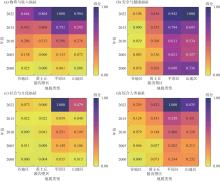
Fig. 5
Changes in human well-being levels in the Guanzhong Plain urban agglomeration from 2000 to 2022"
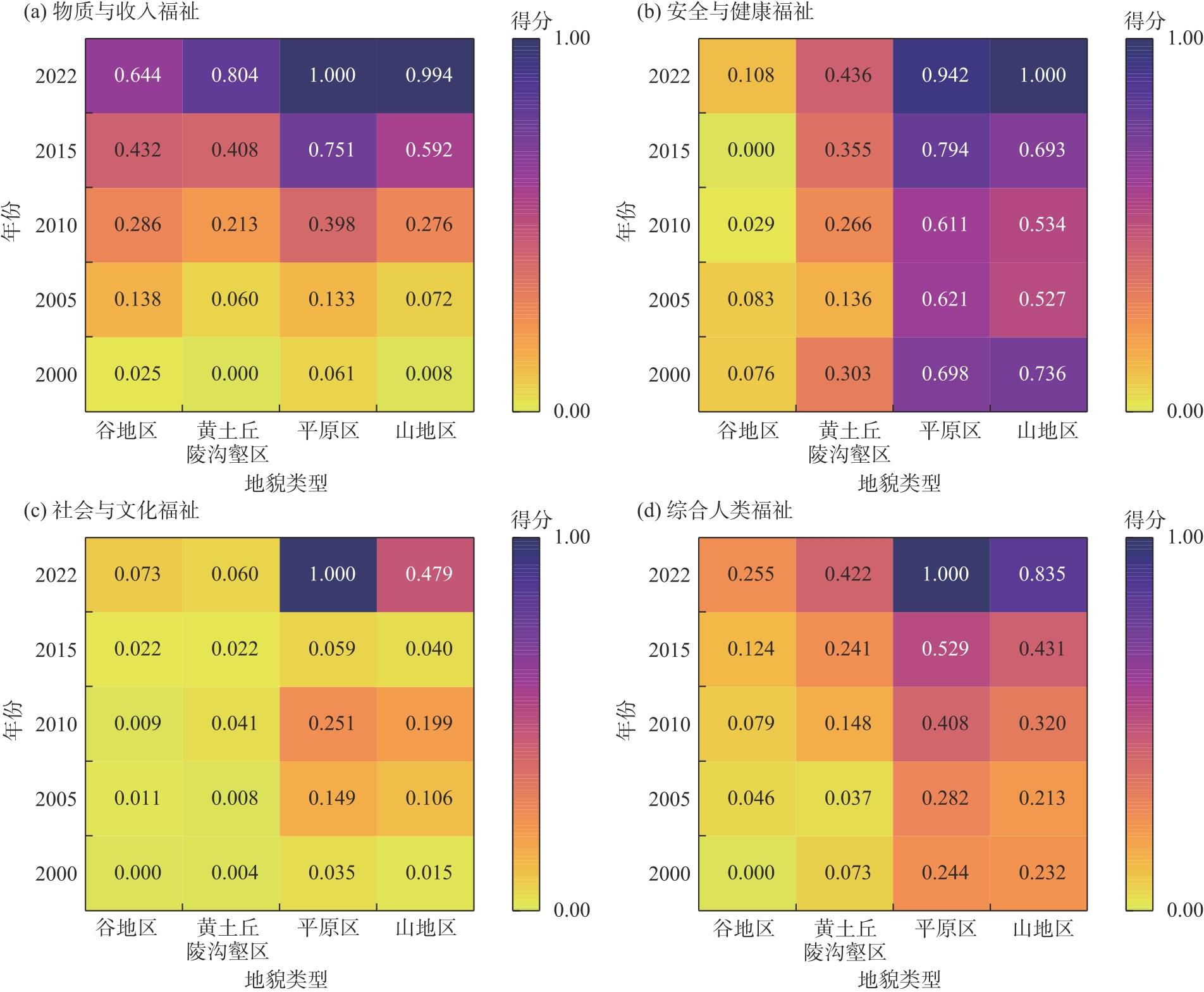
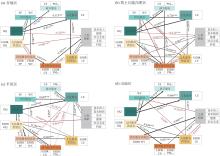
Fig. 6
Impact of ecosystem service supply and demand on human well-being in the Guanzhong Plain urban agglomeration based on the PLS-SEM model"
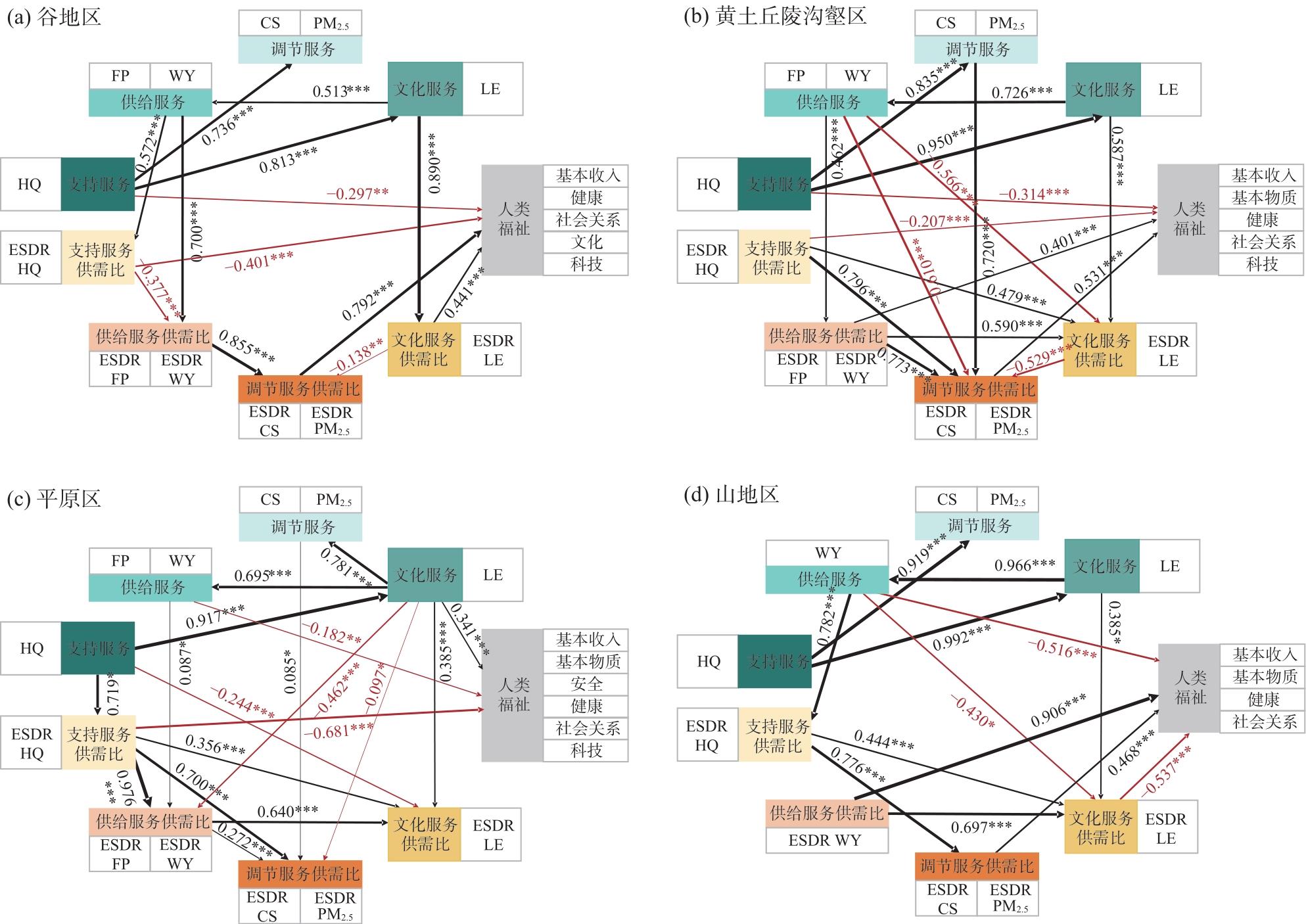
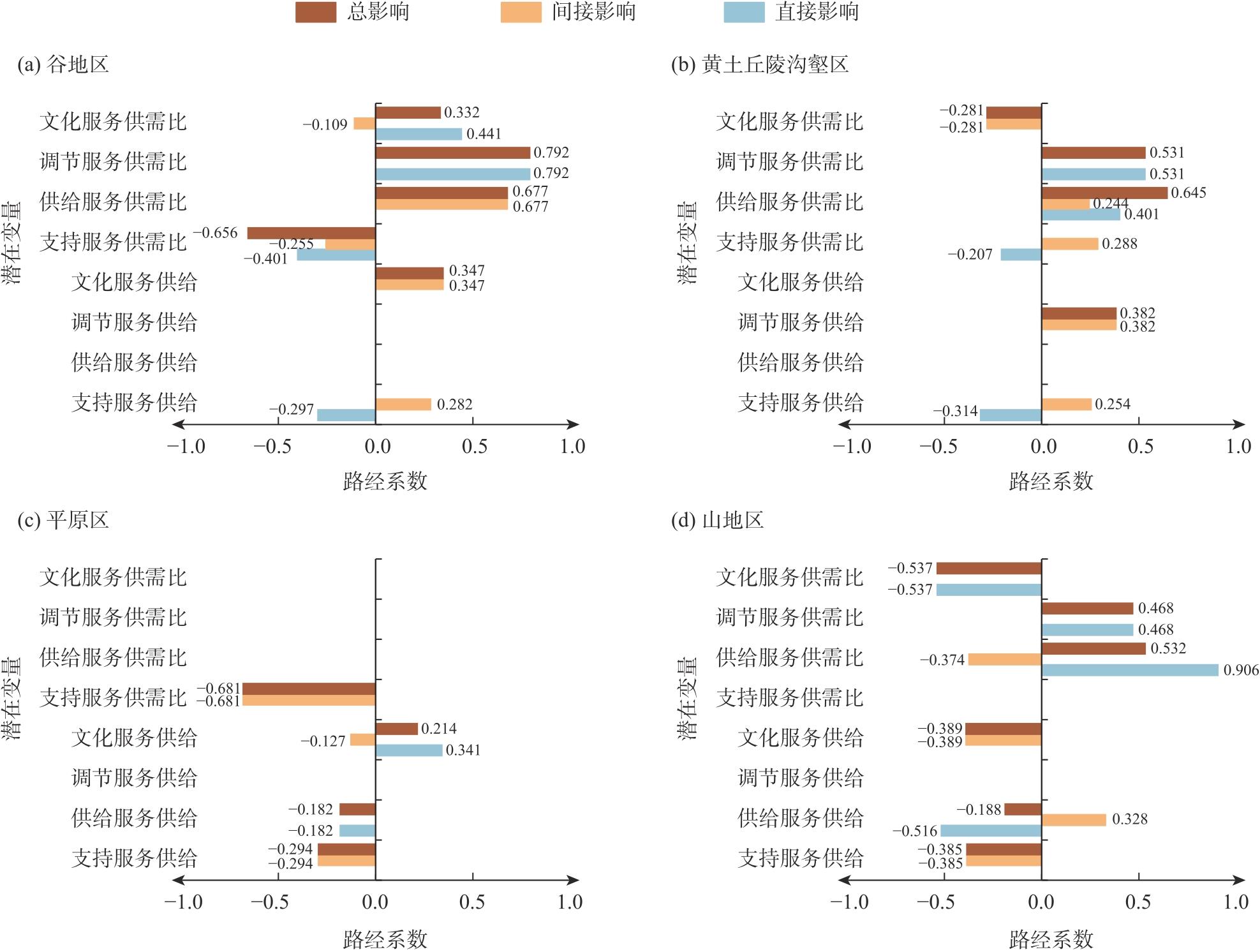
Fig. 7
Direct and indirect effects of latent variables in the PLS-SEM model"
| [1] | Khor N, Arimah B, Otieno R O, et al. World cities report 2022: Envisaging the future of cities[R]. Nairobi: United Nations Human Settlements Programme, 2022: 41-44. |
| [2] | Pukowiec-Kurda K. The urban ecosystem services index as a new indicator for sustainable urban planning and human well-being in cities[J]. Ecological Indicators, 2022, 144: 109532, doi: 10.1016/j.ecolind.2022.109532. |
| [3] | Güneralp B, Seto K C. Futures of global urban expansion: Uncertainties and implications for biodiversity conservation[J]. Environmental Research Letters, 2013, 8(1): 014025, doi: 10.1088/1748-9326/8/1/014025. |
| [4] | Vindigni G, Mosca A, Bartoloni T, et al. Shedding light on peri-urban ecosystem services using automated content analysis[J]. Sustainability, 2021, 13(16): 9182, doi: 10.3390/su13169182. |
| [5] |
Smidt S J, Tayyebi A, Kendall A D, et al. Agricultural implications of providing soil-based constraints on urban expansion: Land use forecasts to 2050[J]. Journal of Environmental Management, 2018, 217: 677-689.
doi: S0301-4797(18)30269-X pmid: 29654971 |
| [6] | Schwarz N, Manceur A M. Analyzing the influence of urban forms on surface urban heat islands in Europe[J]. Journal of Urban Planning and Development, 2015, 141(3): A4014003, doi: 10.1061/(asce)up.1943-5444.0000263. |
| [7] | Lu X Y, Chen X, Zhao X L, et al. Assessing the impact of land surface temperature on urban net primary productivity increment based on geographically weighted regression model[J]. Scientific Reports, 2021, 11(1): 22282, doi: 10.1038/s41598-021-01757-7. |
| [8] | Bi J, Lu M H, Liu F C, et al. Multi-scale urban ecosystem service changes and their impact mechanisms on human well-being[J]. Journal of Environmental Management, 2025, 374: 124117, doi: 10.1016/j.jenvman.2025.124117. |
| [9] |
刘芦萌, 邬建国. 生态系统服务与人类福祉关系的研究框架、途径与方法[J]. 自然资源学报, 2024, 39(9): 2044-2065.
doi: 10.31497/zrzyxb.20240903 |
|
[Liu Lumeng, Wu Jianguo. Frameworks, approaches, and methods for studying the relationship between ecosystem services and human wellbeing[J]. Journal of Natural Resources, 2024, 39(9): 2044-2065.]
doi: 10.31497/zrzyxb.20240903 |
|
| [10] | Qiu J Q, Yu D Y, Huang T. Influential paths of ecosystem services on human well-being in the context of the sustainable development goals[J]. Science of the Total Environment, 2022, 852: 158443, doi: 10.1016/j.scitotenv.2022.158443. |
| [11] |
Felipe-Lucia M R, Comín F A. Ecosystem services-biodiversity relationships depend on land use type in floodplain agroecosystems[J]. Land Use Policy, 2015, 46: 201-210.
doi: 10.1016/j.landusepol.2015.02.003 |
| [12] |
Wu J G. Landscape sustainability science: Ecosystem services and human well-being in changing landscapes[J]. Landscape Ecology, 2013, 28(6): 999-1023.
doi: 10.1007/s10980-013-9894-9 |
| [13] | Luo Z J, Luo S K, Zhang F C, et al. Spatial and temporal matching measurement of ecosystem service supply, demand and human well-being and its coordination in the great rivers economic belt: Evidence from China’s Yangtze River Economic Belt[J]. Sustainability, 2024, 16(17): 7487, doi: 10.3390/su16177487. |
| [14] |
Daily G C, Matson P A. Ecosystem services: From theory to implementation[J]. Proceedings of the National Academy of Sciences, 2008, 105(28): 9455-9456.
doi: 10.1073/pnas.0804960105 |
| [15] |
Reid W V, Mooney H A. The millennium ecosystem assessment: Testing the limits of interdisciplinary and multi-scale science[J]. Current Opinion in Environmental Sustainability, 2016, 19: 40-46.
doi: 10.1016/j.cosust.2015.11.009 |
| [16] |
Burkhard B, Petrosillo I, Costanza R. Ecosystem services-bridging ecology, economy and social sciences[J]. Ecological Complexity, 2010, 7(3): 257-259.
doi: 10.1016/j.ecocom.2010.07.001 |
| [17] |
Mancini M S, Galli A, Coscieme L, et al. Exploring ecosystem services assessment through ecological footprint accounting[J]. Ecosystem Services, 2018, 30: 228-235.
doi: 10.1016/j.ecoser.2018.01.010 |
| [18] | 赵娜, 王辉, 论宇超, 等. 旅游型海岛生态系统服务供需与岛民福祉研究——以长山群岛为例[J]. 旅游科学, 2025, 39(1): 135-159. |
| [Zhao Na, Wang Hui, Lun Yuchao, et al. Study on supply and demand of ecosystem services and islanders well-being in tourism islands: A case of Changshan archipelago[J]. Tourism Science, 2025, 39(1): 135-159.] | |
| [19] | 董文卓, 苏维词, 罗小毛, 等. 西南地区生态系统服务供需与人类福祉的时空匹配测度及其耦合协调分析[J]. 环境科学, 2026, 47(5): 3362-3377. |
|
[Dong Wenzhuo, Su Weici, Luo Xiaomao, et al. Spatiotemporal matching measurement and coupling coordination analysis between ecosystem service supply-demand and human well-being in southwest China[J]. Environmental Science, 2026, 47(5): 3362-3377.]
doi: 10.1021/es304676x |
|
| [20] | Li Y G, Liu W, Zhu M, et al. Influencing factors and paths of the coupling relationship between ecosystem services supply-demand and human well-being in the Hexi regions, northwest China[J]. Remote Sensing, 2025, 17(10): 1787, doi: 10.3390/rs17101787. |
| [21] | 张超正, 杨钢桥, 陈丹玲, 等. 长江中游生态系统服务供需平衡与居民福祉耦合的时空特征[J]. 农业工程学报, 2024, 40(2): 356-368. |
| [Zhang Chaozheng, Yang Gangqiao, Chen Danling, et al. Spatiotemporal coupling relationship between supply-demand balance of ecosystem services and welfare of residents in the middle reaches of the Yangtze River[J]. Transactions of the Chinese Society of Agricultural Engineering, 2024, 40(2): 356-368.] | |
| [22] | Ketema H, Wei W, Legesse A, et al. Quantifying ecosystem service supply-demand relationship and its link with smallholder farmers’ well-being in contrasting agro-ecological zones of the East African rift[J]. Global Ecology and Conservation, 2021, 31: e01829, doi: 10.1016/j.gecco.2021.e01829. |
| [23] |
Wei H J, Liu H M, Xu Z H, et al. Linking ecosystem services supply, social demand and human well-being in a typical mountain-oasis-desert area, Xinjiang, China[J]. Ecosystem Services, 2018, 31: 44-57.
doi: 10.1016/j.ecoser.2018.03.012 |
| [24] | Wang B J, Tang H P, Zhang Q, et al. Exploring connections among ecosystem services supply, demand and human well-being in a mountain-basin system, China[J]. International Journal of Environmental Research and Public Health, 2020, 17(15): 5309, doi: 10.3390/ijerph17155309. |
| [25] |
Raudsepp-Hearne C, Peterson G D, Bennett E M. Ecosystem service bundles for analyzing tradeoffs in diverse landscapes[J]. Proceedings of the National Academy of Sciences, 2010, 107(11): 5242-5247.
doi: 10.1073/pnas.0907284107 |
| [26] | 董孝斌, 刘梦雪. 土地利用/覆盖变化-生态系统服务-人类福祉关系研究进展[J]. 北京师范大学学报(自然科学版), 2022, 58(3): 465-475. |
| [Dong Xiaobin, Liu Mengxue. Relationships among LUCC, ecosystem services and human well-being[J]. Journal of Beijing Normal University (Natural Science Edition), 2022, 58(3): 465-475.] | |
| [27] | Gao Y S, Zhang P, Xu Y Q, et al. A study on the spatiotemporal characteristics of the Xi’an metropolitan area based on the coupling and coordination of ecosystem services and human well-being[J]. Land, 2025, 14(3): 500, doi: 10.3390/land14030500. |
| [28] | 周新宇, 孟士婷, 黄庆旭, 等. 结合生态系统服务供需和人类福祉的区域规划[J]. 生态学报, 2022, 42(14): 5748-5760. |
| [Zhou Xinyu, Meng Shiting, Huang Qingxu, et al. Combining supply and demand of ecosystem services and human well-being for regional planning[J]. Acta Ecologica Sinica, 2022, 42(14): 5748-5760.] | |
| [29] | Xia Z Y, Wang Y, Lu Q L, et al. Understanding residents’ perspectives on cultural ecosystem service supply, demand and subjective well-being in rapidly urbanizing landscapes: A case study of peri-urban Shanghai[J]. Landscape Ecology, 2024, 39(2): 22, doi: 10.1007/s10980-024-01820-4. |
| [30] | Zhao Y, Feng Q, Lu A G. Spatiotemporal variation in vegetation coverage and its driving factors in the Guanzhong Basin, NW China[J]. Ecological Informatics, 2021, 64: 101371, doi: 10.1016/j.ecoinf.2021.101371. |
| [31] | Yang Y, Cai Z X. Ecological security assessment of the Guanzhong Plain urban agglomeration based on an adapted ecological footprint model[J]. Journal of Cleaner Production, 2020, 260: 120973, doi: 10.1016/j.jclepro.2020.120973. |
| [32] | Wang Y, Zhou Z X, Reheman R, et al. Simulation and spatiotemporal dynamic analysis of air-mediated ecosystem service flows: A case study of Guanzhong Plain urban agglomeration[J]. Ecological Indicators, 2025, 178: 113892, doi: 10.1016/j.ecolind.2025.113892. |
| [33] |
张鑫, 张丹, 张广森, 等. 关中平原城市群生态系统服务时空特征及生态功能区划分[J]. 干旱区地理, 2024, 47(9): 1587-1595.
doi: 10.12118/j.issn.1000-6060.2023.555 |
|
[Zhang Xin, Zhang Dan, Zhang Guangsen, et al. Spatiotemporal characteristics of ecosystem services and ecological function areas in Guanzhong Plain urban agglomeration[J]. Arid Land Geography, 2024, 47(9): 1587-1595.]
doi: 10.12118/j.issn.1000-6060.2023.555 |
|
| [34] | Shifaw E, Sha J M, Li X M, et al. Ecosystem services dynamics and their influencing factors: Synergies/tradeoffs interactions and implications, the case of upper Blue Nile Basin, Ethiopia[J]. Science of the Total Environment, 2024, 938: 173524, doi: 10.1016/j.scitotenv.2024.173524. |
| [35] | Shi Y S, Shi D H, Zhou L L, et al. Identification of ecosystem services supply and demand areas and simulation of ecosystem service flows in Shanghai[J]. Ecological Indicators, 2020, 115: 106418, doi: 10.1016/j.ecolind.2020.106418. |
| [36] |
杨宜男, 李敬, 王立, 等. 长三角地区城市化对典型生态系统服务供需的影响[J]. 自然资源学报, 2022, 37(6): 1555-1571.
doi: 10.31497/zrzyxb.20220613 |
|
[Yang Yinan, Li Jing, Wang Li, et al. Impact of urbanization on supply and demand of typical ecosystem services in Yangtze River Delta[J]. Journal of Natural Resources, 2022, 37(6): 1555-1571.]
doi: 10.31497/zrzyxb.20220613 |
|
| [37] | Yu H J, Xie W, Sun L, et al. Identifying the regional disparities of ecosystem services from a supply-demand perspective[J]. Resources, Conservation and Recycling, 2021, 169: 105557, doi: 10.1016/j.resconrec.2021.105557. |
| [38] | Su R, Duan C C, Chen B. The shift in the spatiotemporal relationship between supply and demand of ecosystem services and its drivers in China[J]. Journal of Environmental Management, 2024, 365: 121698, doi: 10.1016/j.jenvman.2024.121698. |
| [39] | Zhang X R, Wang Y S, Yuan X F, et al. Identifying ecosystem service supply-demand imbalance for sustainable land management in China’s Loess Plateau[J]. Land Use Policy, 2022, 123: 106423, doi: 10.1016/j.landusepol.2022.106423. |
| [40] | Wang X M, Qiu X L, Wang Z N, et al. Construction of a social ecological security pattern based on the supply and demand of ecosystem services[J]. Journal for Nature Conservation, 2025, 86: 126962, doi: 10.1016/j.jnc.2025.126962. |
| [41] | Meng F D, Zhou Z, Zhang G J, et al. Land space ecological restoration zoning based on ecosystem service supply and demand and ecological resilience: A case study in the Beijing-Tianjin-Hebei region[J]. Chinese Journal of Eco-Agriculture, 2023, 31(9): 1496-1510. |
| [42] | Zhai T L, Ma Y B, Huang L Y, et al. Research on the spatiotemporal evolution characteristics and driving mechanisms of supply-demand risks of ecosystem services in the Yellow River Basin integrating the hierarchy of needs theory[J]. Ecological Indicators, 2025, 171: 113229, doi: 10.1016/j.ecolind.2025.113229. |
| [43] | 陶芹, 陶宇, 欧维新. 长三角地区休闲游憩服务供需关系研究[J]. 生态学报, 2021, 41(5): 1777-1785. |
| [Tao Qin, Tao Yu, Ou Weixin. Spatial variation of supply and demand relationships of recreational service in the Yangtze River Delta[J]. Acta Ecologica Sinica, 2021, 41(5): 1777-1785.] | |
| [44] | González-García A, Palomo I, González J A, et al. Quantifying spatial supply-demand mismatches in ecosystem services provides insights for land-use planning[J]. Land Use Policy, 2020, 94: 104493, doi: 10.1016/j.landusepol.2020.104493. |
| [45] |
Li J H, Jiang H W, Bai Y, et al. Indicators for spatial-temporal comparisons of ecosystem service status between regions: A case study of the Taihu River Basin, China[J]. Ecological Indicators, 2016, 60: 1008-1016.
doi: 10.1016/j.ecolind.2015.09.002 |
| [46] | Zhang S Y, Hu W Y, Li M R, et al. Multiscale research on spatial supply-demand mismatches and synergic strategies of multifunctional cultivated land[J]. Journal of Environmental Management, 2021, 299: 113605, doi: 10.1016/j.jenvman.2021.113605. |
| [47] | Hu Z N, Yang X, Yang J J, et al. Linking landscape pattern, ecosystem service value, and human well-being in Xishuangbanna, southwest China: Insights from a coupling coordination model[J]. Global Ecology and Conservation, 2021, 27: e1583, doi: 10.1016/j.gecco.2021.e01583. |
| [48] |
Okada M. A method for clinical data reduction based on “weighted entropy”[J]. IEEE Transactions on Biomedical Engineering, 1978, 25(5): 462-467.
pmid: 359452 |
| [49] |
Liu X X, Yu D Y, Li X Y. Identifying ecological compensation standard and influencing factors based on ecosystem service externality[J]. Ecological Frontiers, 2025, 45(4): 1029-1041.
doi: 10.1016/j.ecofro.2025.03.011 |
| [50] | Bollen K A. Structural equations with latent variables[M]. New York: John Wiley & Sons, 1989. |
| [51] | Wang C, Ma L, Zhang Y, et al. Spatiotemporal dynamics of wetlands and their driving factors based on PLS-SEM: A case study in Wuhan[J]. Science of the Total Environment, 2022, 806: 151310, doi: 10.1016/j.scitotenv.2021.151310. |
| [52] | Shi J H, Zhang P, Liu Y, et al. Study on spatiotemporal changes of wetlands based on PLS-SEM and PLUS model: The case of the Sanjiang Plain[J]. Ecological Indicators, 2024, 169: 112812, doi: 10.1016/j.ecolind.2024.112812. |
| [53] | Reid W V, Mooney H A, Cropper A, et al. Ecosystems and human well-being: Synthesis[M]. Washington: Island Press, 2005: 137. |
| [54] |
刘迪, 陈海, 张行, 等. 黄土丘陵沟壑区生态系统服务对人类福祉的影响及其群体差异[J]. 地理研究, 2022, 41(5): 1298-1310.
doi: 10.11821/dlyj020210558 |
| [Liu Di, Chen Hai, Zhang Hang, et al. The impact of ecosystem services on human well-being and its group differences in the loess hilly and gully region[J]. Geographical Research, 2022, 41(5): 1298-1310.] | |
| [55] | 刘迪, 陈海, 王麒菲, 等. 黄土丘陵沟壑区村庄生态系统服务对人类福祉的影响机理——以陕西省米脂县为例[J]. 水土保持研究, 2024, 31(3): 69-78. |
| [Liu Di, Chen Hai, Wang Qifei, et al. Mechanisms of the impact of village ecosystem services on human well-being in the loess hilly and gully region: Case study of Mizhi County, Shaanxi Province[J]. Research of Soil and Water Conservation, 2024, 31(3): 69-78.] | |
| [56] | 邓丽明, 杨骥, 尹小玲, 等. 粤港澳大湾区生态系统服务供需关系及其对城市化多空间尺度的响应[J]. 生态学报, 2024, 44(20): 9094-9107. |
| [Deng Liming, Yang Ji, Yin Xiaoling, et al. Supply and demand of ecosystem services and its multi-spatial scale response to urbanization in Guangdong-Hong Kong-Macao Greater Bay Area[J]. Acta Ecologica Sinica, 2024, 44(20): 9094-9107.] | |
| [57] | 徐茜, 卢芷欣, 许莹杰, 等. 基于供需关系的广东省生态系统服务空间流动研究[J]. 生态学报, 2025, 45(12): 5753-5768. |
| [Xu Qian, Lu Zhixin, Xu Yingjie, et al. Study on spatial flow of ecosystem services in Guangdong Province based on supply-demand relationship[J]. Acta Ecologica Sinica, 2025, 45(12): 5753-5768.] | |
| [58] | Han L J, Zhou Z X. Identifying the changes in ecosystem services and human well-being under agricultural transformation contexts in peri-urban areas: A case study of the Xi’an metropolitan zone, China[J]. Land, 2024, 13(2): 193, doi: 10.3390/land13020193. |
| [59] | Reheman R, Zhou Z X, Wang Y, et al. Response of agroecosystem services to urbanization based on social-ecological networks: A case study of the Guanzhong Plain urban agglomeration[J]. Journal of Environmental Management, 2025, 385: 125712, doi: 10.1016/j.jenvman.2025.125712. |
| [60] |
徐省超, 赵雪雁, 宋晓谕. 退耕还林(草)工程对渭河流域生态系统服务的影响[J]. 应用生态学报, 2021, 32(11): 3893-3904.
doi: 10.13287/j.1001-9332.202111.005 |
|
[Xu Xingchao, Zhao Xueyan, Song Xiaoyu. Impacts of the returning farmland to forest (grassland) project on ecosystem services in the Weihe River Basin, China[J]. Chinese Journal of Applied Ecology, 2021, 32(11): 3893-3904.]
doi: 10.13287/j.1001-9332.202111.005 |
|
| [61] | 赵铭, 周振宏, 智菲, 等. 城市扩张对安徽省马鞍山市生境质量的影响[J]. 水土保持通报, 2024, 44(6): 288-297. |
| [Zhao Ming, Zhou Zhenhong, Zhi Fei, et al. Influence of urban expansion on habitat quality in Ma’anshan City of Anhui Province[J]. Bulletin of Soil and Water Conservation, 2024, 44(6): 288-297.] | |
| [62] | 耿甜伟, 陈海, 刘迪, 等. 县域尺度下生态系统服务供需匹配及生态建设——以陕西省为例[J]. 地域研究与开发, 2021, 40(2): 140-144. |
| [Geng Tianwei, Chen Hai, Liu Di, et al. Matching supply and demand of ecosystem services and ecological construction at county scale: Take Shaanxi Province as an example[J]. Areal Research and Development, 2021, 40(2): 140-144.] | |
| [63] |
徐茜, 许莹杰, 卢芷欣, 等. 生态系统服务与人类福祉的耦合协调关系及其影响因素识别——以广东省为例[J]. 热带地理, 2025, 45(10): 1851-1865.
doi: 10.13284/j.cnki.rddl.20250032 |
|
[Xu Qian, Xu Yingjie, Lu Zhixin, et al. Coupling coordination relationship between ecosystem services and human well-being and the identification of its influencing factors: A case study of Guangdong Province[J]. Tropical Geography, 2025, 45(10): 1851-1865.]
doi: 10.13284/j.cnki.rddl.20250032 |
|
| [64] |
刘焱序, 傅伯杰, 王帅, 等. 旱区人地耦合系统水-粮食-生态关联研究述评[J]. 地理研究, 2021, 40(2): 541-555.
doi: 10.11821/dlyj020191013 |
| [Liu Yanxu, Fu Bojie, Wang Shuai, et al. Review and prospect of the water-food-ecosystem nexus in dryland’s coupled human-earth system[J]. Geographical Research, 2021, 40(2): 541-555.] | |
| [65] |
吴孔森, 芮旸, 陈佳, 等. 旅游驱动下乡村转型发展的微尺度研究——以西安市上王村为例[J]. 地理科学进展, 2020, 39(6): 1047-1059.
doi: 10.18306/dlkxjz.2020.06.014 |
|
[Wu Kongsen, Rui Yang, Chen Jia, et al. Micro-scale study on rural transformation and development driven by tourism: Taking Shangwang Village in Xi’an City as an example[J]. Progress in Geography, 2020, 39(6): 1047-1059.]
doi: 10.18306/dlkxjz.2020.06.014 |
|
| [66] | 刘滨谊, 张德顺, 刘晖, 等. 城市绿色基础设施的研究与实践[J]. 中国园林, 2013, 29(3): 6-10. |
| [Liu Binyi, Zhang Deshun, Liu Hui, et al. Studies and practices on urban green infrastructure[J]. Chinese Landscape Architecture, 2013, 29(3): 6-10.] | |
| [67] | 杨雪婷, 邱孝枰, 徐云, 等. 典型山区生态系统服务对居民福祉影响的空间差异及动态特征——以川西山区为例[J]. 生态学报, 2021, 41(19): 7555-7567. |
| [Yang Xueting, Qiu Xiaoping, Xu Yun, et al. Spatial heterogeneity and dynamic features of the ecosystem services influence on human wellbeing in the west Sichuan Mountain areas[J]. Acta Ecologica Sinica, 2021, 41(19): 7555-7567.] | |
| [68] | 汪鑫, 张宇翔, 赵俊威, 等. 城市公园生态系统文化服务感知满意度评价与提升策略——以成都市成华区为例[J]. 城市发展研究, 2024, 31(11): 120-127. |
| [Wang Xin, Zhang Yuxiang, Zhao Junwei, et al. Evaluation of perceived satisfaction with cultural services in urban park ecosystems and improvement strategies: A case study of Chenghua District, Chengdu City[J]. Urban Development Studies, 2024, 31(11): 120-127.] |
|
||