Arid Land Geography ›› 2025, Vol. 48 ›› Issue (6): 963-972.doi: 10.12118/j.issn.1000-6060.2024.456
• Dynamic Changes of Vegetation • Previous Articles Next Articles
ZOU Xiang( ), ZHANG Yuting, XU Lu
Received:2024-07-30
Revised:2024-10-06
Online:2025-06-25
Published:2025-06-18
ZOU Xiang, ZHANG Yuting, XU Lu. Spatio-temporal patterns of vegetation cover and its responses to climatic factors in Hulun Buir from 2000 to 2022[J].Arid Land Geography, 2025, 48(6): 963-972.
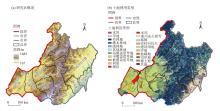
Fig. 1
Schematic diagram of the study area"
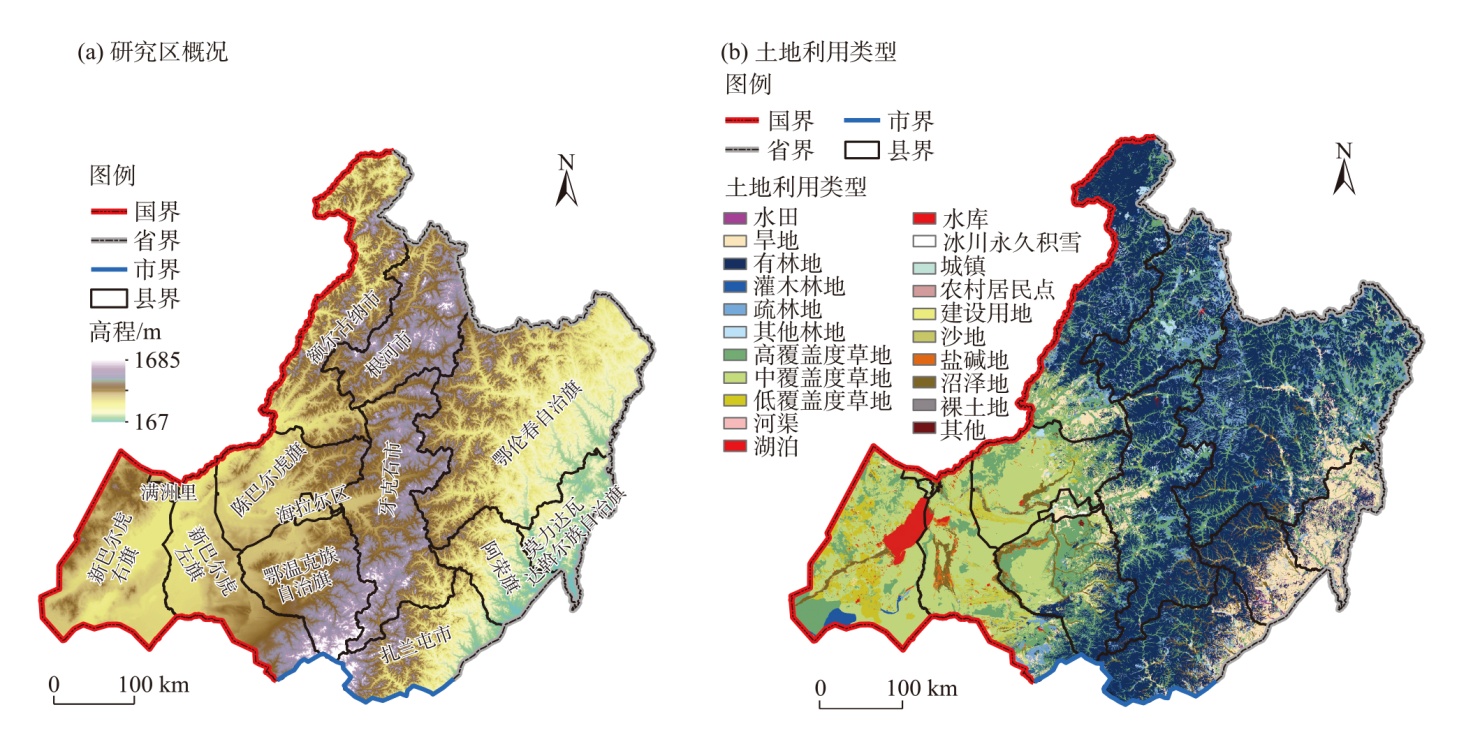
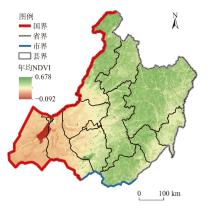
Fig. 2
Spatial distribution of annual mean NDVI in Hulun Buir from 2000 to 2022"
Fig. 3
Variations of NDVI and Mann-Kendall trends in Hulun Buir from 2000 to 2022"
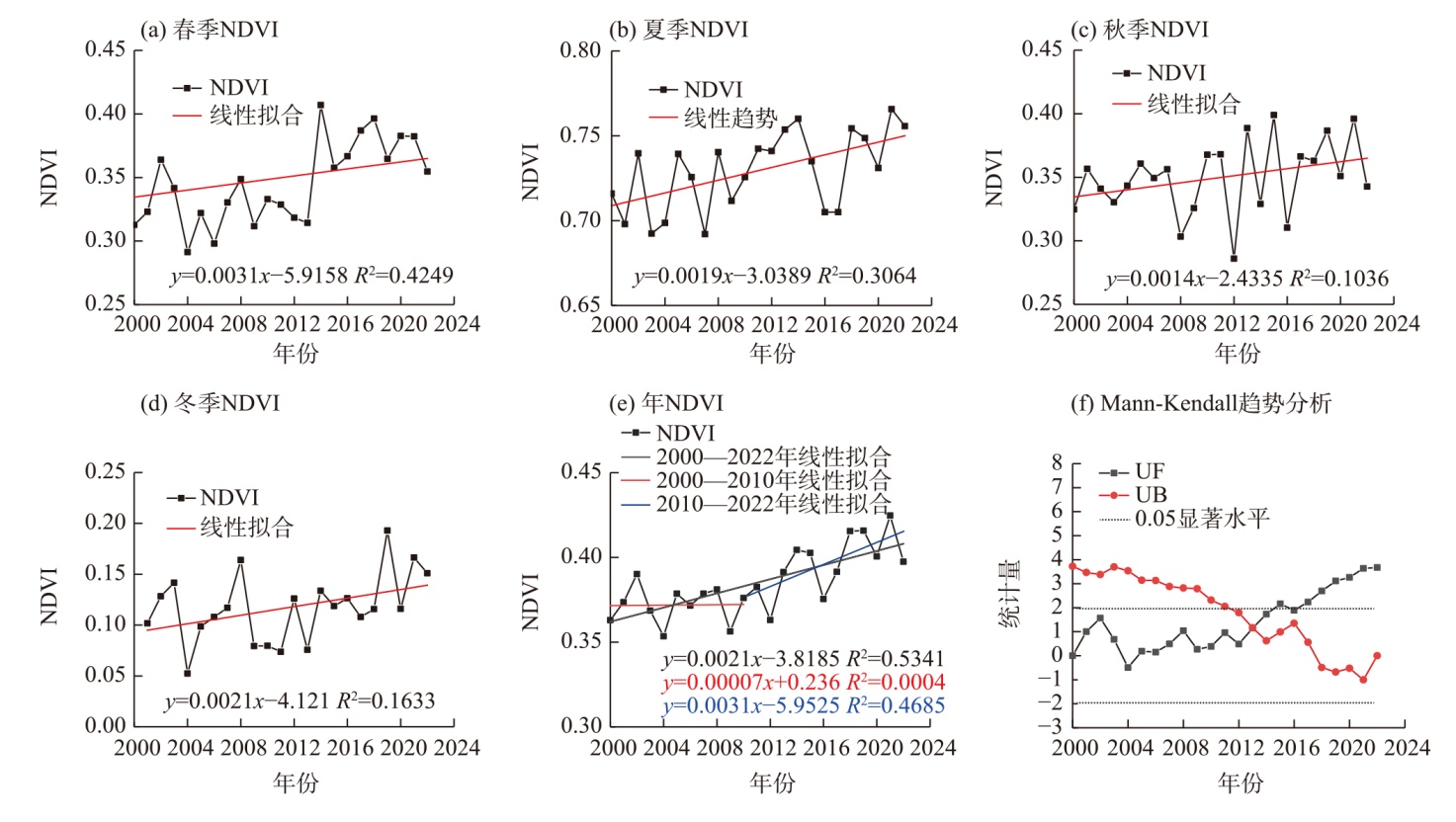
Fig. 4
Distribution of annual mean NDVI change rate and trend classification in Hulun Buir from 2000 to 2022"
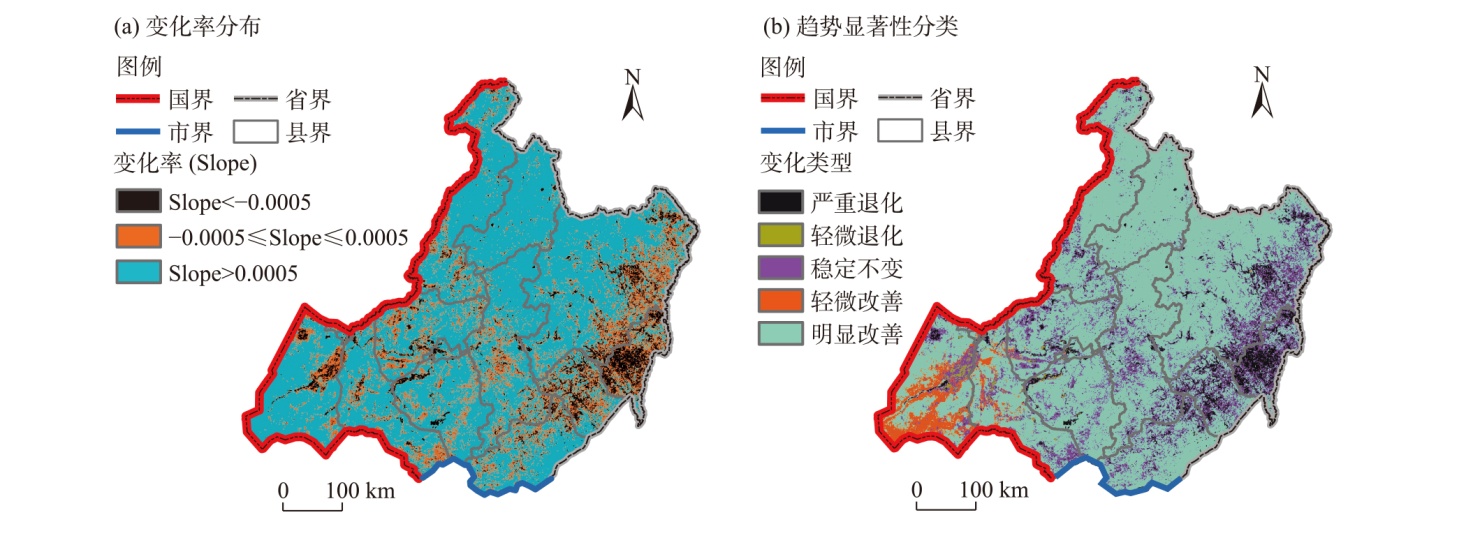
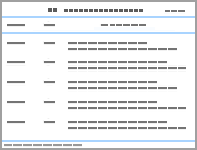
Tab. 1
Significance classification of annual mean NDVI slope in Hulun Buir"
| 变化类型 | 分类标准 | 面积占比/% |
|---|---|---|
| 显著退化 | Slope<-0.0005且P<0.05 | 6.12 |
| 稳定 | -0.0005≤Slope≤0.0005 | 18.10 |
| 显著改善 | Slope>0.0005且P<0.05 | 71.47 |
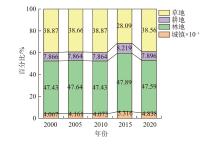
Fig. 5
Proportion of main land utilization types in Hulun Buir"
Fig. 6
Hurst index distribution and future trend prediction of annual mean NDVI in Hulun Buir from 2000 to 2022"
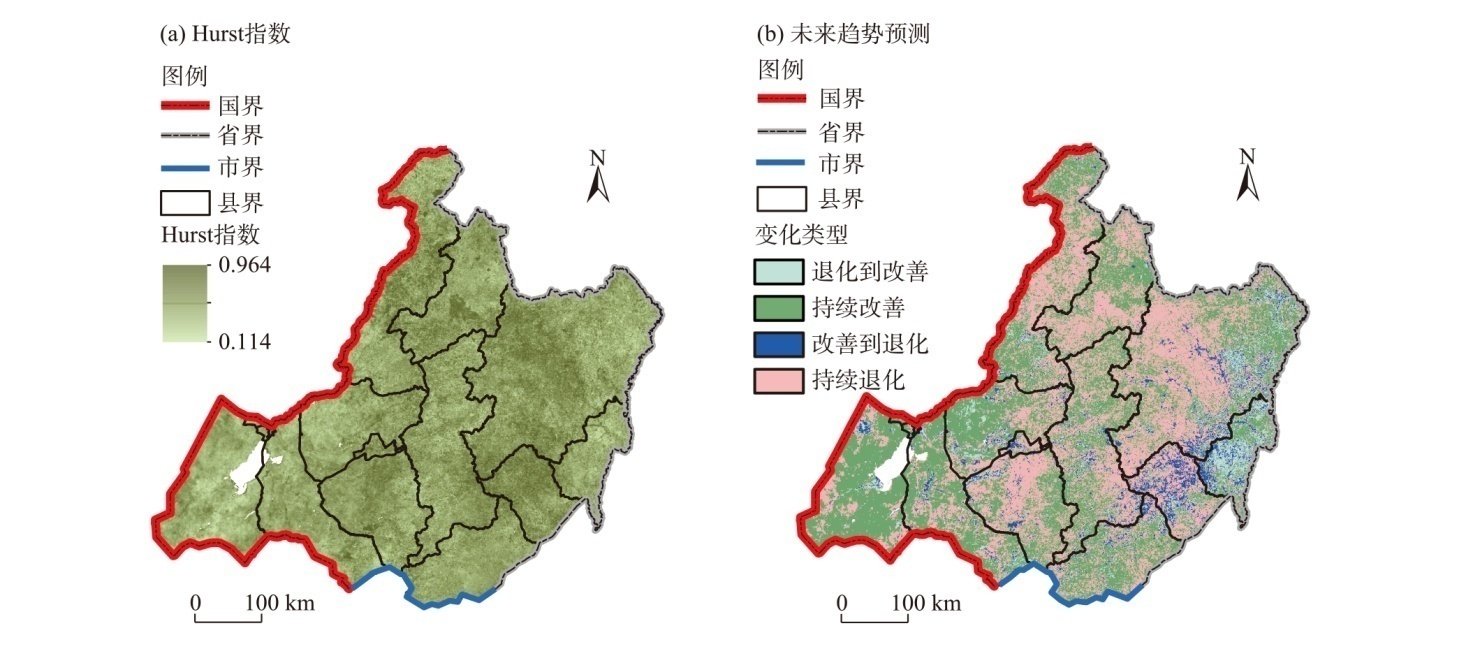
Fig. 7
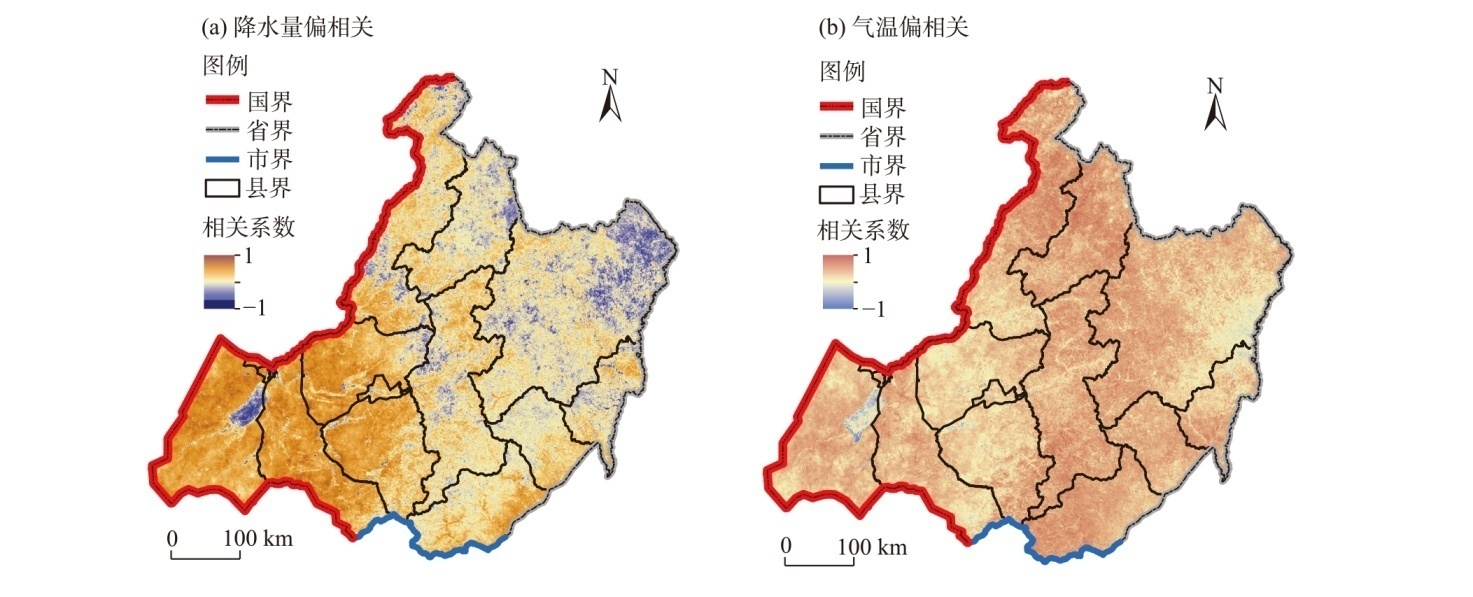
Distributions of annual mean precipitation and annual mean temperature in Hulun Buir from 2000 to 2022"
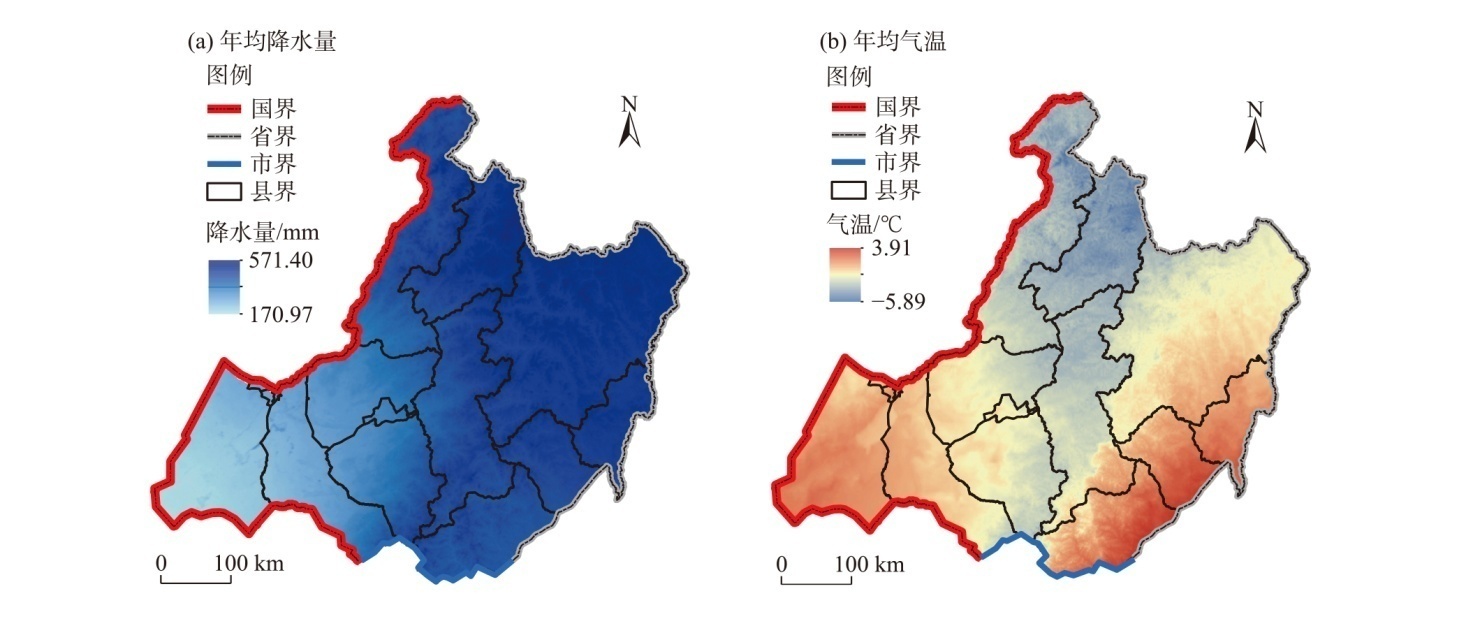
Fig. 8
Distributions of the relationship between annual mean NDVI and annual mean precipitation and annual mean temperature in Hulun Buir from 2000 to 2022"
Tab. 2
Correlation analysis of annual mean NDVI and different climate events in Hulun Buir from 2000 to 2022"
| 类型 | 年均NDVI |
|---|---|
| 年气温最大值 | 0.46* |
| 年气温最小值 | 0.59** |
| 年均气温 | 0.56** |
| 年降水量最大值 | 0.39 |
| 年降水量最小值 | 0.36 |
| 年均降水量 | 0.41* |
| [1] | Lou J, Xu G, Wang Z, et al. Multi-year NDVI values as indicator of the relationship between spatiotemporal vegetation dynamics and environmental factors in the Qaidam Basin, China[J]. Remote Sensing, 2021, 13(7): 1240, doi: 10.3390/rs13071240. |
| [2] |
任继周, 林慧龙. 草地土壤有机碳储量模拟技术研究[J]. 草业学报, 2013, 22(6): 280-294.
doi: 10.11686/cyxb20130634 |
|
[Ren Jizhou, Lin Huilong. Study on the simulation methods of grassland soil organic carbon: A review[J]. Acta Prataculturae Sinica, 2013, 22(6): 280-294. ]
doi: 10.11686/cyxb20130634 |
|
| [3] | 赵旺林, 罗天祥, 张林. 气候变化与放牧对西藏典型高寒荒漠草地植被指数变化的相对影响[J]. 生态学报, 2019, 39(22): 8494-8503. |
| [Zhao Wanglin, Luo Tianxiang, Zhang Lin. Relative impact of climate change and grazing on NDVI variations in typical alpine desert grasslands in Tibet[J]. Acta Ecologica Sinica, 2019, 39(22): 8494-8503. ] | |
| [4] | 李曦彤, 苗正红, 何龙涛, 等. 基于遥感技术的地表水源地植被覆盖度的动态变化[J]. 科学技术与工程, 2020, 20(6): 2155-2160. |
| [Li Xitong, Miao Zhenghong, He Longtao, et al. Dynamic change of vegetation coverage of surface water source based on remote sensing technology[J]. Science Technology and Engineering, 2020, 20(6): 2155-2160. ] | |
| [5] |
常文静, 丛士翔, 王融融, 等. 气候变化和人类活动对毛乌素沙地NDVI变化的量化分析[J]. 干旱区地理, 2025, 48(1): 63-74.
doi: 10.12118/j.issn.1000-6060.2024.029 |
|
[Chang Wenjing, Cong Shixiang, Wang Rongrong, et al. Quantitative analysis of NDVI changes in Mu Us Sandy Land by climate change and human activities[J]. Arid Land Geography, 2025, 48(1): 63-74. ]
doi: 10.12118/j.issn.1000-6060.2024.029 |
|
| [6] |
Li C, Kuang Y, Huang N, et al. The long-term relationship between population growth and vegetation cover: An empirical analysis based on the panel data of 21 cities in Guangdong Province, China[J]. International Journal of Environmental Research and Public Health, 2013, 10(2): 660-677.
doi: 10.3390/ijerph10020660 pmid: 23435589 |
| [7] |
余玉洋, 宋丰艺, 张世杰. 2000—2020 年河南省NDVI时空变化及其驱动因素定量分析[J]. 生态环境学报, 2022, 31(10): 1939-1950.
doi: 10.16258/j.cnki.1674-5906.2022.10.002 |
| [Yu Yuyang, Song Fengyi, Zhang Shijie. Quantitative analysis of temporal and spatial changes of NDVI and its driving factors in Henan Province from 2000 to 2020[J]. Ecology and Environment, 2022, 31(10): 1939-1950. ] | |
| [8] | Ren Y, Zhang F, Zhao C, et al. Attribution of climate change and human activities to vegetation NDVI in Jilin Province, China during 1998—2020[J]. Ecological Indicators, 2023, 153: 110415, doi: 10.1016/j.ecolind.2023.110415. |
| [9] | Zhang R, Zhou Y, Hu T, et al. Detecting the spatiotemporal variation of vegetation phenology in northeastern China based on MODIS NDVI and solar-induced Chlorophyll fluorescence dataset[J]. Sustainability, 2023, 15(7): 6012, doi: 10.3390/su15076012. |
| [10] |
李京忠, 辛振华, 谢潇, 等. 半干旱区植被覆盖时空变化特征及其对气候变化的响应: 以锡林郭勒盟为例[J]. 应用生态学报, 2024, 35(1): 80-86.
doi: 10.13287/j.1001-9332.202401.020 |
|
[Li Jingzhong, Xin Zhenhua, Xie Xiao, et al. Spatio-temporal variations of vegetation cover in semi-arid regions and its response to climate change: A case study of Xilin Gol, Inner Mongolia, China[J]. Chinese Journal of Applied Ecology, 2024, 35(1): 80-86. ]
doi: 10.13287/j.1001-9332.202401.020 |
|
| [11] | Li G, Yu L, Liu T, et al. Spatial and temporal variations of grassland vegetation on the Mongolian Plateau and its response to climate change[J]. Frontiers in Ecology and Evolution, 2023, 11: 1067209, doi: 10.3389/fevo.2023.1067209. |
| [12] | 吴运力, 张钰, 田佳榕. 气候变化和人类活动对内蒙古高原不同植被类型NDVI的影响[J]. 中国农业气象, 2023, 44(12): 1155-1168. |
|
[Wu Yunli, Zhang Yu, Tian Jiarong. Impacts by climate change and human activities on NDVI in different vegetation types across the Inner Mongolia Plateau[J]. Chinese Journal of Agrometeorology, 2023, 44(12): 1155-1168. ]
doi: 10.3969/j.issn.1000-6362.2023.12.008 |
|
| [13] | Chen Y, Zhang Y, Zhang H, et al. Extreme temperatures affect NDVI in Karst ecological fragile area[J]. Theoretical and Applied Climatology, 2024, 155(3): 2017-2029. |
| [14] | 石淞, 李文, 丁一书, 等. 东北地区植被时空演变及影响因素分析[J]. 中国环境科学, 2023, 43(1): 276-289. |
| [Shi Song, Li Wen, Ding Yishu, et al. Spatiotemporal evolution and influencing factors of vegetation in northeast China[J]. Environmental Science, 2023, 43(1): 276-289. ] | |
| [15] | 白永飞, 赵玉金, 王扬, 等. 中国北方草地生态系统服务评估和功能区划助力生态安全屏障建设[J]. 中国科学院院刊, 2020, 35(6): 675-689. |
| [Bai Yongfei, Zhao Yujin, Wang Yang, et al. Assessment of ecosystem services and ecological regionalization of grasslands support establishment of ecological security barriers in northern China[J]. Bulletin of Chinese Academy of Sciences, 2020, 35(6): 675-689. ] | |
| [16] | Liang L, Li L, Liu Q. Precipitation variability in northeast China from 1961 to 2008[J]. Journal of Hydrology, 2011, 404(1-2): 67-76. |
| [17] | 徐新良, 刘纪远, 张树文, 等. 中国多时期土地利用遥感监测数据集(CNLUCC)[EB/OL]. [2018]. http://www.resdc.cn/DOI. |
| [Xu Xinliang, Liu Jiyuan, Zhang Shuwen, et al. China multi-period land use remote sensing monitoring dataset (CNLUCC)[EB/OL]. [2018]. http://www.resdc.cn/DOI.] | |
| [18] | 吴昕浩. 黄河三角洲土地覆盖与生态质量时空变化研究[J]. 地理科学研究, 2023, 12(3): 463-475. |
| [Wu Xinhao. Study on spatial-temporal variation of land cover and ecological quality in the Yellow River Delta[J]. Geographical Science Research, 2023, 12(3): 463-475. ] | |
| [19] |
于泉洲, 梁春玲, 刘煜杰, 等. 基于 MODIS 的山东省植被覆盖时空变化及其原因分析[J]. 生态环境学报, 2015, 24(11): 1799-1807.
doi: 10.16258/j.cnki.1674-5906.2015.11.007 |
| [Yu Quanzhou, Liang Chunling, Liu Yujie, et al. Analysis of vegetation spatio-temporal variation and driving factors in Shandong Province based on MODIS[J]. Ecology and Environmental Sciences, 2015, 24(11): 1799-1807. ] | |
| [20] | 尹航, 张泽中, 张伟杰, 等. 基于植被健康指数的内蒙古干旱时空特征分析及驱动因素研究[J]. 灌溉与排水学报, 2023, 42(8): 80-89, 105. |
| [Yin Hang, Zhang Zezhong, Zhang Weijie, et al. Using vegetation health index to calculate spatiotemporal variation in drought and its determinants in Inner Mongolia[J]. Journal of Irrigation and Drainage, 2023, 42(8): 80-89, 105. ] | |
| [21] |
浮媛媛, 赵建军, 张洪岩, 等. 基于生态地理分区的大兴安岭植被物候时空变化[J]. 应用生态学报, 2016, 27(9): 2797-2806.
doi: 10.13287/j.1001-9332.201609.003 |
|
[Fu Yuanyuan, Zhao Jianjun, Zhang Hongyan, et al. Spatiotemporal variation of vegetation phenology in the Daxing’an Mountains stratified by eco-geographical regions[J]. Chinese Journal of Applied Ecology, 2016, 27(9): 2797-2806. ]
doi: 10.13287/j.1001-9332.201609.003 |
|
| [22] |
尹振良, 冯起, 王凌阁, 等. 2000—2019年中国西北地区植被覆盖变化及其影响因子[J]. 中国沙漠, 2022, 42(4): 11-21.
doi: 10.7522/j.issn.1000-694X.2021.00200 |
|
[Yin Zhenliang, Feng Qi, Wang Lingge, et al. Vegetation coverage change and its influencing factors across the northwest region of China during 2000—2019[J]. Journal of Desert Research, 2022, 42(4): 11-21. ]
doi: 10.7522/j.issn.1000-694X.2021.00200 |
|
| [23] | 张峰源, 苏远航, 刘滨辉. 东北森林生长季NDVI对昼夜不对称增温及降水变化的响应特征[J]. 北京林业大学学报, 2023, 45(2): 34-48. |
| [Zhang Fengyuan, Su Yuanhang, Liu Binhui. Response characteristics of NDVI to asymmetric diurnal temperature increase and precipitation changes during the forest growing season in northeast China[J]. Journal of Beijing Forestry University, 2023, 45(2): 34-48. ] | |
| [24] | 周立华, 侯彩霞. 北方农牧交错区草原利用与禁牧政策的关键问题研究[J]. 干旱区地理, 2019, 42(2): 354-362. |
|
[Zhou Lihua, Hou Caixia. Key problems of grassland utilization and the graze ban policy in farming-pastoral ecotone of northern China[J]. Arid Land Geography, 2019, 42(2): 354-362. ]
doi: 10.12118/j.issn.1000-6060.2019.02.15 |
|
| [25] | 王洪波, 韩爱惠. 中国草原管理政策探讨[J]. 林业资源管理, 2019(3): 8-13, 29. |
| [Wang Hongbo, Han Aihui. Study on grassland management policy in China[J]. Forest Resources Management, 2019(3): 8-13, 29. ] | |
| [26] | 祁晓慧, 高博, 王海春, 等. 牧民视角下的草原生态保护补助奖励政策草畜平衡及禁牧补奖标准研究——以锡林郭勒盟为例[J]. 干旱区资源与环境, 2016, 30(5): 30-35. |
| [Qi Xiaohui, Gao Bo, Wang Haichun, et al. The study on the compensation and award standards for forage-livestock balance and grazing prohibition based on herders perspective of grassland ecological protection subsidies and incentives policies: Take Xilin Gol League as an example[J]. Journal of Arid Land Resources and Environment, 2016, 30(5): 30-35. ] | |
| [27] |
万华伟, 高帅, 刘玉平, 等. 呼伦贝尔生态功能区草地退化的时空特征[J]. 资源科学, 2016, 38(8): 1443-1451.
doi: 10.18402/resci.2016.08.04 |
|
[Wan Huawei, Gao Shuai, Liu Yuping, et al. Grassland degradation monitoring and spatio-temporal variation analysis of the Hulun Buir ecological function region[J]. Resources Science, 2016, 38(8): 1443-1451. ]
doi: 10.18402/resci.2016.08.04 |
| [1] | SONG Xiaolong, LI Longtang, REN Jie, WU Yue, WANG Peng, MI Wenbao, MA Mingde. Spatio-temporal variation characteristics and driving factors of NDVI in the arid and semi-arid region of northwest China [J]. Arid Land Geography, 2025, 48(6): 951-962. |
| [2] | WANG Ruifang, LYU Baoqi, ZHANG Wenjing. Vegetation dynamics and their responses to climate change in the Yellow River Basin: Based on climatic wet and dry zoning scales [J]. Arid Land Geography, 2025, 48(6): 973-984. |
| [3] | Wujisiguleng , Narisu , LI Na, YIN Shan, Wuyundalai , LI Mingxing, LAI Shaojie. Spatiotemporal pattern evolution of land desertification sensitivity in Hulun Buir grassland from 2001 to 2020 [J]. Arid Land Geography, 2025, 48(5): 825-837. |
| [4] | XING Mengxiang, ZHENG Jianghua, LI Gangyong, PENG Jian, Kaisa MIJITI, LIU Liang, ZHANG Jianli, MA Lisha, LU Jiantao. Spatiotemporal dynamics and driving forces of grassland health in Tacheng Prefecture from 2001 to 2020 [J]. Arid Land Geography, 2025, 48(4): 673-688. |
| [5] | LI Kangning, LIN Yilin, ZHAO Junsan, WANG Jian, GE Feng. Driving mechanisms of vegetation change and ecological vulnerability in the Three-River Headwater Region [J]. Arid Land Geography, 2025, 48(2): 283-295. |
| [6] | ZHANG Haidong, LI Chongbo, MENG Liqi, Adilai SAITINIYAZI, JU Xifeng. Evolutionary characteristics of NDVI in the Kashi Delta and its response to the climate [J]. Arid Land Geography, 2025, 48(2): 296-307. |
| [7] | CHANG Wenjing, CONG Shixiang, WANG Rongrong, DING Xudong, YU Hailong, HUANG Juying. Quantitative analysis of NDVI changes in Mu Us Sandy Land by climate change and human activities [J]. Arid Land Geography, 2025, 48(1): 63-74. |
| [8] | HUANG Yunbo, ZHANG Chong, WANG Yudan. Change trend of vegetation cover and its response to soil moisture status in Weihe River Basin [J]. Arid Land Geography, 2024, 47(5): 841-849. |
| [9] | YANG Xiaoling, DING Wenkui, ZHOU Hua, LI Yanying, CHEN Haibei. Normalized difference vegetation index change and its driving factors in Shiyang River Basin [J]. Arid Land Geography, 2024, 47(10): 1735-1744. |
| [10] | SHI Jinli, XU Liping, LI Xiaohang, GAO Zhiyu, XI Yunyun, LI Zhihui. Evaluation of ecological-economic harmony and sustainable development zoning in counties of southern Xinjiang [J]. Arid Land Geography, 2024, 47(10): 1794-1804. |
| [11] | ZHANG Gangdong, BAO Gang, HUANG Xiaojun, YUAN Zhihui, WEN Durina. Asymmetrical warming in winter and spring and its effect on start of growing season and spring NDVI in Mongolia [J]. Arid Land Geography, 2023, 46(8): 1238-1249. |
| [12] | AI Liya, WANG Yongfang, GUO Enliang, YIN Shan, GU Xiling. NDVI change and its influencing factors of Daqingshan National Nature Reserve based on GEE [J]. Arid Land Geography, 2023, 46(8): 1279-1290. |
| [13] | DONG Li, WANG Manwang, DONG Mei. Sustainable development capability of Ningxia ecological migration area based on ecological footprint method [J]. Arid Land Geography, 2023, 46(6): 1004-1012. |
| [14] | CHEN Shujun,XU Guochang,LYU Zhiping,MA Mingyue,LI Hanyu,ZHU Yuyan. Spatiotemporal variations of fractional vegetation cover and its response to climate change and urbanization in China [J]. Arid Land Geography, 2023, 46(5): 742-752. |
| [15] | LUO Jiayan, ZHANG Jing, XU Mengran, MO Yu, TONG Liga. Vegetation dynamic and its driving force and multi-scenario prediction in Otindag Sandy Land [J]. Arid Land Geography, 2023, 46(4): 614-624. |
|
||