Arid Land Geography ›› 2026, Vol. 49 ›› Issue (11): 2269-2281.doi: 10.12118/j.issn.1000-6060.2026.041
• Vegetation and Pedology • Previous Articles Next Articles
MA Fei1,2( ), ZHANG Jun1,2(), LIU Anwei1,2,3, WANG Jing3, XU Yonglong1,2
Received:2026-01-15
Revised:2026-03-01
Online:2026-11-25
Published:2026-11-13
Contact:
ZHANG Jun
E-mail:mafei0701@163.com;13919633663@163.com
MA Fei, ZHANG Jun, LIU Anwei, WANG Jing, XU Yonglong. Spatiotemporal dynamics of vegetation cover and its response to interannual climate variability in Gansu Province from 2000 to 2024[J].Arid Land Geography, 2026, 49(11): 2269-2281.
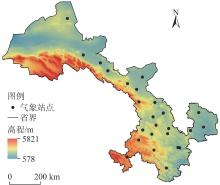
Fig. 1
Schematic diagram of the study area"
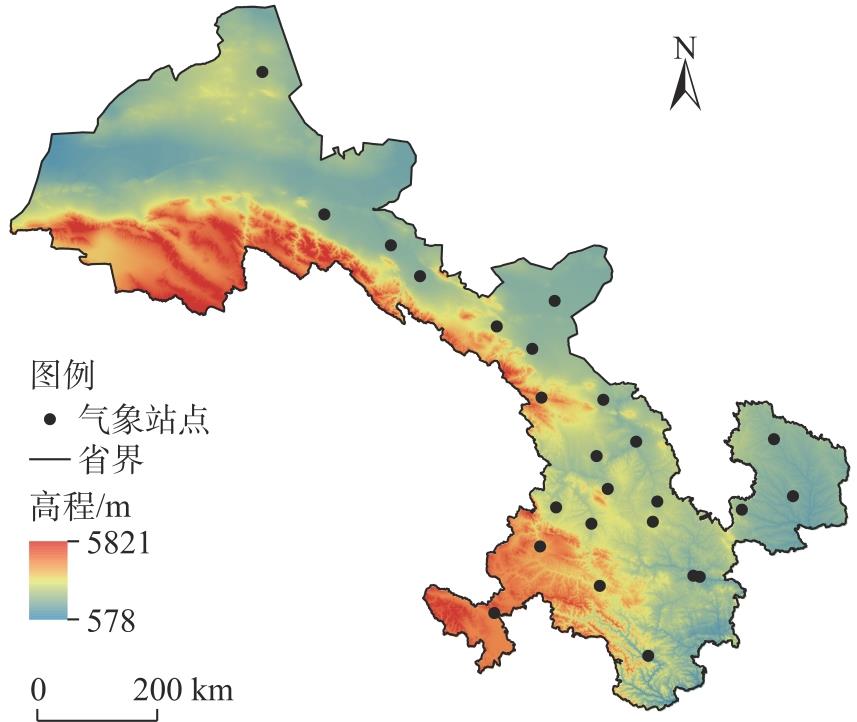
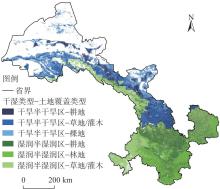
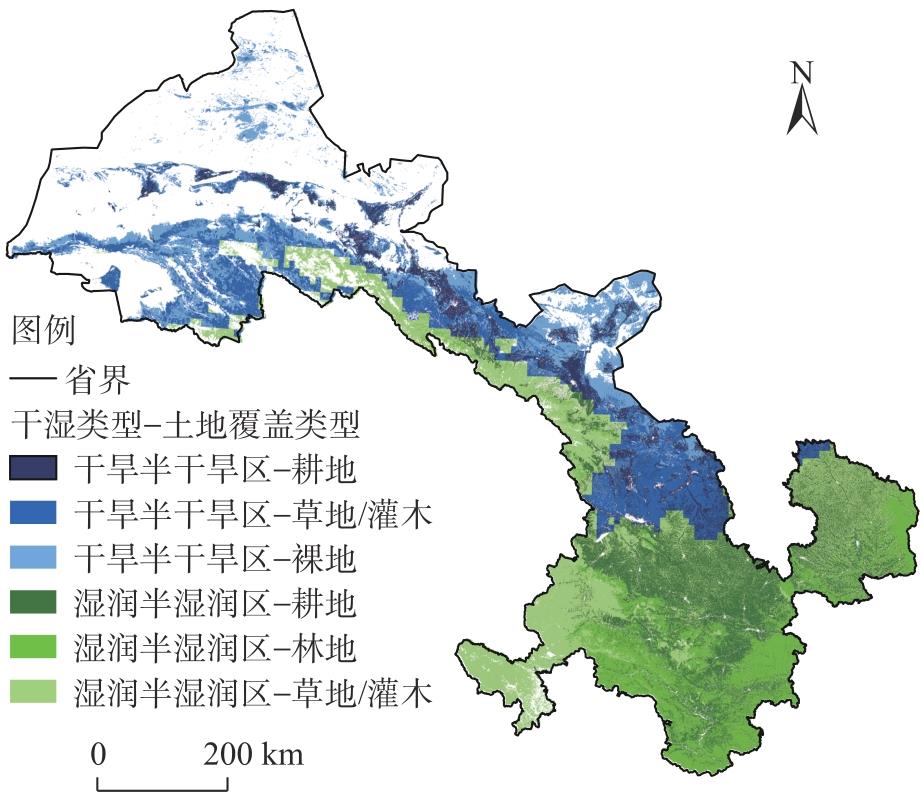
Fig. 2
Spatial distribution of six primary land cover types"
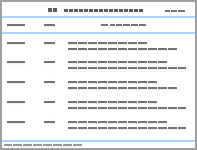
Tab. 1
45 combinations of one or two months from January to September"
| 月份 | 结束月 | |||||||||
|---|---|---|---|---|---|---|---|---|---|---|
| 1 | 2 | 3 | 4 | 5 | 6 | 7 | 8 | 9 | ||
| 起始月 | 1 | 1 | 1—2 | 1—3 | 1—4 | 1—5 | 1—6 | 1—7 | 1—8 | 1—9 |
| 2 | 2 | 2—3 | 2—4 | 2—5 | 2—6 | 2—7 | 2—8 | 2—9 | ||
| 3 | 3 | 3—4 | 3—5 | 3—6 | 3—7 | 3—8 | 3—9 | |||
| 4 | 4 | 4—5 | 4—6 | 4—7 | 4—8 | 4—9 | ||||
| 5 | 5 | 5—6 | 5—7 | 5—8 | 5—9 | |||||
| 6 | 6 | 6—7 | 6—8 | 6—9 | ||||||
| 7 | 7 | 7—8 | 7—9 | |||||||
| 8 | 8 | 8—9 | ||||||||
| 9 | 9 | |||||||||
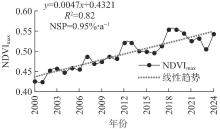
Fig. 3
Trend of average NDVImax in vegetation cover areas of Gansu Province from 2000 to 2024"
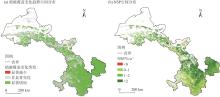
Fig. 4
Spatial distributions of change types and change intensity of vegetation cover in Gansu Province from 2000 to 2024"
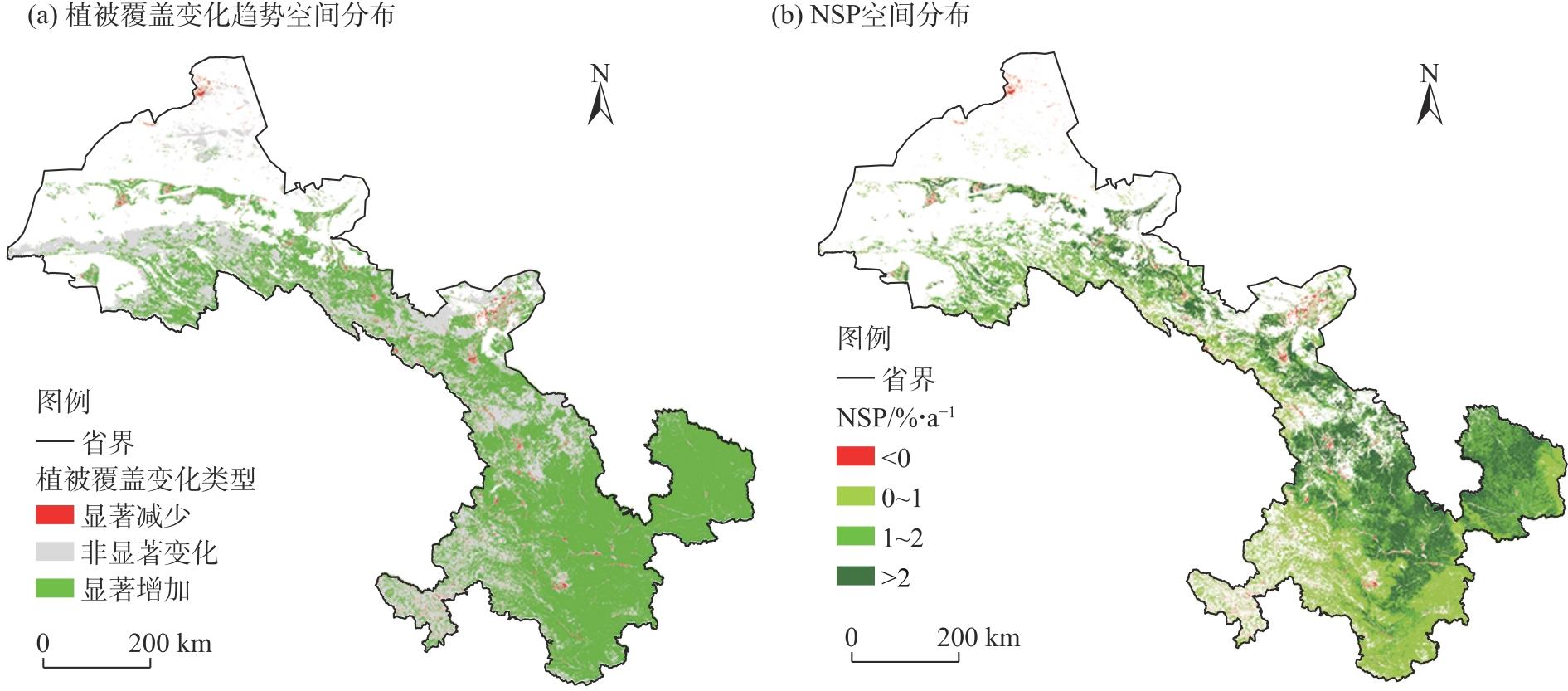
Fig. 5
Trend of average NDVImax by six land cover types in Gansu Province from 2000 to 2024"
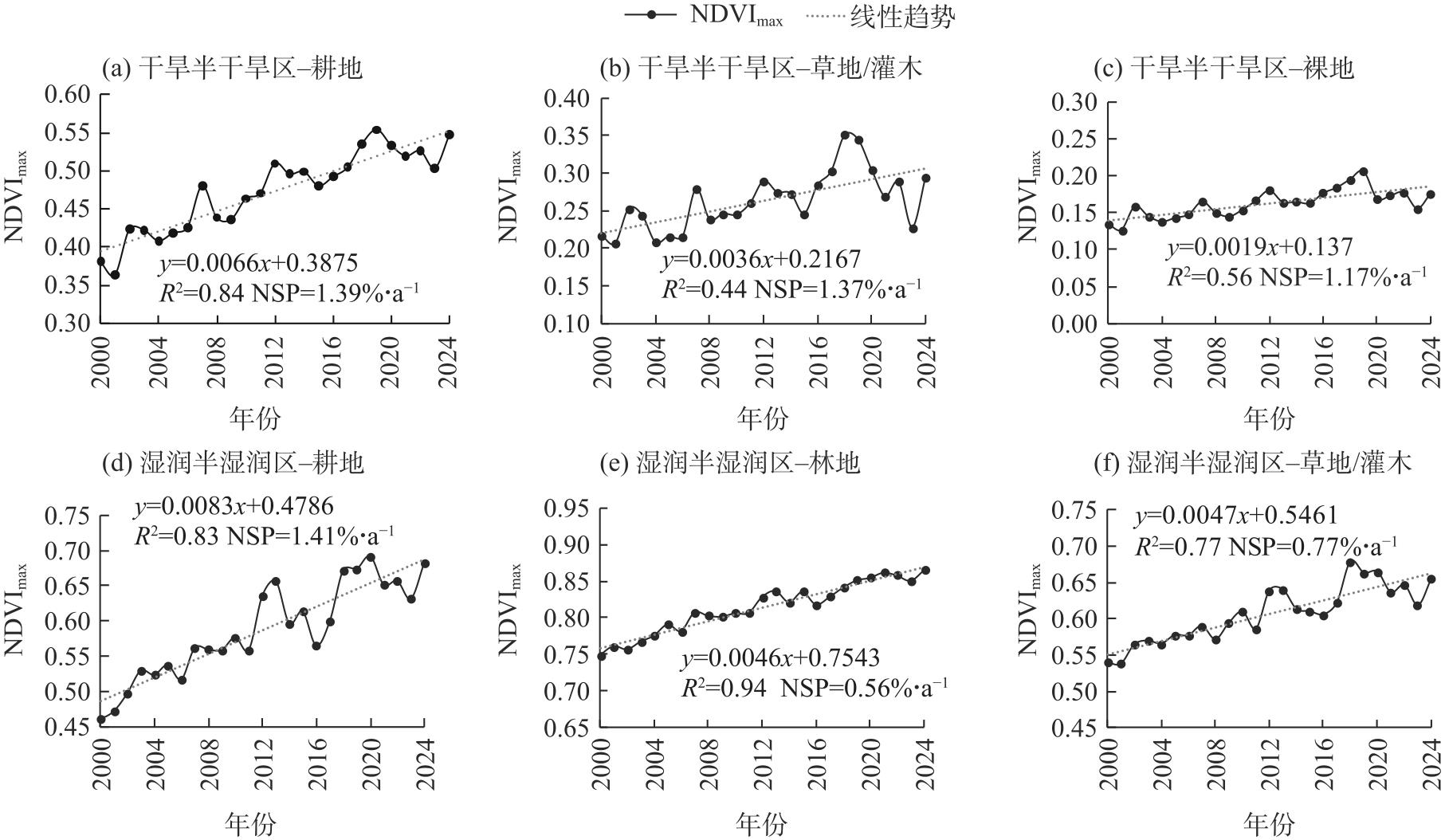
Fig. 6
Stationarity test results for precipitation and temperature across 45 monthly combinations of six land cover types in different dry/wet conditions"
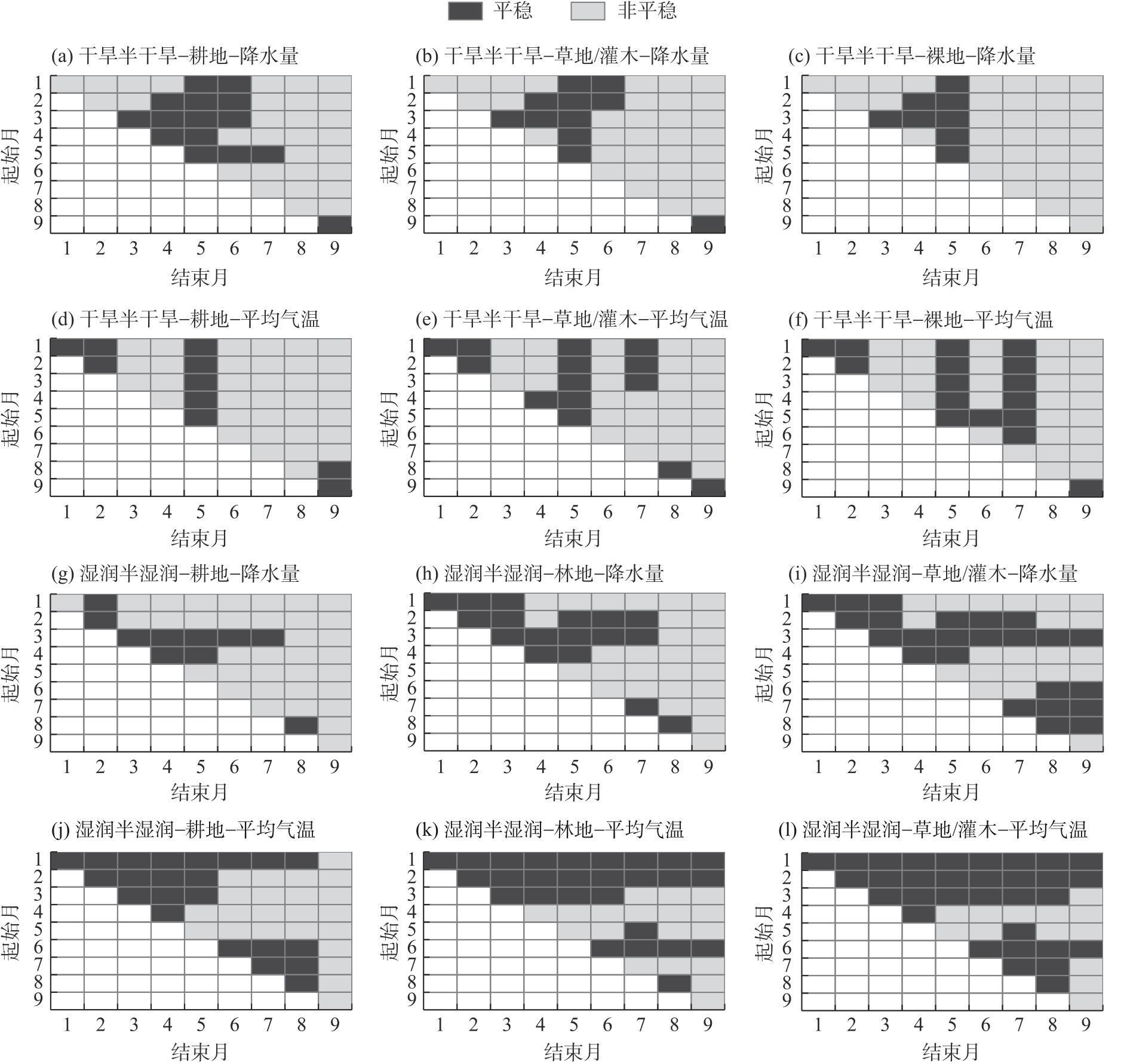
Fig. 7
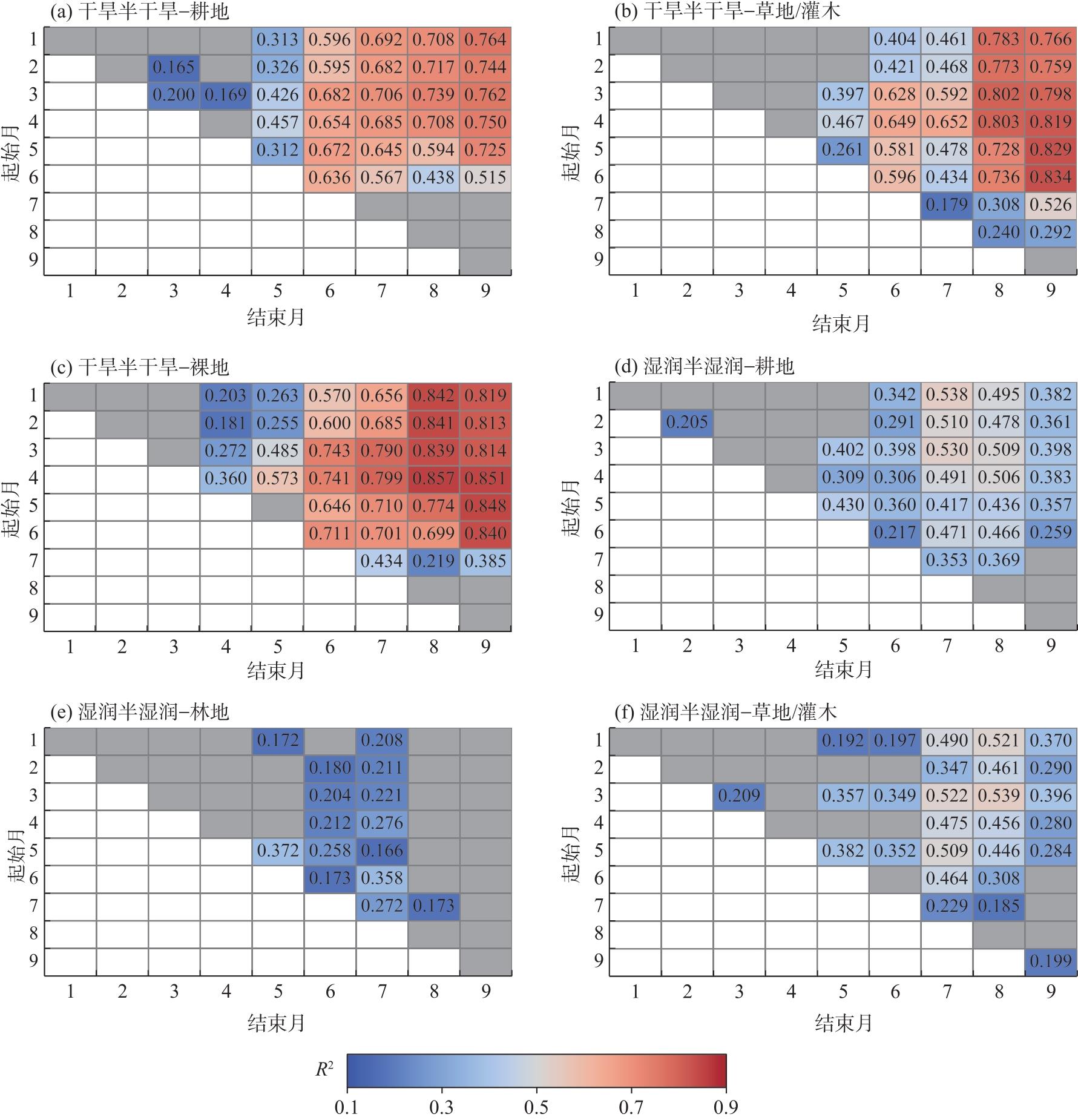
R2 of regression model (P<0.05) for 45 monthly combinations across six major land cover types in different dry/wet conditions"
Tab. 2
Best-fit regression models for ∆NDVImax across six land cover types"
| 干湿类型 | 土地覆盖类型 | 月份组合 | 回归模型 | R2 | P | 德宾-沃森值 |
|---|---|---|---|---|---|---|
| 干旱 半干旱 | 耕地 | 1—9 | 0.764 | <0.001 | 2.03 | |
| 草地/灌木 | 6—9 | 0.834 | <0.001 | 2.13 | ||
| 裸地 | 4—8 | 0.857 | <0.001 | 2.19 | ||
| 湿润 半湿润 | 耕地 | 1—7 | 0.538 | <0.001 | 2.17 | |
| 林地 | 5 | 0.372 | <0.01 | 2.27 | ||
| 草地/灌木 | 3—8 | 0.539 | <0.001 | 2.15 |
| [1] | Roerink G J, Menenti M, Soepboer W, et al. Assessment of climate impact on vegetation dynamics by using remote sensing[J]. Physics & Chemistry of the Earth, 2002, 28(1-3): 103-109. |
| [2] | 杨啸. 基于时序NDVI的湖北省植被覆盖动态变化监测分析[J]. 长江流域资源与环境, 2013, 22(2): 226-231. |
| [Yang Xiao. Dynamic change monitoring and analysis of vegetation cover in Hubei Province based on time series NDVI data[J]. Resources and Environment in the Yangtze Basin, 2013, 22(2): 226-231.] | |
| [3] | Rouse J J, Haas R H, Deering D, et al. Monitoring the vernal advancement and retrogradation (green wave effect) of natural vegetation[R]. Greenbelt, MD, USA: NASA/GSFC, 1974. |
| [4] |
Purevdorj T S, Tateishi R, Ishiyama T, et al. Relationships between percent vegetation cover and vegetation indices[J]. International Journal of Remote Sensing, 1998, 19(18): 3519-3535.
doi: 10.1080/014311698213795 |
| [5] |
Li F, Chen W, Zeng Y, et al. Improving estimates of grassland fractional vegetation cover based on a pixel dichotomy model: A case study in Inner Mongolia, China[J]. Remote Sensing, 2014, 6(6): 4705-4722.
doi: 10.3390/rs6064705 |
| [6] | Camps-Valls G, Campos-Taberner M, Moreno-Martínez Á, et al. A unified vegetation index for quantifying the terrestrial biosphere[J]. Science Advances, 2021, 7(9): eabc7447, doi: 10.1126/sciadv.abc7447. |
| [7] |
Pan N Q, Feng X M, Fu B J, et al. Increasing global vegetation browning hidden in overall vegetation greening: Insights from time-varying trends[J]. Remote Sensing of Environment, 2018, 214: 59-72.
doi: 10.1016/j.rse.2018.05.018 |
| [8] |
Chen C, Park T, Wang X H, et al. China and India lead in greening of the world through land-use management[J]. Nature Sustainability, 2019, 2: 122-129.
doi: 10.1038/s41893-019-0220-7 pmid: 30778399 |
| [9] |
金凯, 王飞, 韩剑桥, 等. 1982—2015 年中国气候变化和人类活动对植被NDVI变化的影响[J]. 地理学报, 2020, 75(5): 961-974.
doi: 10.11821/dlxb202005006 |
| [Jin Kai, Wang Fei, Han Jianqiao, et al. Contribution of climatic change and human activities to vegetation NDVI change over China during 1982—2015[J]. Acta Geographica Sinica, 2020, 75(5): 961-974.] | |
| [10] | 涂又, 姜亮亮, 刘睿, 等. 1982—2015 年中国植被 NDVI 时空变化特征及其驱动分析[J]. 农业工程学报, 2021, 37(22): 75-84. |
| [Tu You, Jiang Liangliang, Liu Rui, et al. Spatiotemporal changes of vegetation NDVI and its driving forces in China during 1982—2015[J]. Transactions of the Chinese Society of Agricultural Engineering, 2021, 37(22): 75-84.] | |
| [11] | 雷茜, 胡忠文, 王敬哲, 等. 1985—2015 年中国不同生态系统 NDVI 时空变化及其对气候因子的响应[J]. 生态学报, 2023, 43(15): 6378-6391. |
| [Lei Qian, Hu Zhongwen, Wang Jingzhe, et al. Spatiotemporal dynamics of NDVI in China from 1985 to 2015: Ecosystem variation, regional differences, and response to climatic factors[J]. Acta Ecologica Sinica, 2023, 43(15): 6378-6391.] | |
| [12] |
Wei Y Y, Sun S G, Liang D, et al. Spatial-temporal variations of NDVI and its response to climate in China from 2001 to 2020[J]. International Journal of Digital Earth, 2022, 15(1): 1463-1484.
doi: 10.1080/17538947.2022.2116118 |
| [13] | 丁海勇, 丁昕玮. 基于SPOT_NDVI 的甘肃省植被覆盖变化及其与气候、地形因子的关系[J]. 长江流域资源与环境, 2020, 29(12): 2665-2678. |
| [Ding Haiyong, Ding Xinwei. Vegetation cover change and its responses to climate and topography in Gansu Province based on SPOT_NDVI[J]. Resources and Environment in the Yangtze Basin, 2020, 29(12): 2665-2678.] | |
| [14] |
He Q, Chun K P, Dieppois B, et al. Investigating and predicting spatiotemporal variations in vegetation cover in transitional climate zone: A case study of Gansu (China)[J]. Theoretical and Applied Climatology, 2022, 150: 283-307.
doi: 10.1007/s00704-022-04140-2 |
| [15] |
路建兵, 鞠珂, 廖伟斌. 2000—2020年甘肃省植被覆盖特征及其对气候变化和人类活动的响应[J]. 中国沙漠, 2023, 43(4): 118-127.
doi: 10.7522/j.issn.1000-694X.2022.00162 |
|
[Lu Jianbing, Ju Ke, Liao Weibin. Variation in NDVI and its response to climate change and human activities in Gansu Province during 2000—2020[J]. Journal of Desert Research, 2023, 43(4): 118-127.]
doi: 10.7522/j.issn.1000-694X.2022.00162 |
|
| [16] |
Overpeck J T, Rind D, Goldberg R. Climate-induced changes in forest disturbance and vegetation[J]. Nature, 1990, 343: 51-53.
doi: 10.1038/343051a0 |
| [17] |
Ichii K, Kawabata A, Yamaguchi Y. Global correlation analysis for NDVI and climatic variables and NDVI trends: 1982—1990[J]. International Journal of Remote Sensing, 2002, 23: 3873-3878.
doi: 10.1080/01431160110119416 |
| [18] | 胡博洋. 基于全局随机森林残差趋势法的甘肃植被变化归因[D]. 兰州: 兰州交通大学, 2024. |
| [Hu Boyang. Attribution of vegetation change in Gansu based on global random forest residual trend method[D]. Lanzhou: Lanzhou Jiaotong University, 2024.] | |
| [19] | Fu J L, Zhang X W, Zhou X L, et al. Analysis of spatial and temporal evolution characteristics and driving forces of NDVI in Gansu Province from 2000 to 2022[J]. Land, 2025, 14: 2184, doi: 10.3390/land14112184. |
| [20] | Brockwell P J, Davis R A. Introduction to time series and forecasting (2nd ed.)[M]. New York: Springer, 2002: 157-193. |
| [21] |
Ryan O, Haslbeck J M B, Waldorp L J. Non-stationarity in time-series analysis: Modeling stochastic and deterministic trends[J]. Multivariate Behavioral Research, 2025, 60(3): 556-588.
doi: 10.1080/00273171.2024.2436413 |
| [22] | 纪学朋, 白永平, 杜海波, 等. 甘肃省生态承载力空间定量评价及耦合协调性[J]. 生态学报, 2017, 37(17): 5861-5870. |
| [Ji Xuepeng, Bai Yongping, Du Haibo, et al. Research on the spatial quantitative evaluation and coupling coordination degree of ecological carrying capacity in Gansu Province[J]. Acta Ecologica Sinica, 2017, 37(17): 5861-5870.] | |
| [23] | 刘春芳, 李鹏杰, 刘立程, 等. 西北生态脆弱区省域国土空间生态修复分区[J]. 农业工程学报, 2020, 36(17): 254-263. |
| [Liu Chunfang, Li Pengjie, Liu Licheng, et al. Ecological restoration zoning of provincial territorial space in the ecologically fragile areas of northwest China[J]. Transactions of the Chinese Society of Agricultural Engineering, 2020, 36(17): 254-263.] | |
| [24] | 李红英. 甘肃省景观生态风险评价与生态安全格局构建[D]. 兰州: 西北师范大学, 2022. |
| [Li Hongying. Landscape ecological risk assessment and ecological security pattern construction in Gansu Province[D]. Lanzhou: Northwest Normal University, 2022.] | |
| [25] | 国家青藏高原科学数据中心. 中国区域250米归一化植被指数数据集(2000—2024)[DB/OL]. [2025-07-24]. https://data.tpdc.ac.cn/zh-hans/data/10535b0b-8502-4465-bc53-78bcf24387b3. |
| [National Tibetan Plateau Data Center. China regional 250 m normalized difference vegetation index data set (2000—2024)[DB/OL]. [2025-07-24]. https://data.tpdc.ac.cn/zh-hans/data/10535b0b-8502-4465-bc53-78bcf24387b3.] | |
| [26] | Shen M G, Piao S L, Jeong S, et al. Evaporative cooling over the Qinghai-Xizang Plateau induced by vegetation growth[J]. Proceedings of the National Academy of Sciences of the United States of America, 2015, 112(30): 9299-9304. |
| [27] | 国家青藏高原科学数据中心. 中国区域地面气象要素驱动数据集v2.0 (1951—2024)[DB/OL]. [2025-09-16]. https://data.tpdc.ac.cn/en/data/e60dfd96-5fd8-493f-beae-e8e5d24dece4. |
| [National Tibetan Plateau Data Center. China meteorological forcing dataset v2.0 (1951—2024)[DB/OL]. [2025-09-16]. https://data.tpdc.ac.cn/en/data/e60dfd96-5fd8-493f-beae-e8e5d24dece4.] | |
| [28] |
He J, Yang K, Tang W J, et al. The first high-resolution meteorological forcing dataset for land process studies over China[J]. Scientific Data, 2020, 7(1): 25, doi: 10.1038/s41597-020-0369-y.
pmid: 31964891 |
| [29] |
闫伟兄, 赵俊芳, 杨洋. GHCN-CAMS和CMFD两种尺度再分析资料对宁夏气温反映能力评估[J]. 地理科学进展, 2021, 40(12): 2061-2072.
doi: 10.18306/dlkxjz.2021.12.007 |
|
[Yan Weixiong, Zhao Junfang, Yang Yang. Comparative evaluation of the ability of GHCN-CAMS and CMFD reanalysis data to reflect regional temperature in Ningxia[J]. Progress in Geography, 2021, 40(12): 2061-2072.]
doi: 10.18306/dlkxjz.2021.12.007 |
|
| [30] |
高黎明, 张乐乐, 沈永平, 等. ERA-Interim和CMFD气象驱动数据在新疆额尔齐斯河流域的适用性评价[J]. 冰川冻土, 2022, 44(1): 179-187.
doi: 10.7522/j.issn.1000-0240.2022.0029 |
|
[Gao Liming, Zhang Lele, Shen Yongping, et al. Evaluation of applicability of ERA-Interim and CMFD meteorological forcing data in the Irtysh River Basin, Xinjiang[J]. Journal of Glaciology and Geocryology, 2022, 44(1): 179-187.]
doi: 10.7522/j.issn.1000-0240.2022.0029 |
|
| [31] |
温婷婷, 郭英香, 董少睿, 等. 1979—2017年CRU、ERA5、CMFD格点降水数据在青藏高原适用性评估[J]. 干旱区研究, 2022, 39(3): 684-697.
doi: 10.13866/j.azr.2022.03.03 |
|
[Wen Tingting, Guo Yingxiang, Dong Shaorui, et al. Assessment of CRU, ERA5, CMFD grid precipitation data for the Tibetan Plateau from 1979 to 2017[J]. Arid Zone Research, 2022, 39(3): 684-697.]
doi: 10.13866/j.azr.2022.03.03 |
|
| [32] | 《中国自然地理》编写组. 中国自然地理(第三版)[M]. 北京: 高等教育出版社, 1995: 15-44. |
| [Writing Group of Chinese Physical Geography. Chinese Physical Geography (3rd ed.)[M]. Beijing: Higher Education Press, 1995: 15-44.] | |
| [33] | Liu Y H, Zhong Y F, Ma A L, et al. Cross-resolution national-scale land-cover mapping based on noisy label learning: A case study of China[J]. International Journal of Applied Earth Observation Geoinformation, 2023, 118: 103265, doi: 10.1016/j.jag.2023.103265. |
| [34] | Kendall M G. Rank correlation methods[J]. British Journal of Psychology, 1990, 25(1): 86-91. |
| [35] |
Sen P K. Estimates of the regression coefficient based on Kendall’s tau[J]. Journal of the American Statistical Association, 1968, 63(324): 1379-1389.
doi: 10.1080/01621459.1968.10480934 |
| [36] |
李康宁, 林伊琳, 赵俊三, 等. 三江源植被覆盖变化驱动机制及生态脆弱性分析[J]. 干旱区地理, 2025, 48(2): 283-295.
doi: 10.12118/j.issn.1000-6060.2024.324 |
|
[Li Kangning, Lin Yilin, Zhao Junsan, et al. Driving mechanisms of vegetation change and ecological vulnerability in the Three-River Headwater region[J]. Arid Land Geography, 2025, 48(2): 283-295.]
doi: 10.12118/j.issn.1000-6060.2024.324 |
|
| [37] |
Ma F, Peng P H. Spatial-temporal dynamics of alpine grassland coverage and its response to climate warming in Mt. Qomolangma Nature Reserve during 2000—2019[J]. Journal of Mountain Science, 2022, 19(8): 2297-2311.
doi: 10.1007/s11629-021-7110-y |
| [38] |
张晓东, 马风华, 赵志鹏, 等. 宁夏中部荒漠草原防沙治沙区NDVI时空演化特征及其对气候因素的响应[J]. 干旱区地理, 2025, 48(10): 1804-1814.
doi: 10.12118/j.issn.1000-6060.2024.782 |
|
[Zhang Xiaodong, Ma Fenghua, Zhao Zhipeng, et al. Spatio-temporal evolution characteristics of NDVI and its response to climate factors of desertification prevention and control zone in the desert grasslands of central Ningxia[J]. Arid Land Geography, 2025, 48(10): 1804-1814.]
doi: 10.12118/j.issn.1000-6060.2024.782 |
|
| [39] |
陈珍, 蔡朝朝, 马楠, 等. 2001—2023年新疆NDVI时空格局与驱动力分析[J]. 干旱区研究, 2025, 42(5): 922-932.
doi: 10.13866/j.azr.2025.05.14 |
| [Chen Zhen, Cai Zhaozhao, Ma Nan, et al. Spatial-temporal pattern and driving force analysis of NDVI in Xinjiang from 2001 to 2023[J]. Arid Zone Research, 2025, 42(5): 922-932.] | |
| [40] |
张秀霞, 韩丽莎, 党星海, 等. 西北干旱区近30 a植被覆盖的时空变化及其对气候因子的响应[J]. 干旱区研究, 2025, 42(6): 1067-1079.
doi: 10.13866/j.azr.2025.06.10 |
|
[Zhang Xiuxia, Han Lisha, Dang Xinghai, et al. Spatiotemporal changes in vegetation coverage in the arid regions of northwest China over the past 30 years and their response to climatic factors[J]. Arid Zone Research, 2025, 42(6): 1067-1079.]
doi: 10.13866/j.azr.2025.06.10 |
|
| [41] |
Rasmus F, Tobias L, Kjeld R, et al. Greenness in semi-arid areas across the globe 1981—2007: An earth observing satellite based analysis of trends and drivers[J]. Remote Sensing of Environment, 2012, 121: 144-158.
doi: 10.1016/j.rse.2012.01.017 |
| [42] |
Lunetta R S, Knight J F, Ediriwickrema J, et al. Land-cover change detection using multi-temporal MODIS NDVI data[J]. Remote Sensing of Environment, 2009, 105(2): 142-154.
doi: 10.1016/j.rse.2006.06.018 |
| [43] |
Ohlson J A, Kilm S. Linear valuation without OLS: The Theil-Sen estimation approach[J]. Review of Accounting Studies, 2015, 20(1): 395-435.
doi: 10.1007/s11142-014-9300-0 |
| [44] | Dickey D A, Fuller W A. Distribution of the estimators for autoregressive time series with a unit root[J]. Journal of the American Statistical Association, 1979, 74(366): 427-431. |
| [45] |
Fick S E, Hijmans R J. WorldClim 2: New 1-km spatial resolution climate surfaces for global land areas[J]. International Journal of Climatology, 2017, 37: 4302-4315.
doi: 10.1002/joc.2017.37.issue-12 |
| [46] |
彭振华, 李艳忠, 余文君, 等. 遥感降水产品在中国不同气候区的适用性研究[J]. 地球信息科学学报, 2021, 23(7): 1296-1311.
doi: 10.12082/dqxxkx.2021.200348 |
| [Peng Zhenhua, Li Yanzhong, Yu Wenjun, et al. Research on the applicability of remote sensing precipitation products in different climatic regions of China[J]. Journal of Geo-Information Science, 2021, 23(7): 1296-1311.] | |
| [47] | 廖荣伟, 曹丽娟, 张冬斌, 等. 中国地面气温和降水网格化数据精度比较[J]. 气象科技, 2017, 45(2): 364-374. |
| [Liao Rongwei, Cao Lijuan, Zhang Dongbin, et al. Validation of gridded precipitation and temperature data over China[J]. Meteorological Science and Technology, 2017, 45(2): 364-374.] | |
| [48] |
刘普幸, 卓玛兰草. 甘肃省1960—2008年潜在蒸散量时空变化及其影响因子[J]. 自然资源学报, 2012, 27(9): 1561-1571.
doi: 10.11849/zrzyxb.2012.09.013 |
|
[Liu Puxing, Zhuoma Lancao. Temporal and spatial change of the potential evaporation and its impact factors in Gansu Province[J]. Journal of Natural Resources, 2012, 27(9): 1561-1571.]
doi: 10.11849/zrzyxb.2012.09.013 |
|
| [49] | 姚玉龙, 刘普幸, 卓玛兰草. 51 a来甘肃省水分盈亏量的时空变化特征[J]. 干旱区研究, 2014, 31(2): 201-208. |
| [Yao Yulong, Liu Puxing, Zhuoma Lancao. Spatiotemporal change of water budget in Gansu Province in recent 51 years[J]. Arid Zone Research, 2014, 31(2): 201-208.] | |
| [50] | Li C Y, Lai C M, Peng F, et al. Dominant plant functional group determine the response of the temporal stability of plant community biomass to 9-year warming on the Qinghai-Xizang Plateau[J]. Frontiers in Plant Science, 2021, 12: 704138, doi: 10.3389/fpls.2021.704138. |
| [51] |
Ganjurjav H, Gao Q Z, Gornish E S, et al. Differential response of alpine steppe and alpine meadow to climate warming in the central Qinghai-Xizang Plateau[J]. Agricultural and Forest Meteorology, 2016, 223: 233-240.
doi: 10.1016/j.agrformet.2016.03.017 |
| [52] |
邓振镛, 张强, 徐金芳, 等. 全球气候增暖对甘肃农作物生长影响的研究进展[J]. 地球科学进展, 2008, 23(10): 1070-1078.
doi: 10.11867/j.issn.1001-8166.2008.10.1070 |
|
[Deng Zhenyong, Zhang Qiang, Xu Jinfang, et al. Research progress of the impact of global climate warming on crops in Gansu Province[J]. Advances in Earth Science, 2008, 23(10): 1070-1078.]
doi: 10.11867/j.issn.1001-8166.2008.10.1070 |
|
| [53] |
Camberlin P, Martiny N, Philippon N, et al. Determinants of the interannual relationships between remote sensed photosynthetic activity and rainfall in tropical Africa[J]. Remote Sensing of Environment, 2007, 106(2): 199-216.
doi: 10.1016/j.rse.2006.08.009 |
| [54] | 程根伟, 田雨. 森林植被的水分自营作用及其观测试验论证方法[J]. 山地学报, 2013, 31(3): 266-272. |
| [Cheng Genwei, Tian Yu. The water self-supporting effects of forest and its field experimental verification[J]. Journal of Mountain Science, 2013, 31(3): 266-272.] | |
| [55] | 杜旭龙, 蔡世锋, 罗素珍, 等. 增温对林木生物量及其分配特征影响的研究进展[J]. 生态学杂志, 2024, 43(10): 3180-3190. |
| [Du Xulong, Cai Shifeng, Luo Suzhen, et al. Effects of warming on biomass and allocation characteristics of forest trees: A review[J]. Chinese Journal of Ecology, 2024, 43(10): 3180-3190.] | |
| [56] | 寇明逸, 朱子珺. 变革: 甘肃退耕还林探索与成就[J]. 甘肃林业科技, 2021, 46(1): 1-5, 31. |
| [Kou Mingyi, Zhu Zijun. The reformation: Exploration and achievement of land retirement in Gansu Province[J]. Journal of Gansu Forestry Science and Technology, 2021, 46(1): 1-5, 31.] | |
| [57] | 荣浩, 刘艳萍. 草原生态建设与草地灌溉耦合效应研究[J]. 水土保持研究, 2005, 12(1): 156-158. |
| [Rong Hao, Liu Yanping. Study on coupling effect between grassland ecology construction and grassland irrigation[J]. Research of Soil and Water Conservation, 2005, 12(1): 156-158.] | |
| [58] | 高天明, 张瑞强, 刘昭, 等. 灌溉对退化草地的恢复作用[J]. 节水灌溉, 2009(8): 26-28. |
| [Gao Tianming, Zhang Ruiqiang, Liu Zhao, et al. Study on effect of irrigation for degraded grassland recovery[J]. Water Saving Irrigation, 2009(8): 26-28.] | |
| [59] | 德力格尔, 汪青春, 周陆生, 等. 1997—1999 年黄河上游玛曲地区人工增雨生态效应的检验[J]. 高原气象, 2005, 24(3): 442-449. |
| [Deli Geer, Wang Qingchun, Zhou Lusheng, et al. Test of ecological effect of artificial precipitation stimulation in Maqu region of upper Yellow River from 1997 to 1999[J]. Plateau Meteorology, 2005, 24(3): 442-449.] | |
| [60] | 龚静, 张玉欣, 王启花, 等. 三江源地区空中云水资源人工增雨潜力及其对生态环境影响评估[J]. 青海环境, 2020, 30(2): 82-90. |
| [Gong Jing, Zhang Yuxin, Wang Qihua, et al. Potential of artificial precipitation enhancement from aerial cloud water resources in the Three-River-Source region and its impact assessment on the ecological environment[J]. Journal of Qinghai Environment, 2020, 30(2): 82-90.] |
|
||