Arid Land Geography ›› 2025, Vol. 48 ›› Issue (9): 1672-1682.doi: 10.12118/j.issn.1000-6060.2024.537
• Regional Development • Previous Articles Next Articles
RUI Dongsheng1,2( ), MAO Lu1,2, REN Yanxia1,2, GONG Haoxuan1,2, LI Yanping1,2, FU Zhicong1,2()
Received:2024-09-09
Revised:2024-11-07
Online:2025-09-25
Published:2025-09-17
Contact:
FU Zhicong
E-mail:ruidongsheng@shzu.edu.cn;15770189555@163.com
RUI Dongsheng, MAO Lu, REN Yanxia, GONG Haoxuan, LI Yanping, FU Zhicong. Spatial distribution characteristics and obstacle factors of relative poverty in Xinjiang[J].Arid Land Geography, 2025, 48(9): 1672-1682.
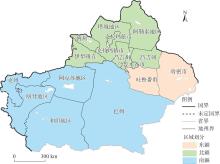
Fig. 1
Schematic diagram of the study area"
Tab. 1
Multi-dimensional relative poverty index system of various prefectures and cities in Xinjiang"
| 目标层 | 维度层 | 指标层 | 指标 单位 | 指标 属性 |
|---|---|---|---|---|
| 多维 相对 贫困 指标 体系 | 自然 | 人均农作物播种面积(X1) | hm2·人-1 | 正向 |
| 年均降水量(X2) | mm | 正向 | ||
| 单位面积粮食产量(X3) | kg·hm-2 | 正向 | ||
| 人力 | 平均万人普通中小学在校 生数(X4) | 人·(10人)-4 | 正向 | |
| 平均万人普通中小学教 师数(X5) | 人·(10人)-4 | 正向 | ||
| 乡村劳动力占乡村人口比例(X6) | % | 正向 | ||
| 人均农业机械总动力(X7) | kW·人-1 | 正向 | ||
| 经济 | 人均GDP(X8) | 元 | 正向 | |
| 非私营单位就业人员平均 工资(X9) | 元 | 正向 | ||
| 私营单位就业人员平均工资(X10) | 元 | 正向 | ||
| 人均社会消费品零售总额(X11) | 元 | 正向 | ||
| 城镇居民人均可支配收入(X12) | 元 | 正向 | ||
| 农村居民人均可支配收入(X13) | 元 | 正向 | ||
| 社会 | 平均万人拥有卫生机构数(X14) | 个·(10人)-4 | 正向 | |
| 平均万人拥有卫生机构床位 数(X15) | 张·(10人)-4 | 正向 | ||
| 平均万人拥有卫生技术人员 数(X16) | 人·(10人)-4 | 正向 | ||
| 一般公共预算收支比(X17) | % | 正向 | ||
| 第一产业增加值占比(X18) | % | 负向 |
Tab. 2
Interaction types of the interaction detector"
| 交互特征 | 交互类型 |
|---|---|
| q(X1∩X2)>q(X1)+q(X2) | 非线性增强 |
| q(X1∩X2)<Min[q(X1), q(X2)] | 非线性减弱 |
| q(X1∩X2)>Max[q(X1), q(X2)] | 双因子增强 |
| Min[q(X1), q(X2)]<q(X1∩X2)<Min[q(X1), q(X2)] | 单因子非线性减弱 |
| q(X1∩X2)=q(X1)+q(X2) | 独立 |
Tab. 3
Weighting assignment results of multi-dimensional relative poverty indices /%"
| 维度层 | 指标层 | 2016年 | 2017年 | 2018年 | 2019年 | 2020年 | 2021年 |
|---|---|---|---|---|---|---|---|
| 自然 | X1 | 7.579 | 7.734 | 8.822 | 8.746 | 8.321 | 9.261 |
| X2 | 5.610 | 4.978 | 5.222 | 4.700 | 6.629 | 4.332 | |
| X3 | 5.213 | 5.493 | 2.636 | 6.573 | 7.239 | 7.438 | |
| 人力 | X4 | 7.256 | 6.711 | 6.316 | 7.005 | 8.570 | 8.382 |
| X5 | 3.631 | 3.794 | 4.793 | 3.972 | 3.633 | 4.494 | |
| X6 | 3.309 | 3.072 | 3.412 | 2.574 | 5.730 | 3.896 | |
| X7 | 11.254 | 11.523 | 14.667 | 13.615 | 10.803 | 12.963 | |
| 经济 | X8 | 6.155 | 5.995 | 5.791 | 5.647 | 5.178 | 5.321 |
| X9 | 4.242 | 4.986 | 5.590 | 8.484 | 7.527 | 6.251 | |
| X10 | 4.442 | 5.937 | 6.190 | 3.480 | 3.467 | 2.301 | |
| X11 | 6.184 | 6.263 | 5.858 | 4.853 | 4.623 | 4.750 | |
| X12 | 4.721 | 4.556 | 4.375 | 4.333 | 4.209 | 4.283 | |
| X13 | 4.286 | 4.717 | 4.732 | 4.521 | 4.653 | 5.210 | |
| 社会 | X14 | 2.261 | 2.231 | 2.103 | 2.027 | 2.184 | 3.262 |
| X15 | 7.180 | 4.240 | 3.327 | 5.311 | 3.401 | 5.770 | |
| X16 | 5.832 | 6.112 | 6.321 | 5.049 | 5.326 | 3.239 | |
| X17 | 6.884 | 7.706 | 6.701 | 6.561 | 6.370 | 6.561 | |
| X18 | 3.961 | 3.953 | 3.144 | 2.549 | 2.140 | 2.286 |
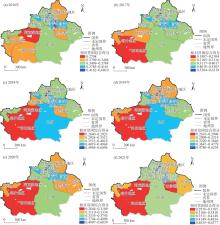
Fig. 2
Spatial distributions of multidimensional relative poverty index in various prefectures and cities of Xinjiang"

Tab. 4
Global Moran’s I of relative poverty levels in various prefectures and cities of Xinjiang"
| 年份 | 全局Moran’s I | Z值 | P值 |
|---|---|---|---|
| 2016 | 0.058476 | 0.561573 | 0.574407 |
| 2017 | 0.228289 | 1.175644 | 0.239737 |
| 2018 | 0.000995 | 0.309823 | 0.756696 |
| 2019 | 0.274568 | -0.856337 | 0.391811 |
| 2020 | 0.015039 | 0.392820 | 0.694452 |
| 2021 | 0.089280 | 1.129658 | 0.258620 |
Tab. 5
Ranking of obstacle degrees of influencing factors of relative poverty in Xinjiang"
| 地州市 | 障碍度指标排序 | |||||
|---|---|---|---|---|---|---|
| 1 | 2 | 3 | 4 | 5 | 6 | |
| 乌鲁木齐市 | X7(0.193) | X1(0.153) | X4(0.150) | X3(0.096) | X2(0.075) | X5(0.067) |
| 克拉玛依市 | X4(0.242) | X2(0.190) | X15(0.103) | X6(0.086) | X5(0.083) | X14(0.070) |
| 吐鲁番市 | X7(0.141) | X1(0.113) | X3(0.098) | X2(0.090) | X9(0.086) | X4(0.067) |
| 哈密市 | X7(0.141) | X4(0.067) | X1(0.113) | X3(0.098) | X2(0.090) | X17(0.046) |
| 昌吉州 | X7(0.142) | X4(0.134) | X3(0.096) | X1(0.079) | X9(0.072) | X2(0.071) |
| 伊犁州直 | X7(0.163) | X1(0.108) | X9(0.097) | X4(0.078) | X17(0.073) | X8(0.068) |
| 塔城地区 | X7(0.135) | X4(0.125) | X9(0.092) | X17(0.081) | X16(0.064) | X11(0.062) |
| 阿勒泰地区 | X7(0.139) | X9(0.103) | X4(0.092) | X17(0.081) | X6(0.071) | X1(0.066) |
| 博州 | X7(0.146) | X4(0.128) | X17(0.082) | X6(0.080) | X1(0.060) | X2(0.059) |
| 巴州 | X7(0.127) | X9(0.115) | X4(0.097) | X2(0.091) | X1(0.068) | X17(0.068) |
| 阿克苏地区 | X7(0.143) | X9(0.090) | X1(0.079) | X3(0.077) | X2(0.067) | X17(0.067) |
| 克州 | X7(0.145) | X1(0.111) | X3(0.094) | X17(0.085) | X9(0.081) | X6(0.079) |
| 喀什地区 | X7(0.141) | X1(0.100) | X3(0.089) | X17(0.085) | X9(0.069) | X16(0.067) |
| 和田地区 | X7(0.135) | X1(0.102) | X3(0.090) | X9(0.089) | X17(0.079) | X16(0.066) |
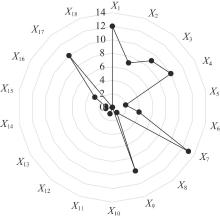
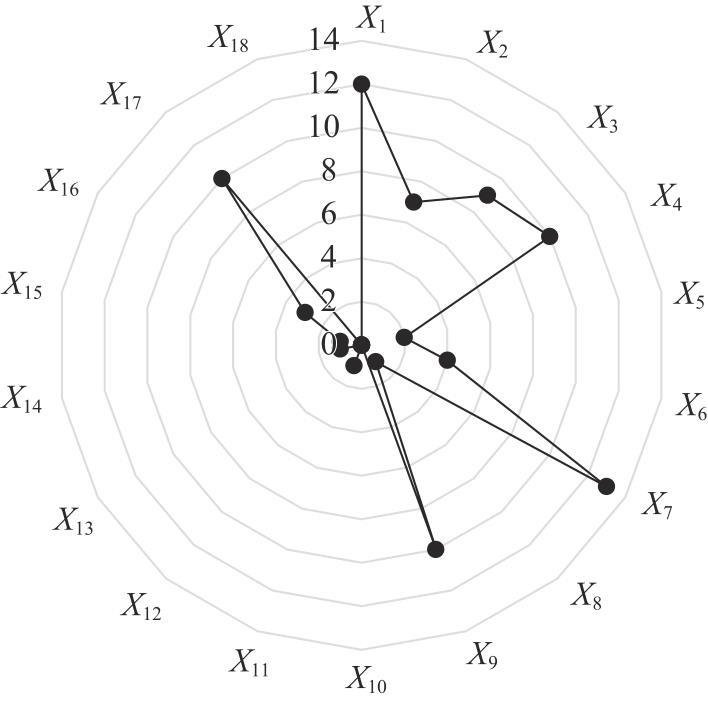
Fig. 3
Radar chart of the top six obstacles to the relative poverty indices"
Tab. 6
Impact of interactions between different factors on relative poverty in Xinjiang"
| 指标 | X1 | X2 | X3 | X4 | X5 | X6 | X7 | X8 | X9 | X10 | X11 | X12 | X13 | X14 | X15 | X16 | X17 | X18 |
|---|---|---|---|---|---|---|---|---|---|---|---|---|---|---|---|---|---|---|
| X1 | 0.729 | - | - | - | - | - | - | - | - | - | - | - | - | - | - | - | - | - |
| X2 | 0.984 | 0.420 | - | - | - | - | - | - | - | - | - | - | - | - | - | - | - | - |
| X3 | 0.987 | 1.000 | 0.460 | - | - | - | - | - | - | - | - | - | - | - | - | - | - | - |
| X4 | 0.992 | 0.621 | 0.677 | 0.390 | - | - | - | - | - | - | - | - | - | - | - | - | - | - |
| X5 | 0.999 | 0.988 | 0.677 | 0.574 | 0.515 | - | - | - | - | - | - | - | - | - | - | - | - | - |
| X6 | 1.000 | 0.976 | 0.941 | 0.948 | 0.950 | 0.540 | - | - | - | - | - | - | - | - | - | - | - | - |
| X7 | 0.770 | 0.993 | 0.987 | 0.962 | 0.999 | 1.000 | 0.739 | - | - | - | - | - | - | - | - | - | - | - |
| X8 | 0.986 | 0.993 | 0.979 | 0.917 | 0.927 | 0.950 | 0.949 | 0.891 | - | - | - | - | - | - | - | - | - | - |
| X9 | 1.000 | 0.998 | 0.992 | 0.879 | 0.971 | 0.972 | 0.968 | 0.942 | 0.836 | - | - | - | - | - | - | - | - | - |
| X10 | 0.837 | 0.987 | 0.928 | 0.874 | 0.985 | 0.941 | 0.843 | 0.968 | 0.871 | 0.769 | - | - | - | - | - | - | - | - |
| X11 | 0.991 | 0.959 | 0.974 | 0.959 | 0.971 | 0.976 | 0.961 | 0.956 | 0.955 | 0.919 | 0.888 | - | - | - | - | - | - | - |
| X12 | 0.966 | 0.958 | 0.953 | 0.988 | 0.971 | 0.967 | 0.983 | 0.959 | 0.969 | 0.938 | 0.945 | 0.906 | - | - | - | - | - | - |
| X13 | 0.991 | 0.988 | 0.990 | 0.949 | 0.964 | 0.998 | 0.961 | 0.956 | 0.945 | 0.956 | 0.954 | 0.968 | 0.939 | - | - | - | - | - |
| X14 | 0.969 | 0.962 | 0.966 | 0.968 | 0.996 | 0.990 | 0.968 | 0.968 | 0.968 | 0.962 | 0.962 | 0.974 | 0.964 | 0.917 | - | - | - | - |
| X15 | 0.915 | 0.621 | 1.000 | 0.619 | 0.990 | 1.000 | 0.907 | 0.987 | 0.991 | 0.898 | 0.994 | 0.991 | 0.983 | 0.992 | 0.489 | - | - | - |
| X16 | 0.994 | 0.980 | 0.984 | 0.965 | 0.976 | 0.981 | 0.967 | 0.962 | 0.956 | 0.950 | 0.949 | 0.968 | 0.959 | 0.962 | 0.999 | 0.916 | - | - |
| X17 | 0.983 | 0.989 | 0.963 | 0.997 | 0.977 | 0.991 | 0.987 | 0.965 | 0.977 | 0.948 | 0.945 | 0.934 | 0.967 | 0.986 | 0.999 | 0.970 | 0.908 | - |
| X18 | 0.986 | 0.998 | 0.992 | 0.887 | 0.971 | 0.938 | 0.954 | 0.971 | 0.963 | 0.934 | 0.931 | 0.947 | 0.971 | 0.974 | 0.994 | 0.948 | 0.931 | 0.758 |
| [1] | 人民日报. 历史性的跨越, 新奋斗的起点——习近平总书记关于打赢脱贫攻坚战重要论述综述[EB/OL]. [2021-02-24]. https://www.gov.cn/xinwen/2021-02/24/content_5588553.htm. |
| [Pe-ople’s daily. A historic leap, a new starting point for new struggles: A summary of the important statements by the general secretary on winning the poverty alleviation campaign[EB/OL]. [2021-02-24]. https://www.gov.cn/xinwen/2021-02/24/content_5588553.htm.] | |
| [2] | Chong C, Cai M, Yue X M. Focus shift needed: From development-oriented to social security-based poverty alleviation in rural China[J]. Economic and Political Studies, 2022, 10(1): 62-84. |
| [3] | 薛子涵, 温立洲, 李金荣, 等. 河北省农村多维相对贫困的测度、分解与影响因素研究[J]. 统计理论与实践, 2023(10): 30-35. |
| [Xue Zihan, Wen Lizhou, Li Jinrong, et al. Measurement, decomposition and influencing factors of multidimensional relative poverty in rural Hebei Province[J]. Statistical Theory and Practice, 2023(10): 30-35.] | |
| [4] | 王婴, 唐钧. 现代贫困研究: 从绝对到相对再到多维[J]. 河海大学学报(哲学社会科学版), 2020, 22(6): 83-89, 112. |
| [Wang Ying, Tang Jun. Modern poverty research: From absolute to relative to multi-dimensional[J]. Journal of Hohai University (Philosophy and Social Sciences Edition), 2020, 22(6): 83-89, 112.] | |
| [5] | Townsend R M. Optimal contracts and competitive markets with costly state verification[J]. Journal of Economic Theory, 1979, 21(2): 265-293. |
| [6] |
何仁伟, 刘邵权, 陈国阶, 等. 中国农户可持续生计研究进展及趋向[J]. 地理科学进展, 2013, 32(4): 657-670.
doi: 10.11820/dlkxjz.2013.04.018 |
|
[He Renwei, Liu Shaoquan, Chen Guojie, et al. Research progress and tendency of sustainable livelihoods for peasant household in China[J]. Progress in Geography, 2013, 32(4): 657-670.]
doi: 10.11820/dlkxjz.2013.04.018 |
|
| [7] |
袁梦, 谢保鹏, 田丽敏, 等. 六盘山甘肃片区土地利用多功能与多维相对贫困的时空耦合关系[J]. 干旱区地理, 2025, 48(7): 1304-1316.
doi: 10.12118/j.issn.1000-6060.2024.447 |
| [Yuan Meng, Xie Baopeng, Tian Limin, et al. Spatiotemporal coupling relationship between multi-function land use and multi-dimension relative poverty in Liupanshan, Gansu Province[J]. Arid Land Geography, 2025, 48(7): 1304-1316.] | |
| [8] | 张建勋, 夏咏. 深度贫困地区多维贫困测度与时空分异特征——来自新疆南疆四地州的证据[J]. 干旱区资源与环境, 2020, 34(4): 88-93. |
| [Zhang Jianxun, Xia Yong. Multidimensional poverty measurement and spatial-temporal differentiation characteristics in the poverty-stricken areas: Evidence from the four regions in southern Xinjiang[J]. Journal of Arid Land Resources and Environment, 2020, 34(4): 88-93.] | |
| [9] | 汪晓文, 何明辉, 李玉洁. 基于空间贫困视角的扶贫模式再选择——以甘肃为例[J]. 甘肃社会科学, 2012(6): 95-98, 108. |
| [Wang Xiaowen, He Minghui, Li Yujie. Re-choosing poverty alleviation models based on spatial poverty perspective: A case study of Gansu Province[J]. Gansu Social Sciences, 2012(6): 95-98, 108.] | |
| [10] |
金贵, 邓祥征, 董寅, 等. 发展地理学视角下中国多维贫困测度及时空交互特征[J]. 地理学报, 2020, 75(8): 1633-1646.
doi: 10.11821/dlxb202008006 |
| [Jin Gui, Deng Xiangzheng, Dong Yin, et al. China’s multidimensional poverty measurement and its spatiotemporal interaction characteristics in the perspective of development geography[J]. Acta Geographica Sinica, 2020, 75(8): 1633-1646.] | |
| [11] | 王佳珊. 贵州省农村贫困测评及其影响因素分析[D]. 贵阳: 贵州财经大学, 2016. |
| [Wang Jiashan. Rural poverty assessment and analysis of its influencing factors in Guizhou Province[D]. Guiyang: Guizhou University of Finance and Economics, 2016.] | |
| [12] | 杨振, 江琪, 刘会敏, 等. 中国农村居民多维贫困测度与空间格局[J]. 经济地理, 2015, 35(12): 148-153. |
| [Yang Zhen, Jiang Qi, Liu Huimin, et al. Multi-dimensional poverty measure and spatial pattern of China’s rural residents[J]. Economic Geography, 2015, 35(12): 148-153.] | |
| [13] | 陈全功, 程蹊. 空间贫困理论视野下的民族地区扶贫问题[J]. 中南民族大学学报(人文社会科学版), 2011, 31(1): 58-63. |
| [Chen Quangong, Cheng Xi. Poverty in space: Issues of poverty alleviation in ethnic regions from the perspective of spatial poverty theory[J]. Journal of Central South University for Nationalities (Humanities and Social Sciences Edition), 2011, 31(1): 58-63.] | |
| [14] |
陈烨烽, 王艳慧, 赵文吉, 等. 中国贫困村致贫因素分析及贫困类型划分[J]. 地理学报, 2017, 72(10): 1827-1844.
doi: 10.11821/dlxb201710008 |
|
[Chen Yefeng, Wang Yanhui, Zhao Wenji, et al. Contributing factors and classification of poor villages in China[J]. Acta Geographica Sinica, 2017, 72(10): 1827-1844.]
doi: 10.11821/dlxb201710008 |
|
| [15] |
刘艳华, 徐勇. 中国农村多维贫困地理识别及类型划分[J]. 地理学报, 2015, 70(6): 993-1007.
doi: 10.11821/dlxb201506012 |
|
[Liu Yanhua, Xu Yong. Geographical identification and classification of multi-dimensional poverty in rural China[J]. Acta Geographica Sinica, 2015, 70(6): 993-1007.]
doi: 10.11821/dlxb201506012 |
|
| [16] |
周扬, 郭远智, 刘彦随. 中国县域贫困综合测度及2020年后减贫瞄准[J]. 地理学报, 2018, 73(8): 1478-1493.
doi: 10.11821/dlxb201808007 |
|
[Zhou Yang, Guo Yuanzhi, Liu Yansui. Comprehensive measurement of county poverty and anti-poverty targeting after 2020 in China[J]. Acta Geographica Sinica, 2018, 73(8): 1478-1493.]
doi: 10.11821/dlxb201808007 |
|
| [17] | 夏春萍, 雷欣悦, 王翠翠. 我国农村多维贫困的空间分布特征及影响因素分析——基于31省的多维贫困测度[J]. 中国农业大学学报, 2019, 24(8): 229-238. |
| [Xia Chunping, Lei Xinyue, Wang Cuicui. Analysis of the spatial distribution characteristics and influencing factors of multidimensional poverty in rural China: Based on a multidimensional poverty measurement of 31 provinces[J]. Journal of China Agricultural University, 2019, 24(8): 229-238.] | |
| [18] | 马文利. 国内外贫困研究热点及前沿动态分析——基于CiteSpace的文献计量[J]. 新疆财经大学学报, 2020(2): 5-15. |
| [Ma Wenli. An analysis of hotspots and frontiers of poverty studies in china and foreign countries: Bibliometrics based on CiteSpace[J]. Journal of Xinjiang University of Finance and Economics, 2020(2): 5-15.] | |
| [19] | 樊增增, 邹薇. 从脱贫攻坚走向共同富裕: 中国相对贫困的动态识别与贫困变化的量化分解[J]. 中国工业经济, 2021(10): 59-77. |
| [Fan Zengzeng, Zou Wei. From anti-poverty campaign to common prosperity: Dynamic identification of relative poverty and quantitative decomposition of poverty changes in China[J]. China Industrial Economics, 2021(10): 59-77.] | |
| [20] | 苏芳, 常江波, 范冰洁, 等. 多维视角下相对贫困治理的中国探索[J]. 中国软科学, 2023(11): 66-73. |
| [Su Fang, Chang Jiangbo, Fan Bingjie, et al. Exploration of relative poverty governance in China from a multidimensional perspective[J]. China Soft Science, 2023(11): 66-73.] | |
| [21] | 高杰. 新疆南疆农村少数民族家庭相对贫困的长效治理路径研究[D]. 阿拉尔: 塔里木大学, 2023. |
| [Gao Jie. Research on the long-term governance path of relative poverty among ethnic minority families in southern Xinjiang[D]. Aral: Tarim University, 2023.] | |
| [22] | 王小林, 冯贺霞. 2020年后中国多维相对贫困标准: 国际经验与政策取向[J]. 中国农村经济, 2020(3): 2-21. |
| [Wang Xiaolin, Feng Hexia. China’s multidimensional relative poverty standards in the post-2020 era: International experience and policy orientation[J]. Chinese Rural Economy, 2020(3): 2-21.] | |
| [23] | 侯守杰. 后小康时代的相对贫困治理[J]. 西北农林科技大学学报(社会科学版), 2021, 21(2): 36-42. |
| [Hou Shoujie. Relative poverty control in the post-well-off era[J]. Journal of Northwest A & F University (Social Science Edition), 2021, 21(2): 36-42.] | |
| [24] |
刘新梅, 韩林芝, 郑江华, 等. 贫困县多维综合贫困度时空分异特征及其驱动机制——以南疆四地州深度贫困地区贫困县为例[J]. 经济地理, 2019, 39(7): 165-174.
doi: 10.15957/j.cnki.jjdl.2019.07.019 |
|
[Liu Xinmei, Han Linzhi, Zheng Jianghua, et al. Temporal-spatial characteristics and the driving mechanism of multidimensional comprehensive poverty degree in poverty-stricken counties: A case study of poor counties in deep poverty-stricken areas of southern Xinjiang[J]. Economic Geography, 2019, 39(7): 165-174.]
doi: 10.15957/j.cnki.jjdl.2019.07.019 |
|
| [25] | 郭显光. 熵值法及其在综合评价中的应用[J]. 财贸研究, 1994(6): 56-60. |
| [Guo Xianguang. Entropy value method and its application in comprehensive evaluation[J]. Finance and Trade Research, 1994(6): 56-60.] | |
| [26] | 苟廷佳, 陆威文. 基于组合赋权TOPSIS模型的生态文明建设评价——以青海省为例[J]. 统计与决策, 2020, 36(24): 57-60. |
| [Gou Tingjia, Lu Weiwen. Evaluation of ecological civilization construction based on combination weighted TOPSIS model: Taking Qinghai Province as an example[J]. Statistics & Decision, 2020, 36(24): 57-60.] | |
| [27] | 许月卿, 李双成, 蔡运龙. 基于GIS和人工神经网络的区域贫困化空间模拟分析——以贵州省猫跳河流域为例[J]. 地理科学进展, 2006, 25(3): 79-85, 140. |
| [Xu Yueqing, Li Shuangcheng, Cai Yunlong. Spatial simulation using GIS and artificial neural network for regional poverty: A case study of Maotiaohe Watershed, Guizhou Province[J]. Progress in Geography, 2006, 25(3): 79-85, 140.] | |
| [28] | 王成武, 黄佳. 基于TOPSIS模型的凉山州空间贫困特征及障碍因素分析[J]. 时空信息学报, 2020, 27(2): 87-93. |
| [Wang Chengwu, Huang Jia. On the spatial distribution and influencing factors of poverty in Liangshan Prefecture using TOPSIS model[J]. Journal of Spatio-temporal Information, 2020, 27(2): 87-93.] | |
| [29] | 尹晓翠, 许洋, 张艺琳, 等. 基于熵权TOPSIS法的青岛市农业高质量发展评价及障碍度分析[J]. 青岛农业大学学报(自然科学版), 2023, 40(4): 304-307, 311. |
| [Yin Xiaocui, Xu Yang, Zhang Yilin, et al. Evaluation and obstacle degree analysis for high-quality development of agriculture in Qingdao based on entropy weight TOPSIS method[J]. Journal of Qingdao Agricultural University (Natural Science Edition), 2023, 40(4): 304-307, 311.] | |
| [30] | 李东, 由亚男, 马长发, 等. 干旱区绿洲城镇空间贫困分异特征及其影响因素分析——以新疆南疆三地州为例[J]. 世界地理研究, 2018, 27(3): 86-98. |
| [Li Dong, You Yanan, Ma Changfa, et al. Analysis on the differentiation characteristics of spatial poverty and its influencing factors in the oasis towns of arid areas: Taking three south Xinjiang districts as an example[J]. World Regional Studies, 2018, 27(3): 86-98.] | |
| [31] |
王劲峰, 徐成东. 地理探测器: 原理与展望[J]. 地理学报, 2017, 72(1): 116-134.
doi: 10.11821/dlxb201701010 |
|
[Wang Jinfeng, Xu Chengdong. Geodetector: Principle and prospective[J]. Acta Geographica Sinica, 2017, 72(1): 116-134.]
doi: 10.11821/dlxb201701010 |
|
| [32] |
郭佳丽, 杜宏茹. 多元流视角下新疆绿洲城市网络格局研究[J]. 干旱区地理, 2025, 48(2): 323-332.
doi: 10.12118/j.issn.1000-6060.2024.158 |
|
[Guo Jiali, Du Hongru. Network pattern of oasis cities in Xinjiang from the perspective of multiple flows[J]. Arid Land Geography, 2025, 48(2): 323-332.]
doi: 10.12118/j.issn.1000-6060.2024.158 |
|
| [33] | 聂蕊, 刘伟, 刘思文. 南疆四地州相对贫困的多维识别与协同治理[J]. 河北农业大学学报(社会科学版), 2022, 24(5): 115-124. |
| [Nie Rui, Liu Wei, Liu Siwen. Multi-dimensional identification and collaborative governance of relative poverty in four prefectures in southern Xinjiang[J]. Journal of Hebei Agricultural University (Social Sciences Edition), 2022, 24(5): 115-124.] | |
| [34] | 蔡兴冉, 梁彦庆, 黄志英, 等. 河北省县域相对贫困度空间分异及影响因素分析[J]. 西南大学学报(自然科学版), 2019, 41(10): 62-71. |
| [Cai Xingran, Liang Yanqing, Huang Zhiying, et al. Analysis of relative poverty degree of the counties of Hebei Province and its influencing factors[J]. Journal of Southwest University (Natural Science Edition), 2019, 41(10): 62-71.] |
|
||