干旱区地理 ›› 2025, Vol. 48 ›› Issue (11): 2053-2061.doi: 10.12118/j.issn.1000-6060.2024.679 cstr: 32274.14.ALG2024679
王生霞( ), 李茂兰(), 刘芮廷
收稿日期:2024-11-04
修回日期:2025-01-02
出版日期:2025-11-25
发布日期:2025-11-26
通讯作者:
李茂兰(2001-),女,硕士研究生,主要从事旅游管理研究. E-mail: 13993164515@163.com作者简介:王生霞(1983-),女,博士,副教授,主要从事旅游地理研究. E-mail: wangshx@lzufe.edu.cn
基金资助:
WANG Shengxia(), LI Maolan(), LIU Ruiting
Received:2024-11-04
Revised:2025-01-02
Published:2025-11-25
Online:2025-11-26
摘要: 旅游业与城镇化相互影响日益显著,其耦合协调对提升区域旅游经济高质量发展至关重要。基于旅游业效率与城镇化的耦合作用机理,运用Super-SBM模型、熵值法、耦合协调度及障碍度模型探讨了2000—2022年“一带一路”核心段(陕西、甘肃、青海、宁夏、新疆和内蒙古6省区)旅游业效率与城镇化耦合协调的时空演变特征及障碍因素。结果表明:(1)6省区旅游业效率均值为0.73,整体处于较低水平;城镇化水平整体稳定增长,省际差异明显。(2)6省区旅游业效率与城镇化耦合协调度由濒临失调趋向初级协调,空间上东南高、西北低,重心呈“东南—东北—西南”偏移,东南部地区集聚逐渐增强。(3)制约旅游业效率与城镇化耦合协调度的关键障碍因子为旅游总收入、旅游总人次、邮电业务总量、普通高等学校在校人数及旅游业从业人员。研究结果为区域旅游业与城镇化高质量协同发展提供了科学依据。
王生霞, 李茂兰, 刘芮廷. 旅游业效率与城镇化耦合协调度的时空演变及障碍因素分析——以“一带一路”核心段为例[J]. 干旱区地理, 2025, 48(11): 2053-2061.
WANG Shengxia, LI Maolan, LIU Ruiting. Spatiotemporal evolution and obstacle factors of the coupling coordination degree of tourism efficiency and urbanization: A case of the core section of the “Belt and Road”[J]. Arid Land Geography, 2025, 48(11): 2053-2061.
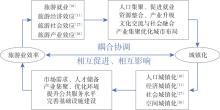
图1
旅游业效率与城镇化耦合协调机理"
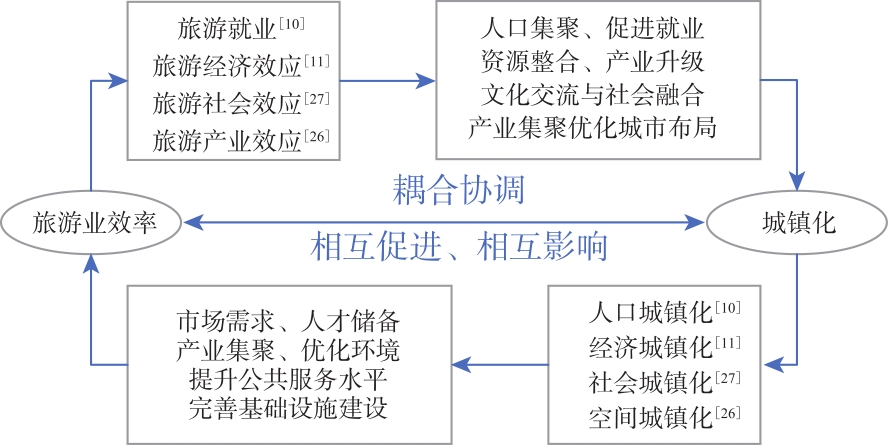

表1
旅游业效率与城镇化水平评价指标体系"
| 目标层 | 准则层 | 指标层 | 属性 |
|---|---|---|---|
| 旅游业 效率 | 旅游投入 | 旅游业从业人员(X1)/人 | + |
| 旅行社数量(X2)/家 | + | ||
| 星级饭店数量(X3)/家 | + | ||
| 旅游产出 | 旅游总人次(X4)/104人 | + | |
| 旅游总收入(X5)/108元 | + | ||
| 城镇化 | 人口城镇化 | 城镇人口(X6)/104人 | + |
| 城镇人口比重(X7)/% | + | ||
| 第三产业从业人员比重(X8)/% | + | ||
| 经济城镇化 | 人均GDP(X9)/元 | + | |
| 第三产业占GDP比重(X10)/% | + | ||
| 城镇居民人均可支配收入(X11)/元 | + | ||
| 社会城镇化 | 卫生技术人员(X12)/104人 | + | |
| 每万人拥有公共交通车辆数(X13)/标台 | + | ||
| 普通高等学校在校人数(X14)/104人 | + | ||
| 空间城镇化 | 邮电业务总量(X15)/104元 | + | |
| 建成区面积(X16)/km2 | + | ||
| 人均城市道路面积(X17)/m2 | + | ||
| 人均公园绿地面积(X18)/m2 | + |
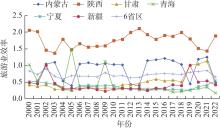
图2
2000—2022年6省区旅游业效率变化"
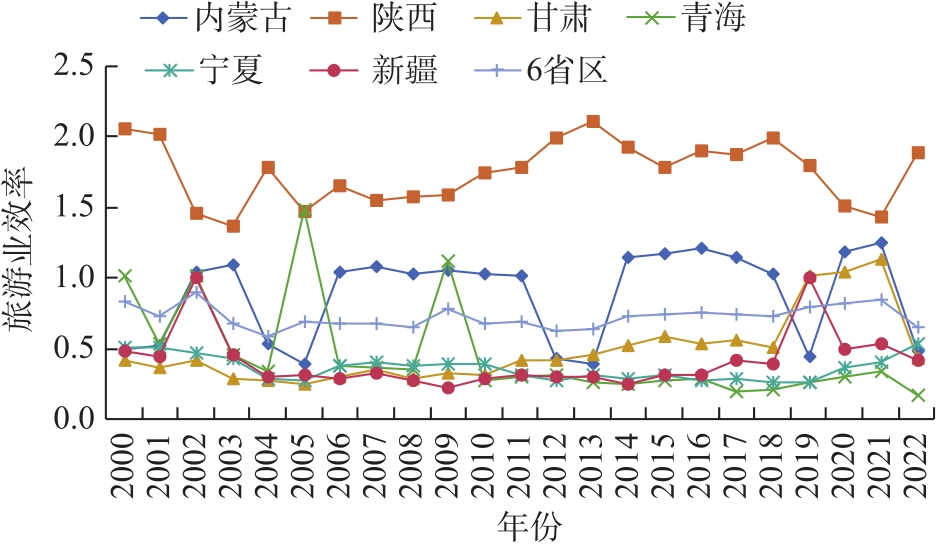
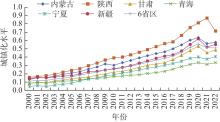
图3
2000—2022年6省区城镇化水平变化"
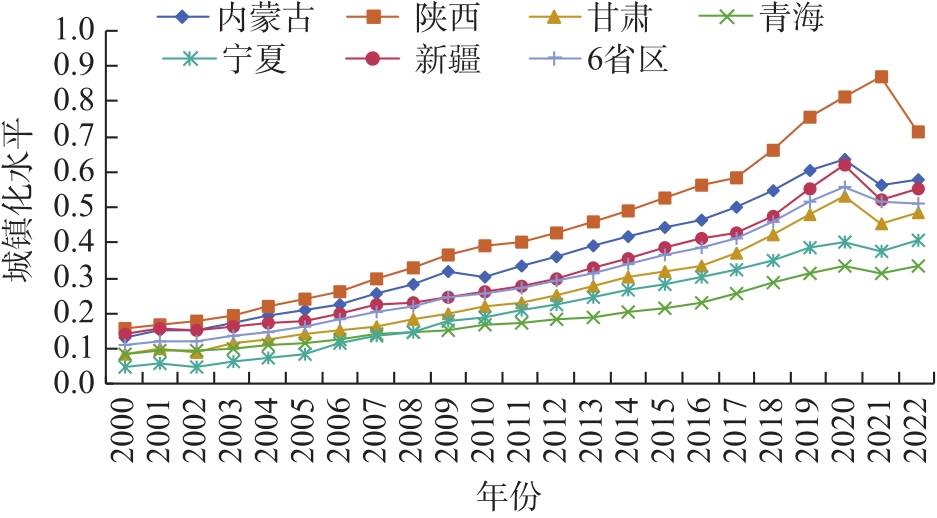
图4
2000—2022年6省区旅游业效率与城镇化耦合协调度的时序演变"
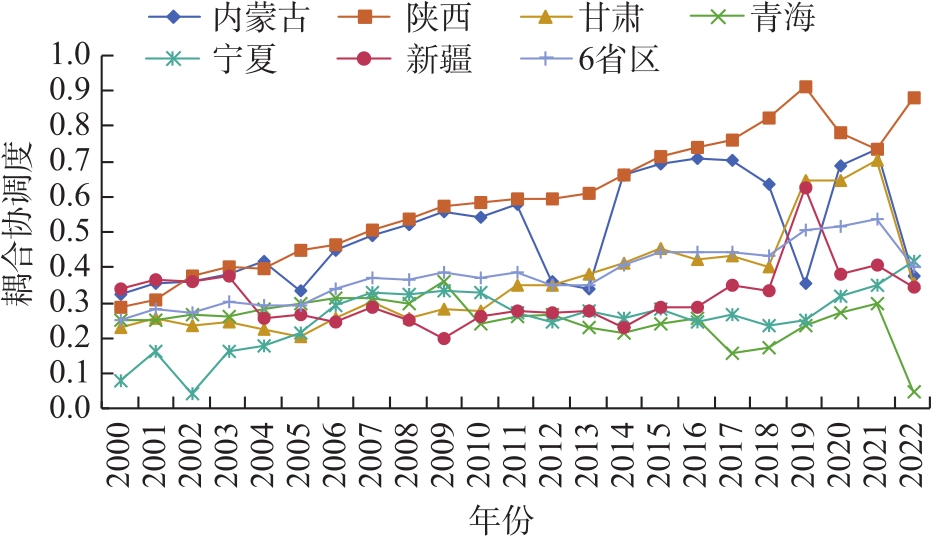
图5
2000—2022年6省区旅游业效率与城镇化耦合协调度空间分布 注:基于自然资源部标准地图服务网站审图号为GS(2023)2767号的标准地图制作,底图边界无修改。"
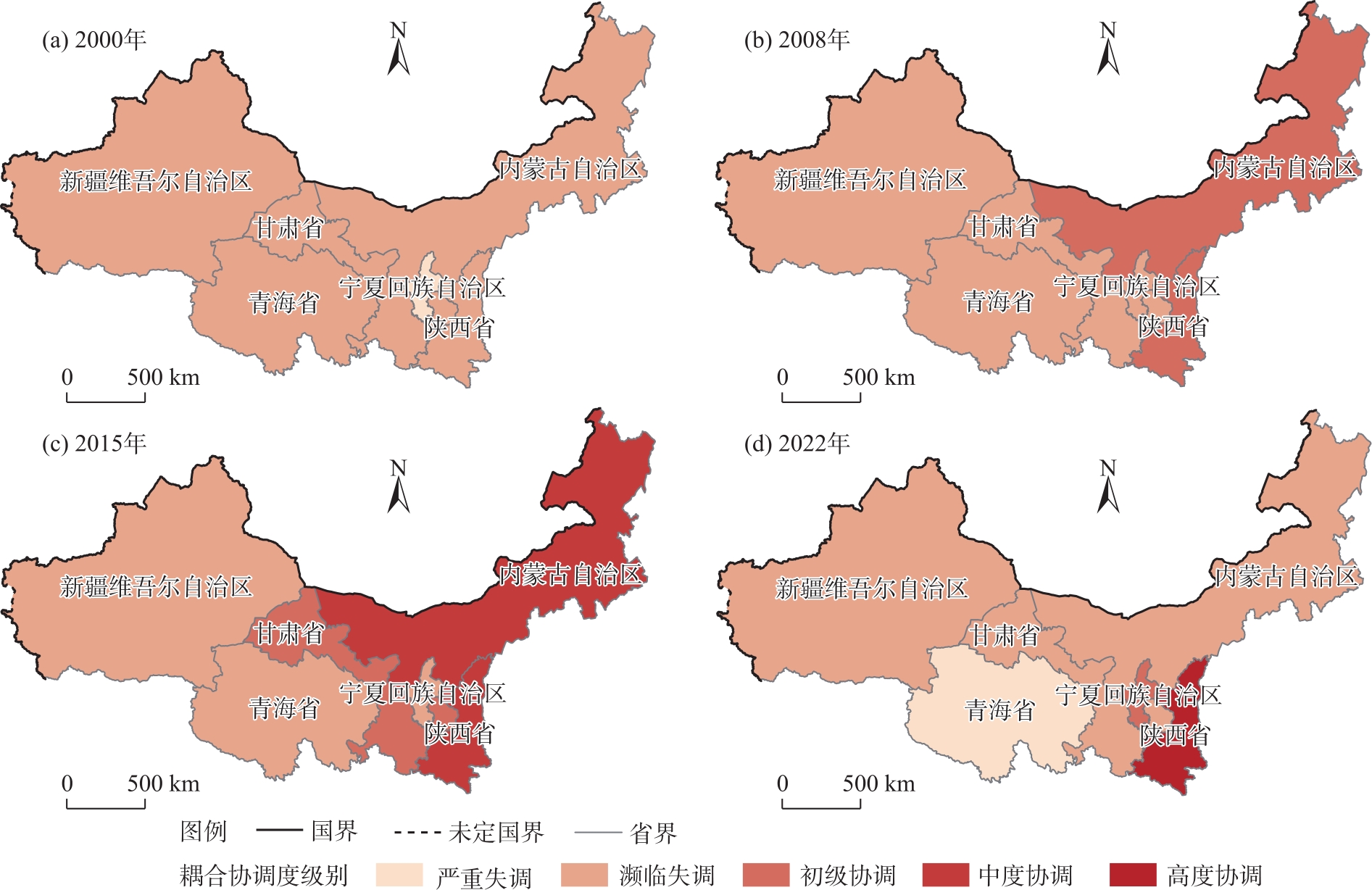
表2
2000—2022年6省区旅游业效率与城镇化耦合协调度标准差椭圆相关参数"
| 年份 | 重心坐标 | 面积 /104 km2 | 长轴 /km | 短轴 /km | 方位角 /(°) | 扁率 |
|---|---|---|---|---|---|---|
| 2000 | 100.88°E,39.48°N | 207.56 | 1180.02 | 559.95 | 93.99 | 0.53 |
| 2008 | 103.99°E,39.01°N | 180.70 | 1014.05 | 567.26 | 88.51 | 0.44 |
| 2015 | 104.50°E,39.18°N | 178.49 | 991.85 | 572.86 | 88.30 | 0.42 |
| 2022 | 104.26°E,38.49°N | 159.23 | 1024.52 | 494.75 | 103.25 | 0.52 |
表3
制约6省区旅游业效率与城镇化耦合协调的主要障碍因子"
| 省区 | 障碍因子(障碍度/%) | ||||
|---|---|---|---|---|---|
| 第一 | 第二 | 第三 | 第四 | 第五 | |
| 内蒙古 | X4(16.96) | X15(16.82) | X5(15.46) | X14(7.73) | X1(7.28) |
| 陕西 | X15(17.21) | X5(15.86) | X4(13.47) | X1(7.67) | X9(6.21) |
| 甘肃 | X5(15.77) | X15(15.34) | X4(14.01) | X14(6.70) | X1(6.64) |
| 青海 | X5(15.02) | X15(14.43) | X4(14.37) | X14(8.03) | X1(6.75) |
| 宁夏 | X5(15.24) | X4(14.51) | X15(14.43) | X14(7.81) | X1(6.78) |
| 新疆 | X5(16.31) | X4(16.02) | X15(15.84) | X14(7.75) | X1(6.65) |
| [9] |
[Ma Xuefeng, Liu Yulin. Urbanization response to tourism and analysis of its influencing mechanism based on three factors in Zhangjiajie[J]. Scientia Geographica Sinica, 2018, 38(8): 1346-1356. ]
doi: 10.13249/j.cnki.sgs.2018.08.017 |
| [10] | 高楠, 马耀峰, 李天顺, 等. 基于耦合模型的旅游产业与城市化协调发展研究——以西安市为例[J]. 旅游学刊, 2013, 28(1): 62-68. |
| [Gao Nan, Ma Yaofeng, Li Tianshun, et al. Study on the coordinative development between tourism industry and urbanization based on coupling model: A case study of Xi’an[J]. Tourism Tribune, 2013, 28(1): 62-68. ] | |
| [11] | 钟家雨, 柳思维, 熊曦. 旅游业与城镇化协同发展的区域差异分析[J]. 经济地理, 2014, 34(2): 187-192. |
|
[Zhong Jiayu, Liu Siwei, Xiong Xi. Analysis on the regional difference of coordinated development between tourism and urbanization[J]. Economic Geography, 2014, 34(2): 187-192. ]
doi: 10.2307/142305 |
|
| [12] | 方叶林. 中国省域旅游业效率及演化机理研究[D]. 南京: 南京师范大学, 2014. |
| [Fang Yelin. Research on the efficiency and evolution mechanism of China’s provincial tourism industry[D]. Nanjing: Nanjing Normal University, 2014. ] | |
| [13] | 刘佳, 陆菊, 刘宁. 基于DEA-Malmquist模型的中国沿海地区旅游产业效率时空演化、影响因素与形成机理[J]. 资源科学, 2015, 37(12): 2381-2393. |
| [Liu Jia, Lu Ju, Liu Ning. Space-time evolution, influencing factors and forming mechanisms of tourism industry’s efficiency in China’s coastal areas of based on DEA-Malmquist model[J]. Resources Science, 2015, 37(12): 2381-2393. ] | |
| [14] | Morey R C, Dittman D A. Evaluating a hotel GM’s performance: A case study in benchmarking[J]. The Cornell Hotel Restaurant and Administration Quarterly, 2003, 44(5-6): 53-59. |
| [15] | 宋明珍, 谢家平, 马腾, 等. 我国西部地区旅游业效率水平与空间差异[J]. 桂林理工大学学报, 2022, 42(1): 265-272. |
| [Song Mingzhen, Xie Jiaping, Ma Teng, et al. Efficiency level and spatial differences of tourism industry in western China[J]. Journal of Guilin University of Technology, 2022, 42(1): 265-272. ] | |
| [16] | 王兆峰, 刘庆芳. 长江经济带旅游生态效率时空演变及其影响因素[J]. 长江流域资源与环境, 2019, 28(10): 2289-2298. |
| [Wang Zhaofeng, Liu Qingfang. Spatio-temporal evolution and influencing factors of tourism eco-efficiency in the Yangtze River Economic Belt[J]. Resources and Environment in the Yangtze Basin, 2019, 28(10): 2289-2298. ] | |
| [17] | 朱承亮, 岳宏志, 严汉平, 等. 基于随机前沿生产函数的我国区域旅游产业效率研究[J]. 旅游学刊, 2009, 24(12): 18-22. |
| [Zhu Chengliang, Yue Hongzhi, Yan Hanping, et al. Study on the efficiency of regional tourism industry in China based on stochastic frontline production and cost function estimation[J]. Tourism Tribune, 2009, 24(12): 18-22. ] | |
| [18] | 夏赞才, 邹泉, 罗文斌, 等. 中国省域旅游业效率时空演变分析[J]. 统计与决策, 2020, 36(8): 62-66. |
| [Xia Zancai, Zou Quan, Luo Wenbin, et al. Spatio-temporal evolution of provincial tourism efficiency in China[J]. Statistics and Decision, 2020, 36(8): 62-66. ] | |
| [19] |
王兆峰, 李琴. 长江中游城市群旅游效率时空演变及其与生态环境的交互响应[J]. 陕西师范大学学报(自然科学版), 2023, 51(2): 24-35.
doi: 10.15983/j.cnki.jsnu.2023102 |
| [Wang Zhaofeng, Li Qin. The spatio-temporal evolution of tourism efficiency and its interactive response with ecological environment in urban agglomeration in the middle reaches of the Yangtze River[J]. Journal of Shaanxi Normal University (Natural Science Edition), 2023, 51(2): 24-35. ] | |
| [20] |
徐晓亮, 黄丹, 刘旭义, 等. 中国省域旅游效率时空演变特征及影响因素研究[J]. 干旱区地理, 2023, 46(12): 2052-2060.
doi: 10.12118/j.issn.1000-6060.2023.157 |
|
[Xu Xiaoliang, Huang Dan, Liu Xuyi, et al. Spatiotemporal evolution characteristics and influencing factors of provincial tourism efficiency in China[J]. Arid Land Geography, 2023, 46(12): 2052-2060. ]
doi: 10.12118/j.issn.1000-6060.2023.157 |
|
| [21] | 贾国栋, 王立国, 张典, 等. “双碳”目标下江西省旅游业碳排放效率时空特征及其影响因素[J]. 湖南师范大学自然科学学报, 2023, 46(1): 10-19. |
| [Jia Guodong, Wang Liguo, Zhang Dian, et al. Spatial and temporal characteristics of carbon emission efficiency of tourism in Jiangxi Province under the “double carbon” target and its influencing factors[J]. Journal of Natural Science of Hunan Normal University, 2023, 46(1): 10-19. ] | |
| [22] | 陈园园, 冯娟, 谢双玉. 长江经济带旅游业效率比较及其时空演化特征研究[J]. 华中师范大学学报(自然科学版), 2019, 53(5): 782-791. |
| [Chen Yuanyuan, Feng Juan, Xie Shuangyu. Study on the comparison of tourism efficiency and spatial-temporal evolution characteristics of the Yangtze River Economic Belt[J]. Journal of Cental China Normal University (Natural Science Edition), 2019, 53(5): 782-791. ] | |
| [23] | 王兆峰, 谢佳亮. 新型城镇化与旅游效率的耦合协调研究——以张家界为例[J]. 福建农林大学学报(哲学社会科学版), 2022, 25(3): 53-63. |
| [Wang Zhaofeng, Xie Jialiang. Research on the coupling coordination of new-type urbanization and tourism efficiency: A case study of Zhangjiajie[J]. Journal of Fujian Agriculture and Forestry University (Philosophy and Social Sciences), 2022, 25(3): 53-63. ] | |
| [24] |
王凯, 何静, 徐小凡, 等. 新型城镇化对旅游效率的空间溢出与门槛效应[J]. 热带地理, 2022, 42(8): 1275-1287.
doi: 10.13284/j.cnki.rddl.003527 |
|
[Wang Kai, He Jing, Xu Xiaofan, et al. Spatial spillover and threshold effect of new urbanization on tourism efficiency[J]. Tropical Geography, 2022, 42(8): 1275-1287. ]
doi: 10.13284/j.cnki.rddl.003527 |
|
| [25] | 唐鸿, 刘雨婧, 麻学锋. 旅游业与新型城镇化协调发展效应评价——以张家界为例[J]. 经济地理, 2017, 37(2): 216-223. |
| [Tang Hong, Liu Yujing, Ma Xuefeng. Effect evaluation of coordinated development between tourism industry and new urbanization: A case study of Zhangjiajie[J]. Economic Geography, 2017, 37(2): 216-223. ] | |
| [26] | 赵磊, 潘婷婷, 方成, 等. 旅游业与新型城镇化——基于系统耦合协调视角[J]. 旅游学刊, 2020, 35(1): 14-31. |
| [1] | 林爽, 赵磊. 城镇化进程对旅游产业竞争力的门槛效应研究[J]. 旅游学刊, 2020, 35(11): 27-41. |
| [Lin Shuang, Zhao Lei. Study on the threshold effect of urbanization process on the competitiveness of tourism industry[J]. Tourism Tribune, 2020, 35(11): 27-41. ] | |
| [2] |
杨山, 杨虹霓, 季增民, 等. 快速城镇化背景下乡村居民生活圈的重组机制——以昆山群益社区为例[J]. 地理研究, 2019, 38(1): 119-132.
doi: 10.11821/dlyj020180451 |
| [Yang Shan, Yang Hongni, Ji Zengmin, et al. The reorganization mechanism of the life circle of rural residents under the background of rapid urbanization: Based on the case study of Qunyi Community of Kunshan[J]. Geographical Research, 2019, 38(1): 119-132. ] | |
| [3] | 黄震方, 陆林, 肖飞, 等. “双循环”新格局与旅游高质量发展: 理论思考与创新实践[J]. 中国名城, 2021, 35(2): 7-18. |
| [Huang Zhenfang, Lu Lin, Xiao Fei, et al. The new pattern of “dual circulation” and the high-quality development of tourism: Theoretical thinking and innovative practice[J]. China Ancient City, 2021, 35(2): 7-18. ] | |
| [4] |
Mullins P. Tourism urbanization[J]. International Journal of Urban and Regional Research, 1991, 15(3): 326-342.
doi: 10.1111/ijur.1991.15.issue-3 |
| [5] |
Douglass W A, Raento P. The tradition of invention[J]. Annals of Tourism Research, 2004, 31(1): 7-23.
doi: 10.1016/j.annals.2003.05.001 |
| [6] | 秦学. 我国城市旅游研究的回顾与展望[J]. 人文地理, 2001, 16(2): 73-78. |
| [Qin Xue. Retrospect and prospect of urban tourism study in China[J]. Human Geography, 2001, 16(2): 73-78. ] | |
| [7] |
陶慧, 刘家明, 虞虎, 等. 旅游城镇化地区的空间重构模式——以马洋溪生态旅游区为例[J]. 地理研究, 2017, 36(6): 1123-1137.
doi: 10.11821/dlyj201706010 |
| [26] | [Zhao Lei, Pan Tingting, Fang Cheng, et al. Tourism industry and new urbanization: A view based on system coupling perspective[J]. Tourism Tribune, 2020, 35(1): 14-31. ] |
| [27] |
黄剑锋, 杨德才, 操彬. 旅游业与城镇化共同演化的时空过程及交互机制——以长三角地区为例[J]. 经济地理, 2021, 41(6): 213-222.
doi: 10.15957/j.cnki.jjdl.2021.06.024 |
|
[Huang Jianfeng, Yang Decai, Cao Bin. Spatial-temporal process and interaction mechanism of co-evolution between tourism industry and urbanization: A case of the Yangtze River Delta[J]. Economic Geography, 2021, 41(6): 213-222. ]
doi: 10.15957/j.cnki.jjdl.2021.06.024 |
|
| [28] |
Tone K. A slacks-based measure of super-efficiency in data envelopment analysis[J]. European Journal of Operational Research, 2002, 143(1): 32-41.
doi: 10.1016/S0377-2217(01)00324-1 |
| [29] | Yan N, Zhang J, Xia B, et al. How can the natural background and ecological & environment promote the green and sustainable development of Chinese tourist attractions?[J]. Ecological Indicators, 2024, 169: 112813, doi: 10.1016/j.ecolind.2024.112813. |
| [30] | 赵静, 郭佩云, 汪辉. 陕西省旅游生态效率的时空差异及影响因素[J]. 华南师范大学学报(自然科学版), 2024, 56(2): 71-81. |
| [Zhao Jing, Guo Peiyun, Wang Hui. Spatial-temporal variation of tourism eco-efficiency and its influencing factors in Shaanxi Province[J]. Journal of South China Normal University (Natural Science Edition), 2024, 56(2): 71-81. ] | |
| [31] | Wang Q, Wei M X, Wang N, et al. The impact of human capital and tourism industry agglomeration on China’s tourism eco-efficiency: An analysis based on the undesirable Super-SBM-ML model[J]. Sustainability, 2024, 16(16): 6918, doi: 10.3390/su16166918. |
| [32] |
刘苗苗, 吴卫东. 陕西省新型城镇化与乡村振兴耦合性实证研究[J]. 干旱区地理, 2024, 47(8): 1420-1430.
doi: 10.12118/j.issn.1000-6060.2024.030 |
|
[Liu Miaomiao, Wu Weidong. Empirical study of the coupling of new urbanization and rural revitalization in Shaanxi Province[J]. Arid Land Geography, 2024, 47(8): 1420-1430. ]
doi: 10.12118/j.issn.1000-6060.2024.030 |
|
| [33] |
王淑佳, 孔伟, 任亮, 等. 国内耦合协调度模型的误区及修正[J]. 自然资源学报, 2021, 36(3): 793-810.
doi: 10.31497/zrzyxb.20210319 |
|
[Wang Shujia, Kong Wei, Ren Liang, et al. Research on misuses and modification of coupling coordination degree model in China[J]. Journal of Natural Resources, 2021, 36(3): 793-810. ]
doi: 10.31497/zrzyxb.20210319 |
|
| [7] | [Tao Hui, Liu Jiaming, Yu Hu, et al. The conceptual model of the spatial restructuring in the region of tourism urbanization: A case study of Mayangxi Ecotourism Area[J]. Geographical Resea-rch, 2017, 36(6): 1123-1137. ] |
| [8] | 甄翌, 王彩霞. 旅游城镇化驱动活跃性测度及影响因素研究[J]. 旅游学刊, 2020, 35(7): 61-72. |
| [Zhen Yi, Wang Caixia. Study on the measurement and influencing factors of tourism urbanization driving activity[J]. Tourism Tribune, 2020, 35(7): 61-72. ] | |
| [9] |
麻学锋, 刘玉林. 基于三要素的张家界旅游城镇化响应测度及影响机制[J]. 地理科学, 2018, 38(8): 1346-1356.
doi: 10.13249/j.cnki.sgs.2018.08.017 |
| [34] |
邵海琴, 吴卫, 王兆峰. 长江经济带旅游资源绿色利用效率与新型城镇化的时空耦合协调[J]. 经济地理, 2021, 41(8): 204-213.
doi: 10.15957/j.cnki.jjdl.2021.08.024 |
|
[Shao Haiqin, Wu Wei, Wang Zhaofeng. Temporal and spatial coupling coordination of green utilization efficiency of tourism resources and new urbanization in the Yangtze River Economic Belt[J]. Economic Geography, 2021, 41(8): 204-213. ]
doi: 10.15957/j.cnki.jjdl.2021.08.024 |
|
| [35] |
程慧, 游珊. 长三角城市群城市韧性与旅游发展的协调关系[J]. 陕西师范大学学报(自然科学版), 2023, 51(2): 59-69.
doi: 10.15983/j.cnki.jsnu.2023124 |
| [Cheng Hui, You Shan. The coordinated relationship between urban resilience and tourism development in the urban agglomeration of Yangtze River Delta[J]. Journal of Shaanxi Normal University (Natural Science Edition), 2023, 51(2): 59-69. ] | |
| [36] | 郭向阳, 明庆忠, 丁正山. 中国旅游业与城镇质量协调度空间特征及驱动力识别[J]. 四川师范大学学报(社会科学版), 2020, 47(2): 72-82. |
| [Guo Xiangyang, Ming Qingzhong, Ding Zhengshan. Spatial characteristics and driving force identification of China’s tourism and urban quality coordination[J]. Journal of Sichuan Normal University (Social Sciences Edition), 2020, 47(2): 72-82. ] |
| [1] | 徐建斌, 曹小曙. 宁夏小流域尺度水土资源耦合特征及影响因素[J]. 干旱区地理, 2025, 48(9): 1531-1540. |
| [2] | 许静, 杨斌. 甘肃省新型城镇化与生态安全耦合协同及其驱动因素非平稳性[J]. 干旱区地理, 2025, 48(8): 1432-1444. |
| [3] | 高帅, 张务伟. 中国新质生产力与新型城镇化的协同演化研究[J]. 干旱区地理, 2025, 48(8): 1445-1456. |
| [4] | 周涛, 王亚娟, 刘小鹏. 宁夏沿黄城市群新型城镇化与低碳发展的耦合交互研究[J]. 干旱区地理, 2025, 48(8): 1457-1468. |
| [5] | 石卓达, 杨宏伟. 旅游经济高质量发展测度及影响因素分析——以新疆为例[J]. 干旱区地理, 2025, 48(7): 1233-1242. |
| [6] | 武志平, 姜民, 付建新. 黄河“几”字弯都市圈城镇化高质量发展时空分异及驱动力[J]. 干旱区地理, 2025, 48(7): 1279-1292. |
| [7] | 袁梦, 谢保鹏, 田丽敏, 陈英, 裴婷婷. 六盘山甘肃片区土地利用多功能与多维相对贫困的时空耦合关系[J]. 干旱区地理, 2025, 48(7): 1304-1316. |
| [8] | 苗颖凤, 原野, 周正伟, 赵嘉瑜, 郭宇茜. 汾渭平原农作物种植结构时空格局演变特征研究[J]. 干旱区地理, 2025, 48(6): 995-1005. |
| [9] | 侯彩霞, 张宇宙, 杨建平. 关中平原城市群水资源-社会-生态系统耦合协调及障碍因子分析[J]. 干旱区地理, 2025, 48(4): 717-727. |
| [10] | 李梦园, 庞家朋, 李欢. 省域典型旅游集散地综合可达性协调发展及空间关系研究——以新疆为例[J]. 干旱区地理, 2025, 48(3): 539-548. |
| [11] | 楚文溪, 杨新军, 李润阳. 关中平原城市群城市韧性与生态系统服务耦合协调关系及影响因素[J]. 干旱区地理, 2025, 48(11): 2005-2018. |
| [12] | 张晓东, 马风华, 赵志鹏, 武丹, 马玉学, 吉卫波, 公亮. 宁夏中部荒漠草原防沙治沙区NDVI时空演化特征及其对气候因素的响应[J]. 干旱区地理, 2025, 48(10): 1804-1814. |
| [13] | 李占稳, 吴文恒, 姚涵刚, 朱昱泽, 李钰萱. 黄河流域新型城镇化与农业现代化耦合协调的时空格局及驱动机制[J]. 干旱区地理, 2025, 48(10): 1878-1891. |
| [14] | 马晓敏, 张志斌, 郭倩倩, 赵学伟, 张宁. 2000—2020年兰州市人口时空格局演变及驱动因素分析[J]. 干旱区地理, 2025, 48(1): 168-178. |
| [15] | 刘苗苗, 吴卫东. 陕西省新型城镇化与乡村振兴耦合性实证研究[J]. 干旱区地理, 2024, 47(8): 1420-1430. |
|
||

