干旱区地理 ›› 2025, Vol. 48 ›› Issue (9): 1531-1540.doi: 10.12118/j.issn.1000-6060.2024.611 cstr: 32274.14.ALG2024611
徐建斌1( ), 曹小曙2()
收稿日期:2024-10-11
修回日期:2025-01-04
出版日期:2025-09-25
发布日期:2025-09-17
通讯作者:
曹小曙(1970-),男,博士,教授,主要从事国土空间生态修复等相关研究. E-mail: caoxsh@snnu.edu.cn作者简介:徐建斌(1991-),男,博士,副教授,主要从事生态经济、乡村地理相关研究. E-mail: xujianbin@sxufe.edu.cn
基金资助:
XU Jianbin1(), CAO Xiaoshu2()
Received:2024-10-11
Revised:2025-01-04
Published:2025-09-25
Online:2025-09-17
摘要:
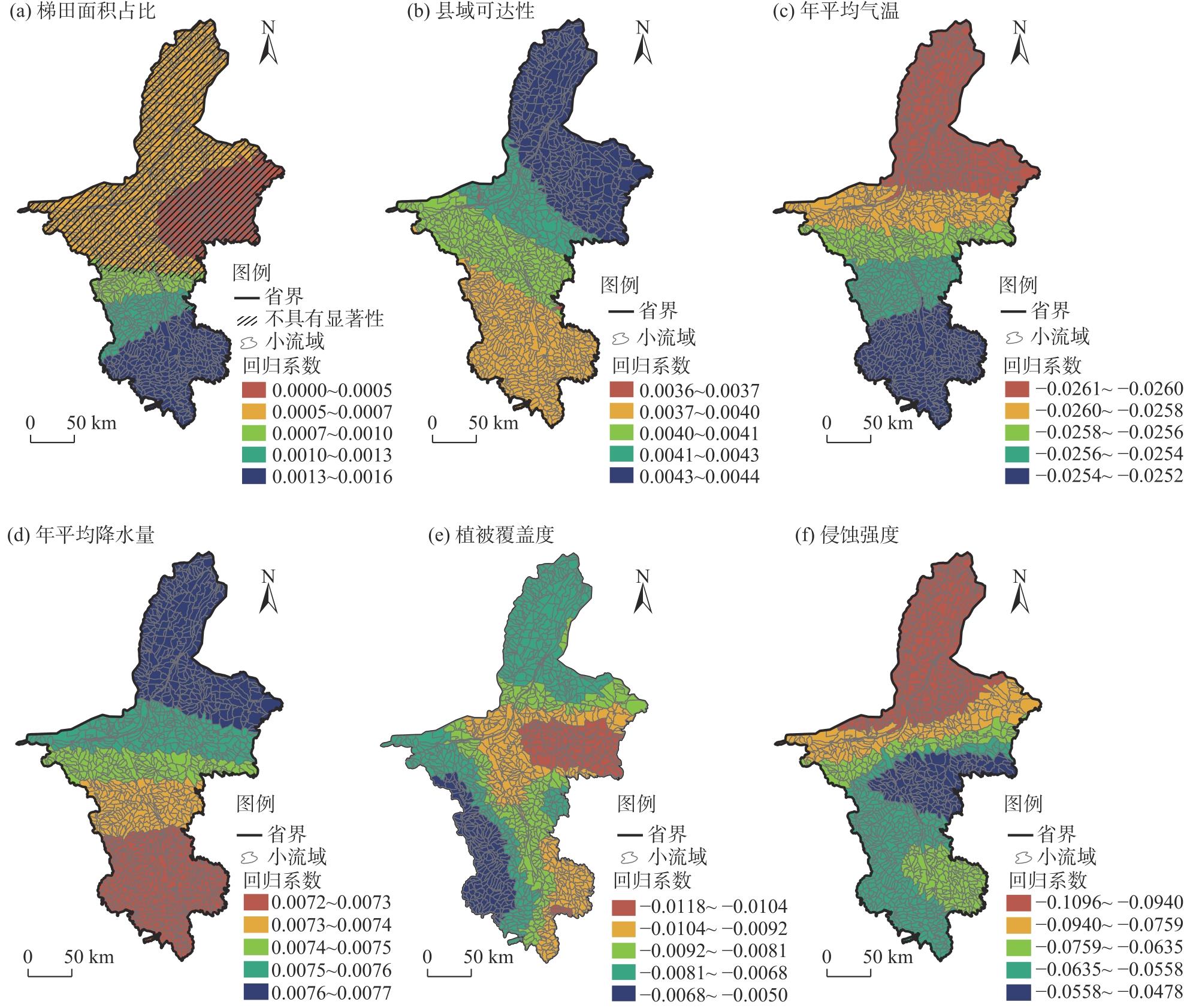
水土资源的耦合协调对于小流域生态系统服务功能的可持续发展具有重要意义。以宁夏小流域为研究单元,采用耦合协调度模型对研究区水土资源耦合协调度进行测度,并采用多尺度地理加权回归模型探究了水土资源耦合协调度的影响因素及空间异质性。 结果表明:(1) 2005—2020年宁夏小流域水土资源耦合协调度从0.37上升到0.43,区域水土资源匹配程度从失调向协调方向发展。(2) 宁夏小流域水土资源耦合协调度呈现出南高北低的空间格局,且2000—2020年南部小流域水土资源耦合协调度的高值区向周边扩展。(3) 宁夏小流域的梯田面积占比、县域可达性和年平均降水量对水土资源耦合协调度会产生显著的正向影响,而年平均气温、植被覆盖度和侵蚀强度对小流域的水土资源耦合协调度会起到显著负向影响;相较于宁夏北部小流域,小流域梯田面积占比和年平均气温对宁夏南部小流域的水土资源耦合协调度影响较大,而县域可达性和年平均降水量对宁夏南部小流域水土资源耦合协调度影响较小。研究结果可为宁夏小流域尺度水土保持措施的科学规划提供参考。
徐建斌, 曹小曙. 宁夏小流域尺度水土资源耦合特征及影响因素[J]. 干旱区地理, 2025, 48(9): 1531-1540.
XU Jianbin, CAO Xiaoshu. Coupling characteristics and influencing factors of water and soil resources at the small watershed scale in Ningxia[J]. Arid Land Geography, 2025, 48(9): 1531-1540.
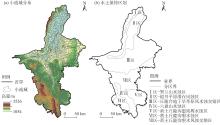
图1
研究区小流域及水土保持区划 注:基于自然资源部标准地图服务网站审图号为GS(2019)3333号的标准地图制作,底图边界无修改。下同。"
表1
数据来源"
| 数据 类别 | 指标 | 数据来源 |
|---|---|---|
| 土地利 用数据 | 人均耕地面积/km2·人-1 | 武汉大学中国土地利用/土地覆被数据( |
| 耕地面积比例/% | 武汉大学中国土地利用/土地覆被数据( | |
| 人均建设用地面积 /km2·人-1 | 武汉大学中国土地利用/土地覆被数据( | |
| 水土保持措施数据 | 淤地坝密度/座·km-2 | 宁夏回族自治区水利厅 |
| 梯田面积占比/% | 宁夏回族自治区水利厅 | |
| 生物措施面积占比/% | 宁夏回族自治区水利厅 | |
| 流域社会经济数据 | 流域人口/人 | 世界人口统计数据和研究开放数据库( |
| 流域经济/104元 | 中国科学院资源环境科学数据平台( | |
| 县域可达性/min | ArcGIS软件结合高德地图API获取 | |
| 流域自然环境数据 | 地形起伏度/(°) | 全球变化科学研究数据出版系统( |
| 平均海拔高度/m | 地理空间数据云平台( | |
| 年平均气温/℃ | 中国科学院资源环境科学数据平台( | |
| 年平均降水量/mm | 中国科学院资源环境科学数据平台( | |
| 植被覆盖度/% | 国家青藏高原科学数据中心( | |
| 侵蚀强度/t·km-2·a-1 | 国家青藏高原科学数据中心( |
表2
水土资源耦合协调度等级划分"
| 耦合协调度 | 协调类型 | 耦合协调度 | 协调类型 |
|---|---|---|---|
| [0.0, 0.1) | 极度失调 | [0.5, 0.6) | 勉强协调 |
| [0.1, 0.2) | 严重失调 | [0.6, 0.7) | 初级协调 |
| [0.2, 0.3) | 中度失调 | [0.7, 0.8) | 中级协调 |
| [0.3, 0.4) | 轻度失调 | [0.8, 0.9) | 良好协调 |
| [0.4, 0.5) | 濒临失调 | [0.9, 1.0] | 优质协调 |
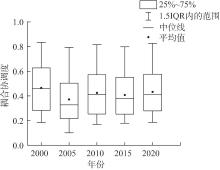
图2
宁夏小流域水土资源耦合协调度变化趋势 注:1.5IQR表示1.5倍的四分位距;25%~75%表示数据分布中第1四分位数到第3四分位数。"
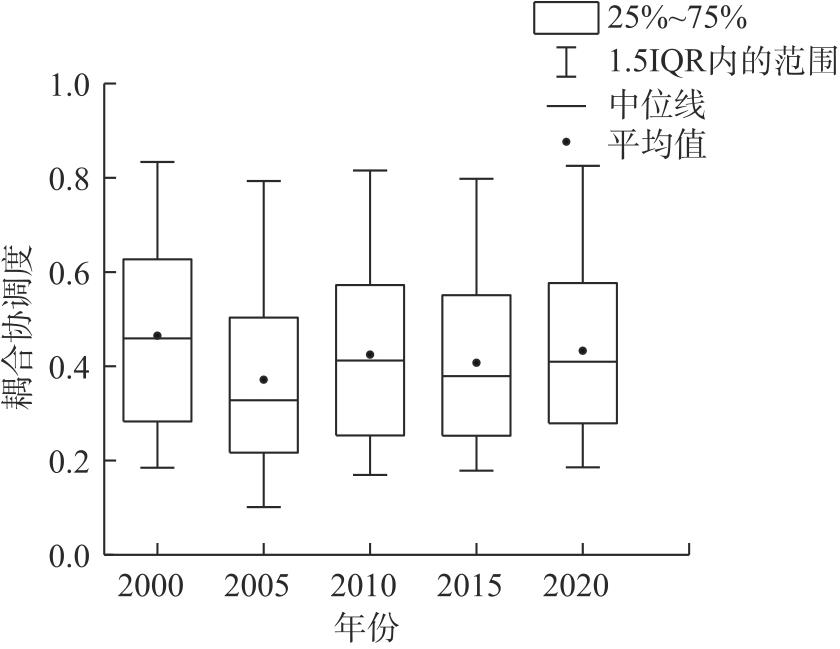
图3
宁夏小流域水土资源耦合协调度空间分布"
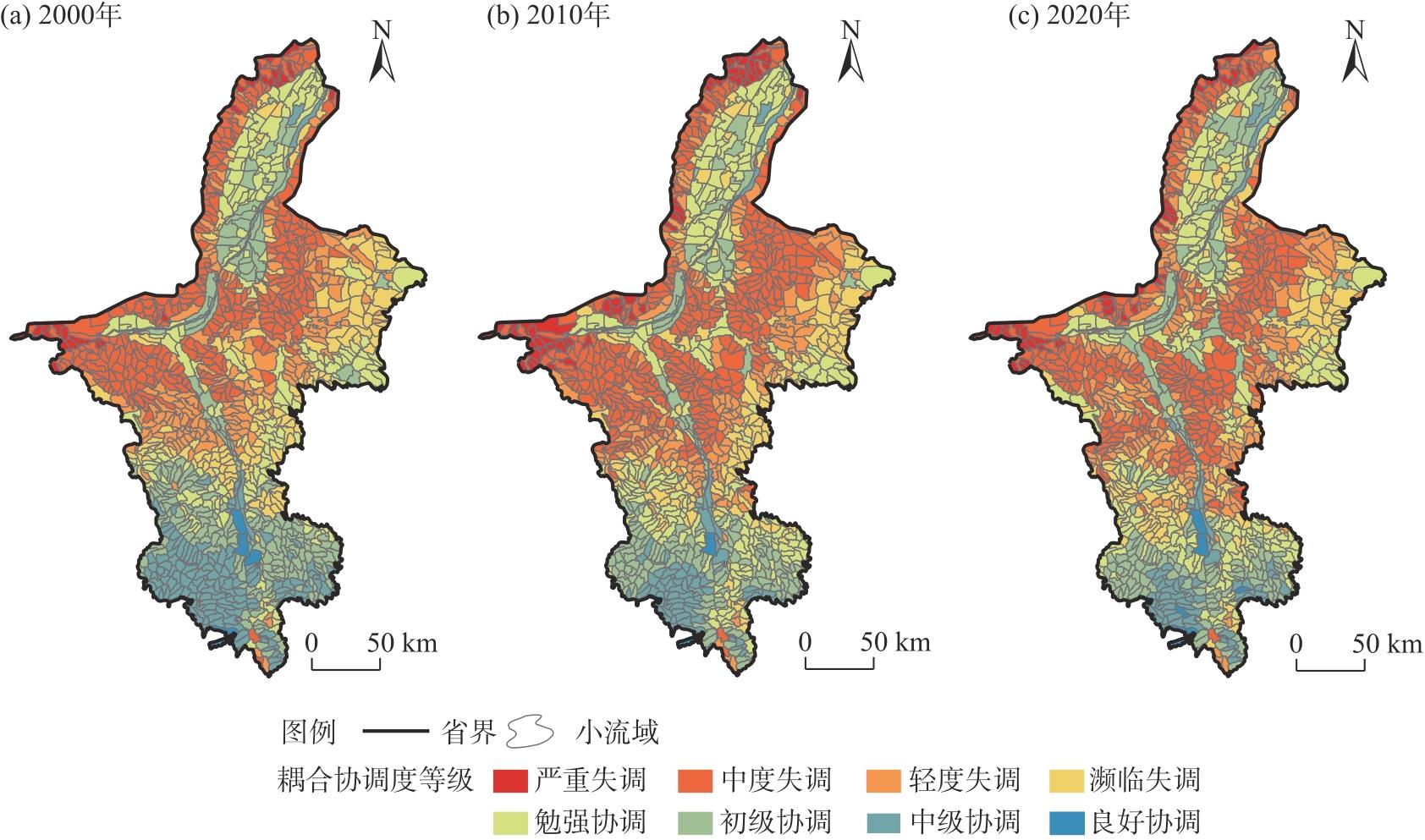
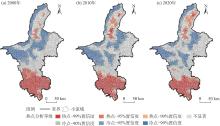
图4
宁夏小流域水土资源耦合协调度热点分析"
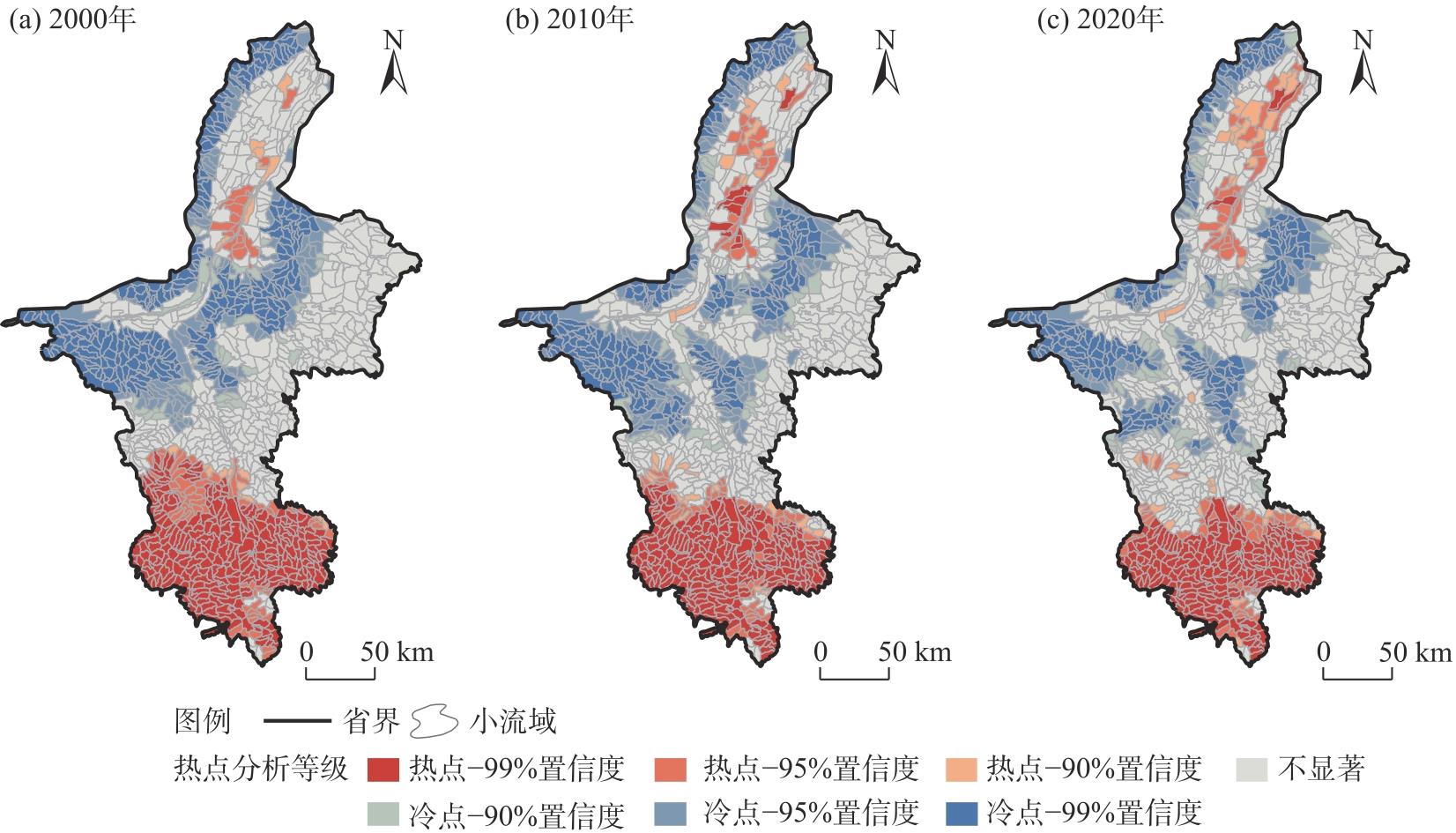
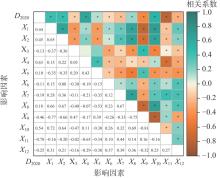
图5
宁夏小流域水土资源耦合协调度与影响因素的相关性分析 注:X1为淤地坝密度;X2为梯田面积占比;X3为生物措施面积占比;X4为流域人口;X5为流域经济;X6为县域可达性;X7为地形起伏度;X8为平均海拔高度;X9为年平均气温;X10为年平均降水量;X11为植被覆盖度;X12为侵蚀强度;D2020为2020年小流域水土资源耦合协调度。*、**、***分别表示在P<0.1、P<0.05、P<0.01水平下显著。"
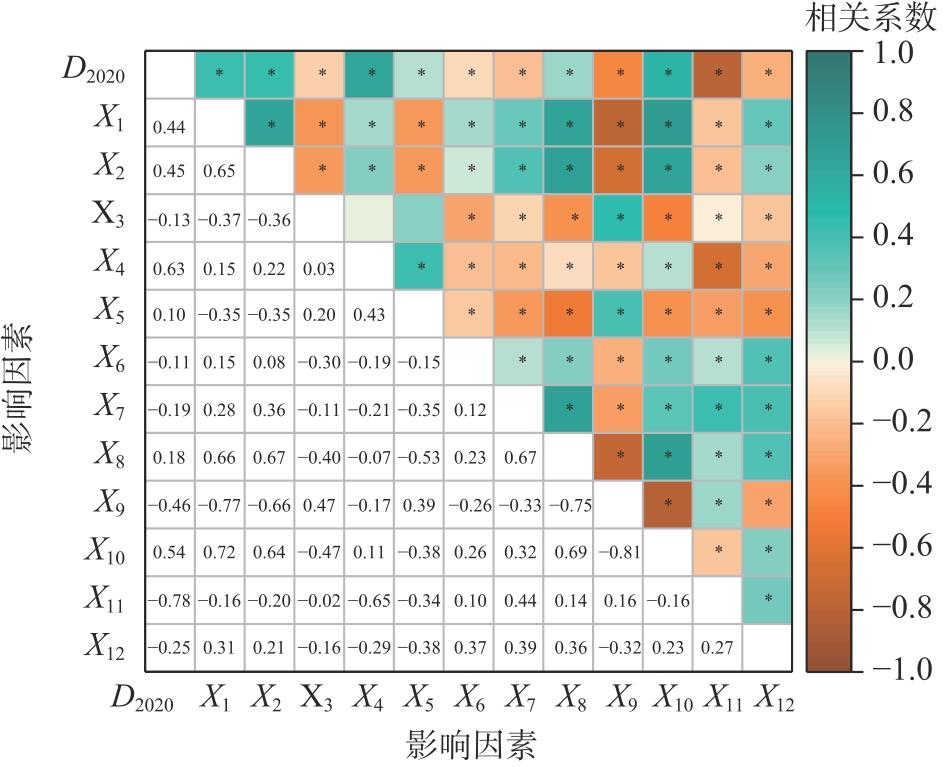
表3
水土资源耦合协调度的MGWR模型回归结果"
| 变量 | 系数平均值 | T统计量 | P值 | 方差膨胀因子 |
|---|---|---|---|---|
| 截距 | 0.931 | 17.167 | 0.000*** | - |
| 淤地坝密度 | -0.033 | -0.129 | 0.897 | 1.738 |
| 梯田面积占比 | 0.000 | 3.048 | 0.002** | 1.698 |
| 生物措施面积占比 | 0.001 | 0.080 | 0.936 | 1.215 |
| 流域人口 | 0.001 | -0.367 | 0.714 | 3.434 |
| 流域经济 | -0.001 | -1.189 | 0.235 | 3.593 |
| 县域可达性 | 0.004 | -6.185 | 0.000*** | 1.224 |
| 地形起伏度 | 0.001 | 2.987 | 0.200 | 2.171 |
| 平均海拔高度 | -0.001 | -4.633 | 0.106 | 5.106 |
| 年平均气温 | -0.026 | -5.266 | 0.000*** | 4.355 |
| 年平均降水量 | 0.001 | 25.264 | 0.000*** | 2.917 |
| 植被覆盖度 | -0.008 | -43.164 | 0.000*** | 1.619 |
| 侵蚀强度 | -0.074 | -10.224 | 0.000*** | 1.480 |
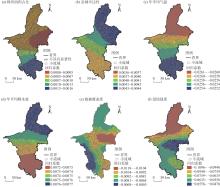
图6
宁夏小流域水土资源耦合协调度影响因素的空间异质性分析"
| [1] | 刘彦随, 吴传钧. 中国水土资源态势与可持续食物安全[J]. 自然资源学报, 2002, 17(3): 270-275. |
|
[Liu Yansui, Wu Chuanjun. Situation of land-water resources and analysis of sustainable food security in China[J]. Journal of Natural Resources, 2002, 17(3): 270-275.]
doi: 10.11849/zrzyxb.2002.03.002 |
|
| [2] |
张恩月, 苏迎庆, 张云枫, 等. 汾河流域水土资源耦合协调格局及驱动因素[J]. 中国沙漠, 2023, 43(3): 169-177.
doi: 10.7522/j.issn.1000-694X.2023.00018 |
|
[Zhang Enyue, Su Yingqing, Zhang Yunfeng, et al. Coupling coordination pattern and driving factors of soil and water resources in Fenhe River Basin of China[J]. Journal of Desert Research, 2023, 43(3): 169-177.]
doi: 10.7522/j.issn.1000-694X.2023.00018 |
|
| [3] | Cheng K, Fu Q, Chen X, et al. Adaptive allocation modeling for a complex system of regional water and land resources based on information entropy and its application[J]. Water Resources Management, 2015, 29(14): 4977-4993. |
| [4] | Ibarrola-rivas M J, Granados-ramírez R, Nonhebel S. Is the available cropland and water enough for food demand? A global perspective of the land-water-food nexus[J]. Advances in Water Resources, 2017, 110: 476-483. |
| [5] | 刘彦随, 甘红, 张富刚. 中国东北地区农业水土资源匹配格局[J]. 地理学报, 2006, 61(8): 847-854. |
|
[Liu Yansui, Gan Hong, Zhang Fugang. Analysis of the matching patterns of land and water resources in northeast China[J]. Acta Geographica Sinica, 2006, 61(8): 847-854.]
doi: 10.11821/xb200608007 |
|
| [6] | 段春青, 刘昌明, 陈晓楠, 等. 区域水资源承载力概念及研究方法的探讨[J]. 地理学报, 2010, 65(1): 82-90. |
|
[Duan Chunqing, Liu Changming, Chen Xiaonan, et al. Preliminary research on regional water resources carrying capacity conception and method[J]. Acta Geographica Sinica, 2010, 65(1): 82-90.]
doi: 10.11821/xb201001009 |
|
| [7] |
马利邦, 田亚亚, 郭晓东, 等. 基于格网的河西绿洲乡村聚落时空演变及其与水土资源的空间耦合关系[J]. 自然资源学报, 2018, 33(5): 775-787.
doi: 10.11849/zrzyxb.20170562 |
|
[Ma Libang, Tian Yaya, Guo Xiaodong, et al. Spatial-temporal change of rural settlements and its spatial coupling relationship with water and soil resources based on grid in the Hexi oasis[J]. Journal of Natural Resources, 2018, 33(5): 775-787.]
doi: 10.11849/zrzyxb.20170562 |
|
| [8] | Rodriguez R, Scanlon B R, King C W, et al. Biofuel-water-land nexus in the last agricultural frontier region of the Brazilian Cerrado[J]. Applied Energy, 2018, 231: 1330-1345. |
| [9] | 张展羽, 司涵, 冯宝平, 等. 缺水灌区农业水土资源优化配置模型[J]. 水利学报, 2014, 45(4): 403-409. |
| [Zhang Zhanyu, Si Han, Feng Baoping, et al. An optimal model for agriculture water and soil resources configuration in water shortage irrigation area[J]. Journal of Hydraulic Engineering, 2014, 45(4): 403-409.] | |
| [10] | Sawaya K E, Olmanson L G, Heinert N J, et al. Extending satellite remote sensing to local scales: Land and water resource monitoring using high-resolution imagery[J]. Remote Sensing of Environment, 2003, 88(1): 144-156. |
| [11] |
王凌阁, 朱睿, 陈泽霞, 等. 甘肃河西地区 2000—2019 年水土资源耦合协调特征[J]. 中国沙漠, 2022, 42(2): 44-53.
doi: 10.7522/j.issn.1000-694X.2021.00108 |
|
[Wang Lingge, Zhu Rui, Chen Zexia, et al. Coupling effect of water-soil resources in Hexi area of Gansu, China in 2000—2019[J]. Journal of Desert Research, 2022, 42(2): 44-53.]
doi: 10.7522/j.issn.1000-694X.2021.00108 |
|
| [12] |
周鹏, 邓伟, 彭立, 等. 典型山地水土要素时空耦合特征及其成因[J]. 地理学报, 2019, 74(11): 2273-2287.
doi: 10.11821/dlxb201911006 |
|
[Zhou Peng, Deng Wei, Peng Li, et al. Spatio-temporal coupling characteristic of water-land elements and its cause in typical mountains[J]. Acta Geographica Sinica, 2019, 74(11): 2273-2287.]
doi: 10.11821/dlxb201911006 |
|
| [13] | 孙宝娣, 于德湖, 崔东旭. 流域生态系统服务和水土资源匹配研究进展[J]. 生态学报, 2023, 43(10): 4308-4318. |
| [Sun Baodi, Yu Dehu, Cui Dongxu. A review of ecosystem services and water-land matching for the river basin[J]. Acta Ecologica Sinica, 2023, 43(10): 4308-4318.] | |
| [14] |
封志明, 杨艳昭, 游珍, 等. 基于分县尺度的中国人口分布适宜度研究[J]. 地理学报, 2014, 69(6): 723-737.
doi: 10.11821/dlxb201406001 |
|
[Feng Zhiming, Yang Yanzhao, You Zhen, et al. Research on the suitability of population distribution at the county level in China[J]. Acta Geographica Sinica, 2014, 69(6): 723-737.]
doi: 10.11821/dlxb201406001 |
|
| [15] | 谭琨, 赵祖军, 赵筱青, 等. 喀斯特山区文山市水土资源利用变化特征及耦合研究[J]. 水土保持研究, 2021, 28(4): 324-332. |
| [Tan Kun, Zhao Zujun, Zhao Xiaoqing, et al. Utilization variation characteristics and coupling of water and land resources in Wenshan City of karst mountain area[J]. Researech of Soil and Water Conservation, 2021, 28(4): 324-332.] | |
| [16] | Salvacion A R. Spatial pattern and determinants of village level poverty in Marinduque Island, Philippines[J]. GeoJournal, 2020, 85(1): 257-267. |
| [17] | Xu J B, Song J, Li B C, et al. Do settlements isolation and land use changes affect poverty? Evidence from a mountainous province of China[J]. Journal of Rural Studies, 2020, 76: 163-172. |
| [18] | Rong Y J, Li K, Guo J W, et al. Multi-scale spatio-temporal analysis of soil conservation service based on MGWR model: A case of Beijing-Tianjin-Hebei, China[J]. Ecological Indicators, 2022, 139: 108946, doi: 10.1016/j.ecolind.2022.108946. |
| [19] | Tu A G, Xie S H, Zheng H J, et al. Long-term effects of living grass mulching on soil and water conservation and fruit yield of citrus orchard in south China[J]. Agricultural Water Management, 2021, 252: 106897, doi: 10.1016/j.agwat.2021.106897. |
| [20] | Bagheri A, Teymouri A. Farmers’ intended and actual adoption of soil and water conservation practices[J]. Agricultural Water Management, 2022, 259: 107244, doi: 10.1016/j.agwat.2021.107244. |
| [21] | 黄明, 张建军, 茹豪, 等. 晋西黄土区不同植被覆盖小流域的产流输沙特性[J]. 中国水土保持科学, 2012, 10(5): 16-23. |
| [Huang Ming, Zhang Jianjun, Ru Hao, et al. Characteristics of runoff and sediment in small watersheds under different vegetation cover in the Loess Plateau of western Shanxi Province[J]. Science of Soil and Water Conservation, 2012, 10(5): 16-23.] | |
| [22] | 卢炜丽, 张洪江, 杜士才, 等. 重庆四面山地区几种不同配置模式水土保持林生物多样性研究[J]. 山地学报, 2009, 27(3): 319-325. |
| [Lu Weili, Zhang Hongjiang, Du Shicai, et al. Studies on biodiversity in five different deposition models of soil and water conservation forest in Chongqing Simian Mountain[J]. Journal of Mountain Science, 2009, 27(3): 319-325.] | |
| [23] | 樊登星, 余新晓, 贾国栋, 等. 密云水库上游不同土地利用方式下的土壤侵蚀特征[J]. 水土保持通报, 2015, 35(1): 5-8. |
| [Fan Dengxing, Yu Xinxiao, Jia Guodong, et al. Characteristics of soil erosion under different landuse types in upper area of Miyun Reservoir[J]. Bulletin of Soil and Water Conservation, 2015, 35(1): 5-8.] | |
| [24] | 饶良懿, 高磊, 彭芳. 水土保持生态效应评价: 内涵、尺度与方法[J]. 环境生态学, 2020, 2(6): 19-26. |
| [Rao Liangyi, Gao Lei, Peng Fang. Ecological effects assessment of soil and water conservation practices: Connotation, scales and methods[J]. Environmental Ecology, 2020, 2(6): 19-26.] | |
| [25] |
利辉, 刘铁军, 王少慧, 等. 2001—2021年内蒙古荒漠草原水分利用效率时空变化特征及影响因素研究[J]. 干旱区地理, 2024, 47(6): 993-1003.
doi: 10.12118/j.issn.1000-6060.2023.388 |
|
[Li Hui, Liu Tiejun, Wang Shaohui, et al. Spatial and temporal variation of water use efficiency and its influencing factors in desert steppe of Inner Mongolia from 2001 to 2021[J]. Arid Land Geography, 2024, 47(6): 993-1003.]
doi: 10.12118/j.issn.1000-6060.2023.388 |
|
| [26] |
马明德, 李俊杰, 薛晨皓. 宁夏区域发展对环境胁迫的时空演变及驱动机制分析[J]. 干旱区地理, 2024, 47(6): 1061-1072.
doi: 10.12118/j.issn.1000-6060.2023.318 |
|
[Ma Mingde, Li Junjie, Xue Chenhao. Spatiotemporal evolution and driving mechanism of environmental stress of regional development in Ningxia Hui Autonomous Region[J]. Arid Land Geography, 2024, 47(6): 1061-1072.]
doi: 10.12118/j.issn.1000-6060.2023.318 |
|
| [27] | Bardram J E. Temporal coordination: On time and coordination of collaborative activities at a surgical department[J]. Computer Supported Cooperative Work, 2000, 9(2): 157-187. |
| [28] |
丛晓男. 耦合度模型的形式、性质及在地理学中的若干误用[J]. 经济地理, 2019, 39(4): 18-25.
doi: 10.15957/j.cnki.jjdl.2019.04.003 |
|
[Cong Xiaonan. Expression and mathematical property of coupling model, and its misuse in geographical science[J]. Economic Geography, 2019, 39(4): 18-25.]
doi: 10.15957/j.cnki.jjdl.2019.04.003 |
|
| [29] | 贾路, 任宗萍, 李占斌, 等. 基于耦合协调度的大理河流域径流和输沙关系分析[J]. 农业工程学报, 2020, 36(11): 86-94. |
| [Jia Lu, Ren Zongping, Li Zhanbin, et al. Relationship between runoff and sediment load in Dali River Basin based on coupling coordination degree[J]. Transactions of the Chinese Society of Agricultural Engineering (Transactions of the CSAE), 2020, 36(11): 86-94.] | |
| [30] | 程飞飞, 李洪庆, 宋红艳, 等. 沿海城市陆海生态环境质量综合评价与耦合协调度[J]. 生态学报, 2024, 44(9): 3855-3867. |
| [Cheng Feifei, Li Hongqing, Song Hongyan, et al. Comprehensive evaluation and coupling coordination analysis of land and sea ecological environment quality in coastal cities[J]. Acta Ecologica Sinca, 2024, 44(9): 3855-3867.] | |
| [31] |
王冠孝, 王伟, 张娟娟. 乡村旅游与农村人居环境的耦合协调关系及障碍因子诊断——以山西省为例[J]. 干旱区地理, 2024, 47(1): 170-180.
doi: 10.12118/j.issn.1000-6060.2023.271 |
|
[Wang Guanxiao, Wang Wei, Zhang Juanjuan. Coupling coordinative relationship and its obstacle factors between rural tourism and rural human settlement environment: A case of Shanxi Province[J]. Arid Land Geography, 2024, 47(1): 170-180.]
doi: 10.12118/j.issn.1000-6060.2023.271 |
|
| [32] | 胡望舒, 洪辉, 周侃, 等. 黄土丘陵区水平梯田与农民收入的关系及原因——以宁夏回族自治区固原市为例[J]. 干旱区地理, 2013, 36(3): 536-544. |
| [Hu Wangshu, Hong Hui, Zhou Kan, et al. Relationship of level terrace and farmers’ income and its causes in Loess Hilly Region: A case study in Guyuan, Ningxia[J]. Arid Land Geography, 2013, 36(3): 536-544.] | |
| [33] | 晁永福. 彭阳县水土保持工程建设以奖代补试点成效与经验[J]. 中国水土保持, 2020, 40(5): 65-66. |
| [Chao Yongfu. The effectiveness and experience of the pilot project of rewarding instead of subsidizing in soil and water conservation engineering construction in Pengyang County[J]. Soil and Water Conservation in China, 2020, 40(5): 65-66.] | |
| [34] |
罗庆, 王冰冰, 樊新生, 等. 山区县人口分布的时空特征及主要影响因素分析——以河南省嵩县为例[J]. 地理科学进展, 2020, 39(7): 1073-1084.
doi: 10.18306/dlkxjz.2020.07.001 |
|
[Luo Qing, Wang Bingbing, Fan Xinsheng, et al. Spatio-temporal change of population distribution and its influencing factors in a poor mountainous county: A case study of Song County, Henan Province[J]. Progress in Geography, 2020, 39(7): 1073-1084.]
doi: 10.18306/dlkxjz.2020.07.001 |
|
| [35] | 赖承义, 左舒翟, 任引. 不同生态修复措施和环境因素对亚热带红壤区针叶纯林坡面水土保持功能的影响[J]. 生态学报, 2021, 41(12): 4913-4922. |
| [Lai Chengyi, Zuo Shuzhai, Ren Yin. Impacts of different ecological restoration measures and environmental factors on water and soil conservation of the slope in the pure coniferous forest of the subtropical red soil area[J]. Acta Ecologica Sinica, 2021, 41(12): 4913-4922.] |
| [1] | 周涛, 王亚娟, 刘小鹏. 宁夏沿黄城市群新型城镇化与低碳发展的耦合交互研究[J]. 干旱区地理, 2025, 48(8): 1457-1468. |
| [2] | 王鑫, 郑芳, 何铃瑶, 何浩亮, 侯迎. 宁夏县域共同富裕水平时空分异格局及驱动因素研究[J]. 干旱区地理, 2025, 48(7): 1293-1303. |
| [3] | 袁梦, 谢保鹏, 田丽敏, 陈英, 裴婷婷. 六盘山甘肃片区土地利用多功能与多维相对贫困的时空耦合关系[J]. 干旱区地理, 2025, 48(7): 1304-1316. |
| [4] | 刘海军, 张海虹, 闫俊杰, 李想, 李高峰. 新疆农业碳排放效率时空异质性及其影响因素[J]. 干旱区地理, 2025, 48(5): 866-878. |
| [5] | 侯彩霞, 张宇宙, 杨建平. 关中平原城市群水资源-社会-生态系统耦合协调及障碍因子分析[J]. 干旱区地理, 2025, 48(4): 717-727. |
| [6] | 王超, 雷婷, 孟晓莎, 樊建强. “交旅”融合下旅游经济与高速交通协调发展分析——以关中平原城市群为例[J]. 干旱区地理, 2024, 47(6): 1015-1025. |
| [7] | 马明德, 李俊杰, 薛晨皓. 宁夏区域发展对环境胁迫的时空演变及驱动机制分析[J]. 干旱区地理, 2024, 47(6): 1061-1072. |
| [8] | 王岱, 崔洋, 王素艳, 张雯. 1961—2020年宁夏干旱事件年代际变化及风险评估[J]. 干旱区地理, 2024, 47(5): 785-797. |
| [9] | 袁庆雯, 刘艳芳, 赵金梅, 安睿, 刘耀林. 宁夏开发区土地集约利用时空分布特征与驱动因素分析[J]. 干旱区地理, 2024, 47(5): 861-871. |
| [10] | 曹佳琳, 刘艳芳, 赵金梅, 安睿, 胡艺川, 孙文杰, 辛格格. 宁夏城市建设用地节约集约利用与高质量发展耦合协调研究[J]. 干旱区地理, 2024, 47(5): 872-884. |
| [11] | 刘玒玒, 刘书芳. 祁连山地区复合生态系统韧性时空演化及障碍因子识别[J]. 干旱区地理, 2024, 47(2): 237-247. |
| [12] | 万赟, 吴文恒, 刘金凤, 史海金, 刘力萌. 近30 a黄河流域中心城市空间扩展特征及启示[J]. 干旱区地理, 2024, 47(2): 281-292. |
| [13] | 高亚苗, 陈浩楠, 王芳, 南雄雄, 陈红翔, 李文慧. 宁夏典型粮食作物生产水足迹时空演变及节水潜力评价[J]. 干旱区地理, 2024, 47(12): 2005-2016. |
| [14] | 张立新, 张家瑞. 中国新基建与区域韧性耦合协调发展:时空差异与演变趋势[J]. 干旱区地理, 2024, 47(12): 2164-2176. |
| [15] | 李海央, 杨敏. 中国西北农作制区耕地利用“显-隐性”形态耦合协调度研究[J]. 干旱区地理, 2024, 47(11): 1924-1934. |
|
||