干旱区地理 ›› 2025, Vol. 48 ›› Issue (8): 1385-1395.doi: 10.12118/j.issn.1000-6060.2024.542 cstr: 32274.14.ALG2024542
仲嘉维( ), 郑军(), 张明月
收稿日期:2024-09-10
修回日期:2024-12-09
出版日期:2025-08-25
发布日期:2025-08-21
通讯作者:
郑军(1971-),男,教授,博士生导师,主要从事生态农业与农业绿色发展等方面研究. E-mail: zhengjun9200@126.com作者简介:仲嘉维(2000-),女,博士研究生,主要从事生态农业与农业绿色发展等方面研究. E-mail: zhongjiawei1222@163.com
基金资助:
ZHONG Jiawei(), ZHENG Jun(), ZHANG Mingyue
Received:2024-09-10
Revised:2024-12-09
Published:2025-08-25
Online:2025-08-21
摘要: 发展农业社会化服务是农业现代化建设的重要内容,在粮食与生态“双安全”的格局下,探究其对粮食生态效率的贡献,对实现农业可持续发展具有重要意义。研究采用2011—2020年黄河流域71个地级市的面板数据,聚焦农业社会化服务对粮食生态效率的空间溢出及非线性效应。结果表明:(1)研究期内,黄河流域城市群粮食生态效率呈明显的改善趋势;空间上,呈现非均衡交错的分布格局,效率优良及以上等级的地市主要分布在黄河流域的下游和中游地区,相对而言,效率中等和效率低下的区域多分布在黄河上游地区。(2)农业社会化服务对粮食生态效率具有显著的正向空间溢出效应,即农业社会化服务既能显著提高本地区的粮食生态效率,而且能辐射带动邻近地区,这一结果经过一系列稳健性检验依然成立。(3)农业社会化服务对粮食生态效率的影响存在复杂的双重门槛效应和人均种植规模发展的适度区间,具体表现为随着人均种植规模的扩大,农业社会化服务对粮食生态效率的积极影响呈现非线性递减态势。
仲嘉维, 郑军, 张明月. 农业社会化服务如何影响粮食生态效率——以黄河流域71个地级市为例[J]. 干旱区地理, 2025, 48(8): 1385-1395.
ZHONG Jiawei, ZHENG Jun, ZHANG Mingyue. How does agricultural socialization service affect grain eco-efficiency: A case study of 71 prefecture-level cities in the Yellow River Basin[J]. Arid Land Geography, 2025, 48(8): 1385-1395.
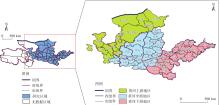
图1
研究区示意图 注:基于自然资源部标准地图服务网站审图号为GS(2023)2767号的标准地图制作,底图边界无修改。下同。"


表1
粮食生态效率测度指标"
| 类型 | 指标 | 指标说明 |
|---|---|---|
| 投入指标 | 劳动力投入 | 农林牧渔业从业人数×(农业产值/农林牧渔总产值)×(粮食播种面积/农作物播种总面积) |
| 土地投入 | 粮食作物播种面积 | |
| 灌溉投入 | 有效灌溉面积×(粮食播种面积/农作物播种面积) | |
| 农资投入 | 农用机械动力×(粮食播种面积/农作物播种面积) | |
| 化肥施用量×(粮食播种面积/农作物播种面积) | ||
| 期望产出 | 经济效应产出 | 粮食产量 |
| 非期望产出 | 碳排放量 | 利用碳排放系数测算的农业碳排放量×(粮食播种面积/农作物播种面积) |

图2
黄河流域粮食生态效率空间格局演进"
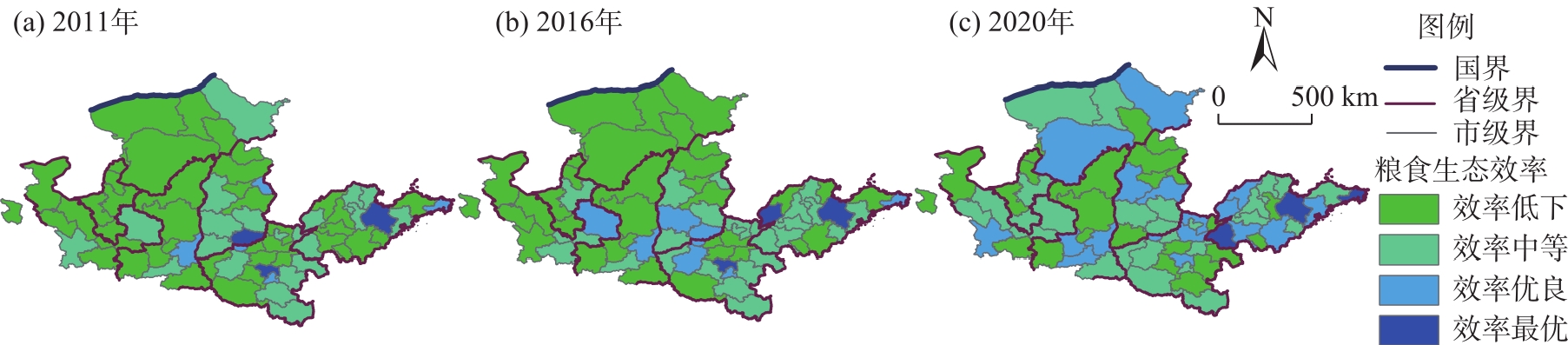
表2
黄河流域粮食生态效率空间自相关检验"
| 指标 | 2011年 | 2012年 | 2013年 | 2014年 | 2015年 | 2016年 | 2017年 | 2018年 | 2019年 | 2020年 |
|---|---|---|---|---|---|---|---|---|---|---|
| Moran’s I | 0.03 | 0.01 | 0.02 | 0.01 | 0.01 | 0.03 | 0.04 | 0.05 | 0.08 | 0.01 |
| Z值 | 3.10 | 2.01 | 2.11 | 1.96 | 1.66 | 2.91 | 3.61 | 4.49 | 5.66 | 1.68 |
| P值 | 0.00 | 0.02 | 0.02 | 0.03 | 0.05 | 0.00 | 0.00 | 0.00 | 0.00 | 0.05 |
表3
LM检验、Hausman检验结果"
| 检验项目 | 反地理距离权重矩阵 | |
|---|---|---|
| 统计量 | P值 | |
| 空间误差模型的拉格朗日乘数检验 | 21.09 | 0.00 |
| 基于稳健的空间误差模型的拉格朗日乘数检验 | 5.49 | 0.01 |
| 空间滞后模型的拉格朗日乘数检验 | 35.55 | 0.00 |
| 基于稳健的空间滞后模型的拉格朗日乘数检验 | 19.94 | 0.00 |
| 豪斯曼检验 | 89.32 | 0.00 |
| 个体固定效应检验 | 3.55 | 0.46 |
| 时间固定效应检验 | 368.48 | 0.00 |
| 模型选择 | 时间固定效应模型 | |
表4
反地理距离矩阵下时间固定效应的空间杜宾模型估计结果"
| 变量 | 模型系数 | 空间滞后项 | Spatial-rho | 直接效应 | 间接效应 | 总效应 |
|---|---|---|---|---|---|---|
| 农业社会化服务 | 0.76*** | -0.12 | 0.45*** | 0.77*** | 0.41*** | 1.18*** |
| (36.23) | (-0.74) | (3.51) | (35.51) | (2.84) | (8.04) | |
| 城镇化水平 | 0.01** | -0.01*** | 0.01** | -0.01** | -0.01* | |
| (2.02) | (-2.86) | (2.50) | (-2.47) | (-1.86) | ||
| 人均种植规模 | -0.09* | 1.36 | -0.08* | 0.31 | 0.23 | |
| (-1.95) | (1.19) | (-1.93) | (0.48) | (0.35) | ||
| 机械化率 | 0.01* | 0.19 | 0.01* | -0.00 | 0.00 | |
| (1.83) | (0.60) | (1.82) | (-0.07) | (0.16) | ||
| 财政支农力度 | 0.01 | -0.01 | 0.05 | 2.47 | 2.51 | |
| (0.03) | (-0.29) | (0.27) | (1.21) | (1.22) |
表5
稳健性检验"
| 变量 | 替换模型 | 替换矩阵 | ||
|---|---|---|---|---|
| 空间误差模型 | 空间滞后模型 | 经济地理嵌套矩阵 | ||
| 农业社会化服务 | 0.76*** | 0.76*** | 0.89*** | |
| (35.86) | (35.74) | (48.76) | ||
| 城镇化水平 | 0.00*** | 0.01** | -0.00 | |
| (2.61) | (2.52) | (-1.47) | ||
| 人均种植规模 | -0.09** | -0.10** | -0.14 | |
| (-2.16) | (-2.20) | (-0.93) | ||
| 机械化率 | 0.00* | 0.01* | 0.08*** | |
| (1.79) | (1.87) | (3.08) | ||
| 财政支农力度 | 0.00 | 0.04* | 0.01*** | |
| (0.02) | (1.83) | (6.06) | ||
表6
门槛效应检验"
| 门槛个数 | 门槛值 | F值 | P值 | 10%临界值 | 5%临界值 | 1%临界值 |
|---|---|---|---|---|---|---|
| 单一门槛 | 0.77 | 143.58 | 0.00 | 19.33 | 23.88 | 33.35 |
| 双重门槛 | 0.84 | 130.81 | 0.00 | 17.06 | 22.85 | 29.08 |
| 三重门槛 | 0.85 | 33.21 | 0.25 | 57.07 | 67.44 | 86.42 |
表7
门槛回归结果"
| 变量 | 粮食生态效率 | P值 |
|---|---|---|
| 人均种植规模≤0.77 | 0.83*** | 0.00 |
| (38.30) | ||
| 0.77<人均种植规模≤0.84 | 0.78* | 0.07 |
| (1.77) | ||
| 人均种植规模>0.84 | 0.54*** | 0.00 |
| (15.80) | ||
| 控制变量 | 控制 | |
| 常数项 | 0.17*** | 0.00 |
| (3.59) | ||
| [1] |
吴尚, 翟彬, 程利莎. 黄河流域城市创新能力测度及空间分异研究[J]. 干旱区地理, 2024, 47(4): 720-732.
doi: 10.12118/j.issn.1000-6060.2023.300 |
|
[Wu Shang, Zhai Bin, Cheng Lisha. Measurement and spatial differentiation of innovation capacity of cities in Yellow River Basin[J]. Arid Land Geography, 2024, 47(4): 720-732. ]
doi: 10.12118/j.issn.1000-6060.2023.300 |
|
| [2] | 钱昭英, 刘书杰. 黄河流域农业绿色低碳生产效率空间关联网络结构特征及驱动因素识别[J]. 干旱区资源与环境, 2024, 38(2): 27-38. |
| [Qian Zhaoying, Liu Shujie. On the characteristics and drivers of spatial correlation network of green low-carbon agricultural production efficiency in the Yellow River Basin[J]. Journal of Arid Land Resources and Environment, 2024, 38(2): 27-38. ] | |
| [3] | 王帅, 王亚静, 方正, 等. 中国粮食生态效率: 水平测度、时空格局演变与影响因素[J]. 农业资源与环境学报, 2024, 41(3): 706-716. |
| [Wang Shuai, Wang Yajing, Fang Zheng, et al. Grain eco-efficiency in China: Horizontal measurement, spatio-temporal pattern evolution and influencing factors[J]. Journal of Agricultural Resources and Environment, 2024, 41(3): 706-716. ] | |
| [4] | Yang B, Wang Z Q, Zou L, et al. Exploring the eco-efficiency of cultivated land utillzation and its influencing factors in China’s Yangtze River Economic Belt, 2001—2018[J]. Journal of Environmental Management, 2021, 294(9): 1-10. |
| [5] | 鲁庆尧, 张旭青, 孟祥海. 我国粮食种植生态效率的空间相关性及影响因素研究[J]. 经济问题, 2021(8): 82-88, 94. |
| [Lu Qingyao, Zhang Xuqing, Meng Xianghai. Empirical analysis of the influence spatial correlation and influencing factors of ecological efficiency of grain planting in China[J]. On Economic Problems, 2021(8): 82-88, 94. ] | |
| [6] | 匡远配, 张容. 农地流转对粮食生产生态效率的影响[J]. 中国人口·资源与环境, 2021, 31(4): 172-180. |
| [Kuang Yuanpei, Zhang Rong. Effect of farmland transfer on the ecological efficiency of food production[J]. China Population, Resources and Environment, 2021, 31(4): 172-180. ] | |
| [7] | 鲁庆尧, 王树进, 孟祥海. 基于SBM模型的我国粮食生产生态效率测度与PS收敛检验[J]. 农村经济, 2020(12): 24-32. |
| [Lu Qingyao, Wang Shujin, Meng Xianghai. Eco-efficiency measurement and PS convergence test of grain production in China based on SBM model[J]. Rural Economy, 2020(12): 24-32. ] | |
| [8] | 杨志海. 老龄化、社会网络与农户绿色生产技术采纳行为——来自长江流域六省农户数据的验证[J]. 中国农村观察, 2018(4): 44-58. |
| [Yang Zhihai. Aging, social network and the adoption of green production technology: Evidence from farm households in six provinces in the Yangtze River Basin[J]. China Rural Survey, 2018(4): 44-58. ] | |
| [9] | 杨彩艳, 齐振宏, 黄炜虹, 等. 效益认知对农户绿色生产技术采纳行为的影响——基于不同生产环节的异质性分析[J]. 长江流域资源与环境, 2021, 30(2): 448-458. |
| [Yang Caiyan, Qi Zhenhong, Huang Weihong, et al. Impact of benefit cognition on farmers’ green production technology adoption behavior: Based on the heterogeneity analysis of different production links[J]. Resources and Environment in the Yangtze Basin, 2021, 30(2): 448-458. ] | |
| [10] |
田旭, 王善高. 中国粮食生产环境效率及其影响因素分析[J]. 资源科学, 2016, 38(11): 2106-2116.
doi: 10.18402/resci.2016.11.09 |
| [Tian Xu, Wang Shangao. Environmental efficiency and its determinants regarding China’s grain production[J]. Resources Science, 2016, 38(11): 2106-2116. ] | |
| [11] |
赵雯歆, 罗小锋, 唐林. 劳动力转移对农户粮食绿色生产效率的影响——兼论技术推广的作用[J]. 资源科学, 2023, 45(7): 1440-1454.
doi: 10.18402/resci.2023.07.12 |
|
[Zhao Wenxin, Luo Xiaofeng, Tang Lin. The influence of labor transfer on farmers’ green grain production efficiency: Also discussing the role of technology extension[J]. Resources Science, 2023, 45(7): 1440-1454. ]
doi: 10.18402/resci.2023.07.12 |
|
| [12] | 李自强, 叶伟娇, 梅冬, 等. 环境规制视角下农业基础设施对粮食生态全要素生产率的影响[J]. 中国生态农业学报(中英文), 2022, 30(11): 1862-1876. |
| [Li Ziqiang, Ye Weijiao, Mei Dong, et al. Impacts of agricultural infrastructure on ecology total factor productivity of grain from the perspective of environmental regulation[J]. Chinese Journal of Eco-Agriculture, 2022, 30(11): 1862-1876. ] | |
| [13] | 焦雨欣, 江生忠, 费清. 农业保险能否助力农业绿色发展水平提升?——基于13个粮食主产区的评估[J]. 保险研究, 2023(11): 61-77. |
| [Jiao Yuxin, Jiang Shengzhong, Fei Qing. Does agricultural insurance have an impact on the green development of agriculture? Assessment based on 13 major grain producing regions[J]. Insurance Studies, 2023(11): 61-77. ] | |
| [14] | 路雯晶, 陈卫洪. 新型城镇化对粮食绿色全要素生产率的影响——兼论中介效应与调节效应[J]. 中国生态农业学报(中英文), 2024, 32(3): 529-545. |
| [Lu Wenjing, Chen Weihong. Influence of new urbanization on grain green total factor productivity: The mediating and regulating effects[J]. Chinese Journal of Eco-Agriculture, 2024, 32(3): 529-545. ] | |
| [15] | 张梦玲, 陈昭玖, 翁贞林, 等. 农业社会化服务对化肥减量施用的影响研究——基于要素配置的调节效应分析[J]. 农业技术经济, 2023(3): 104-123. |
| [Zhang Mengling, Chen Zhaojiu, Weng Zhenlin, et al. Research on the influence of agricultural socialized services on fertilizer reduction: Based on the regulatory effect of element configuration[J]. Journal of Agrotechnical Economics, 2023(3): 104-123. ] | |
| [16] | 詹绍菓, 宦梅丽. 农业社会化服务、作物结构趋粮化与化肥减量施用[J]. 农村经济, 2023(5): 96-105. |
| [Zhan Shaoguo, Huan Meili. Agricultural socialization service, grain-oriented crop structure and chemical fertilizer reduction[J]. Rural Economy, 2023(5): 96-105. ] | |
| [17] | 畅倩. 生产环节外包对农业绿色发展的影响研究——基于经济、环境与技术效益的评价[D]. 咸阳: 西北农林科技大学, 2023. |
| [Chang Qian. Impact of outsourcing on agriculture green development:Evaluation based on economic, environmental, and technological benefits[D]. Xianyang: Northwest Agriculture and Forestry University, 2023. ] | |
| [18] | Bambio Y, Agha S B. Land tenure security and investment: Does strength of land right really matter in rural Burkina Faso[J]. World Development, 2018, 111(6): 130-147. |
| [19] | 谢琳, 张禹欣, 钟文晶. 农业社会化服务组织何以促进化肥减量——基于经营主体的匹配效应研究[J]. 华中农业大学学报(社会科学版), 2022(2): 47-56. |
| [Xie Lin, Zhang Yuxin, Zhong Wenjing. How does the development of agricultural social service organizations promote fertilizer reduction: Based on the matching effect with agricultural management entities[J]. Journal of Huazhong Agricultural University (Social Sciences Edition), 2022(2): 47-56. ] | |
| [20] | 展进涛, 张燕媛, 张忠军. 土地细碎化是否阻碍了水稻生产性环节外包服务的发展?[J]. 南京农业大学学报(社会科学版), 2016, 16(2): 117-124. |
| [Zhan Jintao, Zhang Yanyuan, Zhang Zhongjun. Does land fragmentation hinder the implementation of agricultural production links out-sourcing?[J]. Journal of Nanjing Agricultural University (Social Sciences Edition), 2016, 16(2): 117-124. ] | |
| [21] | 刘冬文, 苗哲瑜, 周月书. 数字化“金融+产业”模式: 农业社会化服务创新的机理与案例分析[J]. 农业经济问题, 2023(9): 96-109. |
| [Liu Dongwen, Miao Zheyu, Zhou Yueshu. Digital “finance+industry” model: Mechanism and case study of agricultural socialized service innovation[J]. Issues in Agricultural Economy, 2023(9): 96-109. ] | |
| [22] | 郭庆海. 小农户: 属性、类型、经营状态及其与现代农业衔接[J]. 农业经济问题, 2018(6): 25-37. |
| [Guo Qinghai. Small farmers: Attribute, type, status of management and the way of embedding modern agriculture[J]. Issues in Agricultural Economy, 2018(6): 25-37. ] | |
| [23] | 彭斯, 陈玉萍. 山区农户绿色防控技术采用及其收入效应研究——基于武陵山茶叶主产区的调研证据[J]. 中国农业资源与区划, 2023, 44(1): 24-35. |
| [Peng Si, Chen Yuping. Research on the adoption of green prevention-control technology and its income effect on farmers in mountainous areas: Based on investigative evidence from the main tea-producing regions in Wuling Mountain[J]. Chinese Journal of Agricultural Resources and Regional Planning, 2023, 44(1): 24-35. ] | |
| [24] | 高恩凯, 朱建军, 郑军. 农业社会化服务对化肥减量的影响——基于全国31个省区面板数据的双重检验[J]. 中国生态农业学报(中英文), 2023, 31(4): 632-642. |
| [Gao Enkai, Zhu Jianjun, Zheng Jun. The impact of agricultural socialized services on the reduction of fertilizer: Double inspection based on panel data of 31 provinces in China[J]. Journal of Chinese Ecological Agriculture, 2023, 31(4): 632-642. ] | |
| [25] |
邱俊杰, 任倩, 余劲. 农业劳动力老龄化、农业资本投入与土地利用效率——基于鲁豫皖三省固定农户跟踪调查[J]. 资源科学, 2019, 41(11): 1982-1996.
doi: 10.18402/resci.2019.11.03 |
|
[Qiu Junjie, Ren Qian, Yu Jin. Aging of agricultural labor, agricultural capital investment and land use efficiency: Based on a longitudinal survey of farmers in Shandong, Henan and Anhui[J]. Resources Science, 2019, 41(11): 1982-1996. ]
doi: 10.18402/resci.2019.11.03 |
|
| [26] | 程永生, 张德元, 汪侠. 农业社会化服务绿色发展效应的作用路径研究——基于农户要素禀赋的调节作用[J]. 中国农业资源与区划, 2024, 45(4): 15-27. |
| [Cheng Yongsheng, Zhang Deyuan, Wang Xia. Research on the action path of green development effect of agricultural socialized services: The moderating role of factor endowments based on farm households[J]. Chinese Journal of Agricultural Resources and Regional Planning, 2024, 45(4): 15-27. ] | |
| [27] | Anselin L. Spatial econometrics: Methods and models[J]. Studies in Operational Regional Science, 1988, 85(411): 310-330. |
| [28] | 黄建欢, 方霞, 黄必红. 中国城市生态效率空间溢出的驱动机制: 见贤思齐VS见劣自缓[J]. 中国软科学, 2018(3): 97-109. |
| [Huang Jianhuan, Fang Xia, Huang Bihong. Eco-efficiency competition across Chinese cities: Bottom up or bottom down?[J]. Chinese Soft Science, 2018(3): 97-109. ] | |
| [29] | 叶敬忠, 豆书龙, 张明皓. 小农户和现代农业发展: 如何有机衔接?[J]. 中国农村经济, 2018(11): 64-79. |
| [Ye Jingzhong, Dou Shulong, Zhang Minghao. How can small farmers become organically involved in the development of modern agriculture?[J]. Chinese Rural Economy, 2018(11): 64-79. ] | |
| [30] | Tone K. A slacks-based measure of efficiency in data envelopment analysis[J]. European Journal of Operational Research, 2001, 130(3): 498-509. |
| [31] |
阎晓, 涂建军. 黄河流域资源型城市生态效率时空演变及驱动因素[J]. 自然资源学报, 2021, 36(1): 223-239.
doi: 10.31497/zrzyxb.20210115 |
|
[Yan Xiao, Tu Jianjun. The spatio-temporal evolution and driving factors of eco-efficiency of resource-based cities in the Yellow River Basin[J]. Journal of Natural Resources, 2021, 36(1): 223-239. ]
doi: 10.31497/zrzyxb.20210115 |
|
| [32] | Hansen B E. Threshold effects in non-dynamic panels: Estimation, testing, and inference[J]. Journal of Econometrics, 1999, 93(2): 345-368. |
| [33] | 李明文, 王振华, 张广胜. 农业服务业促进粮食高质量发展了吗——基于272个地级市面板数据的门槛回归分析[J]. 农业技术经济, 2020(7): 4-16. |
| [Li Mingwen, Wang Zhenhua, Zhang Guangsheng. Has agricultural service industry promoted the development of high-quality grain? Threshold regression analysis based on panel data of 272 prefecture-level cities[J]. Journal of Agrotechnical Economics, 2020(7): 4-16. ] | |
| [34] | 何妮, 姚聪莉, 张畅. “双碳”目标下黄河流域农业生态效率的动态演进与收敛特征[J]. 西北农林科技大学学报(社会科学版), 2024, 24(3): 149-160. |
| [He Ni, Yao Congli, Zhang Chang. Dynamic evolution and convergence characteristics of agricultural ecological efficiency in the Yellow River Basin under the “dual carbon” goal[J]. Journal of Northwest A & F University (Social Science Edition), 2024, 24(3): 149-160. ] | |
| [35] | 吴振磊, 张瀚禹, 程旭翀. 黄河流域生态保护与农业现代化协调发展: 特征成因与优化路径[J]. 中国经济问题, 2024(3): 151-166. |
| [Wu Zhenlei, Zhang Hanyu, Cheng Xuchong. Coordinated development of ecological protection and agricultural modernization in the Yellow River Basin: Characteristics, causes, and optimization pathways[J]. China Economic Studies, 2024(3): 151-166. ] | |
| [36] | 杜宇能, 潘驰宇, 宋淑芳. 中国分地区农业现代化发展程度评价——基于各省份农业统计数据[J]. 农业技术经济, 2018(3): 79-89. |
| [Du Yuneng, Pan Chiyu, Song Shufang. Evaluation on the development degree of China’s agricultural modernization: Based on the calculation and grading of agricultural statistics in different regions at provincial level[J]. Journal of Agrotechnical Economics, 2018(3): 79-89. ] | |
| [37] | 李露, 赵巍. 迈向农业现代化之路: 数字乡村建设的路径检验[J]. 华南农业大学学报(社会科学版), 2024, 23(3): 12-22. |
| [Li Lu, Zhao Wei. Mechanism and path of digital rural construction boosting the modernization of Chinese-style agriculture[J]. Journal of South China Agricultural University (Social Science Edition), 2024, 23(3): 12-22. ] | |
| [38] | 高吉喜, 万华伟, 王永财, 等. 大尺度生态质量遥感评价方法构建及应用[J]. 遥感学报, 2023, 27(12): 2860-2872. |
| [Gao Jixi, Wan Huawei, Wang Yongcai, et al. New framework for large-scale ecological quality evaluation and application research using remote sensing data[J]. National Remote Sensing Bulletin, 2023, 27(12): 2860-2872. ] | |
| [39] | LeSage P, Pace R. Introduction to spatial econometrics[M]. Boca Raton, Florida: CRC Press, 2009: 25-42. |
| [40] |
张利国, 冷浪平, 杨胜苏, 等. 土地流转和社会化服务对农业全要素生产率的影响实证分析[J]. 经济地理, 2024, 44(4): 181-189, 240.
doi: 10.15957/j.cnki.jjdl.2024.04.019 |
|
[Zhang Liguo, Leng Langping, Yang Shengsu, et al. Impact of land circulation and agricultural socialized service on agricultural total factor productivity[J]. Economic Geography, 2024, 44(4): 181-189, 240. ]
doi: 10.15957/j.cnki.jjdl.2024.04.019 |
|
| [41] | 张甜, 张艳荣. 粮食主产区农业社会化服务对农业碳排放强度的影响及空间溢出效应[J]. 中国生态农业学报(中英文), 2024, 32(12): 2008-2021. |
| [Zhang Tian, Zhang Yanrong. Impact of agricultural socialization service on the intensity of agricultural carbon emission in major grain-producing areas and its spatial spillover effect[J]. Chinese Journal of Eco-Agriculture, 2024, 32(12): 2008-2021. ] |
| [1] | 李慧, 姚西龙. 水足迹视角下黄河流域可再生能源制氢节水潜力研究[J]. 干旱区地理, 2025, 48(8): 1353-1362. |
| [2] | 程鹏, 彭海洋, 侯丁榕, 孙明东, 宋晓伟. 黄河流域农业灰水足迹强度空间格局及演进趋势[J]. 干旱区地理, 2025, 48(7): 1185-1197. |
| [3] | 徐铭璟, 段宝玲, 冯强, 吕萌. 生态系统服务及其权衡/协同关系多情景模拟——以黄河流域山西段为例[J]. 干旱区地理, 2025, 48(7): 1206-1219. |
| [4] | 任诗琦, 王永瑜. 黄河流域地级市绿色发展水平测度与空间收敛性研究[J]. 干旱区地理, 2025, 48(6): 1031-1042. |
| [5] | 魏建飞, 袁悠燃, 李强, 董佩佩, 刘玖榕. 黄河流域国土空间效率时空变化及障碍因子分析[J]. 干旱区地理, 2025, 48(6): 1055-1066. |
| [6] | 聂寒玉, 张颜辉, 李慧, 郑姚闽. 黄河流域旅游生态韧性发展水平的时空演化及多尺度障碍因子分析[J]. 干旱区地理, 2025, 48(6): 1089-1102. |
| [7] | 谢宇, 薛选登. 数字经济赋能绿色发展福利——基于黄河流域资源型城市的经验证据[J]. 干旱区地理, 2025, 48(6): 1127-1139. |
| [8] | 王瑞芳, 吕宝奇, 张文静. 黄河流域植被动态及其对气候变化的响应——基于气候干湿分区尺度[J]. 干旱区地理, 2025, 48(6): 973-984. |
| [9] | 程兰花, 杨显明, 吴昕燕. 黄河流域城市紧凑度对碳排放绩效的影响[J]. 干旱区地理, 2025, 48(5): 838-853. |
| [10] | 李梦冉, 徐小任, 王梁, 段健, 史舒琪, 任丹丹. 黄河流域农业碳排放时空变化特征及影响因素分析[J]. 干旱区地理, 2025, 48(5): 854-865. |
| [11] | 崔盼盼, 张丽君, 秦耀辰, 夏四友. 黄河流域市域可持续发展状态评价及其驱动因素分析[J]. 干旱区地理, 2025, 48(5): 916-929. |
| [12] | 李维露, 张明斗. 黄河流域城市人口集聚与土地生态韧性的协同性研究[J]. 干旱区地理, 2025, 48(4): 728-738. |
| [13] | 刘园园, 马彩虹, 马丽娅. 黄河流域典型绿洲城市扩张模拟及其生态韧性响应研究[J]. 干旱区地理, 2025, 48(3): 506-516. |
| [14] | 张傲翔, 苗成林, 陈峥妍. 黄河流域城市生态韧性、社会网络及其影响因素分析[J]. 干旱区地理, 2025, 48(1): 130-142. |
| [15] | 杨燕燕, 王永瑜, 徐绮阳. 黄河流域水资源利用驱动因素及脱钩效应研究[J]. 干旱区地理, 2025, 48(1): 20-30. |
|
||