Arid Land Geography ›› 2026, Vol. 49 ›› Issue (5): 939-948.doi: 10.12118/j.issn.1000-6060.2025.761
• Ecology and Environment • Previous Articles Next Articles
GENG Tianwei1,2( ), HAN Wanxing1,2, LIN Fei1,2, LI Zhenhuan3()
Received:2025-11-24
Revised:2025-12-18
Online:2026-05-25
Published:2026-05-25
Contact:
LI Zhenhuan
E-mail:gengtianwei1002@126.com;lizhenhuan@nbufe.edu.cn
GENG Tianwei, HAN Wanxing, LIN Fei, LI Zhenhuan. Spatiotemporal evolution characteristics and influencing factors of the supply and demand relationship of carbon sequestration services in Shaanxi Province[J].Arid Land Geography, 2026, 49(5): 939-948.
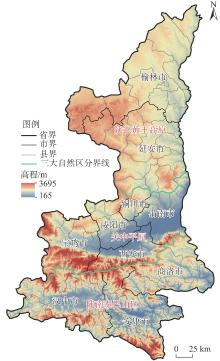
Fig. 1
Schematic diagram of the study area"
Tab. 1
Supply of carbon sequestration in Shaanxi Province from 2015 to 2023 /106 t"
| 区域 | 2015年 | 2020年 | 2023年 |
|---|---|---|---|
| 关中 | 28.18 | 27.04 | 26.05 |
| 陕北 | 32.36 | 31.45 | 32.48 |
| 陕南 | 39.12 | 40.79 | 42.26 |
| 全省 | 99.66 | 99.28 | 100.79 |
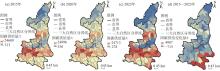
Fig. 2
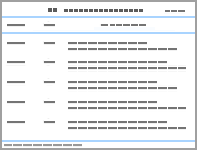
Spatial characteristics of carbon sequestration supply in Shaanxi Province from 2015 to 2023"
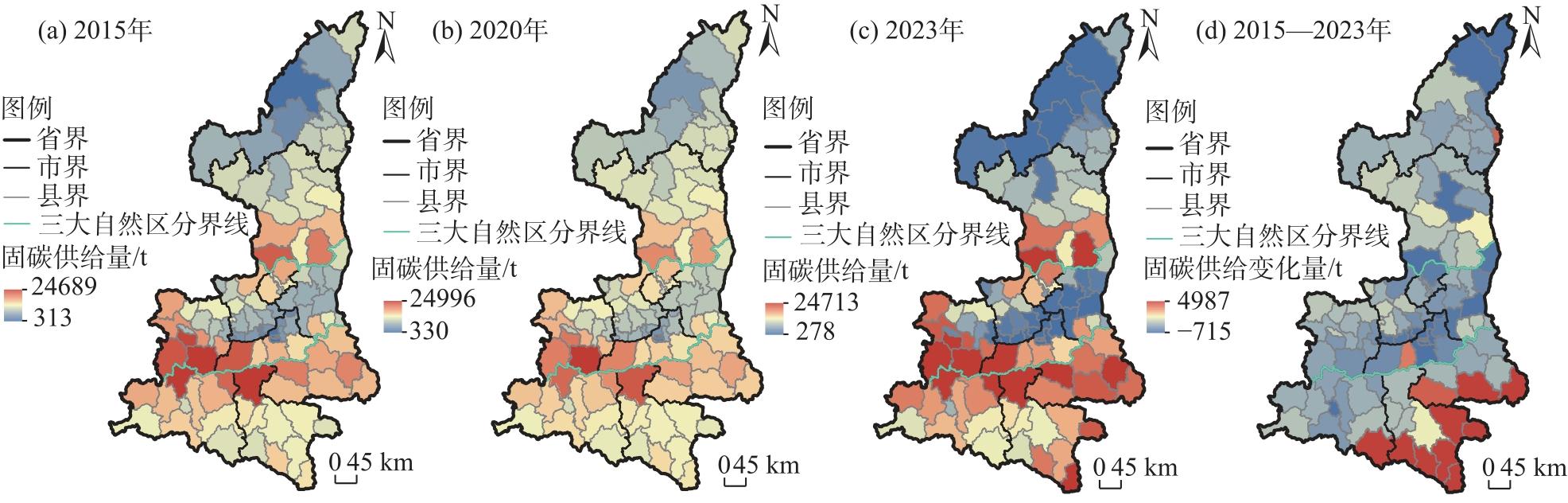
Fig. 3
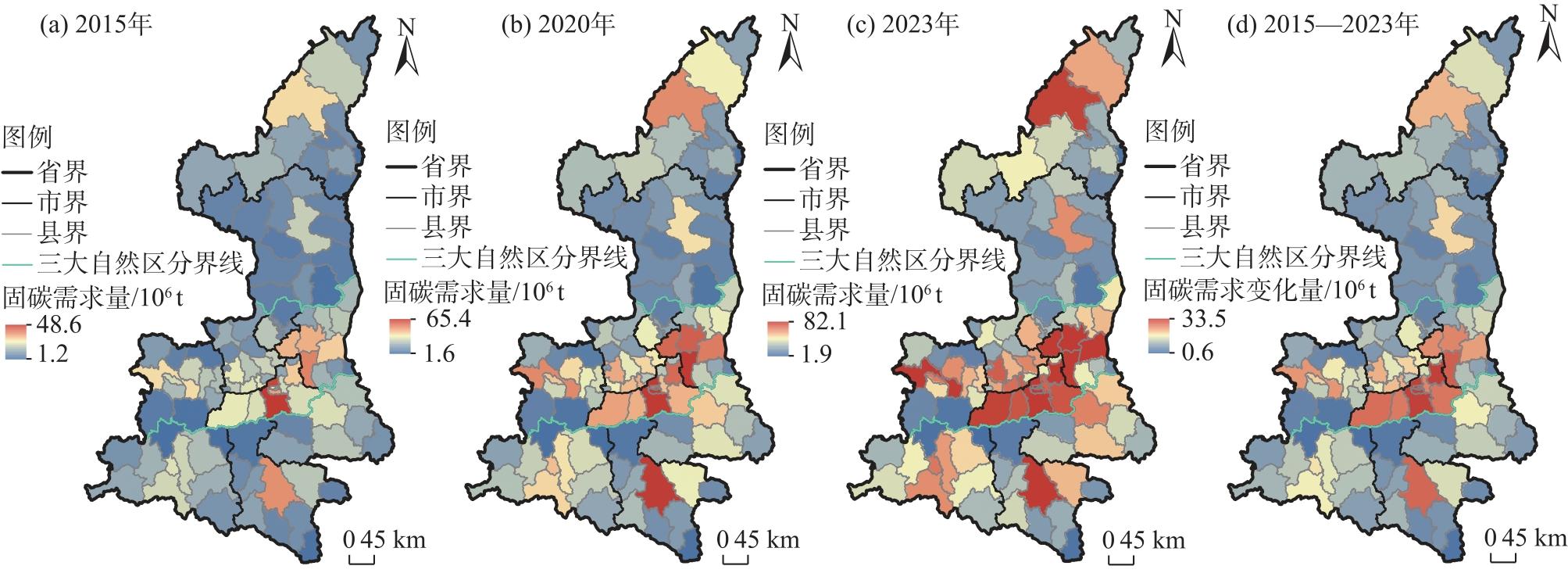
Temporal characteristics of carbon sequestration demand from 2015 to 2023"
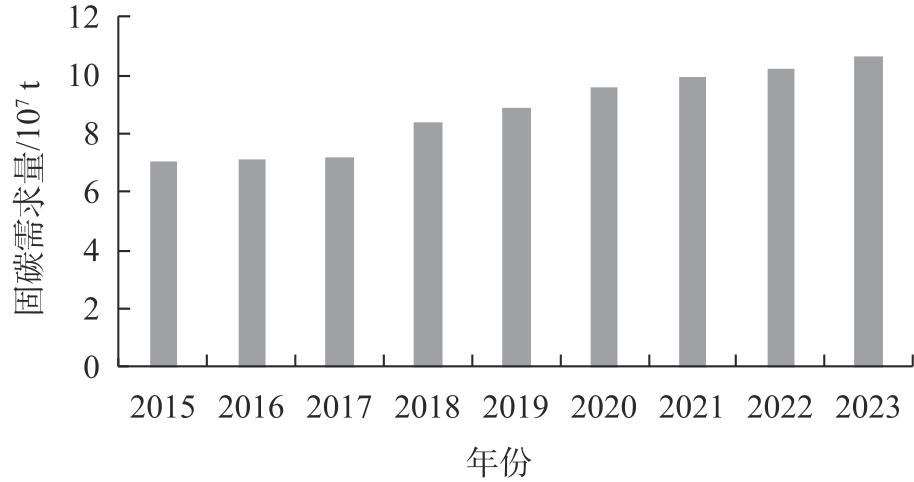
Fig. 4
Spatial characteristics of carbon sequestration demand in Shaanxi Province from 2015 to 2023"
Tab. 2
Supply and demand relationship of carbon sequestration in Shaanxi Province from 2015 to 2023"
| 供需指标 | 2015年 | 2020年 | 2023年 |
|---|---|---|---|
| 供需差值/106 t | 29.46 | 10.58 | -5.81 |
| 供需指数 | 0.17 | 0.05 | -0.03 |
| 供需状态 | 轻度盈余 | 轻度盈余 | 轻度赤字 |
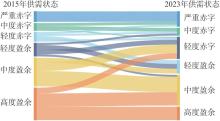
Fig. 5
Transformation of carbon sequestration supply and demand status in Shaanxi Province from 2015 to 2023"
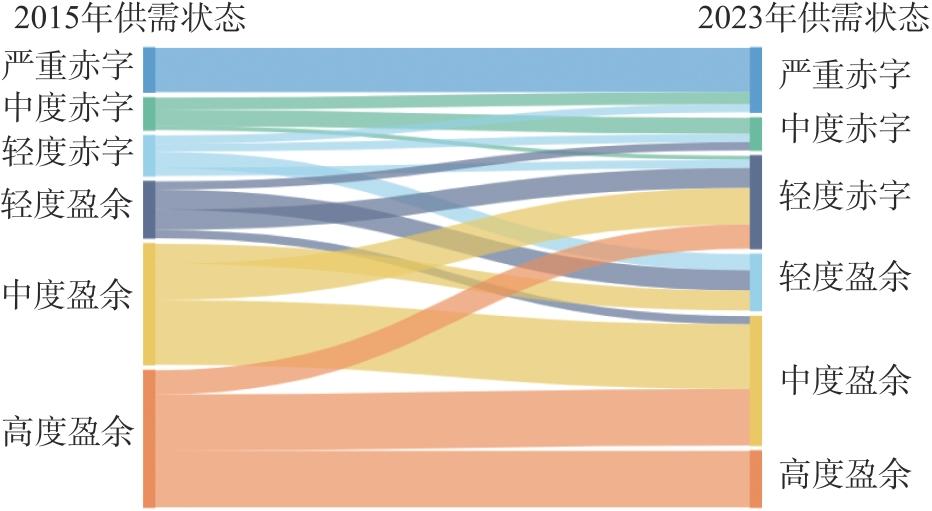
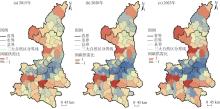
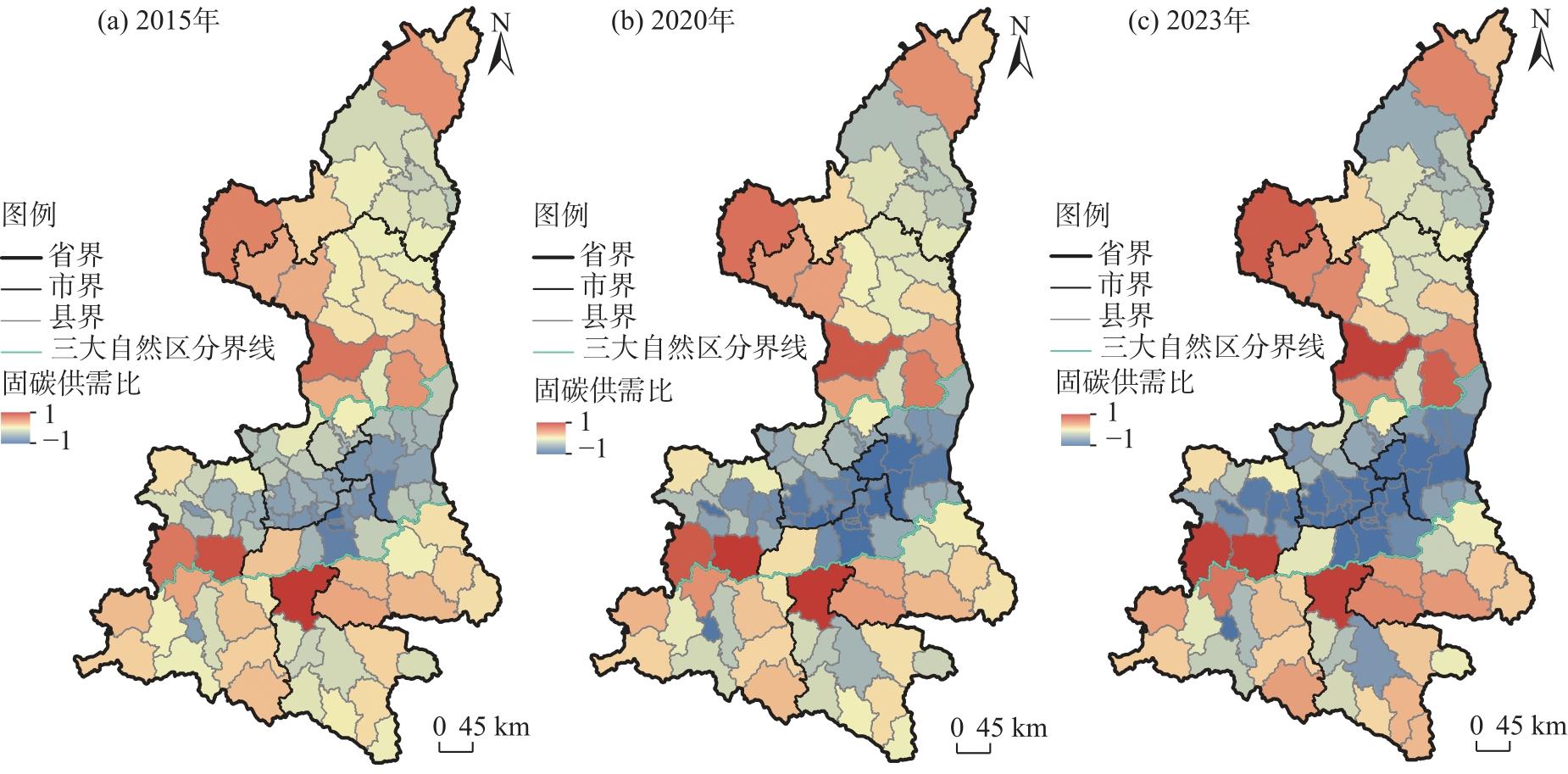
Fig. 6
Spatial characteristics of supply and demand ratio of carbon sequestration in Shaanxi Province from 2015 to 2023"
Tab. 3
Primary selection factors and detection results"
| 影响因素 | 初选因子 | 编号 | q值 | 影响因素 | 初选因子 | 编号 | q值 |
|---|---|---|---|---|---|---|---|
| 自然因素 | 地形起伏度 | N1 | 0.67 | 社会经济因素 | 人均居民可支配收入 | S5 | 0.21* |
| 年均气温 | N2 | 0.07 | 社会消费品零售总额 | S6 | 0.28* | ||
| 年均降水量 | N3 | 0.65** | 人口数量 | S7 | 0.32* | ||
| 日照数 | N4 | 0.24 | 城镇人口数量 | S8 | 0.14 | ||
| 草地面积 | N5 | 0.11 | 能源因素 | 民用汽车拥有量 | E1 | 0.38** | |
| 耕地面积 | N6 | 0.05 | 城市公共交通运营量 | E2 | 0.16* | ||
| 林地面积 | N7 | 0.11* | 私人汽车拥有量 | E3 | 0.39** | ||
| 园林绿化覆盖面积 | N8 | 0.20* | 工业企业能源消耗量 | E4 | 0.31 | ||
| 社会经济因素 | GDP总量 | S1 | 0.15* | 工业废气排放量 | E5 | 0.31* | |
| 人均GDP | S2 | 0.05 | 工业固体废弃物排放量 | E6 | 0.29* | ||
| 工业企业产值 | S3 | 0.08 | 天然气销售量 | E7 | 0.17* | ||
| 第二产业产值 | S4 | 0.08 | 液化石油销售量 | E8 | 0.13 |
Fig. 7
Schematic diagrams of interactive explanatory power of influencing factors"
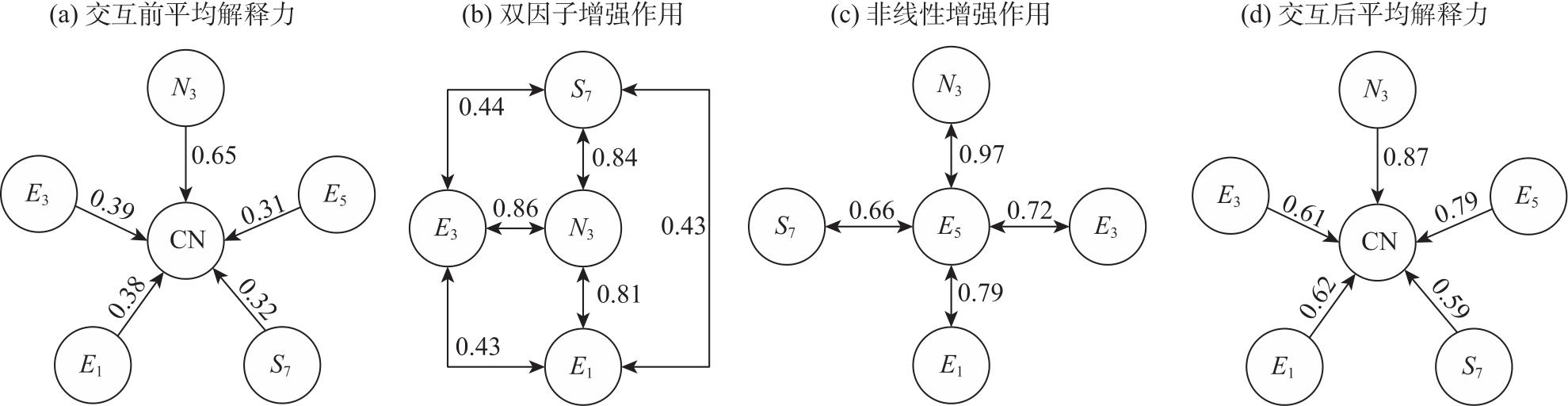
Tab. 4
Interaction results of dominant factors"
| 交互因子 | 解释力 | 解释力排名 | 交互类型 |
|---|---|---|---|
| N3∩E3 | 0.86 | 2 | 双因子增强 |
| N3∩E1 | 0.81 | 4 | 双因子增强 |
| N3∩S7 | 0.84 | 3 | 双因子增强 |
| N3∩E5 | 0.97 | 1 | 非线性增强 |
| E3∩E1 | 0.43 | 9 | 双因子增强 |
| E3∩S7 | 0.44 | 8 | 双因子增强 |
| E3∩E5 | 0.72 | 6 | 非线性增强 |
| E1∩S7 | 0.43 | 10 | 双因子增强 |
| E1∩E5 | 0.79 | 5 | 非线性增强 |
| S7∩E5 | 0.66 | 7 | 非线性增强 |
| [1] | IPCC. Climate change 2021: The physical science basis[R]. Cambridge: Cambridge University Press, 2021. |
| [2] |
李梦冉, 徐小任, 王梁, 等. 黄河流域农业碳排放时空变化特征及影响因素分析[J]. 干旱区地理, 2025, 48(5): 854-865.
doi: 10.12118/j.issn.1000-6060.2024.401 |
|
[Li Mengran, Xu Xiaoren, Wang Liang, et al. Spatial-temporal characteristics and influencing factors of agricultural carbon emissions in the Yellow River Basin[J]. Arid Land Geography, 2025, 48(5): 854-865.]
doi: 10.12118/j.issn.1000-6060.2024.401 |
|
| [3] | 国务院新闻办公室. 碳达峰碳中和的中国行动[R/OL]. [2025-11-19]. https://www.gov.cn/xinwen/2025-11/08/content_5687654.htm. |
| [State Council Information Office of the People’s Republic of China. China’s actions for carbon peaking and carbon neutrality[R/OL]. [2025-11-19]. https://www.gov.cn/xinwen/2025-11/08/content_5687654.htm.] | |
| [4] | 杨文乐. 中国生态系统固碳服务供需平衡时空格局及影响因素研究[D]. 兰州: 西北师范大学, 2024. |
| [Yang Wenle. Research on the spatial-temporal pattern and influencing factors of the balance between supply and demand of carbon sequestration services in Chinese ecosystems[D]. Lanzhou: Northwest Normal University, 2024.] | |
| [5] |
Friedlingstein P, O’Sullivan M, Jones M W, et al. Global carbon budget 2020[J]. Earth System Science Data, 2020, 12(4): 3269-3340.
doi: 10.5194/essd-12-3269-2020 |
| [6] |
Jia B, Zhou G Q. Estimation of global karst carbon sink from 1950s to 2050s using response surface methodology[J]. Geo-Spatial Information Science, 2024, 27(4): 1254-1271.
doi: 10.1080/10095020.2023.2165974 |
| [7] | Zhao C, Sander H A. Quantifying and mapping the supply of and demand for carbon storage and sequestration service fromurban trees[J]. PLoS One, 2015, 10(8): e0136392, doi: 10.1371/journal.pone.0136392. |
| [8] | 耿甜伟. 生态系统服务供需流时空演变特征及调节机制研究——以陕北为例[D]. 西安: 西北大学, 2022. |
| [Geng Tianwei. Research on the spatiotemporal evolution characteristics and regulatory mechanisms of ecosystem service supply and demand flow: A case study of northern Shaanxi[D]. Xi’an: Northwest University, 2022.] | |
| [9] | Ghosh S, Dinda S, Chatterjee N D, et al. Spatial-explicit carbon emission-sequestration balance estimation and evaluation of emission susceptible zones in an eastern Himalayan City using pressure-sensitivity-resilience framework: An approach towards achieving low carbon cities[J]. Journal of Cleaner Production, 2022, 336: 130417, doi: 10.1016/j.jclepro.2022.130417. |
| [10] | 张平平, 李艳红, 殷浩然, 等. 中国南北过渡带生态系统碳储量时空变化及动态模拟[J]. 自然资源学报, 2022, 37(5): 1540-1555. |
|
[Zhang Pingping, Li Yanhong, Yin Haoran, et al. Spatio-temporal variation and dynamic simulation of ecosystem carbon storage in the north-south transitional zone of China[J]. Journal of Natural Resources, 2022, 37(5): 1540-1555.]
doi: 10.31497/zrzyxb.20220612 |
|
| [11] |
殷一丹, 鱼腾飞, 韩拓, 等. 黑河下游胡杨林土壤碳空间分异特征及其影响因素[J]. 干旱区地理, 2025, 48(1): 94-104.
doi: 10.12118/j.issn.1000-6060.2024.125 |
|
[Yin Yidan, Yu Tengfei, Han Tuo, et al. Spatial differentiation and its influencing factors of soil carbon in Populus euphratica Oliv. forest in the lower reach of Heihe River[J]. Arid Land Geography, 2025, 48(1): 94-104.]
doi: 10.12118/j.issn.1000-6060.2024.125 |
|
| [12] | 罗巧灵, 黄荣鋆, 柳明星, 等. 武汉市城市扩张对植被固碳能力间接影响的城乡差异及驱动机制[J]. 环境科学, 2025, 46(11): 6981-6993. |
| [Luo Qiaoling, Huang Rongjun, Liu Mingxing, et al. Urban-rural differences and driving mechanisms of the indirect impact of urban expansion on vegetation carbon sequestration capacity in Wuhan[J]. Environmental Science, 2025, 46(11): 6981-6993.] | |
| [13] | 曹莹. 黄河上游水源涵养区植被恢复合理目标及固碳提升潜力研究[D]. 兰州: 兰州大学, 2024. |
| [Cao Ying. Research on the reasonable objectives and carbon sequestration potential of vegetation restoration in the water source conservation area of the upper Yellow River[D]. Lanzhou: Lanzhou University, 2024.] | |
| [14] | 张炎. “双碳”背景下我国粮食安全与农业固碳减排协同发展研究[D]. 南昌: 南昌大学, 2024. |
| [Zhang Yan. Research on the coordinated development of food security and agricultural carbon sequestration and emission reduction in China under the background of “dual carbon”[D]. Nanchang: Nanchang University, 2024.] | |
| [15] | 王耕, 俞乔山. 大连金普新区碳固持生态服务供需格局时空差异[J]. 生态学报, 2023, 43(12): 4847-4857. |
| [Wang Geng, Yu Qiaoshan. Spatial-temporal pattern of supply and demand of carbon sequestration services in Jinpu New Area, Dalian[J]. Acta Ecologica Sinica, 2023, 43(12): 4847-4857.] | |
| [16] | 徐彩瑶, 崔铭烨, 许文静, 等. 钱江源“山水工程”区生态系统固碳服务供需关系格局变化及其驱动因素[J]. 南京林业大学学报(自然科学版), 2025, 49(3): 1-13. |
| [Xu Caiyao, Cui Mingye, Xu Wenjing, et al. Changes of supply-demand relationship pattern of carbon sequestration services and its driving factors in the Shan-Shui initiative in the source of Qiantang River in China[J]. Journal of Nanjing Forestry University (Natural Science Edition), 2025, 49(3): 1-13.] | |
| [17] | 丁仲礼. 中国碳中和框架路线图研究[J]. 中国工业和信息化, 2021(8): 54-61. |
| [Ding Zhongli. Research on China’s carbon neutralization framework roadmap[J]. China Industry & Information Technology, 2021(8): 54-61.] | |
| [18] | 张蓬涛, 刘双嘉, 周智, 等. 京津冀地区生态系统服务供需测度及时空演变[J]. 生态学报, 2021, 41(9): 3354-3367. |
| [Zhang Pengtao, Liu Shuangjia, Zhou Zhi, et al. Supply and demand measurement and spatiotemporal evolution of ecosystem services in the Beijing-Tianjin-Hebei region[J]. Acta Ecologica Sinica, 2021, 41(9): 3354-3367.] | |
| [19] |
王劲峰, 徐成东. 地理探测器: 原理与展望[J]. 地理学报, 2017, 72(1): 116-134.
doi: 10.11821/dlxb201701010 |
|
[Wang Jinfeng, Xu Chengdong. Geographical detector: Principles and prospects[J]. Acta Geographica Sinica, 2017, 72(1): 116-134.]
doi: 10.11821/dlxb201701010 |
|
| [20] | 耿甜伟, 陈海, 刘迪, 等. 县域尺度下生态系统服务供需匹配及生态建设——以陕西省为例[J]. 地域研究与开发, 2021, 40(2): 144-150. |
| [Geng Tianwei, Chen Hai, Liu Di, et al. Matching supply and demand of ecosystem services and ecological construction at the county level: A case study of Shaanxi Province[J]. Regional Research and Development, 2021, 40(2): 144-150.] | |
| [21] | 王宝强, 陈琦, 张艺宣, 等. 生态-经济社会系统耦合视角下苏州市碳汇绩效评估与对策建议[J]. 长江流域资源与环境, 2025, 34(11): 2433-2444. |
| [Wang Baoqiang, Chen Qi, Zhang Yixuan, et al. Carbon sink performance evaluation and policy recommendations form the perspective of ecological-economic-social system coupling in Suzhou City[J]. Yangtze River Basin Resources and Environment, 2025, 34(11): 2433-2444.] | |
| [22] | 唐云琪, 葛李, 冯虞芯, 等. 基于自动化集成机器学习的污水处理碳排放预测模型构建[J]. 环境科学学报, 2025, 45(12): 1-10. |
| [Tang Yunqi, Ge Li, Feng Yuxin, et al. Construction of a carbon emission prediction model for urban wastewater treatment plants based on automated integrated machine learning[J]. Acta Scientiae Circumstantiae, 2025, 45(12): 1-10.] | |
| [23] | 戴洪霞, 谢慧黎, 陈凌秀, 等. 面向供需协同的闽江流域固碳服务流评价[J]. 环境科学, 2025, 46(9): 5930-5931. |
| [Dai Hongxia, Xie Huili, Chen Lingxiu, et al. Evaluation of carbon sequestration service flow in the Minjiang River Basin for supply demand coordination[J]. Environmental Science, 2025, 46(9): 5930-5931.] |
|
||

