Arid Land Geography ›› 2026, Vol. 49 ›› Issue (2): 381-392.doi: 10.12118/j.issn.1000-6060.2025.310
• Regional Development • Previous Articles Next Articles
LIU Hao1( ), LI Fulian2, WANG Sheng1()
Received:2025-05-28
Revised:2025-07-02
Online:2026-02-25
Published:2026-02-27
Contact:
WANG Sheng
E-mail:lhsdau@163.com;happywangsheng@163.com
LIU Hao, LI Fulian, WANG Sheng. Coupling and coordination pattern and influencing factors of home community elderly care and institutional elderly care in China[J].Arid Land Geography, 2026, 49(2): 381-392.
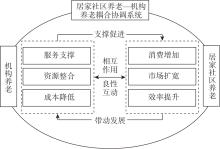
Fig. 1
Coupling and coordination mechanism of the home community elderly care system and institutional elderly care system"
Tab. 1
Indicator system for home community elderly care and institutional elderly care"
| 目标层 | 一级指标 | 二级指标 | 指标说明 | 单位 | 属性 |
|---|---|---|---|---|---|
| 居家社区养老 | 人员情况 | 年末职工数 | 各类社区养老服务机构实有职工人数 | 人 | + |
| 社会工作师人数 | 通过全国社工职业水平考试的人员总数 | 人 | + | ||
| 硬件设施 | 每千老人社区养老服务机构数 | 社区服务机构和设施总数/60岁以上老年人口数 | 个·(103人)-1 | + | |
| 每千老人居家社区养老床位数 | (特困人员救助供养机构床位、全托服务社区养老服务机构和设施床位、日间照料社区养老服务机构床位和社区互助型养老设施床位数总和)/60岁以上老年人口数 | 张·(103人)-1 | + | ||
| 老年人人均居家社区养老建筑面积 | 各类社区养老服务机构和设施建筑面积总和/60岁以上老年人口数 | m2·人-1 | + | ||
| 服务水平 | 每千老人全托照料服务人数 | 为老年人提供全日集中住宿和照料护理服务的人数总和/60岁以上老年人口数 | 人·(103人)-1 | + | |
| 社区养老服务人次数 | 各类社区养老服务机构和设施提供的养老服务人次数 | 人次 | + | ||
| 机构养老 | 人员情况 | 每千老人养老机构职工数 | 各类养老机构实有职工人数/60岁以上老年人口数 | 人·(103人)-1 | + |
| 每千老人专业技术技能人员数 | 各类养老机构中直接为老年人提供服务的人员总数/60岁以上老年人口数 | 人·(103人)-1 | + | ||
| 硬件设施 | 每千老人养老机构数 | (社会福利院、农村特困人员救助供养机构和其他各类养老机构总数)/60岁以上老年人口数 | 个·(103人)-1 | + | |
| 每千老人机构养老床位数 | (社会福利院床位、特困人员救助供养机构床位以及其他各类养老机构床位数总和)/60岁以上老年人口数 | 张·(103人)-1 | + | ||
| 老年人人均机构养老建筑面积 | 各类养老机构建筑面积总和/60岁以上老年人口数 | m2·人-1 | + | ||
| 服务水平 | 年末在院人数 | 各类养老机构在实际收留抚养的人员总数 | 人 | + | |
| 康复和医疗门诊人次数 | 设有医疗服务窗口(部门)的养老机构提供的康复和医疗门诊服务人次数 | 人次 | + |
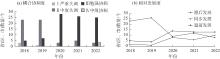
Fig. 2
Coupling coordination degree and relative development degree of home community elderly care and institutional elderly care in China from 2018 to 2022"
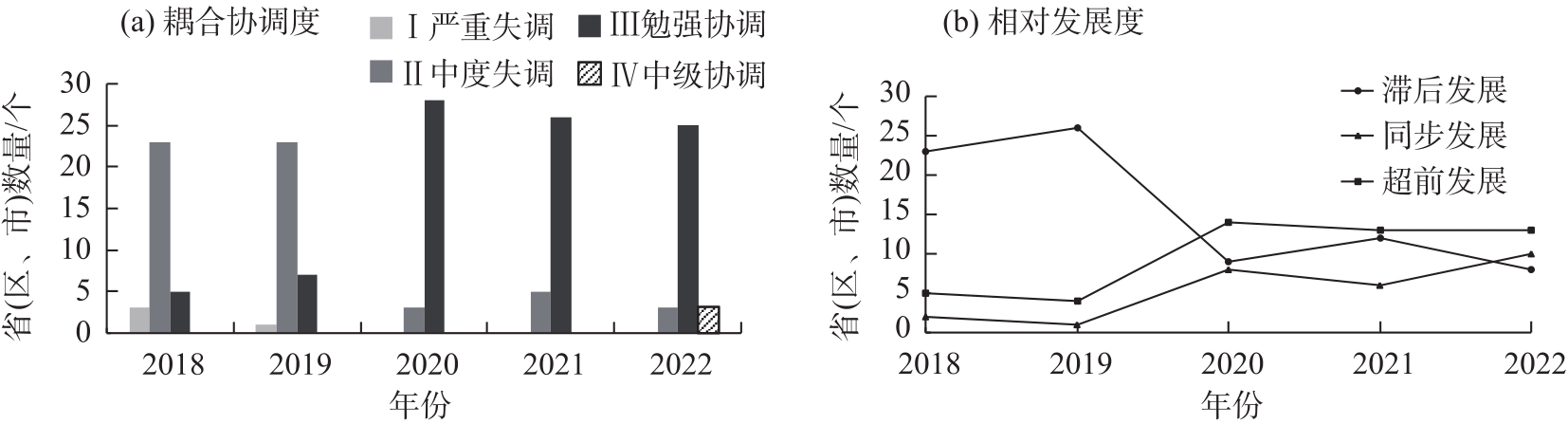
Fig. 3
Coupling coordination degree and relative development degree of home community elderly care and institutional elderly care in different regions from 2018 to 2022"
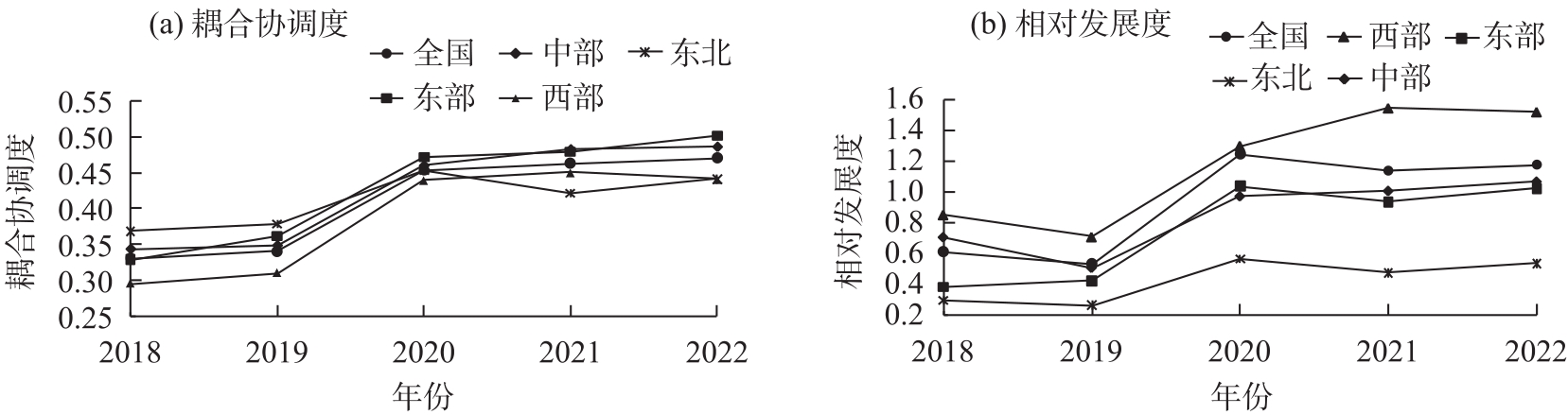
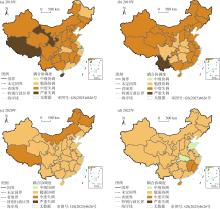
Fig. 4
Spatial distributions of coupling coordination degree of home community elderly care and institutional elderly care in China from 2018 to 2022"

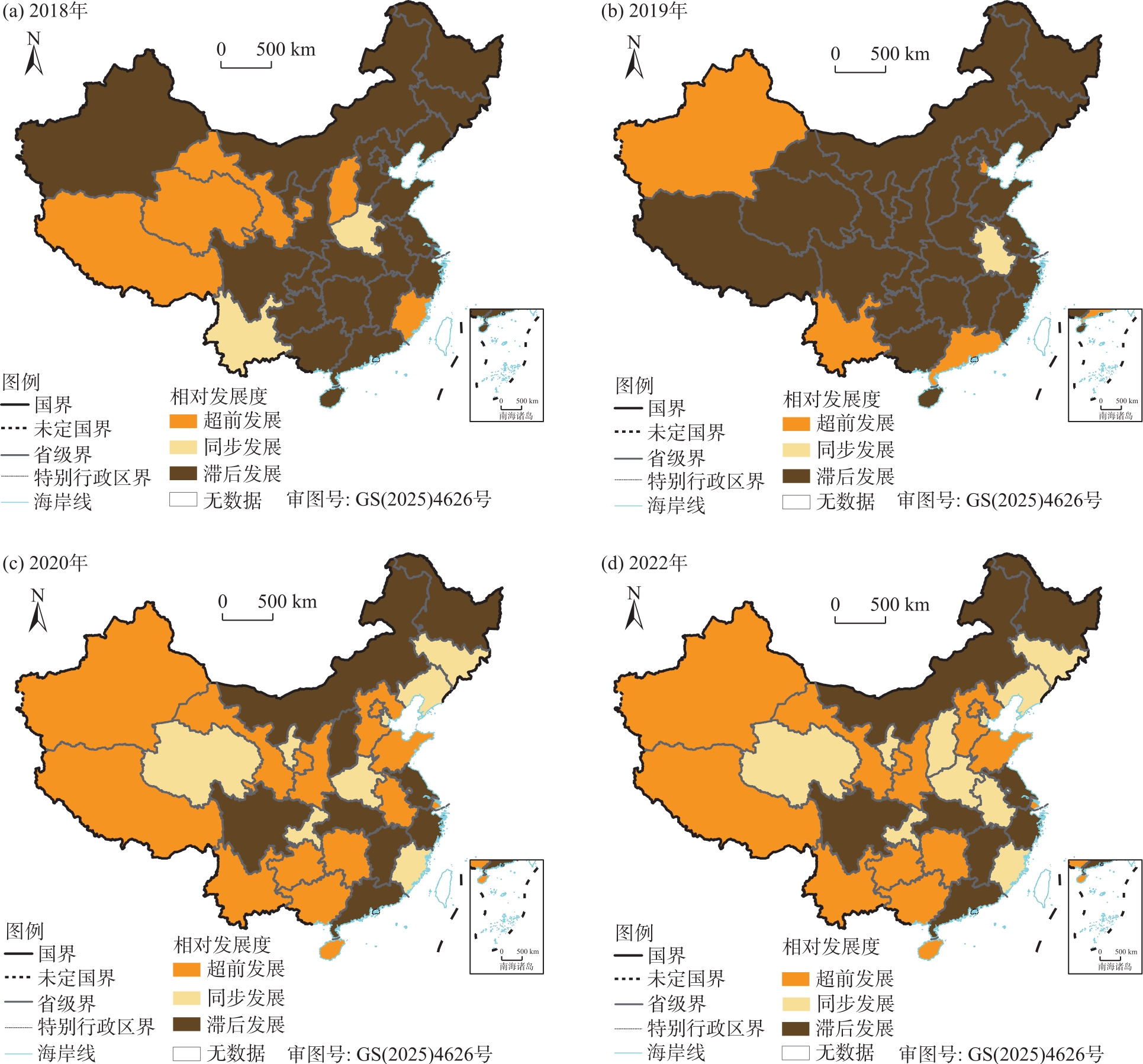
Fig. 5
Spatial distributions of relative development degree of home community elderly care and institutional elderly care in China from 2018 to 2022"
Tab. 2
Global Moran’s I of home community elderly care and institutional elderly care from 2018 to 2022"
| 指标 | 2018年 | 2019年 | 2020年 | 2021年 | 2022年 |
|---|---|---|---|---|---|
| Global Moran’s I | 0.195 | 0.285 | 0.422 | 0.340 | 0.332 |
| Z | 2.298 | 3.058 | 4.569 | 3.836 | 3.762 |
| P | 0.016 | 0.002 | 0.000 | 0.001 | 0.002 |
Tab. 3
Provinces and their cluster type of local spatial that passed significance test from 2018 to 2022"
| 省(区、市) | 2018年 | 2019年 | 2020年 | 2021年 | 2022年 |
|---|---|---|---|---|---|
| 吉林 | - | - | 高-高聚集 | 高-高聚集 | - |
| 河北 | - | 高-高聚集 | 高-高聚集 | 高-高聚集 | - |
| 山东 | - | - | 高-高聚集 | 高-高聚集 | 高-高聚集 |
| 上海 | - | 高-高聚集 | 高-高聚集 | 高-高聚集 | 高-高聚集 |
| 江苏 | 高-高聚集 | 高-高聚集 | - | - | 高-高聚集 |
| 山西 | 低-低聚集 | 低-低聚集 | - | - | 低-低聚集 |
| 安徽 | - | 高-高聚集 | 高-高聚集 | 高-高聚集 | - |
| 江西 | 低-低聚集 | 低-低聚集 | - | - | 低-低聚集 |
| 广西 | - | - | 低-低聚集 | 低-低聚集 | 低-低聚集 |
| 贵州 | 低-低聚集 | 低-低聚集 | - | - | - |
| 甘肃 | - | 高-高聚集 | 高-高聚集 | 高-高聚集 | - |
| 陕西 | - | - | 高-高聚集 | 高-高聚集 | - |
| 内蒙古 | 低-低聚集 | 低-低聚集 | 低-低聚集 | 低-低聚集 | 低-低聚集 |
Tab. 4
Single-factor detection results of the influencing factors of coupling coordination degree between home community elderly care and institutional elderly care in China"
| 因子 | 指标释义 | 单位 | q | P |
|---|---|---|---|---|
| 养老需求(X1) | 老年人抚养比 | % | 0.138 | 0.008 |
| 经济发展(X2) | 人均地区生产总值 | 元 | 0.058 | 0.287 |
| 人才队伍(X3) | 老年相关社会工作志愿者数量 | 104人 | 0.085 | 0.018 |
| 组织力量(X4) | 社会工作类机构数 | 个 | 0.196 | 0.001 |
| 政策支持(X5) | 养老政策文件数目 | 条 | 0.080 | 0.042 |
| 科技水平(X6) | 宽带互联网用户占比 | % | 0.100 | 0.009 |
Tab. 5
Interactive detection results of the influencing factors of coupling coordination degree between home community elderly care and institutional elderly care in China"
| 因子 | X1 | X2 | X3 | X4 | X5 | X6 |
|---|---|---|---|---|---|---|
| X1 | 0.138 | |||||
| X2 | 0.250↖ | 0.058 | ||||
| X3 | 0.267↗ | 0.239↖ | 0.085 | |||
| X4 | 0.360↗ | 0.299↖ | 0.271↗ | 0.196 | ||
| X5 | 0.242↖ | 0.145↖ | 0.239↖ | 0.326↖ | 0.080 | |
| X6 | 0.332↖ | 0.298↖ | 0.355↖ | 0.347↖ | 0.204↖ | 0.100 |
| [1] | 曲嘉瑶. 京津冀养老服务协同发展: 成效、问题及发展路径[J]. 城市问题, 2024(12): 90-92, 99. |
| [Qu Jiayao. Coordinated development of elderly care services in Beijing-Tianjin-Hebei region: Effectiveness, problems and development path[J]. Urban Problems, 2024(12): 90-92, 99.] | |
| [2] | 王震. 公共政策70年: 社会保障与公共服务供给体系的发展与改革[J]. 北京工业大学学报(社会科学版), 2019, 19(5): 25-35. |
| [Wang Zhen. Seventy years of public policy in China: Development and reform of social security and public services provision system[J]. Journal of Beijing University of Technology (Social Sciences Edition), 2019, 19(5): 25-35.] | |
| [3] | 曹海军, 刘少博. 京津冀城市群治理中的协调机制与服务体系构建的关系研究[J]. 中国行政管理, 2015(9): 21-25. |
| [Cao Haijun, Liu Shaobo. The coordination mechanism and service system of Beijing-Tianjin-Hebei urban cluster governance[J]. Chinese Public Administration, 2015(9): 21-25.] | |
| [4] | 唐跟利, 陈立泰. 大数据驱动区域公共服务一体化: 理论逻辑、实现机制与路径创新[J]. 求实, 2021(5): 43-57, 110. |
| [Tang Genli, Chen Litai. Big data driving regional public service integration: Theoretical logic, implementation mechanism and path innovation[J]. Truth Seeking, 2021(5): 43-57, 110.] | |
| [5] | 林闽钢. “系统集成、协同高效”的社会保障制度改革——以长三角社会保障一体化为例[J]. 社会保障评论, 2022, 6(3): 34-43. |
| [Lin Mingang. “System integration, synergetic efficiency”in the reform of the social security system: Taking the integration of social security in the Yangtze River Delta as an example[J]. Chinese Social Security Review, 2022, 6(3): 34-43.] | |
| [6] |
陈卓昀, 顾宗倪, 罗小龙. 区域一体化背景下长三角地区养老设施的演化规律及空间异质性研究[J]. 地域研究与开发, 2025, 44(2): 93-99.
doi: 10.3969/j.issn.1003-2363.2025.02.012 |
|
[Chen Zhuoyun, Gu Zongni, Luo Xiaolong. Examining the evolutionary patterns and the spatial heterogeneity of elderly care facilities in the context of regional integration: A case study of the Yangtze River Delta[J]. Areal Research and Development, 2025, 44(2): 93-99.]
doi: 10.3969/j.issn.1003-2363.2025.02.012 |
|
| [7] | 周榕. 区域一体化视角下异地养老时空演化及分异机理——以长三角地区为例[J]. 人文地理, 2023, 38(6): 73-81, 159. |
| [Zhou Rong. Spatio-temporal evolution and differentiation mechanism of off-site elderly care from the perspective of regional integration: A case of the Yangtze River Delta[J]. Human Geography, 2023, 38(6): 73-81, 159.] | |
| [8] | 胡宏伟, 王静茹. 京津冀养老服务协同中的政府驱动治理研究——基于组织多重制度逻辑的视角[J]. 北京联合大学学报(人文社会科学版), 2022, 20(1): 60-69. |
| [Hu Hongwei, Wang Jingru. A research on government-driven governance in the collaboration of elderly care services among the Beijing-Tianjin-Hebei region[J]. Journal of Beijing Union University (Humanities and Social Sciences Edition), 2022, 20(1): 60-69.] | |
| [9] | 封铁英, 胡毓群. 区域养老服务政策协同测度、演变及其均等化效应——以长三角为例[J]. 北京工业大学学报(社会科学版), 2024, 24(1): 46-61. |
| [Feng Tieying, Hu Yuqun. Measurement, evolution and equalization effect of the coordination of regional elderly service policies: A case study of Yangtze River Delta[J]. Journal of Beijing University of Technology (Social Sciences Edition), 2024, 24(1): 46-61.] | |
| [10] |
Porto E D, Paty S. Cooperation among local governments to deliver public services: Evidence from France[J]. Politics & Policy, 2018, 46(5): 790-820.
doi: 10.1111/polp.v46.5 |
| [11] | 陈飞, 陈琳. 从老龄健康视角评估医养结合试点政策[J]. 经济学动态, 2023(10): 108-127. |
| [Chen Fei, Chen Lin. Policy evaluation of medical and elderly care integration from the perspective of elderly health[J]. Economic Perspectives, 2023(10): 108-127.] | |
| [12] | 陈岩, 杨翠迎. 医养结合与老年健康管理服务利用——来自医养结合试点城市的经验证据[J]. 财经研究, 2023, 49(12): 121-135. |
| [Chen Yan, Yang Cuiying. The integration of medical and elderly care and utilization of elderly health management services: Empirical evidence from pilot cities of integrated medical and elderly care[J]. Journal of Finance and Economics, 2023, 49(12): 121-135.] | |
| [13] | 何涛, 唐健. 从“松散型”到“紧密型”: 利益相关者理论视角下医养联合体协同治理的实现路径[J]. 东岳论丛, 2023, 44(5): 137-147. |
| [He Tao, Tang Jian. From “loose” to “tight”: The implementation path of collaborative governance of medical and elderly care consortia from the perspective of stakeholder theory[J]. Dongyue Tribune, 2023, 44(5): 137-147.] | |
| [14] | 李长远. 民族地区医养结合养老服务财政支出效果的影响路径分析——基于宁夏五市的问卷调查[J]. 云南民族大学学报(哲学社会科学版), 2021, 38(1): 110-119. |
| [Li Changyuan. An analysis of the influencing factors concerning the effect of the financial expenditure of medical and old-age care services in ethnic minority areas: A questionnaire survey of five cities in Ningxia[J]. Journal of Yunnan Minzu University (Philosophy and Social Sciences Edition), 2021, 38(1): 110-119.] | |
| [15] | 郑明明, 李红艳. 基于耦合-熵变方程法的社区医养耦合协调发展研究[J]. 中国卫生事业管理, 2023, 40(1): 6-12, 64. |
| [ZhengMingming, Li Hongyan. Study on the coordinated development of community medical care based on coupling entropy change equation method[J]. Chinese Health Service Management, 2023, 40(1): 6-12, 64.] | |
| [16] |
Harriet R, Susan F, Colette B. Mainstream versus ethno-specific community aged care services: It’s not an ‘either or’[J]. Australasian Journal on Ageing, 2009, 28(2): 58-63.
doi: 10.1111/aja.2009.28.issue-2 |
| [17] | 杜鹏, 马琦峰. 中国社区嵌入式养老: 现状与问题浅析[J]. 人口与发展, 2024, 30(3): 113-124. |
| [Du Peng, Ma Qifeng. Community-embedded elderly care in China: Brief analysis of current situations and issues[J]. Population and Development, 2024, 30(3): 113-124.] | |
| [18] | 朱浩. 社区嵌入式养老服务的社会化运作机制及其实践逻辑[J]. 云南民族大学学报(哲学社会科学版), 2020, 37(5): 98-106. |
| [Zhu Hao. The socialized operation mechanism and practical logic of community-embedded old-age services[J]. Journal of Yunnan Minzu University (Philosophy and Social Sciences Edition), 2020, 37(5): 98-106.] | |
| [19] | 赵曼, 邢怡青. “居家社区机构相协调”: 政策机理和实现路径[J]. 社会保障研究, 2021(2): 55-60. |
| [Zhao Man, Xing Yiqing. “Coordination of Home, community and institution”: Policy mechanism and implementation path[J]. Social Security Studies, 2021(2): 55-60.] | |
| [20] | 龙玉其. 智慧居家养老服务协同治理的逻辑机理与实践路径[J]. 行政管理改革, 2023(7): 50-58. |
| [Long Yuqi. Logic mechanism and practice path of collaborative governance of smart home-based elderly care services[J]. Administration Reform, 2023(7): 50-58.] | |
| [21] | 赵曼, 邢怡青. 人工智能赋能的居家社区养老服务发展及其生态系统优化策略研究[J]. 社会保障研究, 2024(2): 16-25. |
| [Zhao Man, Xing Yiqing. Study on the development of home community-based elderly care service enabled by artificial intelligence and optimization strategy of its ecosystem[J]. Social Security Studies, 2024(2): 16-25.] | |
| [22] | 朱震宇. 居家社区机构养老服务一体化发展的优势、机制与困境——基于北京市海淀曜阳养老的个案分析[J]. 宁夏社会科学, 2022(6): 164-172. |
| [Zhu Zhenyu. Advantages, mechanisms, and challenges of integrated development of home community institution elderly care services: A case study of Yaoyang elderly care in Haidian, Beijing[J]. Ningxia Social Sciences, 2022(6): 164-172.] | |
| [23] |
李琳, 黄拓夫, 欧阳晓. 中国县域城乡产业融合水平测度及其时空格局研究[J]. 地理研究, 2025, 44(4): 1119-1142.
doi: 10.11821/dlyj020240620 |
| [Li Lin, Huang Tuofu, Ou Yangxiao. Research on the measurement of the level andspatial and temporal pattern of urban and rural industrial integration in China[J]. Geographical Research, 2025, 44(4): 1119-1142.] | |
| [24] |
王淑佳, 孔伟, 任亮, 等. 国内耦合协调度模型的误区及修正[J]. 自然资源学报, 2021, 36(3): 793-810.
doi: 10.31497/zrzyxb.20210319 |
|
[Wang Shujia, Kong Wei, Ren Liang, et al. Research on misuses and modification of coupling coordination degree model in China[J]. Journal of Natural Resources, 2021, 36(3): 793-810.]
doi: 10.31497/zrzyxb.20210319 |
|
| [25] |
王凯, 郭鑫, 甘畅, 等. 中国省域科技创新与旅游业高质量发展水平及其互动关系[J]. 资源科学, 2022, 44(1): 114-126.
doi: 10.18402/resci.2022.01.09 |
| [Wang Kai, Guo Xin, Gan Chang, et al. Provincial scientific & technology innovation and high-quality development of tourism in China and their interactive relationship[J]. Resources Science, 2022, 44(1): 114-126.] | |
| [26] |
曹佳琳, 刘艳芳, 赵金梅, 等. 宁夏城市建设用地节约集约利用与高质量发展耦合协调研究[J]. 干旱区地理, 2024, 47(5): 872-884.
doi: 10.12118/j.issn.1000-6060.2023.562 |
|
[Cao Jialin, Liu Yanfang, Zhao Jinmei, et al. Coupling and coordination of economical and intensiveutilization of urban construction land and high-quality development in Ningxia[J]. Arid Land Geography, 2024, 47(5): 872-884.]
doi: 10.12118/j.issn.1000-6060.2023.562 |
|
| [27] | 李雪敏, 李同宁, 李道政, 等. 内蒙古县域生态系统服务与居民福祉耦合协调关系时空特征及影响因素研究[J]. 干旱区资源与环境, 2023, 37(7): 27-37. |
| [Li Xuemin, Li Tongning, Li Daozheng, et al. Spatial-temporal characteristics of county-range coupling coordination relationship between ecosystem services and human’s well-being in Inner Mongolia[J]. Journal of Arid Land Resources and Environment, 2023, 37(7): 27-37.] | |
| [28] |
王劲峰, 徐成东. 地理探测器: 原理与展望[J]. 地理学报, 2017, 72(1): 116-134.
doi: 10.11821/dlxb201701010 |
|
[Wang Jinfeng, Xu Chengdong. Geographic detector: Principles and prospects[J]. Acta Geographica Sinica, 2017, 72(1): 116-134.]
doi: 10.11821/dlxb201701010 |
|
| [29] |
吉宇琴, 姜会明. 新时代老龄化与养老资源适配度时空差异及其影响因素分析[J]. 地理科学, 2022, 42(5): 851-862.
doi: 10.13249/j.cnki.sgs.2022.05.011 |
|
[Ji Yuqin, Jiang Huiming. Spatial and temporal differences and influencing factors of the adaptation degree of aging and pension resources in the New Era[J]. Scientia Geographica Sinica, 2022, 42(5): 851-862.]
doi: 10.13249/j.cnki.sgs.2022.05.011 |
|
| [30] |
古恒宇, 黎宇翔, 万思齐, 等. 中国省际老年人口迁移的空间格局及影响因素研究[J]. 地理科学进展, 2025, 44(3): 534-550.
doi: 10.18306/dlkxjz.2025.03.008 |
|
[Gu Hengyu, Li Yuxiang, Wan Siqi, et al. Spatial patterns and driving factors of interprovincial elderly migration in China[J]. Progress in Geography, 2025, 44(3): 534-550.]
doi: 10.18306/dlkxjz.2025.03.008 |
|
| [31] |
李文, 李德升, 胡浩, 等. 长三角地区养老产业发展水平格局及影响因素研究[J]. 世界地理研究, 2024, 33(2): 123-135.
doi: 10.3969/j.issn.1004-9479.2024.02.20220163 |
|
[Li Wen, Li Desheng, Hu Hao, et al. The spatial pattern and influencing factors of the pension industry in Yangtze River Delta[J]. World Regional Studies, 2024, 33(2): 123-135.]
doi: 10.3969/j.issn.1004-9479.2024.02.20220163 |
|
| [32] | 邵文娟. 供给侧改革视角下社会组织参与养老服务供给研究[J]. 宏观经济研究, 2019(7): 168-175. |
| [Shao Wenjuan. A study on the participation of social organizations in the supply of aged services under the perspective of supply side reform[J]. Macroeconomics, 2019(7): 168-175.] | |
| [33] | 汪伟全. 社区应急志愿者参与公共安全治理的影响因素分析——基于新冠肺炎疫情背景的Nvivo质性研究[J]. 社会科学辑刊, 2021(4): 46-55, 215. |
| [Wang Weiquan. Analysis on the influencing factors of community emergency volunteers; participation in public security governance: Nvivo qualitative research based on the background of COVID-19[J]. Social Science Journal, 2021(4): 46-55, 215.] |
|
||