Arid Land Geography ›› 2026, Vol. 49 ›› Issue (2): 369-380.doi: 10.12118/j.issn.1000-6060.2025.270
• Climatology and Hydrology • Previous Articles Next Articles
ZHAO Qiu1,2( ), GAO Fan1,2(), HE Bing1,2, LI Ying1,2, ZHANG Jiacheng1,2
Received:2025-05-15
Revised:2025-07-07
Online:2026-02-25
Published:2026-02-27
Contact:
GAO Fan
E-mail:zq320232257@163.com;gutongfan0202@163.com
ZHAO Qiu, GAO Fan, HE Bing, LI Ying, ZHANG Jiacheng. Spatiotemporal patterns of cropland water use efficiency in the Aksu River Basin[J].Arid Land Geography, 2026, 49(2): 369-380.
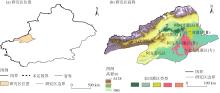
Fig. 1
Schematic diagram of the study area"
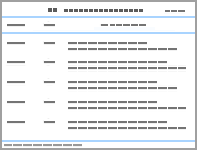
Tab. 1
Main data types and sources"
| 分类 | 名称 | 英文缩写 | 空间分辨率/m | 年份 | 来源 |
|---|---|---|---|---|---|
| 土地利用类型数据 | 中国年度土地覆盖数据 | CLCD | 30 | 2002—2022 | ChinaLandCoverDataset |
| 农田植被数据 | 植被总初级生产力/g C·m-2 | GPP | 500 | 2002—2022 | MODISMYD17A2H |
| 蒸散发/mm | ET | 500 | 2002—2022 | MODISMOD16A2 | |
| 归一化植被指数 | NDVI | 500 | 2002—2022 | MODISMOD13C1 | |
| 增强植被指数 | EVI | 1000 | 2002—2022 | MODISMOD13A1 | |
| 叶面积指数 | LAI | 500 | 2002—2022 | MODISMOD13A1 | |
| 气象数据 | 温度/℃ | T | 1000 | 2002—2022 | 国家地球系统科学数据中心 |
| 降水/mm | Pre | 1000 | 2002—2022 | 国家地球系统科学数据中心 | |
| 饱和水气压差/kPa | VPD | 1000 | 2002—2022 | TerraClimate |
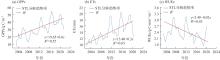
Fig. 2
Slope of the trend component of GPPc, ETc, and WUEc decomposed by STL in the Aksu River Basin from 2002 to 2022"
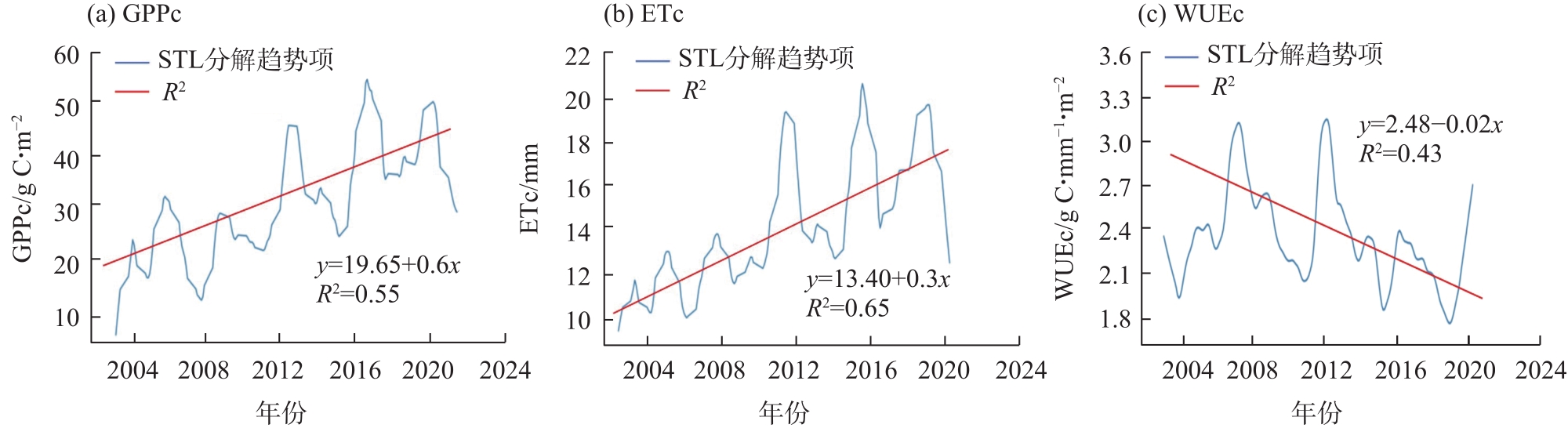
Fig. 3
Interannual variations of GPPc, ETc, and WUEc in the Aksu River Basin from 2002 to 2022"
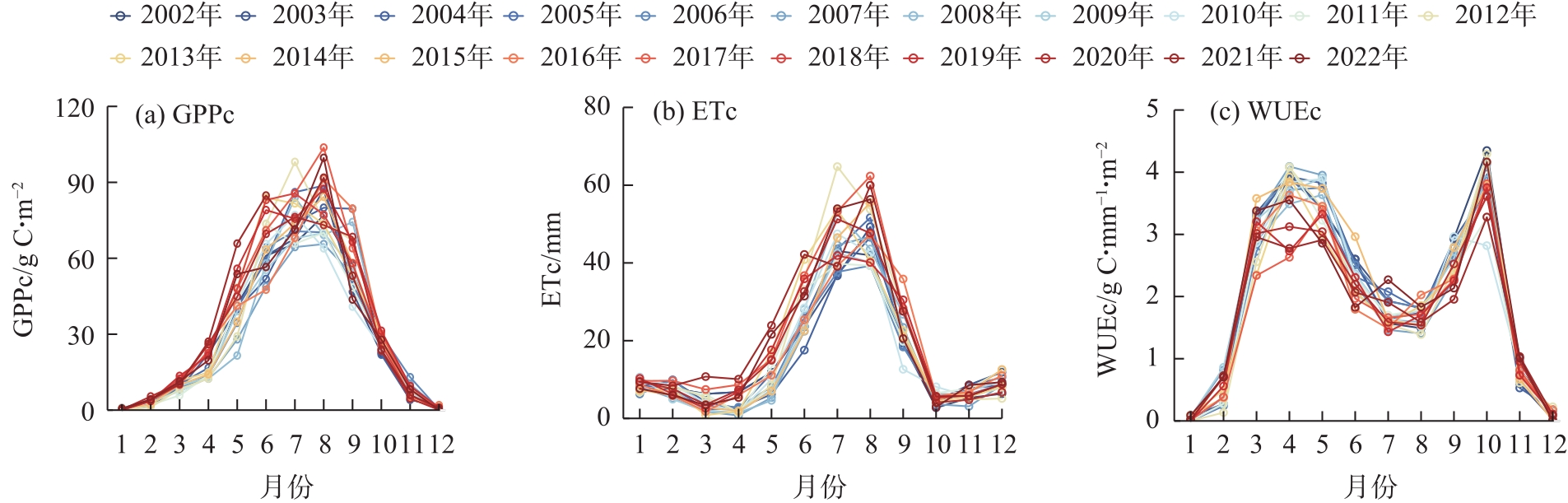
Fig. 4
Spatial distributions and trends of GPPc, ETc, and WUEc in the Aksu River Basin from 2002 to 2022"
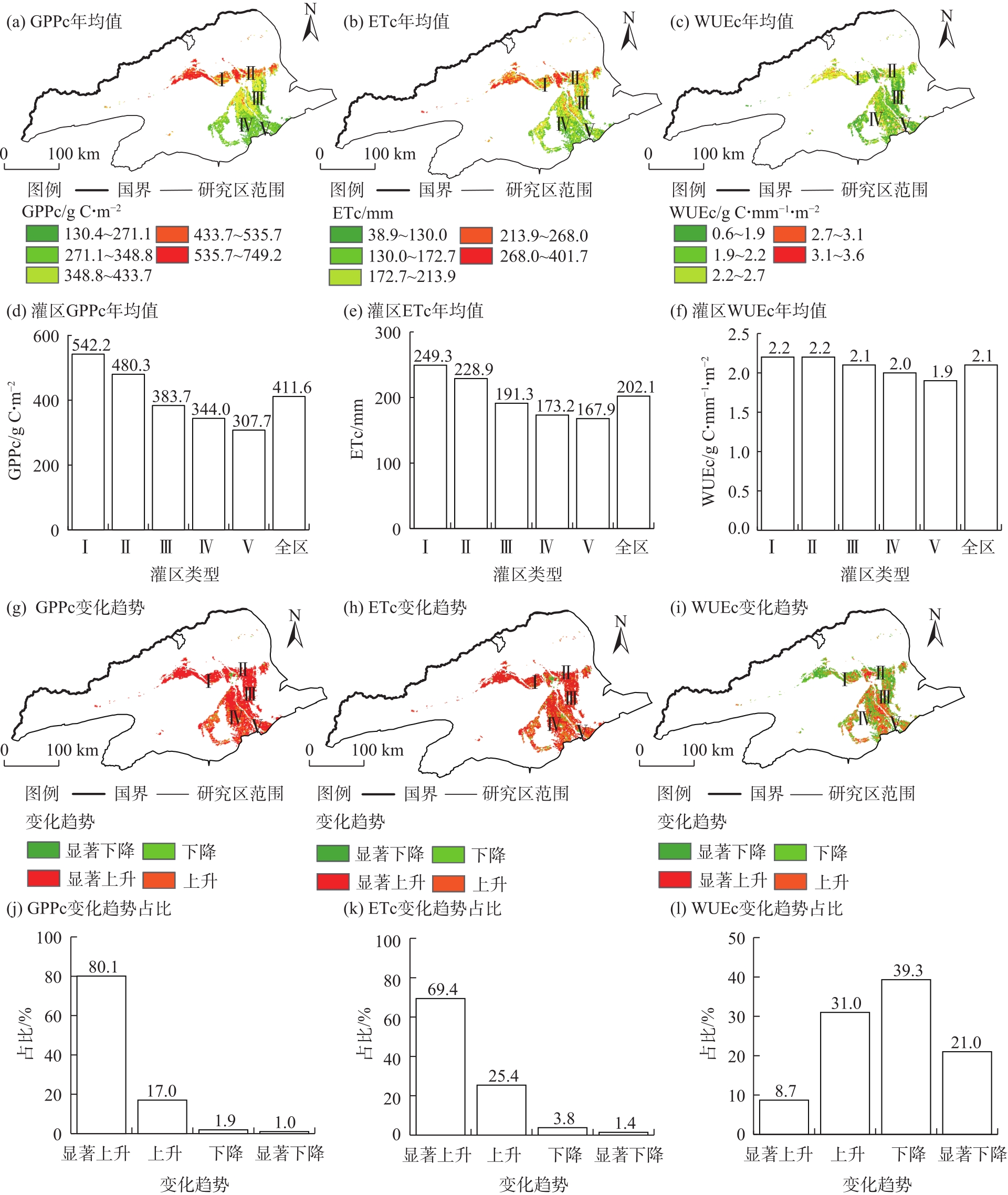
Fig. 5
Characteristics of WUEc sustainability in the Aksu River Basin from 2002 to 2022"
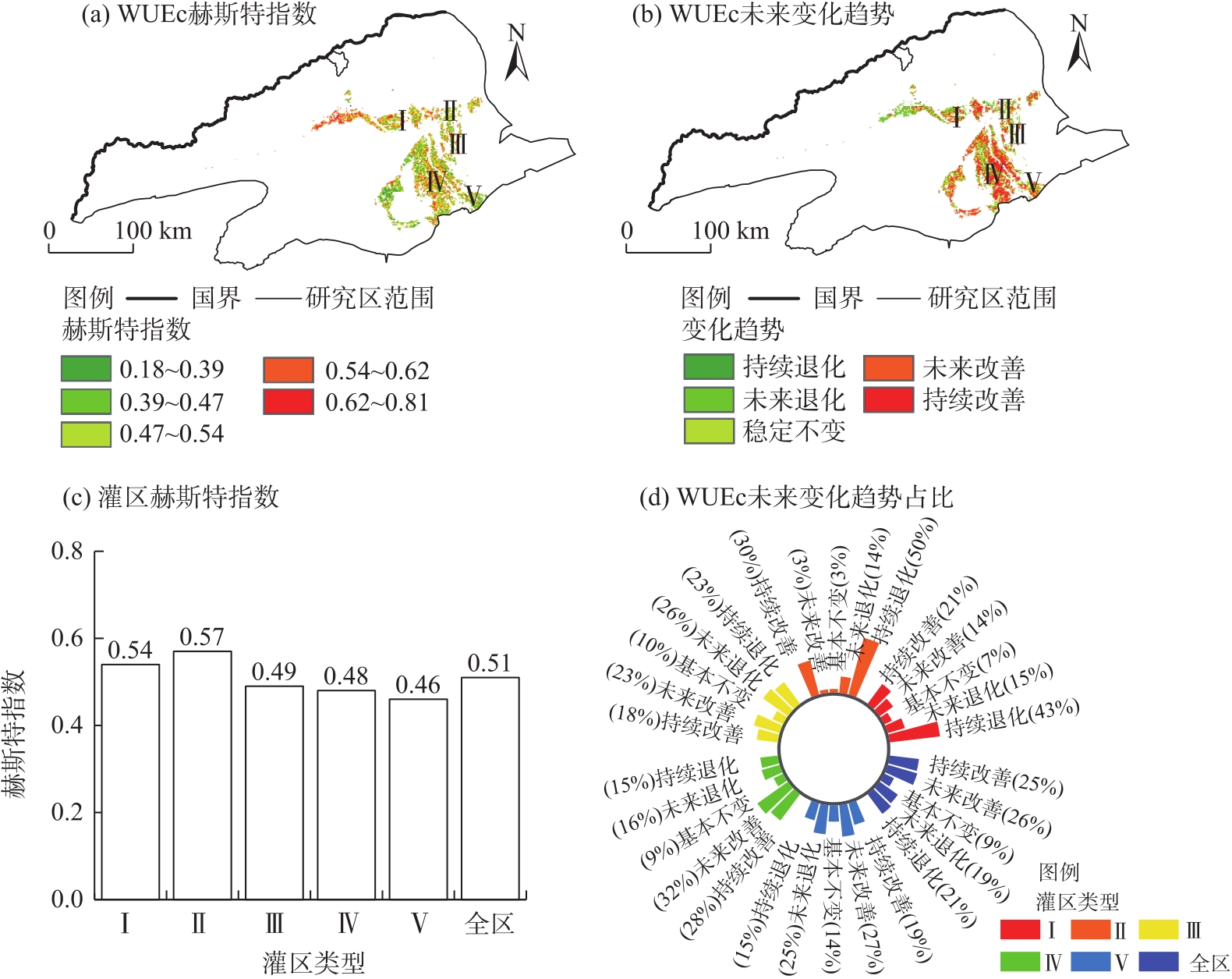
Fig. 6
Spatial distributions of the partial correlation analysis between WUEc and meteorological factors from 2002 to 2022"
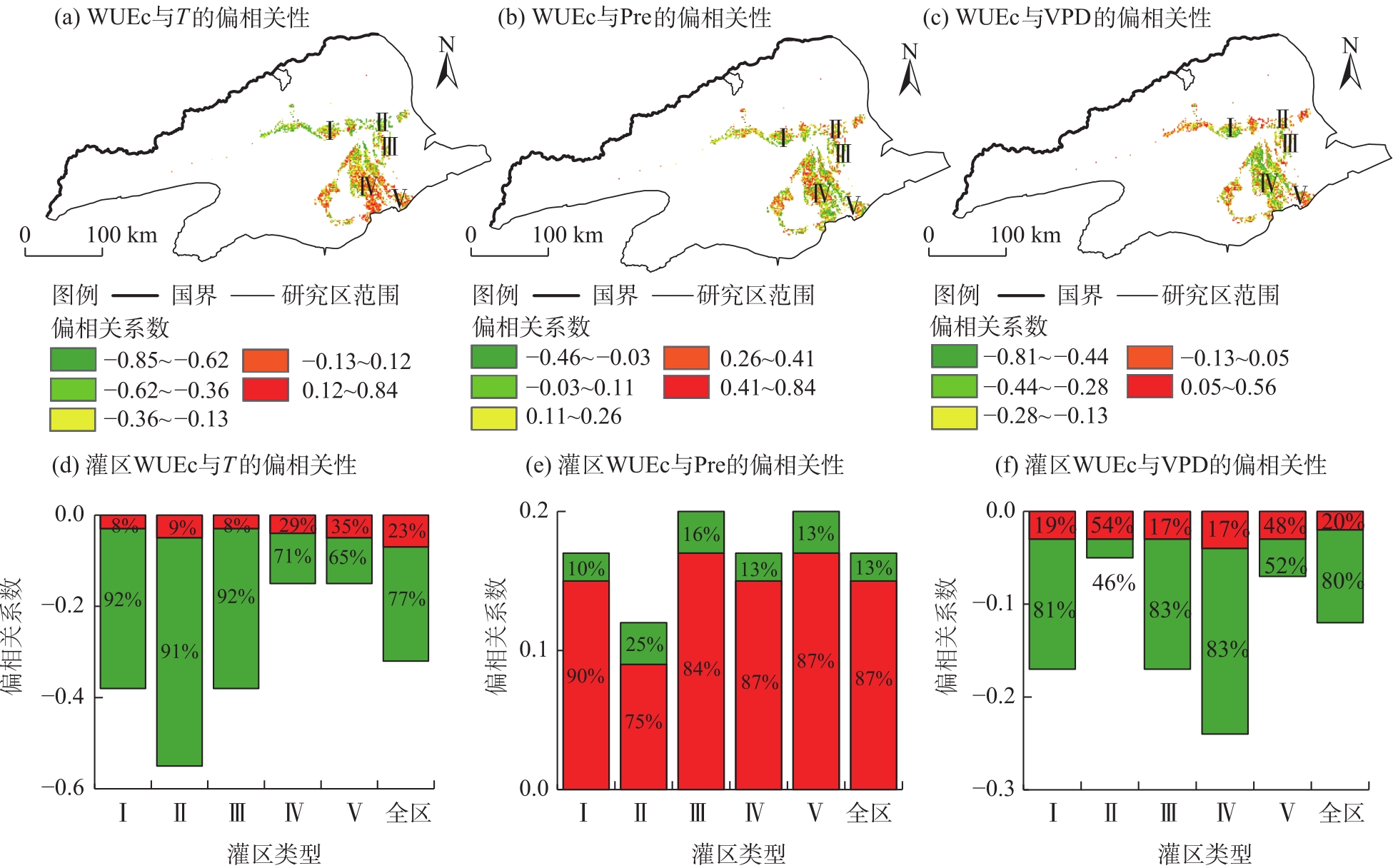
Fig. 7
Spatial distributions of the partial correlation analysis between WUEc and vegetation factors from 2002 to 2022"
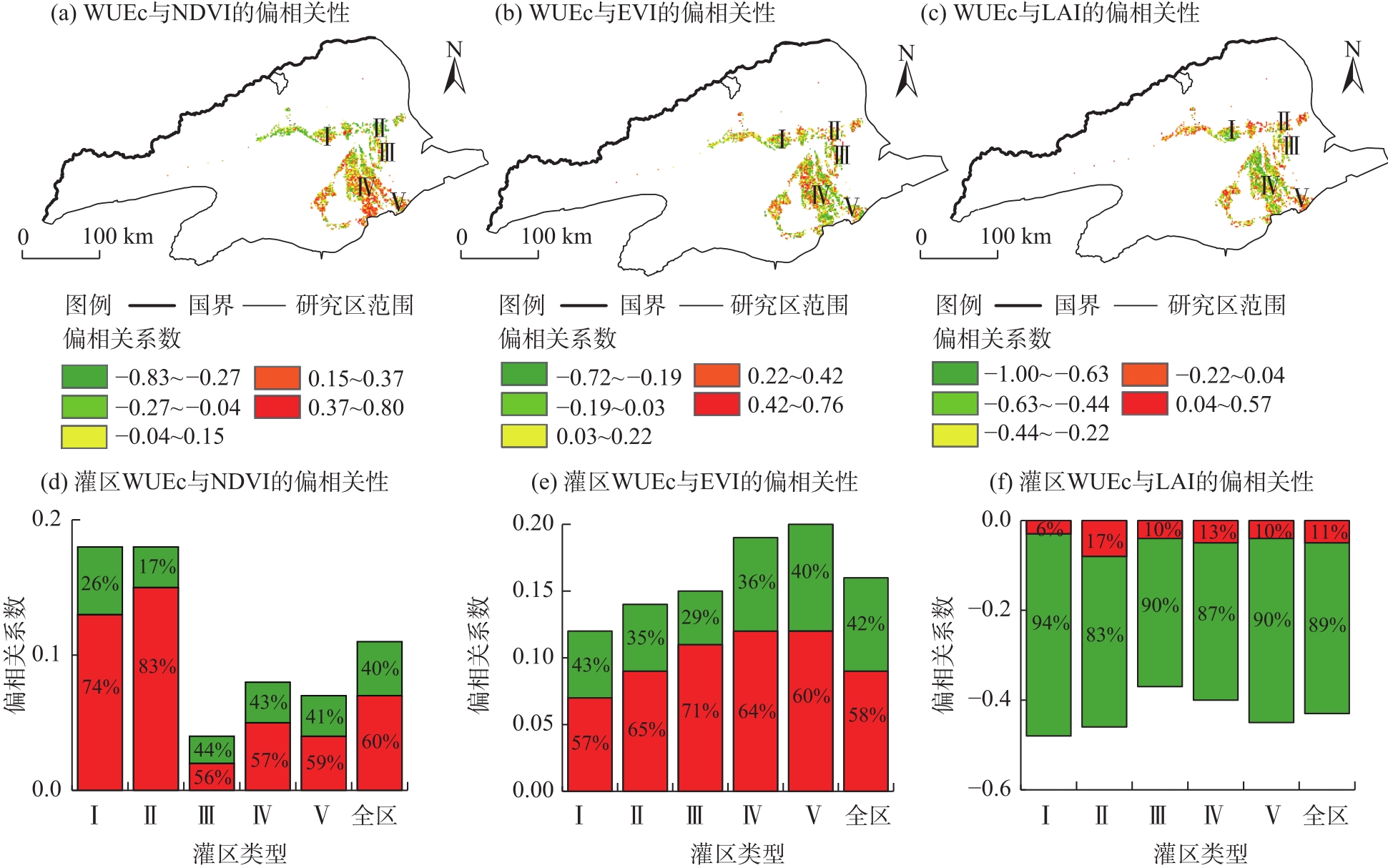
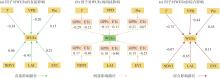
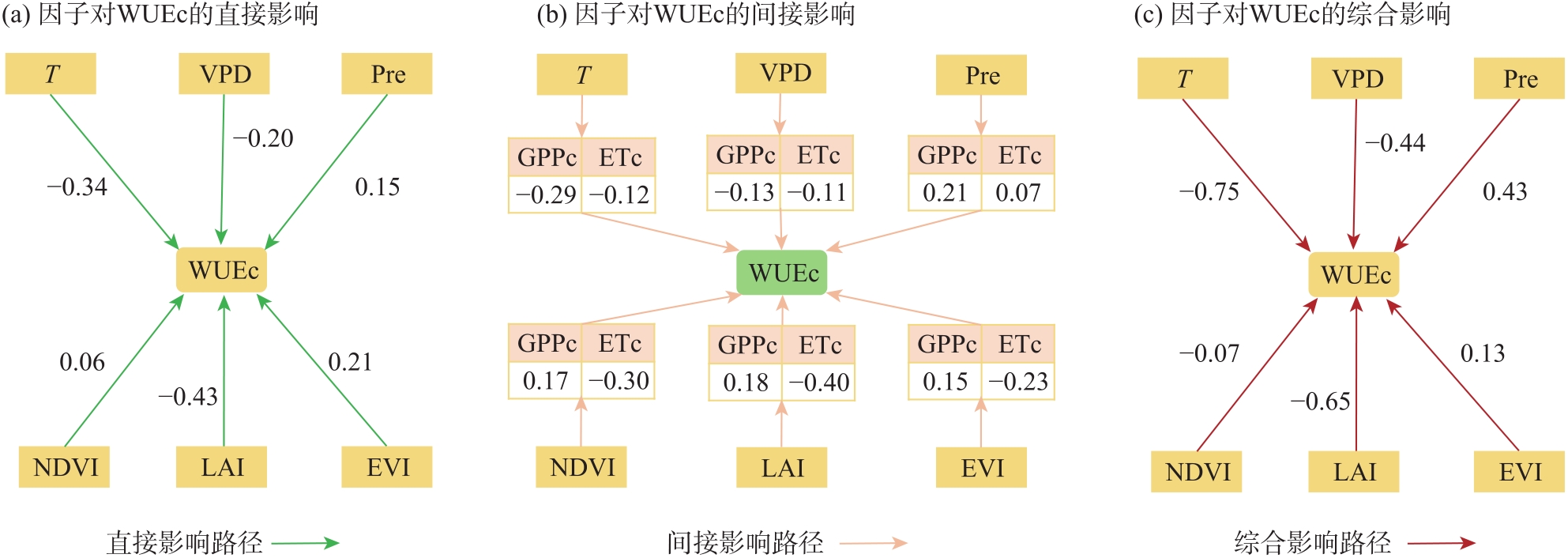
Fig. 8
Path analysis of WUEc with meteorological factors and cropland vegetation factors"
| [1] | 刘婵, 刘冰, 赵文智, 等. 黑河流域植被水分利用效率时空分异及其对降水和气温的响应[J]. 生态学报, 2020, 40(3): 888-899. |
| [Liu Chan, Liu Bin, Zhao Wenzhi, et al. Temporal and spatial variability of water use efficiency of vegetation and its response toprecipitation and temperature in Heihe River Basin[J]. Acta Ecologica Sinica, 2020, 40(3): 888-899.] | |
| [2] | Cao R C, Hu Z M, Jiang Z Y, et al. Shifts in ecosystem water use efficiency on China’s Loess Plateau caused by the interaction of climatic and biotic factors over 1985—2015[J]. Agricultural and Forest Meteorology, 2020, 291: 108100, doi: 10.1016/j.agrformet.2020.108100. |
| [3] |
Hatfield J L, Dold C. Wateruse efficiency: Advances and challenges in a changing climate[J]. Frontiers Plant Science, 2019, 10: 1-14.
doi: 10.3389/fpls.2019.00001 |
| [4] | Terán P C, Naz B S, Graf A, et al. Rising water-use efficiency in European grasslands is driven by increased primary production[J]. Communications Earth & Environment, 2023, 4: 95, doi: 10.1038/s43247-023-00757-x. |
| [5] |
张沛, 龙爱华, 海洋, 等. 1988—2015年新疆农业用水时空变化与政策驱动研究: 基于农作物水足迹的统计分析[J]. 冰川冻土, 2021, 43(1): 242-253.
doi: 10.7522/j.issn.1000-0240.2018.1058 |
| [Zhang Pei, Long Aihua, Hai Yang, et al. Spatiotemporal variations and driving forces of agricultural water consumption in Xinjiang during 1988—2015: Based on statistical analysis of crop water footprint[J]. Journal of Glaciology and Geocryology, 2021, 43(1): 242-253.] | |
| [6] | Kang R, Zhu B, Zhang Z X, et al. Dissecting the characteristics and driver factors of potential vegetation water use efficiency in China[J]. Science of the Total Environment, 2024, 953: 176174, doi: 10.1016/j.scitotenv.2024.176174. |
| [7] |
利辉, 刘铁军, 王少慧, 等. 2001—2021年内蒙古荒漠草原水分利用效率时空变化特征及影响因素研究[J]. 干旱区地理, 2024, 47(6): 993-1003.
doi: 10.12118/j.issn.1000-6060.2023.388 |
|
[Li Hui, Liu Tiejun, Wang Shaohui, et al. Spatial and temporal variation of water use efficiency and its influencing factors in desert steppe of Inner Mongolia from 2001 to 2021[J]. Arid Land Geography, 2024, 47(6): 993-1003.]
doi: 10.12118/j.issn.1000-6060.2023.388 |
|
| [8] | Liu S H, Xue L, Xiao Y, et al. Dynamic process of ecosystem water use efficiency and response to drought in the Yellow River Basin, China[J]. Science of the Total Environment, 2024, 934: 173339, doi: 10.1016/j.scitotenv.2024.173339. |
| [9] | Zhou X, Ao Y, Jiang X, et al. Water use efficiency of China’s karst ecosystems: The effect of different ecohydrological and climatic factors[J]. Science of the Total Environment, 2023, 905: 167069, doi: 10.1016/j.scitotenv.2023.167069. |
| [10] | Lin S, Wang G, Hu Z, et al. Contrasting response of growing season water use efficiency to precipitation changes between alpine meadows and alpine steppes over the Tibetan Plateau[J]. Agricultural Water Management, 2023, 289: 108571, doi: 10.1016/j.agwat.2023.108571. |
| [11] | Tian F, Yang J H, Du R H, et al. Sustained vegetation greening enhanced ecosystem wateruse efficiency in the Loess Plateau of China in recent 20 years[J]. Ecological Engineering, 2022, 184:106768, doi: 10.1016/j.ecoleng.2022.106768. |
| [12] | Lin W, Mo X G, Liu S X, et al. Attributing the changes of grass growth, water consumed and water use efficiency over the Tibetan Plateau[J]. Journal of Hydrology, 2021, 598: 126464, doi: 10.1016/j.jhydrol.2021.126464. |
| [13] | Du X Z, Zhao X, Zhou T, et al. Effects of climate factors and human activities on the ecosystem water use efficiency throughout northern China[J]. Remote Sensing, 2019, 11(23): 2766, doi: 10.3390/rs11232766. |
| [14] |
Sun S B, Song Z L, Wu X C, et al. Spatio-temporal variations in water use efficiency and its drivers in China over the last three decades[J]. Ecological Indicators, 2018, 94: 292-304.
doi: 10.1016/j.ecolind.2018.07.003 |
| [15] |
Guo L M, Shan N, Zhang Y G, et al. Separating the effects of climate change and human activity on water use efficiency over the Beijing: Tianjin sand source region of China[J]. The Science of the Total Environment, 2019, 690: 584-595.
doi: 10.1016/j.scitotenv.2019.07.067 |
| [16] | Yu H, Li S, Ding J, et al. Water use efficiency and its drivers of two typical cash crops in an arid area of northwest China[J]. Agricultural Water Management, 2023, 2-87: 108433, doi: 10.1016/j.agwat.2023.108433. |
| [17] | Tian F, Zhang Y, Lu S. Spatial temporal dynamics of cropland ecosystem water use efficiency and the responses to agricultural water management in the Shiyang River Basin, northwestern China[J]. Agricultural Water Management, 2020, 237: 106176, doi: 10.1016/j.agwat.2020.106176. |
| [18] | 魏光辉, 李江, 巴音达拉, 等. 阿克苏河流域水资源开发利用探析[J]. 水利技术监督, 2024(6): 49-51. |
| [Wei Guanghui, Li Jiang, Ba Yindala, et al. Problems, challenges, and countermeasures for the development and utilization ofwater resources in Aksu River Basin[J]. Technical Supervision in Water Resources, 2024(6): 49-51.] | |
| [19] |
王福红, 夏咏. 干旱区主要农作物生产时空格局演化及影响因素分析——以新疆地区为例[J]. 干旱区地理, 2025, 48(3): 444-454.
doi: 10.12118/j.issn.1000-6060.2024.201 |
|
[Wang Fuhong, Xia Yong. Spatio-temporal pattern evolution and influencing factors of main crops production in arid region: A case of Xinjiang[J]. Arid Land Geography, 2025, 48(3): 444-454.]
doi: 10.12118/j.issn.1000-6060.2024.201 |
|
| [20] | 赵轶琳, 刘文丰, 李政, 等. 基于STL时序分解的天然径流演变规律与影响因素分析[J]. 水利学报, 2025, 56(2): 216-226, 239. |
| [Zhao Tielin, Liu Wenfeng, Li Zhen, et al. Analyses of the evolution and influencing factors of natural runoff in China based on STL decomposition[J]. Journal of Hydraulic Engineering, 2025, 56(2): 216-226, 239.] | |
| [21] | Yi X, Wang Y, Gao C, et al. The dynamic driving mechanisms of wetland change from an asynchrony: Spatiotemporal perspective: A case study in Pearl River Delta, China[J]. Ecological Informatics, 2025, 86: 102979, doi: 10.1016/j.ecoinf.2024.102979. |
| [22] |
邹杰, 丁建丽, 杨胜天. 近15年中亚及新疆生态系统水分利用效率时空变化分析[J]. 地理研究, 2017, 36(9): 1742-1754.
doi: 10.11821/dlyj201709011 |
| [Zou Jie, Ding Jianli, Yang Shengtian. Spatial and temporal variation analysis of ecosystem water use efficiency in Central Asia and Xinjiang in recent 15 years[J]. Geographical Research, 2017, 36(9): 1742-1754.] | |
| [23] |
高晓宇, 郝海超, 张雪琪, 等. 中国西北干旱区植被水分利用效率变化对气象要素的响应——以新疆为例[J]. 干旱区地理, 2023, 46(7): 1111-1120.
doi: 10.12118/j.issn.1000-6060.2022.545 |
|
[Gao Xiaoyu, Hao Haichao, Zhang Xueqi, et al. Responses of vegetation water use efficiency to meteorological factors in arid areas of northwest China: A case of Xinjiang[J]. Arid Land Geography, 2023, 46(7): 1111-1120.]
doi: 10.12118/j.issn.1000-6060.2022.545 |
|
| [24] |
周雄, 孙鹏森, 张明芳, 等. 西南高山亚高山区植被水分利用效率时空特征及其与气候因子的关系[J]. 植物生态学报, 2020, 44(6): 628-641.
doi: 10.17521/cjpe.2019.0281 |
|
[Zhou Xiong, Sun Pengsen, Zhang Mingfang, et al. Spatio-temporal characteristics of vegetation water use efficiency and their relationships with climatic factors in alpine and subalpine area of southwestern China[J]. Chinese Journal of Plant Ecology, 2020, 44(6): 628-641.]
doi: 10.17521/cjpe.2019.0281 |
|
| [25] | Wei S, Chu X, Sun B, et al. Climate warming negatively affects plant water use efficiency in a seasonal hydroperiod wetland[J]. Water Research, 2023, 242: 120246, doi: 10.1016/j.watres.2023.120246. |
| [26] |
位贺杰, 张艳芳, 董孝斌, 等. 渭河流域植被WUE遥感估算及其时空特征[J]. 自然资源学报, 2016, 31(8): 1275-1288.
doi: 10.11849/zrzyxb.20151064 |
|
[Wei Hejie, Zhang Yanfang, Dong Xiaobin, et al. Estimating the spatio-temporal characteristic of vegetation water use efficiency over Weihe River Basin[J]. Journal of Natural Resources, 2016, 31(8):1275-1288.]
doi: 10.11849/zrzyxb.20151064 |
|
| [27] |
Duncan W G. Leaf angles, leaf area, and canopy photosynthesis[J]. Crop Science, 1971, 11(4): 482-485.
doi: 10.2135/cropsci1971.0011183X001100040006x |
| [28] |
Zhang Y C, Piao S L, Sun Y, et al. Future reversal of warming enhanced vegetation productivity in the northern Hemisphere[J]. Nature Climate Change, 2022, 12: 581-586.
doi: 10.1038/s41558-022-01374-w |
| [29] |
肖春旺. 模拟降水量对毛乌素沙柳幼苗蒸发蒸腾的潜在影响[J]. 草地学报, 2001, 9(2): 121-127.
doi: 10.11733/j.issn.1007-0435.2001.02.009 |
|
[Xiao Chunwang. Potential effect of simulated precipitation change on the evapotranspiration of Salix psammophylla seedlings in Maowusu Sandland[J]. Acta Agrestia Sinica, 2001, 9(2): 121-127.]
doi: 10.11733/j.issn.1007-0435.2001.02.009 |
|
||