Arid Land Geography ›› 2026, Vol. 49 ›› Issue (1): 198-210.doi: 10.12118/j.issn.1000-6060.2025.003
• Regional Development • Previous Articles
LI Xiaoke1( ), CHEN Qiangqiang1,2()
Received:2025-01-03
Revised:2025-03-22
Online:2026-01-25
Published:2026-01-18
Contact:
CHEN Qiangqiang
E-mail:15212410866@163.com;jjglxy666@126.com
LI Xiaoke, CHEN Qiangqiang. Influence mechanism and spatial effects of the digital economy on the urban-rural income gap in Gansu Province[J].Arid Land Geography, 2026, 49(1): 198-210.
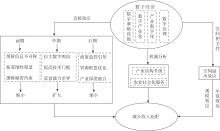
Fig. 1
Analytical framework for the impact of digital economy on urban-rural income gap"
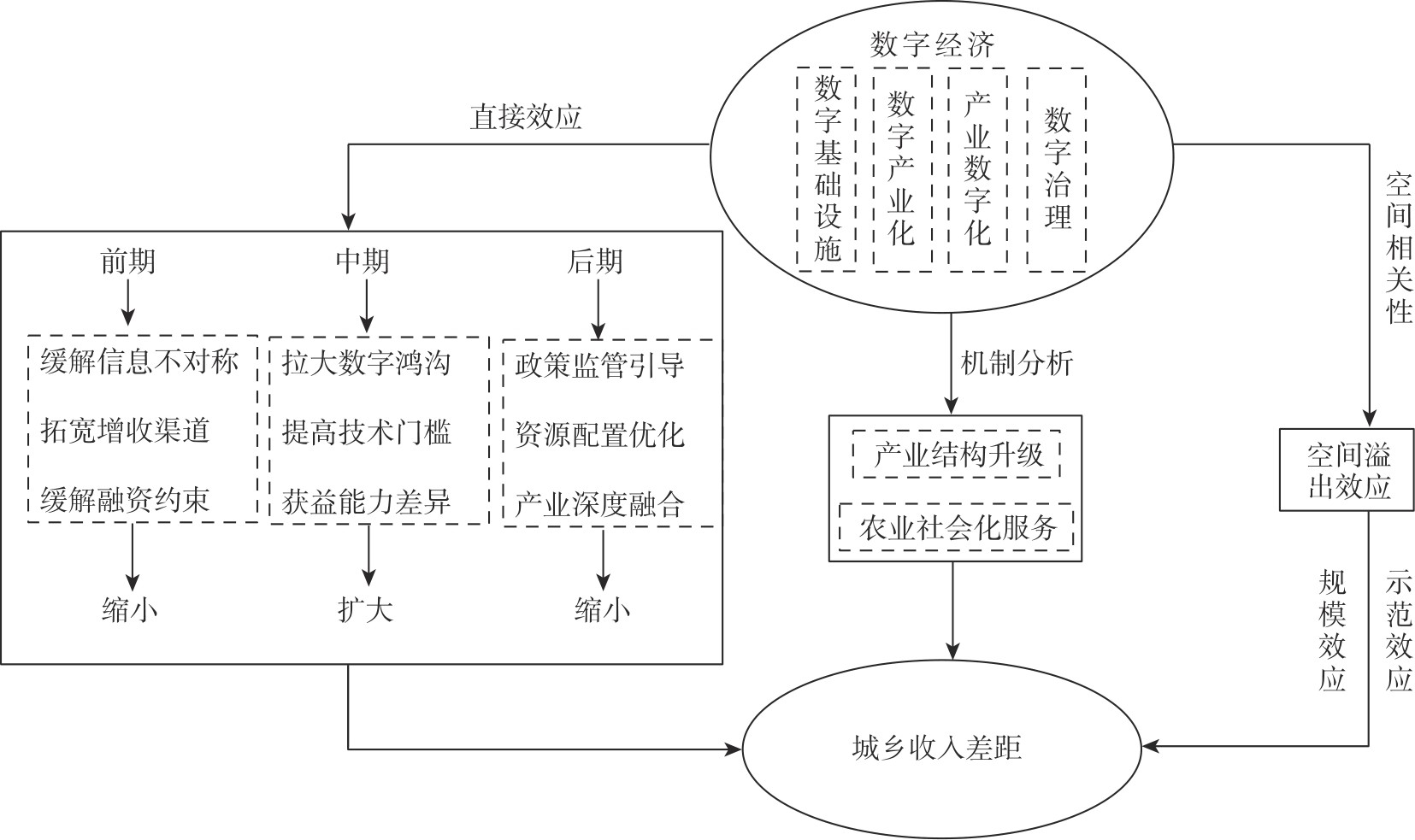
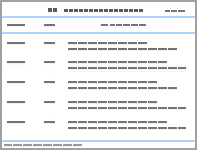
Tab. 1
Descriptive statistics of variables"
| 变量类别 | 变量名称 | 符号 | 均值 | 中位数 | 标准差 | 最小值 | 最大值 |
|---|---|---|---|---|---|---|---|
| 被解释变量 | 城乡收入差距 | 0.122 | 0.143 | 0.067 | 0.007 | 0.277 | |
| 核心解释变量 | 数字经济发展水平 | DE | 0.236 | 0.215 | 0.149 | 0.022 | 0.770 |
| 控制变量 | 经济发展水平/104元 | gdp | 15.281 | 15.273 | 0.660 | 13.782 | 17.325 |
| 教育投入/人 | edu | 6.569 | 6.537 | 0.228 | 5.840 | 7.235 | |
| 财政自给率 | gov | 0.232 | 0.167 | 0.174 | 0.042 | 0.880 | |
| 金融发展水平 | fin | 3.391 | 3.210 | 1.211 | 1.416 | 7.621 | |
| 对外开放水平 | open | 0.065 | 0.008 | 0.140 | 0.001 | 0.928 | |
| 机制变量 | 产业结构升级 | Ind | 1.769 | 1.574 | 1.160 | 0.205 | 6.219 |
| 农业社会化服务/104元 | Soc | 0.497 | 0.430 | 0.198 | 0.226 | 0.945 |
Tab. 2
Index system of digital economy development level in Gansu Province"
| 一级指标 | 二级指标 | 指标说明 | 单位 | 属性 | 权重 |
|---|---|---|---|---|---|
| 数字基础设施 | 互联网普及率 | 每百人互联网宽带用户数 | 户·(100人)-1 | 正 | 0.092 |
| 移动电话普及率 | 每百人移动电话用户数 | 部·(100人)-1 | 正 | 0.053 | |
| 数字产业化 | 信息化从业人员比例 | 信息传输、软件和信息技术服务业从业人员占年末从业人数比重 | % | 正 | 0.023 |
| 人均电信业务总量 | 电信业务总量占常住人口比重 | 104元·人-1 | 正 | 0.209 | |
| 人均邮政业务总量 | 邮政业务总量占常住人口比重 | 104元·人-1 | 正 | 0.103 | |
| 产业数字化 | 数字金融使用深度 | 数字普惠金融使用深度指数 | - | 正 | 0.040 |
| 数字金融覆盖广度 | 数字普惠金融覆盖广度指数 | - | 正 | 0.033 | |
| 普惠金融数字化程度 | 数字普惠金融数字化程度指数 | - | 正 | 0.023 | |
| 电子商务销售额占比 | 电子商务销售额占GDP的比重 | % | 正 | 0.069 | |
| 数字治理 | R&D内部经费支出占比 | R&D内部经费支出占GDP的比重 | % | 正 | 0.178 |
| 每万人发明专利申请授权量 | 发明专利申请授权量占常住人口比重 | 件·(104人)-1 | 正 | 0.177 |
Tab. 3
Baseline regression results"
| 变量 | Gap | |||
|---|---|---|---|---|
| 回归1 | 回归2 | 回归3 | 回归4 | |
| DE | 0.098***(2.671) | -0.147**(-2.120) | -0.373***(-4.468) | -0.559***(-3.475) |
| DE2 | - | 0.194***(4.088) | 1.044***(5.142) | 1.977***(2.745) |
| DE3 | - | - | -0.783***(-4.290) | -2.647*(-1.900) |
| DE4 | - | - | - | 1.226(1.349) |
| gdp | -0.061***(-4.462) | -0.053***(-4.065) | -0.034***(-2.648) | -0.027**(-1.988) |
| edu | -0.001(-0.047) | 0.003(0.267) | -0.002(-0.201) | -0.004(-0.341) |
| gov | 0.120***(3.311) | 0.115***(3.363) | 0.091***(2.808) | 0.086***(2.626) |
| fin | -0.009*(-1.955) | -0.005(-1.134) | -0.004(-0.904) | -0.004(-0.867) |
| open | -0.031(-1.590) | -0.021(-1.168) | -0.002(-0.124) | -0.001(-0.032) |
| Constant | 1.058***(5.038) | 0.921***(4.589) | 0.692***(3.548) | 0.612***(3.008) |
| 控制变量 | 是 | 是 | 是 | 是 |
| N | 154 | 154 | 154 | 154 |
| 0.777 | 0.804 | 0.830 | 0.832 | |
| 城市固定 | 是 | 是 | 是 | 是 |
| 时间固定 | 是 | 是 | 是 | 是 |
Tab. 4
Heterogeneity analysis regression results"
| 变量 | 河西地区 回归5 | 陇中地区 回归6 | 陇东南地区 回归7 |
|---|---|---|---|
| -0.014(-0.159) | -0.231(-1.353) | -0.953***(-3.138) | |
| DE2 | -0.112(-0.460) | 0.761**(2.210) | 5.039***(3.479) |
| DE3 | 0.163(0.721) | -0.603**(-2.338) | -7.612***(-2.908) |
| Constant | 0.520**(2.108) | -0.525*(-1.722) | 2.632***(5.766) |
| 控制变量 | 是 | 是 | 是 |
| N | 55 | 44 | 55 |
| 0.797 | 0.954 | 0.976 | |
| 城市固定 | 是 | 是 | 是 |
| 时间固定 | 是 | 是 | 是 |
Tab. 5
Regression results based on time trends"
| 变量 | Gap 回归8 |
|---|---|
| DE(基期=2012年) | -0.199***(-2.775) |
| DE×2013年 | 0.044(1.206) |
| DE×2014年 | 0.082*(1.978) |
| DE×2015年 | 0.098**(2.156) |
| DE×2016年 | 0.122**(2.566) |
| DE×2017年 | 0.151***(3.139) |
| DE×2018年 | 0.179***(3.636) |
| DE×2019年 | 0.195***(3.795) |
| DE×2020年 | 0.184***(3.503) |
| DE×2021年 | 0.143***(2.935) |
| DE×2022年 | 0.202***(4.181) |
| Constant | 1.265***(7.334) |
| 控制变量 | 是 |
| N | 154 |
| 0.802 | |
| 城市固定 | 是 |
| 时间固定 | 是 |
Tab. 6
Mechanism test of industrial structure and agricultural socialized services"
| 变量 | Gap 回归3 | Ind 回归9 | Soc 回归10 |
|---|---|---|---|
| DE | -0.373***(-4.468) | 13.506***(3.894) | 19.503***(4.048) |
| DE2 | 1.044***(5.142) | -31.016***(-3.679) | -44.069***(-3.764) |
| DE3 | -0.783***(-4.290) | 22.588***(2.981) | 30.081***(2.858) |
| Constant | 0.692***(3.548) | 0.387(0.048) | -11.968(-1.064) |
| 控制变量 | 是 | 是 | 是 |
| N | 154 | 154 | 154 |
| 0.830 | 0.621 | 0.506 | |
| 城市固定 | 是 | 是 | 是 |
| 时间固定 | 是 | 是 | 是 |
Tab. 7
Robustness and endogeneity tests"
| 变量 | 替换解释变量 回归11 | 缩尾处理 回归12 | 改变样本观察期 回归13 | 工具变量法 回归14 |
|---|---|---|---|---|
| DE | -0.102***(-6.410) | -0.373***(-4.468) | -0.232**(-2.186) | -1.043***(-4.943) |
| DE2 | 0.045***(5.809) | 1.044***(5.142) | 0.923***(3.991) | 2.287***(5.109) |
| DE3 | -0.006***(-4.634) | -0.783***(-4.290) | -0.749***(-3.645) | -1.708***(-4.568) |
| Constant | 0.886***(5.008) | 0.692***(3.548) | 0.717***(3.355) | -0.015(-0.053) |
| 控制变量 | 是 | 是 | 是 | 是 |
| N | 154 | 154 | 154 | 154 |
| 0.847 | 0.830 | 0.783 | 0.970 | |
| 城市固定 | 是 | 是 | 是 | 是 |
| 时间固定 | 是 | 是 | 是 | 是 |
| Kleibergen-Paap rk LM统计量 | - | - | - | 15.156 [0.0001] |
| Kleibergen-Paap rk Wald F统计量 | - | - | - | 23.055 {16.38} |
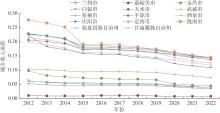
Fig. 2
Change trend of urban-rural income gap in Gansu Province from 2012 to 2022"
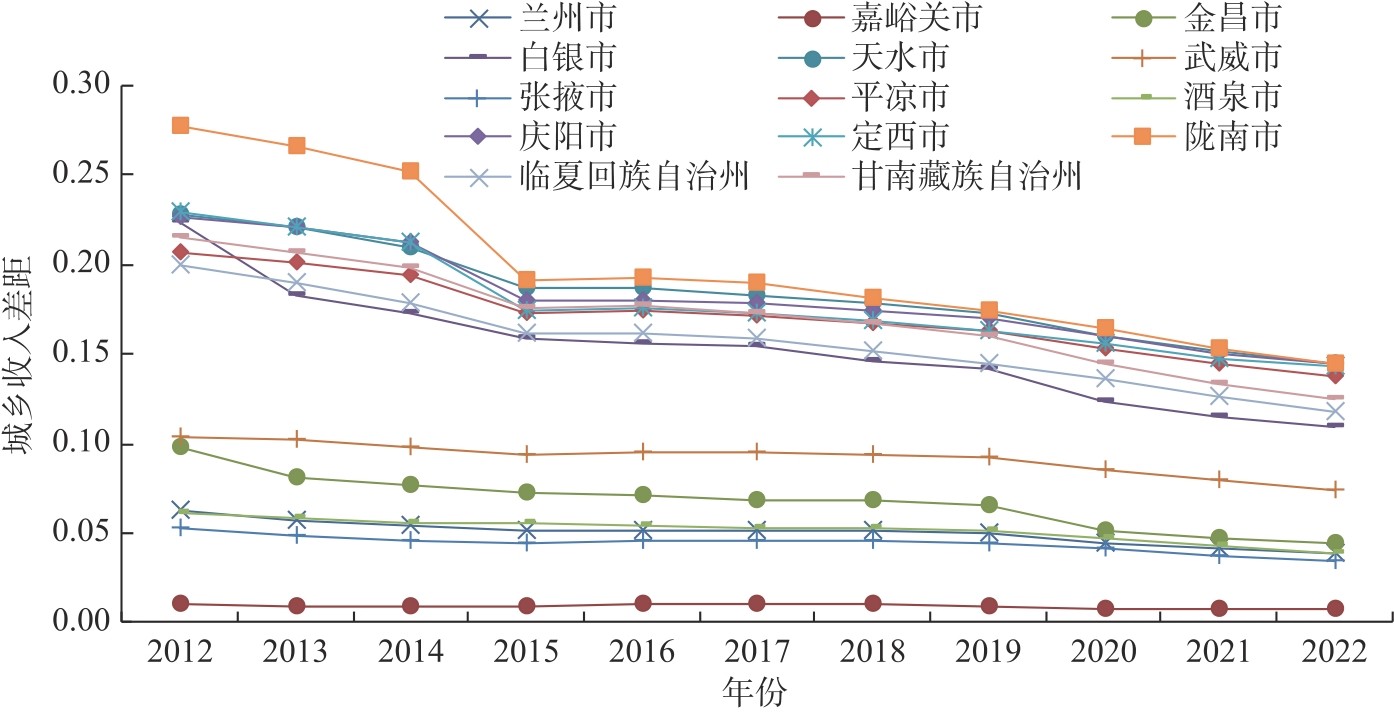
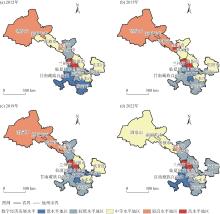
Fig. 3
Evolution of spatial pattern of digital economy development level in Gansu Province from 2012 to 2022"

Tab. 8
Global Moran’s I statistic for urban-rural income gap in Gansu Province from 2012 to 2022"
| 统计量 | 2012年 | 2013年 | 2014年 | 2015年 | 2016年 | 2017年 | 2018年 | 2019年 | 2020年 | 2021年 | 2022年 |
|---|---|---|---|---|---|---|---|---|---|---|---|
| 全局莫兰指数 | 0.696*** | 0.731*** | 0.735*** | 0.728*** | 0.732*** | 0.7332** | 0.738*** | 0.739*** | 0.733*** | 0.740*** | 0.749*** |
| Z统计值 | 3.869 | 4.042 | 4.062 | 4.028 | 4.047 | 4.053 | 4.080 | 4.088 | 4.047 | 4.082 | 4.122 |
| P值 | 0.001 | 0.001 | 0.000 | 0.001 | 0.001 | 0.001 | 0.000 | 0.000 | 0.001 | 0.000 | 0.000 |
Tab. 9
Results of spatial econometric model tests"
| 检验 | 统计量 | P值 |
|---|---|---|
| LM空间误差检验 | 42.129 | 0.000 |
| 稳健的LM空间误差检验 | 28.956 | 0.000 |
| LM空间滞后检验 | 128.041 | 0.000 |
| 稳健的LM空间滞后检验 | 114.867 | 0.000 |
| Wald(SDM退化为SAR)检验 | 74.125 | 0.000 |
| Wald(SDM退化为SEM)检验 | 98.014 | 0.000 |
| LR(有无个体效应)检验 | 32.100 | 0.021 |
| LR(有无时间效应)检验 | 193.412 | 0.000 |
Tab. 10
Decomposition results of spatial spillover effects"
| 变量 | 直接效应 | 间接效应 | 总效应 |
|---|---|---|---|
| DE | -0.211**(-2.172) | -0.390***(-4.136) | -0.602***(-5.080) |
| DE2 | 0.546**(2.208) | 1.024***(3.592) | 1.569***(4.151) |
| DE3 | -0.394**(-1.990) | -0.769***(-3.370) | -1.164***(-3.966) |
| 控制变量 | 是 | 是 | 是 |
| 城市固定 | 是 | 是 | 是 |
| 时间固定 | 是 | 是 | 是 |
| N | 154 | 154 | 154 |
| R2 | 0.847 | 0.847 | 0.847 |
| [1] | 司增绰, 李燕. 数字经济减缩城乡居民收入差距的逻辑及效应[J]. 深圳大学学报(人文社会科学版), 2023, 40(4): 76-86. |
| [Si Zengchuo, Li Yan. The logic and effect of digital economy to narrow the income gap between urban and rural residents[J]. Journal of Shenzhen University (Humanities & Social Sciences Edition), 2023, 40(4): 76-86.] | |
| [2] |
Aker J C, Ghosh I, Burrell J. The promise (and pitfalls) of ICT for agriculture initiatives[J]. Agricultural Economics, 2016, 47(Suppl.1): 35-48.
doi: 10.1111/agec.2016.47.issue-S1 |
| [3] |
吉泽男, 付文婷, 王鹏程, 等. 干旱区数字经济与农业绿色发展耦合协调研究——以新疆为例[J]. 干旱区地理, 2024, 47(11): 1981-1990.
doi: 10.12118/j.issn.1000-6060.2023.637 |
|
[Ji Zenan, Fu Wenting, Wang Pengcheng, et al. Coupling and coordination of digital economy and green development of agriculture in arid zones: A case study of Xinjiang[J]. Arid Land Geography, 2024, 47(11): 1981-1990.]
doi: 10.12118/j.issn.1000-6060.2023.637 |
|
| [4] |
彭继增, 陶旭辉, 徐丽. 我国数字化贫困地理集聚特征及时空演化机制[J]. 经济地理, 2019, 39(2): 169-179.
doi: 10.15957/j.cnki.jjdl.2019.02.021 |
|
[Peng Jizeng, Tao Xuhui, Xu Li. Geographic agglomeration characteristic and temporal & spatial evolution mechanism of digital poverty in China[J]. Economic Geography, 2019, 39(2): 169-179.]
doi: 10.15957/j.cnki.jjdl.2019.02.021 |
|
| [5] | 陈雪梅, 周斌. 数字经济推进乡村振兴的内在机理与实现路径[J]. 理论探讨, 2023(5): 85-90. |
| [Chen Xuemei, Zhou Bin. The internal mechanism and realization path of digital economy promoting rural revitalization[J]. Theoretical Discussions, 2023(5): 85-90.] | |
| [6] | 王子凤, 张桂文. 数字经济对城乡居民收入差距影响的实证检验[J]. 统计与决策, 2023, 39(22): 112-116. |
| [Wang Zifeng, Zhang Guiwen. An empirical test of the impact of digital economy on the urban-rural income gap[J]. Statistics & Decision, 2023, 39(22): 112-116.] | |
| [7] | 米嘉伟, 屈小娥. 数字经济发展如何影响城乡收入差距[J]. 现代经济探讨, 2022(6): 80-91. |
| [Mi Jiawei, Qu Xiaoe. How does the development of digital economy affect the urban-rural income gap[J]. Modern Economic Research, 2022(6): 80-91.] | |
| [8] | 王帅龙, 孙培蕾. 数字经济、劳动力流动与城乡收入差距[J]. 哈尔滨商业大学学报(社会科学版), 2023(5): 108-118. |
| [Wang Shuailong, Sun Peilei. Digital economy, labor mobility, and urban-rural income gap[J]. Journal of Harbin University of Commerce (Social Science Edition), 2023(5): 108-118.] | |
| [9] | 钟文, 严芝清, 郑明贵. 数字经济发展对城乡收入差距缩小的影响: 机制与效应[J]. 农业经济与管理, 2024(1): 89-100. |
| [Zhong Wen, Yan Zhiqing, Zheng Minggui. Impact of development of digital economy on narrowing urban-rural income gap: Mechanisms and effect[J]. Agricultural Economics and Management, 2024(1): 89-100.] | |
| [10] | 邢怀振, 苏群. 数字经济发展水平对城乡收入差距的影响研究[J]. 统计与决策, 2023, 39(18): 78-82. |
| [Xing Huaizhen, Su Qun. Research on the impact of digital economy development level on urban-rural income gap[J]. Statistics & Decision, 2023, 39(18): 78-82.] | |
| [11] | 杨虎涛, 胡乐明. 不确定性、信息生产与数字经济发展[J]. 中国工业经济, 2023(4): 24-41. |
| [Yang Hutao, Hu Leming. Uncertainty, information production, and the development of digital economy[J]. China Industrial Economics, 2023(4): 24-41.] | |
| [12] | 张岳, 张博. 数字治理下农民收入增长与收入分配效应[J]. 华南农业大学学报(社会科学版), 2024, 23(1): 63-75. |
| [Zhang Yue, Zhang Bo. Farmers’ income growth and income distribution effect under digital governance[J]. Journal of South China Agricultural University (Social Science Edition), 2024, 23(1): 63-75.] | |
| [13] | Aker J C, Mbiti I M. Mobile phones and economic development in Africa[J]. Journal of Economic Perspectives, 2010, 24(3): 207-232. |
| [14] | 田秀娟, 李睿. 数字技术赋能实体经济转型发展——基于熊彼特内生增长理论的分析框架[J]. 管理世界, 2022, 38(5): 56-73. |
| [Tian Xiujuan, Li Rui. Digital technology empowers the transformation and development of real economy: An analysis framework based on Schumpeter’s endogenous growth theory[J]. Journal of Management World, 2022, 38(5): 56-73.] | |
| [15] |
生延超, 谭左思, 李倩, 等. 数字经济能否促进黄河流域旅游经济韧性提升?[J]. 干旱区地理, 2023, 46(10): 1704-1713.
doi: 10.12118/j.issn.1000-6060.2023.090 |
|
[Sheng Yanchao, Tan Zuosi, Li Qian, et al. Can the digital economy promote the resilience of the tourism economy in the Yellow River Basin?[J]. Arid Land Geography, 2023, 46(10): 1704-1713.]
doi: 10.12118/j.issn.1000-6060.2023.090 |
|
| [16] | 洪俊杰, 李研, 杨曦. 数字经济与收入差距: 数字经济核心产业的视角[J]. 经济研究, 2024, 59(5): 116-131. |
| [Hong Junjie, Li Yan, Yang Xi. Digital economy and income gap: From the perspective of core industries in the digital economy[J]. Economic Research Journal, 2024, 59(5): 116-131.] | |
| [17] | 伍云云, 李晓春. 农业社会化服务发展、城市就业与收入分配——理论和证据[J]. 审计与经济研究, 2024, 39(5): 101-114. |
| [Wu Yunyun, Li Xiaochun. Development of agricultural socialized services, urban employment, and income distribution: Theory and evidence[J]. Journal of Audit & Economics, 2024, 39(5): 101-114.] | |
| [18] | 童婷, 李谷成, 廖文梅. 互联网使用能影响农户生产托管行为吗?[J]. 中南财经政法大学学报, 2023(4): 149-160. |
| [Tong Ting, Li Gucheng, Liao Wenmei. Can internet use promote farmers’ participation in agricultural production trusteeship?[J]. Journal of Zhongnan University of Economics and Law, 2023(4): 149-160.] | |
| [19] | 张永奇, 单德朋. 县域数字经济、农业社会化服务与小农户受益——基于宏微观数据的经验考察[J]. 上海财经大学学报, 2024, 26(1): 94-107. |
| [Zhang Yongqi, Shan Depeng. County digital economy, agricultural socialized services, and benefits for small farmers: Based on macro and micro data[J]. Journal of Shanghai University of Finance and Economics, 2024, 26(1): 94-107.] | |
| [20] | 陈卫洪, 王莹. 数字化赋能新型农业经营体系构建研究——“智农通”的实践与启示[J]. 农业经济问题, 2022(9): 86-99. |
| [Chen Weihong, Wang Ying. A study on the construction of a new agricultural management system with digital empowerment: Practice and enlightenment of “Zhinongtong”[J]. Issues in Agricultural Economy, 2022(9): 86-99.] | |
| [21] | 蒋自然, 樊俊杰, 黎晨晟, 等. 数字经济发展对中国制造业生产效率的影响: 空间效应与传导机制[J]. 人文地理, 2024, 39(3): 72-80, 122. |
| [Jiang Ziran, Fan Junjie, Li Chensheng, et al. The impact of digital economy development on the production efficiency of China’s manufacturing industry: Spatial effects and transmission mechanisms[J]. Human Geography, 2024, 39(3): 72-80, 122.] | |
| [22] | 殷浩栋, 霍鹏, 汪三贵. 农业农村数字化转型: 现实表征、影响机理与推进策略[J]. 改革, 2020(12): 48-56. |
| [Yin Haodong, Huo Peng, Wang Sangui. Agriculture and rural digital transformation: Realistic representation, impact mechanism, and promotion strategy[J]. Reform, 2020(12): 48-56.] | |
| [23] | 郭峰, 王靖一, 王芳, 等. 测度中国数字普惠金融发展: 指数编制与空间特征[J]. 经济学(季刊), 2020, 19(4): 1401-1418. |
| [Guo Feng, Wang Jingyi, Wang Fang, et al. Measuring China’s digital financial inclusion: Index compilation and spatial characteristics[J]. China Economic Quarterly, 2020, 19(4): 1401-1418.] | |
| [24] | 郭海明, 范勇. 数字经济对区域城乡融合发展水平的空间影响效应——基于甘肃省市域空间面板数据[J]. 区域金融研究, 2024(9): 65-75. |
| [Guo Haiming, Fan Yong. Spatial effect of the digital economy on regional urban-rural integrated development: Based on prefectural panel data in Gansu Province[J]. Journal of Regional Financial Research, 2024(9): 65-75.] | |
| [25] | 王玉珍, 王彤, 宋国靖. 甘肃省数字经济发展水平评价及耦合协调分析[J]. 河西学院学报, 2024, 40(2): 91-97. |
| [Wang Yuzhen, Wang Tong, Song Guojing. Evaluation and coupling coordination analysis of digital economy development in Gansu Province[J]. Journal of the Hexi University, 2024, 40(2): 91-97.] | |
| [26] |
郭沛, 王光远. 数字经济的减污降碳协同作用及机制——基于地级市数据的实证检验[J]. 资源科学, 2023, 45(11): 2117-2129.
doi: 10.18402/resci.2023.11.02 |
|
[Guo Pei, Wang Guangyuan. The synergistic effect of digital economy on pollution and carbon reduction and the influence mechanism: An empirical test based on prefecture-level city data[J]. Resources Science, 2023, 45(11): 2117-2129.]
doi: 10.18402/resci.2023.11.02 |
|
| [27] | 赵航, 高强, 李丹. 农业社会化服务带动小农户增收的机制、障碍与路径——基于城乡经济循环的分析视角[J]. 南京工业大学学报(社会科学版), 2022, 21(6): 98-108, 110. |
| [Zhao Hang, Gao Qiang, Li Dan. Mechanism, obstacle, and path of agricultural socialized service driving small farmers’ income increase: From perspective of urban-rural economic cycle[J]. Journal of Nanjing Tech University (Social Science Edition), 2022, 21(6): 98-108, 110.] | |
| [28] | 郝爱民. 农业生产性服务对农业技术进步贡献的影响[J]. 华南农业大学学报(社会科学版), 2015, 14(1): 8-15. |
| [Hao Aimin. Research of agricultural producer services’ effect on agricultural technology progress[J]. Journal of South China Agricultural University (Social Science Edition), 2015, 14(1): 8-15.] | |
| [29] | 郑黎阳, 王瑜. 县域产业结构优化能缩小城乡收入差距吗?——基于内蒙古县域数据的实证检验[J]. 干旱区资源与环境, 2024, 38(11): 44-51. |
| [Zheng Liyang, Wang Yu. Does optimization of county-level industrial structure narrow the urban-rural income gap? An empirical study in Inner Mongolia[J]. Journal of Arid Land Resources and Environment, 2024, 38(11): 44-51.] | |
| [30] | 管振, 孙志军. 教育对人口结构与经济增长的影响研究[J]. 中国软科学, 2024(6): 79-89. |
| [Guan Zhen, Sun Zhijun. Research on the impact of education on population structure and economic growth[J]. China Soft Science, 2024(6): 79-89.] | |
| [31] | 柳毅, 赵轩, 毛峰. 数字经济驱动共同富裕的发展动力与空间溢出效应研究——基于长三角面板数据和空间杜宾模型[J]. 中国软科学, 2023(4): 98-108. |
| [Liu Yi, Zhao Xuan, Mao Feng. Research on the driving force, mechanism and spatial spillover effects of digital economy blostering common prosperity in the Yangtze River Delta[J]. China Soft Science, 2023(4): 98-108.] | |
| [32] | 朱华友, 金伊勒, 邹小媛, 等. 数字乡村建设对城乡收入差距的传导机制与门槛效应研究——以长三角地区城市为例[J]. 调研世界, 2024(10): 37-47. |
| [Zhu Huayou, Jin Yile, Zou Xiaoyuan, et al. Research on the transmission mechanism and threshold effect of digital rural construction on urban-rural income gap: An example of Yangtze River Delta cities[J]. The World of Survey and Research, 2024(10): 37-47.] | |
| [33] | 张丽君, 梁怡萱, 巩蓉蓉. 数字经济对城乡收入差距的动态影响研究——来自中国31个省(区、市)的证据[J]. 经济问题探索, 2023(3): 18-40. |
| [Zhang Lijun, Liang Yixuan, Gong Rongrong. Research on the dynamic influnence of digital economy on urban-rural income gap: Evidence from 31 provinces (municipalities and autonomous regions) in China[J]. Inquiry into Economic Issues, 2023(3): 18-40.] | |
| [34] | 江艇. 因果推断经验研究中的中介效应与调节效应[J]. 中国工业经济, 2022(5): 100-120. |
| [Jiang Ting. Mediating effects and moderating effects in causal inference[J]. China Industrial Economics, 2022(5): 100-120.] | |
| [35] | 黄群慧, 余泳泽, 张松林. 互联网发展与制造业生产率提升: 内在机制与中国经验[J]. 中国工业经济, 2019(8): 5-23. |
| [Huang Qunhui, Yu Yongze, Zhang Songlin. Internet development and productivity growth in manufacturing industry: Internal mechanism and China experiences[J]. China Industrial Economics, 2019(8): 5-23.] | |
| [36] |
Nunn N, Qian N. US food aid and civil conflict[J]. American Economic Review, 2014, 104(6): 1630-1666.
doi: 10.1257/aer.104.6.1630 |
| [37] | 孔凡斌, 陆雨, 徐彩瑶. 数字经济发展、森林生态产品价值实现与城乡收入差距[J]. 林业科学, 2024, 60(5): 1-21. |
| [Kong Fanbin, Lu Yu, Xu Caiyao. Digital economy development, value realization of forest ecological products, and urban-rural income gap[J]. Scientia Silvae Sinicae, 2024, 60(5): 1-21.] | |
| [38] | 刘渊博, 温涛. 数字素养与农户收入差距: 加剧还是缓解?——基于中西部地区的微观证据[J]. 西北农林科技大学学报(社会科学版), 2024, 24(4): 91-101. |
| [Liu Yuanbo, Wen Tao. Digital literacy and the income gap among farmers: Exacerbation or alleviating? Based on micro-evidence from the central and western regions[J]. Journal of Northwest A & F University (Social Science Edition), 2024, 24(4): 91-101.] |
|
||

