Arid Land Geography ›› 2026, Vol. 49 ›› Issue (1): 164-175.doi: 10.12118/j.issn.1000-6060.2025.109
• Regional Development • Previous Articles Next Articles
LI Lingyan1,2( ), WANG Mengmeng1,2(), XIA Haoming1,2, DUAN Mimi1,2
Received:2025-03-02
Revised:2025-06-21
Online:2026-01-25
Published:2026-01-18
Contact:
WANG Mengmeng
E-mail:lilingyan@xauat.edu.cn;lwangmengmeng@xauat.edu.cn
LI Lingyan, WANG Mengmeng, XIA Haoming, DUAN Mimi. Vulnerability and influencing factors of clean energy use of rural households in ecologically fragile areas of northwest China[J].Arid Land Geography, 2026, 49(1): 164-175.
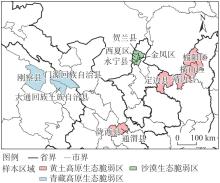
Fig. 1
Schematic diagram of the study area"
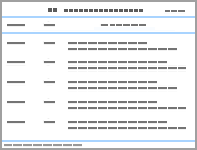
Tab. 1
Vulnerability assessment indicator system of clean energy use of rural households"
| 维度 | 一级指标层 | 二级指标层 | 赋值 | 方向 | 权重 |
|---|---|---|---|---|---|
| 暴露度 | 供暖成本 | 供暖成本增幅(E1) | “非常小”至“非常大”依次赋值1~5 | + | 0.031 |
| 能源易用性 | 能源获取便捷性(E2) | “非常便捷”至“非常不便捷”依次赋值1~5 | + | 0.032 | |
| 设备维护易操作性(E3) | “非常容易”至“非常不容易”依次赋值1~5 | + | 0.033 | ||
| 设备操作便捷性(E4) | “非常便捷”至“非常不便捷”依次赋值1~5 | + | 0.035 | ||
| 自然环境 | 温湿指数(E5) | 60~65=1(很舒适);56~60或65~70=2;50~56或70~75=3; 45~50或75~80=4;40~45或80~85=5;32~40或85~90=6; <32或>90=7(很不舒适) | + | 0.082 | |
| 植被覆盖率(E6) | >60%=1;45%~60%=2;30%~45%=3;<30%=4 | + | 0.068 | ||
| 敏感性 | 认知水平 | 受教育程度(S1) | 大专及以上=1;高中或中专技校=2;中学=3;小学及以下=4 | + | 0.006 |
| 生计类型(S2) | 务工或个体经营=1;务农兼务工=2;务农=3;失业=4 | + | 0.019 | ||
| 经济水平 | 家庭年总收入(S3) | 1×10⁵元以上=1;5×10⁴~1×10⁵元=2; 3×10⁴~5×10⁴元=3; 1×10⁴~3×10⁴元=4; 1×10⁴元以下=5 | + | 0.015 | |
| 家庭耕地面积(S4) | >0.40 hm2=1;0.20~0.40 hm2=2;0.10~0.20 hm2=3; 0.03~0.10 hm2=4;<0.03 hm2=5 | + | 0.113 | ||
| 房屋占地面积(S5) | >240 m2=1;160~240 m2=2;80~160 m2=3;30~80 m2=4;<30 m2=5 | + | 0.007 | ||
| 价格感知 | 设备价格接受度(S6) | “非常接受”至“非常不接受”依次赋值1~5 | + | 0.029 | |
| 设备维护费用接受度(S7) | “非常接受”至“非常不接受”依次赋值1~5 | + | 0.042 | ||
| 心理成本 | 传统能源改变难度(S8) | “非常小”至“非常大”依次赋值1~5 | + | 0.040 | |
| 能源转型感知损失度(S9) | “非常小”至“非常大”依次赋值1~5 | + | 0.032 | ||
| 能源设备故障担忧(S10) | “非常小”至“非常大”依次赋值1~5 | + | 0.039 | ||
| 适应能力 | 生态价值 | 转型后室内烟尘量(A1) | “非常大”至“非常小”依次赋值1~5 | - | 0.046 |
| 转型后空气质量提升(A2) | “非常小”至“非常大”依次赋值1~5 | - | 0.062 | ||
| 转型后村庄面貌改善(A3) | “非常小”至“非常大”依次赋值1~5 | - | 0.063 | ||
| 个人规范 | 减少化石能源责任感(A4) | “非常小”至“非常大”依次赋值1~5 | - | 0.042 | |
| 环保责任感(A5) | “非常小”至“非常大”依次赋值1~5 | - | 0.050 | ||
| 能源升级意识(A6) | “非常小”至“非常大”依次赋值1~5 | - | 0.047 | ||
| 政策满意度 | 清洁能源推广满意度(A7) | “非常不满意”至“非常满意”依次赋值1~5 | - | 0.021 | |
| 补贴政策满意度(A8) | “非常不满意”至“非常满意”依次赋值1~5 | - | 0.022 | ||
| 后续服务政策满意度(A9) | “非常不满意”至“非常满意”依次赋值1~5 | - | 0.024 |
Tab. 2
Explanation of the main variables"
| 维度 | 变量 | 赋值 | 样本均值 | |
|---|---|---|---|---|
| 因变量 | 农户清洁能源使用的脆弱性(y) | 低脆弱性=1;中脆弱性=2;高脆弱性=3 | 2.00 | |
| 自变量 | 经济层面 | 家庭收入(x1) | 1×10⁴元以下=1;1×10⁴~3×10⁴元=2;3×10⁴~5×10⁴元=3;5×10⁴~1×10⁵元=4;1×10⁵元以上=5 | 2.60 |
| 耕地面积(x2) | <0.03 hm2=1;0.03~0.10 hm2=2;0.10~0.20 hm2=3;0.20~0.40 hm2=4;>0.40 hm2=5 | 4.14 | ||
| 社会层面 | 能源补贴政策(x3) | “非常不满意”至“非常满意”依次赋值1~5 | 3.00 | |
| 社会网络(x4) | 受邻居影响:“非常小”至“非常大”依次赋值1~5 | 3.97 | ||
| 家庭层面 | 性别(x5) | 女=0;男=1 | 0.59 | |
| 年龄(x6) | 20岁以下=1;20岁~29岁=2;30~39岁=3;40~49岁=4;50~59岁=5;60岁以上=6 | 4.56 | ||
| 生计类型(x7) | 务农或失业=1;务农兼打工=2;务工(包括个体经营)=3;企事业单位人员(包括村干部)=4;其他=5 | 1.74 | ||
| 受教育程度(x8) | 小学及以下=1;初中毕业=2;高中/中专/职专毕业=3;大专及以上=4 | 1.39 | ||
| 党员数量(x9) | 没有=0;有=1 | 0.13 | ||
| 家庭规模(x10) | 家庭常住人口数量/人 | 3.60 | ||
Tab. 3
Vulnerability characteristics of clean energy use of rural households in ecologically fragile areas of northwest China"
| 聚类结果 | 脆弱性分布 | 脆弱性指数 | |||
|---|---|---|---|---|---|
| 农户数量/户 | 农户占比/% | 取值范围 | 均值 | ||
| 低度脆弱性 | 522 | 26.12 | -0.068~0.121 | 0.083 | |
| 中度脆弱性 | 933 | 46.55 | 0.121~0.200 | 0.158 | |
| 高度脆弱性 | 547 | 27.33 | 0.200~0.392 | 0.243 | |
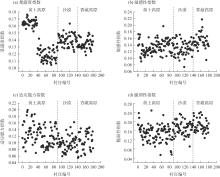
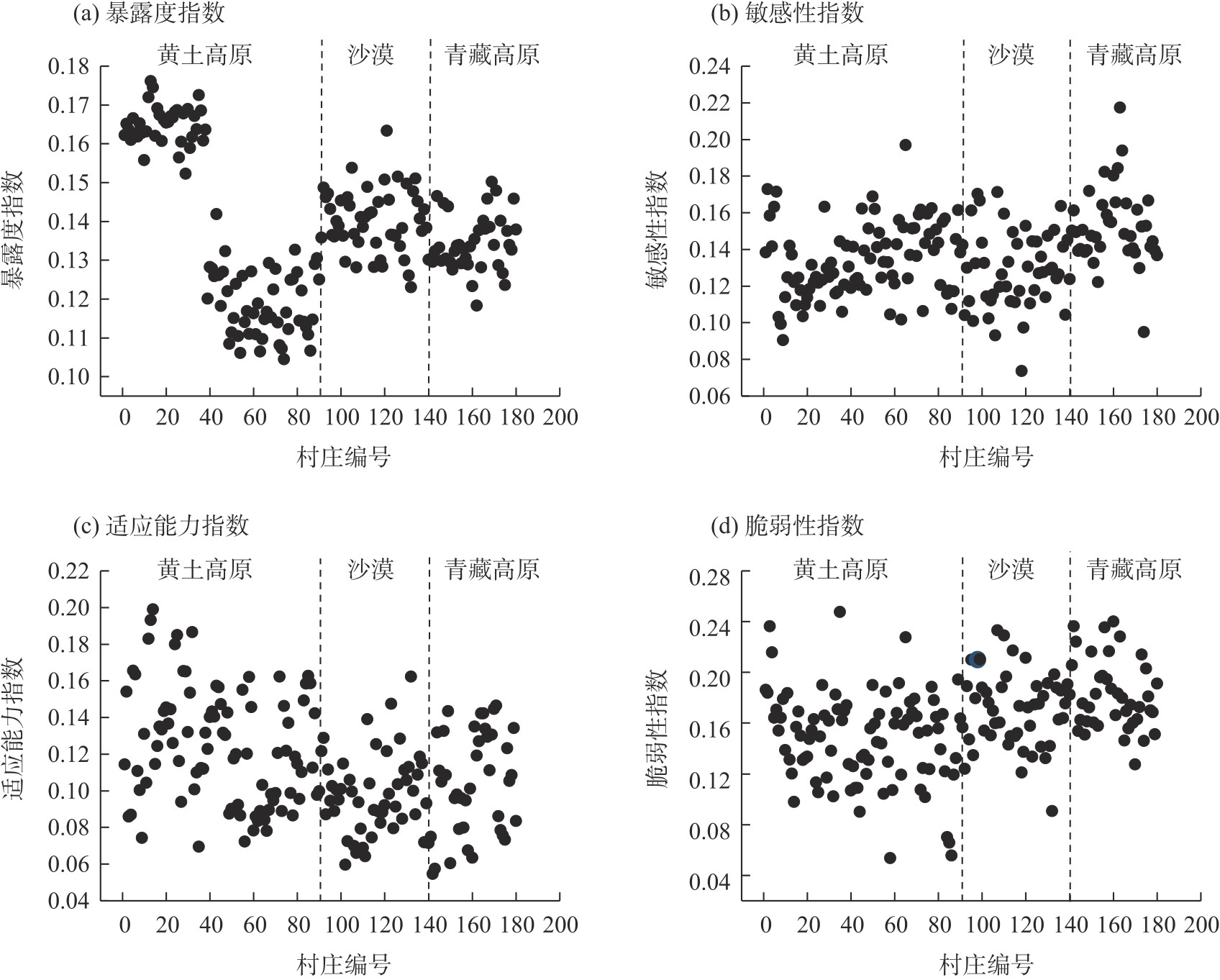
Fig. 2
Exposure, sensitivity, adaptivity and vulnerability indices of villages"
Tab. 4
Exposure, sensitivity, adaptivity and vulnerability indices of different ecologically fragile areas"
| 生态脆弱区 | 暴露度指数 | 敏感性指数 | 适应能力指数 | 脆弱性指数 | |||||||
|---|---|---|---|---|---|---|---|---|---|---|---|
| 指数 | 排序 | 指数 | 排序 | 指数 | 排序 | 指数 | 排序 | ||||
| 黄土高原 | 0.142 | 1 | 0.133 | 2 | 0.125 | 1 | 0.149 | 3 | |||
| 沙漠 | 0.140 | 2 | 0.129 | 3 | 0.098 | 3 | 0.171 | 2 | |||
| 青藏高原 | 0.134 | 3 | 0.148 | 1 | 0.100 | 2 | 0.181 | 1 | |||
Fig. 3
Exposure, sensitivity, adaptivity and vulnerability indices of different ecologically fragile areas"
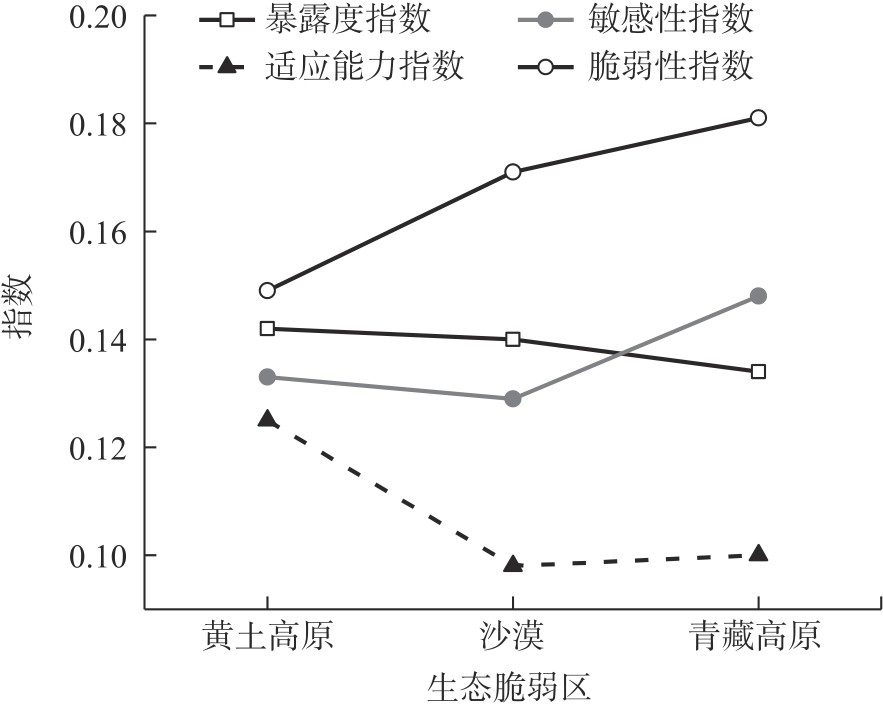
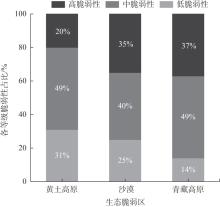
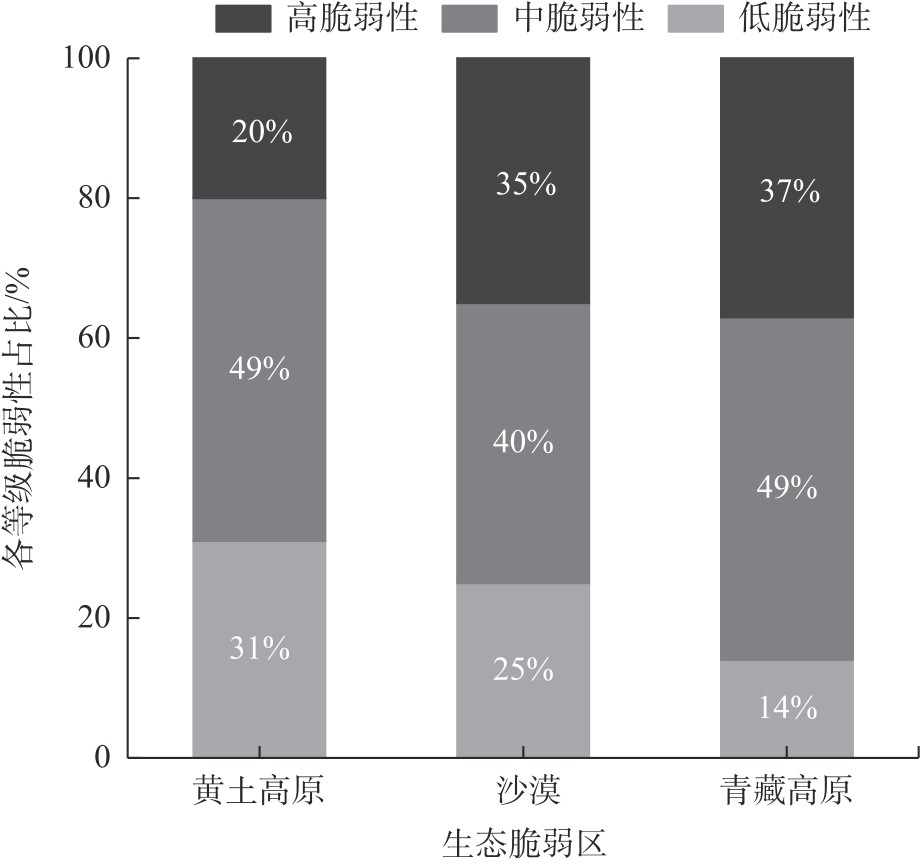
Fig. 4
Percentage of each grade of vulnerability for clean energy use by rural households in different ecologically fragile areas"
Tab. 5
Logit regression results in different ecologically fragile areas"
| 变量 | 总样本 | 黄土高原生态脆弱区 | 沙漠生态脆弱区 | 青藏高原生态脆弱区 | |||||||
|---|---|---|---|---|---|---|---|---|---|---|---|
| B | Exp(B) | B | Exp(B) | B | Exp(B) | B | Exp(B) | ||||
| x1 | -0.074 | 0.929 | -0.032 | 0.969 | -0.188 | 0.829 | -0.359*** | 0.698 | |||
| x2 | -0.822*** | 0.440 | -1.000*** | 0.368 | -0.841*** | 0.431 | -0.608*** | 0.544 | |||
| x3 | -0.359*** | 0.698 | -0.445*** | 0.641 | -0.003 | 0.997 | -0.396*** | 0.673 | |||
| x4 | 0.538*** | 1.713 | 0.608*** | 1.837 | 0.508*** | 1.662 | 0.453*** | 1.573 | |||
| x5 | -0.074 | 0.929 | -0.004 | 0.996 | -0.176 | 0.839 | -0.178 | 0.837 | |||
| x6 | 0.308*** | 1.361 | 0.338*** | 1.402 | 0.534*** | 1.706 | 0.142* | 1.153 | |||
| x7 | -0.179*** | 0.836 | -0.354*** | 0.702 | -0.206 | 0.814 | -0.226* | 0.798 | |||
| x8 | -0.119 | 0.888 | -0.121 | 0.886 | -0.333* | 0.717 | -0.091 | 0.913 | |||
| x9 | -0.115 | 0.891 | -0.030 | 0.970 | -0.187 | 0.829 | -0.578 | 0.561 | |||
| x10 | 0.063** | 1.065 | 0.042 | 1.043 | 0.003 | 1.003 | 0.162** | 1.176 | |||
Tab. 6
Robustness test regression results"
| 变量 | 更换自变量回归 | 缩小研究样本回归 | |||
|---|---|---|---|---|---|
| B | Exp(B) | B | Exp(B) | ||
| x1 | -0.163*** | 0.850 | -0.054 | 0.947 | |
| x2 | 0.099 | 1.104 | -0.673*** | 0.510 | |
| x3 | -0.367*** | 0.693 | -0.276*** | 0.759 | |
| x4 | 0.515*** | 1.674 | 0.421*** | 1.523 | |
| x5 | -0.166* | 0.847 | -0.065 | 0.937 | |
| x6 | 0.261*** | 1.298 | 0.267*** | 1.306 | |
| x7 | -0.207*** | 0.813 | -0.187** | 0.829 | |
| x8 | -0.151** | 0.860 | -0.084 | 0.919 | |
| x9 | -0.139 | 0.870 | -0.025 | 0.975 | |
| x10 | 0.050* | 1.051 | 0.110* | 1.116 | |
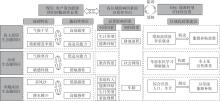
Fig. 5
Vulnerability reduction model of clean energy use of rural households in ecologically fragile areas of northwest China"

| [1] |
韩晓, 魏楚, 吴施美. 中国农村居民生物质能消费估计[J]. 资源科学, 2023, 45(9): 1817-1829.
doi: 10.18402/resci.2023.09.09 |
|
[Han Xiao, Wei Chu, Wu Shimei. Estimation of biomass energy consumption in rural China[J]. Resources Science, 2023, 45(9): 1817-1829.]
doi: 10.18402/resci.2023.09.09 |
|
| [2] | 张增凯, 彭彬彬, 解伟, 等. 能源转型与管理领域的科学研究问题[J]. 管理科学学报, 2021, 24(8): 147-153. |
| [Zhang Zengkai, Peng Binbin, Xie Wei, et al. Scientific research issues in the field of energy transition and management[J]. Journal of Management Science in China, 2021, 24(8): 147-153.] | |
| [3] | 沈国锋, 熊瑞, 程和发, 等. 青藏农村生活能源结构及一次PM2.5排放估算[J]. 科学通报, 2021, 66(15): 1900-1911. |
| [Shen Guofeng, Xiong Rui, Cheng Hefa, et al. Rural residential energy carrier structure and primary PM2.5 emissions from the Qinghai-Tibet Plateau[J]. Chinese Science Bulletin, 2021, 66(15): 1900-1911.] | |
| [4] |
畅华仪, 张俊飚, 何可. 村庄吸引力对农村家庭生活能源清洁转型的影响——来自非正式就业的机制解释[J]. 资源科学, 2023, 45(2): 388-402.
doi: 10.18402/resci.2023.02.12 |
|
[Chang Huayi, Zhang Junbiao, He Ke. The effect of village attraction on rural household clean energy transition: An explanation from informal off-farm employment[J]. Resources Science, 2023, 45(2): 388-402.]
doi: 10.18402/resci.2023.02.12 |
|
| [5] |
EllisonC, Li Y, Yu F, et al. Household transitions to clean energy in a multiprovincial cohort study in China[J]. Nature Sustainability, 2020, 3(1): 42-50.
doi: 10.1038/s41893-019-0432-x |
| [6] | 贺克斌, 李雪玉. 中国散煤综合治理研究报告2023[R]. 北京: 北京大学能源研究院, 2023. |
| [He Kebin, Li Xueyu. China dispersed coalmanagementreport 2023[R]. Beijing: Institute of Energy, Peking University, 2023.] | |
| [7] |
鲍超, 徐牧天. 西北地区投入产出效率的综合测度与时空变化[J]. 干旱区地理, 2021, 44(6): 1772-1783.
doi: 10.12118/j.issn.1000–6060.2021.06.25 |
|
[Bao Chao, Xu Mutian. Comprehensive measurement and spatiotemporal variations of input-output efficiency in northwest China[J]. Arid Land Geography, 2021, 44(6): 1772-1783.]
doi: 10.12118/j.issn.1000–6060.2021.06.25 |
|
| [8] | Duan M M, Li L Y, Liu X J, et al. Turning awareness into behavior: Meta-analysis of household residential life energy transition behavior from the dual perspective of internal driving forces and external inducing forces[J]. Energy, 2023, 279: 128072, doi: 10.1016/j.energy.2023.128072. |
| [9] |
Foster V, Trotter P A, Werner S, et al. Development transitions for fossil fuel-producing low and lower-middle income countries in a carbon-constrained world[J]. Nature Energy, 2024, 9(3): 242-250.
doi: 10.1038/s41560-023-01440-3 |
| [10] | 刘平阔, 卢存禹. 中国能源转型路径选择的影响因素: 理论检验与实证分析[J]. 中国软科学, 2022(6): 51-61. |
| [Liu Pingkuo, Lu Cunyu. Influencing factors of the pathway selection for China’s energy transition: Theoretical verification and empirical analysis[J]. China Soft Science, 2022(6): 51-61.] | |
| [11] | 庄明浩, 鲁玺, 王艳芬, 等. 青藏高原牧区家庭能源消费对生态环境和人体健康的影响研究现状与展望[J]. 生态学报, 2023, 43(5): 1775-1783. |
| [Zhuang Minghao, Lu Xi, Wang Yanfen, et al. Research status and prospect of household energy consumption impact on eco-environment and human health in the pastoral of Qinghai-Xizang Plateau[J]. Acta Ecologica Sinica, 2023, 43(5): 1775-1783.] | |
| [12] | 高鸣, 魏佳朔. 促进农民农村共同富裕: 历史方位和实现路径[J]. 中国软科学, 2022(8): 45-57. |
| [Gao Ming, Wei Jiashuo. Promoting farmers and rural areas to achieve common prosperity: Historical orientation and realization path[J]. China Soft Science, 2022(8): 45-57.] | |
| [13] | Pachauri R K, Allen M R, Barros V R, et al. Climate change 2014 synthesis report. Contribution of working groups I, II and III to the fifth assessment report of the intergovernmental panel on climate change[M]. Geneva: IPCC, 2014: 151. |
| [14] |
Polsky C, Neff R, Yarnal B. Building comparable global change vulnerability assessments: The vulnerability scoping diagram[J]. Global Environmental Change, 2007, 17(3-4): 472-485.
doi: 10.1016/j.gloenvcha.2007.01.005 |
| [15] | 中华人民共和国生态环境部. 全国生态脆弱区保护规划纲要[EB/OL]. [2008-09-27]. https://www.mee.gov.cn/gkml/hbb/bwj/200910/t20091022_174613.htm. |
| [Ministry of Ecology and Enviroment National of the People’s Republic of China. Outline of national ecological fragile area protection plan[EB/OL]. [2008-09-27]. https://www.mee.gov.cn/gkml/hbb/bwj/200910/t20091022_174613.htm. ] | |
| [16] | 姜璐. 青藏高原农村家庭能源消费与能源贫困研究——以青海省为例[D]. 兰州: 兰州大学, 2019. |
| [Jiang Lu. Rural household energy consumption and energy poverty in the Qinghai-Tibet Plateau: Case of Qinghai Province[D]. Lanzhou: Lanzhou University, 2019.] | |
| [17] | Fan S Y, Zha S, Zhao C X, et al. Using energy vulnerability to measure distributive injustice in rural heating energy reform: A case study of natural gas replacing bulk coal for heating in Gaocheng District, Hebei Province, China[J]. Ecological Economics, 2022, 197: 107456, doi: 10.1016/j.ecolecon.2022.107456. |
| [18] | 陶澍, 沈国锋, 沈惠中, 等. 中国生活部门固体燃料消耗的排放贡献和健康风险的区域性差异[R]. 北京: 北京大学, 2024. |
| [Tao Shu, Shen Guofeng, Shen Huizhong, et al. Regional differences in emission contributions and health risks from solid fuel consumption in China’s residential sector[R]. Beijing: Peking University, 2024.] | |
| [19] |
Xu S Q, Wang R, Gasser T, et al. Delayed use of bioenergy crops might threaten climate and food security[J]. Nature, 2022, 609(7926): 299-306.
doi: 10.1038/s41586-022-05055-8 |
| [20] | Sheha M, Mohammadi K, Powell K. Techno-economic analysis of the impact of dynamic electricity prices on solar penetration in a smart grid environment with distributed energy storage[J]. Applied Energy, 2021, 282: 116168, doi: 10.1016/j.apenergy.2020.116168. |
| [21] | 张大永, 姬强, 李佳伽. 中国家庭能源消费: 现状、挑战与未来[M]. 成都: 西南财经大学出版社, 2023: 63-80. |
| [Zhang Dayong, Ji Qiang, Li Jiajia. China’s household energy consumption: Current situation, challenges and future[M]. Chengdu: Southwestern University of Finance and Economics Press, 2023: 63-80.] | |
| [22] | 滕玉华. 农村居民应用和推广清洁能源意愿影响因素研究——采用江西省695份样本数据的经验分析[J]. 西部论坛, 2018, 28(3): 17-24. |
| [Teng Yuhua. Study on influencing factors of the willingness of rural residents to use clean energy: Empirical analysis based on 695 sample data of Jiangxi Province[J]. West Forum, 2018, 28(3): 17-24.] | |
| [23] |
Carley S, Evans T P, Graff M, et al. A framework for evaluating geographic disparities in energy transition vulnerability[J]. Nature Energy, 2018, 3(8): 621-627.
doi: 10.1038/s41560-018-0142-z |
| [24] |
姜璐, 刘艳娟, 史晓楠, 等. 基于物质流的青海高原城镇社区家庭能源消费研究——以西宁市为例[J]. 干旱区地理, 2023, 46(2): 294-304.
doi: 10.12118/j.issn.1000-6060.2022.172 |
|
[Jiang Lu, Liu Yanjuan, Shi Xiaonan, et al. Household energy consumption in urban communities in Qinghai Plateau based on material flow: A case of Xining City[J]. Arid Land Geography, 2023, 46(2): 294-304.]
doi: 10.12118/j.issn.1000-6060.2022.172 |
|
| [25] | 吴施美, 郑新业. 收入增长与家庭能源消费阶梯——基于中国农村家庭能源消费调查数据的再检验[J]. 经济学(季刊), 2022, 22(1): 45-66. |
| [Wu Shimei, Zheng Xinye. Revisit of household energy ladder: Empirical evidence from a household survey in rural China[J]. China Economic Quarterly, 2022, 22(1): 45-66.] | |
| [26] |
Ajzen I. The theory of planned behavior[J]. Organizational Behavior and Human Decision Processes, 1991, 50(2): 179-211.
doi: 10.1016/0749-5978(91)90020-T |
| [27] | 王火根, 梁弋雯. 基于扎根理论农村清洁能源推广影响因素研究[J]. 科技管理研究, 2018, 38(11): 234-239. |
| [Wang Huogen, Liang Yiwen. Analysis on factors affecting promotion of clean energy in the countryside based on the grounded theory[J]. Science and Technology Management Research, 2018, 38(11): 234-239.] | |
| [28] | Zhu H G, Fang S Y, Zhang S P, et al. Effects of social capital on energy poverty: Evidence from the national key ecological function zones in northeast China[J]. Energy, 2024, 304: 131956, doi: 10.1016/j.energy.2024.131956. |
| [29] | 畅华仪, 何可, 张俊飚. 挣扎与妥协: 农村家庭缘何陷入能源贫困“陷阱”[J]. 中国人口·资源与环境, 2020, 30(2): 11-20. |
| [Chang Huayi, He Ke, Zhang Junbiao. Energy poverty in rural China: A psychological explanations base on households[J]. China Population, Resources and Environment, 2020, 30(2): 11-20.] | |
| [30] |
Geng J C, Long R Y, Chen H, et al. Exploring the motivation-behavior gap in urban residents’ green travel behavior: A theoretical and empirical study[J]. Resources, Conservation and Recycling, 2017, 125: 282-292.
doi: 10.1016/j.resconrec.2017.06.025 |
| [31] | 韩振, 彭超, 刘合光. 政府保障、社会监督与农村居民生活垃圾集中处理行为——基于183村1365份农户调查数据的分析[J]. 农村经济, 2023(10): 73-82. |
| [Han Zhen, Peng Chao, Liu Heguang. Government guarantee, social supervision and rural residents’ domestic waste concentrated disposal behavior: Based on the survey data of 1365 households in 183 villages[J]. Rural Economy, 2023(10): 73-82.] | |
| [32] | Neves C, Oliveira T. Drivers of consumers’ change to an energy-efficient heating appliance (EEHA) in households: Evidence from five European countries[J]. Applied Energy, 2021, 298: 117165,doi: 10.1016/j.apenergy.2021.117165. |
| [33] |
秦格霞, 孟治元, 李妮. 黄土高原水分利用效率动态及其对干旱和地表温度的响应[J]. 干旱区地理, 2024, 47(11): 1887-1898.
doi: 10.12118/j.issn.1000-6060.2023.719 |
|
[Qin Gexia, Meng Zhiyuan, Li Ni. Dynamics of water use efficiency and its response to drought and land surface temperature on the Loess Plateau[J]. Arid Land Geography, 2024, 47(11): 1887-1898.]
doi: 10.12118/j.issn.1000-6060.2023.719 |
|
| [34] |
马明德, 李俊杰, 薛晨皓. 宁夏区域发展对环境胁迫的时空演变及驱动机制分析[J]. 干旱区地理, 2024, 47(6): 1061-1072.
doi: 10.12118/j.issn.1000-6060.2023.318 |
|
[Ma Mingde, Li Junjie, Xue Chenhao. Spatiotemporal evolution and driving mechanism of environmental stress of regional development in Ningxia Hui Autonomous Region[J]. Arid Land Geography, 2024, 47(6): 1061-1072.]
doi: 10.12118/j.issn.1000-6060.2023.318 |
|
| [35] | Cao Z, Meng Q, Gao B Z. The consumption patterns and determining factors of rural household energy: A case study of Henan Province in China[J]. Renewable and Sustainable Energy Reviews, 2021, 146: 111142, doi: 10.1016/j.rser.2021.111142. |
| [36] | Yang Y, Xia S Y, Huang P, et al. Energy transition: Connotations, mechanisms and effects[J]. Energy Strategy Reviews, 2024, 52: 101320, doi: 10.1016/j.esr.2024.101320. |
| [37] | 滕玉华, 刘长进, 陈燕, 等. 基于结构方程模型的农户清洁能源应用行为决策研究[J]. 中国人口·资源与环境, 2017, 27(9): 186-195. |
| [Teng Yuhua, Liu Changjin, Chen Yan, et al. Decision research on rural residents’ clean energy applied behavior based on a SEM model[J]. China Population, Resources and Environment, 2017, 27(9): 186-195.] |
|
||