Arid Land Geography ›› 2025, Vol. 48 ›› Issue (7): 1185-1197.doi: 10.12118/j.issn.1000-6060.2024.473
• Climatology and Hydrology • Previous Articles Next Articles
CHENG Peng1( ), PENG Haiyang1, HOU Dingrong1, SUN Mingdong2, SONG Xiaowei1
Received:2024-08-07
Revised:2024-11-21
Online:2025-07-25
Published:2025-07-04
CHENG Peng, PENG Haiyang, HOU Dingrong, SUN Mingdong, SONG Xiaowei. Spatial pattern and evolution trend of agricultural grey water footprint intensity in the Yellow River Basin[J].Arid Land Geography, 2025, 48(7): 1185-1197.
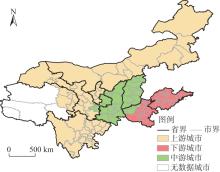
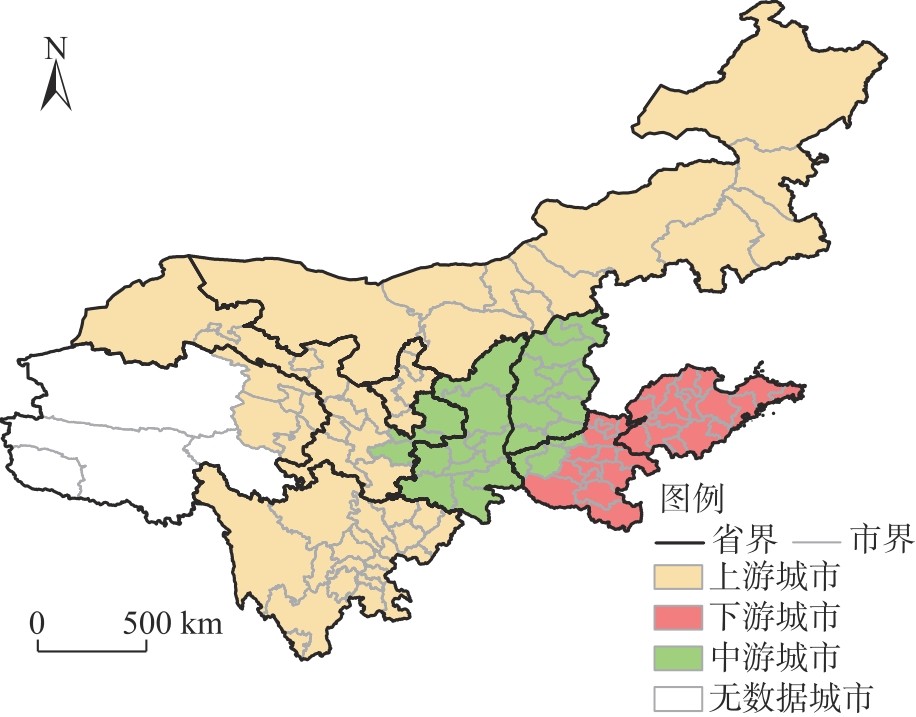
Fig. 1
Schematic diagram of the study area"

Tab. 1
Influencing factors of AGWFI"
| 影响因素 | 平均值 | 标准差 | 最小值 | 最大值 |
|---|---|---|---|---|
| 农业经济发展水平/104元 | 0.456 | 0.214 | 0.063 | 1.448 |
| 农业水资源利用程度/% | 109.606 | 255.217 | 0.213 | 2144.917 |
| 第一产业产值占比/% | 11.859 | 7.134 | 0.641 | 32.810 |
| 粮食产量/104 t | 203.017 | 191.710 | 0.980 | 934.303 |
| 农作物播种面积/104 hm2 | 50.838 | 40.675 | 0.399 | 202.420 |
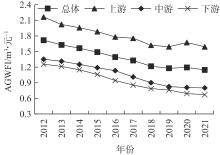
Fig. 2
AGWFI in the Yellow River Basin and its upstream, midstream, and downstream regions from 2012 to 2021"
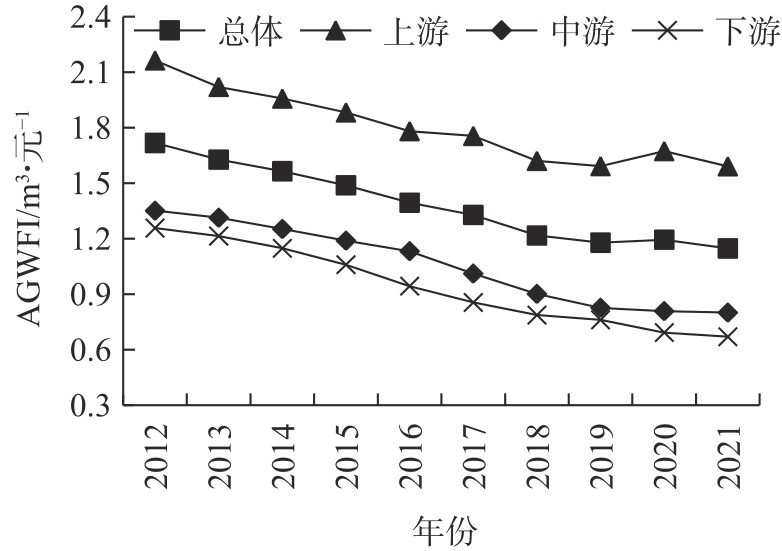
Fig. 3
Spatial distribution of AGWFI in the Yellow River Basin"
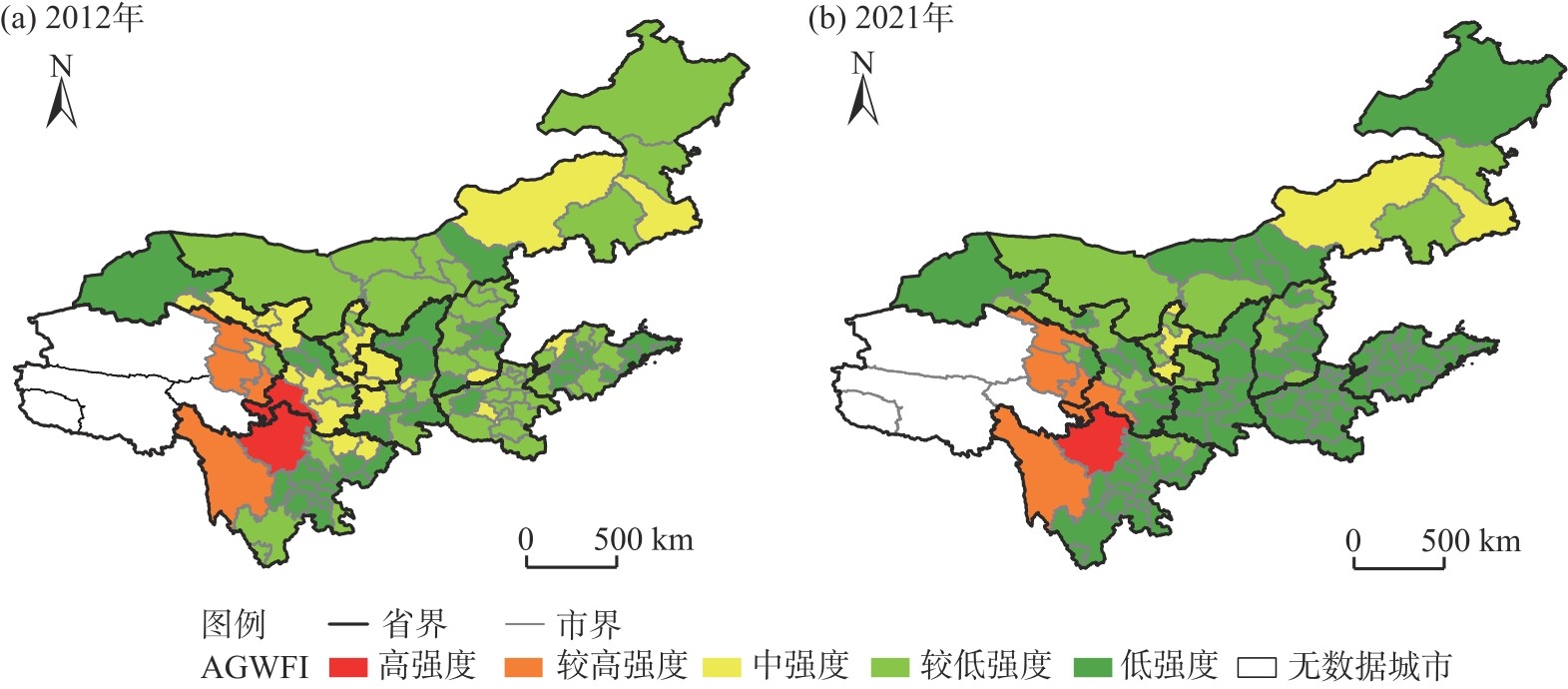
Fig. 4
Difference of AGWFI and its contribution rates in the Yellow River Basin from 2012 to 2021"
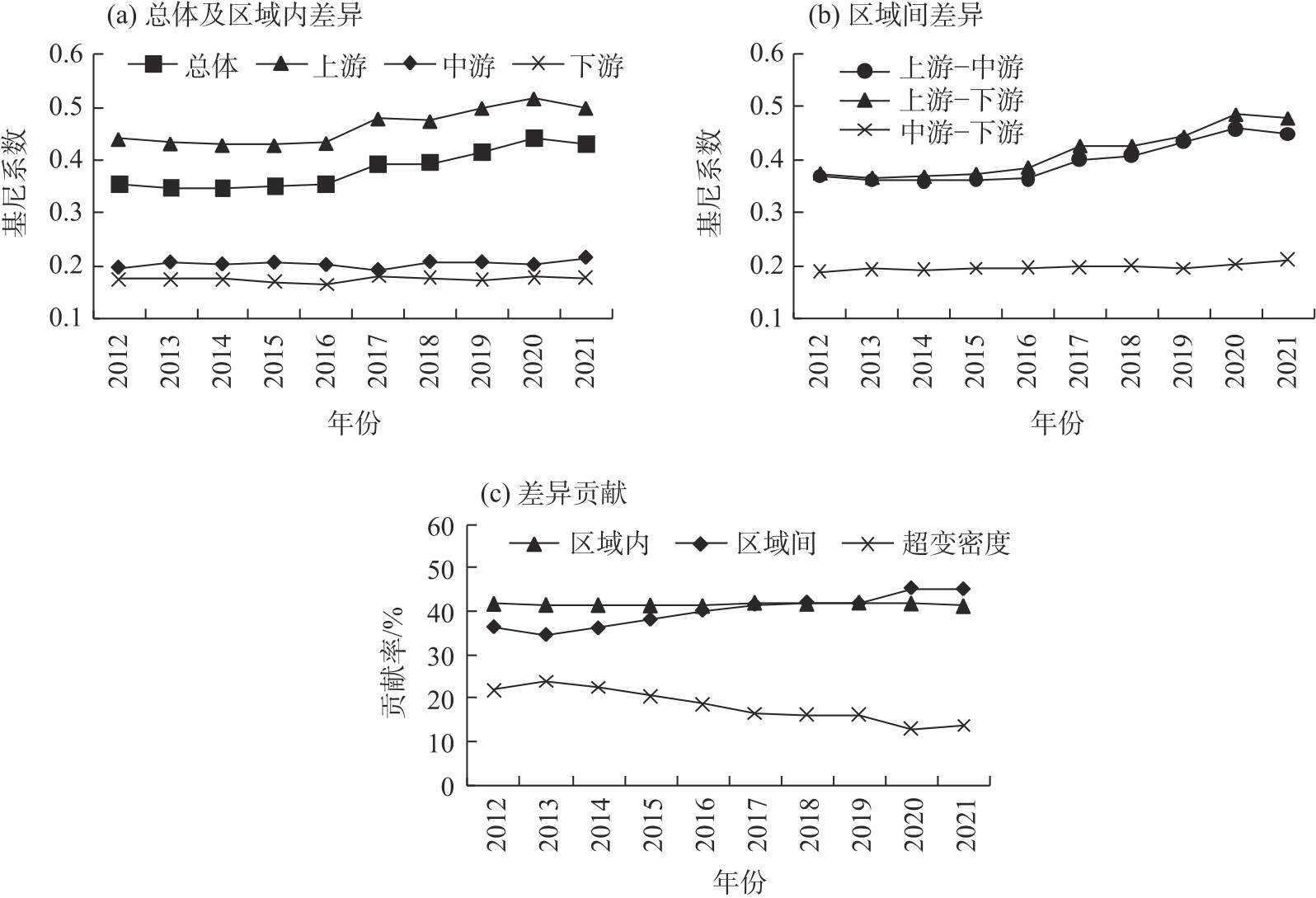
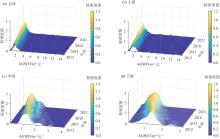
Fig. 5
Dynamic evolution of AGWFI in the Yellow River Basin"

Tab. 2
Markov transition probability matrix of AGWFI in the Yellow River Basin"
| 地区 | 类型 | 低值 | 中值 | 较高值 | 高值 |
|---|---|---|---|---|---|
| 总体 | 低值 | 0.996 | 0.004 | 0.000 | 0.000 |
| 中值 | 0.188 | 0.793 | 0.020 | 0.000 | |
| 较高值 | 0.004 | 0.205 | 0.757 | 0.034 | |
| 高值 | 0.000 | 0.000 | 0.130 | 0.870 | |
| 上游 | 低值 | 0.990 | 0.010 | 0.000 | 0.000 |
| 中值 | 0.215 | 0.763 | 0.022 | 0.000 | |
| 较高值 | 0.010 | 0.143 | 0.810 | 0.038 | |
| 高值 | 0.000 | 0.000 | 0.087 | 0.913 | |
| 中游 | 低值 | 1.000 | 0.000 | 0.000 | 0.000 |
| 中值 | 0.189 | 0.784 | 0.027 | 0.000 | |
| 较高值 | 0.000 | 0.230 | 0.703 | 0.068 | |
| 高值 | 0.000 | 0.000 | 0.220 | 0.780 | |
| 下游 | 低值 | 1.000 | 0.000 | 0.000 | 0.000 |
| 中值 | 0.157 | 0.831 | 0.011 | 0.000 | |
| 较高值 | 0.000 | 0.262 | 0.738 | 0.000 | |
| 高值 | 0.000 | 0.000 | 0.250 | 0.750 |
Tab. 3
Test results of the panel data regression model"
| 地区 | 分位点 | 农业经济发展水平 | 农业水资源利用程度 | 第一产业产值占比 | 粮食产量 | 农作物播种面积 | 常数项 |
|---|---|---|---|---|---|---|---|
| 总体 | 0.25 | -0.817*** | 0.045*** | 3.493*** | 0.000 | -0.002 | 0.713*** |
| 0.50 | -0.766*** | 0.039*** | 4.371*** | 0.001 | -0.004** | 0.990*** | |
| 0.75 | -0.932*** | 0.020** | 6.045*** | 0.001 | -0.007* | 1.290*** | |
| 上游 | 0.25 | -0.562*** | 0.045*** | 4.284*** | 0.217 | -0.005 | 0.629*** |
| 0.50 | -0.530*** | 0.028*** | 5.298*** | 1.657** | -0.012*** | 0.909*** | |
| 0.75 | 1.088 | -0.008 | 7.678*** | 2.946*** | -0.033*** | 1.314*** | |
| 中游 | 0.25 | -0.846*** | 0.076 | 0.986 | -0.001 | 0.005* | 0.935*** |
| 0.50 | -1.551*** | 0.235** | 1.898** | -0.002*** | 0.009*** | 1.298*** | |
| 0.75 | -1.848*** | 0.236*** | 2.711*** | -0.003*** | 0.009*** | 1.674*** | |
| 下游 | 0.25 | -1.295*** | 0.106*** | 3.593*** | -0.001*** | 0.003*** | 0.893*** |
| 0.50 | -1.285*** | 0.134*** | 2.703*** | 0.000 | 0.000 | 1.063*** | |
| 0.75 | -1.790*** | 0.105** | 3.157*** | 0.000 | -0.001 | 1.462*** |
Tab. 4
OLS test results"
| 地区 | 变量 | 农业经济发展水平 | 农业水资源利用程度 | 第一产业产值占比 | 粮食产量 | 农作物播种面积 | 常数项 |
|---|---|---|---|---|---|---|---|
| 总体 | 系数 | -1.126*** | -0.024 | 10.059*** | 0.002*** | -0.024*** | 1.470*** |
| 标准误 | 0.249 | 0.017 | 0.767 | 0.001 | 0.004 | 0.110 | |
| 上游 | 系数 | -0.260 | -0.056** | 10.456*** | 3.188** | -0.042*** | 1.769*** |
| 标准误 | 0.429 | 0.025 | 1.343 | 1.618 | 0.007 | 0.227 | |
| 中游 | 系数 | -1.505*** | 0.052 | 2.239*** | -0.002** | 0.007** | 1.339*** |
| 标准误 | 0.175 | 0.087 | 0.614 | 0.001 | 0.003 | 0.065 | |
| 下游 | 系数 | -1.603*** | 0.114*** | 3.403*** | 0.000 | -0.001 | 1.204*** |
| 标准误 | 0.138 | 0.028 | 0.452 | 0.000 | 0.001 | 0.068 |
| [1] | 李汝资, 白昳, 周云南, 等. 黄河流域水资源利用与经济增长脱钩及影响因素分解[J]. 地理科学, 2023, 43(1): 110-118. |
| [ Li Ruzi, Bai Yi, Zhou Yunnan, et al. Decoupling and decomposition of driving factors of water resources utilization and economic growth in the Yellow River Basin[J]. Scientia Geographica Sinica, 2023, 43(1): 110-118. ] | |
| [2] | Distefano T, Kelly S. Are we in deep water? Water scarcity and its limits to economic growth[J]. Ecological Economics, 2017, 142: 130-147. |
| [3] | 金银雪. 全球变暖下的水资源危机[J]. 生态经济, 2020, 36(6): 5-8. |
| [ Jin Yinxue. Water crisis under global warming[J]. Ecological Economy, 2020, 36(6): 5-8. ] | |
| [4] | 梁赛, 吴晓慧, 李晓燕, 等. 社会经济驱动的环境水质问题研究进展[J]. 环境科学学报, 2023, 43(12): 93-101. |
| [ Liang Sai, Wu Xiaohui, Li Xiaoyan, et al. Review on environmental water quality issues driven by socioeconomic activities[J]. Acta Scientiae Circumstantiae, 2023, 43(12): 93-101. ] | |
| [5] | Kong Y, He W J, Zhang Z F, et al. Spatial-temporal variation and driving factors decomposition of agricultural grey water footprint in China[J]. Journal of Environmental Management, 2022, 318: 115601, doi: 10.1016/j.jenvman.2022.115601. |
| [6] | 曾昭, 刘俊国. 北京市灰水足迹评价[J]. 自然资源学报, 2013, 28(7): 1169-1178. |
| [ Zeng Zhao, Liu Junguo. Historical trend of grey water footprint of Beijing, China[J]. Journal of Natural Resources, 2013, 28(7): 1169-1178. ] | |
| [7] | Hoekstra A Y, Chapagain A K, Aldaya M M, et al. The water footprint assessment manual: Setting the global standard[M]. London: Routledge, 2011. |
| [8] | 楚天舒, 黄译萱, 赖世宣, 等. 中国各省市区种养业灰水足迹分析与评价[J]. 中国农业资源与区划, 2023, 44(11): 53-64. |
| [ Chu Tianshu, Huang Yixuan, Lai Shixuan, et al. Analysis and evaluation of gray water footprint for planting-animal husbandry industry in provincial regions, China[J]. Chinese Journal of Agricultural Resources and Regional Planning, 2023, 44(11): 53-64. ] | |
| [9] | Yan Y A, Wang R, Chen S, et al. Three-dimensional agricultural water scarcity assessment based on water footprint: A study from a humid agricultural area in China[J]. Science of the Total Environment, 2023, 857: 159407, doi: 10.1016/j.scitotenv.2022.159407. |
| [10] | 王丹阳, 李景保, 叶亚亚, 等. 基于不同受纳水体的湖南省农业灰水足迹分析[J]. 水资源保护, 2016, 32(4): 49-54. |
| [ Wang Danyang, Li Jingbao, Ye Yaya, et al. Analysis of agricultural grey water footprint in Hunan Province based on different receiving water bodies[J]. Water Resources Protection, 2016, 32(4): 49-54. ] | |
| [11] | 程鹏, 李叙勇, 孙明东. 基于河流参照状态的季风区域季节性农业灰水足迹核算方法与例证[J]. 环境科学学报, 2020, 40(9): 3453-3462. |
| [ Cheng Peng, Li Xuyong, Sun Mingdong. Calculation method and illustration of seasonal agricultural grey water footprint in monsoon region based on river reference conditions[J]. Acta Scientiae Circumstantiae, 2020, 40(9): 3453-3462. ] | |
| [12] | 杜慧娟, 王光耀, 冉光妍, 等. 面向SDGs的塔里木河流域农业灰水足迹分析[J]. 干旱区研究, 2023, 40(7): 1184-1193. |
| [ Du Huijuan, Wang Guangyao, Ran Guangyan, et al. Agricultural gray water footprint in the Tarim River Basin using SDGs analysise[J]. Arid Zone Research, 2023, 40(7): 1184-1193. ] | |
| [13] | 张鑫, 李磊, 甄志磊, 等. 时空与效率视角下汾河流域农业灰水足迹分析[J]. 中国环境科学, 2019, 39(4): 1502-1510. |
| [ Zhang Xin, Li Lei, Zhen Zhilei, et al. Analysis of agricultural grey water footprint in Fenhe River Basin based on the perspective of space-time and efficiency[J]. China Environmental Science, 2019, 39(4): 1502-1510. ] | |
| [14] | Li H Y, Wang Y F, Qin L J, et al. Effects of different slopes and fertilizer types on the grey water footprint of maize production in the black soil region of China[J]. Journal of Cleaner Production, 2020, 246: 119077, doi: 10.1016/j.jclepro.2019.119077. |
| [15] | Barreto M D L P, Netto A M, Da Silva J P S, et al. Gray water footprint assessment for pesticide mixtures applied to a sugarcane crop in Brazil: A comparison between two models[J]. Journal of Cleaner Production, 2020, 276: 124254, doi: 10.1016/j.jclepro.2020. 124254. |
| [16] | Xu C X, Liu Y, Fu T B. Spatial-temporal evolution and driving factors of grey water footprint efficiency in the Yangtze River Economic Belt[J]. Science of the Total Environment, 2022, 844: 156930, doi: 10.1016/j.scitotenv.2022.156930. |
| [17] | 李胜楠, 王远, 罗进, 等. 福建省灰水足迹时空变化及驱动因素[J]. 生态学报, 2020, 40(21): 7952-7965. |
| [ Li Shengnan, Wang Yuan, Luo Jin, et al. Spatio-temporal variations and driving factors of grey water footprint in Fujian Province[J]. Acta Ecologica Sinica, 2020, 40(21): 7952-7965. ] | |
| [18] | 赵良仕. 中国省际灰水足迹强度的空间收敛性研究[J]. 辽宁师范大学学报(自然科学版), 2017, 40(4): 541-547. |
| [ Zhao Liangshi. Study on spatial convergence of grey water footprint intensity on provincial scale in China[J]. Journal of Liaoning Normal University (Natural Science Edition), 2017, 40(4): 541-547. ] | |
| [19] | 徐瑞璠, 赵敏娟, 高建中. 中国农业灰水足迹测度及时空分异研究[J]. 中国农业资源与区划, 2023, 44(10): 52-66. |
| [ Xu Ruifan, Zhao Minjuan, Gao Jianzhong. Measurement and spatial-temporal variation of agricultural grey water footprint in China[J]. Chinese Journal of Agricultural Resources and Regional Planning, 2023, 44(10): 52-66. ] | |
| [20] | Zhang L L, Zhang R, Wang Z Z, et al. Spatial heterogeneity of the impact factors on gray water footprint intensity in China[J]. Sustainability, 2020, 12(3): 865, doi: 10.3390/su12030865. |
| [21] | He W J, Zhang K, Kong Y, et al. Reduction pathways identification of agricultural water pollution in Hubei Province, China[J]. Ecological Indicators, 2023, 153: 110464, doi: 10.1016/j.ecolind. 2023.110464. |
| [22] | 徐春霞. 山东省金融服务业发展的空间非均衡及分布动态演进——基于银行业的实证分析[J]. 经济与管理评论, 2016, 32(6): 109-117. |
| [ Xu Chunxia. The spatial disequilibrium and dynamic evolution of financial services industry development in Shandong Province: Based on an empirical analysis of banking industry[J]. Review of Economy and Management, 2016, 32(6): 109-117. ] | |
| [23] | 陈明华, 刘华军, 孙亚男. 中国五大城市群金融发展的空间差异及分布动态: 2003—2013年[J]. 数量经济技术经济研究, 2016, 33(7): 130-144. |
| [ Chen Minghua, Liu Huajun, Sun Yanan. Reseach on the spatial differences and distributional dynamic evolution of financial development of five megalopolises from 2003 to 2013 in China[J]. Journal of Quantitative & Technological Economics, 2016, 33(7): 130-144. ] | |
| [24] | 陈明华, 张晓萌, 刘玉鑫, 等. 绿色TFP增长的动态演进及趋势预测——基于中国五大城市群的实证研究[J]. 南开经济研究, 2020(1): 20-44. |
| [ Chen Minghua, Zhang Xiaomeng, Liu Yuxin, et al. Dynamic evolution and trend prediction of green TFP growth: Empirical research based on five urban agglomerations in China[J]. Nankai Economic Studies, 2020(1): 20-44. ] | |
| [25] | 白天骄, 孙才志. 中国人均灰水足迹区域差异及因素分解[J]. 生态学报, 2018, 38(17): 6314-6325. |
| [ Bai Tianjiao, Sun Caizhi. Regional inequality and factor decomposition of the per capita grey water footprint in China[J]. Acta Ecologica Sinica, 2018, 38(17): 6314-6325. ] | |
| [26] | Chen J, Gao Y Y, Qian H, et al. Insights into water sustainability from a grey water footprint perspective in an irrigated region of the Yellow River Basin[J]. Journal of Cleaner Production, 2021, 316: 128329, doi: 10.1016/j.jclepro.2021.128329. |
| [27] | 程鹏, 孙明东, 宋晓伟. 中国灰水足迹时空动态演进及驱动因素研究[J]. 生态环境学报, 2024, 33(5): 745-756. |
| [ Cheng Peng, Sun Mingdong, Song Xiaowei. Study on the spatial and temporal dynamic evolution and driving factors of grey water footprint in China[J]. Ecology and Environmental Sciences, 2024, 33(5): 745-756. ] | |
| [28] | 陈岩, 童国平, 王蕾. 淮河流域农业灰水足迹效率的时空分布与驱动模式[J]. 水资源保护, 2020, 36(6): 60-66, 85. |
| [ Chen Yan, Tong Guoping, Wang Lei. Spatial-temporal distribution and driving models of agricultural grey water footprint efficiency in the Huai River Basin[J]. Water Resources Protection, 2020, 36(6): 60-66, 85. ] | |
| [29] | Fu T B, Xu C X, Yang L H, et al. Measurement and driving factors of grey water footprint efficiency in Yangtze River Basin[J]. Science of the Total Environment, 2022, 802: 149587, doi: 10.1016/j.scitotenv.2021.149587. |
| [30] | 王少剑, 谢紫寒, 王泽宏. 中国县域碳排放的时空演变及影响因素[J]. 地理学报, 2021, 76(12): 3103-3118. |
| [ Wang Shaojian, Xie Zihan, Wang Zehong. The spatiotemporal pattern evolution and influencing factors of CO2 emissions at the county level of China[J]. Acta Geographica Sinica, 2021, 76(12): 3103-3118. ] | |
| [31] | 毕茜, 于连超. 环境税的企业绿色投资效应研究——基于面板分位数回归的实证研究[J]. 中国人口·资源与环境, 2016, 26(3): 76-82. |
| [ Bi Qian, Yu Lianchao. Relationship between environmental taxes and enterprise green investment behavior: A panel quantile regression approach[J]. China Population, Resources and Environment, 2016, 26(3): 76-82. ] | |
| [32] | 刘志涛, 王少剑, 方创琳. 粤港澳大湾区生态系统服务价值的时空演化及其影响机制[J]. 地理学报, 2021, 76(11): 2797-2813. |
| [ Liu Zhitao, Wang Shaojian, Fang Chuanglin. Spatiotemporal evolution and influencing mechanism of ecosystem service value in the Guangdong-Hong Kong-Macao Greater Bay Area[J]. Acta Geographica Sinica, 2021, 76(11): 2797-2813. ] | |
| [33] | 刘佳琪, 周璐红, 席小雅. 2000—2020年黄河流域土地生态质量及其变化趋势预测[J]. 干旱区地理, 2023, 46(10): 1654-1662. |
| [ Liu Jiaqi, Zhou Luhong, Xi Xiaoya. Land ecological quality and its change trend prediction in the Yellow River Basin from 2000 to 2020[J]. Arid Land Geography, 2023, 46(10): 1654-1662. ] | |
| [34] | 黄万华, 王婷婷, 高红贵. 由“政区单元”河长制到“流域单元”河长制的转向——基于黄河流域河长制政策的准自然实验[J]. 东北财经大学学报, 2022(6): 74-84. |
| [ Huang Wanhua, Wang Tingting, Gao Honggui. Transforming of river chief system from district unit to basin unit: A quasi-natural experiment based on the policy of river chief system in the Yellow River Basin[J]. Journal of Dongbei University of Finance and Economics, 2022(6): 74-84. ] | |
| [35] | 罗静怡, 东梅. 中国粮食生产用水绿色效率与回弹效应研究——基于三阶段超效率SBM-Malmquist模型[J]. 干旱区地理, 2024, 47(9): 1508-1517. |
| [ Luo Jingyi, Dong Mei. Green efficiency and rebound effect of water for grain production in China: Based on the three-stage super-efficiency SBM-Malmquist model[J]. Arid Land Geography, 2024, 47(9): 1508-1517. ] | |
| [36] | 韩琴, 孙才志, 邹玮. 1998—2012年中国省际灰水足迹效率测度与驱动模式分析[J]. 资源科学, 2016, 38(6): 1179-1191. |
| [ Han Qin, Sun Caizhi, Zou Wei. Grey water footprint efficiency measure and its driving pattern analysis on provincial scale in China from 1998 to 2012[J]. Resources Science, 2016, 38(6): 1179-1191. ] | |
| [37] | Feng H Y, Sun F Y, Liu Y Y, et al. Mapping multiple water pollutants across China using the grey water footprint[J]. Science of the Total Environment, 2021, 785: 147255, doi: 10.1016/j.scitotenv.2021.147255. |
| [38] | Dagum C. A new approach to the decomposition of the Gini income inequality ratio[M]. Berlin: Springer, 1998. |
| [39] | 陈明华, 岳海珺, 郝云飞, 等. 黄河流域生态效率的空间差异、动态演进及驱动因素[J]. 数量经济技术经济研究, 2021, 38(9): 25-44. |
| [ Chen Minghua, Yue Haijun, Hao Yunfei, et al. The spatial disparity, dynamic evolution and driving factors of ecological efficiency in the Yellow River Basin[J]. The Journal of Quantitative & Technical Economics, 2021, 38(9): 25-44. ] | |
| [40] | 穆学青, 郭向阳, 明庆忠, 等. 黄河流域旅游生态安全的动态演变特征及驱动因素[J]. 地理学报, 2022, 77(3): 714-735. |
| [ Mu Xueqing, Guo Xiangyang, Ming Qingzhong, et al. Dynamic evolution characteristics and driving factors of tourism ecological security in the Yellow River Basin[J]. Acta Geographica Sinica, 2022, 77(3): 714-735. ] | |
| [41] | 刘帅宾, 杨山, 王钊. 基于人口流的中国省域城镇化空间关联特征及形成机制[J]. 地理学报, 2019, 74(4): 648-663. |
| [ Liu Shuaibin, Yang Shan, Wang Zhao. Characteristics and formation mechanism of China’s provincial urbanization spatial correlation based on population flow[J]. Acta Geographica Sinica, 2019, 74(4): 648-663. ] | |
| [42] | 刘统兵, 方瑜, 黄峰, 等. 中国广义农业水土资源匹配及利用状况动态评价[J]. 农业工程学报, 2023, 39(10): 56-65. |
| [ Liu Tongbing, Fang Yu, Huang Feng. Dynamic evaluation of the matching degree and utilization condition of generalized agricultural water and arable land resources in China[J]. Transactions of the Chinese Society of Agricultural Engineering, 2023, 39(10): 56-65. ] | |
| [43] | Zhang X Y, Xiao Y A, Ramsey T S, et al. Decoupling agricultural grey water footprint from economic growth in the Yellow River Basin[J]. Water, 2024, 16(8): 1129, doi: 10.3390/w16081129. |
| [44] | 徐瑞璠, 刘文新. 黄河流域农业灰水足迹与经济增长的关系研究——基于脱钩及回弹效应[J]. 中国农业资源与区划, 2023, 44(11): 79-91. |
| [ Xu Ruifan, Liu Wenxin. Relationship between agricultural grey water footprint and economic growth in the Yellow River Basin: Based on decoupling and rebound effects[J]. Chinese Journal of Agricultural Resources and Regional Planning, 2023, 44(11): 79-91. ] | |
| [45] | 郭玮, 胡西武. 黄河流域农业灰水足迹效率时空格局演变与驱动因素[J]. 水土保持通报, 2024, 44(2): 437-445. |
| [ Guo Wei, Hu Xiwu. Spatial-temporal pattern evolution and driving factors of agricultural grey water footprint efficiency in Yellow River Basin[J]. Bulletin of Soil and Water Conservation, 2024, 44(2): 437-445. ] |
|
||

