Arid Land Geography ›› 2026, Vol. 49 ›› Issue (4): 769-777.doi: 10.12118/j.issn.1000-6060.2025.588
• “Dual Carbon”Research • Previous Articles Next Articles
LIU Honghong( ), ZHANG Wenbin()
Received:2025-10-02
Revised:2025-11-10
Online:2026-04-25
Published:2026-04-28
Contact:
ZHANG Wenbin
E-mail:hhdmn@xaufe.edu.cn;zhangwbufe@xaufe.edu.cn
LIU Honghong, ZHANG Wenbin. Where is the big gap of the coordinated development of carbon reduction, pollution reduction, green expansion, and growth in China? The east and the west or the north and the south[J].Arid Land Geography, 2026, 49(4): 769-777.

Tab. 1
Evaluation indicators of carbon reduction, pollution reduction, green expansion, and growth"
| 目标层 | 指标层 | 指标说明 | 单位 | 指标属性 |
|---|---|---|---|---|
| 降碳 | CO2强度 | CO2排放量/GDP | t·(104元)-1 | - |
| 人均CO2排放量 | CO2排放量/总人口 | t·人-1 | - | |
| 能源结构 | 煤炭消费量/能源消费量 | % | - | |
| 减污 | 工业SO2排放量 | 工业SO2排放量 | 104 t | - |
| 工业废水排放量 | 工业废水排放总量 | 104 t | - | |
| 工业烟尘排放量 | 工业烟尘排放量 | 104 t | - | |
| 氮氧化物排放量 | 氮氧化物排放量 | 104 t | - | |
| 农用化肥使用量 | 农业化肥使用量 | 104 t | - | |
| PM2.5浓度 | 逐年PM2.5浓度 | g·m-3 | - | |
| 扩绿 | 绿色金融发展水平 | 贾洪文等[ | % | + |
| 人均公园绿地面积 | 公园绿地面积/总人口 | hm2·(104人)-1 | + | |
| 人均造林面积 | 造林面积/总人口 | hm2·(104人)-1 | + | |
| 建成区绿化覆盖率 | 建成区所有植被的垂直投影面积/建成面积 | % | + | |
| 森林覆盖率 | - | % | + | |
| 增长 | 城镇化率 | 城市人口/总人口 | % | + |
| 人均GDP | GDP/总人口 | 元·人-1 | + | |
| GDP增长率 | [(当期的不变价GDP/上年同期同基期不变价GDP)-1]×100% | % | + | |
| 居民消费水平 | 社会零售总额/GDP | % | + | |
| 居民人均可支配收入增速 | (报告期人均可支配收入-基期人均可支配收入)/基期人均可支配收入 | % | + |
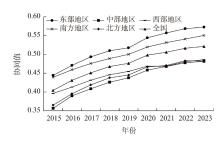
Fig. 1
Level of coordinated development of carbon reduction, pollution reduction, green expansion, and growth in China from 2015 to 2023"
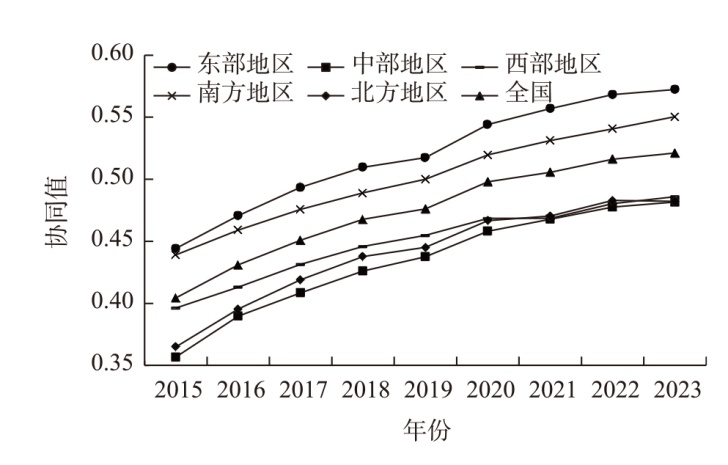
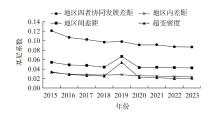
Fig. 2
Disparity and source decomposition of coordinated development between the eastern and western regions"
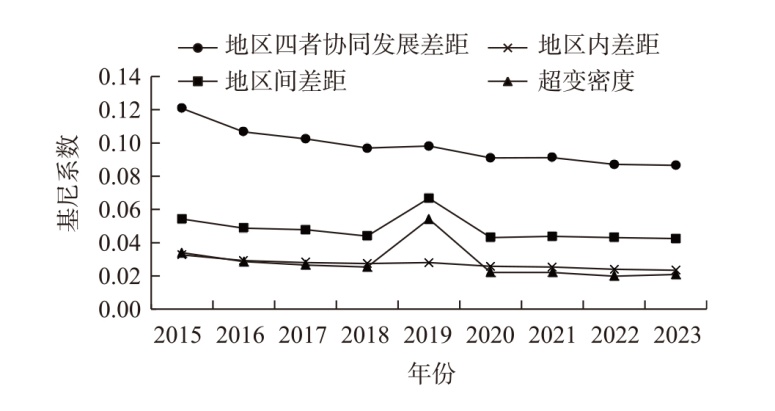
Fig. 3
Disparity and source decomposition of coordinated development between the northern and southern regions"
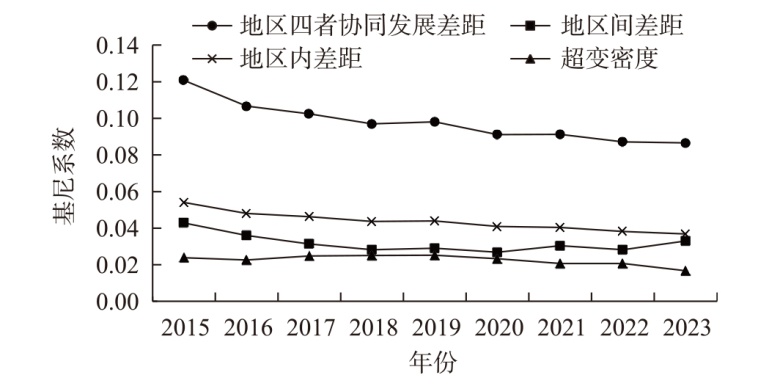
Fig. 4
Comparison of disparities in coordinated development among different regions"
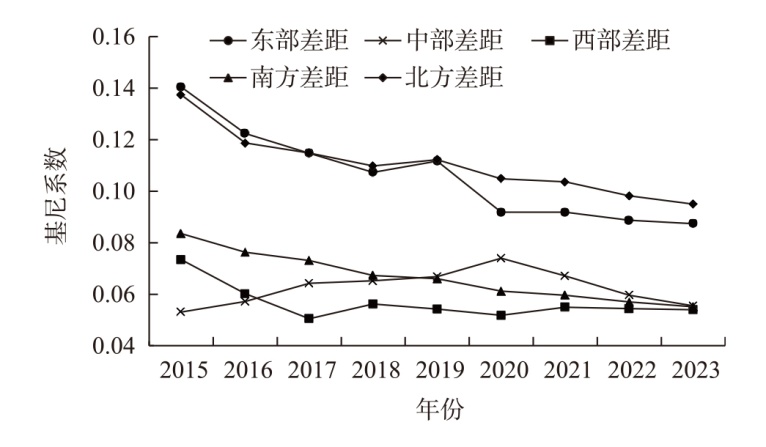
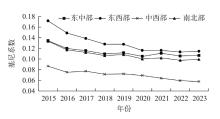
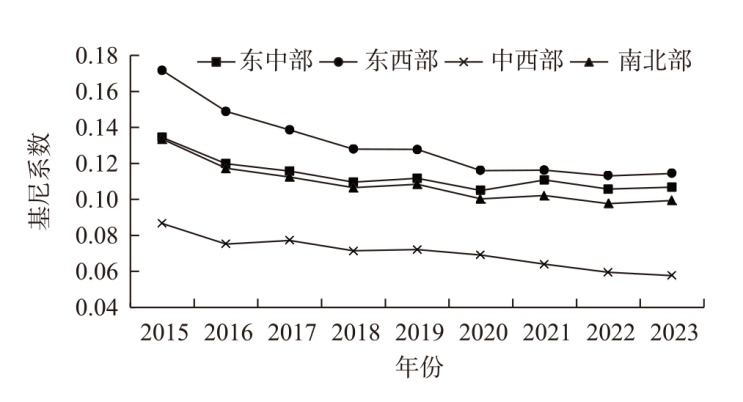
Fig. 5
Comparison of collaborative development gaps between regions"
Tab. 2
Results of QAP correlation analysis"
| 变量 | 四者协同发展水平 | 绿色创新水平 | 公共环境关注度 | 科技投入水平 | 产业集聚水平 | 数字经济发展水平 | 环境规制强度 |
|---|---|---|---|---|---|---|---|
| 四者协同发展水平 | 1.000*** | 0.112 | 0.325*** | 0.399*** | 0.349*** | 0.231** | -0.088 |
| 绿色创新水平 | 0.112 | 1.000*** | 0.570*** | 0.393** | 0.119 | 0.914*** | -0.007 |
| 公共环境关注度 | 0.325*** | 0.570*** | 1.000*** | 0.338** | 0.387** | 0.651*** | 0.070 |
| 科技投入水平 | 0.399*** | 0.393** | 0.338** | 1.000*** | 0.183* | 0.439** | -0.052 |
| 产业集聚水平 | 0.349*** | 0.119 | 0.387** | 0.183* | 1.000*** | 0.159 | -0.140** |
| 数字经济发展水平 | 0.231** | 0.914*** | 0.651*** | 0.439** | 0.159 | 1.000*** | 0.006 |
| 环境规制强度 | -0.088 | -0.007 | 0.070 | -0.052 | -0.140** | 0.006 | 1.000*** |
Tab. 3
Results of the national and regional full sample QAP regression analysis"
| 变量 | 全国 | 东部 | 中部 | 西部 | 北方 | 南方 |
|---|---|---|---|---|---|---|
| 绿色创新水平 | 0.331*** | 0.436*** | 0.239** | 0.330* | 0.176* | 0.280** |
| 公共环境关注度 | 0.152* | 0.183** | 0.161* | 0.368 | 0.029 | 0.131* |
| 科技投入水平 | 0.320*** | 0.232* | 0.140 | 0.321** | 0.773*** | 0.281** |
| 产业集聚水平 | 0.216*** | 0.113 | -0.106 | -0.226** | 0.153*** | 0.219 |
| 数字经济发展水平 | 0.443** | 0.248*** | 0.141** | 0.110* | 0.210** | 0.315*** |
| 环境规制强度 | -0.058 | 0.090 | 0.525** | -0.021 | 0.018 | -0.068 |
| 调整R2 | 0.695 | 0.679 | 0.618 | 0.525 | 0.756 | 0.725 |
| 样本数 | 870 | 110 | 72 | 90 | 210 | 210 |
| [1] |
罗良文, 雷朱家华. 中国碳市场政策的减污降碳协同效应[J]. 资源科学, 2024, 46(1): 53-68.
doi: 10.18402/resci.2024.01.05 |
|
[Luo Liangwen, Lei Zhujiahua. Synergetic effect of China’s carbon market policies on pollution reduction and carbon reduction[J]. Resources Science, 2024, 46(1): 53-68.]
doi: 10.18402/resci.2024.01.05 |
|
| [2] | 陈诗一, 祁毓. “双碳”目标约束下应对气候变化的中长期财政政策研究[J]. 中国工业经济, 2022(5): 5-23. |
| [Chen Shiyi, Qi Yu. Research on medium-and long-term fiscal policies to address climate change under the constraints of “Carbon Peak and Neutrality” target[J]. China Industrial Economics, 2022(5): 5-23.] | |
| [3] | 夏学超, 孙慧, 祝树森, 等. 多元主体环境规制组合如何实现降碳减污扩绿增长协同推进?[J]. 中国人口·资源与环境, 2024, 34(8): 22-35. |
| [Xia Xuechao, Sun Hui, Zhu Shusen, et al. How can a combination of environmental regulations by multiple stakeholders achieve the synergistic advancement of carbon reduction, pollution control, green expansion, and economic growth?[J]. China Population, Resources and Environment, 2024, 34(8): 22-35.] | |
| [4] | Li H, Lu J. Driving effect of digital government policy on synergy in corporate pollution reduction, carbon reduction, and green expansion[J]. Journal of Environmental Management, 2024, 369: 9, doi: 10.1016/j.jenvman.2024.122301. |
| [5] | Zeng Q H, He L Y. Study on the synergistic effect of air pollution prevention and carbon emission reduction in the context of “dual carbon”: Evidence from China’s transport sector[J]. Energy Policy, 2023, 173: 113370, doi: 10.1016/j.enpol.2022.113370. |
| [6] | Lin B Q, Teng Y Q. Synergistic disparities of pollution reduction and carbon mitigation in the industrial chain: Evidence from China’s industrial sector[J]. Environmental Research, 2024, 248: 115226, doi: 10.1016/j.envres.2024.118226. |
| [7] |
刘玒玒, 刘书芳. 祁连山地区复合生态系统韧性时空演化及障碍因子识别[J]. 干旱区地理, 2024, 47(2): 237-247.
doi: 10.12118/j.issn.1000-6060.2023.214 |
|
[Liu Honghong, Liu Shufang. Spatiotemporal evolution and obstacle identification of complex ecosystem resilience in the Qilian Mountain area[J]. Arid Land Geography, 2024, 47(2): 237-247.]
doi: 10.12118/j.issn.1000-6060.2023.214 |
|
| [8] |
李占稳, 吴文恒, 姚涵刚, 等. 黄河流域新型城镇化与农业现代化耦合协调的时空格局及驱动机制[J]. 干旱区地理, 2025, 48(10): 1878-1891.
doi: 10.12118/j.issn.1000-6060.2025.052 |
|
[Li Zhanwen, Wu Wenheng, Yao Hangang, et al. Spatio-temporal evolution and driving mechanism of coupling coordination between new urbanization and agricultural modernization in the Yellow River Basin[J]. Arid Land Geography, 2025, 48(10): 1878-1891.]
doi: 10.12118/j.issn.1000-6060.2025.052 |
|
| [9] | 李敏, 崔晓阳, 庞贵芳, 等. 长江经济带生态环境与经济高质量发展耦合协调及交互影响研究[J]. 长江流域资源与环境, 2025, 34(7): 1399-1412. |
| [Li Min, Cui Xiaoyang, Pang Guifang, et al. Coupling coordination and interactive influence of ecological environment and high-quality economic development in the Yangtze River Economic Belt[J]. Resources and Environment in the Yangtze Basin, 2025, 34(7): 1399-1412.] | |
| [10] | 李健, 邱广伟. 贵州降碳减污扩绿增长协同空间演进及路径探析[J]. 环境科学, 2025, 46(10): 6465-6474. |
| [Li Jian, Qiu Guangwei. Spatial evolution of carbon reduction, pollution reduction, green expanding, and economic growth synergy in Guizhou and path analysis[J]. Environmental Science, 2025, 46(10): 6465-6474.] | |
| [11] | 胡剑波, 张宽元, 韩君. 我国省域降碳减污绩效测度、时空分异与收敛性研究[J]. 统计研究, 2025, 42(2): 99-110. |
| [Hu Jianbo, Zhang Kuanyuan, Han Jun. Research on the measurement, spatiotemporal differentiation and convergence of carbon and pollution reduction performance in China[J]. Statistical Research, 2025, 42(2): 99-110.] | |
| [12] | 胡剑波, 周宗康, 李潇潇. 中国降碳减污扩绿增长的时空分异及收敛性研究[J]. 长江流域资源与环境, 2025, 34(1): 166-180. |
| [Hu Jianbo, Zhou Zongkang, Li Xiaoxiao. Spatiotemporal differentiation and convergence of carbon reduction, pollution reduction and green expansion growth in China[J]. Resources and Environment in the Yangtze River Basin, 2025, 34(1): 166-180.] | |
| [13] | 段冶, 韩楠, 孙才志, 等. 减污降碳协同效应空间关联关系及驱动因素研究[J]. 环境科学研究, 2024, 37(11): 2413-2422. |
| [Duan Ye, Han Nan, Sun Caizhi, et al. Investigation into spatial correlation and driving factors of synergistic effect of pollution reduction and carbon emission mitigation[J]. Research of Environmental Sciences, 2024, 37(11): 2413-2422.] | |
| [14] |
尹碧波, 邝萍, 欧阳昕彤, 等. 中国减污降碳与扩绿增长耦合协调度的时空特征及其驱动因素[J]. 经济地理, 2024, 44(11): 122-131.
doi: 10.15957/j.cnki.jjdl.2024.11.013 |
|
[Yin Bibo, Kuang Ping, Ouyang Xintong, et al. Spatial-temporal characteristics and driving factors of coupling coordination degree of pollution and carbon reduction and green expansion in China[J]. Economic Geography, 2024, 44(11): 122-131.]
doi: 10.15957/j.cnki.jjdl.2024.11.013 |
|
| [15] | 邢文婷, 刘明珠, 李利娟. 长江经济带能源绿色低碳转型与减污降碳协同效应时空演进及地区差异[J]. 环境科学, 2025, 46(7): 4198-4210. |
| [Xing Wenting, Liu Mingzhu, Li Lijuan. Spatial-temporal evolution and regional differences of synergistic effect of green and low-carbon energy transformation and pollution reduction & carbon reduction in the Yangtze River Economic Belt[J]. Environmental Science, 2025, 46(7): 4198-4210.] | |
| [16] | 刘玒玒, 李新一. 长江经济带绿色创新、经济发展与环境改善协同推进的时空演化特征[J]. 环境科学研究, 2025, 38(3): 702-712. |
| [Liu Honghong, Li Xinyi. The spatiotemporal evolution characteristics of the coordinated advancement of green innovation, economic development, and environmental improvement in the Yangtze River Economic Belt[J]. Research of Environmental Sciences, 2025, 38(3): 702-712.] | |
| [17] |
张文彬, 宋建波. 中国低碳经济协同效率的区域差异及其影响因素[J]. 经济地理, 2024, 44(3): 22-32, 54.
doi: 10.15957/j.cnki.jjdl.2024.03.003 |
|
[Zhang Wenbin, Song Jianbo. Regional differences and influencing factors of China’s low-carbon economic synergy efficiency[J]. Economic Geography, 2024, 44(3): 22-32, 54.]
doi: 10.15957/j.cnki.jjdl.2024.03.003 |
|
| [18] | 赵曼仪, 王科. 减污降碳协同效应综合评估的研究综述与展望[J]. 中国人口·资源与环境, 2024, 34(2): 58-69. |
| [Zhao Manyi, Wang Ke. Research review and prospect of comprehensive assessment of synergistic effects of pollution reduction and carbon reduction[J]. Chinese Population, Resources and Environment, 2024, 34(2): 58-69.] | |
| [19] | 任晓松, 李佳徽. 中国降碳-减污-扩绿-增长耦合协同发展的组态路径分析[J/OL]. 环境科学. [2025-08-19]. https://doi.org/10.13227/j.hjkx.202501124. |
| [Ren Xiaosong, Li Jiahui. Analysis of the configuration path of the coupled coordinated development of carbon reduction, pollution reduction, green expansion, and economic growth in China[J/OL]. Environmental Science. [2025-08-19]. https://doi.org/10.13227/j.hjkx.202501124.] | |
| [20] | 刘玒玒, 王雨昕. 黄河流域水-社会-经济系统韧性的时空演化及影响因素分析[J]. 环境科学, 2026, 47(4): 2673-2687. |
| [Liu Honghong, Wang Yuxin. Spatiotemporal evolution and influencing factors analysis of the resilience of the water-society-economy system in the Yellow River Basin[J]. Environmental Science, 2026, 47(4): 2673-2687.] | |
| [21] | 李汶豫, 文传浩, 苏旭阳, 等. 长江经济带城市减污降碳协同效应时空演化及驱动因素研究[J]. 环境科学研究, 2024, 37(8): 1641-1653. |
| [Li Wenyu, Wen Chuanhao, Su Xuyang, et al. Spatiotemporal evolution and driving factors of synergistic effect of urban pollution reduction and carbon reduction in Yangtze River Economic Belt[J]. Research of Environmental Sciences, 2024, 37(8): 1641-1653.] | |
| [22] |
原伟鹏, 孙慧, 王晶, 等. 中国城市减污降碳协同的时空演化及驱动力探析[J]. 经济地理, 2022, 42(10): 72-82.
doi: 10.15957/j.cnki.jjdl.2022.10.009 |
|
[Yuan Weipeng, Sun Hui, Wang Jing, et al. Spatial-temporal evolution and driving forces of urban pollution and carbon reduction in China[J]. Economic Geography, 2022, 42(10): 72-82.]
doi: 10.15957/j.cnki.jjdl.2022.10.009 |
|
| [23] | 马艺鸣, 李国平. 中国降碳减污扩绿协同水平、区域差异及影响因素[J]. 统计与决策, 2025, 41(5): 103-108. |
| [Ma Yiming, Li Guoping. Synergistic development of carbon reduction, pollution mitigation, and green expansion in China: Coordination level, regional disparities, and influencing factors[J]. Statistics & Decision, 2025, 41(5): 103-108.] | |
| [24] | 杨喜, 汪思辰. 长江经济带城市土地“降碳减污扩绿增长”效率时空特征及影响因素[J]. 长江流域资源与环境, 2025, 34(4): 721-733. |
| [Yang Xi, Wang Sichen. Spatial-temporal characteristics and influencing factors of the efficiency of urban land “carbon reduction, pollution reduction and green expansion” in the Yangtze River Economic Belt[J]. Resources and Environment in the Yangtze River Basin, 2025, 34(4): 721-733.] | |
| [25] | 崔新蕾, 王冉冉. 中国降碳-减污-扩绿-增长协同发展空间关联网络特征及影响因素研究[J]. 环境科学研究, 2024, 37(7): 1446-1457. |
| [Cui Xinlei, Wang Ranran. Research on the characteristics and influencing factors of the spatial association network of China’s coordinated development of carbon reduction, pollution reduction, green expansion and growth[J]. Research of Environmental Sciences, 2024, 37(7): 1446-1457.] | |
| [26] | 贾洪文, 樊树钢. 黄河流域绿色金融与经济高质量发展耦合协调研究[J]. 生态经济, 2023, 39(10): 89-98. |
| [Jia Hongwen, Fan Shugang. Study on the coupling and coordination of green finance and high-quality economic development in the Yellow River Basin[J]. Ecological Economy, 2023, 39(10): 89-98.] | |
| [27] |
Buldakova I T, Vishnevskaya A J, Dzhalolov S A, et al. Assessment of the socio-economic state of a region based on the Haken model[J]. Automatic Documentation and Mathematical Linguistics, 2024, 58(5): 351-358.
doi: 10.3103/S0005105524700274 |
| [28] |
赵林, 张春霆, 郭付友, 等. 中国绿色发展与共同富裕协同演化及其驱动因素[J]. 自然资源学报, 2025, 40(8): 2177-2194.
doi: 10.31497/zrzyxb.20250811 |
|
[Zhao Lin, Zhang Chunting, Guo Fuyou, et al. Coordinated evolution and driving factors of green development and common prosperity in China[J]. Journal of Natural Resources, 2025, 40(8): 2177-2194.]
doi: 10.31497/zrzyxb.20250811 |
|
| [29] |
马丽君, 敖烨. “东西”还是“南北”地区旅游发展差距大?[J]. 经济地理, 2023, 43(1): 206-216.
doi: 10.15957/j.cnki.jjdl.2023.01.023 |
|
[Ma Lijun, Ao Ye. Where is the big gap of tourism development in China? The east and the west or the north and the south[J]. Economic Geography, 2023, 43(1): 206-216.]
doi: 10.15957/j.cnki.jjdl.2023.01.023 |
|
| [30] | 陈明华, 刘玉鑫, 刘文斐, 等. 中国城市民生发展的区域差异测度、来源分解与形成机理[J]. 统计研究, 2020, 37(5): 54-67. |
| [Chen Minghua, Liu Yuxin, Liu Wenfei, et al. Measurement, source decomposition and formation mechanism of regional differences in urban livelihood development in China[J]. Statistical Research, 2020, 37(5): 54-67.] | |
| [31] | 吴力波, 杨眉敏, 孙可哿. 公众环境关注度对企业和政府环境治理的影响[J]. 中国人口·资源与环境, 2022, 32(2): 1-14. |
| [Wu Libo, Yang Meimin, Sun Kege. The impact of public environmental concern on the environmental governance of enterprises and governments[J]. Chinese Population, Resources and Environment, 2022, 32(2): 1-14.] | |
| [32] | 邵帅, 葛力铭, 朱佳玲. 人与自然何以和谐共生: 地理要素视角下的环境规制与环境福利绩效[J]. 管理世界, 2024, 40(8): 119-146. |
| [Shao Shuai, Ge Liming, Zhu Jialing. How to harmonious coexistence between man and nature: Environmental regulation and environmental welfare performance from the perspective of geographical elements[J]. Management World, 2024, 40(8): 119-146.] |
| [1] | PANG Jiapeng, LI Mengyuan. Spatial differences and causes of tourism and leisure blocks in China [J]. Arid Land Geography, 2025, 48(5): 905-915. |
| [2] | WANG JiaJia, ZHANG Ke. Unevenness and evolutionary trend of high-quality development in the Yellow River Basin from an ecological protection perspective [J]. Arid Land Geography, 2024, 47(4): 695-706. |
| [3] | WANG Yukai,GUO Hui. Spatial and temporal differentiation and convergence studies of the eco-efficiency of Xinjiang tourism industry [J]. Arid Land Geography, 2022, 45(4): 1320-1331. |
| [4] | LI Lingwei,BAI Yongping,YANG Xuedi,ZHANG Chunyue,LIANG Jianshe,WANG Qian. Dynamic evolution and regional differences of sustainable development in Jiziwan of the Yellow River [J]. Arid Land Geography, 2022, 45(2): 639-649. |
| [5] | ZHOU Di, ZHOU Feng-nian, ZHENG Chu-peng. Regional differences and its solidification of carbon emission in China: An equity and efficiency perspective [J]. Arid Land Geography, 2019, 42(6): 1461-1469. |
|
||