Arid Land Geography ›› 2025, Vol. 48 ›› Issue (10): 1841-1854.doi: 10.12118/j.issn.1000-6060.2025.098
• Regional Development • Previous Articles Next Articles
MENG Wangsheng1( ), LIU Weilin1, LIU Huazhen2()
Received:2025-02-27
Revised:2025-03-19
Online:2025-10-25
Published:2025-10-27
Contact:
LIU Huazhen
E-mail:mengwangsheng@163.com;lhz7305@163.com
MENG Wangsheng, LIU Weilin, LIU Huazhen. Measurement and analysis of inclusive green development efficiency in the Yellow River Basin cities from the perspective of water cycle[J].Arid Land Geography, 2025, 48(10): 1841-1854.
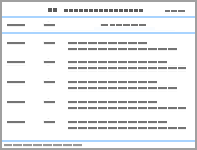
Tab. 1
Regional division of cities in the Yellow River Basin"
| 区域 | 包含城市 |
|---|---|
| 上游 | 白银市、定西市、嘉峪关市、金昌市、酒泉市、兰州市、平凉市、庆阳市、天水市、武威市、西宁市、张掖市 |
| 中游 | 安康市、安阳市、巴彦淖尔市、包头市、宝鸡市、大同市、鄂尔多斯市、汉中市、鹤壁市、呼和浩特市、焦作市、晋城市、晋中市、开封市、临汾市、洛阳市、漯河市、吕梁市、南阳市、平顶山市、濮阳市、三门峡市、商洛市、商丘市、石嘴山市、朔州市、太原市、铜川市、渭南市、乌海市、乌兰察布市、吴忠市、西安市、咸阳市、忻州市、新乡市、信阳市、许昌市、延安市、阳泉市、银川市、榆林市、运城市、长治市、郑州市、中卫市、周口市、驻马店市、固原市、晋中市 |
| 下游 | 滨州市、德州市、东营市、菏泽市、济南市、济宁市、聊城市、临沂市、青岛市、日照市、泰安市、威海市、潍坊市、烟台市、枣庄市、淄博市 |
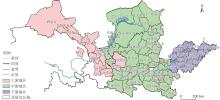
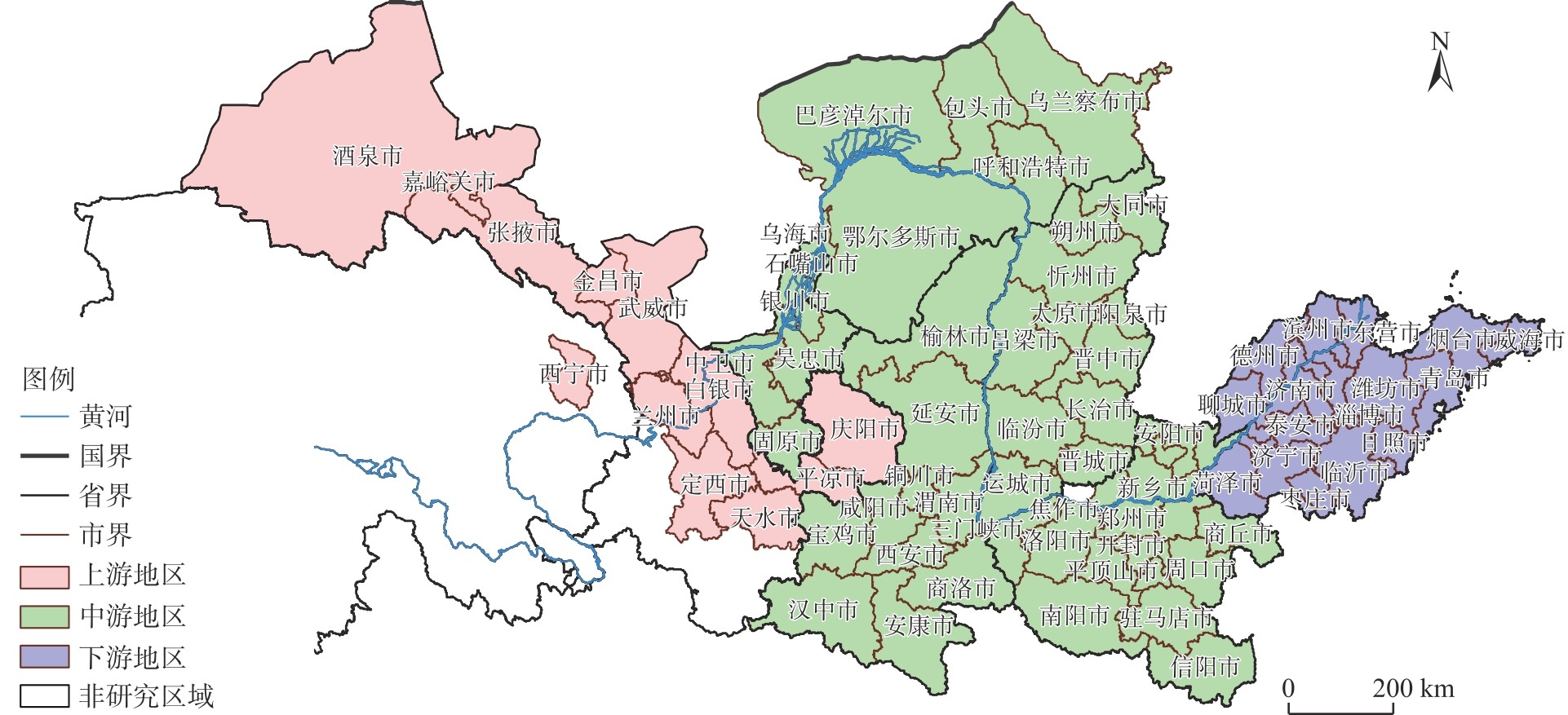
Fig. 1
Regional division of cities in the Yellow River Basin"
Tab. 2
Explanation of the metrics for measuring the efficiency of green inclusive development"
| 类别 | 指标 | 衡量方式 |
|---|---|---|
| 投入 | 资本 | 固定资产投资/104元 |
| 劳动 | 城镇从业人员数/104人 | |
| 能源 | 全社会用电量/10 MWh | |
| 水资源 | 城市供水总量/104 m3 | |
| 期望产出 | 经济产出 | 实际生产总值/104元 |
| 社会福利 | 社会福利指数(运用RAGA-PPC模型将每万人医疗床位、中小学师生比、养老保险覆盖率综合成社会福利指数) | |
| 水资源重复利用 | 城市用水重复利用率/% | |
| 非期望产出(环境 污染) | 空气污染 | 空气污染指数(运用RAGA-PPC模型将空气质量体系指标群中各子指标值(PM2.5、PM10、SO2、NO2、CO、O3)与CO2值综合成空气污染指数) |
| 水污染 | 污水排放量/104 t | |
| 非期望产出(社会 不公) | 城乡居民收入 差距 | 城镇居民可支配收入/农村居民可支配收入 |
| 失业 | 失业率/% |
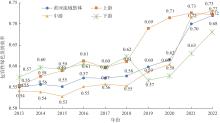
Fig. 2
Trends in inclusive green development efficiency in the Yellow River Basin from 2013 to 2022"
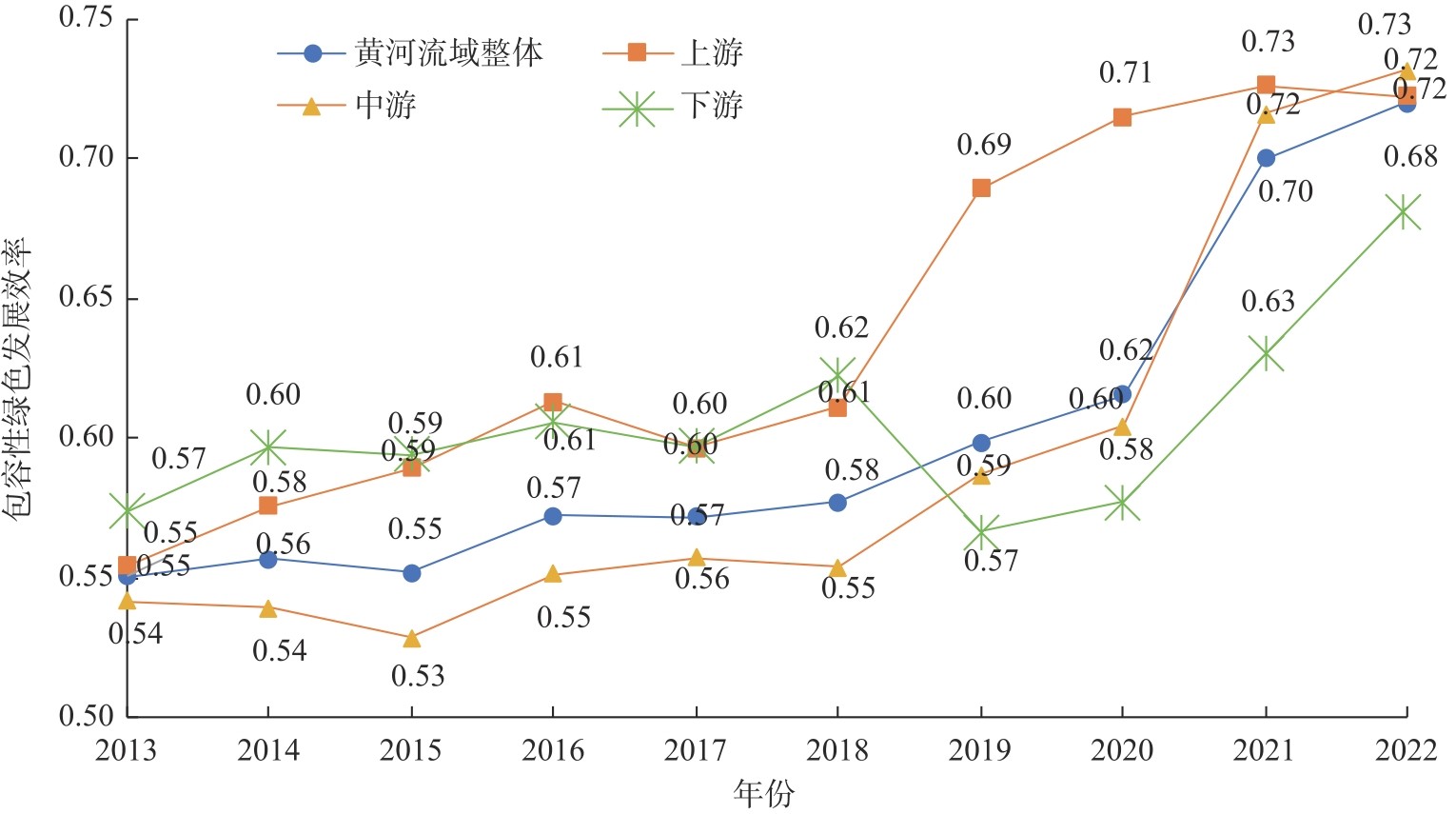
Fig. 3
Kernel density of inclusive green development efficiency in the Yellow River Basin"
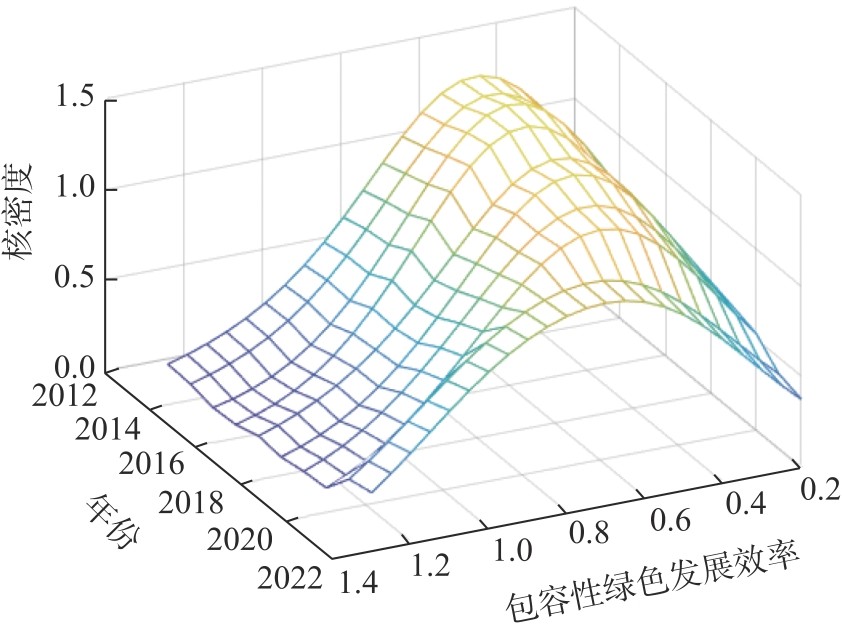
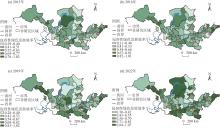
Fig. 4
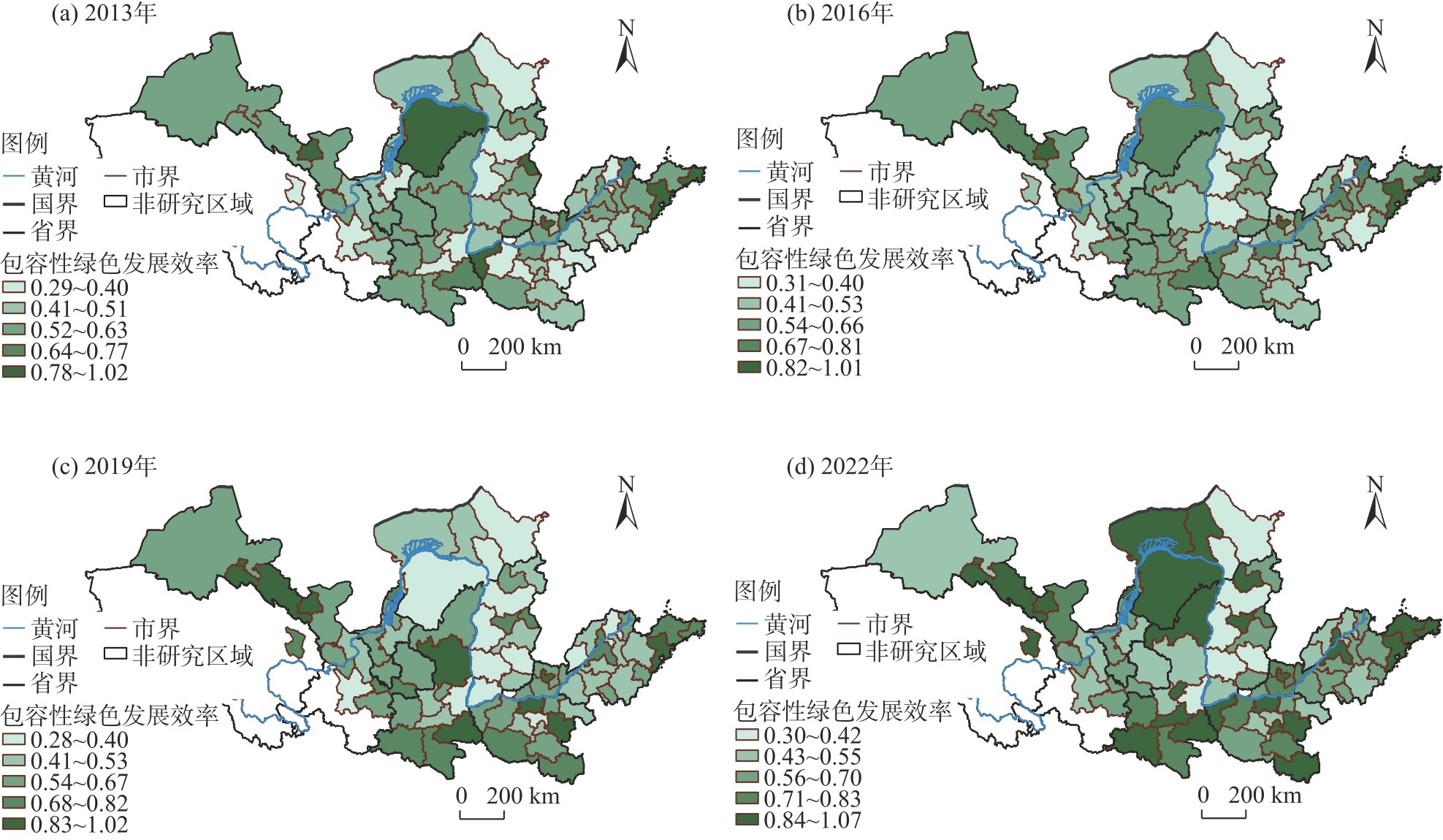
Spatial distributions of inclusive green development efficiency in the Yellow River Basin from 2013 to 2022"
Tab. 3
Global Moran's I measurement results for cities in the Yellow River Basin"
| 年份 | 全局莫 兰指数 | 期望莫 兰指数 | 莫兰指数 标准差 | Z统计量 | P值 |
|---|---|---|---|---|---|
| 2013 | 0.235 | -0.013 | 0.069 | 3.597 | 0.000 |
| 2014 | 0.241 | -0.013 | 0.069 | 3.692 | 0.000 |
| 2015 | 0.274 | -0.013 | 0.069 | 4.168 | 0.000 |
| 2016 | 0.254 | -0.013 | 0.069 | 3.876 | 0.000 |
| 2017 | 0.188 | -0.013 | 0.069 | 2.911 | 0.002 |
| 2018 | 0.147 | -0.013 | 0.069 | 2.318 | 0.010 |
| 2019 | 0.115 | -0.013 | 0.069 | 1.866 | 0.031 |
| 2020 | 0.157 | -0.013 | 0.069 | 2.480 | 0.007 |
| 2021 | 0.229 | -0.013 | 0.068 | 3.561 | 0.000 |
| 2022 | 0.075 | -0.013 | 0.068 | 1.285 | 0.099 |
Tab. 4
Measurement results of the Dagum Gini coefficient for inclusive green development efficiency in the Yellow River Basin"
| 年份 | 总基尼系数 | 地区内基尼系数 | 贡献率/% | |||||
|---|---|---|---|---|---|---|---|---|
| 上游 | 中游 | 下游 | 地区内 | 地区间 | 超变密度 | |||
| 2013 | 0.125 | 0.173 | 0.117 | 0.043 | 46.304 | 37.644 | 16.052 | |
| 2014 | 0.110 | 0.165 | 0.098 | 0.034 | 44.560 | 40.554 | 14.886 | |
| 2015 | 0.103 | 0.165 | 0.089 | 0.037 | 43.891 | 39.996 | 16.113 | |
| 2016 | 0.103 | 0.150 | 0.091 | 0.040 | 44.446 | 39.621 | 15.933 | |
| 2017 | 0.105 | 0.146 | 0.098 | 0.039 | 46.183 | 37.323 | 16.494 | |
| 2018 | 0.101 | 0.140 | 0.094 | 0.047 | 46.660 | 34.390 | 18.951 | |
| 2019 | 0.092 | 0.133 | 0.091 | 0.027 | 48.739 | 30.303 | 20.958 | |
| 2020 | 0.086 | 0.132 | 0.082 | 0.028 | 47.160 | 30.161 | 22.678 | |
| 2021 | 0.077 | 0.132 | 0.070 | 0.029 | 45.988 | 31.097 | 22.914 | |
| 2022 | 0.096 | 0.151 | 0.088 | 0.055 | 46.817 | 26.912 | 26.272 | |
Tab. 5
Descriptive statistics of major influencing factors for inclusive green development efficiency in the Yellow River Basin cities"
| 影响因子 | 样本量 | 最小值 | 最大值 | 均值 | 标准误差 |
|---|---|---|---|---|---|
| 城市空间形态紧凑度 | 770 | 1.00 | 1.97 | 1.23 | 0.01 |
| 城市多中心结构 | 770 | 0.00 | 0.84 | 0.32 | 0.01 |
| 城市化水平 | 770 | 0.15 | 1.00 | 0.47 | 0.01 |
| 降水量 | 770 | 69.90 | 1552.51 | 681.74 | 9.12 |
| 气温 | 770 | 4.21 | 21.92 | 12.71 | 0.13 |
| 风速 | 770 | 5.40 | 15.64 | 9.33 | 0.06 |
| 环境规制 | 770 | 3.00 | 139.00 | 49.01 | 0.69 |
| 政府财政支持 | 770 | 0.07 | 0.92 | 0.21 | 0.00 |
| 产业结构 | 770 | 0.23 | 2.19 | 0.82 | 0.01 |
| 对外开放度 | 770 | 0.00 | 0.73 | 0.11 | 0.01 |
| 技术进步 | 770 | 1.79 | 11.36 | 7.28 | 0.06 |
Tab. 6
Variance inflation factor (VIF) coefficients of explanatory variables in the GTWR model"
| 变量名 | 城市空间形 态紧凑度 | 城市多中 心结构 | 城市化水平 | 降水量 | 气温 | 风速 | 环境规制 | 政府财 政支持 | 产业结构 | 对外开放度 | 技术进步 |
|---|---|---|---|---|---|---|---|---|---|---|---|
| VIF | 1.083 | 1.448 | 1.866 | 1.672 | 1.750 | 1.508 | 1.147 | 2.124 | 1.754 | 1.589 | 2.643 |
Tab. 7
Comparison of goodness of fit and results of regression model"
| 模型 | OLS模型 | GTWR模型 |
|---|---|---|
| 残差平方和(RSS) | 29.019 | 28.807 |
| 拟合优度(R2) | 0.013 | 0.021 |
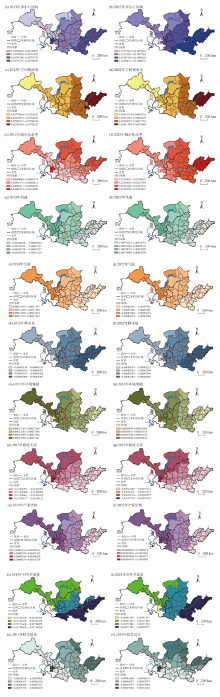
Fig. 5
Spatial distributions of GTWR regression coefficients for urban inclusive green development efficiency in the Yellow River Basin in 2013 and 2022"

| [1] | 王修华, 彭德荣, 李万利. 以新质生产力发展推进中国式现代化——第二届“中国式现代化经济发展前沿论坛”研讨会综述[J]. 中国农村经济, 2024(10): 174-184. |
| [Wang Xiuhua, Peng Derong, Li Wanli. Advancing Chinese modernization through the development of new quality productive forces: A summary of the 2nd frontier forum on Chinese modernization and economic development[J]. Chinese Rural Economy, 2024(10): 174-184.] | |
| [2] |
周小亮, 吴武林, 廖达颖. 我国区域包容性绿色增长测度与差异研究[J]. 科技进步与对策, 2018, 35(6): 42-49.
doi: 10.6049/kjjbydc.2017060419 |
| [Zhou Xiaoliang, Wu Wulin, Liao Daying. Research on the measurement and difference of regional inclusive green growth in China[J]. Science & Technology Progress and Policy, 2018, 35(6): 42-49.] | |
| [3] | 周小亮, 吴武林. 中国包容性绿色增长的测度及分析[J]. 数量经济技术经济研究, 2018, 35(8): 3-20. |
| [Zhou Xiaoliang, Wu Wulin. The measurement and analysis of the inclusive green growth in China[J]. Journal of Quantitative & Technological Economics, 2018, 35(8): 3-20.] | |
| [4] | 吴武林, 罗世华, 刘祥官. 长江经济带包容性绿色发展的测度评价、动态分布与收敛趋势[J]. 江西财经大学学报, 2022(6): 13-28. |
| [Wu Wulin, Luo Shihua, Liu Xiangguan. Measurement evaluation, dynamic distribution and convergent tendency of the inclusive green development in the Yangtze River Economic Belt[J]. Journal of Jiangxi University of Finance and Economics, 2022(6): 13-28.] | |
| [5] | 王宇昕, 余兴厚, 黄玲. 长江经济带市域包容性绿色增长的空间格局分布与演变特征[J]. 技术经济, 2019, 38(6): 80-89. |
| [Wang Yuxin, Yu Xinghou, Huang Ling. Spatial pattern distribution and evolution characteristics of inclusive green growth in urban areas of Yangtze River Economic Belt[J]. Journal of Technology Economics, 2019, 38(6): 80-89.] | |
| [6] | 李清, 贾庆洲, 汪福庆. 中国包容性绿色发展协同演进及空间收敛性分析[J]. 生态经济, 2024, 40(10): 156-164. |
| [Li Qing, Jia Qingzhou, Wang Fuqing. Analysis of inclusive green growth, synergy evolution, and spatial convergence in China[J]. Ecological Economy, 2024, 40(10): 156-164.] | |
| [7] | 周锐波, 吴云峰, 宋佳晞. 共生共荣: 工业智能化发展与包容性绿色增长[J]. 中国人口·资源与环境, 2024, 34(5): 162-174. |
| [Zhou Ruibo, Wu Yunfeng, Song Jiaxi. Symbiosis and co-prosperity: Industrial intelligence development and inclusive green growth[J]. China Population, Resources and Environment, 2024, 34(5): 162-174.] | |
| [8] | 李波, 徐奥辉, 甘天琦. 信息基础设施赋能包容性绿色增长的效应与机制[J]. 统计与决策, 2024, 40(16): 73-78. |
| [Li Bo, Xu Aohui, Gan Tianqi. Effects and mechanisms of information infrastructure empowering inclusive green growth[J]. Statistics & Decision, 2024, 40(16): 73-78.] | |
| [9] | 李华, 董艳玲. 中国经济高质量发展水平及差异探源——基于包容性绿色全要素生产率视角的考察[J]. 财经研究, 2021, 47(8): 4-18. |
| [Li Hua, Dong Yanling. China's high-quality economic development level and the source of differences: Based on the inclusive green TFP perspective[J]. Journal of Finance and Economics, 2021, 47(8): 4-18.] | |
| [10] | 孟望生. 黄河流域地级市经济绿色增长效率的测度[J]. 统计与决策, 2022, 38(1): 113-117. |
| [Meng Wangsheng. Measurement of economic green growth efficiency in prefecture-level cities of the Yellow River Basin[J]. Statistics & Decision, 2022, 38(1): 113-117.] | |
| [11] | 谷魁英, 孙慧. 中国城市包容性绿色增长指数测度与分析[J]. 统计与决策, 2022, 38(8): 100-104. |
| [Gu Kuiying, Sun Hui. Measurement and analysis of inclusive green growth index in cities of China[J]. Statistics & Decision, 2022, 38(8): 100-104.] | |
| [12] |
曹姗姗, 何昭丽, 徐力璇, 等. 区域旅游发展对水资源绿色效率的影响及其时空分异[J]. 经济地理, 2023, 43(7): 215-224.
doi: 10.15957/j.cnki.jjdl.2023.07.021 |
|
[Cao Shanshan, He Zhaoli, Xu Lixuan, et al. The impact of tourism development on green efficiency of water resources in China and its spatiotemporal differentiation[J]. Economic Geography, 2023, 43(7): 215-224.]
doi: 10.15957/j.cnki.jjdl.2023.07.021 |
|
| [13] |
赵林, 高晓彤, 刘焱序, 等. 中国包容性绿色效率空间关联网络结构演变特征分析[J]. 经济地理, 2021, 41(9): 69-78, 90.
doi: 10.15957/j.cnki.jjdl.2021.09.008 |
|
[Zhao Lin, Gao Xiaotong, Liu Yanxu, et al. Evolution characteristics of spatial correlation network of inclusive green efficiency in China[J]. Economic Geography, 2021, 41(9): 69-78, 90.]
doi: 10.15957/j.cnki.jjdl.2021.09.008 |
|
| [14] |
吴雨阳, 曹煜玲, 朱悦, 等. 中国包容性绿色发展的空间关联网络与区域分异及收敛性研究[J]. 自然资源学报, 2025, 40(2): 436-458.
doi: 10.31497/zrzyxb.20250210 |
|
[Wu Yuyang, Cao Yuling, Zhu Yue, et al. Spatial correlation network, regional differentiation and convergence of inclusive green development in China[J]. Journal of Natural Resources, 2025, 40(2): 436-458.]
doi: 10.31497/zrzyxb.20250210 |
|
| [15] | 吴洋宏, 林栋, 周小亮. 调整财政支出结构推进中国式现代化: 基于包容性绿色增长目标的理论模型与实证检验[J]. 中国环境管理, 2025, 17(1): 40-53. |
| [Wu Yanghong, Lin Dong, Zhou Xiaoliang. Adjusting fiscal expenditure structure to advance Chinese modernization: A theoretical model and empirical analysis based on inclusive green growth goals[J]. Chinese Journal of Environmental Management, 2025, 17(1): 40-53.] | |
| [16] | 马玉林, 马运鹏. 数字经济对城市包容性绿色增长的影响研究[J/OL]. 科研管理. [2025-03-25]. http://kns.cnki.net/kcms/detail/11.1567.G3.20250107.0909.002.html. |
| [Ma Yulin, Ma Yunpeng. The effects of digital economy on urban inclusive green growth[J/OL]. Science Research Management. [2025-03-25]. http://kns.cnki.net/kcms/detail/11.1567.G3.20250107.0909.002.html.] | |
| [17] | 邓淇中, 秦燕丝, 何晓慧. 长江经济带包容性绿色发展时空异质特征及影响因素识别[J]. 中南林业科技大学学报(社会科学版), 2021, 15(6): 1-9. |
| [Deng Qizhong, Qin Yansi, He Xiaohui. Recognition of the spatio-temporal heterogeneity characteristics and influencing factors about inclusive green development in the Yangtze River Economic Belt[J]. Journal of Central South University of Forestry & Technology (Social Science Edition), 2021, 15(6): 1-9.] | |
| [18] |
岳立, 薛丹. 黄河流域沿线城市绿色发展效率时空演变及其影响因素[J]. 资源科学, 2020, 42(12): 2274-2284.
doi: 10.18402/resci.2020.12.02 |
|
[Yue Li, Xue Dan. Spatiotemporal change of urban green development efficiency in the Yellow River Basin and influencing factors[J]. Resources Science, 2020, 42(12): 2274-2284.]
doi: 10.18402/resci.2020.12.02 |
|
| [19] |
柴国荣, 李佳音, 付文昊. 黄河流域城市群生态安全能级: 区域差异、动态演化及提升路径[J]. 经济地理, 2025, 45(2): 69-79.
doi: 10.15957/j.cnki.jjdl.2025.02.007 |
|
[Chai Guorong, Li Jiayin, Fu Wenhao. Ecological security level of urban agglomerations in the Yellow River Basin: Regional difference, dynamic evolution and improvement path[J]. Economic Geography, 2025, 45(2): 69-79.]
doi: 10.15957/j.cnki.jjdl.2025.02.007 |
|
| [20] | 李新越, 班凤梅, 毕旭, 等. 黄河流域减污降碳协同效应的时空特征及影响因素分析[J]. 环境科学研究, 2024, 37(12): 2610-2621. |
| [Li Xinyue, Ban Fengmei, Bi Xu, et al. Spatio-temporal characteristics and influencing factors of the synergistic effects of pollution and carbon emission reduction in the Yellow River Basin[J]. Research of Environmental Sciences, 2024, 37(12): 2610-2621.] | |
| [21] |
岳立, 任婉瑜. 黄河流域城市能源综合效率时空分异与影响因素研究[J]. 地理科学, 2024, 44(4): 630-639.
doi: 10.13249/j.cnki.sgs.20220667 |
| [Yue Li, Ren Wanyu. Spatio-temporal distribution and influencing factors of urban comprehensive energy efficiency in the Yellow River Basin[J]. Geographical Science, 2024, 44(4): 630-639.] | |
| [22] | Tone K. A slacks-based measure of super-efficiency in data envelopment analysis[J]. European Journal of Operational Research, 2002, 143(1): 32-41. |
| [23] | Huang B, Wu B, Barry M. Geographically and temporally weighted regression for modeling spatio-temporal variation in house prices[J]. International Journal of Geographical Information Science, 2010, 24(3): 383-401. |
| [24] |
王浩, 牛存稳, 赵勇. 流域“自然-社会”二元水循环与水资源研究[J]. 地理学报, 2023, 78(7): 1599-1607.
doi: 10.11821/dlxb202307002 |
|
[Wang Hao, Niu Cunwen, Zhao Yong. Natural-artificial dualistic water cycle in river basins and water resources research[J]. Acta Geographica Sinica, 2023, 78(7): 1599-1607.]
doi: 10.11821/dlxb202307002 |
|
| [25] |
孟望生, 刘华桢, 张扬. 黄河流域七大城市群绿色发展效率测度及特征分析[J]. 干旱区地理, 2023, 46(5): 846-856.
doi: 10.12118/j.issn.1000-6060.2022.401 |
|
[Meng Wangsheng, Liu Huazhen, Zhang Yang. Measurement and characterization of green development efficiency in seven urban agglomerations in the Yellow River Basin[J]. Arid Land Geography, 2023, 46(5): 846-856.]
doi: 10.12118/j.issn.1000-6060.2022.401 |
|
| [26] | 徐辉, 武彦青. 可持续发展目标下全球包容性绿色增长指数测度研究[J/OL]. 经济地理. [2025-02-25]. http://kns.cnki.net/kcms/detail/43.1126.k.20241022.0925.002.html. |
| [Xu Hui, Wu Yanqing. Study of the measurement of the global inclusive green growth index under the sustainable development goals[J/OL]. Economic Geography. [2025-02-25]. http://kns.cnki.net/kcms/detail/43.1126.k.20241022.0925.002.html.] | |
| [27] | 吴洋宏, 周小亮. 推动高质量发展的《资本论》逻辑基础与拓展分析——基于包容性绿色增长视角[J]. 当代经济管理, 2022, 44(7): 17-23. |
| [Wu Yanghong, Zhou Xiaoliang. Logical basis and expansion analysis of capital to promote high-quality development: From the perspective of inclusive green growth[J]. Contemporary Economic Management, 2022, 44(7): 17-23.] | |
| [28] | 周小亮. 包容性绿色发展: 理论阐释与制度支撑体系[J]. 学术月刊, 2020, 52(11): 41-54. |
| [Zhou Xiaoliang. Inclusive green development: Theoretical interpretation and institutional support system[J]. Academic Monthly, 2020, 52(11): 41-54.] | |
| [29] | 史献芝, 王新建. 包容性绿色发展: 构建人类命运共同体的着力点[J]. 理论探讨, 2018(5): 52-58. |
| [Shi Xianzhi, Wang Xinjian. Inclusive green development: The pivot for building a community of human destiny[J]. Theoretical Investigation, 2018(5): 52-58.] | |
| [30] |
张昊, 韩增林, 乔国荣, 等. 黄河流域城市间旅游经济联系格局及影响因素研究[J]. 干旱区地理, 2023, 46(8): 1344-1354.
doi: 10.12118/j.issn.1000-6060.2022.570 |
|
[Zhang Hao, Han Zenglin, Qiao Guorong, et al. Patterns and influencing factors of tourism economic linkages between cities in the Yellow River Basin[J]. Arid Land Geography, 2023, 46(8): 1344-1354.]
doi: 10.12118/j.issn.1000-6060.2022.570 |
|
| [31] |
张明斗, 任衍婷, 周亮. 黄河流域城市生态韧性时空演变特征及影响因素分析[J]. 干旱区地理, 2024, 47(3): 445-454.
doi: 10.12118/j.issn.1000-6060.2023.381 |
|
[Zhang Mingdou, Ren Yanting, Zhou Liang. Spatiotemporal evolution characteristics and influencing factors of urban ecological resilience in the Yellow River Basin[J]. Arid Land Geography, 2024, 47(3): 445-454.]
doi: 10.12118/j.issn.1000-6060.2023.381 |
|
| [32] | 方颖, 白秀叶. 城市空间形态、公共服务空间均等化与居民满意度[J]. 经济学(季刊), 2022, 22(4): 1405-1424. |
| [Fang Ying, Bai Xiuye. Urban geometric shape, spatial equalization of public service and residents' satisfaction[J]. China Economic Quarterly, 2022, 22(4): 1405-1424.] | |
| [33] | 申婧, 文清, 张敏, 等. 考虑河长代际责任的城市内河生态可持续治理机制研究[J/OL]. 中国环境科学. [2025-02-25]. https://doi.org/10.19674/j.cnki.issn1000-6923.20241030.001. |
| [Shen Jing, Wen Qing, Zhang Min, et al. Research on the mechanism of ecologically sustainable governance of urban inland rivers with consideration of river chiefs' inter-generational responsibility[J/OL]. China Environmental Science. [2025-02-25]. https://doi.org/10.19674/j.cnki.is-sn1000-6923.20241030.001.] |
|
||

