Arid Land Geography ›› 2025, Vol. 48 ›› Issue (11): 1951-1960.doi: 10.12118/j.issn.1000-6060.2024.757
• Hydrology and Water Resoures • Previous Articles Next Articles
LIU Wenjun1,2,3( ), HU Keke1,2,3, SU Litan1,3(), JIN Lei1,2,3
Received:2024-12-10
Revised:2025-02-12
Online:2025-11-25
Published:2025-11-26
Contact:
SU Litan
E-mail:liuwenjun231@mails.ucas.ac.cn;sulitan@ms.xjb.ac.cn
LIU Wenjun, HU Keke, SU Litan, JIN Lei. Characteristics and influencing factors of agricultural water consumption in the Tarim River Basin[J].Arid Land Geography, 2025, 48(11): 1951-1960.
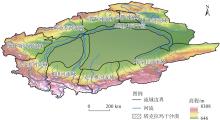
Fig. 1
Schematic diagram of the study area"
Tab. 1
Classification standards for adaptation levels corresponding to the imbalance index"
| 不平衡指数 | 适配等级 | 不平衡指数 | 适配等级 |
|---|---|---|---|
| <-0.06 | 重-Ⅱ型错配 | 0.02~0.04 | 轻-Ⅰ型错配 |
| -0.06~-0.04 | 中-Ⅱ型错配 | 0.04~0.06 | 中-Ⅰ型错配 |
| -0.04~-0.02 | 轻-Ⅱ型错配 | >0.06 | 重-Ⅰ型错配 |
| -0.02~0.02 | 适配 |
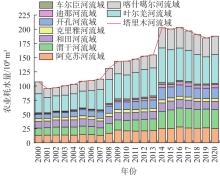
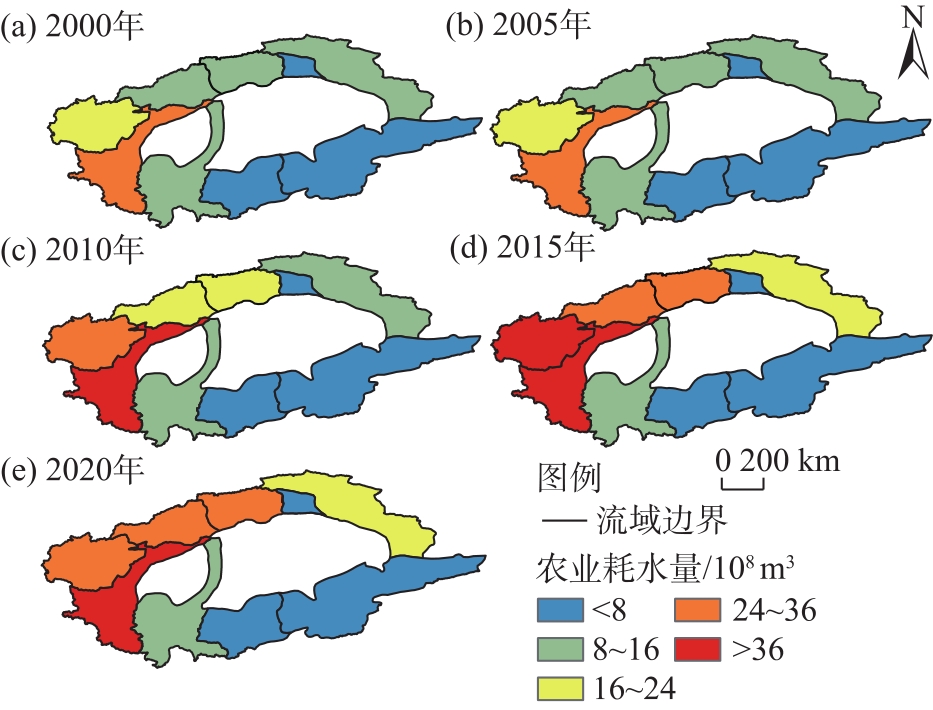
Fig. 2
Agricultural water consumption in the Tarim River Basin"
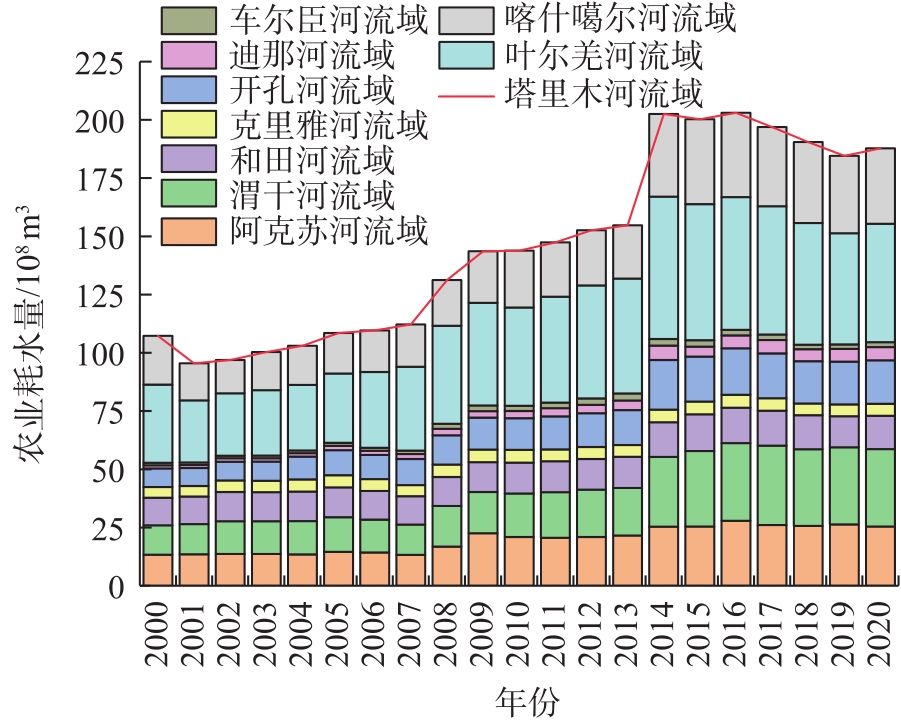
Fig. 3
Temporal variation of agricultural water consumption in each sub-basin"
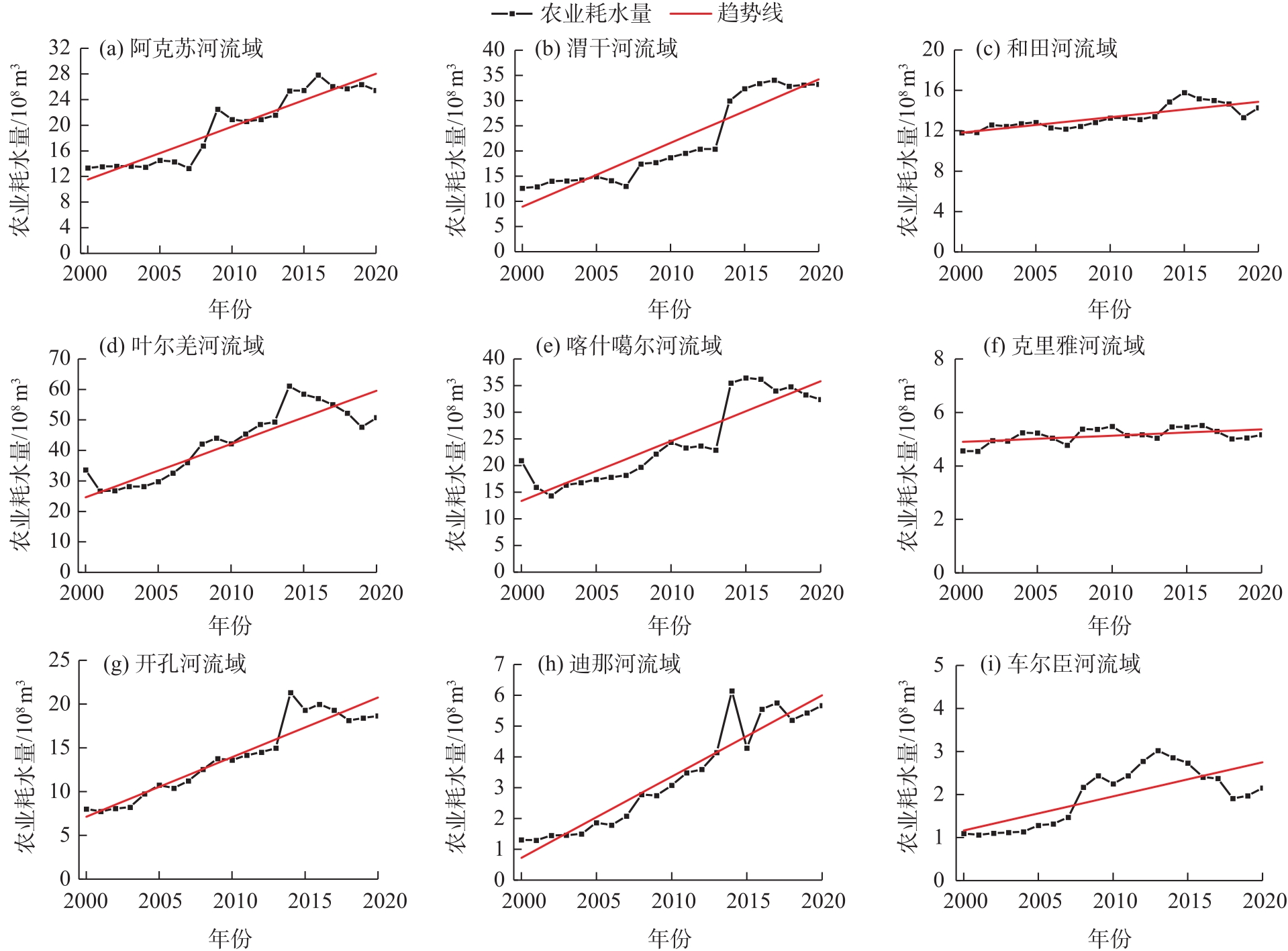
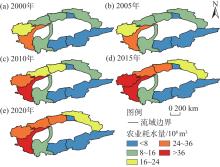
Fig. 4
Spatial distributions of agricultural water consumption in the Tarim River Basin"
Tab. 2
Imbalance indices of agricultural water consumption and water resources in the Tarim River Basin"
| 年份 | 阿克苏河 流域 | 渭干河 流域 | 和田河 流域 | 克里雅河 流域 | 开孔河 流域 | 迪那河 流域 | 车尔臣河 流域 | 叶尔羌河 流域 | 喀什噶尔河流域 |
|---|---|---|---|---|---|---|---|---|---|
| 2000 | -0.0212 | -0.0438 | 0.0470 | 0.0150 | 0.0508 | -0.0004 | 0.0736 | -0.0790 | -0.0473 |
| 2005 | -0.0244 | -0.0554 | 0.0370 | 0.0100 | 0.0262 | -0.0043 | 0.0628 | -0.0450 | -0.0192 |
| 2010 | -0.0329 | -0.0502 | 0.0755 | 0.0260 | 0.0182 | -0.0056 | 0.0328 | -0.0663 | -0.0305 |
| 2015 | -0.0113 | -0.0766 | 0.0661 | 0.0252 | 0.0433 | -0.0071 | 0.0690 | -0.0730 | -0.0436 |
| 2020 | -0.0337 | -0.0876 | 0.0713 | 0.0253 | 0.0416 | -0.0112 | 0.0769 | -0.0598 | -0.0376 |
| 平均值 | -0.0285 | -0.0619 | 0.0549 | 0.0181 | 0.0368 | -0.0065 | 0.0664 | -0.0648 | -0.0280 |
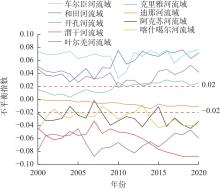
Fig. 5
Temporal variation of the imbalance index"
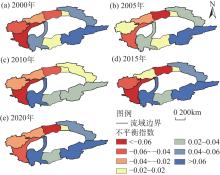
Fig. 6
Spatial distributions of agricultural water consumption adaptability in the Tarim River Basin"

Tab. 3
Entropy values of crop water consumption"
| 年份 | 信息熵 | 年份 | 信息熵 |
|---|---|---|---|
| 2000 | 1.6686 | 2011 | 1.7885 |
| 2001 | 1.6354 | 2012 | 1.7938 |
| 2002 | 1.7969 | 2013 | 1.7860 |
| 2003 | 1.7498 | 2014 | 1.5502 |
| 2004 | 1.7288 | 2015 | 1.6332 |
| 2005 | 1.7227 | 2016 | 1.7149 |
| 2006 | 1.6932 | 2017 | 1.6210 |
| 2007 | 1.7293 | 2018 | 1.6122 |
| 2008 | 1.7833 | 2019 | 1.6344 |
| 2009 | 1.8184 | 2020 | 1.6582 |
| 2010 | 1.8056 |
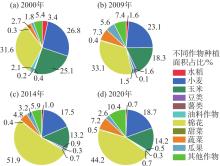
Fig. 7
Crop planting structure in typical years in the Tarim River Basin"
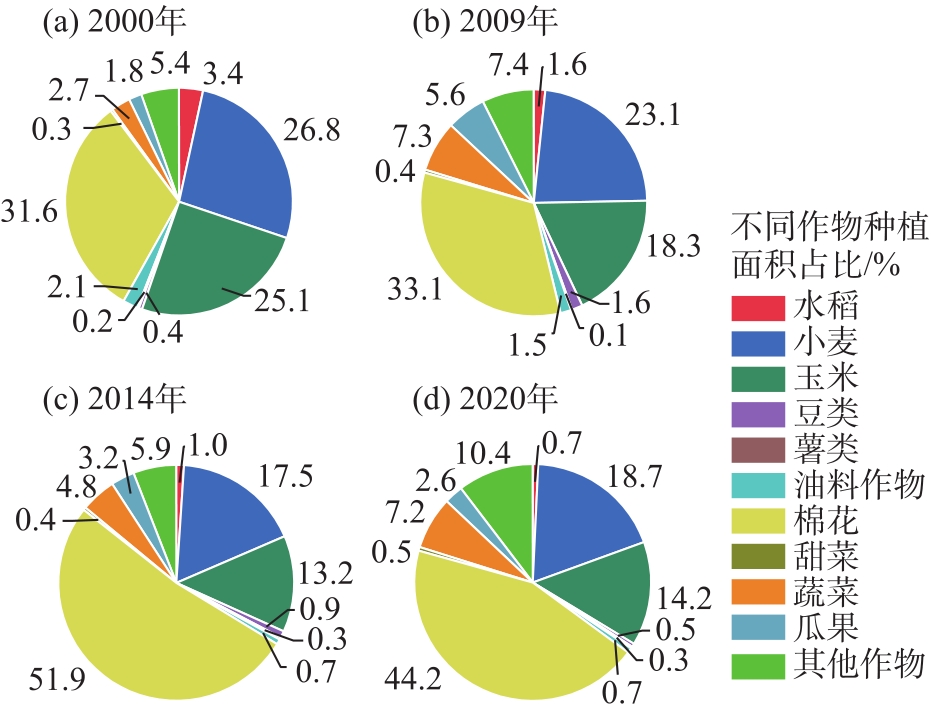
Tab. 4
Entropy values of different basins"
| 流域 | 2000年 | 2009年 | 2014年 | 2020年 |
|---|---|---|---|---|
| 阿克苏河流域 | 1.6992 | 1.6268 | 1.3658 | 1.5721 |
| 渭干河流域 | 1.5888 | 1.4518 | 1.2497 | 1.3037 |
| 和田河流域 | 1.5448 | 1.6324 | 1.6226 | 1.5701 |
| 克里雅河流域 | 1.6452 | 1.8674 | 1.8283 | 1.6134 |
| 开孔河流域 | 1.8354 | 1.6057 | 1.2084 | 1.4987 |
| 迪那河流域 | 1.3929 | 1.2395 | 0.7582 | 0.9304 |
| 车尔臣河流域 | 1.5343 | 1.5580 | 1.4158 | 1.5218 |
| 叶尔羌河流域 | 1.4463 | 1.8310 | 1.6205 | 1.6746 |
| 喀什噶尔河流域 | 1.6227 | 1.8168 | 1.4761 | 1.5502 |
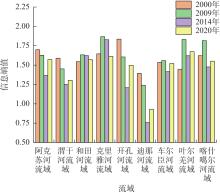
Fig. 8
Entropy values of each sub-basins in the Tarim River Basin across different years"
Tab. 5
Eigenvalue and contribution rate of principal component"
| 主成分 | 特征值 | 贡献率/% | 累计贡献率/% |
|---|---|---|---|
| 1 | 5.5105 | 68.88 | 68.88 |
| 2 | 1.0776 | 13.47 | 82.35 |
| 3 | 0.8955 | 11.19 | 93.55 |
| 4 | 0.4051 | 5.06 | 98.61 |
| 5 | 0.0764 | 0.96 | 99.56 |
| 6 | 0.0186 | 0.23 | 99.80 |
| 7 | 0.0127 | 0.16 | 99.95 |
| 8 | 0.0036 | 0.05 | 100.00 |
Tab. 6
Load values of principal component"
| 指标 | 主成分1 | 主成分2 | 主成分3 | 主成分4 |
|---|---|---|---|---|
| 灌溉面积 | 0.4216 | -0.0252 | 0.0179 | 0.0066 |
| 播种面积 | 0.4214 | -0.0302 | 0.0568 | -0.0997 |
| 地膜覆盖面积 | 0.4107 | -0.0383 | 0.0786 | -0.3242 |
| 农业人口 | 0.3859 | 0.0264 | -0.0131 | -0.5885 |
| 农业机械拥有量 | 0.3881 | 0.0225 | 0.0163 | 0.6291 |
| 农业产值 | 0.4110 | 0.0052 | 0.0480 | 0.3775 |
| 气温 | 0.0455 | -0.7257 | -0.6856 | 0.0150 |
| 降水量 | 0.0745 | 0.6849 | -0.7193 | -0.0073 |
| [1] | 时荣超, 郭文忠. 农业灌溉水资源优化配置研究进展[J]. 农业工程学报, 2024, 40(4): 1-13. |
| [Shi Rongchao, Guo Wenzhong. Research progress on the optimal allocation of agricultural irrigation water resources[J]. Transactions of the Chinese Society of Agricultural Engineering, 2024, 40(4): 1-13. ] | |
| [2] | 李存才. 2023年《中国水资源公报》发布[N]. 中国财经报, 2024-07-02(03). |
| [Li Cuncai. The 2023 China Water Resources Bulletin issued[N]. China Financial and Economic News, 2024-07-02(3). ] | |
| [3] | 魏敬周, 刘维忠. 农作物面积变化对新疆水资源结构偏差的影响[J]. 节水灌溉, 2017(2): 76-79. |
| [Wei Jingzhou, Liu Weizhong. Effects of planting area change of cotton, wheat and corn on water resources utilization structure deviation of in Xinjiang[J]. Water Saving Irrigation, 2017(2): 76-79. ] | |
| [4] | 李保国, 黄峰. 1998—2007年中国农业用水分析[J]. 水科学进展, 2010, 21(4): 575-583. |
| [Li Baoguo, Huang Fei. Trends in China’s agricultural water use during recent decade using the green and blue water approach[J]. Advances in Water Science, 2010, 21(4): 575-583. ] | |
| [5] | Hoekstra A Y, Mekonnen M M, Chapagain A K, et al. Global monthly water scarcity: Blue water footprints versus blue water availability[J]. PLoS One, 2012, 7(2): e32688, doi: 10.1371/journal.pone.0032688. |
| [6] |
Hatfield L J, Dold C. Water-use efficiency: Advances and challenges in a changing climate[J]. Frontiers in Plant Science, 2019, 10: 103, doi: 10.3389/fpls.2019.00103.
pmid: 30838006 |
| [7] | Mpakairi S K, Dube T, Sibanda M, et al. Remote sensing crop water productivity and water use for sustainable agriculture during extreme weather events in South Africa[J]. International Journal of Applied Earth Observation and Geoinformation, 2024, 129: 103833, doi: 10.1016/j.jag.2024.103833. |
| [8] | Feng Y, Cheng J H, Deng Y. Study on agricultural water resource utilization efficiency under the constraint of carbon emission and water pollution[J]. Environmental Research, 2024, 253: 119142, doi: 10.1016/j.envres.2024.119142. |
| [9] | Bonfante A, Monaco E, Manna P, et al. LCIS DSS—an irrigation supporting system for water use efficiency improvement in precision agriculture: A maize case study[J]. Agricultural Systems, 2019, 176: 102646, doi: 10.1016/j.agsy.2019.102646. |
| [10] | Xu H, Yang R. Does agricultural water conservation policy necessarily reduce agricultural water extraction? Evidence from China[J]. Agricultural Water Management, 2022, 274: 107987, doi: 10.1016/j.agwat.2022.107987. |
| [11] | García A E J, Yazici B, Richa A, et al. Digitalising governance processes and water resources management to foster sustainability strategies in the Mediterranean agriculture[J]. Environmental Science and Policy, 2024, 158: 103805, doi: 10.1016/j.envsci.2024.103805. |
| [12] |
尚杰, 于浩然, 杨旭. 农业用水效率时空差异与影响因素分析[J]. 中国农业科技导报, 2022, 24(3): 11-19.
doi: 10.13304/j.nykjdb.2021.0346 |
|
[Shang Jie, Yu Haoran, Yang Xu. Spatial temporal differences and influencing factors of agricultural water use efficiency[J]. Journal of Agricultural Science and Technology, 2022, 24(3): 11-19. ]
doi: 10.13304/j.nykjdb.2021.0346 |
|
| [13] | 张惠茹, 许航, 宋健峰. 西北地区农业灌溉用水反弹的影响因素分析[J]. 灌溉排水学报, 2021, 40(8): 129-135. |
| [Zhang Huiru, Xu Hang, Song Jianfeng. What caused the irrigation water use rebound in northwest China?[J]. Journal of Irrigation and Drainage, 2021, 40(8): 129-135. ] | |
| [14] | 关全力, 刘维忠, 余国新. 新疆农业用水配置及用水效率动态评析[J]. 人民黄河, 2016, 38(3): 136-139. |
| [Guan Quanli, Liu Weizhong, Yu Guoxin. Dynamic analysis on the allocation efficiency of agricultural water use in Xinjiang[J]. Yellow River, 2016, 38(3): 136-139. ] | |
| [15] | 阳君, 肖作林, 刘睿, 等. 水足迹视角下四川省主要粮食作物种植结构优化及用水效率分析[J]. 农业工程学报, 2024, 40(12): 117-127. |
| [Yang Jun, Xiao Zuolin, Liu Rui, et al. Optimizing major grain crop planting structure and analysis of water use efficiency in the Sichuan Province from the perspective of water footprint[J]. Transactions of the Chinese Society of Agricultural Engineering, 2024, 40(12): 117-127. ] | |
| [16] |
胡可可, 何建村, 赵健, 等. 气候变化背景下尼雅河流域生态基流研究[J]. 干旱区地理, 2022, 45(5): 1472-1480.
doi: 10.12118/j.issn.1000-6060.2021.476 |
|
[Hu Keke, He Jiancun, Zhao Jian, et al. Ecological base flow in Niya River Basin under climate change[J]. Arid Land Geography, 2022, 45(5): 1472-1480. ]
doi: 10.12118/j.issn.1000-6060.2021.476 |
|
| [17] | 谢桂云, 张飞云. 新疆农业水土资源利用及对策[J]. 农业展望, 2020, 16(2): 89-92. |
| [Xie Guiyun, Zhang Feiyun. Utilization and countermeasures of agricultural water and soil resources in Xinjiang[J]. Agricultural Outlook, 2020, 16(2): 89-92. ] | |
| [18] |
高晓宇, 郝海超, 张雪琪, 等. 中国西北干旱区植被水分利用效率变化对气象要素的响应——以新疆为例[J]. 干旱区地理, 2023, 46(7): 1111-1120.
doi: 10.12118/j.issn.1000-6060.2022.545 |
|
[Gao Xiaoyu, Hao Haichao, Zhang Xueqi, et al. Responses of vegetation water use efficiency to meteorological factors in arid areas of northwest China: A case of Xinjiang[J]. Arid Land Geography, 2023, 46(7): 1111-1120. ]
doi: 10.12118/j.issn.1000-6060.2022.545 |
|
| [19] |
卢泉, 高花彦, 王鹏鹏, 等. 塔里木河流域水-耕地-粮棉系统耦合关系及影响因素分析[J]. 干旱区地理, 2024, 47(5): 820-829.
doi: 10.12118/j.issn.1000-6060.2023.496 |
|
[Lu Quan, Gao Huayan, Wang Pengpeng, et al. Coupling relationship and influencing factors of water-cropland-grain-cotton system in Tarim River Basin[J]. Arid Land Geography, 2024, 47(5): 820-829. ]
doi: 10.12118/j.issn.1000-6060.2023.496 |
|
| [20] | 李雨芩, 张鹏鹏, 张力小, 等. 中国水-能-粮资源适配格局动态演化及其驱动因素[J]. 生态学报, 2023, 43(21): 8985-8997. |
| [Li Yuqin, Zhang Pengpeng, Zhang Lixiao, et al. Regional inequality of water-energy-food resources in China: Evolution trend and driving forces[J]. Acta Ecologica Sinica, 2023, 43(21): 8985-8997. ] | |
| [21] | 曹丽娟, 张小平. 基于主成分分析的甘肃省水资源承载力评价[J]. 干旱区地理, 2017, 40(4): 906-912. |
| [Cao Lijuan, Zhang Xiaoping. Assessment of water resources carrying capacity in Gansu Province based on principal component analysis[J]. Arid Land Geography, 2017, 40(4): 906-912. ] | |
| [22] |
张沛, 龙爱华, 海洋, 等. 1988—2015年新疆农业用水时空变化与政策驱动研究——基于农作物水足迹的统计分析[J]. 冰川冻土, 2021, 43(1): 242-253.
doi: 10.7522/j.issn.1000-0240.2018.1058 |
| [Zhang Pei, Long Aihua, Hai Yang, et al. Spatiotemporal variations and driving forces of agricultural water consumption in Xinjiang during 1988—2015: Based on statistical analysis of crop water footprint[J]. Journal of Glaciology and Geocryology, 2021, 43(1): 242-253. ] | |
| [23] | 王力, 温雅. 新疆棉花目标价格补贴政策的实施效果与对策分析[J]. 价格月刊, 2015(9): 37-41. |
| [Wang Li, Wen Ya. An analysis of implementation effect of Sinkiang cotton target price subsidy policy and its countermeasure[J]. Prices Monthly, 2015(9): 37-41. ] | |
| [24] | 吴春辉. 新疆农业节水灌溉现状分析[J]. 吉林水利, 2019(3): 39-41, 44. |
| [Wu Chunhui. Analysis of current situation of agricultural water-saving irrigation in Xinjiang[J]. Jilin Water Resources, 2019(3): 39-41, 44. ] | |
| [25] | 吴霞, 王世荣, 尚红莺, 等. 宁夏近18年来耕地面积动态变化及驱动力分析[J]. 中国农业资源与区划, 2017, 38(8): 98-104. |
| [Wu Xia, Wang Shirong, Shang Hongying, et al. Analysis of dynamic change and driving forces of cultivated land in Ningxia during the past 18 years[J]. Chinese Journal of Agricultural Resources and Regional Planning, 2017, 38(8): 98-104. ] | |
| [26] | 王世威, 范文波, 马军勇, 等. 基于主成分及信息熵的额敏灌区农业用水特征[J]. 中山大学学报(自然科学版)(中英文), 2024, 63(3): 103-112. |
| [Wang Shiwei, Fan Wenbo, Ma Junyong, et al. Characteristics of agricultural water use in Emin irrigation area based on principal component and information entropy[J]. Acta Scientiarum Naturalium Universitatis Sunyatseni, 2024, 63(3): 103-112. ] |
| [1] | ZHANG Yiming, TANG Yulei, FENG Junbo. Predicting and analysing glaciers in the Qinghai-Xizang Plateau: A random forest model [J]. Arid Land Geography, 2025, 48(8): 1342-1352. |
| [2] | FU Wei, XIA Wenhao, FAN Tongsheng, ZOU Zhen, HUO Yu. Scenario projection analysis of ecosystem carbon stocks in the Tarim River Basin [J]. Arid Land Geography, 2024, 47(4): 634-647. |
| [3] | ZHANG Qifei, CHEN Yaning, SUN Congjian, XIANG Yanyun, HAO Haichao. Changes in terrestrial water storage and evaluation of oasis ecological security in the Tarim River Basin [J]. Arid Land Geography, 2024, 47(1): 1-14. |
| [4] | MU Jiawei, QIAO Baorong, YU Guoxin. Spatial and temporal patterns of agricultural low-carbon productivity and its influence effects in the counties of Tarim River Basin, Xinjiang [J]. Arid Land Geography, 2023, 46(6): 968-981. |
| [5] | ZHANG Jiudan, LI Junli, BAO Anming, BAI Jie, LIU Tie, HUANG Yue. Effectiveness assessment of ecological restoration of Populus euphratica forest in the Tarim River Basin during 2013—2020 [J]. Arid Land Geography, 2022, 45(6): 1824-1835. |
| [6] | LIU Xia,ZHANG Man,XU Jianhua,GUO Ying,DUAN Weili,SHEN Yanjun. Water resources carrying capacity of Tarim River Basin based on system dynamics model [J]. Arid Land Geography, 2021, 44(5): 1407-1416. |
| [7] |
SUN Tian-yao, LI Xue-mei, XU Min, ZHANG Meng-sheng.
Spatialtemporal variations of vegetation coverage in the Tarim River Basin from 2000 to 2018 [J]. Arid Land Geography, 2020, 43(2): 415-424. |
| [8] | JIAO Wei, LIU Xin-ping, ZHANG Lin, LIANG Ling-xia. Ecological response to the land development in Tarim River Basin [J]. 干旱区地理, 2018, 41(6): 1396-1404. |
| [9] | WANG Guang-yan, WANG Yuan-jian, GUI Dong-wei. A review on water resources research in Tarim River Basin [J]. 干旱区地理, 2018, 41(6): 1151-1159. |
| [10] | CHEN Ya-ning, LI Wei-hong, CHEN Ya-peng, ZHU Cheng-gang. Science in supporting the ecological restoration and sustainable development of the Tarim River Basin [J]. 干旱区地理, 2018, 41(5): 901-907. |
| [11] | WEI Guang-hui, GUI Dong-wei, ZHAO Xin-feng. Irrigation area carrying capacity in Tarim River Basin in different years [J]. 干旱区地理, 2018, 41(2): 230-237. |
| [12] | HAN Qiang, XUE Lian-qing, LIU Yuan-hong, REN Lei. Hydrological responses to land use change in upper-middle reaches of the Tarim River Basin [J]. , 2017, 40(6): 1165-1170. |
| [13] | DENG Ming-jiang, FAN Zi-li, XU Hai-liang, ZHOU Hai-ying. Ecological function regionalization of Tarim River Basin [J]. , 2017, 40(4): 705-717. |
| [14] | ZHANG Peng-fei, Guli JIAPAER, BAO An-ming, MENG Fan-hao, GUO Hui, GUO Hao, LUO Min, HUANG Xiao-ran. Ecological effects evaluation for short term planning of the Tarim River [J]. , 2017, 40(1): 156-164. |
| [15] | DENG Ming-jiang. Prospecting development of south Xinjiang: water strategy and problem of Tarim River Basin [J]. , 2016, 39(1): 1-11. |
|
||

