干旱区地理 ›› 2026, Vol. 49 ›› Issue (1): 198-210.doi: 10.12118/j.issn.1000-6060.2025.003 cstr: 32274.14.ALG2025003
• 区域发展 • 上一篇
李晓柯1( ), 陈强强1,2()
收稿日期:2025-01-03
修回日期:2025-03-22
出版日期:2026-01-25
发布日期:2026-01-18
通讯作者:
陈强强(1979-),男,硕士,教授,主要从事区域经济研究. E-mail: jjglxy666@126.com作者简介:李晓柯(2001-),女,硕士研究生,主要从事区域经济研究. E-mail: 15212410866@163.com
基金资助:
LI Xiaoke1(), CHEN Qiangqiang1,2()
Received:2025-01-03
Revised:2025-03-22
Published:2026-01-25
Online:2026-01-18
摘要:
探讨数字经济对城乡收入差距的作用机理对促进城乡融合发展、实现共同富裕具有重要意义。基于2012—2022年甘肃省14市(州)相关数据,运用固定效应模型和空间计量模型实证分析甘肃省数字经济对城乡收入差距的影响机制及空间效应。结果表明:(1)甘肃省数字经济对城乡收入差距的影响呈“缩小-扩大-缩小”的非线性关系,从2022年开始处于数字经济扩大城乡收入差距的鸿沟期。(2)区域异质性显示,甘肃省数字经济对城乡收入差距的影响在不同区域有所差异,陇东南地区呈明显“倒N”型关系,陇中地区较为微弱,而河西地区不显著。(3)作用机制分析显示,产业结构升级和农业社会化服务是甘肃省数字经济影响城乡收入差距的重要机制。(4)甘肃省城乡收入差距存在显著的空间集聚现象,数字经济对城乡收入差距的直接效应、间接效应和总效应均表现为“倒N”型关系,说明数字经济对城乡收入差距的影响具有空间溢出效应。
李晓柯, 陈强强. 数字经济对甘肃省城乡收入差距的影响机制与空间效应[J]. 干旱区地理, 2026, 49(1): 198-210.
LI Xiaoke, CHEN Qiangqiang. Influence mechanism and spatial effects of the digital economy on the urban-rural income gap in Gansu Province[J]. Arid Land Geography, 2026, 49(1): 198-210.
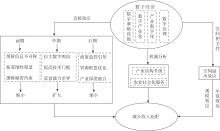
图1
数字经济对城乡收入差距影响的分析框架"
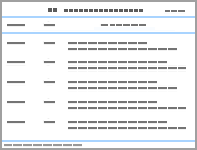
表1
变量描述性统计"
| 变量类别 | 变量名称 | 符号 | 均值 | 中位数 | 标准差 | 最小值 | 最大值 |
|---|---|---|---|---|---|---|---|
| 被解释变量 | 城乡收入差距 | 0.122 | 0.143 | 0.067 | 0.007 | 0.277 | |
| 核心解释变量 | 数字经济发展水平 | DE | 0.236 | 0.215 | 0.149 | 0.022 | 0.770 |
| 控制变量 | 经济发展水平/104元 | gdp | 15.281 | 15.273 | 0.660 | 13.782 | 17.325 |
| 教育投入/人 | edu | 6.569 | 6.537 | 0.228 | 5.840 | 7.235 | |
| 财政自给率 | gov | 0.232 | 0.167 | 0.174 | 0.042 | 0.880 | |
| 金融发展水平 | fin | 3.391 | 3.210 | 1.211 | 1.416 | 7.621 | |
| 对外开放水平 | open | 0.065 | 0.008 | 0.140 | 0.001 | 0.928 | |
| 机制变量 | 产业结构升级 | Ind | 1.769 | 1.574 | 1.160 | 0.205 | 6.219 |
| 农业社会化服务/104元 | Soc | 0.497 | 0.430 | 0.198 | 0.226 | 0.945 |
表2
甘肃省数字经济发展水平指标体系"
| 一级指标 | 二级指标 | 指标说明 | 单位 | 属性 | 权重 |
|---|---|---|---|---|---|
| 数字基础设施 | 互联网普及率 | 每百人互联网宽带用户数 | 户·(100人)-1 | 正 | 0.092 |
| 移动电话普及率 | 每百人移动电话用户数 | 部·(100人)-1 | 正 | 0.053 | |
| 数字产业化 | 信息化从业人员比例 | 信息传输、软件和信息技术服务业从业人员占年末从业人数比重 | % | 正 | 0.023 |
| 人均电信业务总量 | 电信业务总量占常住人口比重 | 104元·人-1 | 正 | 0.209 | |
| 人均邮政业务总量 | 邮政业务总量占常住人口比重 | 104元·人-1 | 正 | 0.103 | |
| 产业数字化 | 数字金融使用深度 | 数字普惠金融使用深度指数 | - | 正 | 0.040 |
| 数字金融覆盖广度 | 数字普惠金融覆盖广度指数 | - | 正 | 0.033 | |
| 普惠金融数字化程度 | 数字普惠金融数字化程度指数 | - | 正 | 0.023 | |
| 电子商务销售额占比 | 电子商务销售额占GDP的比重 | % | 正 | 0.069 | |
| 数字治理 | R&D内部经费支出占比 | R&D内部经费支出占GDP的比重 | % | 正 | 0.178 |
| 每万人发明专利申请授权量 | 发明专利申请授权量占常住人口比重 | 件·(104人)-1 | 正 | 0.177 |
表3
基准回归结果"
| 变量 | Gap | |||
|---|---|---|---|---|
| 回归1 | 回归2 | 回归3 | 回归4 | |
| DE | 0.098***(2.671) | -0.147**(-2.120) | -0.373***(-4.468) | -0.559***(-3.475) |
| DE2 | - | 0.194***(4.088) | 1.044***(5.142) | 1.977***(2.745) |
| DE3 | - | - | -0.783***(-4.290) | -2.647*(-1.900) |
| DE4 | - | - | - | 1.226(1.349) |
| gdp | -0.061***(-4.462) | -0.053***(-4.065) | -0.034***(-2.648) | -0.027**(-1.988) |
| edu | -0.001(-0.047) | 0.003(0.267) | -0.002(-0.201) | -0.004(-0.341) |
| gov | 0.120***(3.311) | 0.115***(3.363) | 0.091***(2.808) | 0.086***(2.626) |
| fin | -0.009*(-1.955) | -0.005(-1.134) | -0.004(-0.904) | -0.004(-0.867) |
| open | -0.031(-1.590) | -0.021(-1.168) | -0.002(-0.124) | -0.001(-0.032) |
| Constant | 1.058***(5.038) | 0.921***(4.589) | 0.692***(3.548) | 0.612***(3.008) |
| 控制变量 | 是 | 是 | 是 | 是 |
| N | 154 | 154 | 154 | 154 |
| 0.777 | 0.804 | 0.830 | 0.832 | |
| 城市固定 | 是 | 是 | 是 | 是 |
| 时间固定 | 是 | 是 | 是 | 是 |
表4
异质性分析回归结果"
| 变量 | 河西地区 回归5 | 陇中地区 回归6 | 陇东南地区 回归7 |
|---|---|---|---|
| -0.014(-0.159) | -0.231(-1.353) | -0.953***(-3.138) | |
| DE2 | -0.112(-0.460) | 0.761**(2.210) | 5.039***(3.479) |
| DE3 | 0.163(0.721) | -0.603**(-2.338) | -7.612***(-2.908) |
| Constant | 0.520**(2.108) | -0.525*(-1.722) | 2.632***(5.766) |
| 控制变量 | 是 | 是 | 是 |
| N | 55 | 44 | 55 |
| 0.797 | 0.954 | 0.976 | |
| 城市固定 | 是 | 是 | 是 |
| 时间固定 | 是 | 是 | 是 |
表5
基于时间趋势的回归结果"
| 变量 | Gap 回归8 |
|---|---|
| DE(基期=2012年) | -0.199***(-2.775) |
| DE×2013年 | 0.044(1.206) |
| DE×2014年 | 0.082*(1.978) |
| DE×2015年 | 0.098**(2.156) |
| DE×2016年 | 0.122**(2.566) |
| DE×2017年 | 0.151***(3.139) |
| DE×2018年 | 0.179***(3.636) |
| DE×2019年 | 0.195***(3.795) |
| DE×2020年 | 0.184***(3.503) |
| DE×2021年 | 0.143***(2.935) |
| DE×2022年 | 0.202***(4.181) |
| Constant | 1.265***(7.334) |
| 控制变量 | 是 |
| N | 154 |
| 0.802 | |
| 城市固定 | 是 |
| 时间固定 | 是 |
表6
产业结构和农业社会化服务的机制检验"
| 变量 | Gap 回归3 | Ind 回归9 | Soc 回归10 |
|---|---|---|---|
| DE | -0.373***(-4.468) | 13.506***(3.894) | 19.503***(4.048) |
| DE2 | 1.044***(5.142) | -31.016***(-3.679) | -44.069***(-3.764) |
| DE3 | -0.783***(-4.290) | 22.588***(2.981) | 30.081***(2.858) |
| Constant | 0.692***(3.548) | 0.387(0.048) | -11.968(-1.064) |
| 控制变量 | 是 | 是 | 是 |
| N | 154 | 154 | 154 |
| 0.830 | 0.621 | 0.506 | |
| 城市固定 | 是 | 是 | 是 |
| 时间固定 | 是 | 是 | 是 |
表7
稳健性与内生性检验"
| 变量 | 替换解释变量 回归11 | 缩尾处理 回归12 | 改变样本观察期 回归13 | 工具变量法 回归14 |
|---|---|---|---|---|
| DE | -0.102***(-6.410) | -0.373***(-4.468) | -0.232**(-2.186) | -1.043***(-4.943) |
| DE2 | 0.045***(5.809) | 1.044***(5.142) | 0.923***(3.991) | 2.287***(5.109) |
| DE3 | -0.006***(-4.634) | -0.783***(-4.290) | -0.749***(-3.645) | -1.708***(-4.568) |
| Constant | 0.886***(5.008) | 0.692***(3.548) | 0.717***(3.355) | -0.015(-0.053) |
| 控制变量 | 是 | 是 | 是 | 是 |
| N | 154 | 154 | 154 | 154 |
| 0.847 | 0.830 | 0.783 | 0.970 | |
| 城市固定 | 是 | 是 | 是 | 是 |
| 时间固定 | 是 | 是 | 是 | 是 |
| Kleibergen-Paap rk LM统计量 | - | - | - | 15.156 [0.0001] |
| Kleibergen-Paap rk Wald F统计量 | - | - | - | 23.055 {16.38} |
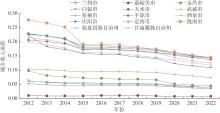
图2
2012—2022年甘肃省城乡收入差距变化趋势"
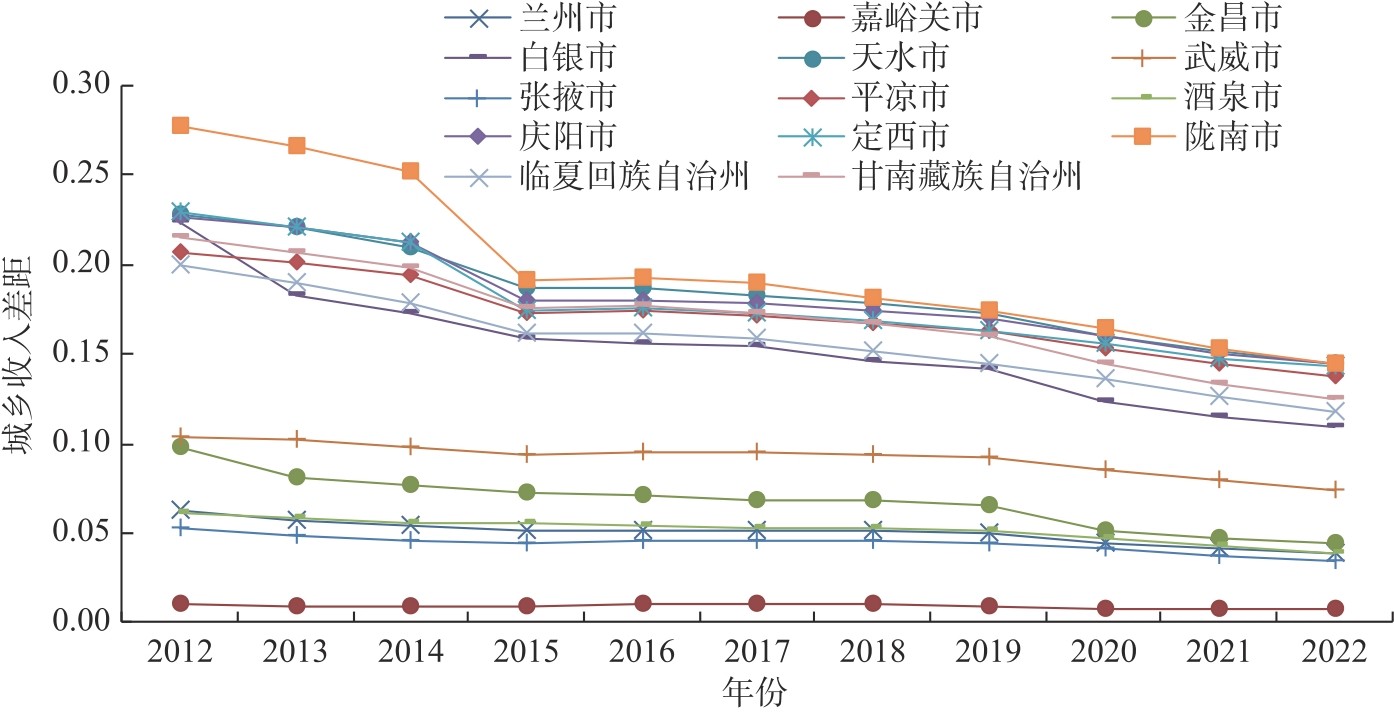
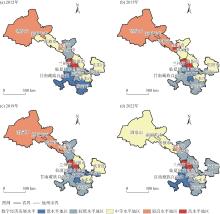
图3
2012—2022年甘肃省数字经济发展水平空间格局演变 注:基于自然资源部标准地图服务网站审图号为GS(2022)1873号的标准地图制作,底图边界无修改。"

表8
2012—2022年甘肃省城乡收入差距全局莫兰指数统计值"
| 统计量 | 2012年 | 2013年 | 2014年 | 2015年 | 2016年 | 2017年 | 2018年 | 2019年 | 2020年 | 2021年 | 2022年 |
|---|---|---|---|---|---|---|---|---|---|---|---|
| 全局莫兰指数 | 0.696*** | 0.731*** | 0.735*** | 0.728*** | 0.732*** | 0.7332** | 0.738*** | 0.739*** | 0.733*** | 0.740*** | 0.749*** |
| Z统计值 | 3.869 | 4.042 | 4.062 | 4.028 | 4.047 | 4.053 | 4.080 | 4.088 | 4.047 | 4.082 | 4.122 |
| P值 | 0.001 | 0.001 | 0.000 | 0.001 | 0.001 | 0.001 | 0.000 | 0.000 | 0.001 | 0.000 | 0.000 |
表9
空间计量模型检验结果"
| 检验 | 统计量 | P值 |
|---|---|---|
| LM空间误差检验 | 42.129 | 0.000 |
| 稳健的LM空间误差检验 | 28.956 | 0.000 |
| LM空间滞后检验 | 128.041 | 0.000 |
| 稳健的LM空间滞后检验 | 114.867 | 0.000 |
| Wald(SDM退化为SAR)检验 | 74.125 | 0.000 |
| Wald(SDM退化为SEM)检验 | 98.014 | 0.000 |
| LR(有无个体效应)检验 | 32.100 | 0.021 |
| LR(有无时间效应)检验 | 193.412 | 0.000 |
表10
空间溢出效应分解结果"
| 变量 | 直接效应 | 间接效应 | 总效应 |
|---|---|---|---|
| DE | -0.211**(-2.172) | -0.390***(-4.136) | -0.602***(-5.080) |
| DE2 | 0.546**(2.208) | 1.024***(3.592) | 1.569***(4.151) |
| DE3 | -0.394**(-1.990) | -0.769***(-3.370) | -1.164***(-3.966) |
| 控制变量 | 是 | 是 | 是 |
| 城市固定 | 是 | 是 | 是 |
| 时间固定 | 是 | 是 | 是 |
| N | 154 | 154 | 154 |
| R2 | 0.847 | 0.847 | 0.847 |
| [1] | 司增绰, 李燕. 数字经济减缩城乡居民收入差距的逻辑及效应[J]. 深圳大学学报(人文社会科学版), 2023, 40(4): 76-86. |
| [Si Zengchuo, Li Yan. The logic and effect of digital economy to narrow the income gap between urban and rural residents[J]. Journal of Shenzhen University (Humanities & Social Sciences Edition), 2023, 40(4): 76-86.] | |
| [2] |
Aker J C, Ghosh I, Burrell J. The promise (and pitfalls) of ICT for agriculture initiatives[J]. Agricultural Economics, 2016, 47(Suppl.1): 35-48.
doi: 10.1111/agec.2016.47.issue-S1 |
| [3] |
吉泽男, 付文婷, 王鹏程, 等. 干旱区数字经济与农业绿色发展耦合协调研究——以新疆为例[J]. 干旱区地理, 2024, 47(11): 1981-1990.
doi: 10.12118/j.issn.1000-6060.2023.637 |
|
[Ji Zenan, Fu Wenting, Wang Pengcheng, et al. Coupling and coordination of digital economy and green development of agriculture in arid zones: A case study of Xinjiang[J]. Arid Land Geography, 2024, 47(11): 1981-1990.]
doi: 10.12118/j.issn.1000-6060.2023.637 |
|
| [4] |
彭继增, 陶旭辉, 徐丽. 我国数字化贫困地理集聚特征及时空演化机制[J]. 经济地理, 2019, 39(2): 169-179.
doi: 10.15957/j.cnki.jjdl.2019.02.021 |
|
[Peng Jizeng, Tao Xuhui, Xu Li. Geographic agglomeration characteristic and temporal & spatial evolution mechanism of digital poverty in China[J]. Economic Geography, 2019, 39(2): 169-179.]
doi: 10.15957/j.cnki.jjdl.2019.02.021 |
|
| [5] | 陈雪梅, 周斌. 数字经济推进乡村振兴的内在机理与实现路径[J]. 理论探讨, 2023(5): 85-90. |
| [Chen Xuemei, Zhou Bin. The internal mechanism and realization path of digital economy promoting rural revitalization[J]. Theoretical Discussions, 2023(5): 85-90.] | |
| [6] | 王子凤, 张桂文. 数字经济对城乡居民收入差距影响的实证检验[J]. 统计与决策, 2023, 39(22): 112-116. |
| [Wang Zifeng, Zhang Guiwen. An empirical test of the impact of digital economy on the urban-rural income gap[J]. Statistics & Decision, 2023, 39(22): 112-116.] | |
| [7] | 米嘉伟, 屈小娥. 数字经济发展如何影响城乡收入差距[J]. 现代经济探讨, 2022(6): 80-91. |
| [Mi Jiawei, Qu Xiaoe. How does the development of digital economy affect the urban-rural income gap[J]. Modern Economic Research, 2022(6): 80-91.] | |
| [8] | 王帅龙, 孙培蕾. 数字经济、劳动力流动与城乡收入差距[J]. 哈尔滨商业大学学报(社会科学版), 2023(5): 108-118. |
| [Wang Shuailong, Sun Peilei. Digital economy, labor mobility, and urban-rural income gap[J]. Journal of Harbin University of Commerce (Social Science Edition), 2023(5): 108-118.] | |
| [9] | 钟文, 严芝清, 郑明贵. 数字经济发展对城乡收入差距缩小的影响: 机制与效应[J]. 农业经济与管理, 2024(1): 89-100. |
| [Zhong Wen, Yan Zhiqing, Zheng Minggui. Impact of development of digital economy on narrowing urban-rural income gap: Mechanisms and effect[J]. Agricultural Economics and Management, 2024(1): 89-100.] | |
| [10] | 邢怀振, 苏群. 数字经济发展水平对城乡收入差距的影响研究[J]. 统计与决策, 2023, 39(18): 78-82. |
| [Xing Huaizhen, Su Qun. Research on the impact of digital economy development level on urban-rural income gap[J]. Statistics & Decision, 2023, 39(18): 78-82.] | |
| [11] | 杨虎涛, 胡乐明. 不确定性、信息生产与数字经济发展[J]. 中国工业经济, 2023(4): 24-41. |
| [Yang Hutao, Hu Leming. Uncertainty, information production, and the development of digital economy[J]. China Industrial Economics, 2023(4): 24-41.] | |
| [12] | 张岳, 张博. 数字治理下农民收入增长与收入分配效应[J]. 华南农业大学学报(社会科学版), 2024, 23(1): 63-75. |
| [Zhang Yue, Zhang Bo. Farmers’ income growth and income distribution effect under digital governance[J]. Journal of South China Agricultural University (Social Science Edition), 2024, 23(1): 63-75.] | |
| [13] | Aker J C, Mbiti I M. Mobile phones and economic development in Africa[J]. Journal of Economic Perspectives, 2010, 24(3): 207-232. |
| [14] | 田秀娟, 李睿. 数字技术赋能实体经济转型发展——基于熊彼特内生增长理论的分析框架[J]. 管理世界, 2022, 38(5): 56-73. |
| [Tian Xiujuan, Li Rui. Digital technology empowers the transformation and development of real economy: An analysis framework based on Schumpeter’s endogenous growth theory[J]. Journal of Management World, 2022, 38(5): 56-73.] | |
| [15] |
生延超, 谭左思, 李倩, 等. 数字经济能否促进黄河流域旅游经济韧性提升?[J]. 干旱区地理, 2023, 46(10): 1704-1713.
doi: 10.12118/j.issn.1000-6060.2023.090 |
|
[Sheng Yanchao, Tan Zuosi, Li Qian, et al. Can the digital economy promote the resilience of the tourism economy in the Yellow River Basin?[J]. Arid Land Geography, 2023, 46(10): 1704-1713.]
doi: 10.12118/j.issn.1000-6060.2023.090 |
|
| [16] | 洪俊杰, 李研, 杨曦. 数字经济与收入差距: 数字经济核心产业的视角[J]. 经济研究, 2024, 59(5): 116-131. |
| [Hong Junjie, Li Yan, Yang Xi. Digital economy and income gap: From the perspective of core industries in the digital economy[J]. Economic Research Journal, 2024, 59(5): 116-131.] | |
| [17] | 伍云云, 李晓春. 农业社会化服务发展、城市就业与收入分配——理论和证据[J]. 审计与经济研究, 2024, 39(5): 101-114. |
| [Wu Yunyun, Li Xiaochun. Development of agricultural socialized services, urban employment, and income distribution: Theory and evidence[J]. Journal of Audit & Economics, 2024, 39(5): 101-114.] | |
| [18] | 童婷, 李谷成, 廖文梅. 互联网使用能影响农户生产托管行为吗?[J]. 中南财经政法大学学报, 2023(4): 149-160. |
| [Tong Ting, Li Gucheng, Liao Wenmei. Can internet use promote farmers’ participation in agricultural production trusteeship?[J]. Journal of Zhongnan University of Economics and Law, 2023(4): 149-160.] | |
| [19] | 张永奇, 单德朋. 县域数字经济、农业社会化服务与小农户受益——基于宏微观数据的经验考察[J]. 上海财经大学学报, 2024, 26(1): 94-107. |
| [Zhang Yongqi, Shan Depeng. County digital economy, agricultural socialized services, and benefits for small farmers: Based on macro and micro data[J]. Journal of Shanghai University of Finance and Economics, 2024, 26(1): 94-107.] | |
| [20] | 陈卫洪, 王莹. 数字化赋能新型农业经营体系构建研究——“智农通”的实践与启示[J]. 农业经济问题, 2022(9): 86-99. |
| [Chen Weihong, Wang Ying. A study on the construction of a new agricultural management system with digital empowerment: Practice and enlightenment of “Zhinongtong”[J]. Issues in Agricultural Economy, 2022(9): 86-99.] | |
| [21] | 蒋自然, 樊俊杰, 黎晨晟, 等. 数字经济发展对中国制造业生产效率的影响: 空间效应与传导机制[J]. 人文地理, 2024, 39(3): 72-80, 122. |
| [Jiang Ziran, Fan Junjie, Li Chensheng, et al. The impact of digital economy development on the production efficiency of China’s manufacturing industry: Spatial effects and transmission mechanisms[J]. Human Geography, 2024, 39(3): 72-80, 122.] | |
| [22] | 殷浩栋, 霍鹏, 汪三贵. 农业农村数字化转型: 现实表征、影响机理与推进策略[J]. 改革, 2020(12): 48-56. |
| [Yin Haodong, Huo Peng, Wang Sangui. Agriculture and rural digital transformation: Realistic representation, impact mechanism, and promotion strategy[J]. Reform, 2020(12): 48-56.] | |
| [23] | 郭峰, 王靖一, 王芳, 等. 测度中国数字普惠金融发展: 指数编制与空间特征[J]. 经济学(季刊), 2020, 19(4): 1401-1418. |
| [Guo Feng, Wang Jingyi, Wang Fang, et al. Measuring China’s digital financial inclusion: Index compilation and spatial characteristics[J]. China Economic Quarterly, 2020, 19(4): 1401-1418.] | |
| [24] | 郭海明, 范勇. 数字经济对区域城乡融合发展水平的空间影响效应——基于甘肃省市域空间面板数据[J]. 区域金融研究, 2024(9): 65-75. |
| [Guo Haiming, Fan Yong. Spatial effect of the digital economy on regional urban-rural integrated development: Based on prefectural panel data in Gansu Province[J]. Journal of Regional Financial Research, 2024(9): 65-75.] | |
| [25] | 王玉珍, 王彤, 宋国靖. 甘肃省数字经济发展水平评价及耦合协调分析[J]. 河西学院学报, 2024, 40(2): 91-97. |
| [Wang Yuzhen, Wang Tong, Song Guojing. Evaluation and coupling coordination analysis of digital economy development in Gansu Province[J]. Journal of the Hexi University, 2024, 40(2): 91-97.] | |
| [26] |
郭沛, 王光远. 数字经济的减污降碳协同作用及机制——基于地级市数据的实证检验[J]. 资源科学, 2023, 45(11): 2117-2129.
doi: 10.18402/resci.2023.11.02 |
|
[Guo Pei, Wang Guangyuan. The synergistic effect of digital economy on pollution and carbon reduction and the influence mechanism: An empirical test based on prefecture-level city data[J]. Resources Science, 2023, 45(11): 2117-2129.]
doi: 10.18402/resci.2023.11.02 |
|
| [27] | 赵航, 高强, 李丹. 农业社会化服务带动小农户增收的机制、障碍与路径——基于城乡经济循环的分析视角[J]. 南京工业大学学报(社会科学版), 2022, 21(6): 98-108, 110. |
| [Zhao Hang, Gao Qiang, Li Dan. Mechanism, obstacle, and path of agricultural socialized service driving small farmers’ income increase: From perspective of urban-rural economic cycle[J]. Journal of Nanjing Tech University (Social Science Edition), 2022, 21(6): 98-108, 110.] | |
| [28] | 郝爱民. 农业生产性服务对农业技术进步贡献的影响[J]. 华南农业大学学报(社会科学版), 2015, 14(1): 8-15. |
| [Hao Aimin. Research of agricultural producer services’ effect on agricultural technology progress[J]. Journal of South China Agricultural University (Social Science Edition), 2015, 14(1): 8-15.] | |
| [29] | 郑黎阳, 王瑜. 县域产业结构优化能缩小城乡收入差距吗?——基于内蒙古县域数据的实证检验[J]. 干旱区资源与环境, 2024, 38(11): 44-51. |
| [Zheng Liyang, Wang Yu. Does optimization of county-level industrial structure narrow the urban-rural income gap? An empirical study in Inner Mongolia[J]. Journal of Arid Land Resources and Environment, 2024, 38(11): 44-51.] | |
| [30] | 管振, 孙志军. 教育对人口结构与经济增长的影响研究[J]. 中国软科学, 2024(6): 79-89. |
| [Guan Zhen, Sun Zhijun. Research on the impact of education on population structure and economic growth[J]. China Soft Science, 2024(6): 79-89.] | |
| [31] | 柳毅, 赵轩, 毛峰. 数字经济驱动共同富裕的发展动力与空间溢出效应研究——基于长三角面板数据和空间杜宾模型[J]. 中国软科学, 2023(4): 98-108. |
| [Liu Yi, Zhao Xuan, Mao Feng. Research on the driving force, mechanism and spatial spillover effects of digital economy blostering common prosperity in the Yangtze River Delta[J]. China Soft Science, 2023(4): 98-108.] | |
| [32] | 朱华友, 金伊勒, 邹小媛, 等. 数字乡村建设对城乡收入差距的传导机制与门槛效应研究——以长三角地区城市为例[J]. 调研世界, 2024(10): 37-47. |
| [Zhu Huayou, Jin Yile, Zou Xiaoyuan, et al. Research on the transmission mechanism and threshold effect of digital rural construction on urban-rural income gap: An example of Yangtze River Delta cities[J]. The World of Survey and Research, 2024(10): 37-47.] | |
| [33] | 张丽君, 梁怡萱, 巩蓉蓉. 数字经济对城乡收入差距的动态影响研究——来自中国31个省(区、市)的证据[J]. 经济问题探索, 2023(3): 18-40. |
| [Zhang Lijun, Liang Yixuan, Gong Rongrong. Research on the dynamic influnence of digital economy on urban-rural income gap: Evidence from 31 provinces (municipalities and autonomous regions) in China[J]. Inquiry into Economic Issues, 2023(3): 18-40.] | |
| [34] | 江艇. 因果推断经验研究中的中介效应与调节效应[J]. 中国工业经济, 2022(5): 100-120. |
| [Jiang Ting. Mediating effects and moderating effects in causal inference[J]. China Industrial Economics, 2022(5): 100-120.] | |
| [35] | 黄群慧, 余泳泽, 张松林. 互联网发展与制造业生产率提升: 内在机制与中国经验[J]. 中国工业经济, 2019(8): 5-23. |
| [Huang Qunhui, Yu Yongze, Zhang Songlin. Internet development and productivity growth in manufacturing industry: Internal mechanism and China experiences[J]. China Industrial Economics, 2019(8): 5-23.] | |
| [36] |
Nunn N, Qian N. US food aid and civil conflict[J]. American Economic Review, 2014, 104(6): 1630-1666.
doi: 10.1257/aer.104.6.1630 |
| [37] | 孔凡斌, 陆雨, 徐彩瑶. 数字经济发展、森林生态产品价值实现与城乡收入差距[J]. 林业科学, 2024, 60(5): 1-21. |
| [Kong Fanbin, Lu Yu, Xu Caiyao. Digital economy development, value realization of forest ecological products, and urban-rural income gap[J]. Scientia Silvae Sinicae, 2024, 60(5): 1-21.] | |
| [38] | 刘渊博, 温涛. 数字素养与农户收入差距: 加剧还是缓解?——基于中西部地区的微观证据[J]. 西北农林科技大学学报(社会科学版), 2024, 24(4): 91-101. |
| [Liu Yuanbo, Wen Tao. Digital literacy and the income gap among farmers: Exacerbation or alleviating? Based on micro-evidence from the central and western regions[J]. Journal of Northwest A & F University (Social Science Edition), 2024, 24(4): 91-101.] |
| [1] | 刘艺欣, 裴婷婷, 陈英, 谢保鹏. 基于县域尺度的甘肃省乡村振兴发展水平测度及时空分异[J]. 干旱区地理, 2025, 48(9): 1683-1693. |
| [2] | 仲嘉维, 郑军, 张明月. 农业社会化服务如何影响粮食生态效率——以黄河流域71个地级市为例[J]. 干旱区地理, 2025, 48(8): 1385-1395. |
| [3] | 余瀚, 孟志华, 王静爱. 甘肃省自然灾害社会脆弱性评价与综合区划[J]. 干旱区地理, 2025, 48(8): 1421-1431. |
| [4] | 谢宇, 薛选登. 数字经济赋能绿色发展福利——基于黄河流域资源型城市的经验证据[J]. 干旱区地理, 2025, 48(6): 1127-1139. |
| [5] | 马海清, 陈强强. 甘肃省农业碳排放时空分异特征及影响因素[J]. 干旱区地理, 2025, 48(5): 879-892. |
| [6] | 李潇飞, 龚健, 叶菁, 方鸿嘉, 张世镇, 林家胜. 生态系统服务权衡协同下的甘肃省生态功能分区优化[J]. 干旱区地理, 2025, 48(3): 467-479. |
| [7] | 胡舒云, 陆玉麒. 甘肃省冷凉区宜农空间识别与开发[J]. 干旱区地理, 2025, 48(2): 257-270. |
| [8] | 夏文浩, 霍瑜, 逯渊, 王超毅. 新疆农业碳排放的时空差异与空间溢出效应分析[J]. 干旱区地理, 2024, 47(6): 1084-1096. |
| [9] | 姜筱筱, 李雪梅, 韩惠, 许民, 凌红波. 甘肃省土地利用转变对碳储量变化的影响研究[J]. 干旱区地理, 2024, 47(12): 2075-2082. |
| [10] | 谭丹, 聂灿齐, 黄武斌, 李文瑶, 谢丽君. 甘肃省雷暴大风活动特征及潜势预报研究[J]. 干旱区地理, 2024, 47(12): 2083-2092. |
| [11] | 吉泽男, 付文婷, 王鹏程, 廖升, 潘铮. 干旱区数字经济与农业绿色发展耦合协调研究——以新疆为例[J]. 干旱区地理, 2024, 47(11): 1981-1990. |
| [12] | 张君霞, 黄武斌, 李安泰, 杨秀梅, 黎倩, 边宏伟. 甘肃省主要地质灾害精细化气象风险预警预报[J]. 干旱区地理, 2023, 46(9): 1443-1452. |
| [13] | 杨思存,霍琳,王成宝,温美娟. 基于STIRPAT模型的甘肃省农业碳排放特征分析[J]. 干旱区地理, 2023, 46(9): 1493-1502. |
| [14] | 马振邦,王思鉴,李薇,吕鹏,郭晓东. 1986—2020年甘肃省六盘山片区贫困演变及启示[J]. 干旱区地理, 2023, 46(9): 1545-1555. |
| [15] | 陈龙, 张志斌, 赵学伟, 郭倩倩, 郭燕. 甘肃省区域空间格局形成机制与发展战略[J]. 干旱区地理, 2023, 46(9): 1556-1566. |
|
||