干旱区地理 ›› 2026, Vol. 49 ›› Issue (10): 2030-2041.doi: 10.12118/j.issn.1000-6060.2025.336 cstr: 32274.14.ALG2025336
苏飞1( ), 陈秀碧1(), 吴宝锐2,3
收稿日期:2025-06-11
修回日期:2025-08-21
出版日期:2026-10-25
发布日期:2026-10-26
通讯作者:
陈秀碧(2004-),女,本科生,主要从事城乡发展与规划方向研究. E-mail: chenxiubi0117@163.com作者简介:苏飞(1982-),男,博士,副教授,主要从事城乡发展与规划方向研究. E-mail: suf910@163.com论文构思:苏飞、吴宝锐、陈秀碧;数据管理:陈秀碧、吴宝锐;规范分析:苏飞、陈秀碧、吴宝锐;获取资助:苏飞;调查研究:陈秀碧、吴宝锐;方法设计:吴宝锐、陈秀碧;项目管理:陈秀碧、吴宝锐;提供资源:苏飞;软件编程:吴宝锐;监督指导:苏飞、吴宝锐、陈秀碧;验证复核:陈秀碧、吴宝锐;可视化:陈秀碧;初稿撰写:陈秀碧、吴宝锐;修订编辑:陈秀碧、吴宝锐、苏飞。
基金资助:
SU Fei1(), CHEN Xiubi1(), WU Baorui2,3
Received:2025-06-11
Revised:2025-08-21
Published:2026-10-25
Online:2026-10-26
摘要:
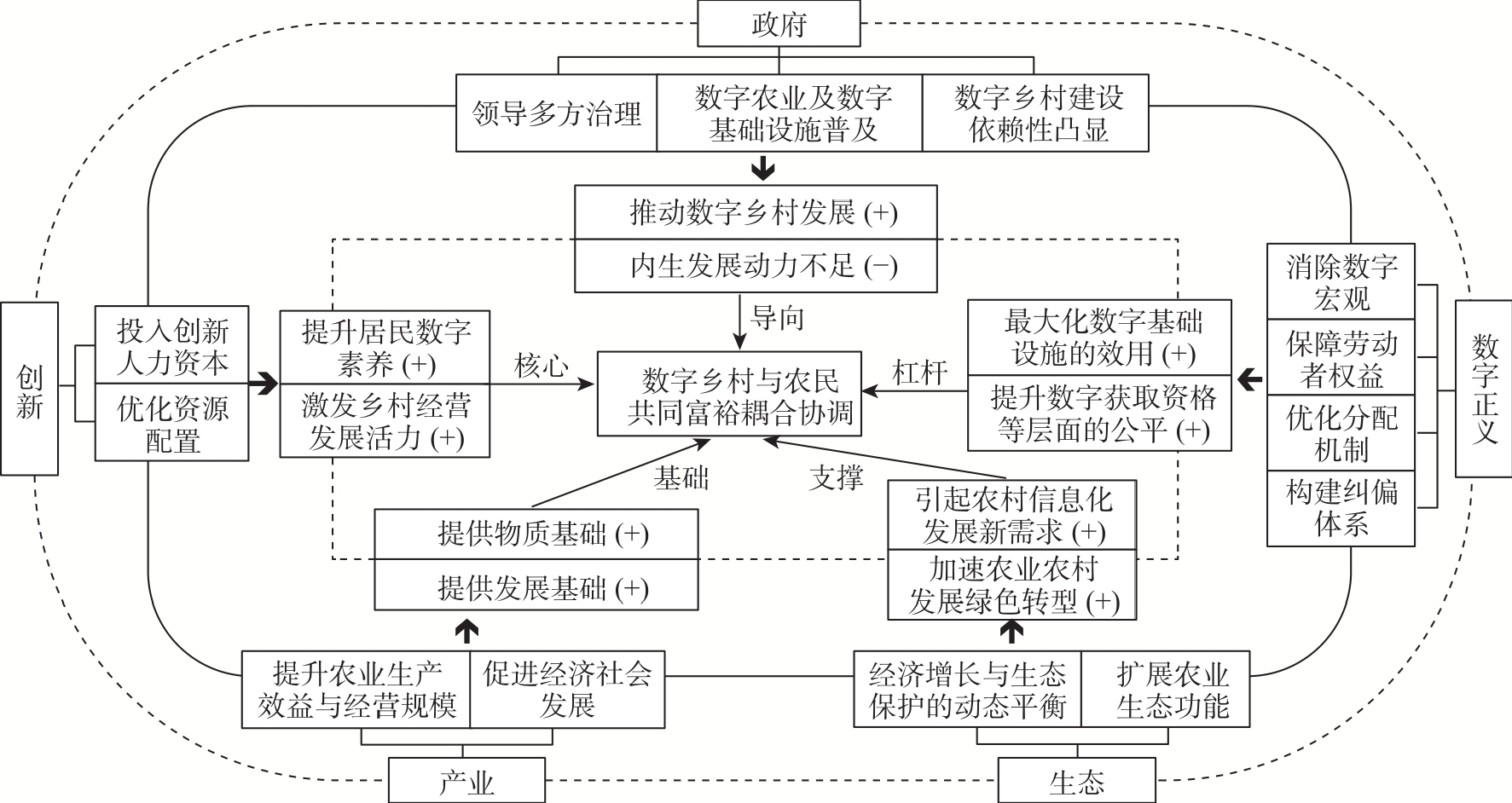
数字乡村建设与农民共同富裕的耦合协调发展是推动经济社会高质量发展的重要路径。然而,现有研究对二者耦合发展特征关注不足,其内在驱动机制尚未得到系统揭示。基于2011—2023年中国省域面板数据,综合运用纵横向拉开档次法、改进后的耦合协调度模型与地理探测器等方法分析中国数字乡村建设与农民共同富裕耦合协调的时空演变特征及驱动机制。结果表明:(1) 中国数字乡村建设与农民共同富裕的耦合协调度逐步提升,呈现“东高-西低”的梯度特征,全国总体与中西部地区存在极化现象。(2) 各省域发展呈现“跨界跳跃型”“低中水平递进型”“中高水平递进型”“单步进阶型”4种类型,“低中水平递进型”为主要发展类型,高耦合协调发展水平地区表现出明显的空间溢出效应。(3) 创新、数字正义、生态、产业与政府构成数字乡村建设与农民共同富裕耦合协调发展的5维动力机制,分别扮演着“核心”“杠杆”“支撑”“基础”“导向”的角色。基于上述结论,应当通过优化区域协调发展机制、强化空间协同效应、加强创新引领作用等方面推动二者耦合协调发展。
苏飞, 陈秀碧, 吴宝锐. 数字乡村建设与农民共同富裕耦合协调的时空演进及驱动机制[J]. 干旱区地理, 2026, 49(10): 2030-2041.
SU Fei, CHEN Xiubi, WU Baorui. Spatiotemporal evolution and driving mechanism of the coupling and coordination between digital rural construction and farmers’ common prosperity[J]. Arid Land Geography, 2026, 49(10): 2030-2041.
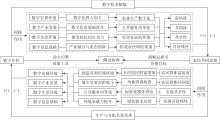
图1
数字乡村建设与农民共同富裕耦合协调机制 注:“+”代表正向作用;“-”代表负向作用。下同。"
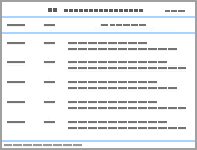
表1
数字乡村建设水平评价指标体系"
| 维度指标 | 准则指标 | 测度指标 | 方向 | 指标权重 |
|---|---|---|---|---|
| 数字宏观环境 | 数字化农业人才 | 每千人农业技术人员/人·(104人)-1 | + | 0.085 |
| 数字化建设投入 | 人均信息传输、软件和信息技术服务业固定资产投资额/104元·人-1 | + | 0.041 | |
| 农村用电情况 | 农村人均用电量/104 kWh·人-1 | + | 0.013 | |
| 数字信息基础 | 农村互联网普及率 | 农村宽带接入用户数占农村总户数的比重/% | + | 0.055 |
| 广播电视普及率 | 农村有线广播电视用户数占农村家庭总户数的比重/% | + | 0.065 | |
| 农村移动电话普及率 | 农村居民家庭平均每百户移动电话拥有量/部·(102户)-1 | + | 0.129 | |
| 农村计算机普及率 | 农村居民家庭平均每百户计算机拥有量/台·(102户)-1 | + | 0.077 | |
| 数字生活环境 | 农村物联网应用 | 农村投递路线密度(农村投递线路/行政区面积)/km·(104km2)-1 | + | 0.036 |
| 农业气象观测服务水平 | 农业气象观测站密度(农业气象观测站/行政区面积)/个·(104km2)-1 | + | 0.078 | |
| 农村数字服务消费水平 | 农村人均交通和通讯支出/元·人-1 | + | 0.073 | |
| 邮政通信服务水平 | 农村每周平均投递次数/次 | + | 0.075 | |
| 数字产业发展 | 农村企业数字化水平 | 国家现代农业示范区和产业园数量、国家农村产业融合发展示范园数量及农业产业化国家重点龙头企业数/个 | + | 0.072 |
| 农业农村数字基地 | 行政村中淘宝村占比/% | + | 0.012 | |
| 农村网络支付水平 | 农村数字普惠金融指数 | + | 0.172 | |
| 农村数字交易水平 | 人均电商销售额和采购额/104元·人-1 | + | 0.018 |
表2
农民共同富裕水平评价指标体系"
| 维度指标 | 准则指标 | 测度指标 | 方向 | 指标权重 |
|---|---|---|---|---|
| 农民群体富裕度 | 农民收入水平 | 农村居民人均可支配收入/元·人-1 | + | 0.051 |
| 农民消费水平 | 农村居民人均消费支出/元·人-1 | + | 0.056 | |
| 农民消费结构 | 农村居民家庭恩格尔系数/% | - | 0.055 | |
| 农民财产性收入水平 | 农村居民人均财产性收入/元·人-1 | + | 0.020 | |
| 农民群体共同度 | 农民生活最低保障 | 农村最低生活保障/元·(人·a)-1 | + | 0.044 |
| 城乡收入差距 | 城乡收入倍差 | - | 0.053 | |
| 农民收入差距 | 农村基尼系数 | - | 0.081 | |
| 农民市民化 | 城镇化率/% | + | 0.084 | |
| 发展共享性 | 农民受教育水平 | 农村平均受教育年限/a | + | 0.061 |
| 农村医疗水平 | 人均农村医疗床位数/张 | + | 0.058 | |
| 农村社会保障 | 农村人均转移性收入/元·人-1 | + | 0.038 | |
| 农村基础设施 | 集中供水行政村比例/% | + | 0.104 | |
| 农村精神文化 | 农村人均文化娱乐消费/元·人-1 | + | 0.068 | |
| 发展可持续性 | 农村生态环境 | 农业碳排放强度/t·(104元)-1 | - | 0.052 |
| 农村产业发展 | 农业全要素生产率 | + | 0.043 | |
| 农村产业收入 | 农林牧渔业职工平均工资/元·人-1 | + | 0.071 | |
| 财政支农 | 人均农林水财政支出/104元·人-1 | + | 0.036 | |
| 金融发展 | 人均涉农贷款余额/元·人-1 | + | 0.027 |
表3
耦合协调度的分类标准"
| 耦合协调度(D) | 耦合协调发展水平 |
|---|---|
| (0.0, 0.5] | 濒临失调 |
| (0.5, 0.6] | 初级协调 |
| (0.6, 0.7] | 中级协调 |
| (0.7, 1.0] | 高级协调 |
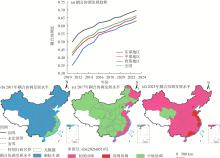
图2
2011—2023年省域耦合协调发展水平"
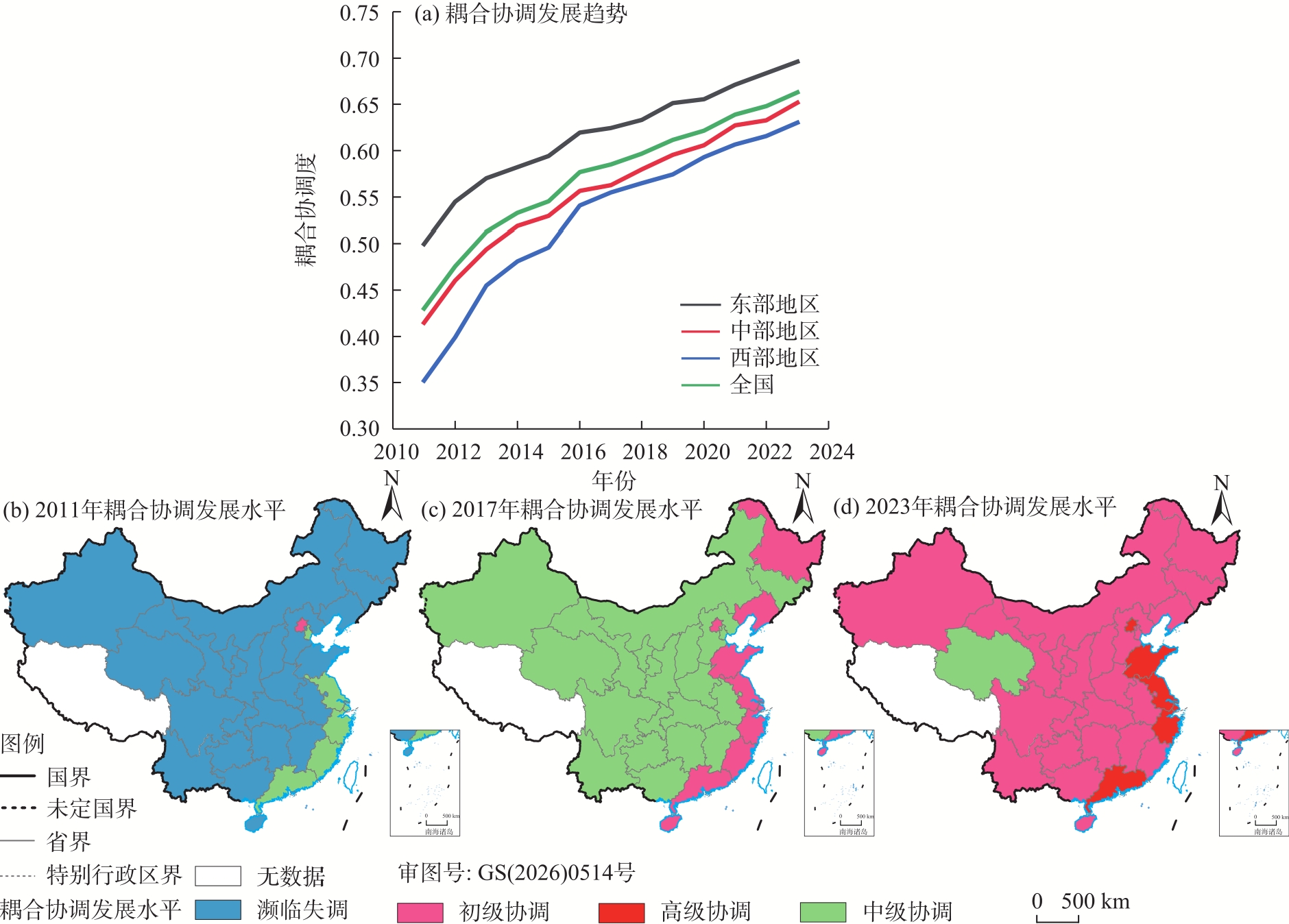
图3
2011—2023年全国及各地区耦合协调度的三维核密度分析图"
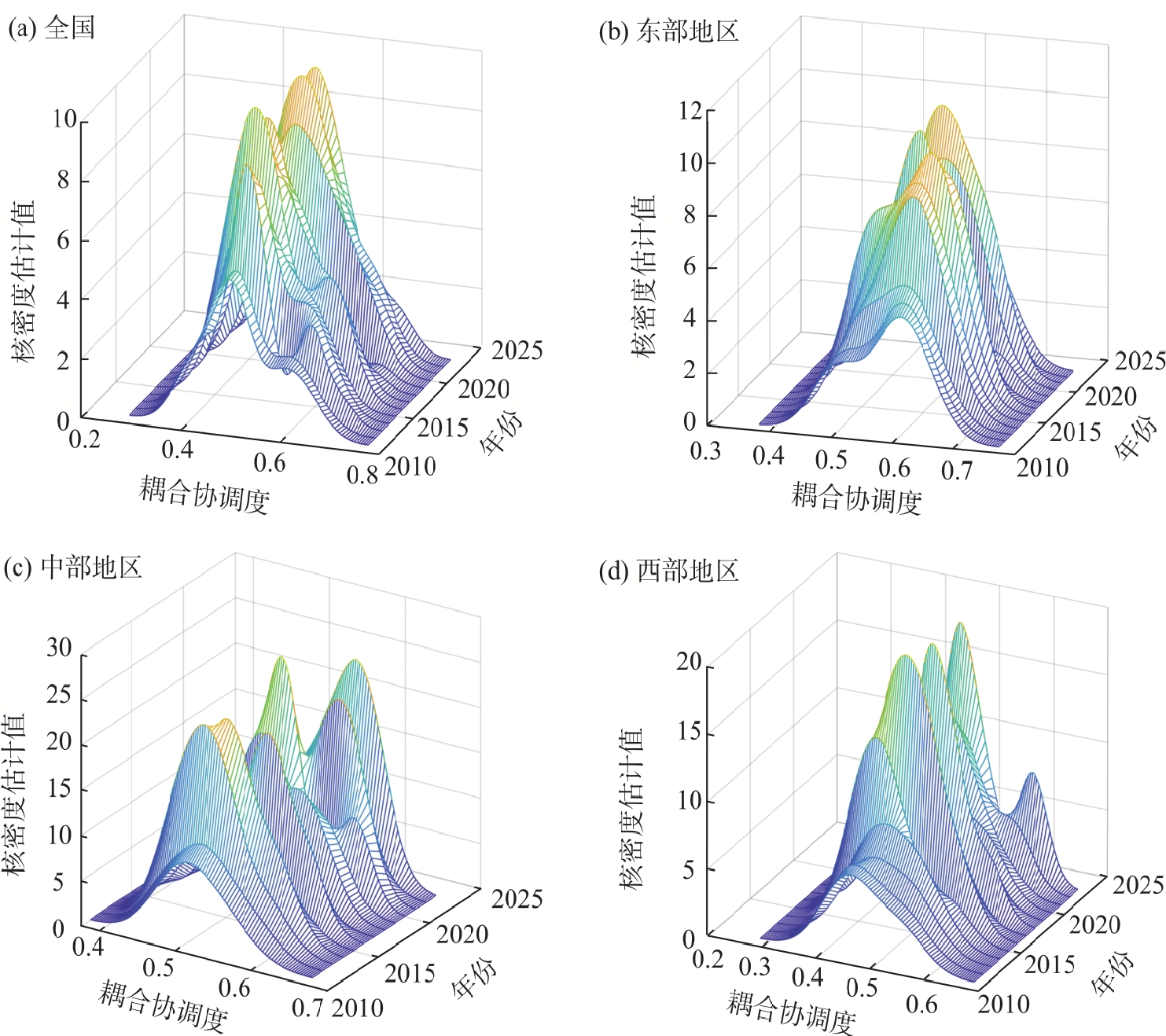
表4
耦合协调度驱动因子指标体系"
| 变量 | 变量名称 | 变量说明 |
|---|---|---|
| 被解释变量 | 耦合协调度 | 数字乡村建设与农民共同富裕耦合协调度计算结果 |
| 解释变量 | 产业驱动 | 第二、三产业增加值/GDP |
| 政府驱动 | 公共财政预算农林水事务支出/GDP | |
| 创新驱动 | 人均R&D人员全时当量/对应地区人口数 | |
| 生态驱动 | 能源消费总量/GDP | |
| 数字正义驱动 | 数字金融使用深度 |
表5
耦合协调度驱动因子解释力(q值)"
| 驱动因子 | 2011年 | 2017年 | 2023年 |
|---|---|---|---|
| 产业驱动 | 0.547** | 0.443* | 0.462* |
| 政府驱动 | 0.467** | 0.565* | 0.501* |
| 创新驱动 | 0.843*** | 0.843*** | 0.513** |
| 生态驱动 | 0.520*** | 0.586* | 0.520*** |
| 数字正义驱动 | 0.688* | 0.688* | 0.567** |
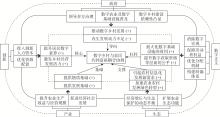
图4
数字乡村与农民共同富裕耦合协调发展的驱动机制"
| [1] |
Nerini F F, Mazzucato M, Rockström J, et al. Extending the sustainable development goals to 2050: A road map[J]. Nature, 2024, 630: 555-558.
doi: 10.1038/d41586-024-01754-6 |
| [2] |
Arion F H, Harutyunyan G, Aleksanyan V, et al. Determining digitalization issues (ICT adoption, digital literacy, and the digital divide) in rural areas by using sample surveys: The case of Armenia[J]. Agriculture, 2024, 14(2): 249-355.
doi: 10.3390/agriculture14020249 |
| [3] | Lythreatis S, Singh S K, El-Kassar A N. The digital divide: A review and future research agenda[J]. Technological Forecasting and Social Change, 2022, 175: 121359, doi: 10.1016/j.techfore.2021.121359. |
| [4] |
Heeks R. Digital inequality beyond the digital divide: Conceptualizing adverse digital incorporation in the global south[J]. Information Technology for Development, 2022, 28(4): 688-704.
doi: 10.1080/02681102.2022.2068492 |
| [5] | Bai C Y, Guan W, Wang D W, et al. Digital village construction and the quality of life of rural residents[J]. International Review of Economics & Finance, 2024, 96 (Part C): 103729, doi: 10.1016/j.iref.2024.103729. |
| [6] | 李丽莉, 曾亿武, 郭红东. 数字乡村建设: 底层逻辑、实践误区与优化路径[J]. 中国农村经济, 2023(1): 77-92. |
| [Li Lili, Zeng Yiwu, Guo Hongdong. Digital countryside construction: Underlying logic, practical errors and optimization path[J]. Chinese Rural Economy, 2023(1): 77-92. ] | |
| [7] | 汤临佳, 张婕雯, 蒋子燕. 数字乡村与乡村共同富裕--数字孪生的调节作用[J]. 科研管理, 2025, 46(5): 182-192. |
| [Tang Linjia, Zhang Jiewen, Jiang Ziyan. Digital villages and rural common prosperity: The moderating effect of digital twin[J]. Science Research Management, 2025, 46(5): 182-192. ] | |
| [8] |
谭燕芝, 王超, 陈铭仕, 等. 中国农民共同富裕水平测度及时空分异演变[J]. 经济地理, 2022, 42(8): 11-21.
doi: 10.15957/j.cnki.jjdl.2022.08.002 |
|
[Tan Yanzhi, Wang Chao, Chen Mingshi, et al. Measurement and spatio-temporal differentiation of common prosperity level of Chinese farmers[J]. Economic Geography, 2022, 42(8): 11-21. ]
doi: 10.15957/j.cnki.jjdl.2022.08.002 |
|
| [9] | 马少春, 朱杰, 王军. 共同富裕视域下数字乡村建设的农民增收与分配效应[J]. 经济问题探索, 2025, 46(1): 109-127. |
| [Ma Shaochun, Zhu Jie, Wang Jun. The effect of digital village construction on farmers’ income growth and distribution under the perspective of common prosperity[J]. Inquiry into Economic Issues, 2025, 46(1): 109-127. ] | |
| [10] | 王凤婷, 王浩, 孔凡斌. 农村数字化发展对农业全要素碳生产率的提升效应[J]. 中国人口·资源与环境, 2024, 34(3): 79-90. |
| [Wang Fengting, Wang Hao, Kong Fanbin. Enhancement effect of rural digital development on agricultural total factor carbon productivity[J]. China Population, Resources and Environment, 2024, 34(3): 79-90. ] | |
| [11] | 李丽莉, 邱亚娟, 曾亿武. 数字乡村建设: 国内研究动态与展望[J]. 农业经济问题, 2025(1): 44-57. |
| [Li Lili, Qiu Yajuan, Zeng Yiwu. Digital countryside construction: Domestic research trends and prospects[J]. Issues in Agricultural Economy, 2025(1): 44-57. ] | |
| [12] |
刘艺欣, 裴婷婷, 陈英, 等. 基于县域尺度的甘肃省乡村振兴发展水平测度及时空分异[J]. 干旱区地理, 2025, 48(9): 1683-1689.
doi: 10.12118/j.issn.1000-6060.2024.545 |
|
[Liu Yixin, Pei Tingting, Chen Ying, et al. Measurement and spatial-temporal differentiation of rural revitalization development level in Gansu Province based on county scale[J]. Arid Land Geography, 2025, 48(9): 1683-1689. ]
doi: 10.12118/j.issn.1000-6060.2024.545 |
|
| [13] | 张世贵, 吴合庆. 数字乡村建设何以推进共同富裕--基于“赋能-调适”的分析框架[J]. 中国行政管理, 2024, 40(2): 103-111. |
| [Zhang Shigui, Wu Heqing. How to promote common prosperity in digital rural construction: The analysis framework based on “empowerment-adaptation”[J]. Chinese Public Administration, 2024, 40(2): 103-111. ] | |
| [14] | 孙迎联, 贾海刚. 数字乡村建设助推农民农村共同富裕的价值逻辑、现实图景与优化路径[J]. 农村经济, 2024(11): 1-10. |
| [Sun Yinglian, Jia Haigang. The value logic, realistic picture and optimization path of digital rural construction in promoting the common wealth of farmers and rural areas[J]. Rural Economy, 2024(11): 1-10. ] | |
| [15] | 陈桂生, 史珍妮. 面向共同富裕的数字乡村建设: 基于“做大蛋糕”与“分好蛋糕”的分析[J]. 行政管理改革, 2022(7): 25-34. |
| [Chen Guisheng, Shi Zhenni. Digital rural construction for common prosperity: An analysis based on making a bigger and sharable “cake”[J]. Administration Reform, 2022(7): 25-34. ] | |
| [16] |
苏飞, 吴宝锐, 张平宇, 等. 数字乡村建设与乡村经济韧性耦合协调的时空演进及驱动机制[J]. 地理科学进展, 2025, 44(7): 1434-1451.
doi: 10.18306/dlkxjz.2025.07.009 |
|
[Su Fei, Wu Baorui, Zhang Pingyu, et al. Spatial and temporal coupling relationship of digital village construction and rural economic resilience in China and mechanism of influence[J]. Progress in Geography, 2025, 44(7): 1434-1451. ]
doi: 10.18306/dlkxjz.2025.07.009 |
|
| [17] | 朱红根, 周柏樊. 数字乡村建设与农业绿色发展: 理论与实证[J]. 世界农业, 2025(3): 42-54. |
| [Zhu Honggen, Zhou Baifan. Digital rural construction and green agricultural development: Theory and empirical research[J]. World Agriculture, 2025(3): 42-54. ] | |
| [18] | 陈丽君, 郁建兴, 徐铱娜. 共同富裕指数模型的构建[J]. 治理研究, 2021, 37(4): 5-16, 2. |
| [Chen Lijun, Yu Jianxing, Xu Yina. Construction of the common prosperity index model[J]. Governance Studies, 2021, 37(4): 5-16, 2. ] | |
| [19] | 申云, 尹业兴, 钟鑫. 共同富裕视域下我国农村居民生活质量测度及其时空演变[J]. 西南民族大学学报(人文社会科学版), 2022, 43(2): 103-114. |
| [Shen Yun, Yin Yexing, Zhong Xin. The measurement of the quality of life of rural residents in China and its temporal and spatial evolution from the perspective of common prosperity[J]. Journal of Southwest Minzu University (Humanities and Social Sciences Edition), 2022, 43(2): 103-114. ] | |
| [20] | 田云, 尹忞昊. 中国农业碳排放再测算: 基本现状、动态演进及空间溢出效应[J]. 中国农村经济, 2022(3): 104-127. |
| [Tian Yun, Yin Minhao. Re-evaluation of China’s agricultural carbon emissions: Basic status, dynamic evolution and spatial spillover effects[J]. Chinese Rural Economy, 2022(3): 104-127. ] | |
| [21] | 李雪松. 中国农业生产效率变动的驱动因素研究[J]. 重庆大学学报(社会科学版), 2015, 21(4): 37-46. |
| [Li Xuesong. A study of the driving factors of agricultural production efficiency in China[J]. Journal of Chongqing University (Social Science Edition), 2015, 21(4): 37-46. ] | |
| [22] | 郭亚军. 一种新的动态综合评价方法[J]. 管理科学学报, 2002(2): 49-54. |
| [Guo Yajun. A new dynamic comprehensive evaluation method[J]. Journal of Management Sciences in China, 2002(2): 49-54. ] | |
| [23] |
王淑佳, 孔伟, 任亮, 等. 国内耦合协调度模型的误区及修正[J]. 自然资源学报, 2021, 36(3): 793-810.
doi: 10.31497/zrzyxb.20210319 |
|
[Wang Shujia, Kong Wei, Ren Liang, et al. Research on misuses and modification of coupling coordination degree model in China[J]. Journal of Natural Resources, 2021, 36(3): 793-810. ]
doi: 10.31497/zrzyxb.20210319 |
|
| [24] | Yu T H, Zhang Y, Jia S S, et al. Spatio-temporal evolution and drivers of coupling coordination between digital infrastructure and inclusive green growth: Evidence from the Yangtze River Economic Belt[J]. Journal of Environmental Management, 2025, 376: 124416, doi: 10.1016/j.jenvman.2025.124416. |
| [25] | Zhang Q F, Li J F, Li Y, et al. Coupling analysis and driving factors between carbon emission intensity and high-quality economic development: Evidence from the Yellow River Basin, China[J]. Journal of Cleaner Production, 2023, 423: 138831, doi: 10.1016/j.jclepro.2023.138831. |
| [26] | 田祥宇. 乡村振兴驱动共同富裕: 逻辑、特征与政策保障[J]. 山西财经大学学报, 2023, 45(1): 1-12. |
| [Tian Xiangyu. Rural revitalization drives common prosperity: Logic, characteristics and policy guarantee[J]. Journal of Shanxi University of Finance and Economics, 2023, 45(1): 1-12. ] | |
| [27] |
杨巨星, 孙慧, 周晋楠, 等. 中国资源型城市转型脱碳时空演进及路径选择[J]. 干旱区地理, 2026, 49(1): 151-163.
doi: 10.12118/j.issn.1000-6060.2024.743 |
|
[Yang Juxing, Sun Hui, Zhou Jinnan, et al. Spatio-temporal evolution and pathway selection of transformation decarbonization in China’s resource-based cities[J]. Arid Land Geography, 2026, 49(1): 151-163. ]
doi: 10.12118/j.issn.1000-6060.2024.743 |
|
| [28] |
吉泽男, 付文婷, 王鹏程, 等. 干旱区数字经济与农业绿色发展耦合协调研究--以新疆为例[J]. 干旱区地理, 2024, 47(11): 1981-1990.
doi: 10.12118/j.issn.1000-6060.2023.637 |
|
[Ji Zenan, Fu Wenting, Wang Pengcheng, et al. Coupling and coordination of digital economy and green development of agriculture in arid zones: A case of Xinjiang[J]. Arid Land Geography, 2024, 47(11): 1981-1990. ]
doi: 10.12118/j.issn.1000-6060.2023.637 |
|
| [29] | 靳文辉. 数字金融公平价值的实现路径研究[J]. 中国法学, 2023(4): 69-86. |
| [Jin Wenhui. Research on the realization path of the fair value of digital finance[J]. Chinese Legal Science, 2023(4): 69-86. ] | |
| [30] | 郭峰, 王靖一, 王芳, 等. 测度中国数字普惠金融发展: 指数编制与空间特征[J]. 经济学(季刊), 2020, 19(4): 1401-1418. |
| [Guo Feng, Wang Jingyi, Wang Fang, et al. Measuring China’s digital financial inclusion: Index compilation and spatial characteristics[J]. China Economic Quarterly, 2020, 19(4): 1401-1418. ] | |
| [31] | 沈费伟, 崔钰. 从“政府主导”到“村庄经营”: 实现数字乡村高质量发展的策略选择[J]. 电子政务, 2024(2): 100-112. |
| [Shen Feiwei, Cui Yu. From “government-led” to “village operation”: Strategic choices for achieving high-quality development of digital rural areas[J]. E-Government, 2024(2): 100-112. ] | |
| [32] |
杨玉欢, 贺建雄, 张新红, 等. 中国农文旅耦合协调发展空间分异特征及影响肌理[J]. 干旱区地理, 2023, 46(3): 448-459.
doi: 10.12118/j.issn.1000-6060.2022.295 |
|
[Yang Yuhuan, He Jianxiong, Zhang Xinhong, et al. Spatial differentiation characteristics and influencing texture of the coordinated development of the coupling coordinated development of agro-culture-tourism in China[J]. Arid Land Geography, 2023, 46(3): 448-459. ]
doi: 10.12118/j.issn.1000-6060.2022.295 |
|
| [33] | 张磊, 王越, 陈华帅, 等. 数字乡村建设、产业振兴与农户收入提升[J]. 财经研究, 2025, 51(5): 19-33. |
| [Zhang Lei, Wang Yue, Chen Huashuai, et al. Digital village construction, industrial revitalization, and rural households’ income enhancement[J]. Journal of Finance and Economics, 2025, 51(5): 19-33. ] | |
| [34] | 李刚, 王雨菲, 颜廷武. 数字化转型促进了乡村创新创业吗--基于“国家数字乡村试点”政策的准自然实验[J]. 经济学家, 2024(12): 114-124. |
| [Li Gang, Wang Yufei, Yan Tingwu. Does digital transformation promote rural innovation and entrepreneurship: A quasi-natural experiment based on the “National Digital Rural Pilot” policy[J]. Economist, 2024(12): 114-124. ] | |
| [35] |
Yang J J, Pan W. The path of promoting rural ecological revitalization under the perspective of system concept[J]. Ecological Frontiers, 2024, 44(5): 950-957.
doi: 10.1016/j.ecofro.2024.04.009 |
| [36] |
任洪杰, 李辉尚. 中国乡村生态韧性时空演变特征及影响因素探究[J]. 干旱区地理, 2024, 47(11): 1915-1923.
doi: 10.12118/j.issn.1000-6060.2023.707 |
|
[Ren Hongjie, Li Huishang. Spatial and temporal evolution characteristics and influencing factors of rural ecological resilience in China[J]. Arid Land Geography, 2024, 47(11): 1915-1923. ]
doi: 10.12118/j.issn.1000-6060.2023.707 |
|
| [37] | 季连帅, 安娜. 数字治理的法治化展开: 核心命题与体系建构[J]. 学习与探索, 2023(5): 96-103. |
| [Ji Lianshuai, An Na. The legalization of digital governance: Core propositions and system construction[J]. Study & Exploration, 2023(5): 96-103. ] | |
| [38] | 张世青. 数字时代实现共同富裕的正义要求及社会政策优化[J]. 探索, 2024(4): 79-91. |
| [Zhang Shiqing. The justice requirement for the realization of common prosperity in the digital age and the optimization of social policy[J]. Probe, 2024(4): 79-91. ] |
| [1] | 樊瑞博, 李岚, 陈强强. 中国农村生态保护与农业经济韧性耦合协调及障碍因素[J]. 干旱区地理, 2026, 49(9): 1914-1923. |
| [2] | 郭金忠, 刘雅婕, 刘晓玲. 中国WEFE系统耦合协调演变及其约束机制——基于省域尺度与干旱半干旱区视角[J]. 干旱区地理, 2026, 49(9): 1924-1939. |
| [3] | 张毓利, 刘巧妹, 王思媛, 樊馨雨, 徐彤, 王彬彬. 中国式现代化与旅游高质量发展耦合协调的时空特征与动力机制研究[J]. 干旱区地理, 2026, 49(9): 1965-1976. |
| [4] | 杨晴, 张金茹, 郝嘉怡, 邹绍辉, 张磊. 数字经济如何提升全要素碳效率——基于市场扭曲视角研究[J]. 干旱区地理, 2026, 49(9): 1977-1994. |
| [5] | 聂承静, 李雅迪, 刘方田, 韩芳, 高星. 长城沿线生境质量与城镇化时空耦合协调及驱动因子研究[J]. 干旱区地理, 2026, 49(8): 1587-1600. |
| [6] | 仝雁军, 袁露, 雷军. 边疆安全背景下新疆边境人口-社会经济-资源环境耦合协调关系研究[J]. 干旱区地理, 2026, 49(8): 1626-1639. |
| [7] | 路知秋, 律名扬, 李智慧, 徐丽萍. “人-地-业”视角下新疆城乡融合发展的多维评价与时空演化[J]. 干旱区地理, 2026, 49(8): 1750-1763. |
| [8] | 宁雅萱, 尹豪, 李金诺. 中国北方农牧交错带中段新型城镇化与农业生态系统服务耦合分析[J]. 干旱区地理, 2026, 49(7): 1457-1469. |
| [9] | 李文君, 张维梅. 中国数字经济与共同富裕的耦合协调关系及时空演进趋势[J]. 干旱区地理, 2026, 49(7): 1481-1492. |
| [10] | 高莹, 周可丽, 元媛, 史薪茹, 吴佳霖. 黄河流域旅游经济与居民福祉耦合协调时空演变及驱动机制研究[J]. 干旱区地理, 2026, 49(7): 1493-1508. |
| [11] | 吕宛青, 宋志高, 肖钊富. 中国新型城镇化与旅游业高质量发展耦合协调、障碍诊断及驱动因素[J]. 干旱区地理, 2026, 49(5): 1063-1073. |
| [12] | 杨蓉欣, 原野, 袁媛, 杨雨青, 武艺超. 陕北黄土高原生态系统服务与人类福祉关系的尺度依赖性——基于生态恢复与社会发展双重驱动[J]. 干旱区地理, 2026, 49(5): 949-962. |
| [13] | 王伟军, 李娟, 李花. 黄河流域旅游-生态-福祉耦合协调的多尺度时空演化及分异机理[J]. 干旱区地理, 2026, 49(4): 683-696. |
| [14] | 王慧丽, 李妞, 刘英, 刘咏涵. 黄河流域水资源-生态韧性动态耦合与级层障碍解析[J]. 干旱区地理, 2026, 49(3): 569-580. |
| [15] | 高俊杰, 仲俊涛, 马勇洁, 陈颖慧. 青海湖国家公园农户现代化与生计稳定性耦合协调研究[J]. 干旱区地理, 2026, 49(3): 631-642. |
|
||