干旱区地理 ›› 2026, Vol. 49 ›› Issue (9): 1924-1939.doi: 10.12118/j.issn.1000-6060.2026.001 cstr: 32274.14.ALG2026001
郭金忠( ), 刘雅婕, 刘晓玲
收稿日期:2026-01-04
修回日期:2026-02-20
出版日期:2026-09-25
发布日期:2026-09-07
作者简介:郭金忠(1985-),男,博士,教授,主要从事区域地理与经济研究. E-mail: guojz@xjufe.edu.cn
基金资助:
GUO Jinzhong(), LIU Yajie, LIU Xiaoling
Received:2026-01-04
Revised:2026-02-20
Published:2026-09-25
Online:2026-09-07
摘要:
水资源-能源-粮食-生态(WEFE)系统的协同发展已成为区域可持续发展的关键议题,尤其在干旱半干旱区,系统协调性对资源安全与生态安全至关重要。基于2006—2022年中国30个省(自治区、直辖市)(除西藏自治区和港澳台地区以外)的面板数据,在省域尺度上构建了WEFE系统综合评价指标体系,采用熵权法、耦合协调度模型、空间自相关分析与灰色关联度模型等方法,系统刻画了中国WEFE系统协调发展的时空演变特征与空间关联格局,并重点剖析了干旱半干旱区在省域层面上的差异化表现及其主导约束机制。结果表明:(1) 在省域层面,中国WEFE系统综合发展水平稳步提升,但子系统发展不均衡,水资源子系统长期滞后,在干旱半干旱区表现出显著的刚性约束特征。(2) 中国WEFE系统耦合协调度整体由濒临失调衰退类向勉强协调发展类演进,空间上呈现东部领先、中部稳健、西部追赶的梯度格局,区域差距逐步缩小。干旱半干旱区实现了从全国低值集聚区向局部高值增长极的转变。(3) 从空间关联看,中国WEFE系统耦合协调度具有稳定的空间正相关性,高-高集聚与低-低集聚并存。(4) 从约束机制看,全国层面,粮食安全是支撑WEFE系统协调发展的基础。具体到子系统的制约因素,干旱半干旱区主要受用水效率和能源利用效率的制约,而湿润半湿润区则更多受生产效率和生态质量的限制。
郭金忠, 刘雅婕, 刘晓玲. 中国WEFE系统耦合协调演变及其约束机制——基于省域尺度与干旱半干旱区视角[J]. 干旱区地理, 2026, 49(9): 1924-1939.
GUO Jinzhong, LIU Yajie, LIU Xiaoling. Coupling coordination evolution and constraint mechanisms of the WEFE system in China: Based on the provincial scale and the perspective of arid and semi-arid regions[J]. Arid Land Geography, 2026, 49(9): 1924-1939.
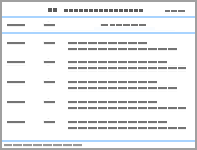
表1
水资源-能源-粮食-生态(WEFE)系统综合评价指标体系"
| 子系统层 | 准则层 | 评价指标 | 单位 | 熵权法比重 | 性质 |
|---|---|---|---|---|---|
| 水资源子系统 | 总量指标 | 人均水资源总量(W1) | m3·人-1 | 0.2500 | 正 |
| 人均用水量(W2) | m3·人-1 | 0.0130 | 负 | ||
| 产水模数(W3) | m3·km-2 | 0.3043 | 正 | ||
| 结构指标 | 农业用水量占比(W4) | % | 0.0631 | 负 | |
| 工业用水量占比(W5) | % | 0.0243 | 负 | ||
| 生活用水量占比(W6) | % | 0.0198 | 负 | ||
| 生态用水量占比(W7) | % | 0.3100 | 正 | ||
| 效益指标 | 万元GDP用水量(W8) | m3·(104元)-1 | 0.0047 | 负 | |
| 万元工业增加值用水量(W9) | m3·(104元)-1 | 0.0110 | 负 | ||
| 能源子系统 | 总量指标 | 一次性能源生产总量(E1) | 104 tce | 0.3679 | 正 |
| 发电量(E2) | 108 kWh | 0.1517 | 正 | ||
| 人均能源生产量(E3) | tce·人-1 | 0.4356 | 正 | ||
| 能源消耗总量(E4) | 104 tce | 0.0225 | 负 | ||
| 效益指标 | 万元GDP能耗(E5) | tce·(104元)-1 | 0.0120 | 负 | |
| 万元GDP电耗(E6) | kWh·(104元)-1 | 0.0103 | 负 | ||
| 粮食子系统 | 总量指标 | 人均粮食产量(F1) | kg·人-1 | 0.1552 | 正 |
| 粮食总产值(F2) | 104 t | 0.1875 | 正 | ||
| 农用机械总动力(F3) | 104 kWh | 0.1871 | 正 | ||
| 粮食播种面积(F4) | hm2 | 0.1413 | 正 | ||
| 效益指标 | 城镇居民家庭恩格尔系数(F5) | % | 0.0333 | 负 | |
| 农村居民家庭恩格尔系数(F6) | % | 0.0335 | 负 | ||
| 农产品生产价格指数(F7) | 点 | 0.0364 | 正 | ||
| 单位面积产量(F8) | kg·hm-2 | 0.0570 | 正 | ||
| 有效灌溉面积(F9) | 103 hm2 | 0.1687 | 正 | ||
| 生态子系统 | 生态基础 | 森林覆盖率(Ec1) | % | 0.1159 | 正 |
| 城市绿地面积(Ec2) | 104 hm2 | 0.2110 | 正 | ||
| 建成区绿化覆盖率(Ec3) | % | 0.0258 | 正 | ||
| 生态压力 | SO2排放量(Ec4) | 104 t | 0.0291 | 负 | |
| 农用化肥施用折纯量(Ec5) | 104 t | 0.0244 | 负 | ||
| 治理废水项目完成投资(Ec6) | 104元 | 0.2792 | 正 | ||
| 治理废气项目完成投资(Ec7) | 104元 | 0.2599 | 正 | ||
| 生态效率 | 生活垃圾无害化处理率(Ec8) | % | 0.0271 | 正 | |
| 城镇生活污水处理率(Ec9) | % | 0.0276 | 正 |
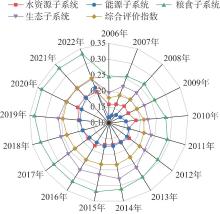
图1
2006—2022年中国水资源-能源-粮食-生态(WEFE)系统综合评价指数"
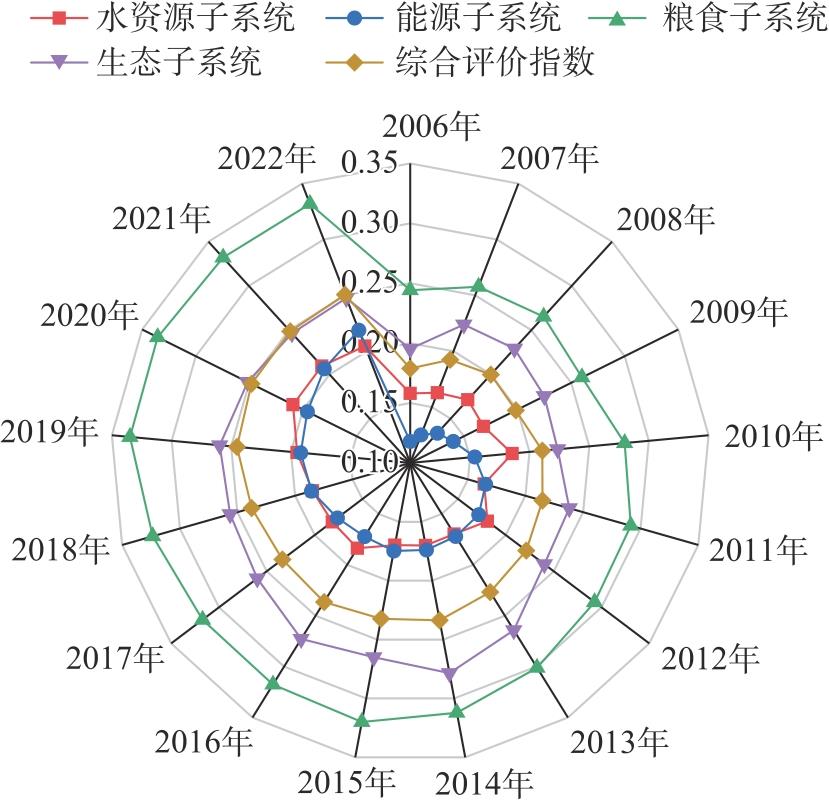
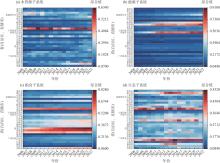
图2
2006—2022 年中国WEFE各系统综合值分布特征"
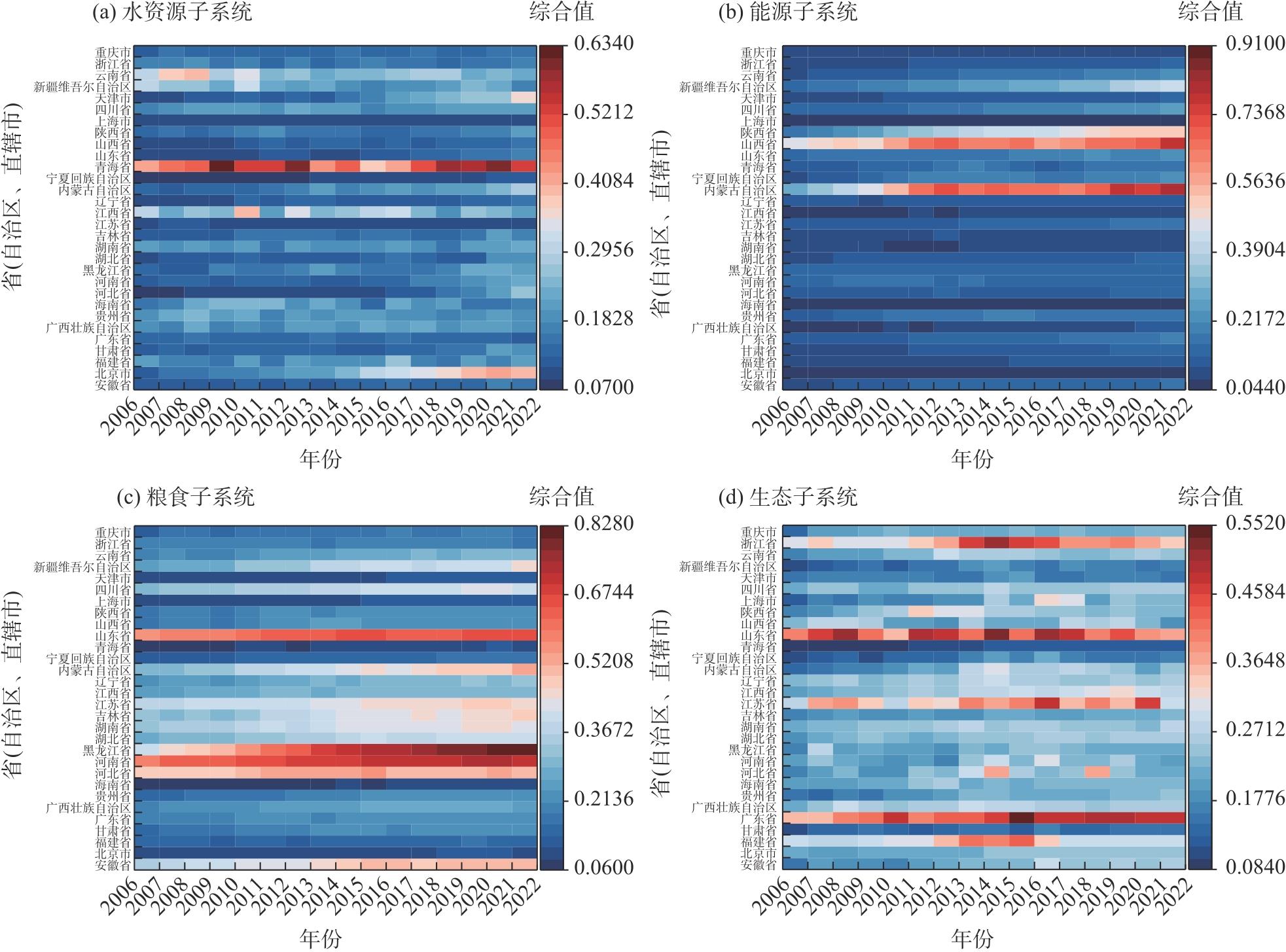
图3
2006—2022年中国WEFE系统耦合度"
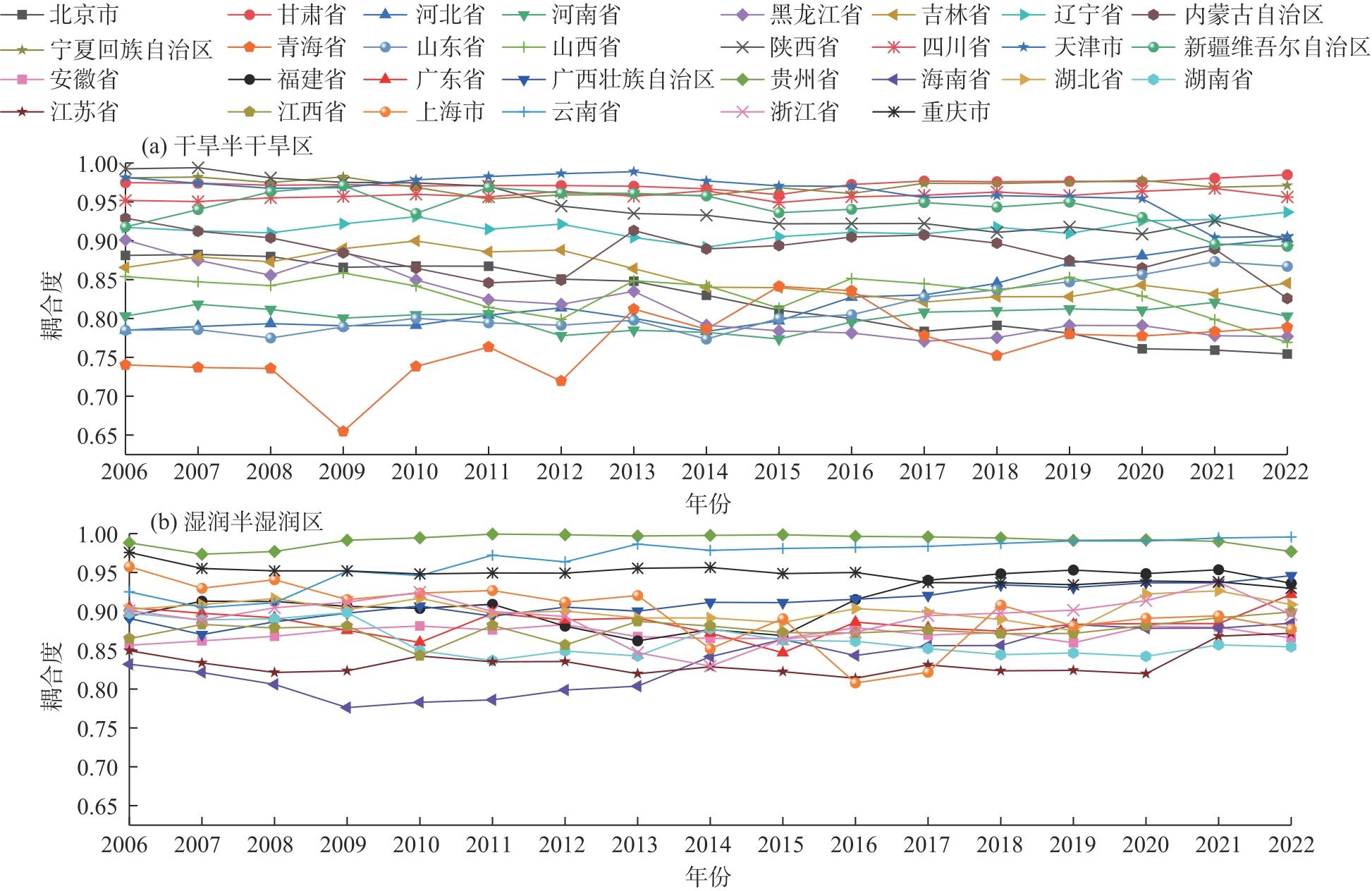
图4
2006—2022年中国WEFE系统耦合协调度"
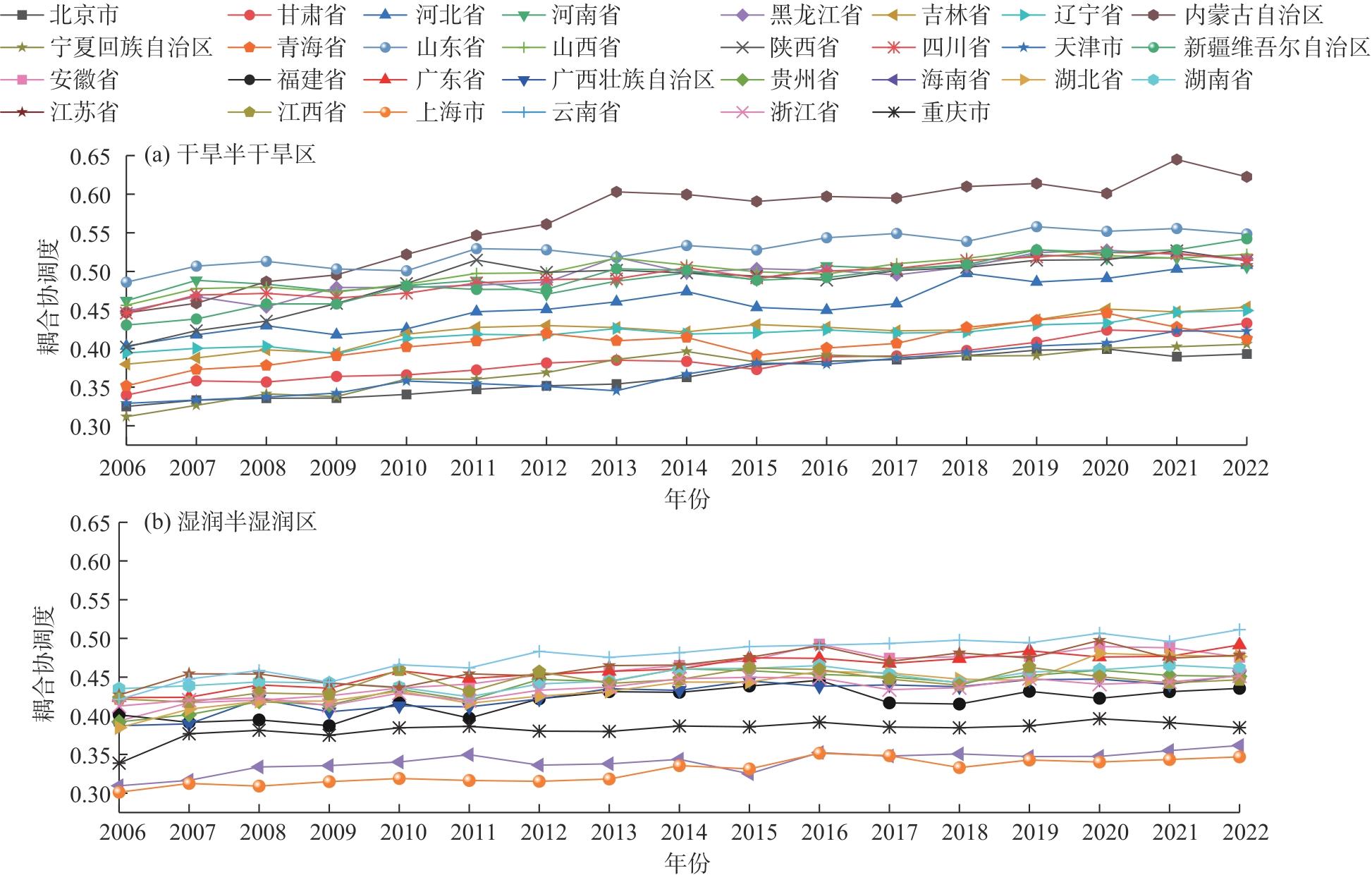
图5
2006—2022年中国WEFE系统耦合协调度空间格局分布"
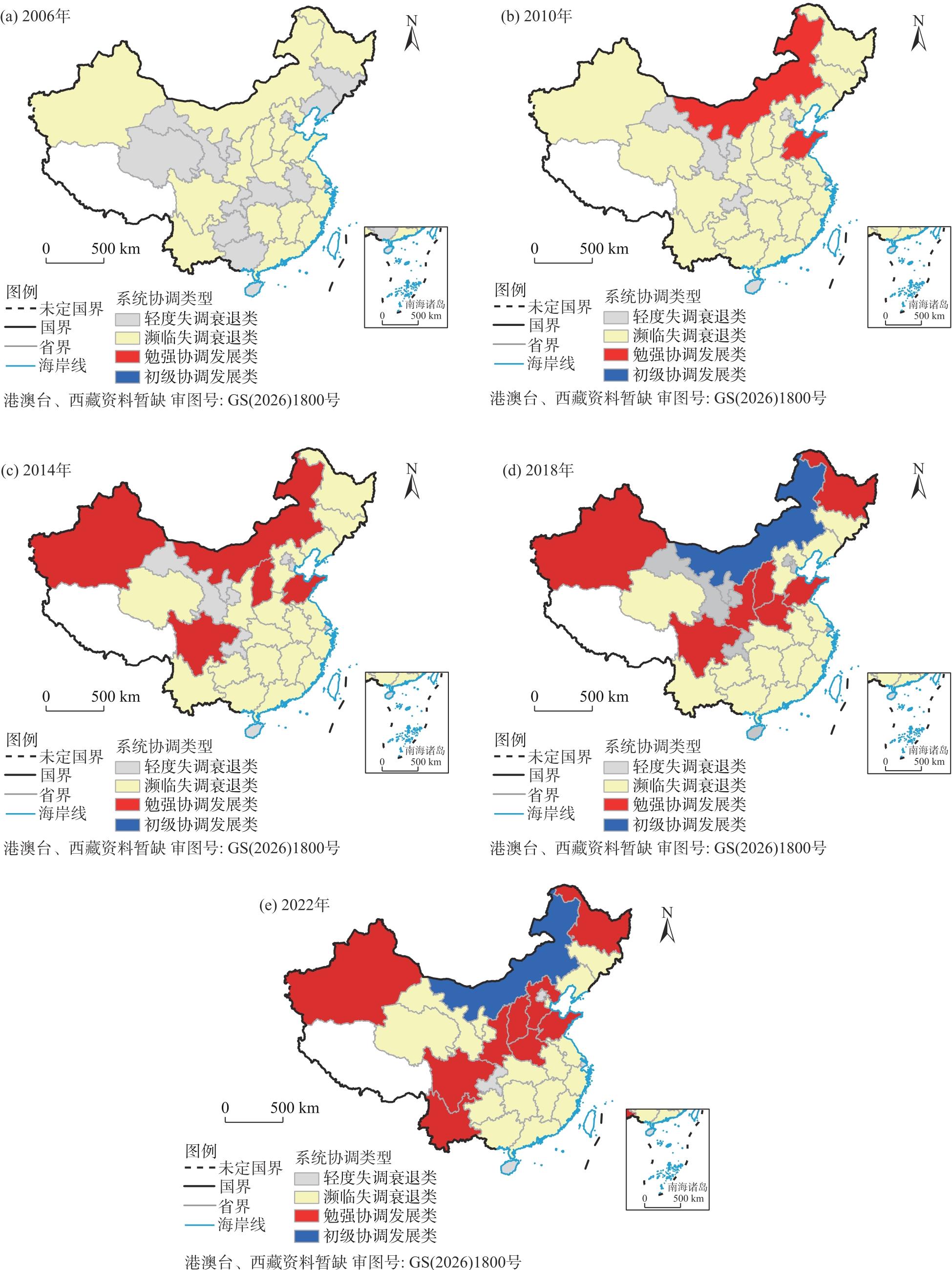
表2
2006—2022年中国 WEFE系统耦合协调度 全局莫兰指数"
| 年份 | 全局莫兰指数 | P | 年份 | 全局莫兰指数 | P |
|---|---|---|---|---|---|
| 2006 | 0.397 | 0.006 | 2015 | 0.331 | 0.015 |
| 2007 | 0.390 | 0.006 | 2016 | 0.338 | 0.013 |
| 2008 | 0.403 | 0.005 | 2017 | 0.333 | 0.014 |
| 2009 | 0.412 | 0.004 | 2018 | 0.306 | 0.021 |
| 2010 | 0.447 | 0.002 | 2019 | 0.352 | 0.011 |
| 2011 | 0.411 | 0.004 | 2020 | 0.327 | 0.016 |
| 2012 | 0.422 | 0.003 | 2021 | 0.319 | 0.016 |
| 2013 | 0.347 | 0.011 | 2022 | 0.293 | 0.025 |
| 2014 | 0.335 | 0.014 |
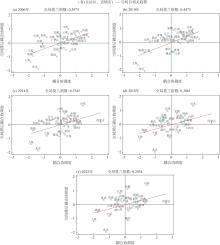
图6
2006—2022年中国WEFE系统耦合协调度的莫兰散点图"
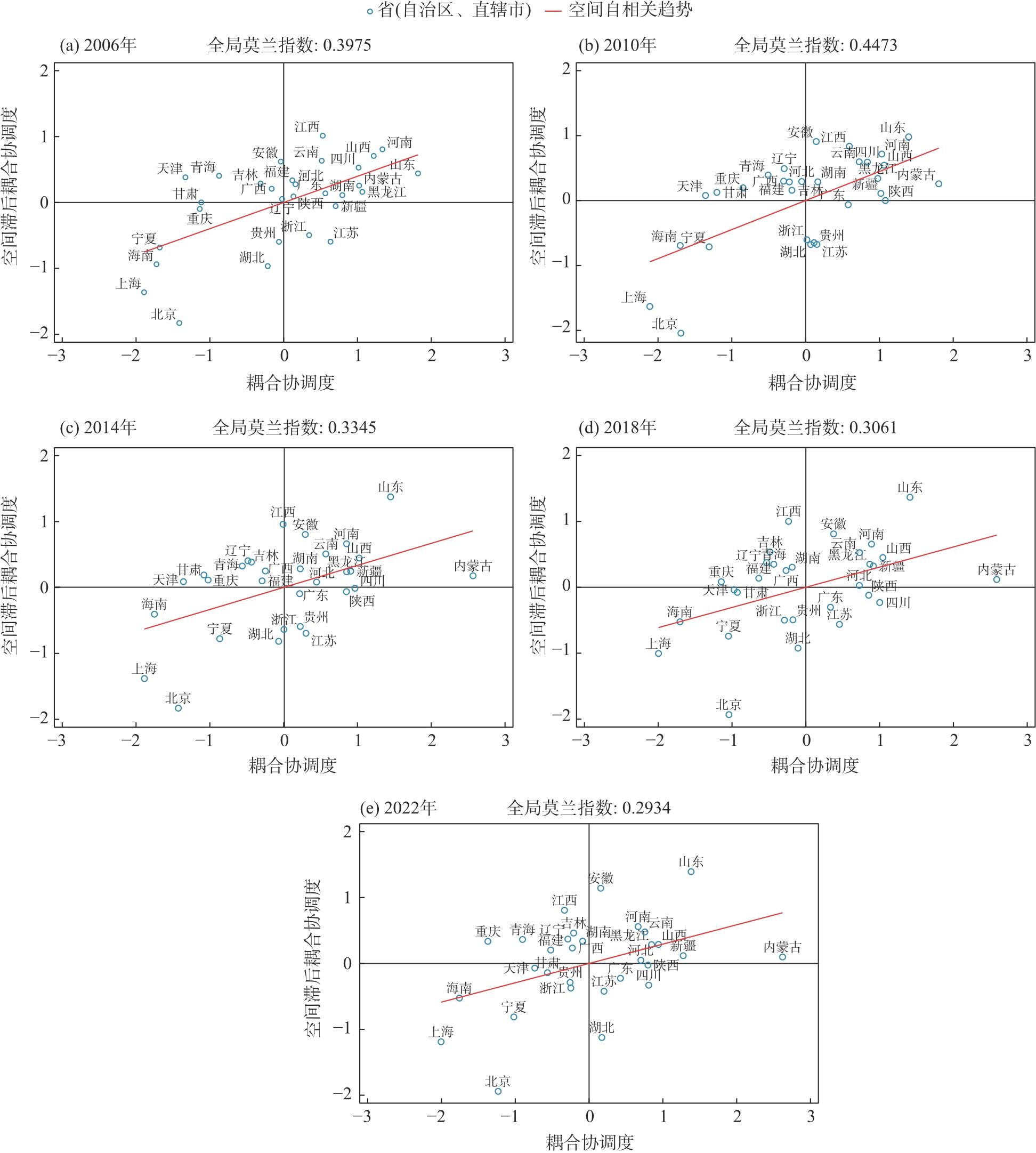
图7
2006—2022年中国WEFE系统耦合协调度的空间集聚图"
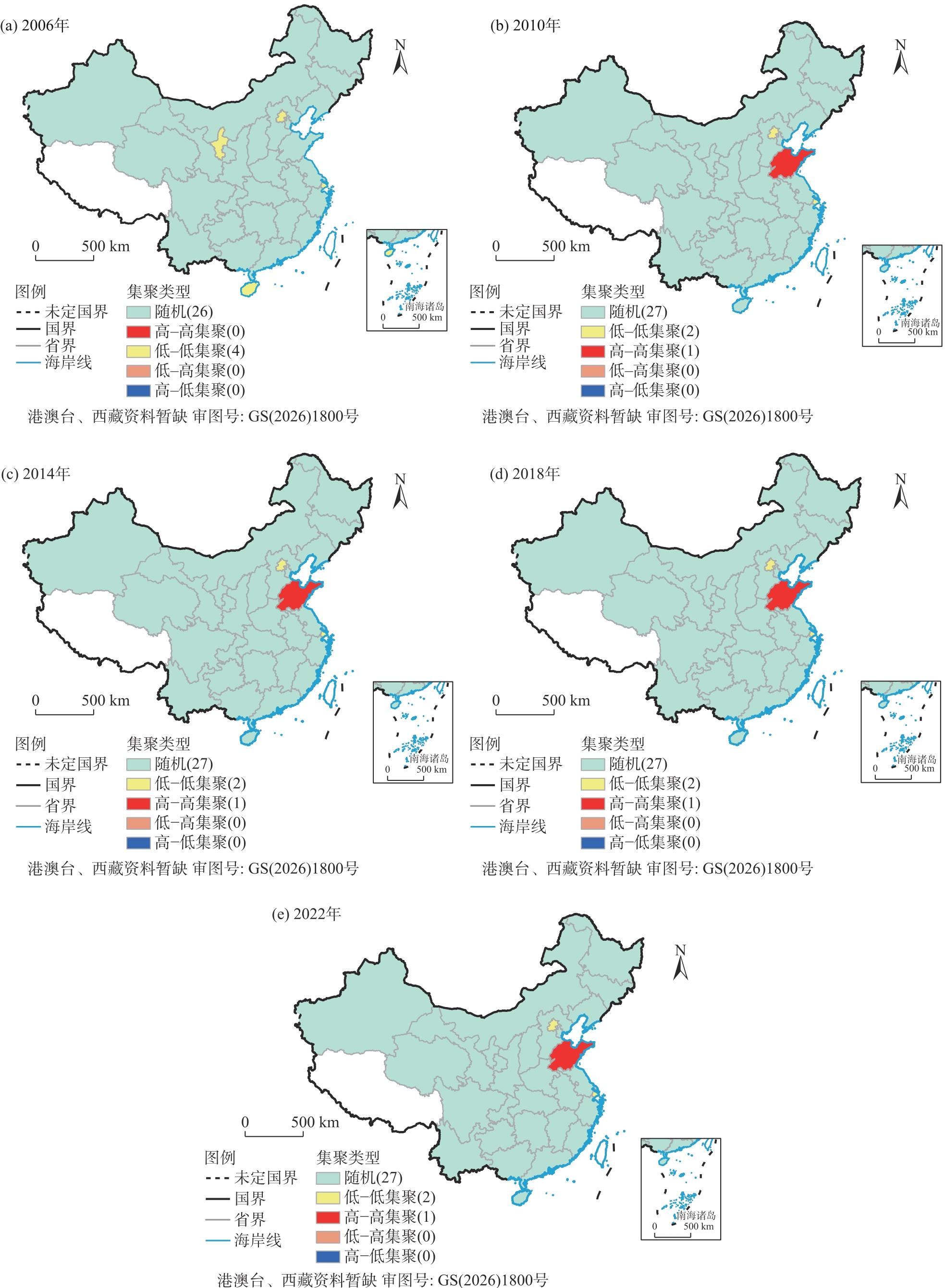
表3
各子系统与WEFE系统耦合协调发展的灰色关联度"
| 子系统 | 北京市 | 天津市 | 河北省 | 山西省 | 辽宁省 | |||||||||
|---|---|---|---|---|---|---|---|---|---|---|---|---|---|---|
| 关联度 | 排名 | 关联度 | 排名 | 关联度 | 排名 | 关联度 | 排名 | 关联度 | 排名 | |||||
| 水资源 | 0.578 | 4 | 0.697 | 4 | 0.780 | 4 | 0.650 | 3 | 0.655 | 4 | ||||
| 能源 | 0.892 | 3 | 0.926 | 2 | 0.936 | 2 | 0.626 | 4 | 0.916 | 1 | ||||
| 粮食 | 0.956 | 1 | 0.958 | 1 | 0.950 | 1 | 0.804 | 1 | 0.690 | 3 | ||||
| 生态 | 0.954 | 2 | 0.922 | 3 | 0.789 | 3 | 0.732 | 2 | 0.876 | 2 | ||||
| 子系统 | 吉林省 | 黑龙江省 | 上海市 | 浙江省 | 安徽省 | |||||||||
| 关联度 | 排名 | 关联度 | 排名 | 关联度 | 排名 | 关联度 | 排名 | 关联度 | 排名 | |||||
| 水资源 | 0.663 | 4 | 0.752 | 2 | 0.883 | 3 | 0.760 | 2 | 0.818 | 1 | ||||
| 能源 | 0.815 | 1 | 0.736 | 3 | 0.950 | 1 | 0.620 | 4 | 0.514 | 4 | ||||
| 粮食 | 0.669 | 3 | 0.509 | 4 | 0.927 | 2 | 0.846 | 1 | 0.757 | 2 | ||||
| 生态 | 0.705 | 2 | 0.786 | 1 | 0.582 | 4 | 0.698 | 3 | 0.615 | 3 | ||||
| 子系统 | 福建省 | 江西省 | 河南省 | 湖北省 | 湖南省 | |||||||||
| 关联度 | 排名 | 关联度 | 排名 | 关联度 | 排名 | 关联度 | 排名 | 关联度 | 排名 | |||||
| 水资源 | 0.676 | 3 | 0.581 | 3 | 0.705 | 4 | 0.723 | 1 | 0.696 | 2 | ||||
| 能源 | 0.568 | 4 | 0.769 | 1 | 0.859 | 1 | 0.652 | 4 | 0.709 | 1 | ||||
| 粮食 | 0.834 | 1 | 0.677 | 2 | 0.859 | 2 | 0.686 | 3 | 0.512 | 4 | ||||
| 生态 | 0.779 | 2 | 0.519 | 4 | 0.803 | 3 | 0.722 | 2 | 0.585 | 3 | ||||
| 子系统 | 广东省 | 海南省 | 重庆市 | 四川省 | 贵州省 | |||||||||
| 关联度 | 排名 | 关联度 | 排名 | 关联度 | 排名 | 关联度 | 排名 | 关联度 | 排名 | |||||
| 水资源 | 0.581 | 3 | 0.628 | 3 | 0.856 | 1 | 0.865 | 1 | 0.736 | 1 | ||||
| 能源 | 0.769 | 1 | 0.805 | 2 | 0.847 | 2 | 0.612 | 4 | 0.659 | 2 | ||||
| 粮食 | 0.677 | 2 | 0.627 | 4 | 0.493 | 3 | 0.810 | 3 | 0.624 | 4 | ||||
| 生态 | 0.519 | 4 | 0.892 | 1 | 0.440 | 4 | 0.862 | 2 | 0.625 | 3 | ||||
| 子系统 | 陕西省 | 甘肃省 | 青海省 | 宁夏回族自治区 | 内蒙古自治区 | |||||||||
| 关联度 | 排名 | 关联度 | 排名 | 关联度 | 排名 | 关联度 | 排名 | 关联度 | 排名 | |||||
| 水资源 | 0.918 | 2 | 0.777 | 1 | 0.756 | 1 | 0.826 | 2 | 0.828 | 2 | ||||
| 能源 | 0.526 | 4 | 0.614 | 4 | 0.548 | 4 | 0.525 | 4 | 0.527 | 4 | ||||
| 粮食 | 0.970 | 1 | 0.641 | 4 | 0.658 | 3 | 0.897 | 1 | 0.893 | 1 | ||||
| 生态 | 0.819 | 3 | 0.666 | 2 | 0.720 | 2 | 0.761 | 3 | 0.777 | 3 | ||||
| 子系统 | 江苏省 | 山东省 | 广西壮族自治区 | 云南省 | 新疆维吾尔自治区 | |||||||||
| 关联度 | 排名 | 关联度 | 排名 | 关联度 | 排名 | 关联度 | 排名 | 关联度 | 排名 | |||||
| 水资源 | 0.755 | 2 | 0.694 | 4 | 0.850 | 1 | 0.717 | 2 | 0.751 | 2 | ||||
| 能源 | 0.628 | 4 | 0.756 | 3 | 0.571 | 4 | 0.579 | 4 | 0.642 | 4 | ||||
| 粮食 | 0.872 | 1 | 0.915 | 1 | 0.800 | 2 | 0.794 | 1 | 0.807 | 1 | ||||
| 生态 | 0.630 | 3 | 0.780 | 2 | 0.737 | 3 | 0.689 | 3 | 0.748 | 3 | ||||
表4
子系统的各个指标与WEFE系统耦合协调发展的灰色关联度"
| 类型 | 省(自治区、直辖市) | 指标(灰色关联度) | |||
|---|---|---|---|---|---|
| 水资源 | 能源 | 粮食 | 生态 | ||
| 干旱半干旱区 | 青海省 | W4(0.9865) | E6(0.9898) | F8(0.8263) | Ec3(0.9980) |
| 黑龙江省 | W4(0.8964) | E4(0.9653) | F4(0.8964) | Ec1(0.9905) | |
| 内蒙古自治区 | W2(0.9000) | E6(0.9843) | F8(0.8914) | Ec3(0.9419) | |
| 四川省 | W2(0.9496) | E2(0.9902) | F9(0.9376) | Ec1(0.9473) | |
| 山西省 | W2(0.9903) | E4(0.9763) | F4(0.8231) | Ec5(0.9649) | |
| 宁夏回族自治区 | W5(0.9500) | E6(0.9666) | F9(0.8976) | Ec1(0.9936) | |
| 新疆维吾尔自治区 | W5(0.8293) | E6(0.9863) | F8(0.9267) | Ec1(0.9959) | |
| 陕西省 | W5(0.9736) | E6(0.9730) | F8(0.8503) | Ec1(0.9884) | |
| 甘肃省 | W6(0.9462) | E1(0.9830) | F9(0.8182) | Ec3(0.9720) | |
| 河南省 | W6(0.9855) | E1(0.9631) | F9(0.9148) | Ec1(0.9627) | |
| 北京市 | W6(0.9851) | E4(0.9938) | F8(0.9159) | Ec9(0.9216) | |
| 天津市 | W6(0.9880) | E2(0.9515) | F8(0.8932) | Ec8(0.9283) | |
| 河北省 | W6(0.9971) | E1(0.9755) | F1(0.8727) | Ec4(0.9857) | |
| 山东省 | W6(0.9792) | E1(0.9632) | F8(0.8967) | Ec3(0.9866) | |
| 吉林省 | W9(0.9563) | E4(0.9843) | F9(0.9563) | Ec3(0.9974) | |
| 辽宁省 | W9(0.8600) | E1(0.9643) | F9(0.8600) | Ec3(0.9855) | |
| 湿润半湿润区 | 安徽省 | W6(0.9740) | E1(0.9758) | F8(0.8850) | Ec3(0.9944) |
| 云南省 | W6(0.9796) | E4(0.9758) | F4(0.9489) | Ec1(0.9840) | |
| 江西省 | W6(0.9601) | E1(0.9843) | F4(0.9645) | Ec1(0.9893) | |
| 湖南省 | W6(0.9700) | E4(0.9622) | F8(0.9449) | Ec1(0.9799) | |
| 广西壮族自治区 | W5(0.8343) | E6(0.9784) | F4(0.9190) | Ec1(0.9949) | |
| 重庆市 | W2(0.9393) | E1(0.9920) | F9(0.9128) | Ec5(0.9768) | |
| 贵州省 | W2(0.9017) | E2(0.9883) | F4(0.9168) | Ec5(0.9396) | |
| 湖北省 | W2(0.9994) | E2(0.9759) | F4(0.9368) | Ec1(0.9366) | |
| 海南省 | W4(0.9742) | E6(0.9844) | F8(0.8899) | Ec1(0.9958) | |
| 浙江省 | W4(0.8173) | E6(0.9617) | F9(0.8223) | Ec1(0.9730) | |
| 福建省 | W4(0.9809) | E2(0.9935) | F8(0.7890) | Ec1(0.9796) | |
| 广东省 | W4(0.9369) | E2(0.9814) | F8(0.9151) | Ec3(0.9799) | |
| 上海市 | W8(0.8785) | E3(0.9624) | F8(0.8093) | Ec3(0.9921) | |
| 江苏省 | W8(0.8777) | E2(0.9688) | F8(0.8777) | Ec8(0.9297) | |
| [1] | 常远, 夏朋, 王建平. 水-能源-粮食纽带关系概述及对我国的启示[J]. 水利发展研究, 2016, 16(5): 67-70. |
| [Chang Yuan, Xia Peng, Wang Jianping. Overview of the water-energy-food linkage and its implications for China[J]. Water Resources Development Research, 2016, 16(5): 67-70.] | |
| [2] |
Bazilian M, Rogner H, Howells M, et al. Considering the energy, water and food nexus: Towards an integrated modelling approach[J]. Energy Policy, 2011, 39(12): 7896-7906.
doi: 10.1016/j.enpol.2011.09.039 |
| [3] |
Jesus M N, Eusiel R C, Jose M P. Involving resilience in optimizing the water-energy-food nexus at macroscopic level[J]. Process Safety and Environmental Protection, 2021, 147: 259-273.
doi: 10.1016/j.psep.2020.09.037 |
| [4] | Yuan M H, Lo S L. Ecosystem services and sustainable development: Perspectives from the food-energy-water nexus[J]. Ecosystem Services, 2020, 46: 101217, doi: 10.1016/j.ecoser.2020.101217. |
| [5] |
Hanes R J, Gopalakrishnan V, Bakshi B R. Including nature in the food-energy-water nexus can improve sustainability across multiple ecosystem services[J]. Resources, Conservation and Recycling, 2018, 137: 214-228.
doi: 10.1016/j.resconrec.2018.06.003 |
| [6] | Song S, Chen X, Liu T, et al. Indicator-based assessments of the coupling coordination degree and correlations of water-energy-food-ecology nexus in Uzbekistan[J]. Journal of Environmental Management, 2023, 345: 118674, doi: 10.1016/j.jenvman.2023.118674. |
| [7] |
de Andrade Guerra J B S O, Berchin I I, Garcia J, et al. A literature-based study on the water-energy-food nexus for sustainable development[J]. Stochastic Environmental Research and Risk Assessment, 2021, 35(1): 95-116.
doi: 10.1007/s00477-020-01772-6 |
| [8] |
Martinez-Hernandez E, Leach M, Yang A. Understanding water-energy-food and ecosystem interactions using the nexus simulation tool nexsym[J]. Applied Energy, 2017, 206: 1009-1021.
doi: 10.1016/j.apenergy.2017.09.022 |
| [9] |
杨昊凡, 黄维东, 牛最荣. 陇中地区干旱特征及其与降水量和潜在蒸散发的关系[J]. 干旱区地理, 2026, 49(7): 1336-1346.
doi: 10.12118/j.issn.1000-6060.2025.683 |
|
[Yang Haofan, Huang Weidong, Niu Zuirong. Drought characteristics in the Longzhong region and their relationship with precipitation and potential evapotranspiration[J]. Arid Land Geography, 2026, 49(7): 1336-1346.]
doi: 10.12118/j.issn.1000-6060.2025.683 |
|
| [10] | 王浩, 孟现勇, 丁建丽, 等. 数字孪生驱动的水-能-粮-生耦合系统协同治理新范式[J]. 中国水利, 2025(18): 1-11. |
| [Wang Hao, Meng Xianyong, Ding Jianli, et al. A new paradigm for digital twin-driven water-energy-food-ecosystem (WEFE) nexus collaborative governance[J]. China Water Resources, 2025(18): 1-11.] | |
| [11] |
王玉宝, 刘显, 史利洁, 等. 西北地区水资源与食物安全可持续发展研究[J]. 中国工程科学, 2019, 21(5): 38-44.
doi: 10.15302/J-SSCAE-2019.05.017 |
|
[Wang Yubao, Liu Xian, Shi Lijie, et al. Sustainable development of water resources and food security in northwest China[J]. Strategic Study of CAE, 2019, 21(5): 38-44.]
doi: 10.15302/J-SSCAE-2019.05.017 |
|
| [12] | 赖玉珮. 中国水-能源-粮食协同需求的区域特征研究[J]. 北京规划建设, 2019(1): 74-77. |
| [Lai Yupei. Research on the regional characteristics of the synergistic demand for water-energy-food in China[J]. Beijing Planning Review, 2019(1): 74-77.] | |
| [13] |
Cui D, Chen X, Xue Y L, et al. An integrated approach to investigate the relationship of coupling coordination between social economy and water environment on urban scale: A case study of Kunming[J]. Journal of Environmental Management, 2019, 234: 189-199.
doi: 10.1016/j.jenvman.2018.12.091 |
| [14] | 嵇娟, 陈军飞, 邓梦华, 等. 绿色发展下长三角地区水-能源-粮食-生态系统仿真和优化研究[J]. 软科学, 2023, 37(5): 105-114. |
| [Ji Juan, Chen Junfei, Deng Menghua, et al. Simulation and optimization of water-energy-food-ecology system for green development in the Yangtze River Delta[J]. Soft Science, 2023, 37(5): 105-114.] | |
| [15] | 覃湘, 周浩, 杨扬. 衡邵干旱走廊“水-能-粮-生”系统仿真及优化研究[J]. 水土保持研究, 2025, 32(4): 405-417. |
| [Qin Xiang, Zhou Hao, Yang Yang. Study on the simulation and optimization of ‘water-energy-food-ecology’ system in the Heng Shao arid corridor[J]. Research of Soil and Water Conservation, 2025, 32(4): 405-417.] | |
| [16] | 赵英凯. 灌区水-粮-碳-生耦合系统分析及水资源优化配置[D]. 大庆: 黑龙江八一农垦大学, 2025. |
| [Zhao Yingkai. Analysis of the water-grain-carbon-life coupled system in irrigation districts and optimization of water resources allocation[D]. Daqing: Heilongjiang Bayi Agricultural University, 2025.] | |
| [17] | 王晶, 高紫妍, 陈文辉, 等. 京津冀水-能-粮-生态系统安全和经济韧性耦合网络研究[J]. 中国农村水利水电, 2026(1): 1-7. |
| [Wang Jing, Gao Ziyan, Chen Wenhui, et al. Research on the coupling network of water-energy-food-ecology system security and economic resilience in Beijing-Tianjin-Hebei[J]. China Rural Water and Hydropower, 2026(1): 1-7.] | |
| [18] |
吴玥葶, 郭利丹, 井沛然, 等. 中亚五国水-能源-粮食-生态耦合关系及时空分异[J]. 干旱区研究, 2023, 40(4): 573-582.
doi: 10.13866/j.azr.2023.04.06 |
|
[Wu Yueting, Guo Lidan, Jing Peiran, et al. Coupling relationship and spatiotemporal differentiation of the water-energy-food-ecology nexus in five Central Asian countries[J]. Arid Zone Research, 2023, 40(4): 573-582.]
doi: 10.13866/j.azr.2023.04.06 |
|
| [19] | 潘悦. 长江经济带“水-能源-粮食-生态”关联系统脆弱性评价与预测研究[D]. 南京: 南京林业大学, 2023. |
| [Pan Yue. Study on vulnerability of the water-energy-food-ecology nexus in the Yangtze River Economic Belt[D]. Nanjing: Nanjing Forestry University, 2023.] | |
| [20] | 刘黎明, 陈军飞, 王春宝. 长江经济带水-能源-粮食-生态脆弱性时空特征及影响机制[J]. 长江流域资源与环境, 2023, 32(8): 1628-1640. |
| [Liu Liming, Chen Junfei, Wang Chunbao. Spatiotemporal evolution and influencing mechanism of water-energy-food-ecology vulnerability: A case study of Yangtze River Economic Belt, China[J]. Resources and Environment in the Yangtze Basin, 2023, 32(8): 1628-1640.] | |
| [21] | 李占斌, 邓铭江, 李鹏, 等. 黄河几字弯水土流失区水-能-粮-生融合发展研究[J]. 中国水利, 2025(11): 20-27. |
| [Li Zhanbin, Deng Mingjiang, Li Peng, et al. Studies on integrated development of water-energy-food-ecosystem in soil erosion areas of the Ω Bend of the Yellow River[J]. China Water Resources, 2025(11): 20-27.] | |
| [22] | 徐凯, 高建刚. 黄河流域水-能源-粮食-生态系统协同发展及驱动因素分析[J]. 河北环境工程学院学报, 2025, 35(4): 45-53. |
| [Xu Kai, Gao Jiangang. Analysis of the synergistic development and driving factors of water-energy-food-ecology system in the Yellow River Basin[J]. Journal of Hebei University of Environmental Engineering, 2025, 35(4): 45-53.] | |
| [23] | 杨正. 西北五省水-能-粮-生态系统耦合协调分析及仿真优化模拟[D]. 银川: 宁夏大学, 2024. |
| [Yang Zheng. Analysis of water-energy-grain-ecosystem coupling coordination in five northwestern provinces and simulation optimization simulation[D]. Yinchuan: Ningxia University, 2024.] | |
| [24] | 张紫晴. 河南省水-能源-粮食-生态系统耦合协调发展及影响因素研究[D]. 郑州: 河南财经政法大学, 2024. |
| [Zhang Ziqing. Study on coordinated development of the WEFE (water-energy-food-ecology) system and its influencing factors in Henan Province[D]. Zhengzhou: Henan University of Economics and Law, 2024.] | |
| [25] | 檀汉泽, 张泽中, 冯凯, 等. 基于耦合协调度模型的十大孔兑流域水-能源-粮食-生态耦合系统协调及驱动机制[J]. 人民珠江, 2025, 46(4): 101-112. |
| [Tan Hanze, Zhang Zezhong, Feng Kai, et al. Coordination and driving mechanism of water-energy-food-ecology coupling system in Inner-Mongolia reaches of Yellow River Based on coupling coordination degree model[J]. Pearl River, 2025, 46(4): 101-112.] | |
| [26] | 何一帆. 区域水-生态-能源-粮食协同发展的水权配置研究[D]. 郑州: 郑州大学, 2022. |
| [He Yifan. Research on water rights allocation of coordinated development on water-ecology-energy-food[D]. Zhengzhou: Zhengzhou University, 2022.] | |
| [27] | Zhang W, Liu T, Wang X, et al. Relationships between ecosystem services and human well-being from a water-energy-food nexus perspective: A case study of Jiziwan, Yellow River Basin, China[J]. Ecosystem Services, 2025, 76: 101773, doi: 10.1016/J.ECOSER.2025.101773. |
| [28] |
马荣乐, 薛亚永, 陈静霖, 等. 中国干旱半干旱区植被“碳-水”耦合权衡协同作用[J]. 干旱区研究, 2025, 42(12): 2231-2244.
doi: 10.13866/j.azr.2025.12.07 |
|
[Ma Rongle, Xue Yayong, Chen Jinglin, et al. Tradeoffs and synergies in carbon-water coupling of vegetation across China’s arid and semi-arid regions[J]. Arid Zone Research, 2025, 42(12): 2231-2244.]
doi: 10.13866/j.azr.2025.12.07 |
|
| [29] |
王晶, 叶宁杰. 水-能源-粮食系统耦合协调的动态演化与空间特征分析——以河北省为例[J]. 中国农村水利水电, 2022(12): 66-71.
doi: 10.12396/znsd.220269 |
| [Wang Jing, Ye Ningjie. Dynamic evolution and spatial characteristics analysis of water-energy-food system coupling and coordination: A case study of Hebei Province[J]. Chinese Rural Water and Hydropower, 2022(12): 66-71.] | |
| [30] | 李成宇, 张士强. 中国省际水-能源-粮食耦合协调度及影响因素研究[J]. 中国人口·资源与环境, 2020, 30(1): 120-128. |
| [Li Chengyu, Zhang Shiqiang. Chinese provincial water-energy-food coupling coordination degree and influencing factors research[J]. China Population, Resources and Environment, 2020, 30(1): 120-128.] | |
| [31] | 赵金辉, 田林, 李思源, 等. 黄河流域能源与环境-经济-生态耦合协调发展研究[J]. 人民黄河, 2022, 44(11): 13-19. |
| [Zhao Jinhui, Tian Lin, Li Siyuan, et al. Research on the coupling and coordination development of energy and environment-economy-ecology in the Yellow River Basin[J]. Yellow River, 2022, 44(11): 13-19.] | |
| [32] | 王锐, 祝笑笑, 彭艳艳, 等. 2000-2020年黄河流域水-能源-粮食系统耦合协调时空演变特征[J]. 水土保持研究, 2024, 31(1): 354-362. |
| [Wang Rui, Zhu Xiaoxiao, Peng Yanyan, et al. Spatiotemporal characteristics of water-energy-food coupling coordination in the Yellow River Basin in the period from 2000 to 2020[J]. Research of Soil and Water Conservation, 2024, 31(1): 354-362.] | |
| [33] |
孙宇, 刘维忠, 盛洋. 基于PSR模型的新疆水资源经济生态韧性时空差异及影响因素分析[J]. 干旱区地理, 2023, 46(12): 2017-2028.
doi: 10.12118/j.issn.1000-6060.2023.155 |
|
[Sun Yu, Liu Weizhong, Sheng Yang. Spatiotemporal differences and influencing factors of economic and ecological resilience of water resources in Xinjiang based on the PSR model[J]. Arid Land Geography, 2023, 46(12): 2017-2028.]
doi: 10.12118/j.issn.1000-6060.2023.155 |
|
| [34] |
王勇, 孙瑞欣. 土地利用变化对区域水-能源-粮食系统耦合协调度的影响——以京津冀城市群为研究对象[J]. 自然资源学报, 2022, 37(3): 582-599.
doi: 10.31497/zrzyxb.20220303 |
|
[Wang Yong, Sun Ruixin. Impact of land use change on coupling coordination degree of regional water-energy-food system: A case study of Beijing-Tianjin-Hebei urban agglomeration[J]. Journal of Natural Resources, 2022, 37(3): 582-599.]
doi: 10.31497/zrzyxb.20220303 |
|
| [35] | 崔草草, 王韵, 王文彬. 中国水-能源-粮食-生态系统协调发展时空格局及驱动因素研究[J]. 华北水利水电大学学报(社会科学版), 2024, 40(4): 12-26. |
| [Cui Caocao, Wang Yun, Wang Wenbin. Research on the spatio-temporal pattern and driving factors of coordinated development of china’s water-energy-food-ecosystem[J]. Journal of North China University of Water Resources and Electric Power (Social Science Edition), 2024, 40(4): 12-26.] | |
| [36] | 白雪梅, 赵松山. 由指标相关性引出的确定权重的方法[J]. 江苏统计, 1998(4): 14-16. |
| [Bai Xuemei, Zhao Songshan. A method for determining weights based on correlation of indicators[J]. Jiangsu Statistics, 1998(4): 14-16.] | |
| [37] |
王淑佳, 孔伟, 任亮, 等. 国内耦合协调度模型的误区及修正[J]. 自然资源学报, 2021, 36(3): 793-810.
doi: 10.31497/zrzyxb.20210319 |
|
[Wang Shujia, Kong Wei, Ren Liang, et al. Research on misuses and modification of coupling coordination degree model in China[J]. Journal of Natural Resources, 2021, 36(3): 793-810.]
doi: 10.31497/zrzyxb.20210319 |
|
| [38] | 翁钢民, 李凌雁. 中国旅游与文化产业融合发展的耦合协调度及空间相关分析[J]. 经济地理, 2016, 36(1): 178-185. |
| [Weng Gangmin, Li Lingyan. The coupling coordination degree and spatial correlation analysis on integrational development of tourism industry and cultural industry in China[J]. Economic Geography, 2016, 36(1): 178-185.] | |
| [39] | 刘耀彬, 李仁东, 宋学锋. 中国区域城市化与生态环境耦合的关联分析[J]. 地理学报, 2005, 60(2): 237-247. |
|
[Liu Yaobin, Li Rendong, Song Xuefeng. Grey associative analysis of regional urbanization and eco-environment coupling in China[J]. Acta Geographica Sinica, 2005, 60(2): 237-247.]
doi: 10.11821/xb200502007 |
|
| [40] | 葛世帅, 李婉琪, 刘建华, 等. 黄河流域数字经济-生态保护-文旅融合协调发展评价及障碍因子[J]. 西北大学学报(自然科学版), 2025, 55(4): 808-821. |
| [Ge Shishuai, Li Wanqi, Liu Jianhua, et al. The evaluation of coordinated development of digital economy, ecological protection, and cultural tourism integration in the Yellow River Basin and its obstacle factors[J]. Journal of Northwest University (Natural Science Edition), 2025, 55(4): 808-821.] | |
| [41] | 刘思峰. 灰色系统理论及其应用[M]. 北京: 科学出版社, 2021: 2-9. |
| [Liu Sifeng. Grey system theory and its applications[M]. Beijing: Science Press, 2021: 2-9.] | |
| [42] | 杨建仁, 刘卫东. 基于灰色关联分析和层次分析法的新型工业化水平综合评价——以中部六省为例[J]. 数学的实践与认识, 2011, 41(2): 122-132. |
| [Yang Jianren, Liu Weidong. Comprehensive evaluation of the new-type industrialization based on grey relational analysis and analytic hierarchy process: A case study of the six provinces in central China[J]. Mathematics in Practice and Theory, 2011, 41(2): 122-132.] |
| [1] | 路知秋, 律名扬, 李智慧, 徐丽萍. “人-地-业”视角下新疆城乡融合发展的多维评价与时空演化[J]. 干旱区地理, 2026, 49(8): 1750-1763. |
| [2] | 宁雅萱, 尹豪, 李金诺. 中国北方农牧交错带中段新型城镇化与农业生态系统服务耦合分析[J]. 干旱区地理, 2026, 49(7): 1457-1469. |
| [3] | 李文君, 张维梅. 中国数字经济与共同富裕的耦合协调关系及时空演进趋势[J]. 干旱区地理, 2026, 49(7): 1481-1492. |
| [4] | 陈文宣, 陈钰, 王生隆. 黄河流域农业碳排放时空演化特征及其影响因素分析[J]. 干旱区地理, 2026, 49(4): 713-726. |
| [5] | 王伟军, 李娟, 李花. 黄河流域旅游-生态-福祉耦合协调的多尺度时空演化及分异机理[J]. 干旱区地理, 2026, 49(4): 683-696. |
| [6] | 王慧丽, 李妞, 刘英, 刘咏涵. 黄河流域水资源-生态韧性动态耦合与级层障碍解析[J]. 干旱区地理, 2026, 49(3): 569-580. |
| [7] | 欧开航, 方世巧, 程乾, 周徐帆. 农村公共服务与乡村旅游耦合协调度及其乡村振兴影响效应——基于西部地区的实证[J]. 干旱区地理, 2026, 49(2): 404-415. |
| [8] | 孙国军, 李家瑶, 王子轩. 黄河流域数文旅产业发展水平评价与耦合协调时空特征分析[J]. 干旱区地理, 2026, 49(1): 117-127. |
| [9] | 徐建斌, 曹小曙. 宁夏小流域尺度水土资源耦合特征及影响因素[J]. 干旱区地理, 2025, 48(9): 1531-1540. |
| [10] | 袁梦, 谢保鹏, 田丽敏, 陈英, 裴婷婷. 六盘山甘肃片区土地利用多功能与多维相对贫困的时空耦合关系[J]. 干旱区地理, 2025, 48(7): 1304-1316. |
| [11] | 侯彩霞, 张宇宙, 杨建平. 关中平原城市群水资源-社会-生态系统耦合协调及障碍因子分析[J]. 干旱区地理, 2025, 48(4): 717-727. |
| [12] | 王超, 雷婷, 孟晓莎, 樊建强. “交旅”融合下旅游经济与高速交通协调发展分析——以关中平原城市群为例[J]. 干旱区地理, 2024, 47(6): 1015-1025. |
| [13] | 曹佳琳, 刘艳芳, 赵金梅, 安睿, 胡艺川, 孙文杰, 辛格格. 宁夏城市建设用地节约集约利用与高质量发展耦合协调研究[J]. 干旱区地理, 2024, 47(5): 872-884. |
| [14] | 万赟, 吴文恒, 刘金凤, 史海金, 刘力萌. 近30 a黄河流域中心城市空间扩展特征及启示[J]. 干旱区地理, 2024, 47(2): 281-292. |
| [15] | 刘玒玒, 刘书芳. 祁连山地区复合生态系统韧性时空演化及障碍因子识别[J]. 干旱区地理, 2024, 47(2): 237-247. |
|
||

