干旱区地理 ›› 2025, Vol. 48 ›› Issue (12): 2197-2209.doi: 10.12118/j.issn.1000-6060.2025.212 cstr: 32274.14.ALG2025212
汪左1,2( ), 聂家静1,2, 王梦雪1,2, 魏子然1,2, 李虎1,2, 尤元红1,2
收稿日期:2025-04-17
修回日期:2025-05-27
出版日期:2025-12-25
发布日期:2025-12-30
作者简介:汪左(1986-),男,副教授,主要从事积雪遥感及积雪生态效应研究. E-mail: wangzuo@ahnu.edu.cn
基金资助:
WANG Zuo1,2(), NIE Jiajing1,2, WANG Mengxue1,2, WEI Ziran1,2, LI Hu1,2, YOU Yuanhong1,2
Received:2025-04-17
Revised:2025-05-27
Published:2025-12-25
Online:2025-12-30
摘要:
新疆是我国陆域碳汇的重要组成,揭示其植被固碳时空特征与驱动因素对于区域生态安全与保护具有重要意义。目前对该区植被固碳驱动因子的研究多聚焦于水分、热量等气候要素,而对新疆固有的积雪物候作用关注不足。为此,基于2001—2018年全球逐日碳通量模拟数据,分析新疆植被总初级生产力(Gross primary production,GPP)和净初级生产力(Net primary production,NPP)的时空变化特征,并引入积雪物候指标,结合地理探测器和偏相关分析方法,从区域与栅格尺度探讨GPP和NPP的空间分异与时间变化驱动机制。结果表明:(1) 2001—2018年新疆地区植被GPP、NPP以2007年为分隔呈先下降后上升的变化趋势;空间上具有北高南低、西高东低、山区高平原低的分布特征。(2) 新疆植被GPP、NPP空间分异主要受降水、积雪日数和高程的驱动;栅格尺度上新疆植被GPP、NPP的时间变化受降水主导的范围最大,其次是太阳辐射和积雪日数。(3) 土地利用变化下,农田扩张和农田区域是新疆植被年固碳量增加的最主要贡献者;草地退化是新疆植被年固碳量减少的最主要因素。研究结果揭示了新疆植被碳汇的独特驱动过程,有助于深化气候变化和土地利用变化对植被固碳影响的认识,为新疆生态保护与可持续发展提供理论依据。
汪左, 聂家静, 王梦雪, 魏子然, 李虎, 尤元红. 新疆植被固碳时空特征及驱动因素分析[J]. 干旱区地理, 2025, 48(12): 2197-2209.
WANG Zuo, NIE Jiajing, WANG Mengxue, WEI Ziran, LI Hu, YOU Yuanhong. Spatiotemporal characteristics and driving factors of vegetation carbon sequestration in Xinjiang, China[J]. Arid Land Geography, 2025, 48(12): 2197-2209.
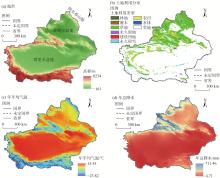
图1
新疆地区地形、土地利用(2018年)与气候特征分布 注:基于自然资源部标准地图服务网站审图号为GS(2024)0650号的标准地图制作,底图边界无修改。下同。"

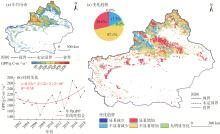
图2
2001—2018年新疆植被GPP空间分布及时空变化 注:GPP为总初级生产力。下同。"
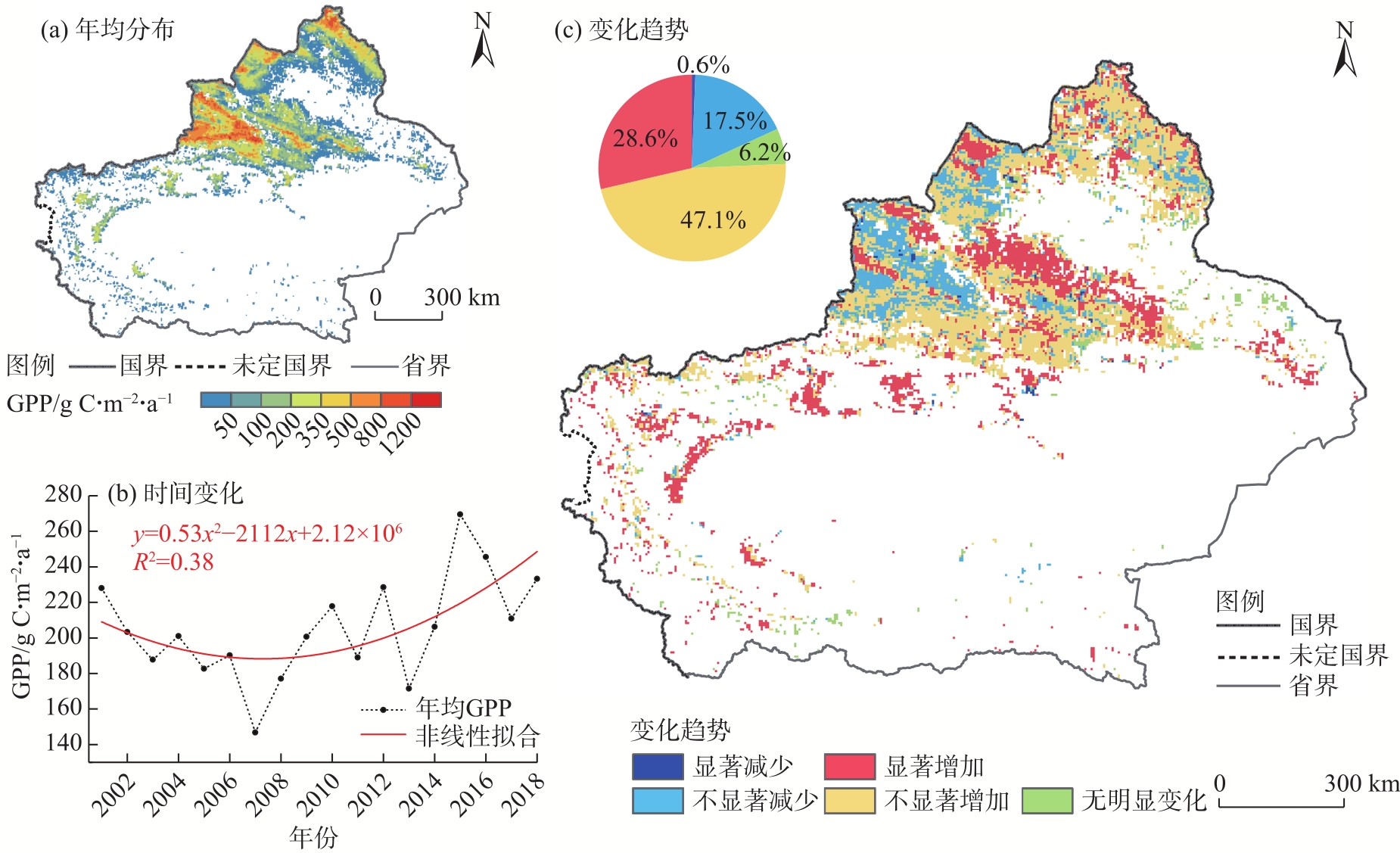
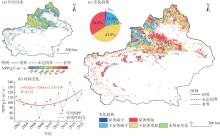
图3
2001—2018年新疆植被NPP空间分布及时空变化 注:NPP为净初级生产力。下同。"

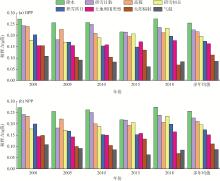
图4
新疆植被GPP、NPP空间分异因子探测结果"
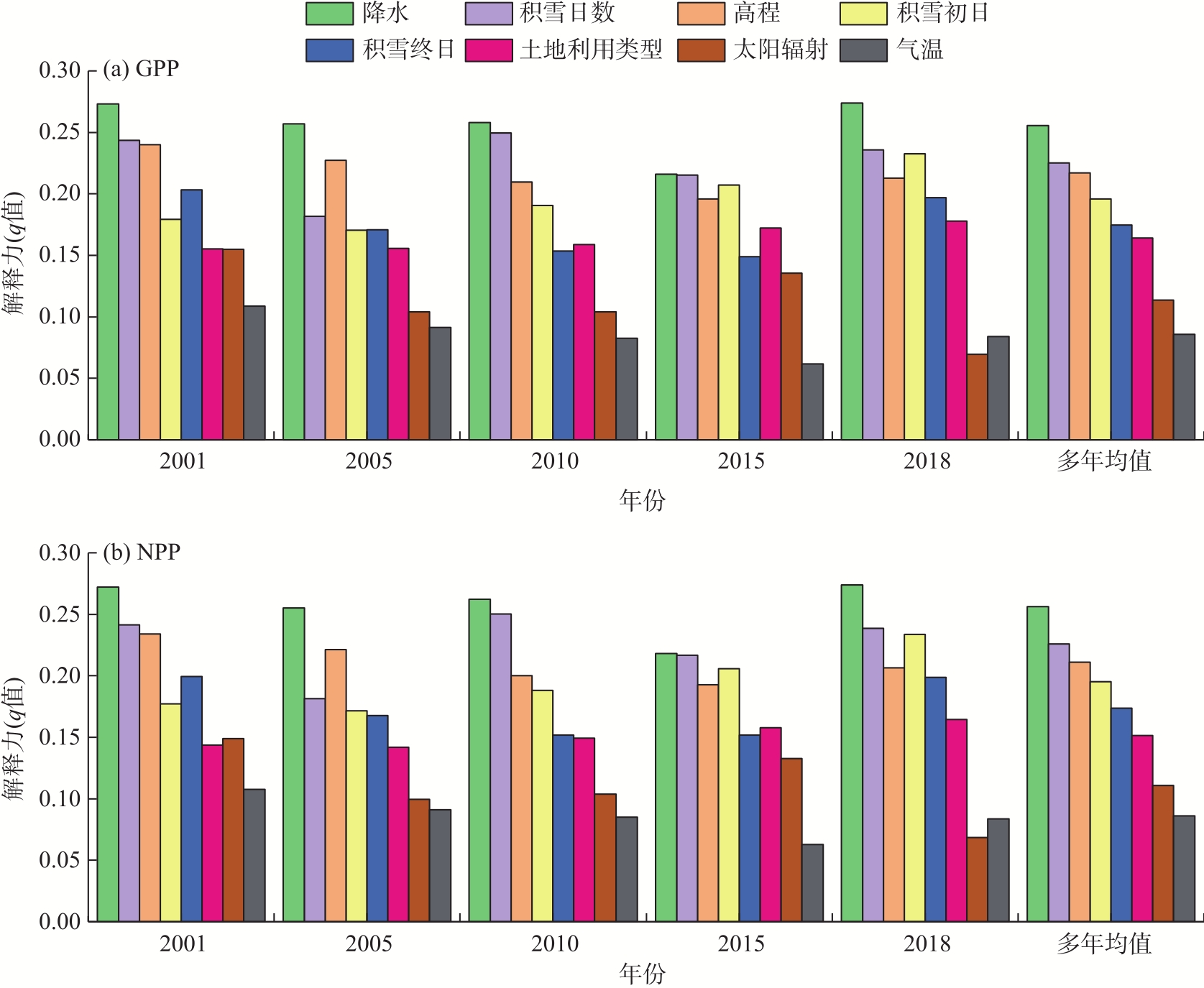
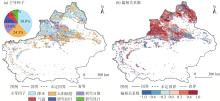
图5
新疆植被GPP变化主导驱动因子及其偏相关系数空间分布"
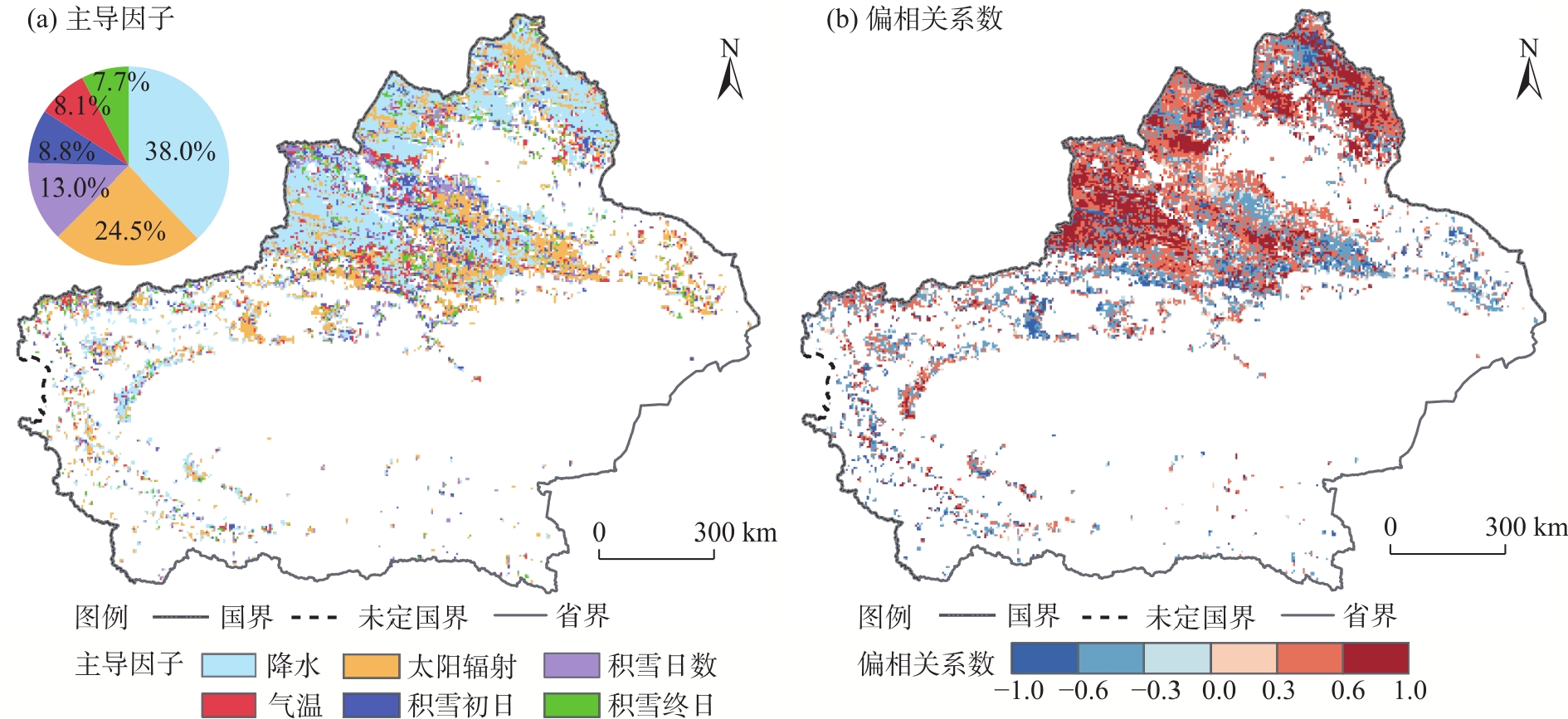
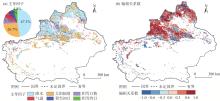
图6
新疆植被NPP变化主导驱动因子及其偏相关系数空间分布"
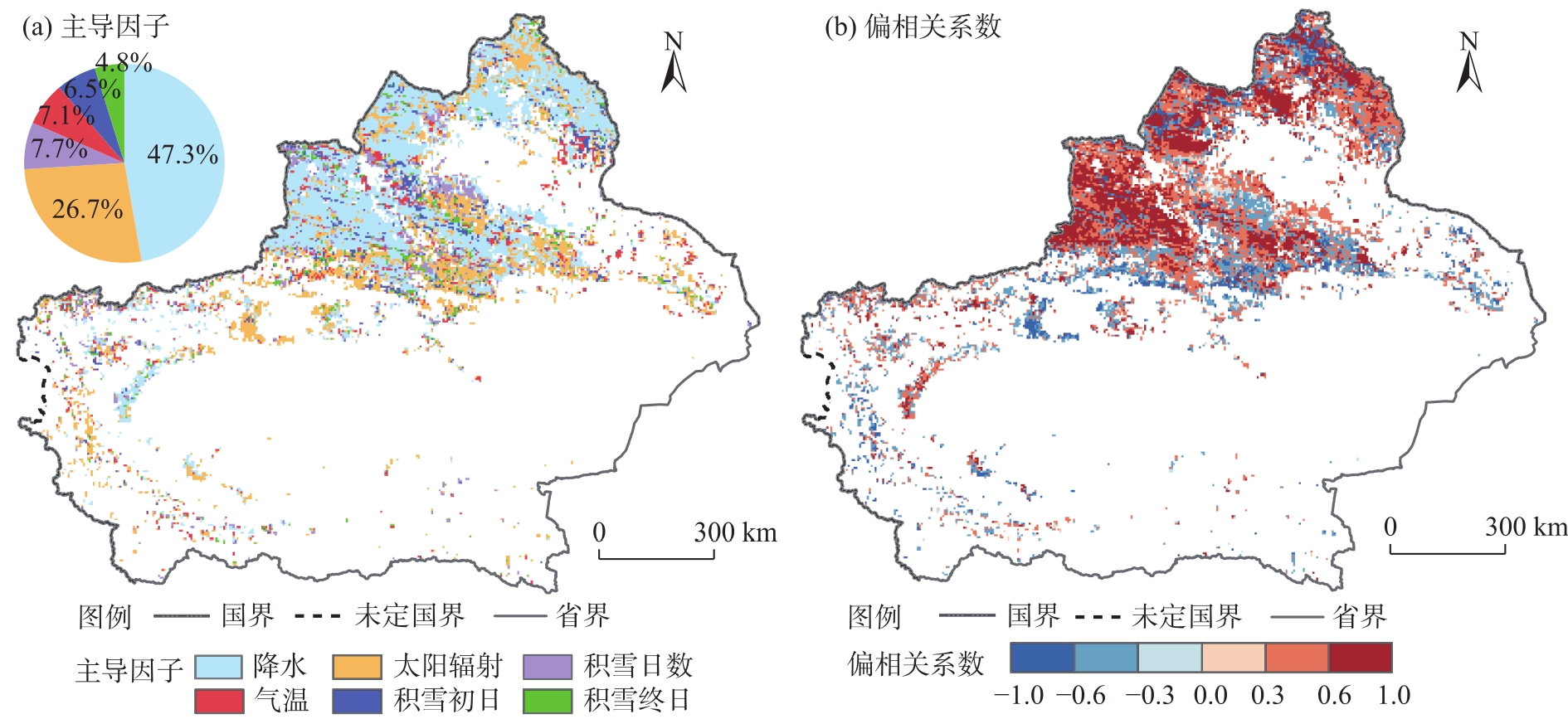

表1
新疆植被GPP、NPP变化主导驱动因子的面积与正负相关性占比"
| 植被固碳能力 | 占比项 | 驱动因子 | |||||
|---|---|---|---|---|---|---|---|
| 降水 | 太阳辐射 | 积雪日数 | 积雪初日 | 气温 | 积雪终日 | ||
| GPP | 面积占比 | 38.0 | 24.5 | 13.0 | 8.8 | 8.1 | 7.7 |
| 正相关占比 | 93.0 | 5.9 | 79.0 | 41.8 | 75.7 | 72.7 | |
| 负相关占比 | 7.0 | 94.1 | 21.0 | 58.2 | 24.3 | 27.3 | |
| NPP | 面积占比 | 47.3 | 26.7 | 7.7 | 6.5 | 7.1 | 4.8 |
| 正相关占比 | 98.5 | 4.4 | 79.4 | 32.1 | 71.7 | 70.5 | |
| 负相关占比 | 1.5 | 95.7 | 20.6 | 67.9 | 28.3 | 29.5 | |
表2
2001—2018年新疆土地利用类型转移矩阵"
| 2001年土地利用类型 | 2018年土地利用类型 | |||||
|---|---|---|---|---|---|---|
| 草地 | 灌木 | 荒地 | 建设用地 | 林地 | 农田 | |
| 草地 | 238950 | 75 | 6900 | 500 | 1025 | 22725 |
| 灌木 | - | - | 25 | - | - | - |
| 荒地 | 12200 | 25 | 57300 | 50 | - | 650 |
| 建设用地 | 275 | - | - | 1750 | - | 400 |
| 林地 | 1200 | - | - | - | 625 | - |
| 农田 | 3650 | - | 75 | 225 | - | 36775 |
表3
2001—2018年新疆土地利用类型转移下植被GPP均值变化"
| 2001年土地利用类型 | 2018年土地利用类型 | |||||
|---|---|---|---|---|---|---|
| 草地 | 灌木 | 荒地 | 建设用地 | 林地 | 农田 | |
| 草地 | -4.1 | 3.2 | 5.7 | 3.0 | 8.0 | 52.5 |
| 灌木 | - | - | 0.4 | - | - | - |
| 荒地 | 6.6 | 12.4 | 0.8 | 34.6 | - | 63.1 |
| 建设用地 | 33.5 | - | - | 15.7 | - | -2.9 |
| 林地 | 14.8 | - | - | - | -16.8 | - |
| 农田 | -2.9 | - | -87.5 | 51.0 | - | 41.2 |
表4
2001—2018年新疆土地利用类型转移下植被NPP均值变化"
| 2001年土地利用类型 | 2018年土地利用类型 | |||||
|---|---|---|---|---|---|---|
| 草地 | 灌木 | 荒地 | 建设用地 | 林地 | 农田 | |
| 草地 | -3.3 | 2.9 | 2.1 | 0.3 | 4.8 | 23.8 |
| 灌木 | - | - | 0.3 | - | - | - |
| 荒地 | 2.6 | 7.9 | 0.0 | 12.1 | - | 25.9 |
| 建设用地 | 15.9 | - | - | 5.7 | - | -5.3 |
| 林地 | 7.4 | - | - | - | -10.9 | - |
| 农田 | -5.3 | - | -52.1 | 22.4 | - | 17.2 |
表5
2001—2018年新疆土地利用类型转移下植被年固碳量变化"
| 2001年土地利用类型 | 2018年土地利用类型 | ||||||
|---|---|---|---|---|---|---|---|
| 草地 | 灌木 | 荒地 | 建设用地 | 林地 | 农田 | 累计 | |
| 草地 | -753970 | 214 | 14285 | 125 | 4751 | 523532 | -211063 |
| 灌木 | - | - | 7 | - | - | - | 7 |
| 荒地 | 31276 | 191 | 942 | 585 | - | 16289 | 49283 |
| 建设用地 | 4240 | - | - | 13077 | - | -2048 | 15269 |
| 林地 | 8646 | - | - | - | -6609 | - | 2037 |
| 农田 | -18794 | - | -3785 | 4876 | - | 613991 | 596289 |
| 累计 | -728602 | 405 | 11450 | 18664 | -1858 | 1151763 | 451822 |
| [1] |
袁文平, 蔡文文, 刘丹, 等. 陆地生态系统植被生产力遥感模型研究进展[J]. 地球科学进展, 2014, 29(5): 541-550.
doi: 10.11867/j.issn.1001-8166.2014.05.0541 |
|
[Yuan Wenping, Cai Wenwen, Liu Dan, et al. Satellite-based vegetation production models of terrestrial ecosystem: An overview[J]. Advances in Earth Science, 2014, 29(5): 541-550.]
doi: 10.11867/j.issn.1001-8166.2014.05.0541 |
|
| [2] | Yan M, Xue M, Zhang L, et al. A decade’s change in vegetation productivity and its response to climate change over northeast China[J]. Plants, 2021, 10(5): 821, doi: 10.3390/plants10050821. |
| [3] |
Anav A, Friedlingstein P, Beer C, et al. Spatiotemporal patterns of terrestrial gross primary production: A review[J]. Reviews of Geophysics, 2015, 53(3): 785-818.
doi: 10.1002/rog.v53.3 |
| [4] |
Field C B, Behrenfeld M J, Randerson J T, et al. Primary production of the biosphere: Integrating terrestrial and oceanic components[J]. Science, 1998, 281(5374): 237-240.
doi: 10.1126/science.281.5374.237 pmid: 9657713 |
| [5] |
Running S W, Nemani R R, Heinsch F A, et al. A continuous satellite-derived measure of global terrestrial primary production[J]. Bioscience, 2004, 54(6): 547-560.
doi: 10.1641/0006-3568(2004)054[0547:ACSMOG]2.0.CO;2 |
| [6] |
Zhao M S, Running S W. Drought-induced reduction in global terrestrial net primary production from 2000 through 2009[J]. Science, 2010, 329(5994): 940-943.
doi: 10.1126/science.1192666 pmid: 20724633 |
| [7] | Zhang Y, Zhang C B, Wang Z Q, et al. Vegetation dynamics and its driving forces from climate change and human activities in the Three-River Source Region, China from 1982 to 2012[J]. Science of the Total Environment, 2016, 563: 210-220. |
| [8] | 冯婉, 谢世友. 长江流域片2001—2015年植被NPP时空特征及影响因子探测[J]. 水土保持研究, 2022, 29(1): 176-183. |
| [Feng Wan, Xie Shiyou. Spatiotemporal characteristics and influencing factors of vegetation NPP in the Yangtze River Basin from 2000 to 2015[J]. Research of Soil and Water Conservation, 2022, 29(1): 176-183.] | |
| [9] | Liu H, Xiao P F, Zhang X L, et al. Increased snow cover enhances gross primary productivity in cold and dry regions of the Tibetan Plateau[J]. Ecosphere, 2023, 14(9): e4656, doi: 10.1002/ecs2.4656. |
| [10] | 刘旻霞, 焦骄, 潘竟虎, 等. 青海省植被净初级生产力(NPP)时空格局变化及其驱动因素[J]. 生态学报, 2020, 40(15): 5306-5317. |
| [Liu Minxia, Jiao Jiao, Pan Jinghu, et al. Spatial and temporal patterns of planting NPP and its driving factors in Qinghai Province[J]. Acta Ecologica Sinica, 2020, 40(15): 5306-5317.] | |
| [11] | 高振翔, 叶剑, 丁仁惠, 等. 中国植被总初级生产力对气候变化的响应[J]. 水土保持研究, 2022, 29(4): 394-399. |
| [Gao Zhenxiang, Ye Jian, Ding Renhui, et al. Response of vegetation gross primary productivity to climate change in China[J]. Research of Soil and Water Conservation, 2022, 29(4): 394-399.] | |
| [12] | Wang X, Tan K, Chen B Z, et al. Assessing the spatiotemporal variation and impact factors of net primary productivity in China[J]. Scientific Reports, 2017, 7(1): 44415, doi: 10.1038/srep44415. |
| [13] | 毕晓丽, 王辉, 葛剑平. 植被归一化指数(NDVI)及气候因子相关起伏型时间序列变化分析[J]. 应用生态学报, 2005, 16(2): 284-288. |
|
[Bi Xiaoli, Wang Hui, Ge Jianping. Wave-type time series variation of the correlation between NDVI and climatic factors[J]. Chinese Journal of Applied Ecology, 2005, 16(2): 284-288.]
pmid: 15852924 |
|
| [14] |
陈亚宁, 李稚, 范煜婷, 等. 西北干旱区气候变化对水文水资源影响研究进展[J]. 地理学报, 2014, 69(9): 1295-1304.
doi: 10.11821/dlxb201409005 |
| [Chen Yaning, Li Zhi, Fan Yuting, et al. Research progress on the impact of climate change on water resources in the arid region of northwest China[J]. Acta Geogrephica Sinica, 2014, 69(9): 1295-1304.] | |
| [15] | 车涛, 李新. 1993—2002年中国积雪水资源时空分布与变化特征[J]. 冰川冻土, 2005, 27(1): 64-67. |
| [Che Tao, Li Xin. Spatial distribution and temporal variation of snow water resources in China during 1993—2002[J]. Journal of Glaciology and Geocryology, 2005, 27(1): 64-67.] | |
| [16] |
Niu L N, Shao Q Q, Ning J, et al. Ecological changes and the tradeoff and synergy of ecosystem services in western China[J]. Journal of Geographical Sciences, 2022, 32(6): 1059-1075.
doi: 10.1007/s11442-022-1985-6 |
| [17] |
姚俊强, 李漠岩, 迪丽努尔·托列吾别克, 等. 不同时间尺度下新疆气候“暖湿化”特征[J]. 干旱区研究, 2022, 39(2): 333-346.
doi: 10.13866/j.azr.2022.02.01 |
|
[Yao Junqiang, Li Moyan, Tuoliewubieke Dilinuer, et al. The assessment on “warming-wetting” trend in Xinjiang at multi-scale during 1961—2019[J]. Arid Zone Research, 2022, 39(2): 333-346.]
doi: 10.13866/j.azr.2022.02.01 |
|
| [18] |
Wang H J, Chen Y N, Xun S, et al. Changes in daily climate extremes in the arid area of northwestern China[J]. Theoretical and Applied Climatology, 2013, 112(1-2): 15-28.
doi: 10.1007/s00704-012-0698-7 |
| [19] | 杨静, 黄秉光, 黄玫, 等. 近55 a新疆净生态系统生产力对气候变化的响应[J]. 干旱区地理, 2017, 40(5): 1054-1060. |
| [Yang Jing, Huang Bingguang, Huang Mei, et al. Responses of net ecosystem productivity to climate change in Xinjiang in recent 55 years[J]. Arid Land Geography, 2017, 40(5): 1054-1060.] | |
| [20] |
Yang H F, Mu S J, Li J L. Effects of ecological restoration projects on land use and land cover change and its influences on territorial NPP in Xinjiang, China[J]. Catena, 2014, 115: 85-95.
doi: 10.1016/j.catena.2013.11.020 |
| [21] | 秦景秀, 郝兴明, 张颖, 等. 气候变化和人类活动对干旱区植被生产力的影响[J]. 干旱区地理, 2020, 43(1): 117-125. |
|
[Qin Jingxiu, Hao Xingming, Zhang Ying, et al. Effects of climate change and human activities on vegetation productivity in arid areas[J]. Arid Land Geography, 2020, 43(1): 117-125.]
doi: 10.12118/j.issn.1000-6060.2020.01.14 |
|
| [22] | 张山清, 普宗朝, 伏晓慧, 等. 气候变化对新疆自然植被净第一性生产力的影响[J]. 干旱区研究, 2010, 27(6): 905-914. |
| [Zhang Shanqing, Pu Zongchao, Fu Xiaohui, et al. Effect of climate change on NPP of natural vegetation in Xinjiang[J]. Arid Zone Research, 2010, 27(6): 905-914.] | |
| [23] |
姜萍, 袁野. 新疆植被总初级生产力对大气水分亏缺的响应[J]. 干旱区地理, 2024, 47(3): 403-412.
doi: 10.12118/j.issn.1000-6060.2023.413 |
|
[Jiang Ping, Yuan Ye. Responses of vegetation gross primary production to vapor pressure deficit in Xinjiang[J]. Arid Land Geography, 2024, 47(3): 403-412.]
doi: 10.12118/j.issn.1000-6060.2023.413 |
|
| [24] | 姚宏达, 顾玉丽, 罗青红, 等. 典型荒漠绿化工程区净生态系统生产力的时空变化特征[J]. 气候与环境研究, 2025, 30(3): 322-334. |
| [Yao Hongda, Gu Yuli, Luo Qinghong, et al. Characteristics of spatial and temporal changes in net ecosystem productivity across the typical desert greening project areas[J]. Climatic and Environmental Research, 2025, 30(3): 322-334.] | |
| [25] |
赵晓涵, 张方敏, 韩典辰, 等. 内蒙古半干旱区蒸散特征及归因分析[J]. 干旱区研究, 2021, 38(6): 1614-1623.
doi: 10.13866/j.azr.2021.06.13 |
|
[Zhao Xiaohan, Zhang Fangmin, Han Dianchen, et al. Evapotranspiration changes and its attribution in semi-arid regions of Inner Mongolia[J]. Arid Zone Research, 2021, 38(6): 1614-1623.]
doi: 10.13866/j.azr.2021.06.13 |
|
| [26] | He Q, Ju W, Dai S, et al. Drought risk of global terrestrial gross primary productivity over the last 40 years detected by a remote sensing-driven process model[J]. Journal of Geophysical Research: Biogeosciences, 2021, 126(6): e2020JG005944, doi: 10.1029/2020JG-005944. |
| [27] | Gong H B, Cao L, Duan Y F, et al. Multiple effects of climate changes and human activities on NPP increase in the Three-north Shelter Forest Program area[J]. Forest Ecology and Management, 2023, 529: 120732, doi: 10.1016/j.foreco.2022.120732. |
| [28] | Li J H, Han W Q, Zheng J H, et al. Grassland productivity in arid Central Asia depends on the greening rate rather than the growing season length[J]. Science of the Total Environment, 2024, 933: 173155, doi: 10.1016/j.scitotenv.2024.173155. |
| [29] | Gong H X, Wang G Y, Fan C Q, et al. Temporal accumulation and lag effects of precipitation on carbon fluxes in terrestrial ecosystems across semi-arid regions in China[J]. Agricultural and Forest Meteorology, 2024, 356: 110189, doi: 10.1016/j.agrformet.2024.110189. |
| [30] | Liu H H, Liu Y, Chen Y, et al. Dynamics of global dryland vegetation were more sensitive to soil moisture: Evidence from multiple vegetation indices[J]. Agricultural and Forest Meteorology, 2023, 331: 109327, doi: 10.1016/j.agrformet.2023.109327. |
| [31] | 郝晓华, 赵琴, 纪文政, 等. 1980—2020年AVHRR中国积雪物候数据集[J]. 中国科学数据, 2022, 7(3): 1-10. |
| [Hao Xiaohua, Zhao Qin, Ji Wenzheng, et al. A dataset of snow cover phenology in China based on AVHRR from 1980 to 2020[J]. China Scientific Data, 2022, 7(3): 1-10.] | |
| [32] |
Peng S Z, Ding Y X, Wen Z M, et al. Spatiotemporal change and trend analysis of potential evapotranspiration over the Loess Plateau of China during 2011—2100[J]. Agricultural and Forest Meteorology, 2017, 233: 183-194.
doi: 10.1016/j.agrformet.2016.11.129 |
| [33] |
Abatzoglou J T, Dobrowski S Z, Parks S A, et al. TerraClimate, a high-resolution global dataset of monthly climate and climatic water balance from 1958—2015[J]. Scientific Data, 2018, 5(1): 1-12.
doi: 10.1038/s41597-018-0002-5 |
| [34] |
Hamed K H, Rao A R. A modified Mann-Kendall trend test for autocorrelated data[J]. Journal of Hydrology, 1998, 204(1-4): 182-196.
doi: 10.1016/S0022-1694(97)00125-X |
| [35] |
王劲峰, 徐成东. 地理探测器: 原理与展望[J]. 地理学报, 2017, 72(1): 116-134.
doi: 10.11821/dlxb201701010 |
| [Wang Jinfeng, Xu Chengdong. Geodetector: Principle and prospective[J]. Acta Geologica Sinica, 2017, 72(1): 116-134.] | |
| [36] | 张磊, 罗平平, 王小珲, 等. 1960—2019年关中平原极端降水时空变化及非平稳性分析[J]. 水利水电技术, 2023, 54(3): 35-46. |
| [Zhang Lei, Luo Pingping, Wang Xiaohui, et al. Spatial and temporal variation and non-stationary analysis of extreme precipitation in Guanzhong Plain from 1960 to 2019[J]. Water Resources and Hydropower Engineering, 2023, 54(3): 35-46.] | |
| [37] | 温宥越, 孙强, 燕玉超, 等. 粤港澳大湾区陆地生态系统演变对固碳释氧服务的影响[J]. 生态学报, 2020, 40(23): 8482-8493. |
| [Wen Youyue, Sun Qiang, Yan Yuchao, et al. Impacts of the terrestrial ecosystem changes on the carbon fixation and oxygen release services in the Guangdong-Hong Kong-Macao Greater Bay Area[J]. Acta Ecologica Sinica, 2020, 40(23): 8482-8493.] | |
| [38] |
高晓宇, 郝海超, 张雪琪, 等. 中国西北干旱区植被水分利用效率变化对气象要素的响应——以新疆为例[J]. 干旱区地理, 2023, 46(7): 1111-1120.
doi: 10.12118/j.issn.1000-6060.2022.545 |
|
[Gao Xiaoyu, Hao Haichao, Zhang Xueqi, et al. Responses of vegetation water use efficiency to meteorological factors in arid areas of northwest China: A case of Xinjiang[J]. Arid Land Geography, 2023, 46(7): 1111-1120.]
doi: 10.12118/j.issn.1000-6060.2022.545 |
|
| [39] |
韩炳宏, 周秉荣, 颜玉倩, 等. 2000—2018年间青藏高原植被覆盖变化及其与气候因素的关系分析[J]. 草地学报, 2019, 27(6): 1651-1658.
doi: 10.11733/j.issn.1007-0435.2019.06.023 |
|
[Han Binghong, Zhou Bingrong, Yan Yuqian, et al. Analysis of vegetation coverage change and its driving factors over Tibetan Plateau from 2000 to 2008[J]. Acta Agrestia Sinica, 2019, 27(6): 1651-1658.]
doi: 10.11733/j.issn.1007-0435.2019.06.023 |
|
| [40] | 姚俊强, 杨青, 陈亚宁, 等. 西北干旱区气候变化及其对生态环境影响[J]. 生态学杂志, 2013, 32(5): 1283-1291. |
| [Yao Junqiang, Yang Qing, Chen Yaning, et al. Climate change in arid areas of northwest China in past 50 years and its effects on the local ecological environment[J]. Chinese Journal of Ecology, 2013, 32(5): 1283-1291.] | |
| [41] | 同琳静, 刘洋洋, 王倩, 等. 西北植被净初级生产力时空变化及其驱动因素[J]. 水土保持研究, 2019, 26(4): 367-374. |
| [Tong Linjing, Liu Yangyang, Wang Qian, et al. Spatial and temporal dynamics of net primary productivity and its driving factors in northwest China[J]. Research of Soil and Water Conservation, 2019, 26(4): 367-374.] | |
| [42] |
孔冬冬, 张强, 黄文琳, 等. 1982—2013年青藏高原植被物候变化及气象因素影响[J]. 地理学报, 2017, 72(1): 39-52.
doi: 10.11821/dlxb201701004 |
|
[Kong Dongdong, Zhang Qiang, Huang Wenlin, et al. Vegetation phenology change in Tibetan Plateau from 1982 to 2013 and its related meteorological factors[J]. Acta Geographica Sinica, 2017, 72(1): 39-52.]
doi: 10.11821/dlxb201701004 |
|
| [43] | 姬盼盼, 高敏华, 杨晓东. 中国西北部干旱区NPP驱动力分析——以新疆伊犁河谷和天山山脉部分区域为例[J]. 生态学报, 2019, 39(8): 2995-3006. |
| [Ji Panpan, Gao Minhua, Yang Xiaodong. Analysis of NPP driving force in an arid region of northwest China: A case study in Yili Valley and parts of Tianshan Mountains, Xinjiang, China[J]. Acta Ecologica Sinica, 2019, 39(8): 2995-3006.] | |
| [44] |
Chen S L, Huang Y F, Wang G Q. Response of vegetation carbon uptake to snow-induced phenological and physiological changes across temperate China[J]. Science of the Total Environment, 2019, 692: 188-200.
doi: 10.1016/j.scitotenv.2019.07.222 |
| [45] |
Yu Z, Liu S R, Wang J X, et al. Effects of seasonal snow on the growing season of temperate vegetation in China[J]. Global Change Biology, 2013, 19(7): 2182-2195.
doi: 10.1111/gcb.12206 pmid: 23532953 |
| [46] |
吴瀚, 白洁, 李均力, 等. 新疆地区植被覆盖度时空变化及其影响因素分析[J]. 植物生态学报, 2024, 48(1): 41-55.
doi: 10.17521/cjpe.2022.0397 |
|
[Wu Han, Bai Jie, Li Junli, et al. Study of spatio-temporal variation in fractional vegetation cover and its influencing factors in Xinjiang, China[J]. Chinese Journal of Plant Ecology, 2024, 48(1): 41-55.]
doi: 10.17521/cjpe.2022.0397 |
| [1] | 李亮亮, 夏咏, 王福红, 郭冰心, 赵兰兰. 新疆甜瓜生产格局及其贡献因素分析[J]. 干旱区地理, 2025, 48(9): 1567-1577. |
| [2] | 芮东升, 毛璐, 任艳霞, 贡浩轩, 李延萍, 付志聪. 新疆相对贫困空间分布特征及障碍因素分析[J]. 干旱区地理, 2025, 48(9): 1672-1682. |
| [3] | 刘艺欣, 裴婷婷, 陈英, 谢保鹏. 基于县域尺度的甘肃省乡村振兴发展水平测度及时空分异[J]. 干旱区地理, 2025, 48(9): 1683-1693. |
| [4] | 许静, 杨斌. 甘肃省新型城镇化与生态安全耦合协同及其驱动因素非平稳性[J]. 干旱区地理, 2025, 48(8): 1432-1444. |
| [5] | 薛晨浩, 白永平, 王生鹏. 基于多维评价方法的沿黄地区经济韧性时空分异规律[J]. 干旱区地理, 2025, 48(6): 1103-1114. |
| [6] | 刘海军, 张海虹, 闫俊杰, 李想, 李高峰. 新疆农业碳排放效率时空异质性及其影响因素[J]. 干旱区地理, 2025, 48(5): 866-878. |
| [7] | 李松芮, 林秋平, 杨上广. 新疆物流企业空间布局多尺度演化特征及影响因素研究[J]. 干旱区地理, 2025, 48(4): 739-752. |
| [8] | 王福红, 夏咏. 干旱区主要农作物生产时空格局演化及影响因素分析——以新疆地区为例[J]. 干旱区地理, 2025, 48(3): 444-454. |
| [9] | 李梦园, 庞家朋, 李欢. 省域典型旅游集散地综合可达性协调发展及空间关系研究——以新疆为例[J]. 干旱区地理, 2025, 48(3): 539-548. |
| [10] | 贾妮娅·叶力肯, 侯建楠, 刘思博. 近30 a新疆地州市旅游气候舒适度时空特征分析[J]. 干旱区地理, 2025, 48(2): 212-222. |
| [11] | 郭佳丽, 杜宏茹. 多元流视角下新疆绿洲城市网络格局研究[J]. 干旱区地理, 2025, 48(2): 323-332. |
| [12] | 牛飞飞, 郭靖, 罗杰, 勾雪平, 刘雪薇, 张仁平. 基于GeoSOS-FLUS和InVEST模型的新疆地区土地利用变化模拟及碳储量预测[J]. 干旱区地理, 2025, 48(12): 2169-2182. |
| [13] | 施秀娟, 王志强. 新疆县域土地利用碳收支平衡与碳补偿分区研究[J]. 干旱区地理, 2025, 48(12): 2183-2196. |
| [14] | 白洋, 包洁, 刘晓燕, 陈明珠, 许文娜. “新疆礼物”的时空分异及其影响机制[J]. 干旱区地理, 2025, 48(11): 2042-2052. |
| [15] | 杨扬, 常伟, 张兴东. 新疆极端气温冷(暖)指数历史变化及未来情景预估[J]. 干旱区地理, 2025, 48(10): 1747-1759. |
|
||