干旱区地理 ›› 2025, Vol. 48 ›› Issue (12): 2210-2219.doi: 10.12118/j.issn.1000-6060.2025.092 cstr: 32274.14.ALG2025092
高瑞翔1,2( ), 罗格平1(), 张文强1, 谢明娟1, 王渊刚1
收稿日期:2025-02-24
修回日期:2025-04-01
出版日期:2025-12-25
发布日期:2025-12-30
通讯作者:
罗格平(1968-),男,博士,研究员,主要从事干旱区土地利用/覆被变化及其生态与气候效应、遥感与GIS应用研究. E-mail: luogp@ms.xjb.ac.cn作者简介:高瑞翔(1997-),男,硕士,主要从事机器学习碳通量模拟研究. E-mail: gaoruixiang22@mails.ucas.ac.cn
基金资助:
GAO Ruixiang1,2(), LUO Geping1(), ZHANG Wenqiang1, XIE Mingjuan1, WANG Yuangang1
Received:2025-02-24
Revised:2025-04-01
Published:2025-12-25
Online:2025-12-30
摘要:
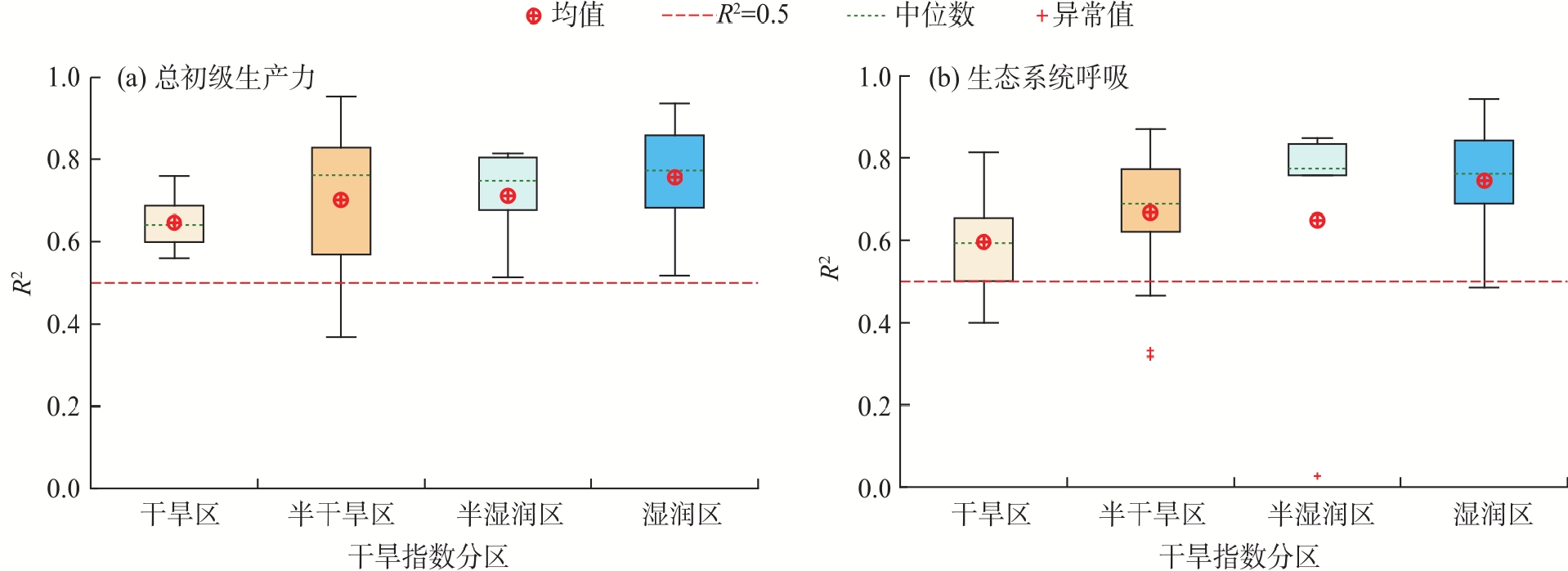
基于长短期记忆网络方法,结合FLUXNET通量站观测数据与对应遥感生物物理参数数据,提出通过综合欧氏距离指数量化训练集与测试集之间数据异质性,并结合模糊数学理论构建碳通量反演模型。结果表明:(1) 通过数据预处理、模型训练,分别利用随机森林、支持向量机、多元线性回归和长短期记忆网络算法建立模型,发现长短期记忆网络在碳通量反演中具有优势。(2) 采用留一交叉验证策略,在不同气候区内构建碳通量反演模型,以反映地表空间异质性,并用决定系数(R2)对模型进行评估,发现综合欧式距离与R2之间为显著负相关。(3) 将构建的模型应用于美国通量站进行验证,总初级生产力和生态系统呼吸的R2均值均为0.72。总体而言,研究结果提出了一种有效的碳通量模拟方法,具有较好的应用潜力。
高瑞翔, 罗格平, 张文强, 谢明娟, 王渊刚. 长短期记忆网络在生态系统碳通量反演中的优势与应用[J]. 干旱区地理, 2025, 48(12): 2210-2219.
GAO Ruixiang, LUO Geping, ZHANG Wenqiang, XIE Mingjuan, WANG Yuangang. Ecosystem carbon flux inversion method combining LSTM and fuzzy mathematics[J]. Arid Land Geography, 2025, 48(12): 2210-2219.
表1
通量塔汇总表"
| 干旱指数分区 | 站点数量 |
|---|---|
| 干旱区 | 15 |
| 半干旱区 | 44 |
| 半湿润区 | 20 |
| 湿润区 | 111 |
表2
解释变量汇总表"
| 解释变量 | 描述 | 单位 | 时间/空间分辨率 | 来源 |
|---|---|---|---|---|
| Tmax | 最高气温 | ℃ | 日 | 通量塔 |
| Tmin | 最低气温 | ℃ | 日 | 通量塔 |
| Tmean | 平均气温 | ℃ | 日 | 通量塔 |
| P | 降水量 | mm | 日 | 通量塔 |
| WS | 风速 | m·s-1 | 日 | 通量塔 |
| VPD | 大气水气压差 | hPa | 日 | 通量塔 |
| LAI | 叶面积指数 | m2 | 8 d/500 m | MODIS |
| DSR | 向下短波辐射 | W·m-2 | d/5 km | Seoul National |
| DEM | 高程 | m | 静态变量 | GLOBE from NOAA |
| Aspect | 坡向 | (°) | 静态变量 | GLOBE from NOAA |
| Slope | 坡度 | (°) | 静态变量 | GLOBE from NOAA |
| Clay | 表土黏土占比 | % | 静态变量 | HWSD from FAO |
| Sand | 表土砂占比 | % | 静态变量 | HWSD from FAO |
| Silt | 表土粉砂占比 | % | 静态变量 | HWSD from FAO |
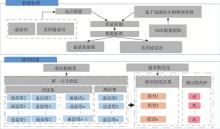
图1
数据处理与模型构建流程图 注:R2为决定系数。下同。"
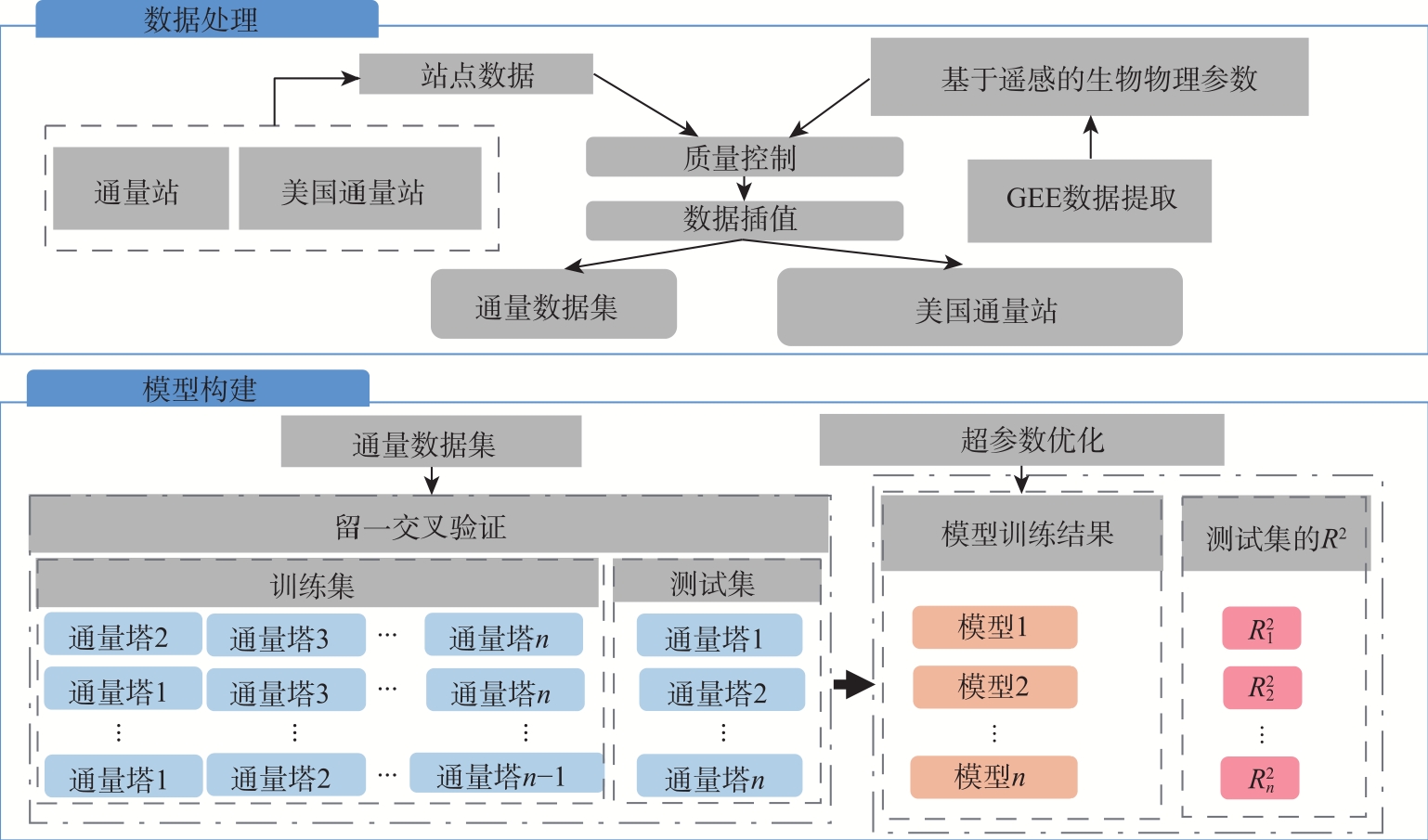
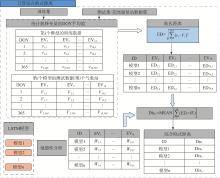
图2
综合欧式距离计算流程图 注:DOY为一年中的第几天;EVi为第i个解释变量;vij为模型训练集解释变量的平均DOY值;Vij为模型测试集解释变量的平均DOY值;Wij为模型j的第i个解释变量的敏感性;EDij为模型j的第i个解释变量与测试集的欧式距离;Disn为第n个模型的训练集和测试集之间的综合欧氏距离。"
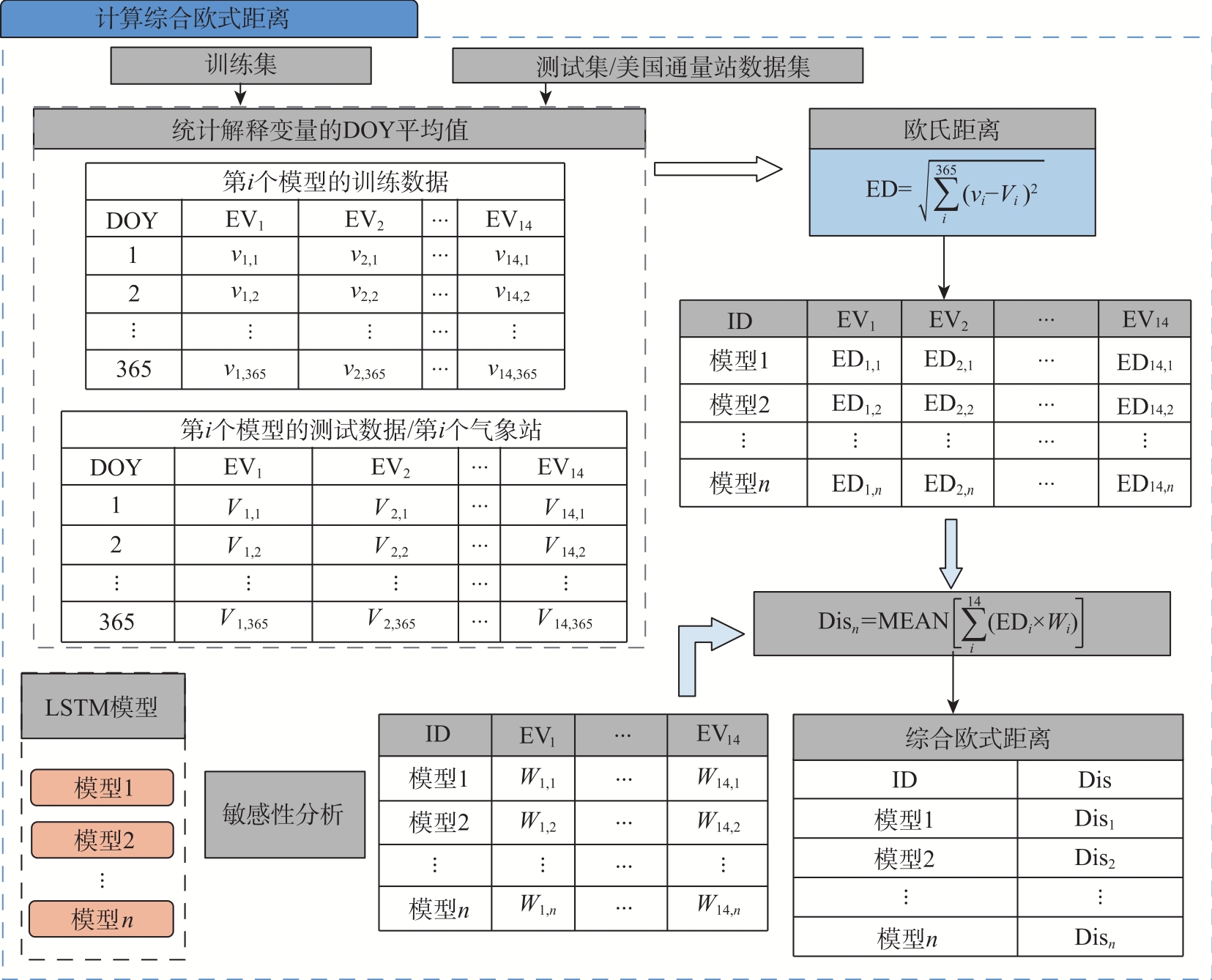
图3
不同机器学习碳通量模型决定系数(R2)箱线 注:RF为随机森林模型;MLR为多元线性回归;LSTM为长短期记忆网络;SVM为支持向量机。"
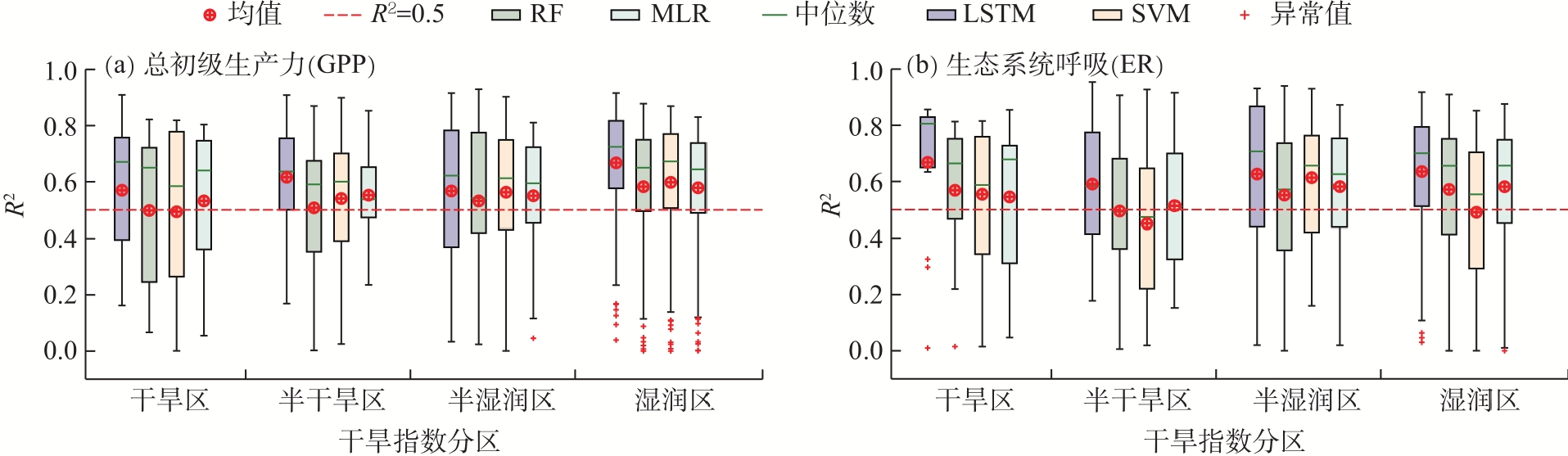
表3
模型均方根误差均值和方差"
| 干旱指数分区 | LSTM模型 | RF模型 | SVM模型 | MLR模型 |
|---|---|---|---|---|
| 干旱区(GPP) | 0.62(±0.37) | 0.80(±0.20) | 0.98(±0.55) | 0.99(±0.32) |
| 干旱区(ER) | 0.78(±0.40) | 0.99(±0.65) | 1.01(±0.69) | 1.17(±0.66) |
| 半干旱区(GPP) | 0.74(±0.50) | 0.81(±0.52) | 0.84(±0.33) | 0.80(±0.51) |
| 半干旱区(ER) | 0.85(±1.13) | 0.96(±1.07) | 0.87(±0.76) | 0.90(±0.91) |
| 半湿润区(GPP) | 1.06(±2.04) | 1.31(±2.90) | 1.29(±2.64) | 2.99(±9.24) |
| 半湿润区(ER) | 0.80(±1.14) | 0.84(±0.94) | 0.90(±1.45) | 1.95(±1.05) |
| 湿润区(GPP) | 0.61(±0.39) | 0.63(±0.34) | 0.78(±0.29) | 0.70(±0.55) |
| 湿润区(ER) | 0.63(±0.45) | 0.64(±0.51) | 0.83(±0.46) | 0.78(±0.70) |
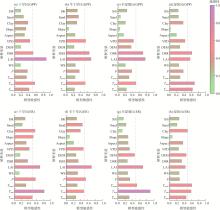
图4
总初级生产力和生态系统呼吸模型敏感性分析 注:图中y轴为解释变量详细描述见表2。"

图5
综合距离与R2的关系"
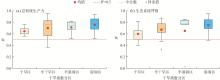
图6
美国通量站验证R2箱线图"
| [1] | Kanevski M, Pozdnoukhov A, Timonin V. Machine learning for spatial environmental data: Theory, applications, and software[M]. New York: EPFL Press, 2009: 40-52. |
| [2] | 朴世龙, 何悦, 王旭辉, 等. 中国陆地生态系统碳汇估算: 方法、进展、展望[J]. 中国科学: 地球科学, 2022, 52(6): 1010-1020. |
| [Piao Shilong, He Yue, Wang Xuhui, et al. Estimation of carbon sinks in terrestrial ecosystems in China: Methods, progress, and prospects[J]. Scientia Sinica (Terrae), 2022, 52(6): 1010-1020.] | |
| [3] | Zhan W W, Yang X, Ryu Y, et al. Two for one: Partitioning CO2 fluxes and understanding the relationship between solar-induced chlorophyll fluorescence and gross primary productivity using machine learning[J]. Agricultural and Forest Meteorology, 2022, 321: 108980, doi: 10.1016/j.agrformet.2022.108980. |
| [4] |
Pichler M, Hartig F. Machine learning and deep learning: A review for ecologists[J]. Methods in Ecology and Evolution, 2023, 14(4): 994-1016.
doi: 10.1111/mee3.v14.4 |
| [5] |
Reichstein M, Camps-Valls G, Stevens B, et al. Deep learning and process understanding for data-driven Earth system science[J]. Nature, 2019, 566(7743): 195-204.
doi: 10.1038/s41586-019-0912-1 |
| [6] | Hungershoefer K, Breon F-M, Peylin P, et al. Evaluation of various observing systems for the global monitoring of CO2 surface fluxes[J]. Atmospheric Chemistry and Physics, 2010, 10(21): 10503-10520. |
| [7] | Ciais P, Peylin P, Bousquet P. Regional biospheric carbon fluxes as inferred from atmospheric CO2 measurements[J]. Ecological Applications, 2000, 10(6): 1574-1589. |
| [8] |
Foley J A, Prentice I C, Ramankutty N, et al. An integrated biosphere model of land surface processes, terrestrial carbon balance, and vegetation dynamics[J]. Global Biogeochemical Cycles, 1996, 10(4): 603-628.
doi: 10.1029/96GB02692 |
| [9] |
Houghton R A, House J I, Pongratz J, et al. Carbon emissions from land use and land-cover change[J]. Biogeosciences, 2012, 9(12): 5125-5142.
doi: 10.5194/bg-9-5125-2012 |
| [10] | Liang S. Quantitative remote sensing of land surfaces[M]. Canada: John Wiley & Sons, 2005: 10-22. |
| [11] |
Liu X, Lu D, Zhang A, et al. Data-driven machine learning in environmental pollution: Gains and problems[J]. Environmental Science & Technology, 2022, 56(4): 2124-2133.
doi: 10.1021/acs.est.1c06157 |
| [12] |
Tuia D, Kellenberger B, Beery S, et al. Perspectives in machine learning for wildlife conservation[J]. Nature Communications, 2022, 13(1): 792, doi: 10.1038/s41467-022-27980-y.
pmid: 35140206 |
| [13] |
Silva L A, Zanella G. Robust leave-one-out cross-validation for high-dimensional Bayesian models[J]. Journal of the American Statistical Association, 2023, 119(547): 2369-2381.
doi: 10.1080/01621459.2023.2257893 |
| [14] | Watson G L. On model determination, prediction and statistical learning: The case of space-time data[M]. California: University of California, Los Angeles, 2021: 1-33. |
| [15] |
Meyer H, Pebesma E. Predicting into unknown space? Estimating the area of applicability of spatial prediction models[J]. Methods in Ecology and Evolution, 2021, 12(9): 1620-1633.
doi: 10.1111/mee3.v12.9 |
| [16] | Xu Z, Peng J, Dong J, et al. Spatial correlation between the changes of ecosystem service supply and demand: An ecological zoning approach[J]. Landscape and Urban Planning, 2022, 217: 104258, doi: 10.1016/j.landurbplan.2021.104258. |
| [17] | Shafahi A, Huang W R, Najibi M, et al. Poison frogs! targeted clean-label poisoning attacks on neural networks[J]. Advances in Neural Information Processing Systems, 2018, 31: 42, doi: 10.48550/arXiv.1804.00792. |
| [18] | Singla A, Bertino E, Verma D. Preparing network intrusion detection deep learning models with minimal data using adversarial domain adaptation[R]. United States:Proceedings of the 15th ACM Asia Conference on Computer and Communications Security, 2020. |
| [19] | Gu X, Easwaran A. Towards safe machine learning for cps: Infer uncertainty from training data[R]. Montreal, QC, Canada:In 10th ACM/IEEE International Conference on Cyber-Physical Systems, 2019. |
| [20] |
Zhu A X, Lu G, Liu J, et al. Spatial prediction based on Third Law of Geography[J]. Annals of GIS, 2018, 24(4): 225-240.
doi: 10.1080/19475683.2018.1534890 |
| [21] | Zhu A, Lü G, Zhou C, et al. Geographic similarity: Third law of geography[J]. Journal of Geo-information Science, 2020, 22(4): 673-679. |
| [22] |
Jegou H, Douze M, Schmid C. Product quantization for nearest neighbor search[J]. IEEE Transactions on Pattern Analysis and Machine Intelligence, 2010, 33(1): 117-128.
doi: 10.1109/TPAMI.2010.57 |
| [23] |
Sheridan R P, Feuston B P, Maiorov V N, et al. Similarity to molecules in the training set is a good discriminator for prediction accuracy in QSAR[J]. Journal of Chemical Information and Computer Sciences, 2004, 44(6): 1912-1928.
pmid: 15554660 |
| [24] |
于贵瑞, 王秋凤, 朱先进. 区域尺度陆地生态系统碳收支评估方法及其不确定性[J]. 地理科学进展, 2011, 30(1): 103-113.
doi: 10.11820/dlkxjz.2011.01.013 |
|
[Yu Guirui, Wang Qiufeng, Zhu Xianjing. Methods and uncertainties in evaluating the carbon budgets of regional terrestrial ecosystems[J]. Progress in Geography, 2011, 30(1): 103-113.]
doi: 10.11820/dlkxjz.2011.01.013 |
|
| [25] | 李宏业, 谢惠春. 基于涡度相关法的不同生态系统碳通量研究进展[J]. 青海草业, 2024, 33(3): 33-38. |
| [Li Hongye, Xie Huichun. Research progress on carbon fluxes in different ecosystems based on eddy correlation method[J]. Qinghai Prataculture, 2024, 33(3): 33-38.] | |
| [26] |
Massman W J, Lee X. Eddy covariance flux corrections and uncertainties in long-term studies of carbon and energy exchanges[J]. Agricultural and Forest Meteorology, 2002, 113(1): 121-144.
doi: 10.1016/S0168-1923(02)00105-3 |
| [27] | Yu G, Fu Y, Sun X, et al. Recent progress and future directions of ChinaFLUX[J]. Science in China Series D: Earth Sciences, 2006, 49(Suppl. 2): 1-23. |
| [28] |
陈世苹, 游翠海, 胡中民, 等. 涡度相关技术及其在陆地生态系统通量研究中的应用[J]. 植物生态学报, 2020, 44(4): 291-304.
doi: 10.17521/cjpe.2019.0351 |
|
[Chen Shiping, You Cuihai, Hu Zhongmin, et al. Eddy covariance technique and its applications in flux observations of terrestrial ecosystems[J]. Chinese Journal of Plant Ecology, 2020, 44(4): 291-304.]
doi: 10.17521/cjpe.2019.0351 |
|
| [29] | 岳斌, 余赛芬, 董晶晶, 等. 温室气体通量测量方法及进展[J]. 光学学报, 2023, 43(18): 90-102. |
| [Yu Bing, Yu Saifen, Dong Jingjing, et al. Measurement methods and progress of greenhouse gas flux[J]. Optics Journal, 2023, 43(18): 90-102.] | |
| [30] | Knyazikhin Y. MODIS leaf area index (LAI) and fraction of photosynthetically active radiation absorbed by vegetation (FPAR) product (MOD15) algorithm theoretical basis document[DB/OL]. [1999-04-30]. http://eospso gsfc nasa gov/atbd/modistables html. |
| [31] |
Myneni R B, Hoffman S, Knyazikhin Y, et al. Global products of vegetation leaf area and fraction absorbed PAR from year one of MODIS data[J]. Remote Sensing of Environment, 2002, 83(1-2): 214-231.
doi: 10.1016/S0034-4257(02)00074-3 |
| [32] |
Ryu Y, Jiang C, Kobayashi H, et al. MODIS-derived global land products of shortwave radiation and diffuse and total photosynthetically active radiation at 5 km resolution from 2000[J]. Remote Sensing of Environment, 2018, 204: 812-825.
doi: 10.1016/j.rse.2017.09.021 |
| [33] | Hastings D, Dunbar P, Elphingstone G, et al. SAFARI 2000 digital elevation model, 1-km (GLOBE)[J]. ORNL Distributed Active Archive Center (DAAC) Dataset, 2002, 630, doi: 10.3334/ORNLDAAC/630. |
| [34] | Zhang W, Luo G, Chen C, et al. Quantifying the contribution of climate change and human activities to biophysical parameters in an arid region[J]. Ecological Indicators, 2021, 129: 107996, doi: 10.1016/j.ecolind.2021.107996. |
| [35] |
Xiao J F, Zhuang Q L, Law B E, et al. Assessing net ecosystem carbon exchange of US terrestrial ecosystems by integrating eddy covariance flux measurements and satellite observations[J]. Agricultural and Forest Meteorology, 2011, 151(1): 60-69.
doi: 10.1016/j.agrformet.2010.09.002 |
| [36] |
Gorelick N, Hancher M, Dixon M, et al. Google Earth Engine: Planetary-scale geospatial analysis for everyone[J]. Remote Sensing of Environment, 2017, 202: 18-27.
doi: 10.1016/j.rse.2017.06.031 |
| [37] | Kulanuwat L, Chantrapornchai C, Maleewong M, et al. Anomaly detection using a sliding window technique and data imputation with machine learning for hydrological time series[J]. Water, 2021, 13(13): 1862, doi: 10.3390/w13131862. |
| [38] |
Nash D J. World atlas of desertification[J]. The Geographical Journal, 1999, 165: 325-326.
doi: 10.2307/3060449 |
| [39] |
Hochreiter S, Schmidhuber J. Long short-term memory[J]. Neural Computation, 1997, 9(8): 1735-1780.
doi: 10.1162/neco.1997.9.8.1735 pmid: 9377276 |
| [40] | Graves A, Graves A. Supervised sequence labelling with recurrent neural networks[M]. New York Dordrecht London: Springer-Verlag Berlin Heidelberg, 2012: 37-45. |
| [41] | Ancona M, Ceolini E, Öztireli C, et al. Explainable AI:Interpreting, explaining and visualizing deep learning[M]. Switzerlan: Springer Nature Switzerland AG, 2019: 169-191. |
| [42] | Zhu A X. Measuring uncertainty in class assignment for natural resource maps under fuzzy logic[J]. Photogrammetric Engineering and Remote Sensing, 1997, 63(10): 1195-1201. |
| [43] | Fan N Q, Zhao F H, Zhu L J, et al. Digital soil mapping with adaptive consideration of the applicability of environmental covariates over large areas[J]. International Journal of Applied Earth Observation and Geoinformation, 2022, 113: 102986, doi: 10.1016/j.jag.2022.102986. |
| [44] | Farahani M A, Goodwell A E. Causal drivers of land-atmosphere carbon fluxes from machine learning models and data[J]. Journal of Geophysical Research: Biogeosciences, 2024, 129(6): e2023JG 007815, doi: 10.1029/2023JG007815. |
| [45] | Huang C, He W, Liu J, et al. Exploring the potential of long short-term memory networks for predicting net CO2 exchange across various ecosystems with multi-source data[J]. Journal of Geophysical Research: Atmospheres, 2024, 129(7): e2023JD040418, doi: 10.1029/2023JD040418. |
| [46] |
Novick K A, Biederman J, Desai A, et al. The AmeriFlux network: A coalition of the willing[J]. Agricultural and Forest Meteorology, 2018, 249: 444-456.
doi: 10.1016/j.agrformet.2017.10.009 |
| [1] | 张春燕, 李岩瑛, 吴雯, 陈静, 马幸蔚, 聂鑫. 河西走廊夏秋季2次强沙尘暴天气成因及传输特征分析[J]. 干旱区地理, 2025, 48(8): 1363-1373. |
| [2] | 王希, 李微, 朱涛, 金文哲, 孙建富. 基于文献计量的艾比湖区域遥感研究进展与热点分析[J]. 干旱区地理, 2025, 48(4): 689-703. |
| [3] | 于凯昕, 李继峰, 甄天乐, 张夏蕾, 李慧茹, 郭中领, 常春平, 赵雪晴. 结合光学与雷达遥感的张家口坝上地区作物残茬生物量估算[J]. 干旱区地理, 2025, 48(3): 455-466. |
| [4] | 唐延东, 臧翠萍, 于云鹏, 余青霖. 基于分形理论的陇东地区沟谷发育特征及影响因素分析[J]. 干旱区地理, 2025, 48(2): 223-233. |
| [5] | 刘伟, 凌红波, 公延明, 陈伏龙, 单钱娟. 基于改进型遥感生态指数的塔里木河干流生态环境质量评价[J]. 干旱区地理, 2025, 48(2): 271-282. |
| [6] | 邓文彬, 宋森, 易红梅. 基于改进遥感生态指数的准东地区生态环境质量时空变化分析[J]. 干旱区地理, 2025, 48(12): 2073-2086. |
| [7] | 郭佳丽, 马勇刚, 潘恒, 李娜, 孙长宁, 孙倩, 周文昶, 党瑀璇. 艾比湖春夏季土壤盐渍化卫星监测对比分析[J]. 干旱区地理, 2025, 48(12): 2143-2157. |
| [8] | 陈先林, 闫志远, 刘全明, 李瑞平, 张圣微. 基于GEE优选遥感干旱指数的内蒙古干旱时空特征[J]. 干旱区地理, 2025, 48(11): 1903-1912. |
| [9] | 张音, 孙从建, 刘庚, 钞锦龙, 耿甜伟, 刘宏红. 2000—2023年黄河流域山西段生态环境质量时空变化及其驱动因素[J]. 干旱区地理, 2025, 48(11): 1983-1994. |
| [10] | 阿迪力江·帕尔合提, 李刚勇, 陈春波, 彭建. 昆仑山北坡绿洲荒漠关键带生境质量时空变化——以和田地区于田绿洲为例[J]. 干旱区地理, 2025, 48(10): 1721-1735. |
| [11] | 辛悦, 苏立娟, 郑旭程, 李慧, 衣娜娜, 靳雨晨. 内蒙古冰雹特征及基于机器学习的冰雹识别方法研究[J]. 干旱区地理, 2025, 48(1): 11-19. |
| [12] | 谢俊博, 王兴鹏, 何帅, 刘洋, 忠智博, 李妍, 洪国军. 基于光谱指数建模的沙井子灌区土壤盐分反演[J]. 干旱区地理, 2024, 47(7): 1199-1209. |
| [13] | 吕娜, 郭梦京, 赵馨, 刘可乐, 黄宇佳. 内陆淡水湖博斯腾湖水质遥感反演及时空演变特征[J]. 干旱区地理, 2024, 47(6): 953-966. |
| [14] | 黄曼捷, 李艳忠, 王渊刚, 于志国, 庄稼成, 星寅聪. 多源遥感降水产品在西北干旱区的气象干旱性能评估[J]. 干旱区地理, 2024, 47(4): 549-560. |
| [15] | 刘瑞亮, 贾科利, 李小雨, 陈睿华, 王怡婧, 张俊华. 组合光学和微波遥感的耕地土壤含盐量反演[J]. 干旱区地理, 2024, 47(3): 433-444. |
|
||