干旱区地理 ›› 2025, Vol. 48 ›› Issue (11): 2031-2041.doi: 10.12118/j.issn.1000-6060.2025.181 cstr: 32274.14.ALG2025181
李珂( ), 何静(), 孟阳阳, 李昌睿
收稿日期:2025-04-07
修回日期:2025-06-13
出版日期:2025-11-25
发布日期:2025-11-26
通讯作者:
何静(1982-),女,硕士,副教授,主要从事乡村旅游、旅游资源保护与开发研究. E-mail: hejing@henau.edu.cn作者简介:李珂(1994-),女,硕士研究生,主要从事乡村旅游研究. E-mail: likelikejune@163.com
基金资助:
LI Ke(), HE Jing(), MENG Yangyang, LI Changrui
Received:2025-04-07
Revised:2025-06-13
Published:2025-11-25
Online:2025-11-26
摘要: 乡村旅游重点村的空间分异格局及其影响因素分析对黄河流域统筹推进乡村振兴战略实施、保障流域生态屏障功能及活化地域文化遗产具有重要战略意义。运用空间分析法对2023年黄河流域9省区65个市域内的244个国家级乡村旅游重点村展开空间分异特征的定量解析,并融合随机森林回归模型与地理探测器方法,揭示其空间集聚模式及影响因素。结果表明:(1)黄河流域乡村旅游重点村在空间上具有显著集聚性与不均衡性,整体呈“多核集聚-带状延伸”空间分布格局。(2)随机森林回归模型与地理探测器分析显示,距省会城市距离、非物质文化遗产数量及高程是影响乡村旅游重点村空间分异的关键驱动因子,体现出“区位-资源-自然”协同作用的主导驱动机制。(3)因子交互作用探测显示,路网密度、城镇化率与其他因素的交互作用是影响乡村旅游重点村空间分异的主导因素组合,距省会城市距离与年平均降水量的交互效应呈现出最高空间解释力,揭示重点村流域分异与开发矛盾并存。
李珂, 何静, 孟阳阳, 李昌睿. 黄河流域乡村旅游重点村空间分布及影响因素[J]. 干旱区地理, 2025, 48(11): 2031-2041.
LI Ke, HE Jing, MENG Yangyang, LI Changrui. Spatial distribution and influencing factors of key rural tourism villages in the Yellow River Basin[J]. Arid Land Geography, 2025, 48(11): 2031-2041.

图1
研究区示意图 注:基于自然资源部标准地图服务网站审图号为GS(2020)4619号的标准地图制作,底图边界无修改。下同。"
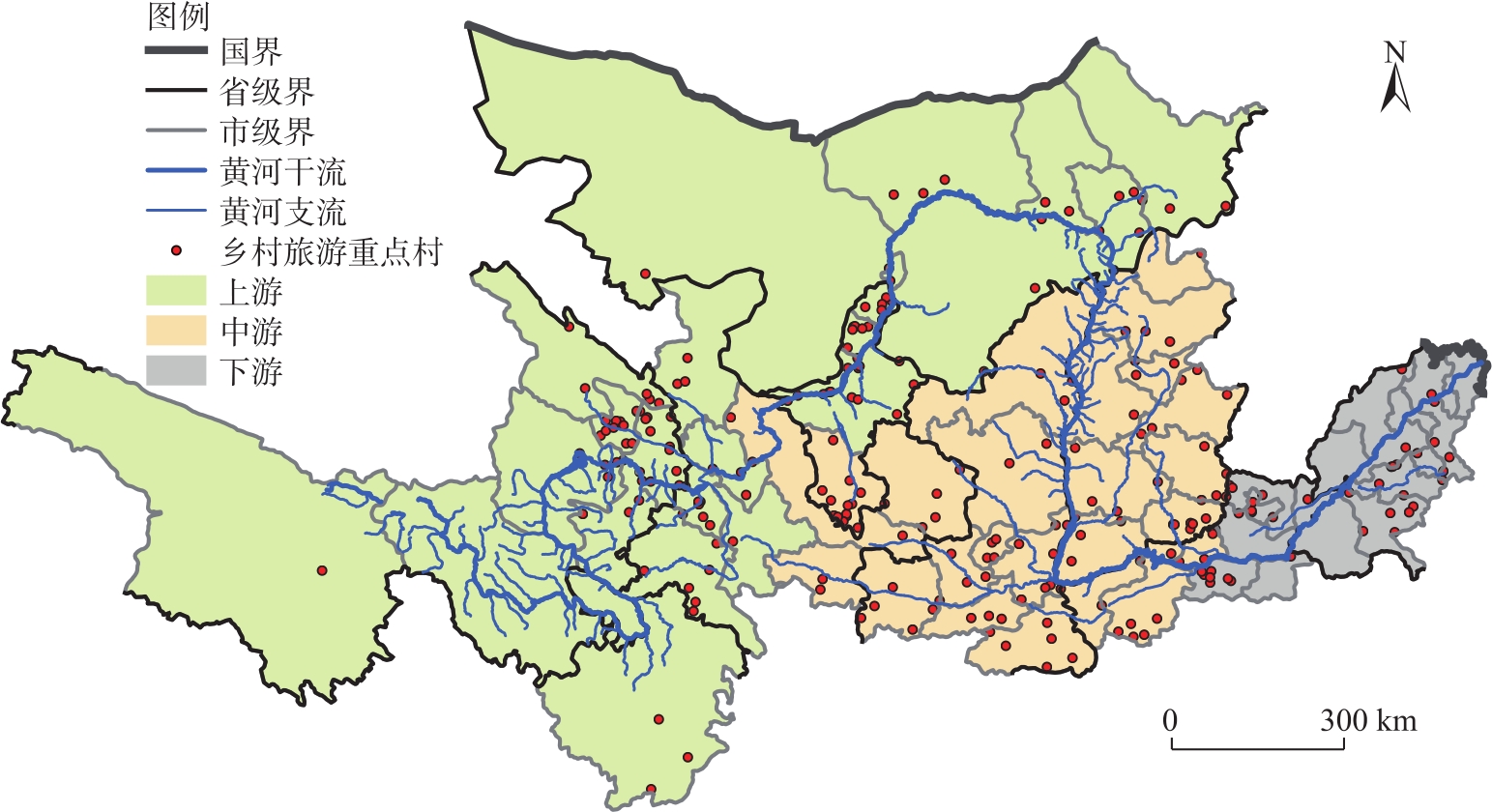

图2
黄河流域乡村旅游重点村空间分布特征"


表1
黄河流域乡村旅游重点村空间分布影响因素指标体系"
| 一级指标 | 二级指标 | 三级指标 | 指标释义 | 单位 |
|---|---|---|---|---|
| 自然环境条件 | 自然地理特征 | 高程(x1) | 重点村海拔高度 | m |
| 河网密度(x2) | 各市区内河流总长度/市区面积 | km·km-2 | ||
| 气候与水文 | 年平均降水量(x3) | 各市区年平均降雨量 | mm | |
| 年平均气温(x4) | 各市区年平均气温 | ℃ | ||
| 生态环境质量 | 植被覆盖度(x5) | 各市区地表植被覆盖/市区面积 | - | |
| 空气质量优良率(x6) | 区域空气质量的整体状况 | - | ||
| 社会经济条件 | 人口与城镇化 | 人口密度(x7) | 各市区人口总量/市区面积 | 人·km-2 |
| 城镇化率(x8) | 城镇人口占总人口的比例 | - | ||
| 经济发展水平 | 城镇居民人均可支配收入(x9) | 各市区城镇人口收入水平 | 元 | |
| 人均GDP(x10) | 经济基础支撑 | 元 | ||
| 交通与区位 | 路网密度(x11) | 各市区内道路总长度/市区面积 | km·km-2 | |
| 距省会城市距离(x12) | 区位优势、经济辐射影响和交通可达性 | km | ||
| 旅游产业条件 | 资源禀赋 | A级景区数量(x13) | 重点村所在市区A级景区数量 | 个 |
| 非物质文化遗产数量(x14) | 重点村所在市区非物质文化遗产数量 | 个 | ||
| 旅游经济规模 | 全年接待国内外游客数(x15) | 旅游市场活力及吸引力水平 | 人 | |
| 旅游总收入(x16) | 旅游业市场地位 | 元 |
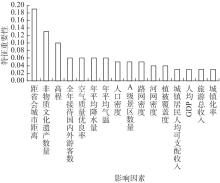
图3
黄河流域乡村旅游重点村空间分布影响因素重要性度量"

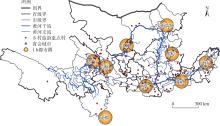
图4
黄河流域省会城市1 h都市圈"


图5
黄河流域乡村旅游重点村与高程叠加分析"

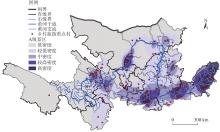
图6
黄河流域乡村旅游重点村与A级景区叠加分析"

表2
黄河流域乡村旅游重点村空间分布影响因素交互探测结果"
| 影响因素 | x1 | x2 | x3 | x4 | x5 | x6 | x7 | x8 | x9 | x10 | x11 | x12 | x13 | x14 | x15 | x16 |
|---|---|---|---|---|---|---|---|---|---|---|---|---|---|---|---|---|
| x1 | 0.20 | |||||||||||||||
| x2 | 0.28 | 0.06 | ||||||||||||||
| x3 | 0.33 | 0.28 | 0.18 | |||||||||||||
| x4 | 0.26 | 0.31 | 0.39 | 0.15 | ||||||||||||
| x5 | 0.32 | 0.17 | 0.29 | 0.37 | 0.04 | |||||||||||
| x6 | 0.27 | 0.19 | 0.42 | 0.31 | 0.28 | 0.13 | ||||||||||
| x7 | 0.36 | 0.25 | 0.34 | 0.33 | 0.19 | 0.35 | 0.09 | |||||||||
| x8 | 0.40 | 0.31 | 0.42 | 0.30 | 0.43 | 0.40 | 0.31 | 0.15 | ||||||||
| x9 | 0.40 | 0.24 | 0.37 | 0.25 | 0.37 | 0.38 | 0.27 | 0.25 | 0.04 | |||||||
| x10 | 0.25 | 0.11 | 0.29 | 0.25 | 0.15 | 0.19 | 0.17 | 0.26 | 0.09 | 0.02 | ||||||
| x11 | 0.47 | 0.31 | 0.42 | 0.47 | 0.40 | 0.41 | 0.25 | 0.47 | 0.42 | 0.23 | 0.15 | |||||
| x12 | 0.43 | 0.33 | 0.54 | 0.43 | 0.20 | 0.45 | 0.30 | 0.44 | 0.26 | 0.18 | 0.33 | 0.15 | ||||
| x13 | 0.31 | 0.26 | 0.33 | 0.29 | 0.22 | 0.35 | 0.33 | 0.27 | 0.22 | 0.07 | 0.35 | 0.30 | 0.01 | |||
| x14 | 0.45 | 0.41 | 0.40 | 0.42 | 0.26 | 0.49 | 0.22 | 0.43 | 0.28 | 0.15 | 0.33 | 0.34 | 0.21 | 0.10 | ||
| x15 | 0.26 | 0.16 | 0.32 | 0.22 | 0.19 | 0.31 | 0.18 | 0.27 | 0.16 | 0.20 | 0.28 | 0.30 | 0.13 | 0.26 | 0.05 | |
| x16 | 0.32 | 0.17 | 0.29 | 0.26 | 0.19 | 0.25 | 0.15 | 0.26 | 0.16 | 0.14 | 0.24 | 0.28 | 0.16 | 0.19 | 0.18 | 0.09 |
| [1] | 崔茂森, 刘荣庆. 黄河流域生态旅游与乡村振兴耦合协调及障碍因子研究[J]. 河南师范大学学报(自然科学版), 2024, 52(2): 1-7. |
| [Cui Maosen, Liu Rongqing. A study on the coupling coordination and obstacle factors of ecotourism and rural revitalization in the Yellow River Basin[J]. Journal of Henan Normal University (Natural Science Edition), 2024, 52(2): 1-7. ] | |
| [2] |
杨燕燕, 王永瑜, 徐绮阳. 黄河流域水资源利用驱动因素及脱钩效应研究[J]. 干旱区地理, 2025, 48(1): 20-30.
doi: 10.12118/j.issn.1000-6060.2024.073 |
|
[Yang Yanyan, Wang Yongyu, Xu Qiyang. Driving factors and decoupling effect of water resources utilization in the Yellow River Basin[J]. Arid Land Geography, 2025, 48(1): 20-30. ]
doi: 10.12118/j.issn.1000-6060.2024.073 |
|
| [3] | 方永恒, 张开欣. 黄河流域乡村旅游高质量发展水平测度研究[J]. 四川旅游学院学报, 2024(1): 70-76. |
| [Fang Yongheng, Zhang Kaixin. On the measurement of high-quality development level of rural tourism in the Yellow River Basin[J]. Journal of Sichuan Tourism University, 2024(1): 70-76. ] | |
| [4] | 刘凯霞, 王伟, 程金龙, 等. 黄河流域文旅协调发展水平空间差异与影响机制研究[J]. 河南师范大学学报(自然科学版), 2024, 52(2): 8-15. |
| [Liu Kaixia, Wang Wei, Cheng Jinlong, et al. Spatial differentiation and influencing mechanism of integration between culture and tourism on coupling coordination in the Yellow River Basin[J]. Journal of Henan Normal University (Natural Science Edition), 2024, 52(2): 8-15. ] | |
| [5] | 戚禹林, 王丽丽, 李丁, 等. 中国乡村旅游重点村空间分布及影响因素[J]. 资源开发与市场, 2021(6): 734-740, 746. |
| [Qi Yulin, Wang Lili, Li Ding, et al. Spatial distribution and influencing factors of kev rural tourism villages in China[J]. Resource Development & Market, 2021(6): 734-740, 746. ] | |
| [6] | 刘宇杰, 周勇, 刘小东, 等. 中国“乡村旅游重点村”空间分布格局及影响因素[J]. 华中师范大学学报(自然科学版), 2022, 56(1): 211-220. |
| [Liu Yujie, Zhou Yong, Liu Xiaodong, et al. Spatial distribution and influencing factors of “key rural tourism villages” in China[J]. Journal of Central China Normal University (Natural Sciences Edition), 2022, 56(1): 211-220. ] | |
| [7] | 王慧娴, 杨蓓, 陈思静, 等. 基于网络关注度的黄河流域乡村旅游发展模式研究[J]. 中国农业资源与区划, 2024, 45(7): 221-235. |
| [Wang Huixian, Yang Bei, Chen Sijing, et al. Research on the development mode of rural tourism in the Yellow River Basin based on network attention[J]. Chinese Journal of Agricultural Resources and Regional Planning, 2024, 45(7): 221-235. ] | |
| [8] | 马斌斌, 陈兴鹏, 马凯凯, 等. 中国乡村旅游重点村空间分布、类型结构及影响因素[J]. 经济地理, 2020, 40(7): 191-199. |
| [Ma Binbin, Chen Xingpeng, Ma Kaikai, et al. Spatial distribution, type structure and influencing factors of key rural tourism villages in China[J]. Economic Geography, 2020, 40(7): 191-199. ] | |
| [9] | 孙卿, 高楠, 田祥宇. 山西省乡村旅游重点村空间分布特征及其影响因素研究[J]. 经济问题, 2024(3): 106-112. |
| [Sun Qing, Gao Nan, Tian Xiangyu. A study on the spatial distribution characteristics and influencing factors of key rural tourism villages in Shanxi Province[J]. On Economic Problems, 2024(3): 106-112. ] | |
| [10] | 郑光辉, 蒋涤非, 陈国磊, 等. 中国乡村旅游重点村空间分布格局及影响机理研究[J]. 干旱区资源与环境, 2020, 34(9): 194-201. |
| [Zheng Guanghui, Jiang Difei, Chen Guolei, et al. Spatial distribution pattern and influence mechanism of key rural tourism villages in China[J]. Journal of Arid Land Resources and Environment, 2020, 34(9): 194-201. ] | |
| [11] | 张慧, 李嘉琛, 刘江龙. 湖南省乡村旅游重点村空间分异特征及影响因子[J]. 中南林业科技大学学报, 2023, 43(9): 171-180. |
| [Zhang Hui, Li Jiachen, Liu Jianglong. Spatial differentiation characteristics and influencing factors of key rural tourism villages in Hunan Province[J]. Journal of Central South University of Forestry & Technology, 2023, 43(9): 171-180. ] | |
| [12] | 吴昕昱, 张文政. 河南省乡村旅游地空间分布与影响因素研究[J]. 中国农业资源与区划, 2020, 41(8): 238-246. |
| [Wu Xinyu, Zhang Wenzheng. Study on the spatial distribution and influencing factors of rural tourism destinations in Henan Province[J]. Chinese Journal of Agricultural Resources and Regional Planning, 2020, 41(8): 238-246. ] | |
| [13] |
沈士琨, 史春云, 张大园, 等. 江苏省乡村旅游地空间分布及其影响因素研究[J]. 中国生态旅游, 2021, 11(3): 455-467.
doi: 10.12342/zgstly.20210047 |
|
[Shen Shikun, Shi Chunyun, Zhang Dayuan, et al. Research on the spatial distribution of rural tourist attractions in Jiangsu Province and its influencing factors[J]. Journal of Chinese Ecotourism, 2021, 11(3): 455-467. ]
doi: 10.12342/zgstly.20210047 |
|
| [14] | 田彩云, 管祥泰, 田惠文. 黄河流域乡村旅游重点村空间分布特征及其影响因素研究[J]. 旅游学刊, 2023, 38(8): 32-44. |
| [Tian Caiyun, Guan Xiangtai, Tian Huiwen. Spatial distribution characteristic and its influencing factors of key rural tourism villages in the Yellow River Basin[J]. Tourism Tribune, 2023, 38(8): 32-44. ] | |
| [15] |
宋小龙, 马明德, 李陇堂, 等. 宁夏乡村旅游重点村空间格局与影响因素分析[J]. 干旱区地理, 2024, 47(11): 1957-1969.
doi: 10.12118/j.issn.1000-6060.2023.731 |
|
[Song Xiaolong, Ma Mingde, Li Longtang, et al. Spatial pattern and influencing factors of key rural tourism villages in Ningxia[J]. Arid Land Geography, 2024, 47(11): 1957-1969. ]
doi: 10.12118/j.issn.1000-6060.2023.731 |
|
| [16] | 崔红茶, 陈新, 王涛, 等. 长江流域乡村旅游重点村空间分异特征及影响因素[J]. 生态经济, 2024, 40(6): 126-134. |
| [Cui Hongcha, Chen Xin, Wang Tao, et al. Spatial differentiation and influencing factors of rural tourism key villages in the Yangtze River Basin[J]. Ecological Economy, 2024, 40(6): 126-134. ] | |
| [17] | 温秀, 黄枭, 崔林. 黄河流域乡村旅游重点村及其网络关注度空间分异规律[J]. 西北大学学报(自然科学版), 2024, 54(3): 472-488. |
| [Wen Xiu, Huang Xiao, Cui Lin. Key villages of rural tourism in the Yellow River Basin and their network attention levels research on the law of spatial differentiation[J]. Journal of Northwest University (Natural Science Edition), 2024, 54(3): 472-488. ] | |
| [18] | 孙锦甲. 黄河流域乡村旅游重点村空间分布特征与影响因素分析[D]. 开封: 河南大学, 2022. |
| [Sun Jinjia. Spatial distribution characteristic and its influencing factors of key rural tourism villages in the Yellow River Basin[D]. Kaifeng: Henan University, 2022. ] | |
| [19] | 刘丽梅, 习瑞, 李帅威. 全国乡村旅游重点村空间分布及区位优势度分析[J]. 城市发展研究, 2024, 31(12): 26-33. |
| [Liu Limei, Xi Rui, Li Shuaiwei. Analysis of spatial distribution and location advantage of national rural tourism key villages: Take Gansu as an example[J]. Urban Development Research, 2024, 31(12): 26-33. ] | |
| [20] | 张定祥, 彭晋福. 2022年中国1 km格网河网密度数据集[DB/OL]. [2025-04-17]. https://doi.org/10.57760/sciencedb.16001. |
| [Zhang Dingxiang, Peng Jinfu. China 1-km grid rivernetwork density dataset (2022)[DB/OL]. [2025-04-17]. https://doi.org/10.57760/scien-cedb.16001.] | |
| [21] | 李亚南, 张定祥. 2019年中国1 km格网路网密度数据集[DB/OL]. [2024-09-02]. https://cstr.cn/31253.11.sciencedb.02938.CSTR:31253.11.sciencedb.02938. |
| [Li Yanan, Zhang Dingxiang. China 1-km grid road network density dataset (2022)[DB/OL]. [2025-04-17]. https://cstr.cn/31253.11.sciencedb.02938.CSTR:31253.11.sciencedb.02938.] | |
| [22] |
周成, 赵亚玲, 任敏敏, 等. 黄河流域国家湿地公园时空分异、重心演化与驱动因素分析[J]. 干旱区地理, 2024, 47(3): 506-514.
doi: 10.12118/j.issn.1000-6060.2023.365 |
|
[Zhou Cheng, Zhao Yaling, Ren Minmin, et al. Spatiotemporal differentiation, center of gravity evolution and driving factors of national wetland parks in the Yellow River Basin[J]. Arid Land Geography, 2024, 47(3): 506-514. ]
doi: 10.12118/j.issn.1000-6060.2023.365 |
|
| [23] |
曹开军, 商宁, 王秘秘. 中国西北五省乡村旅游重点村时空分布格局与可达性分析[J]. 干旱区地理, 2023, 46(7): 1196-1205.
doi: 10.12118/j.issn.1000-6060.2022.531 |
|
[Cao Kaijun, Shang Ning, Wang Mimi. Spatial distribution pattern and accessibility analysis of the key rural tourism villages in the five northwestern provinces of China[J]. Arid Land Geography, 2023, 46(7): 1196-1205. ]
doi: 10.12118/j.issn.1000-6060.2022.531 |
|
| [24] |
谭翠, 黄钦, 杨波, 等. 随机森林算法在区域生态旅游适宜性评价中的应用研究[J]. 地球信息科学学报, 2024, 26(2): 318-331.
doi: 10.12082/dqxxkx.2024.230198 |
| [Tan Cui, Huang Qin, Yang Bo, et al. Application of random forest algorithm in regional ecotourism suitability assessment[J]. Journal of Geo-information Science, 2024, 26(2): 318-331. ] | |
| [25] | 李云涛, 王海英, 陶犁, 等. 京郊乡村旅游地空间分布演化及其影响因素的地理探测[J]. 中国农业资源与区划, 2023, 44(1): 214-228. |
| [Li Yuntao, Wang Haiying, Tao Li, et al. Geogeraphic detector of spatial differentiation evolution and its influencing factors of rural tourism destination in suburbs of Beijing[J]. Chinese Journal of Agricultural Resources and Regional Planning, 2023, 44(1): 214-228. ] | |
| [26] | 唐黎, 黄舒琪. 福建省全国乡村旅游重点村空间分布及影响因素[J]. 中南林业科技大学学报, 2023, 43(9): 181-190. |
| [Tang Li, Huang Shuqi. Spatial distribution and influencing factors of the key villages of national rural tourism in Fujian Province[J]. Journal of Central South University of Forestry & Technology, 2023, 43(9): 181-190. ] | |
| [27] | 张诗语, 何峰, 胡晓慧, 等. 河北省乡村旅游地空间分布特征及其影响因素[J]. 湖南师范大学自然科学学报, 2023, 46(2): 103-112. |
| [Zhang Shiyu, He Feng, Hu Xiaohui, et al. Spatial distribution characteristics and influencing factors of rural tourism destinations in Hebei Province[J]. Journal of Natural Science of Hunan Normal University, 2023, 46(2): 103-112. ] | |
| [28] |
耿满国, 张伟, 唐相龙, 等. 中国乡村旅游地的空间分布特征及影响因素[J]. 世界地理研究, 2024, 33(2): 151-163.
doi: 10.3969/j.issn.1004-9479.2024.02.20220431 |
|
[Geng Manguo, Zhang Wei, Tang Xianglong, et al. Spatial distribution characteristics and influencing factors of rural tourism destinations in China[J]. World Regional Studies, 2024, 33(2): 151-163. ]
doi: 10.3969/j.issn.1004-9479.2024.02.20220431 |
|
| [29] | 卫威, 姚瑶. 文旅融合背景下非物质文化遗产旅游开发[J]. 西部旅游, 2023(24): 49-51. |
| [Wei Wei, Yao Yao. Tourism development of intangible cultural heritage under the background of cultural-tourism integration[J]. Western Tourism, 2023(24): 49-51. ] | |
| [30] | 朱尖, 姜维公. 黄河故道线性文化遗产旅游价值评价与开发研究[J]. 资源开发与市场, 2013, 29(5): 553-556. |
| [Zhu Jian, Jiang Weigong. Study on evaluating tourism value of ancient course of Yellow River lineal cultural heritage and tourism development[J]. Resource Development & Market, 2013, 29(5): 553-556. ] |
| [1] | 王晓菲, 邳华伟, 李思思. 青藏高原土壤风蚀潜力时空特征及驱动因素分析[J]. 干旱区地理, 2025, 48(9): 1589-1599. |
| [2] | 张少华, 关海玲. 创新集聚空间分布模式对中国城市经济韧性的影响机制研究[J]. 干旱区地理, 2025, 48(9): 1636-1647. |
| [3] | 彭文英, 赵爽, 单子溢, 陈泽宇. 黄河流域新质生产力生态化水平测度与障碍因子[J]. 干旱区地理, 2025, 48(9): 1648-1659. |
| [4] | 田小波. 黄河流域城市旅游业高质量发展水平测度与空间格局特征[J]. 干旱区地理, 2025, 48(9): 1660-1671. |
| [5] | 张毅明, 汤宇磊, 冯俊波. 基于随机森林模型的青藏高原冰川预测及分析[J]. 干旱区地理, 2025, 48(8): 1342-1352. |
| [6] | 李慧, 姚西龙. 水足迹视角下黄河流域可再生能源制氢节水潜力研究[J]. 干旱区地理, 2025, 48(8): 1353-1362. |
| [7] | 仲嘉维, 郑军, 张明月. 农业社会化服务如何影响粮食生态效率——以黄河流域71个地级市为例[J]. 干旱区地理, 2025, 48(8): 1385-1395. |
| [8] | 赵建文, 李金麟, 王圣杰. 祁连山土壤水分时空变化特征及主要驱动因素分析[J]. 干旱区地理, 2025, 48(8): 1480-1491. |
| [9] | 程鹏, 彭海洋, 侯丁榕, 孙明东, 宋晓伟. 黄河流域农业灰水足迹强度空间格局及演进趋势[J]. 干旱区地理, 2025, 48(7): 1185-1197. |
| [10] | 徐铭璟, 段宝玲, 冯强, 吕萌. 生态系统服务及其权衡/协同关系多情景模拟——以黄河流域山西段为例[J]. 干旱区地理, 2025, 48(7): 1206-1219. |
| [11] | 张晓明, 宿星, 张军, 贾静. 基于PLUS-InVEST模型的甘肃通渭滑坡区生境质量时空变化及预测[J]. 干旱区地理, 2025, 48(7): 1220-1232. |
| [12] | 夏梓洋, 夏云帆, 王宁, 林伟, 马丽娜, 谭晓平, 张艳珍, 焦瑞. 基于POI的天山北坡城市群旅游要素空间格局及影响因素[J]. 干旱区地理, 2025, 48(7): 1243-1254. |
| [13] | 田志馥, 于亚娟, 黄辰宇. 基于POI数据挖掘的内蒙古县域旅游要素空间分布特征及影响因素[J]. 干旱区地理, 2025, 48(7): 1255-1266. |
| [14] | 武志平, 姜民, 付建新. 黄河“几”字弯都市圈城镇化高质量发展时空分异及驱动力[J]. 干旱区地理, 2025, 48(7): 1279-1292. |
| [15] | 任诗琦, 王永瑜. 黄河流域地级市绿色发展水平测度与空间收敛性研究[J]. 干旱区地理, 2025, 48(6): 1031-1042. |
|
||

