干旱区地理 ›› 2026, Vol. 49 ›› Issue (3): 594-606.doi: 10.12118/j.issn.1000-6060.2025.199 cstr: 32274.14.ALG2025199
屠正伟( ), 张沛(), 张中华
收稿日期:2025-04-14
修回日期:2025-05-22
出版日期:2026-03-25
发布日期:2026-03-24
通讯作者:
张沛(1968-),男,教授,博士生导师,主要从事城市与区域规划、乡村规划建设研究. E-mail: tianxingjiansmx@126.com作者简介:屠正伟(1995-),男,博士研究生,主要从事城市与区域规划、乡村规划建设研究. E-mail: tuzhengwei1898@xauat.edu.cn
基金资助:
TU Zhengwei(), ZHANG Pei(), ZHANG Zhonghua
Received:2025-04-14
Revised:2025-05-22
Published:2026-03-25
Online:2026-03-24
摘要:
厘清都市圈乡村“三生空间”冲突格局的演变进程及其影响因素是实现都市圈乡村高质量协同发展的理论前提。以中国西北地区培育型都市圈——银川都市圈为例,结合空间冲突测度模型、热点分析、地理探测器模型等方法,剖析自城乡一体化发展阶段以来都市圈乡村“三生空间”冲突格局的时空演变进程、规律及影响因素。结果表明:(1)自城乡一体化发展阶段以来,银川都市圈乡村“三生空间”长期保持着权衡关系,冲突格局在空间维度呈现显著的“城乡分异”聚类特征,在时间维度呈现显著的“时空交替”演变规律。(2)“自然本底、城乡关系、发展阶段”等维度的差异是银川都市圈乡村“三生空间”冲突格局形成与演变的核心影响因素。研究认为:城乡融合发展阶段以后,以合理的政策制度作为牵引,以“地形地势、地理区位、交通区位”等维度作支撑,实现“资源禀赋、人口规模、产业结构”3维度的有效协调,可推动银川都市圈乡村“三生空间”冲突格局的深度优化。
屠正伟, 张沛, 张中华. 银川都市圈乡村“三生空间”冲突格局演变特征及影响因素[J]. 干旱区地理, 2026, 49(3): 594-606.
TU Zhengwei, ZHANG Pei, ZHANG Zhonghua. Evolutionary characteristics and influencing factors of conflict patterns of rural “production-living-ecological spaces” in the Yinchuan metropolitan coordinating region[J]. Arid Land Geography, 2026, 49(3): 594-606.
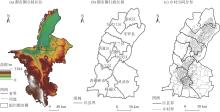
图1
研究区概况 注:基于自然资源部标准地图服务网站审图号为GS(2024)0650号的标准地图制作,底图边界无修改。下同。"
表1
数据来源"
| 类型 | 名称 | 年份 | 来源 |
|---|---|---|---|
| 空间数据 | 15 m分辨率多波段遥感影像数据 | 2013、2018、2023 | 中国遥感数据网( |
| 30 m分辨率数字高程数据 | 2013、2018、2023 | 阿拉斯加卫星设施网站( | |
| 气象数据 | 2013、2018、2023 | 中国气象网(http:∥data.cma.cn) | |
| 道路数据 | 2013、2018、2023 | Open Street Map网站( | |
| 1 km分辨率人口密度数据 | 2013、2018、2023 | 美国能源部橡树岭国家实验室网站( | |
| 乡镇级行政区划矢量数据 | 2021 | 百度地图( | |
| 省市县级行政区划矢量数据 | 2024 | 国家地理信息公共服务平台( | |
| 统计数据 | 社会经济数据 | 2013、2018、2023 | 《宁夏回族自治区统计年鉴》 |
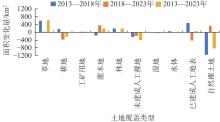
图2
两阶段10类型土地覆盖的面积变化"
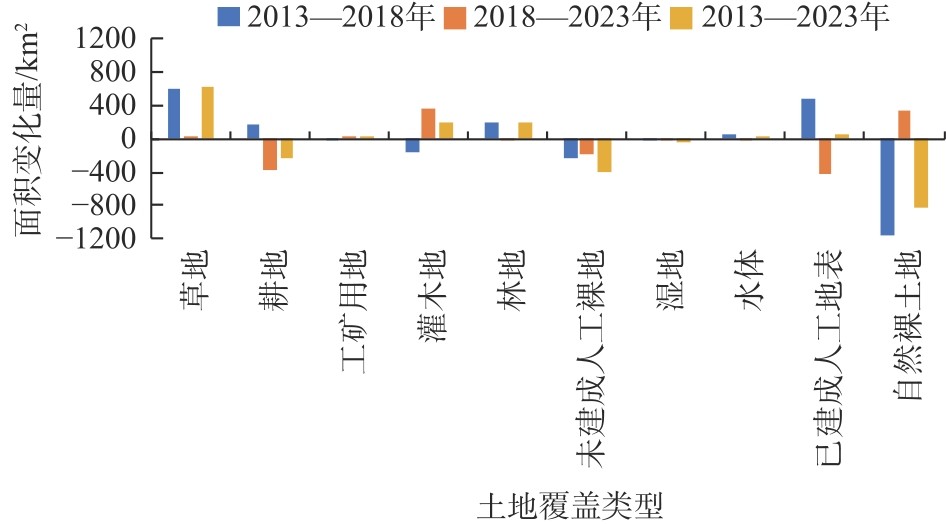
表2
2013—2023年银川都市圈乡村“三生空间”面积及其变化"
| 空间类型 | 面积/km2 | 面积变化量/km2 | |||||
|---|---|---|---|---|---|---|---|
| 2013年 | 2018年 | 2023年 | 2013—2018年 | 2018—2023年 | 2013—2023年 | ||
| 生产空间 | 2812.57 | 2950.98 | 2595.94 | 138.41 | -355.04 | -216.63 | |
| 生活空间 | 1835.75 | 2192.39 | 1846.96 | 356.64 | -345.43 | 11.20 | |
| 生态空间 | 4968.92 | 4473.87 | 5174.27 | -495.05 | 700.40 | 205.35 | |
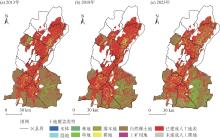
图3
2013—2023年银川都市圈乡村“三生空间”分布格局"
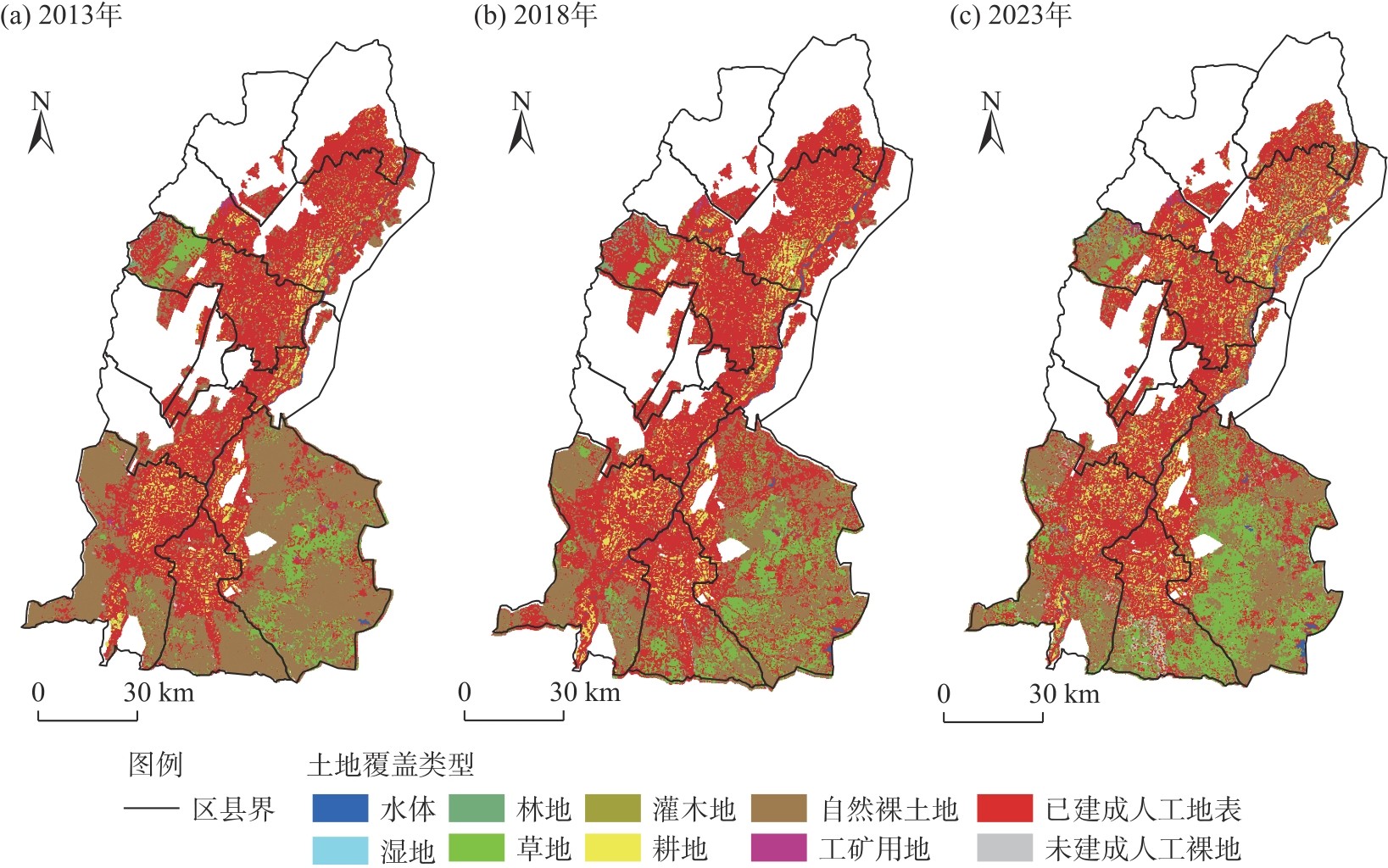
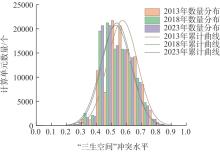
图4
2013—2023年银川都市圈乡村“三生空间”冲突指数统计"
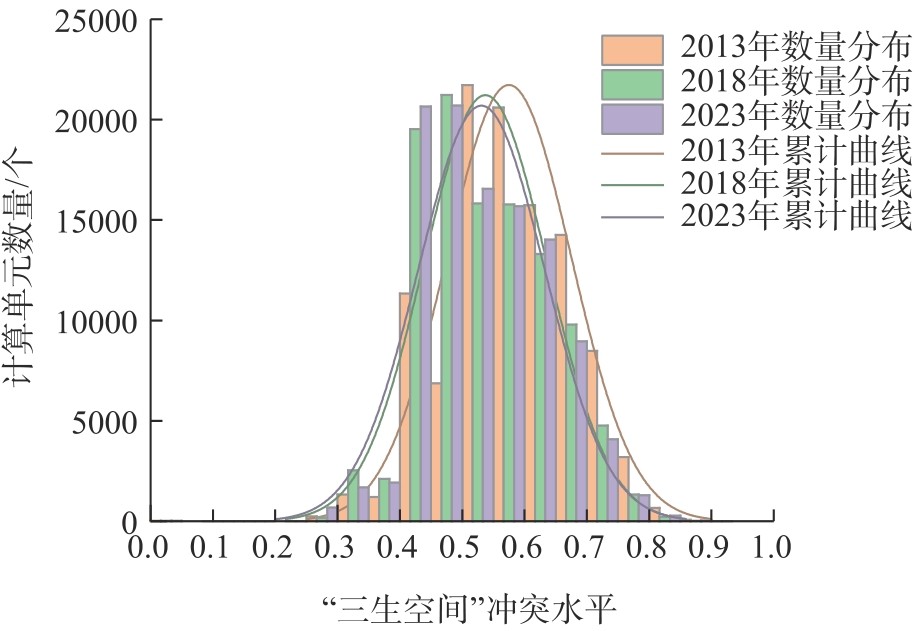
图5
2013—2023年银川都市圈乡村“三生空间”冲突指数分布格局及其变化"
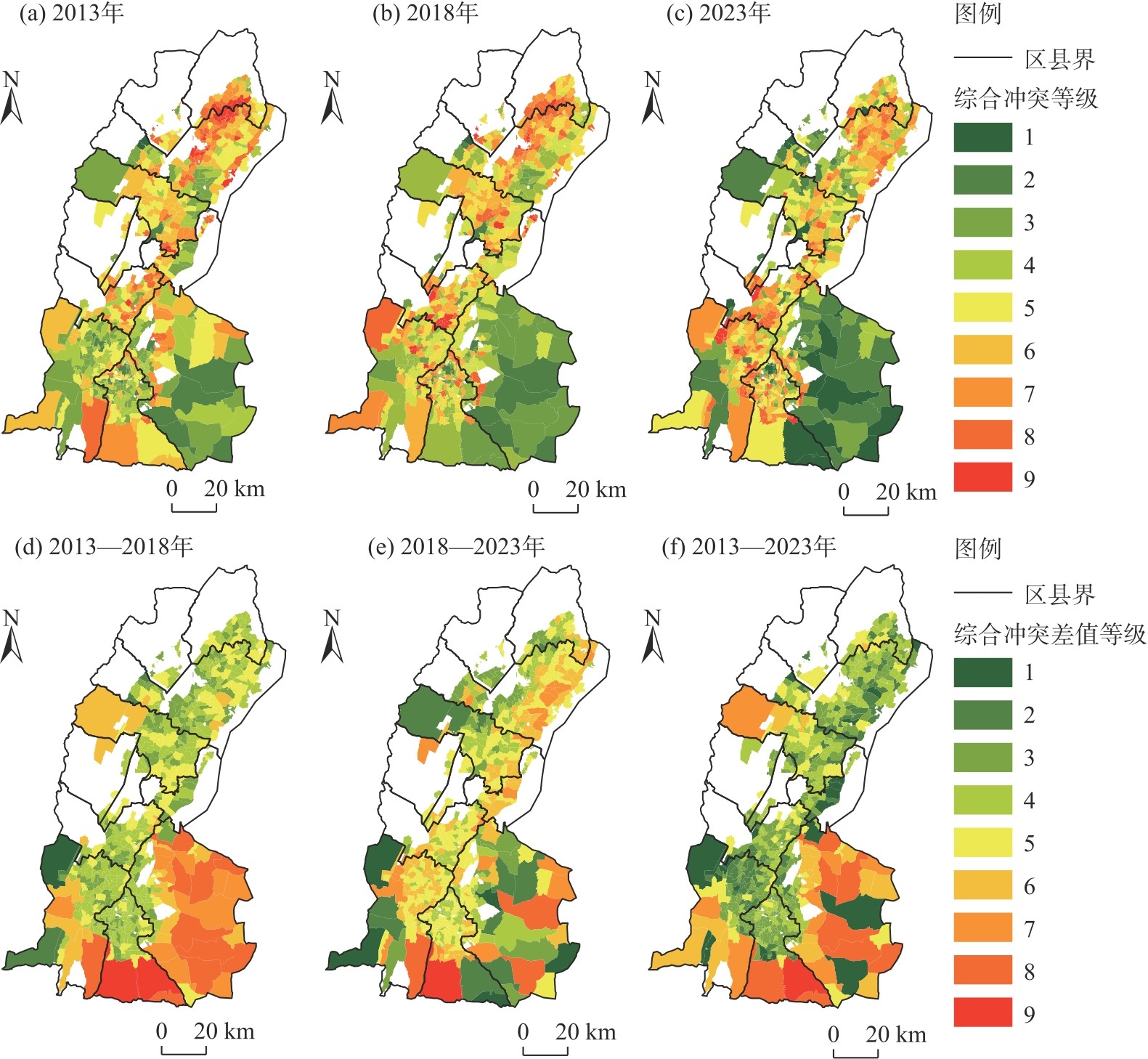
图6
2013—2023年银川都市圈乡村“三生空间”冲突指数热点分析"
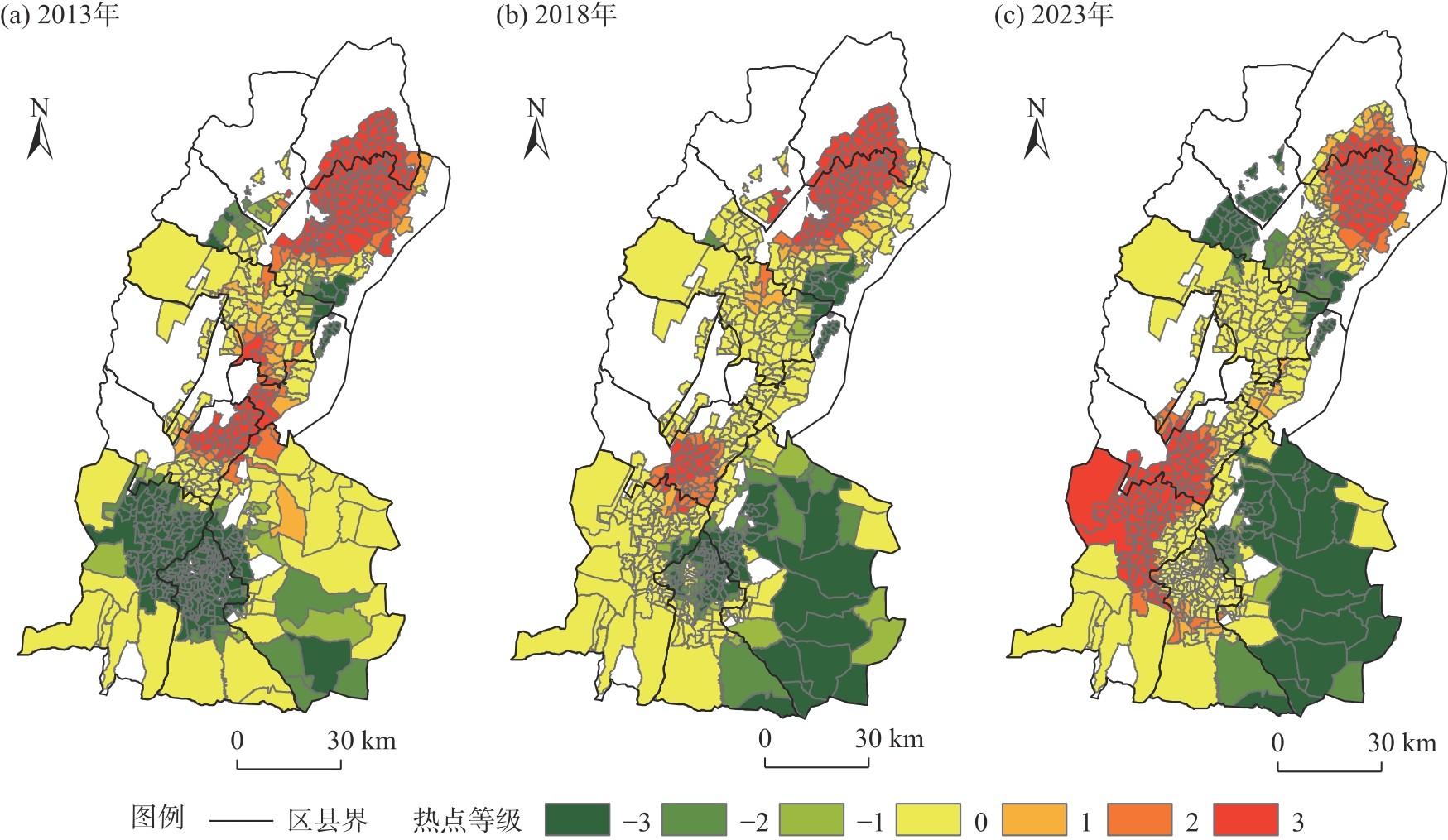
表3
解释变量"
| 一级指标 | 二级指标 | 具体指标 | 变量阐释 |
|---|---|---|---|
| 自然本底条件 | 地形地势 | 地形起伏(A1)/m | 村域内海拔的最大、最小值差[ |
| 平均海拔(A2)/m | 村域内海拔平均值[ | ||
| 平均坡度(A3)/(°) | 村域内坡度平均值[ | ||
| 气候条件 | 平均气温(A4)/℃ | 村域内气温平均值[ | |
| 日照小时(A5)/h | 村域内月平均日照小时 | ||
| 平均降水量(A6)/mm | 村域内月平均降水总量[ | ||
| 交通区位条件 | 地理区位 | 距离中心城市距离(B1)/km | 乡村质心与都市圈中心城市质心的直线距离[ |
| 距离地级城市距离(B2)/km | 乡村质心与都市圈地级市质心的直线距离[ | ||
| 交通便利度 | 高等级道路密度(B3)/m·km-2 | 村域内国道、省道等道路网络密度[ | |
| 低等级道路密度(B4)/m·km-2 | 村域内县道、乡道网络密度[ | ||
| 产业发展环境 | 经济发展水平 | 县域平均GDP(C1)/元 | 县域平均生产总值[ |
| 产业结构现状 | 第一产业占比(C2)/% | 县域第一产业占总GDP的比值[ | |
| 第二产业占比(C3)/% | 县域第二产业占总GDP的比值[ | ||
| 第三产业占比(C4)/% | 县域第三产业占总GDP的比值[ | ||
| 社会经济环境 | 人口规模 | 年末人口密度(D1)/人·km-2 | 村域内年末人口密度[ |
| 民族融合水平 | 少数民族人口占比(D2)/% | 县域少数民族人口占总人口的比值 | |
| 政府支撑力度 | 地方财政一般预算支出(D3)/元 | 县域财政一般预算支出[ | |
| 城乡居民生活水平差异 | 城乡居民人均可支配收入比(D4)/% | 县域乡村人均可支配收入与城市的比值 | |
| 城乡居民人均生活消费支出比(D5)/% | 县域乡村人均生活消费支出与城市的比值 |
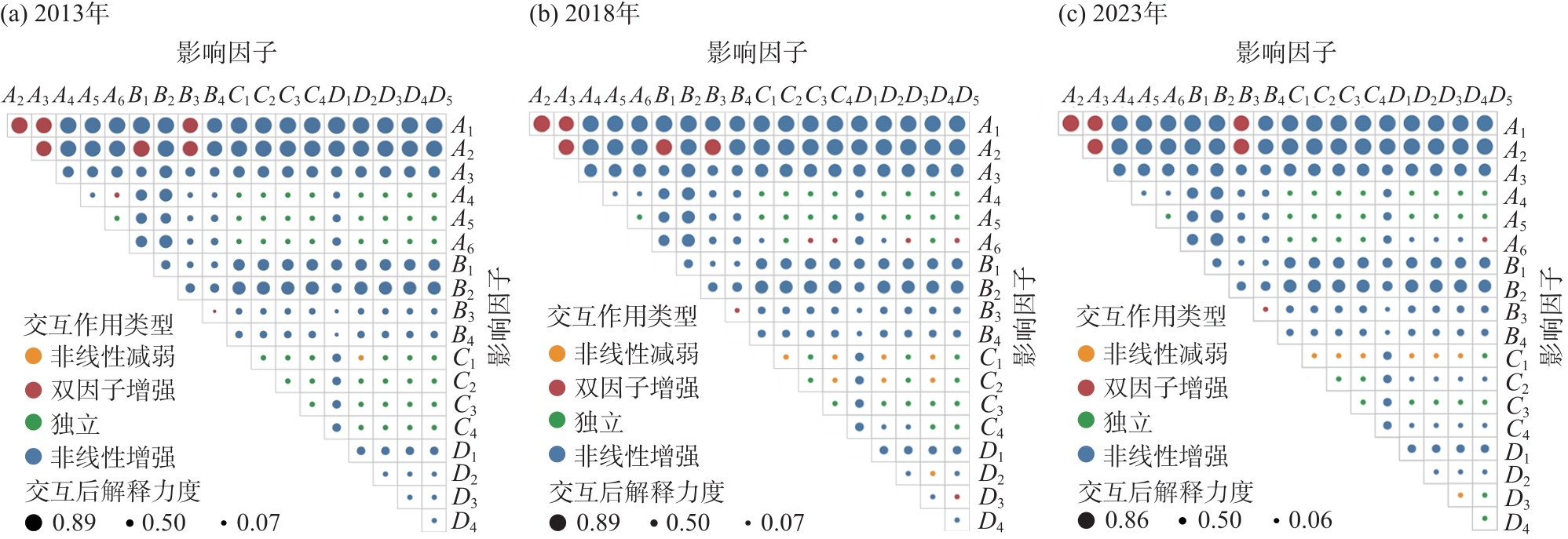
图7
2013—2023年影响因子的离散系数与单因子探测结果 注:q值反映影响因子对冲突指数空间分异的解释力度;P值用于判断q值统计结果的显著性;A1~D5的含义见表3。下同。"
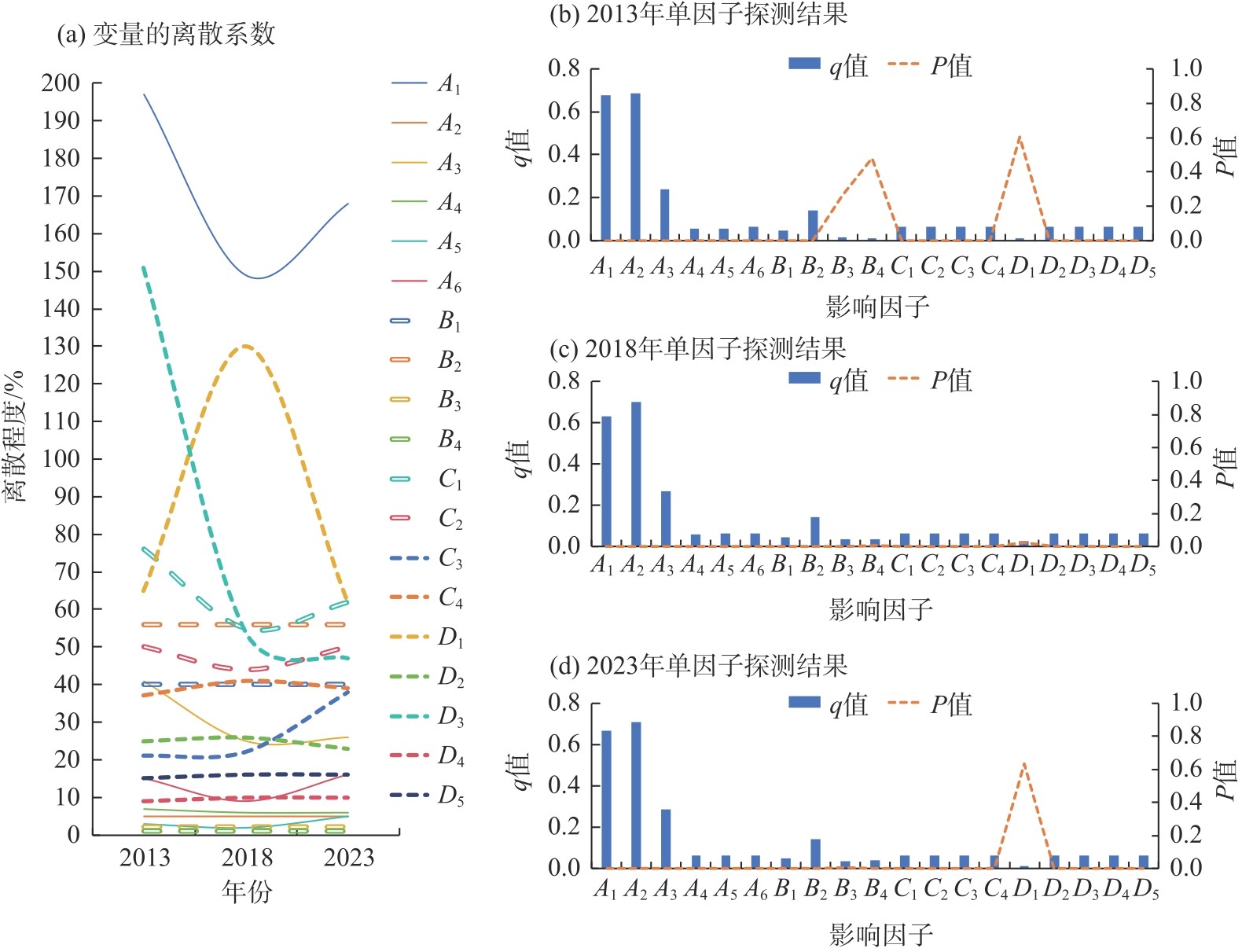
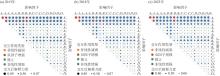
图8
2013—2023年影响因子的交互探测结果"
| [1] |
黄安, 许月卿, 卢龙辉, 等. “生产-生活-生态”空间识别与优化研究进展[J]. 地理科学进展, 2020, 39(3): 503-518.
doi: 10.18306/dlkxjz.2020.03.014 |
|
[Huang An, Xu Yueqing, Lu Longhui, et al. Research progress of the identification and optimization of production-living-ecological spaces[J]. Progress in Geography, 2020, 39(3): 503-518.]
doi: 10.18306/dlkxjz.2020.03.014 |
|
| [2] |
邹利林, 刘彦随, 王永生. 中国土地利用冲突研究进展[J]. 地理科学进展, 2020, 39(2): 298-309.
doi: 10.18306/dlkxjz.2020.02.011 |
|
[Zou Lilin, Liu Yansui, Wang Yongsheng. Research progress and prospect of land-use conflicts in China[J]. Progress in Geography, 2020, 39(2): 298-309.]
doi: 10.18306/dlkxjz.2020.02.011 |
|
| [3] |
方创琳. 城乡融合发展机理与演进规律的理论解析[J]. 地理学报, 2022, 77(4): 759-776.
doi: 10.11821/dlxb202204001 |
|
[Fang Chuanglin. Theoretical analysis on the mechanism and evolution law of urban-rural integration development[J]. Acta Geographica Sinica, 2022, 77(4): 759-776.]
doi: 10.11821/dlxb202204001 |
|
| [4] |
刘彦随. 中国新时代城乡融合与乡村振兴[J]. 地理学报, 2018, 73(4): 637-650.
doi: 10.11821/dlxb201804004 |
|
[Liu Yansui. Research on the urban-rural integration and rural revitalization in the new era in China[J]. Acta Geographica Sinica, 2018, 73(4): 637-650.]
doi: 10.11821/dlxb201804004 |
|
| [5] | 汪光焘, 叶青, 李芬, 等. 培育现代化都市圈的若干思考[J]. 城市规划学刊, 2019(5): 14-23. |
| [Wang Guangtao, Ye Qing, Li Fen, et al. Some thoughts on cultivating a modern metropolitan area[J]. Urban Planning Forum, 2019(5): 14-23.] | |
| [6] |
田俊峰, 王彬燕, 王士君. 土地利用冲突研究的逻辑主线与内容框架[J]. 资源科学, 2023, 45(3): 465-479.
doi: 10.18402/resci.2023.03.01 |
|
[Tian Junfeng, Wang Binyan, Wang Shijun. The paradigms and main content of land use conflict research[J]. Resources Science, 2023, 45(3): 465-479.]
doi: 10.18402/resci.2023.03.01 |
|
| [7] | 翟端强. 城市群国土空间冲突识别、归因与消解[J]. 城市规划, 2024, 48(4): 71-84. |
| [Zhai Duanqiang. Identification, attribution, and resolution of territorial space conflict in urban agglomerations[J]. City Planning Review, 2024, 48(4): 71-84.] | |
| [8] | 周国华, 彭佳捷. 空间冲突的演变特征及影响效应——以长株潭城市群为例[J]. 地理科学进展, 2012, 31(6): 717-723. |
|
[Zhou Guohua, Peng Jiajie. The evolution characteristics and influence effect of spatial conflict: A case study of Changsha-Zhuzhou-Xiangtan urban agglomeration[J]. Progress in Geography, 2012, 31(6): 717-723.]
doi: 10.11820/dlkxjz.2012.06.007 |
|
| [9] |
蒙吉军, 江颂, 拉巴卓玛, 等. 基于景观格局的黑河中游土地利用冲突时空分析[J]. 地理科学, 2020, 40(9): 1553-1562.
doi: 10.13249/j.cnki.sgs.2020.09.017 |
|
[Meng Jijun, Jiang Song, Laba Zhuoma, et al. The spatial and temporal analysis of land use conflict in the middle reaches of the Heihe River based on landscape pattern[J]. Scientia Geographica Sinica, 2020, 40(9): 1553-1562.]
doi: 10.13249/j.cnki.sgs.2020.09.017 |
|
| [10] |
冀正欣, 许月卿, 孙丹峰, 等. 土地系统科学支撑“三生”空间识别与管控——衔接逻辑及实现路径[J]. 资源科学, 2025, 47(1): 14-25.
doi: 10.18402/resci.2025.01.02 |
|
[Ji Zhengxin, Xu Yueqing, Sun Danfeng, et al. The identification and management of production-living-ecological space from the perspective of land system science: Connection logic and realization path[J]. Resources Science, 2025, 47(1): 14-25.]
doi: 10.18402/resci.2025.01.02 |
|
| [11] | Pérez-Soba M, Petit S, Jones L, et al. Land use functions: A multifunctionality approach to assess the impact of land use changes on landuse sustainability[M]. Berlin Heidelberg: Springer, 2008: 76-106. |
| [12] | Kleemann J, Struve B, Spyra M. Conflicts in urban peripheries in Europe[J]. Land Use Policy, 2023, 133: 106849, doi: 10.1016/j.landusepol.2023.106849. |
| [13] |
Winemiller K O, McIntyre P B, Castello L, et al. Balancing hydropower and biodiversity in the Amazon, Congo, and Mekong[J]. Science, 2016, 351(6269): 128-129.
doi: 10.1126/science.aac7082 pmid: 26744397 |
| [14] | 张令达, 侯全华, 段亚琼. 生态文明背景下三生空间研究: 内涵、进展与对策[J]. 生态学报, 2024, 44(1): 47-59. |
| [Zhang Lingda, Hou Quanhua, Duan Yaqiong. A literature review on production-living-ecological spaces in the context of ecological civilization: Connotation, problems and countermeasures[J]. Acta Ecologica Sinica, 2024, 44(1): 47-59.] | |
| [15] |
王成, 唐宁. 重庆市乡村三生空间功能耦合协调的时空特征与格局演化[J]. 地理研究, 2018, 37(6): 1100-1114.
doi: 10.11821/dlyj201806004 |
| [Wang Cheng, Tang Ning. Spatio-temporal characteristics and evolution of rural production-living-ecological space function coupling coordination in Chongqing municipality[J]. Geographical Research, 2018, 37(6): 1100-1114.] | |
| [16] | 倪维秋, 夏源, 赵宁宁. 乡村地域“三生空间”功能演化与耦合协调度研究——以黑龙江省为例[J]. 中国土地科学, 2022, 36(9): 111-119. |
| [Ni Weiqiu, Xia Yuan, Zhao Ningning. Functional evolution and coupling coordination measurement of production-living-ecological space in rural areas: Taking Heilongjiang Province as an example[J]. China Land Sciences, 2022, 36(9): 111-119.] | |
| [17] | 黄勇, 刘浩然, 李旭, 等. 城乡互动视角下村镇聚落发展规律与驱动因素研究——以重庆市永川区为例[J]. 西部人居环境学刊, 2023, 38(6): 115-121. |
| [Huang Yong, Liu Haoran, Li Xu, et al. Research on evolution law and driving factors of rural settlements from the perspective of urban-rural interaction: A case study of Yongchuan District in Chongqing[J]. Journal of Human Settlements in West China, 2023, 38(6): 115-121.] | |
| [18] | 田健, 宿荣, 曾穗平. 大运河天津段沿岸乡村“三生”脆弱性评价与韧性重构策略[J]. 规划师, 2022, 38(10): 117-123. |
| [Tian Jian, Su Rong, Zeng Suiping. Vulnerability assessment and resilience reconstruction of rural production-living-ecological areas along the Grand Canal, Tianjin section[J]. Planners, 2022, 38(10): 117-123.] | |
| [19] | 杨政琨, 张雪松, 雷自耕, 等. 鄂北低丘岗地乡村三生空间功能耦合协调度时空变化研究——以湖北省广水市长岭镇为例[J]. 长江流域资源与环境, 2024, 33(6): 1354-1368. |
| [Yang Zhengkun, Zhang Xuesong, Lei Zigeng, et al. Spatial-temporal variation of the coupling coordination degree for rural production-living-ecology spatial functions in the low hilly area of northern Hubei Province: Take Changling Town, Guangshui City, Hubei Province as an example[J]. Resources and Environment in the Yangtze Basin, 2024, 33(6): 1354-1368.] | |
| [20] | 张新鼎, 崔文刚, 韩会庆, 等. 基于“三生”适宜性的典型喀斯特乡村土地利用冲突识别及分析[J]. 水土保持研究, 2023, 30(4): 412-422. |
| [Zhang Xinding, Cui Wengang, Han Huiqing, et al. Identification and analysis of land use conflicts in typical karst villages based on ‘production-living-ecology’ suitability[J]. Research of Soil and Water Conservation, 2023, 30(4): 412-422.] | |
| [21] | 赵旭, 汤峰, 张蓬涛, 等. 基于CLUE-S模型的县域生产-生活-生态空间冲突动态模拟及特征分析[J]. 生态学报, 2019, 39(16): 5897-5908. |
| [Zhao Xu, Tang Feng, Zhang Pengtao, et al. Dynamic simulation and characteristic analysis of county production-living-ecological spatial conflicts based on CLUE-S model[J]. Acta Ecologica Sinica, 2019, 39(16): 5897-5908.] | |
| [22] | 赵瑞, 刘学敏. 京津冀都市圈“三生”空间时空格局演变及其驱动力研究[J]. 生态经济, 2021, 37(4): 201-208. |
| [Zhao Rui, Liu Xuemin. Analysis on spatial-temporal changes and driving forces of “production-living-ecological” spaces in Beijing-Tianjin-Hebei metropolitan area[J]. Ecological Economy, 2021, 37(4): 201-208.] | |
| [23] |
周德, 徐建春, 王莉. 环杭州湾城市群土地利用的空间冲突与复杂性[J]. 地理研究, 2015, 34(9): 1630-1642.
doi: 10.11821/dlyj201509003 |
| [Zhou De, Xu Jianchun, Wang Li. Land use spatial conflicts and complexity: A case study of the urban agglomeration around Hangzhou Bay, China[J]. Geographical Research, 2015, 34(9): 1630-1642.] | |
| [24] | 王志炜, 魏宇, 李申, 等. 胶东半岛三生空间的时空演变与冲突测度研究[J]. 环境工程技术学报, 2023, 13(1): 386-393. |
| [Wang Zhiwei, Wei Yu, Li Shen, et al. Spatio-temporal evolution and conflict measurement of ecological-production-living spaces in Jiaodong Peninsula[J]. Journal of Environmental Engineering Technology, 2023, 13(1): 386-393.] | |
| [25] | 谭洁, 范思毓, 余德, 等. 洞庭湖生态经济区“三生”空间冲突特征与预测[J/OL]. 环境科学. [2025-06-07]. https://doi.org/10.13227/j.hjkx.202502145. |
| [Tan Jie, Fan Siyu, Yu De, et al. Characteristics and prediction of “production-living-ecology” space conflict in the Dongting Lake Eco-Economic Zone[J/OL]. Environmental Science. [2025-06-07]. https://doi.org/10.13227/j.hjkx.202502145.] | |
| [26] |
孔冬艳, 陈会广, 吴孔森. 中国“三生空间”演变特征、生态环境效应及其影响因素[J]. 自然资源学报, 2021, 36(5): 1116-1135.
doi: 10.31497/zrzyxb.20210503 |
|
[Kong Dongyan, Chen Huiguang, Wu Kongsen. The evolution of “production-living-ecological” space, eco-environmental effects and its influencing factors in China[J]. Journal of Natural Resources, 2021, 36(5): 1116-1135.]
doi: 10.31497/zrzyxb.20210503 |
|
| [27] |
徐建斌, 曹小曙. 宁夏小流域尺度水土资源耦合特征及影响因素[J]. 干旱区地理, 2025, 48(9): 1531-1540.
doi: 10.12118/j.issn.1000-6060.2024.611 |
|
[Xu Jianbin, Cao Xiaoshu. Coupling characteristics and influencing factors of water and soil resources at the sub-basin scale in Ningxia[J]. Arid Land Geography, 2025, 48(9): 1531-1540.]
doi: 10.12118/j.issn.1000-6060.2024.611 |
|
| [28] |
张晓东, 马风华, 赵志鹏, 等. 宁夏中部荒漠草原防沙治沙区NDVI时空演化特征及其对气候因素的响应[J]. 干旱区地理, 2025, 48(10): 1804-1814.
doi: 10.12118/j.issn.1000-6060.2024.782 |
|
[Zhang Xiaodong, Ma Fenghua, Zhao Zhipeng, et al. Spatio-temporal evolution characteristics of NDVI and its response to climate factors of desertification prevention and control zone in the desert grasslands of central Ningxia[J]. Arid Land Geography, 2025, 48(10): 1804-1814.]
doi: 10.12118/j.issn.1000-6060.2024.782 |
|
| [29] | 冯丽媛, 米文宝, 马国庆. 基于CA-Markov模型的宁夏沿黄生态经济带土地利用变化及模拟研究[J]. 水土保持通报, 2019, 39(5): 218-222, 230, 2. |
| [Feng Liyuan, Mi Wenbao, Ma Guoqing. A study of land use change and simulation of a Ningxia Eco-Economic Belt along Yellow River based on CA-Markov model[J]. Bulletin of Soil and Water Conservation, 2019, 39(5): 218-222, 230, 2.] | |
| [30] |
李瑾, 文琦, 杨骁. 基于资源环境承载力的干旱区乡村振兴路径研究——以宁夏为例[J]. 干旱区地理, 2022, 45(1): 287-297.
doi: 10.12118/j.issn.1000–6060.2021.063 |
|
[Li Jin, Wen Qi, Yang Xiao. Rural revitalization path based on the resources and environment carrying capacity in arid area: A case of Ningxia Hui Autonomous Region[J]. Arid Land Geography, 2022, 45(1): 287-297.]
doi: 10.12118/j.issn.1000–6060.2021.063 |
|
| [31] |
马彩虹, 安斯文, 滑雨琪, 等. 宁夏沿黄经济带生态用地格局演变及其驱动机制[J]. 经济地理, 2022, 42(6): 179-187.
doi: 10.15957/j.cnki.jjdl.2022.06.018 |
|
[Ma Caihong, An Siwen, Hua Yuqi, et al. Evolution and driving mechanism of ecological land use along the Yellow Economic Belt in Ningxia[J]. Economic Geography, 2022, 42(6): 179-187.]
doi: 10.15957/j.cnki.jjdl.2022.06.018 |
|
| [32] |
廖李红, 戴文远, 陈娟, 等. 平潭岛快速城市化进程中三生空间冲突分析[J]. 资源科学, 2017, 39(10): 1823-1833.
doi: 10.18402/resci.2017.10.03 |
|
[Liao Lihong, Dai Wenyuan, Chen Juan, et al. Spatial conflict between ecological-production-living spaces on Pingtan Island during rapid urbanization[J]. Resources Science, 2017, 39(10): 1823-1833.]
doi: 10.18402/resci.2017.10.03 |
|
| [33] | 宋复蓉, 曾向阳, 陈勇. 矿粮复合区“三生”空间冲突诊断及演化特征分析——以大冶市陈贵镇为例[J]. 水土保持研究, 2024, 31(2): 401-412, 421. |
| [Song Furong, Zeng Xiangyang, Chen Yong. Diagnosis and optimization of ‘production-living-ecology’space conflict in the mine-grain mixed zone: An example of Chengui Town, Daye City[J]. Research of Soil and Water Conservation, 2024, 31(2): 401-412, 421.] | |
| [34] | 武燕, 吴映梅, 李琛, 等. 基于风险-质量的高原湖泊流域生态分区构建——以滇池流域为例[J]. 生态学报, 2024, 44(3): 1052-1066. |
| [Wu Yan, Wu Yingmei, Li Chen, et al. Construction of ecological zoning of plateau lake basin based on spatial conflict and eco-environmental quality: A case of Dianchi Lake Basin[J]. Acta Ecologica Sinica, 2024, 44(3): 1052-1066.] | |
| [35] |
Wang J F, Zhang T L, Fu B J. A measure of spatial stratified heterogeneity[J]. Ecological Indicators, 2016, 67: 250-256.
doi: 10.1016/j.ecolind.2016.02.052 |
| [36] |
尹君锋, 宋长青, 石培基, 等. 耦合视角下甘肃省县域乡村“三生”功能协调度的时空跃迁特征与影响因素[J]. 地理研究, 2024, 43(4): 874-892.
doi: 10.11821/dlyj020230643 |
| [Yin Junfeng, Song Changqing, Shi Peiji, et al. Spatial and temporal transition characteristics and influencing factors of “production-living-ecological” functions of rural areas at county level in Gansu Province from the perspective of coupling[J]. Geographical Research, 2024, 43(4): 874-892.] | |
| [37] |
陈万旭, 李江风, 曾杰, 等. 中国土地利用变化生态环境效应的空间分异性与形成机理[J]. 地理研究, 2019, 38(9): 2173-2187.
doi: 10.11821/dlyj020180659 |
| [Chen Wanxu, Li Jiangfeng, Zeng Jie, et al. Spatial heterogeneity and formation mechanism of eco-environmental effect of land use change in China[J]. Geographical Research, 2019, 38(9): 2173-2187.] | |
| [38] | Liu D, Li F, Qiu M, et al. An integrated framework for measuring sustainable rural development towards the SDGs[J]. Land Use Policy, 2024, 147: 107339, doi: 10.1016/j.landusepol.2024.107339. |
| [39] |
杨燕, 胡书玲, 王坤, 等. 少数民族旅游村寨的三生空间演变及驱动机制——以肇兴侗寨为例[J]. 经济地理, 2023, 43(12): 222-230.
doi: 10.15957/j.cnki.jjdl.2023.12.022 |
| [Yang Yan, Hu Shuling, Wang Kun, et al. Evolution and driving mechanism of “production-living-ecological” space in ethnic tourism village: A case study of Dong Village in Zhaoxing Town[J]. Economic Geography, 2023, 43(12): 222-230.] | |
| [40] |
武志平, 姜民, 付建新. 黄河“几”字弯都市圈城镇化高质量发展时空分异及驱动力[J]. 干旱区地理, 2025, 48(7): 1279-1292.
doi: 10.12118/j.issn.1000-6060.2024.501 |
|
[Wu Zhiping, Jiang Min, Fu Jianxin. Spatial and temporal differences and driving forces for high-quality development of urbanization in the Jiziwan metropolitan area of the Yellow River[J]. Arid Land Geography, 2025, 48(7): 1279-1292.]
doi: 10.12118/j.issn.1000-6060.2024.501 |
| [1] | 周灵敏, 伊木然·库鲁万, 玉素甫江·如素力, 吴海智, 娜扎开提·尼加提. 中国西北干旱区大型湖泊湖冰物候时空差异及影响因素[J]. 干旱区地理, 2026, 49(3): 484-495. |
| [2] | 张嘉伟, 裴婷婷, 陈英, 谢保鹏. 大食物观下甘肃省粮食和重要农产品供给安全评价及影响因素[J]. 干旱区地理, 2026, 49(3): 619-630. |
| [3] | 魏丽蓉, 程占红, 石烨, 张玉尧, 王紫彦, 牛莉芹. 黄河流域旅游生态安全的演化特征和影响因素分析——基于社会网络分析视角[J]. 干旱区地理, 2026, 49(2): 245-254. |
| [4] | 刘昊, 李福莲, 汪圣. 中国居家社区养老与机构养老耦合协调格局及影响因素研究[J]. 干旱区地理, 2026, 49(2): 381-392. |
| [5] | 杨迪, 邹进, 马晓飞, 张珣, 周锐, 刘艳春, 石金莲. 体育旅游资源空间分布特征及可持续发展研究——以新疆为例[J]. 干旱区地理, 2026, 49(1): 140-150. |
| [6] | 戢晓峰, 李子歆, 曹瑞, 李武, 陈方. 地级市尺度下中国物流企业空间格局演化特征及影响因素[J]. 干旱区地理, 2026, 49(1): 176-185. |
| [7] | 王雅俊, 王一峰. 宁夏易地扶贫搬迁安置区融入新型城镇化效果评价及影响因素[J]. 干旱区地理, 2026, 49(1): 186-197. |
| [8] | 李佳琳, 李新虎, 王弘超, 崔萌萌, 郭语博, 靳浩东, 任萧萧. 不同影响因素下盐结皮蒸发阻力定量模拟研究[J]. 干旱区地理, 2026, 49(1): 80-93. |
| [9] | 黄静, 李婷, 李朋飞, Altansukh OCHIR, 杨梅焕, 王涛, 李莎. 2000—2020年蒙古国植被净初级生产力时空演变特征及其影响因素[J]. 干旱区地理, 2025, 48(9): 1541-1554. |
| [10] | 张可心, 赵玉娟, 李美瑜. 1978—2023年陇东冰雹气候特征及其影响因素分析[J]. 干旱区地理, 2025, 48(8): 1374-1384. |
| [11] | 程鹏, 彭海洋, 侯丁榕, 孙明东, 宋晓伟. 黄河流域农业灰水足迹强度空间格局及演进趋势[J]. 干旱区地理, 2025, 48(7): 1185-1197. |
| [12] | 郭念发, 王录仓. 兰州市主城区幼儿园入学可达性及影响因素分析[J]. 干旱区地理, 2025, 48(6): 1043-1054. |
| [13] | 卢晗, 曾永年, 王盼成. 青藏高原东北部实际蒸散发时空变化特征及影响因素[J]. 干旱区地理, 2025, 48(5): 753-764. |
| [14] | 李梦冉, 徐小任, 王梁, 段健, 史舒琪, 任丹丹. 黄河流域农业碳排放时空变化特征及影响因素分析[J]. 干旱区地理, 2025, 48(5): 854-865. |
| [15] | 刘海军, 张海虹, 闫俊杰, 李想, 李高峰. 新疆农业碳排放效率时空异质性及其影响因素[J]. 干旱区地理, 2025, 48(5): 866-878. |
|
||

