Arid Land Geography ›› 2026, Vol. 49 ›› Issue (8): 1687-1699.doi: 10.12118/j.issn.1000-6060.2025.648
• Earth Surface Process • Previous Articles Next Articles
YI Tingnan1,2( ), CHANG Hong1(), LUO Jiaxin1,2, LONG Xueying1, MA Baocheng1, ZHAO Liangliang1
Received:2025-10-18
Revised:2025-11-07
Online:2026-08-25
Published:2026-08-21
Contact:
CHANG Hong
E-mail:yitn@ieecas.cn;changh@loess.llqg.ac.cn
YI Tingnan, CHANG Hong, LUO Jiaxin, LONG Xueying, MA Baocheng, ZHAO Liangliang. Grain-size record of environmental evolution in the Lop Nur in Xinjiang since 33.9 ka BP[J].Arid Land Geography, 2026, 49(8): 1687-1699.
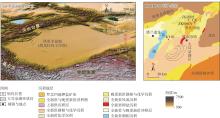
Fig. 1
Schematic diagram of the study area"

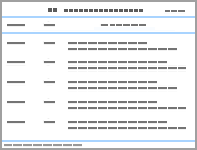
Tab. 1
Description of lithostratigraphy of core ZK0205 in the Lop Nur"
| 深度/m | 岩性地层 |
|---|---|
| 0.00~1.54 | 浅灰黄色细粒石盐集合含少量细砂,松散堆积,石盐晶体呈无色透明 |
| 1.54~3.54 | 浅灰色细粒石膏集合含少量粉砂,石膏晶体呈灰白色细粒针状集合排列 |
| 3.54~4.54 | 灰黄色块状粉砂含少量石膏隐晶质,偶见石盐 |
| 4.54~5.42 | 灰白色块状粉砂含细粒石盐及少量黏土 |
| 5.42~6.72 | 灰黑色块状黏土含粉砂及少量细粒石膏 |
| 6.72~11.96 | 深灰色块状细粒钙芒硝含粉砂钙芒硝晶体呈灰色鳞板状、片状集合,与粉砂胶结,可见少量孔隙。在9.21~11.00 m阶段,粉砂与细砂含量增多 |
| 11.96~15.85 | 黑绿色块状黏土含少量粉砂,偶见钙芒硝隐晶体。15 m后钙芒硝含量逐渐增加颜色转为灰黄色 |
| 15.85~16.10 | 灰绿色块状细粒钙芒硝胶结粉砂,结构坚硬致密 |
Tab. 2
Results of AMS 14C dating and calibration of core ZK0205 in the Lop Nur"
| 实验室编号 | 样品编号 | 深度/m | 材料 | 测试年龄/ka BP | 校正年龄/ka BP | 数据质量 |
|---|---|---|---|---|---|---|
| XA55102 | ZK0205-5H-2 | 3.68 | 有机沉积物 | 10.200±0.030 | 9.926±0.073 | 有效 |
| XA55103 | ZK0205-5H-7 | 3.98 | 有机沉积物 | 10.000±0.030 | 9.860±0.168 | 剔除 |
| XA50296 | ZK0205-14C-2 | 5.24 | 有机沉积物 | 10.705±0.030 | 10.763±0.029 | 剔除 |
| XA55104 | ZK0205-7H-5 | 5.67 | 有机沉积物 | 14.850±0.040 | 16.220±0.096 | 有效 |
| XA50297 | ZK0205-14C-3 | 10.70 | 有机沉积物 | 23.170±0.060 | 25.510±0.185 | 有效 |
| XA50298 | ZK0205-14C-4 | 11.20 | 有机沉积物 | 12.425±0.040 | 12.639±0.303 | 剔除 |
| XA55105 | ZK0205-11H-29 | 12.60 | 有机沉积物 | 25.000±0.040 | 27.352±0.320 | 有效 |
| XA55106 | ZK0205-12H-23 | 14.34 | 有机沉积物 | 28.095±0.125 | 30.052±0.324 | 有效 |
| XA50300 | ZK0205-14C-6 | 15.98 | 有机沉积物 | 36.450±0.150 | 34.580±0.310 | 有效 |
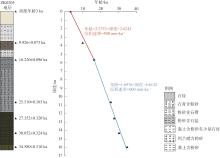
Fig. 2
Lithology and depth-age model of core ZK0205 in the Lop Nur"
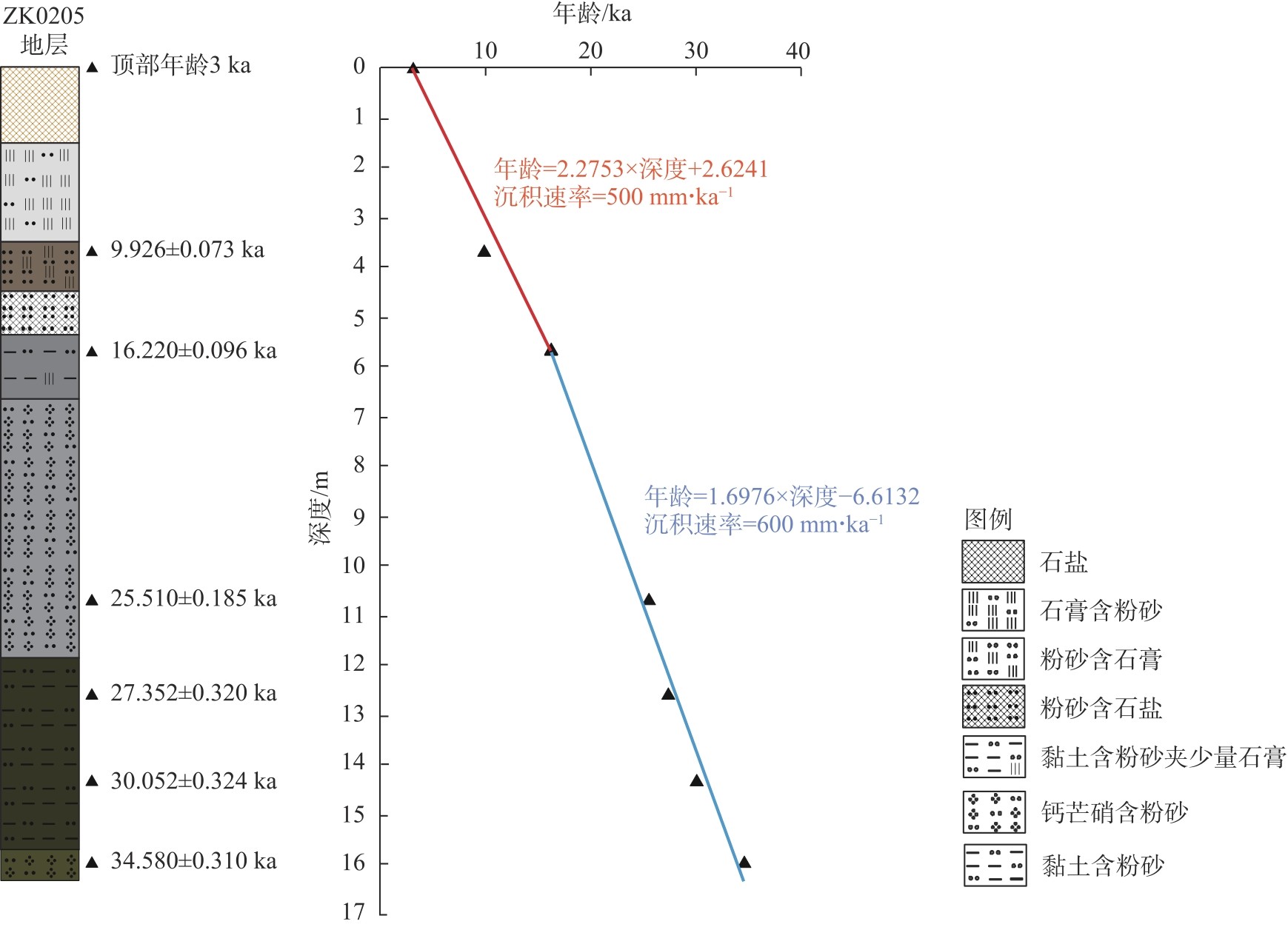
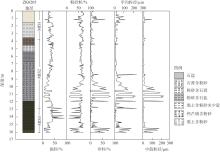
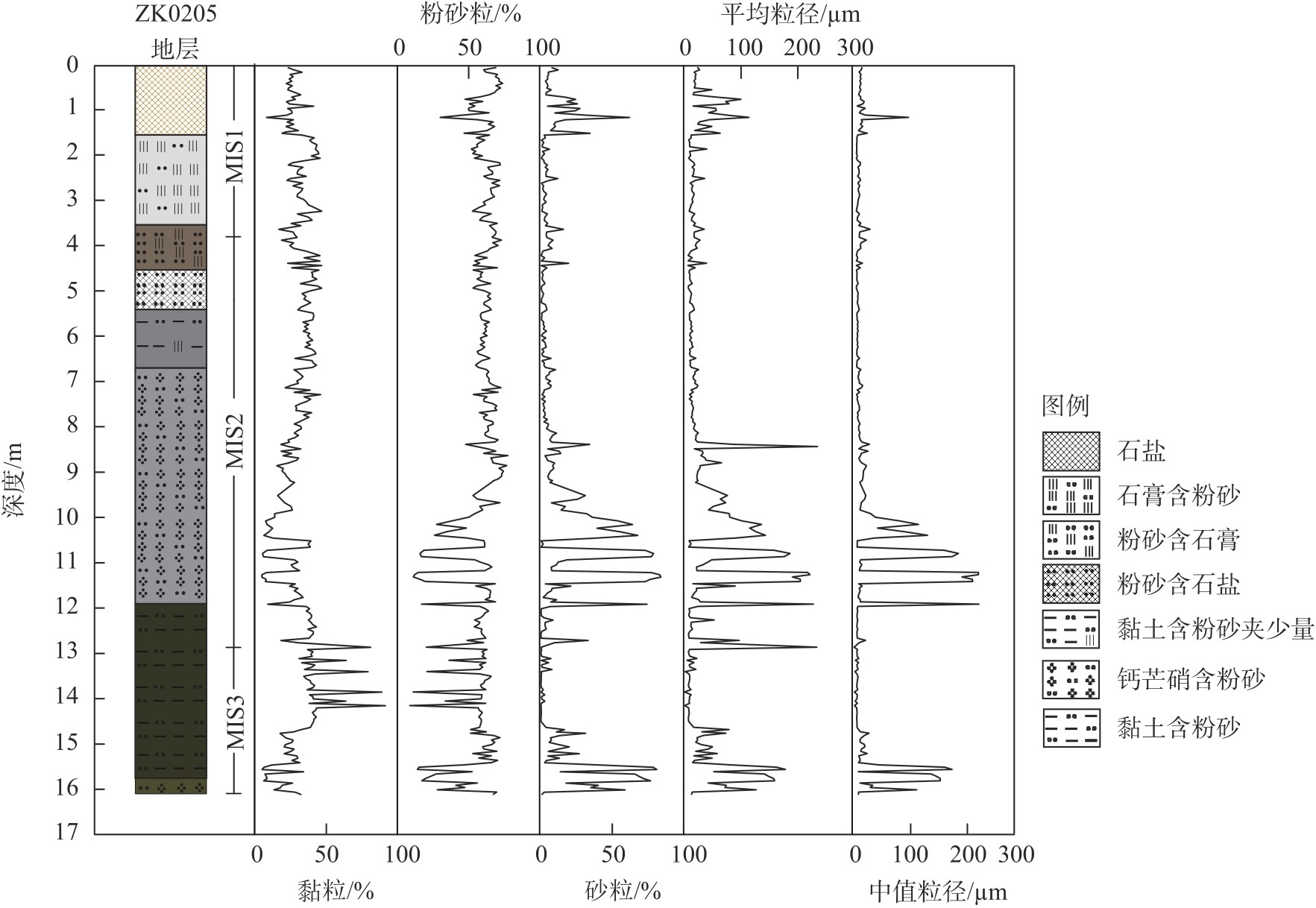
Fig. 3
Vertical variation characteristics of grain size composition from borehole ZK0205 in the Lop Nur"
Tab. 3
Grain-size characteristics of sediments from borehole ZK0205 in the Lop Nur"
| 深度/m | 平均粒径/μm | 中值粒径/μm | 标准偏差/μm |
|---|---|---|---|
| 0.00~1.54 | 18.30~115.00 | 6.24~20.50 | 0.833~1.361 |
| 1.54~3.54 | 9.17~41.10 | 4.90~12.60 | 1.112~1.521 |
| 3.54~4.54 | 7.43~40.60 | 4.84~29.20 | 1.008~1.447 |
| 4.54~5.42 | 8.48~17.60 | 4.88~9.97 | 1.147~1.436 |
| 5.42~6.72 | 10.50~26.50 | 5.44~12.80 | 1.113~1.286 |
| 6.72~11.96 | 8.98~235.11 | 5.08~220.00 | 0.876~2.191 |
| 11.96~15.85 | 2.04~158.00 | 0.79~173.00 | 0.945~1.947 |
| 15.85~16.10 | 14.00~75.20 | 15.90~16.10 | 0.970~1.333 |
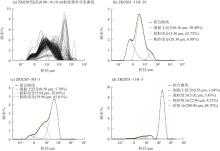
Fig. 4
Grain-size distribution curve of borehole ZK0205 (0.00-16.10 m) in the Lop Nur"
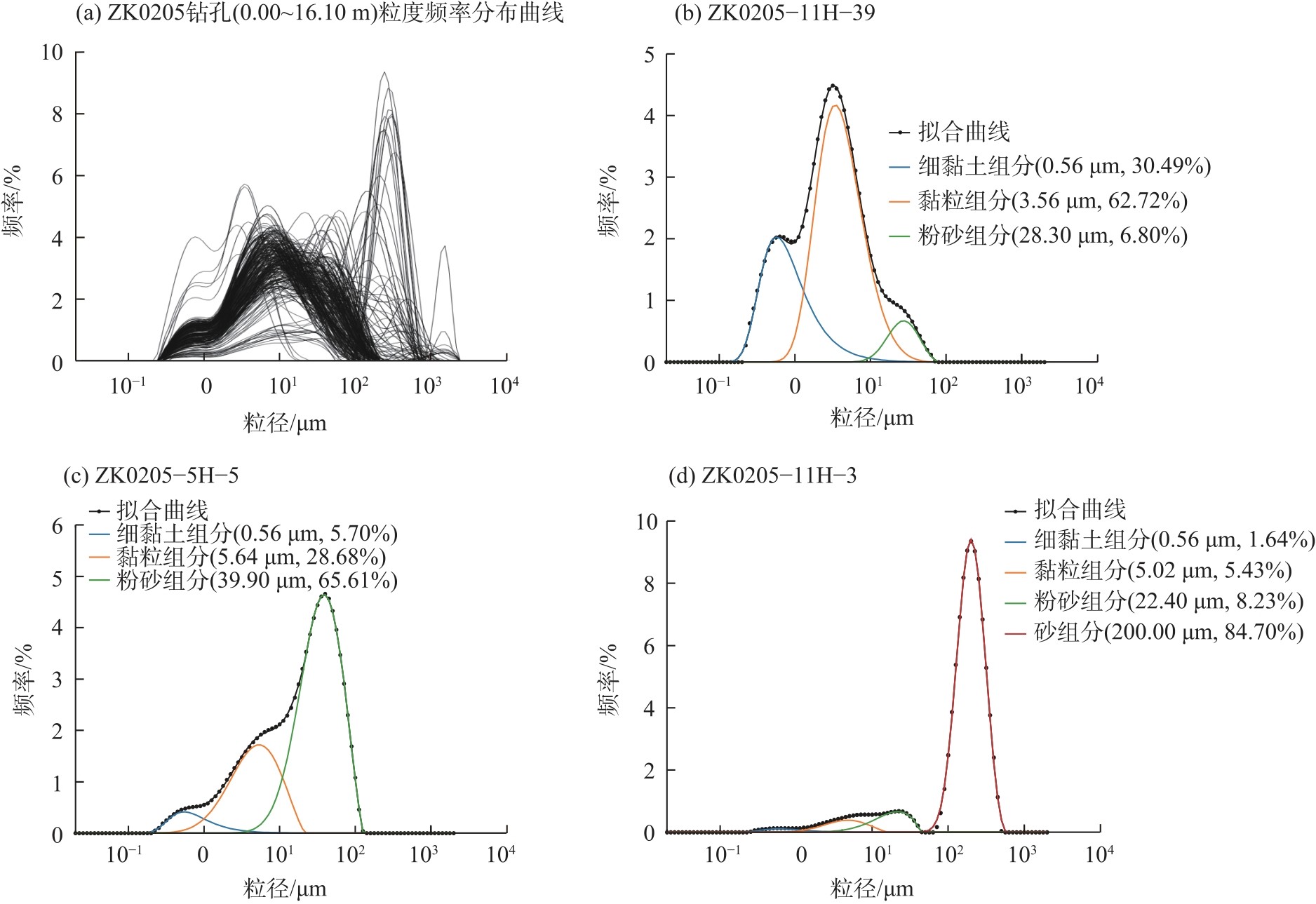
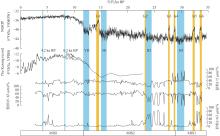
Fig. 5
Comparison of sediment grain-size from Lop Nur since 33.9 ka BP with the NGRIP and the Kesang Cave δ18O record"
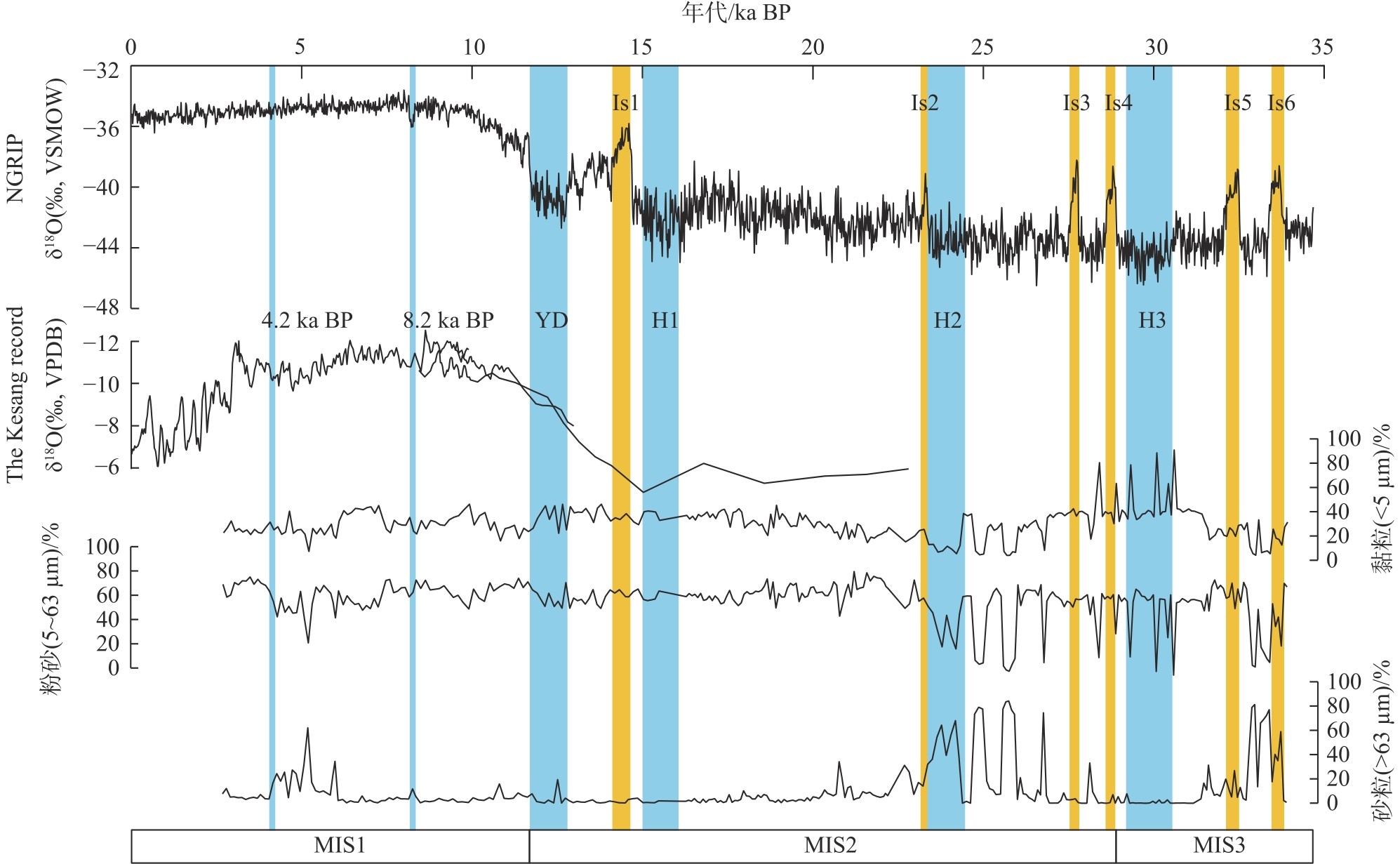
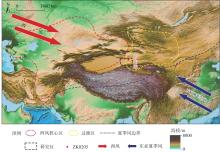
Fig. 6
Spatial extent of the “westerlies-dominated climatic regime” during the Holocene[53]"

| [1] |
An C B, Tao S C, Zhao J J, et al. Late Quaternary (30.7—9.0 cal ka BP) vegetation history in Central Asia inferred from pollen records of Lake Balikun northwest China[J]. Journal of Paleolimnology, 2012, 49: 145-154.
doi: 10.1007/s10933-012-9649-7 |
| [2] |
Luo C, Peng Z C, Yang D, et al. A lacustrine record from Lop Nur, Xinjiang, China: Implications for paleoclimate change during Late Pleistocene[J]. Journal of Asian Earth Sciences, 2009, 34(1): 38-45.
doi: 10.1016/j.jseaes.2008.03.011 |
| [3] |
Rhodes T E, Gasse F, Lin R F, et al. A Late Pleistocene-Holocene lacustrine record from Lake Manas, Zunggar (northern Xinjiang, western China)[J]. Palaeogeography, Palaeoclimatology, Palaeoecology, 1996, 120(1-2): 105-121.
doi: 10.1016/0031-0182(95)00037-2 |
| [4] |
Herzschuh U, Harald K, Mischke S. Temperature variability and vertical vegetation belt shifts during the last -50000 yr in the Qilian Mountains (NE margin of the Tibetan Plateau, China)[J]. Quaternary Research, 2006, 66(1): 133-146.
doi: 10.1016/j.yqres.2006.03.001 |
| [5] |
Lehmkuhl F, Haselein F. Quaternary Paleoenvironmental change on the Tibetan Plateau and adjacent areas (western China and western Mongolia)[J]. Quaternary International, 2000, 65-66: 121-145.
doi: 10.1016/S1040-6182(99)00040-3 |
| [6] |
An Z S. The history and variability of the East Asian Paleomonsoon climate[J]. Quaternary Science Reviews, 2000, 19(1-5): 171-187.
doi: 10.1016/S0277-3791(99)00060-8 |
| [7] |
Zhou W J, Head J, Deng L. Climatic changes in northern China since the Late Pleistocene and its response to global change[J]. Quaternary International, 2001, 83-85: 285-292.
doi: 10.1016/S1040-6182(01)00046-5 |
| [8] | 李吉均. 中国西北地区晚更新世以来环境变迁模式[J]. 第四纪研究, 1990, 10(3): 197-204. |
| [Li Jijun. The patterns of environmental changes since Late Pleistocene in northwestern China[J]. Quaternary Sciences, 1990, 10(3): 197-204.] | |
| [9] | 王宁, 刘卫国, 常宏, 等. 中更新世以来新疆罗布泊地区气候演化过程[J]. 海洋地质与第四纪地质, 2009, 29(2): 131-137. |
| [Wang Ning, Liu Weiguo, Chang Hong, et al. Evolutionary process of the climate of Lop Nur region of Xinjiang since Mid-Pleistocene[J]. Marine Geology & Quaternary Geology, 2009, 29(2): 131-137.] | |
| [10] |
Yang D, Peng Z C, Luo C, et al. High-resolution pollen sequence from Lop Nur, Xinjiang, China: Implications on environmental changes during the Late Pleistocene to the Early Holocene[J]. Review of Palaeobotany and Palynology, 2013, 192: 32-41.
doi: 10.1016/j.revpalbo.2012.12.002 |
| [11] |
李文, 穆桂金, 林永崇, 等. 罗布泊盐湖沉积物磁性特征及其环境意义[J]. 干旱区研究, 2021, 38(1): 257-266.
doi: 10.13866/j.azr.2021.01.27 |
|
[Li Wen, Mu Guijin, Lin Yongchong, et al. Magnetic properties of Lop Nur saline sediments and the environmental implications[J]. Arid Zone Research, 2021, 38(1): 257-266.]
doi: 10.13866/j.azr.2021.01.27 |
|
| [12] |
Liu J, Wang R J, Zhao Y, et al. A 40000-year record of aridity and dust activity at Lop Nur, Tarim Basin, northwestern China[J]. Quaternary Science Reviews, 2019, 211: 208-221.
doi: 10.1016/j.quascirev.2019.03.023 |
| [13] | Li G Q, Yang H, Stevens T, et al. Differential ice volume and orbital modulation of Quaternary moisture patterns between Central and East Asia[J]. Earth and Planetary Science Letters, 2019, 530: 115901, doi: 10.1016/j.epsl.2019.115901. |
| [14] | 于秋莲, 张展适, 杜后发. 粒度分析在古环境中的应用[J]. 能源研究与管理, 2010(2): 49-52. |
| [Yu Qiulian, Zhang Zhanshi, Du Houfa. The application of granularity analysis in paleoenvironment[J]. Energy Research and Management, 2010(2): 49-52.] | |
| [15] |
Porter S C, An Z S. Correlation between climate events in the North Atlantic and China during the last glaciation[J]. Nature, 1995, 375: 305-308.
doi: 10.1038/375305a0 |
| [16] | Sun Y B, Clemens S C, Guo F, et al. High-sedimentation-rate loess records: A new window into understanding orbital-and millennial-scale monsoon variability[J]. Earth-Science Reviews, 2021, 220: 103731, doi: 10.1016/j.earscirev.2021.103731. |
| [17] | Zhang J G, Lü D Y, Chen H Y, et al. Evolution of sedimentary environment in the eastern Henan Basin since the Late Pliocene[J]. Palaeogeography, Palaeoclimatology, Palaeoecology, 2024, 633: 111896, doi: 10.1016/j.palaeo.2023.111896. |
| [18] | 李晨光. 中国北方湖泊沉积物粒度特征及环境指示意义[D]. 哈尔滨: 哈尔滨师范大学, 2020. |
| [Li Chenguang. Grain size characteristics and environmental indicators of lake sediments in northern China[D]. Harbin: Harbin Normal University, 2020.] | |
| [19] |
杨艺, 王汝建, 刘健, 等. 新疆罗布泊45 ka BP以来沉积物粒度敏感组分记录的区域沙尘活动历史[J]. 地学前缘, 2015, 22(5): 247-258.
doi: 10.13745/j.esf.2015.05.021 |
| [Yang Yi, Wang Rujian, Liu Jian, et al. Regional dust activity history during the past 45 ka reflected by sensitive grain-size components in Lop Nur, Xinjiang[J]. Earth Science Frontiers, 2015, 22(5): 247-258.] | |
| [20] | 易庭楠, 常宏, 杨茂洁, 等. 盐类矿物去除对盐湖沉积粒度分析的意义——以罗布泊为例[J]. 盐湖研究, 2026, 34(1): 51-59. |
|
[Yi Tingnan, Chang Hong, Yang Maojie, et al. The significance of evaporite mineral removal in salt lake sediment particle size analysis: A case study from Lop Nur[J]. Journal of Salt Lake Research, 2026, 34(1): 51-59.]
doi: 10.3724/j.yhyj.2025033 |
|
| [21] | 夏训诚, 王富葆, 赵元杰. 中国罗布泊[M]. 北京: 科学出版社, 2007: 28-303. |
| [Xia Xuncheng, Wang Fubao, Zhao Yuanjie. The Lop Nur of China[M]. Beijing: Science Press, 2007: 28-303.] | |
| [22] | 王弭力, 刘成林, 焦鹏程, 等. 罗布泊盐湖钾盐资源[M]. 北京: 地质出版社, 2001: 31-32. |
| [Wang Mili, Liu Chenglin, Jiao Pengcheng, et al. Potassium salt resources of Lop Nur Lake[M]. Beijing: Geological Publishing House, 2001: 31-32.] | |
| [23] | 罗超, 彭子成, 刘卫国, 等. 新仙女木事件在罗布泊湖相沉积物中的记录[J]. 地球科学(中国地质大学学报), 2008, 33(2): 190-196. |
| [Luo Chao, Peng Zicheng, Liu Weiguo, et al. Evidence from the lacustrine sediments of Lop-Nur Lake, northwest China for the Younger Dryas Event[J]. Earth Sciences (Journal of China University of Geosciences), 2008, 33(2): 190-196.] | |
| [24] |
Chang H, An Z S, Wu F, et al. Late Miocene-early Pleistocene climate change in the mid-latitude westerlies and their influence on Asian monsoon as constrained by the K/Al ratio record from drill core Ls2 in the Tarim Basin[J]. Catena, 2017, 153: 75-82.
doi: 10.1016/j.catena.2017.02.002 |
| [25] | 李保国, 马黎春, 蒋平安, 等. 罗布泊“大耳朵”干盐湖区地形特征与干涸时间讨论[J]. 科学通报, 2008, 53(3): 327-334. |
| [Li Baoguo, Ma Lichun, Jiang Ping’an, et al. Topographic characteristics and discussion on the desiccation time of the “Big Ear” dry salt lake area in Lop Nur[J]. Chinese Science Bulletin, 2008, 53(3): 327-334.] | |
| [26] | 袁革新, 陈剑杰, 赵振华, 等. 罗布泊地区第四纪环境演化若干新认识[J]. 现代应用物理, 2013, 4(3): 293-298. |
| [Yuan Gexin, Chen Jianjie, Zhao Zhenhua, et al. Some latest cognitions in environmental evolution of Lop Nur in the Quaternary period[J]. Modern Applied Physics, 2013, 4(3): 293-298.] | |
| [27] | 刘成林. 罗布泊盐湖钾盐矿床形成条件与规律[M]. 北京: 科学出版社, 2020: 1-220. |
| [Liu Chenglin. Formation conditions and regularities of potash deposits in the Lop Nur Salt Lake[M]. Beijing: Science Press, 2020: 1-220.] | |
| [28] |
Luo J X, He M Y, Chang H, et al. Does climate change lead to potash deposits? A perspective of Lop Nur Salt Lake, China[J]. Quaternary International, 2024, 692: 56-72.
doi: 10.1016/j.quaint.2024.03.003 |
| [29] | 鹿化煜, 安芷生. 黄土高原黄土粒度组成的古气候意义[J]. 中国科学(D辑), 1998, 28: 278-283. |
| [Lu Huayu, An Zhisheng. Paleoclimatic significance of grain size of loess-palaeosol deposit in Chinese Loess Plateau[J]. Science in China (Series D), 1998, 28: 278-283.] | |
| [30] | 蒲晓强, 钟少军. 不同的前处理方法对南黄海沉积物粒度测试的影响[J]. 海洋地质动态, 2009, 25(5): 15-18. |
| [Pu Xiaoqiang, Zhong Shaojun. Influence of different pretreatment methods on grain size analysis of sediments from South Yellow Sea[J]. Marine Geology Frontiers, 2009, 25(5): 15-18.] | |
| [31] |
张成琦, 李育, 周雪花, 等. 晚第四纪湖泊沉积物盐类与碎屑矿物反相关关系的沉积学解释[J]. 冰川冻土, 2015, 37(1): 95-108.
doi: 10.7522/j.issn.1000-0240.2015.0010 |
|
[Zhang Chengqi, Li Yu, Zhou Xuehua, et al. A sedimentological interpretation of the inverse correlation between saline minerals and detrital minerals in the Late Quaternary lake sediments[J]. Journal of Glaciology and Geocryology, 2015, 37(1): 95-108.]
doi: 10.7522/j.issn.1000-0240.2015.0010 |
|
| [32] | 程鹏, 卢雪峰, 杜花, 等. 青海湖老碳效应的时空变化初步研究[J]. 地球环境学报, 2016, 7(4): 357-365. |
| [Cheng Peng, Lu Xuefeng, Du Hua, et al. The preliminary study of spatio-temporal change of old carbon effect in Lake Qinghai (NE Tibet-Qinghai Plateau), China[J]. Journal of Earth Environment, 2016, 7(4): 357-365.] | |
| [33] |
张瑜, 马黎春, 王凯. 罗布泊干盐湖第四纪环境演变研究进展[J]. 地球科学进展, 2022, 37(2): 149-164.
doi: 10.11867/j.issn.1001-8166.2022.005 |
|
[Zhang Yu, Ma Lichun, Wang Kai. Research progress of Quaternary environmental evolution in Lop Nor Playa[J]. Advances in Earth Science, 2022, 37(2): 149-164.]
doi: 10.11867/j.issn.1001-8166.2022.005 |
|
| [34] |
Zhang J F, Liu C L, Wu X H, et al. Optically stimulated luminescence and radiocarbon dating of sediments from Lop Nur (Lop Nor), China[J]. Quaternary Geochronology, 2012, 10: 150-155.
doi: 10.1016/j.quageo.2011.12.001 |
| [35] | 刘成林, 焦鹏程, 陈永志, 等. 罗布泊盐湖晚更新世末期芒硝岩沉积及其古气候意义[J]. 地球学报, 2008, 29(4): 397-404. |
| [Liu Chenglin, Jiao Pengcheng, Chen Yongzhi, et al. Late Pleistocene mirabilite deposition in the Lop Nur Saline Lake, Xinjiang, and its paleoclimate implications[J]. Acta Geoscientica Sinica, 2008, 29(4): 397-404.] | |
| [36] | 于苗苗, 蒙红卫, 陈金龙, 等. 云南湖泊碳库效应[J]. 第四纪研究, 2023, 43(2): 390-402. |
| [Yu Miaomiao, Meng Hongwei, Chen Jinlong, et al. The radiocarbon reservoir effects of lakes in Yunnan[J]. Quaternary Sciences, 2023, 43(2): 390-402.] | |
| [37] | 刘成林, 焦鹏程, 王弭力, 等. 罗布泊盐湖巨量钙芒硝沉积及其成钾效应分析[J]. 矿床地质, 2007(3): 322-329. |
| [Liu Chenglin, Jiao Pengcheng, Wang Mili, et al. Sedimentation of glauberite and its effect on potash deposits formation in Lop Nur Salt Lake, Xinjiang, China[J]. Mineral Deposits, 2007(3): 322-329.] | |
| [38] | 罗超, 刘卫国, 彭子成, 等. 新疆罗北洼地湖相沉积物有机碳同位素的变化序列及其古环境意义[J]. 第四纪研究, 2008, 28(4): 621-628. |
| [Luo Chao, Liu Weiguo, Peng Zicheng, et al. Stable carbon isotope record of organic matter from the Lop Nur lacustrine sediments in Xinjiang, northwestern China[J]. Quaternary Sciences, 2008, 28(4): 621-628.] | |
| [39] | 吕凤琳, 刘成林, 焦鹏程, 等. 罗布泊第四纪湖盆物源与盆地构造演化特征: 来自LDK01孔碎屑锆石U-Pb年龄证据[J]. 地质学报, 2018, 92(8): 1571-1588. |
| [Lü Fenglin, Liu Chenglin, Jiao Pengcheng, et al. Provenance of the Quaternary Lake Basin and tectonic evolution of the basin in Lop Nur: Evidence from detrital zircon U-Pb age of core LDK01[J]. Acta Geologica Sinica, 2018, 92(8): 1571-1588.] | |
| [40] | 刘成林, 焦鹏程, 陈永志, 等. 罗布泊断陷带内形成富钾卤水机理研究[J]. 矿床地质, 2010, 29(4): 602-608. |
| [Liu Chenglin, Jiao Pengcheng, Chen Yongzhi, et al. Formation mechanism of potash-bearing brine in fault belts of Lop Nur Lake, Xinjiang[J]. Mineral Deposits, 2010, 29(4): 602-608.] | |
| [41] | 焦鹏程, 刘成林, 颜辉, 等. 新疆罗布泊盐湖深部钾盐找矿新进展[J]. 地质学报, 2014, 88(6): 1011-1024. |
|
[Jiao Pengcheng, Liu Chenglin, Yan Hui, et al. New progress of potassium prospecting in deep salt lake of Lop Nur Region in Xinjiang[J]. Acta Geologica Sinica, 2014, 88(6): 1011-1024.]
doi: 10.1111/acgs.2014.88.issue-s2 |
|
| [42] | Luo J X, He M Y, Chang H, et al. Organic geochemistry analysis to decipher temporal carbon variations in Lop Nur Salt Lake, China[J]. Palaeogeography, Palaeoclimatology, Palaeoecology, 2025, 661: 112735, doi: 10.1016/j.palaeo.2025.112735. |
| [43] | 孙千里, 周杰, 肖举乐. 岱海沉积物粒度特征及其古环境意义[J]. 海洋地质与第四纪地质, 2001, 21(1): 93-95. |
| [Sun Qianli, Zhou Jie, Xiao Jule. Grain-size characteristics of Lake Daihai sediments and its paleaoenvironment significance[J]. Marine Geology & Quaternary Geology, 2001, 21(1): 93-95.] | |
| [44] | 孙东怀, 安芷生, 苏瑞侠, 等. 古环境中沉积物粒度组分分离的数学方法及其应用[J]. 自然科学进展, 2001, 11(3): 47-54. |
| [Sun Donghuai, An Zhisheng, Su Ruixia, et al. Mathematical method for separating grain-size components of sediment and its application in paleoenvironment[J]. Progress in Natural Science, 2001, 11(3): 47-54.] | |
| [45] | 肖雨琳. 北疆地区湖泊沉积记录的近2400年来湿度变化与水文动态[D]. 兰州: 兰州大学, 2022. |
| [Xiao Yulin. Moisture changes and hydrological dynamics recorded by lake sediments in northern Xinjiang over the past 2400 years[D]. Lanzhou: Lanzhou University, 2022.] | |
| [46] | 薛积彬, 钟巍. 干旱区湖泊沉积物粒度组分记录的区域沙尘活动历史: 以新疆巴里坤湖为例[J]. 沉积学报, 2008, 26(4): 647-654, 669. |
| [Xue Jibin, Zhong Wei. Variations in dust event reflected by grain-size component of lacustrine records in droughty area: A case study on Barkol Lake, Xinjiang, China[J]. Acta Sedimentologica Sinica, 2008, 26(4): 647-654, 669.] | |
| [47] | 沈吉, 汪勇, 羊向东, 等. 湖泊沉积记录的区域风沙特征及湖泊演化历史: 以陕西红碱淖湖泊为例[J]. 科学通报, 2006, 51(1): 87-92. |
| [Shen Ji, Wang Yong, Yang Xiangdong, et al. Regional wind-sand characteristics and lake evolution history recorded in lake sediments: A case study of Hongjiannao Lake in Shaanxi Province[J]. Chinese Science Bulletin, 2006, 51(1): 87-92.] | |
| [48] |
马龙, 吴敬禄. 新疆湖泊沉积记录的气候水文变化及其环境效应[J]. 干旱区研究, 2009, 26(6): 786-792.
doi: 10.13866/j.azr.2009.06.011 |
|
[Ma Long, Wu Jinglu. Climatic and hydrological change and environmental response recorded in lacustrine sediment in Xinjiang[J]. Arid Zone Research, 2009, 26(6): 786-792.]
doi: 10.3724/SP.J.1148.2009.00786 |
|
| [49] |
Chen F H, Qiang M R, Zhou A F, et al. A 2000-year dust storm record from Lake Sugan in the dust source area of arid China[J]. Journal of Geophysical Research Atmospheres, 2013, 118(5): 2149-2160.
doi: 10.1002/jgrd.v118.5 |
| [50] |
Chen S Q, Liu J B, Chen J H, et al. Differences in the evolutionary pattern of dust storms over the past 2000 years between eastern and western China and the driving mechanisms[J]. Science China Earth Sciences, 2020, 63(9): 1422-1424.
doi: 10.1007/s11430-020-9632-y |
| [51] | 段含明, 艾里西尔·库尔班, 张燕, 等. 近百年来罗布泊最后干涸时间的评述[J]. 干旱区研究, 2013, 30(3): 541-549. |
| [Duan Hanming, Kurban Erisier, Zhang Yan, et al. Review of the studies about the latest dried-up time of the Lop Nur Lake in recent 100 years[J]. Arid Zone Research, 2013, 30(3): 541-549.] | |
| [52] | 李开封, 穆桂金, 徐立帅, 等. 塔里木河干流古河道表层沉积物粒度特征及其意义[J]. 水土保持通报, 2012, 32(1): 161-164. |
| [Li Kaifeng, Mu Guijin, Xu Lishuai, et al. Grain size characteristics and their significance for surface sediment of paleochannels along main stream of Tarim River[J]. Bulletin of Soil and Water Conservation, 2012, 32(1): 161-164.] | |
| [53] |
Chen F H, Chen J, Huang W, et al. Westerlies Asia and monsoonal Asia: Spatiotemporal differences in climate change and possible mechanisms on decadal to sub-orbital timescales[J]. Earth-Science Reviews, 2019, 192: 337-354.
doi: 10.1016/j.earscirev.2019.03.005 |
| [54] | 刘蔚, 王涛. 我国沙尘暴变化及降尘特征研究[J]. 干旱区资源与环境, 2004, 18(1): 26-32. |
| [Liu Wei, Wang Tao. Research on the variation and characteristics of dust storms in China[J]. Journal of Arid Land Resources and Environment, 2004, 18(1): 26-32.] | |
| [55] | 孙东怀, 鹿化煜, Rea David, 等. 中国黄土粒度的双峰分布及其古气候意义[J]. 沉积学报, 2000, 18(3): 327-335. |
| [Sun Donghuai, Lu Huayu, Rea David, et al. Bimode grain-size distribution of Chinese loess and its paleoclimate implication[J]. Acta Sedimentologica Sinica, 2000, 18(3): 327-335.] | |
| [56] |
Vandenberghe J. Grain size of fine-grained windblown sediment: A powerful proxy for process identification[J]. Earth-Science Reviews, 2013, 121: 18-30.
doi: 10.1016/j.earscirev.2013.03.001 |
| [57] | 朱青, 王富葆, 曹琼英, 等. 罗布泊全新世沉积特征及其环境意义[J]. 地层学杂志, 2009, 33(3): 283-290. |
| [Zhu Qing, Wang Fubao, Cao Qiongying, et al. Grain size distribution characteristics and changes of Lop-Nur Lake sediments during the past 10000 years[J]. Journal of Stratigraphy, 2009, 33(3): 283-290.] | |
| [58] |
Sun J M, Liu T S. The age of the Taklimakan Desert[J]. Science, 2006, 312: 1621, doi: 10.1126/science.1124616.
pmid: 16778048 |
| [59] |
Xiao J L, Fan J W, Zhou L, et al. A model for linking grain-size component to lake level status of a modern clastic lake[J]. Journal of Asian Earth Sciences, 2013, 69: 149-158.
doi: 10.1016/j.jseaes.2012.07.003 |
| [60] |
Chen F H, Huang X Z, Zhang J W, et al. Humid little ice age in arid Central Asia documented by Bosten Lake, Xinjiang, China[J]. Science China Earth Sciences, 2006, 49(12): 1280-1290.
doi: 10.1007/s11430-006-2027-4 |
| [61] |
吕爽, 韩文霞, 张涛, 等. 塔里木盆地南缘8.5 ka以来的黄土岩石磁学特征及其磁化率变化机制[J]. 地球物理学报, 2019, 62(8): 3053-3066.
doi: 10.6038/cjg2019M0443 |
| [Lü Shuang, Han Wenxia, Zhang Tao, et al. Rock magnetic characteristics and magnetic susceptibility change mechanism of the loess since 8.5 ka in the southern margin of Tarim Basin[J]. Chinese Journal of Geophysics, 2019, 62(8): 3053-3066.] | |
| [62] |
Han W X, Lü S, Appel E, et al. Dust storm outbreak in Central Asia after -3.5 kyr BP[J]. Geophysical Research Letters, 2019, 46(13): 7063-7856.
doi: 10.1002/grl.v46.13 |
| [63] | 常秋芳, 常宏. 罗布泊Ls2孔近7.1 Ma以来沉积物的环境磁学研究[J]. 第四纪研究, 2013, 33(5): 876-888. |
| [Chang Qiufang, Chang Hong. The environmental magnetism study of core Ls2 in Lop Nur, Tarim since 7.1 Ma[J]. Quaternary Sciences, 2013, 33(5): 876-888.] | |
| [64] | Vinther B M, Clausen H B, Johnsen S J, et al. A synchronized dating of three Greenland ice cores throughout the Holocene[J]. Journal of Geophysical Research: Atmospheres, 2006, 111: D13102, doi: 10.1029/2005JD006921. |
| [65] | Rasmussen S O, Andersen K K, Svensson A M, et al. A new Greenland ice core chronology for the last glacial termination[J]. Journal of Geophysical Research: Atmospheres, 2006, 111: D06102, doi: 10.1029/2005JD006079. |
| [66] |
Andersen K K, Svensson A, Johnsen S J, et al. The Greenland ice core chronology 2005, 15-42 ka. Part 1: Constructing the time scale[J]. Quaternary Science Reviews, 2006, 25(23-24): 3246-3257.
doi: 10.1016/j.quascirev.2006.08.002 |
| [67] |
Wang Y J, Cheng H, Edwards R L, et al. A high-resolution absolute-dated Late Pleistocene monsoon record from Hulu Cave, China[J]. Science, 2001, 294(5550): 2345-2348.
pmid: 11743199 |
| [68] | 程良清, 宋友桂, 李越, 等. 粒度端元模型在新疆黄土粉尘来源与古气候研究中的初步应用[J]. 沉积学报, 2018, 36(6): 1148-1156. |
| [Cheng Liangqing, Song Yougui, Li Yue, et al. Preliminary application of grain size end member model for dust source tracing of Xinjiang loess and paleoclimate reconstruction[J]. Acta Sedimentologica Sinica, 2018, 36(6): 1148-1156.] | |
| [69] | Cheng H, Zhang P Z, Spotl C, et al. The climatic cyclicity in semiarid-arid Central Asia over the past 500000 years[J]. Geophysical Research Letters, 2012, 39(1): L01705, doi: 10.1029/2011GL050202. |
| [70] |
李稚, 朱成刚, 汪家友, 等. 东昆仑库木库里盆地典型湖泊水量蒸发损失估算[J]. 干旱区地理, 2024, 47(8): 1263-1276.
doi: 10.12118/j.issn.1000-6060.2024.166 |
|
[Li Zhi, Zhu Chenggang, Wang Jiayou, et al. Estimation of evaporation loss from typical lakes in the Kumukuli Basin, East Kunlun Mountains[J]. Arid Land Geography, 2024, 47(8): 1263-1276.]
doi: 10.12118/j.issn.1000-6060.2024.166 |
| [1] | SUN Aijun, ZHAO Hui, LIU Bing, WANG Keqi, CHAO Qian, SHI Zhilin, CHEN Fahu. Oases evolution in Tarim Basin since the Last Glacial Maximum: Progress and issues [J]. Arid Land Geography, 2022, 45(6): 1761-1772. |
| [2] | LIANG Xiaolei,ZHAI Xiaohui,NIU Qinghe,HU Zihao,WANG Tianhu,LIU Wancheng. Grain-size characteristics of yardang strata sediment in the Dunhuang Yardang National Geopark, northwest China [J]. Arid Land Geography, 2022, 45(1): 141-152. |
| [3] | LIN Guiquan,LIN Yongchong,WANG Xueping. Morphological characteristics and genesis of Bailongdui Yardang landforms in Lop Nur, Xinjiang [J]. Arid Land Geography, 2021, 44(5): 1309-1316. |
| [4] | SONG Hao-ze, MU Gui-jin, LIN Yong-chong, LI Wen, TANG Zi-hua, QIN Xiao-guang, ZHAO Xue, ZHANG Lei, LI Kang-kang. Influence of common pedestal of Yardangs on the morphological measurement [J]. Arid Land Geography, 2020, 43(1): 48-55. |
| [5] | LIN Yong-chong, MU Gui-jin, QIN Xiao-guang, TANG Zi-hua, LI Wen, XU Li-shuai. Weathering impact on the development of Yardang landforms in Loulan region [J]. 干旱区地理, 2018, 41(6): 1278-1284. |
| [6] | LI Shengyu,GU Feng,WANG Haifeng,PANG Yingjun,,MU Guijin,LEI Jiaqiang,LIU Xiaolu,ZHANG Zhongliang,YAN Jian. Exogenic forces action mechanism in the development processof erosion landform on alluvial plains composed offluviallacustrine deposits in the Taklimakan Desert [J]. , 2012, 35(03): 358-364. |
| [7] | ZHAO Zhen-hong, HOU Guang-cai, QI Wang-qiu, CHANG Zhi-yong, CHEN Xu-guang, WANG Yong, LIN Jing-xing. DISCUSSION OF THE LOWER LIMIT OF QUATERNARY IN LOP NUR, XINJIANG [J]. Arid Land Geography, 2001, 24(2): 130-135. |
| [8] | WANG Yong, ZHAO Zhen-hong, YAN Fu-hua, LIN Jing-xing, LI Qing-hai, HOU Guang-cai. THE SPORE-POLLEN ASSEMBLAGE AND ITS SIGNIFICANCE OF BAYI QUAN PROFILE IN LOP NUR, XINJIANG [J]. Arid Land Geography, 2000, 23(2): 112-115. |
|
||