Arid Land Geography ›› 2025, Vol. 48 ›› Issue (6): 985-994.doi: 10.12118/j.issn.1000-6060.2024.536
• Dynamic Changes of Vegetation • Previous Articles Next Articles
WU Xiulan1( ), CHENG Heqian1, TONG Xinyi1, ZHANG Xu2()
Received:2024-09-05
Revised:2024-12-19
Online:2025-06-25
Published:2025-06-18
Contact:
ZHANG Xu
E-mail:wuxiulanxj@163.com;zhangxu_home@163.com
WU Xiulan, CHENG Heqian, TONG Xinyi, ZHANG Xu. Response of vegetation changes to meteorological drought in Tianshan Mountains, Xinjiang[J].Arid Land Geography, 2025, 48(6): 985-994.

Fig. 1
Schematic diagram of the study area"

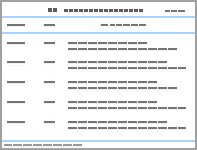
Tab. 1
Drought classification standard of MCI"
| 等级 | 类型 | MCI |
|---|---|---|
| 1 | 无旱 | -0.5<MCI |
| 2 | 轻旱 | -1.0<MCI≤-0.5 |
| 3 | 中旱 | -1.5<MCI≤-1.0 |
| 4 | 重旱 | -2.0<MCI≤-1.5 |
| 5 | 特旱 | MCI≤-2.0 |

Fig. 2
Interannual variations of NDVI in Tianshan Mountains, Xinjiang from 2001 to 2023"


Fig. 3
Spatial distributions of NDVI indifferent seasons in Tianshan Mountains, Xinjiang from 2001 to 2023"


Fig. 4
Interannual variations of annual mean MCI in Tianshan Mountains, Xinjiang from 2001 to 2023"


Fig. 5
Trend of MCI at different time scales in Tianshan Mountains, Xinjiang from 2001 to 2023"


Fig. 6
Spatial distributions of MCI in different seasons in Tianshan Mountains, Xinjiang from 2001 to 2023"


Fig. 7
Correlation between NDVI and MCI in Tianshan Mountains, Xinjiang from 2001 to 2023"


Fig. 8
Spatial correlation and significance test between NDVI and MCI in Tianshan Mountains, Xinjiang from 2001 to 2023"


Fig. 9
Variation characteristics of NDVI and MCI in typical regions of Tianshan Mountains, Xinjiang from 2001 to 2023"


Fig. 10
Correlation between NDVI and MCI in typical regions of Tianshan Mountains, Xinjiang"

| [1] | 王雨晴, 王菜林, 布仁吉日嘎拉, 等. 内蒙古典型植被区NDVI演化对干旱事件的响应研究[J]. 华北水利水电大学学报(自然科学版), 2023, 44(3): 44-52. |
| [Wang Yuqing, Wang Cailin, Burenji Gala, et al. Response of NDVI index evolution to drought events in typical vegetation areas of Inner Mongolia[J]. Journal of North China University of Water Resources and Electric Power (Natural Science Edition), 2023, 44(3): 44-52. ] | |
| [2] |
Du J Q, Quan Z J, Fang S F, et al. Spatiotemporal changes in vegetation coverage and its causes in China since the Chinese economic reform[J]. Environmental Science and Pollution Research International, 2020, 27(1): 1144-1159.
doi: 10.1007/s11356-019-06609-6 pmid: 31814074 |
| [3] | Tang L, He M Z, Xu H, et al. Validation of vegetation coverage and NDVI based on UAV remote sensing method and its response to hydrothermal gradient[J]. The Journal of Applied Ecology, 2020, 31(1): 35-44. |
| [4] | Zheng H F, Shen G Q, He X Y, et al. Spatial assessment of vegetation vulnerability to accumulated drought in northeast China[J]. Regional Environmental Change, 2015, 15(8): 1639-1650. |
| [5] | Nash M, Wickham J, Christensen J, et al. Changes in landscape greenness and climatic factors over 25 years (1989—2013) in the USA[J]. Remote Sensing, 2017, 9(3): 295, doi: 10.3390/rs9030295. |
| [6] | Gong Z N, Zhao S Y, Gu J Z. Correlation analysis between vegetation coverage and climate drought conditions in north China during 2001—2013[J]. Journal of Geographical Sciences, 2017, 27(2): 143-160. |
| [7] | 朱光磊. 嫩江流域植被动态变化及其对气象干旱的响应研究[D]. 延吉: 延边大学, 2021. |
| [Zhu Guanglei. Study on dynamic change of vegetation and its response to meteorological drought in Nenjiang River Basin[D]. Yanji: Yanbian University, 2021. ] | |
| [8] | 皮贵宁, 贺中华, 张浪, 等. 区域植被对不同时间尺度气象干旱的响应——以贵州省为例[J]. 水土保持研究, 2022, 29(4): 277-284, 291. |
| [Pi Guining, He Zhonghua, Zhang Lang, et al. Response of regional vegetation to meteorological drought at different time scales: A case study of Guizhou Province[J]. Research of Soil and Water Conservation, 2022, 29(4): 277-284, 291. ] | |
| [9] | 徐泽华. 山东省植被时空变化特征及其对气象干旱指数的响应[D]. 济南: 山东师范大学, 2019. |
| [Xu Zehua. Characteristics of temporal-spatial variation of vegetation in Shandong Province and its response to meteorological drought index[D]. Jinan: Shandong Normal University, 2019. ] | |
| [10] | 魏彦强, 芦海燕, 王金牛, 等. 近35年青藏高原植被带变化对气候变化及人类活动的响应[J]. 草业科学, 2019, 36(4): 1163-1176, 927. |
| [Wei Yanqiang, Lu Haiyan, Wang Jinniu, et al. Responses of vegetation zones, in the Qinghai-Tibetan Plateau, to climate change and anthropogenic influences over the last 35 years[J]. Pratacultural Science, 2019, 36(4): 1163-1176, 927. ] | |
| [11] | 尤南山, 蒙吉军, 孙慕天. 2000—2015年黑河流域中上游NDVI时空变化及其与气候的关系[J]. 北京大学学报 |
| ( 自然科学版), 2019, 55(1) : 171-181. | |
| [You Nanshan, Meng Jijun, Sun Mutian. Spatio-temporal change of NDVI and its relationship with climate in the upper and middle reaches of Heihe River Basin from 2000 to 2015[J]. Acta Scientiarum Naturalium Universitatis Pekinensis, 2019, 55(1): 171-181. ] | |
| [12] |
黄云博, 张翀, 王玉丹. 渭河流域植被覆盖变化趋势及其对土壤干湿状况的响应[J]. 干旱区地理, 2024, 47(5): 841-849.
doi: 10.12118/j.issn.1000-6060.2023.489 |
| [Huang Yunbo, Zhang Chong, Wang Yudan. Change trend of vegetation cover and its response to soilmoisture status in Weihe River Basin[J]. Arid Land Geography, 2024, 47(5): 841-849. ] | |
| [13] | 陈春波, 李刚勇, 彭建. 1981—2018年新疆草地归一化植被指数时空特征及其对气候变化的响应[J]. 生态学报, 2023, 43(4): 1537-1552. |
| [Chen Chunbo, Li Gangyong, Peng Jian. Spatio-temporal characteristics of Xinjiang grassland NDVI and its response to climate change from 1981 to 2018[J]. Acta Ecologica Sinica, 2023, 43(4): 1537-1552. ] | |
| [14] |
张华, 徐存刚, 王浩. 2001—2018年西北地区植被变化对气象干旱的响应[J]. 地理科学, 2020, 40(6): 1029-1038.
doi: 10.13249/j.cnki.sgs.2020.06.019 |
|
[Zhang Hua, Xu Cungang, Wang Hao. Response of vegetation change to meteorological drought in northwest China from 2001 to 2018[J]. Scientia Geographica Sinica, 2020, 40(6): 1029-1038. ]
doi: 10.13249/j.cnki.sgs.2020.06.019 |
|
| [15] | 陈家宁, 孙怀卫, 王建鹏, 等. 综合气象干旱指数改进及其适用性分析[J]. 农业工程学报, 2020, 36(16): 71-77. |
| [Chen Jianing, Sun Huaiwei, Wang Jianpeng, et al. Improvement of comprehensive meteorological drought index and its applicability analysis[J]. Transactions of the Chinese Society of Agricultural Engineering, 2020, 36(16): 71-77. ] | |
| [16] |
吴秀兰, 段春锋, 玛依拉·买买提艾力, 等. 基于MCI的新疆近60 a干旱时空特征分析[J]. 干旱区研究, 2022, 39(1): 75-83.
doi: 10.13866/j.azr.2022.01.08 |
|
[Wu Xiulan, Duan Chunfeng, Maimaitiaili Mayila, et al. Analysis of the temporal-spatial variation characteristics of drought in the Xinjiang based on the meteorological drought comprehensive index[J]. Arid Zone Research, 2022, 39(1): 75-83. ]
doi: 10.13866/j.azr.2022.01.08 |
|
| [17] | 罗晓玲, 赵慧华, 杨梅, 等. 基于MCI的河西走廊东部近60年干旱特征及对厄尔尼诺事件的响应[J/OL]. 沙漠与绿洲气象. [2024-11-20]. http://kns.cnki.net/kcms/detail/65.1265.p.20241114.1549.016.html. |
| [Luo Xiaoling, Zhao Huihua, Yang Mei, et al. Characteristics of drought and response to El Niño events over the last 60 years in eastern Hexi Corridor based on MCI[J/OL]. Desert and Oasis Meteorology. [2024-11-20]. http://kns.cnki.net/kcms/detail/65.1265.p.202411 14.1549.016.html.] | |
| [18] | 许丹, 龙俐, 张东海, 等. 基于MCI干旱综合指数的贵州省干旱时空分布及灾情变化特征[J]. 干旱气象, 2023, 41(6): 897-909. |
| [Xu Dan, Long Li, Zhang Donghai, et al. Drought and disaster variation characteristics in Guizhou based on meteorological drought composite index[J]. Journal of Arid Meteorology, 2023, 41(6): 897-909. ] | |
| [19] | 魏文寿, 袁玉江, 喻树龙, 等. 中国天山山区235 a气候变化及降水趋势预测[J]. 中国沙漠, 2008, 28(5): 803-808. |
| [Wei Wenshou, Yuan Yujiang, Yu Shulong, et al. Climate change in recent 235 years and trend prediction in Tianshan Mountainous area[J]. Journal of Desert Research, 2008, 28(5): 803-808. ] | |
| [20] | 吴秀兰, 张婧莉, 余行杰, 等. 新疆天山山区干旱灾害综合风险评估与区划[J]. 气象与环境学报, 2022, 38(4): 161-167. |
| [Wu Xiulan, Zhang Jingli, Yu Xingjie, et al. Comprehensive risk assessment and zoning of drought disasters in Tianshan Mountains of Xinjiang, Xinjiang Uygur Autonomous Region[J]. Journal of Meteorology and Environment, 2022, 38(4): 161-167. ] | |
| [21] | 郭冬, 吐尔逊·哈斯木, 吴秀兰, 等. 四种气象干旱指数在新疆区域适用性研究[J]. 沙漠与绿洲气象, 2022, 16(3): 90-101. |
| [Guo Dong, Hasimu Tursun, Wu Xiulan, et al. Applicability of four meteorological drought indices in Xinjiang[J]. Desert and Oasis Meteorology, 2022, 16(3): 90-101. ] | |
| [22] | 张存杰, 刘海波, 宋艳玲, 等. GB/T20481-2017. 气象干旱等级[S]. 北京: 中国标准出版社, 2017. |
| [Zhang Cunjie, Liu Haibo, Song Yanling, et al. GB/T20481-2017. Classification of meteorological drought[S]. Beijing: China Standards Press, 2017. ] | |
| [23] |
陈淑君, 许国昌, 吕志平, 等. 中国植被覆盖度时空演变及其对气候变化和城市化的响应[J]. 干旱区地理, 2023, 46(5): 742-752.
doi: 10.12118/j.issn.1000-6060.2022.375 |
|
[Chen Shujun, Xu Guochang, Lü Zhiping, et al. Spatiotemporal variations of fractional vegetation cover and its response toclimate change and urbanization in China[J]. Arid Land Geography, 2023, 46(5): 742-752. ]
doi: 10.12118/j.issn.1000-6060.2022.375 |
|
||