Arid Land Geography ›› 2026, Vol. 49 ›› Issue (7): 1375-1384.doi: 10.12118/j.issn.1000-6060.2025.547
• Earth Surface Process • Previous Articles Next Articles
PENG Xueqing1,2,3( ), CHEN Hongyang1,2,3, DONG Shengtianzi1,2,3, QIN Tiantian1,2,3, CHEN Shengjie1,2,3, WANG Hanyue1,2,3()
Received:2025-09-10
Revised:2025-11-26
Online:2026-07-25
Published:2026-07-07
Contact:
WANG Hanyue
E-mail:20221006152@stu.shzu.edu.cn;why1993@shzu.edu.cn
PENG Xueqing, CHEN Hongyang, DONG Shengtianzi, QIN Tiantian, CHEN Shengjie, WANG Hanyue. Degradation of Tamarix chinensis community in desert-oasis ecotone of the Keriya River Basin driven by the decline of groundwater level[J].Arid Land Geography, 2026, 49(7): 1375-1384.
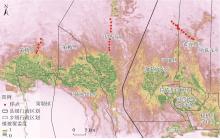
Fig. 1
Scope of the study area and layout of sample points"
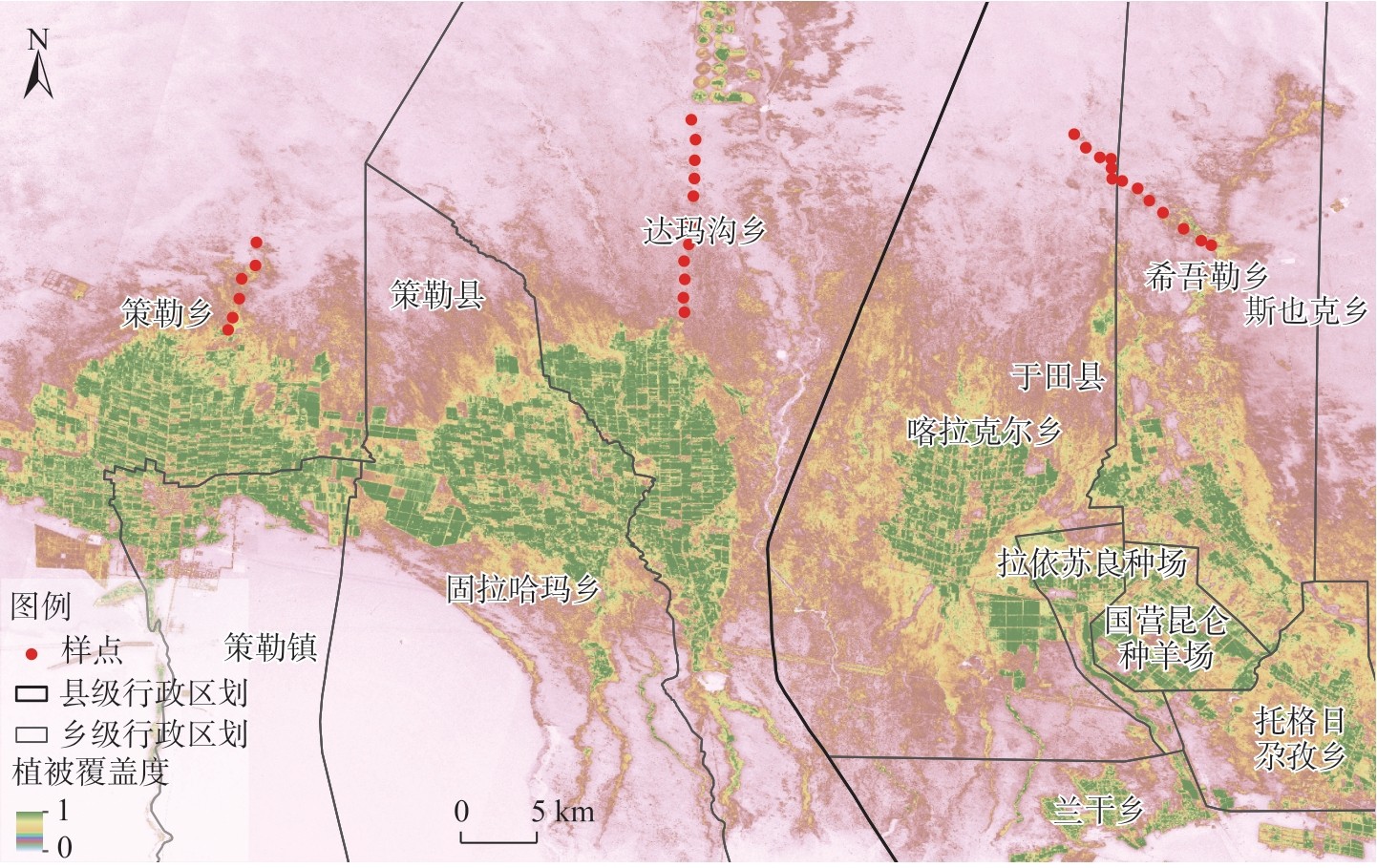
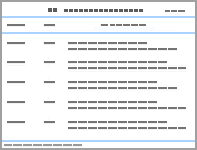
Tab. 1
Species composition and importance values of Tamarix chinensis community in the transition zone"
| 分层 | 属名 | 种名 | 相对密度 | 相对盖度 | 相对频度 | 重要值 |
|---|---|---|---|---|---|---|
| 灌木层 | 柽柳属(Tamarix) | 多枝柽柳(Tamarix ramosissima) | 0.4332 | 0.0354 | 0.4375 | 0.3020 |
| 刚毛柽柳(Tamarix hispida) | 0.2003 | 0.0076 | 0.2031 | 0.1370 | ||
| 枸杞属(Lycium) | 黑果枸杞(Lycium ruthenicum) | 0.0199 | 0.0001 | 0.0156 | 0.0119 | |
| 盐穗木属(Halostachys) | 盐穗木(Halostachys caspica) | 0.0142 | 0.0010 | 0.0469 | 0.0207 | |
| 白刺属(Nitraria) | 白刺(Nitraria tangutorum) | 0.0128 | 0.0010 | 0.0313 | 0.0150 | |
| 花花柴属(Karelinia) | 花花柴(Karelinia caspia) | 0.1392 | 0.7605 | 0.1563 | 0.3520 | |
| 草本层 | 芦苇属(Phragmites) | 芦苇(Phragmites australis) | 0.1790 | 0.1934 | 0.0938 | 0.1554 |
| 骆驼刺属(Alhagi) | 骆驼刺(Alhagi camelorum) | 0.0014 | 0.0010 | 0.0156 | 0.0060 |
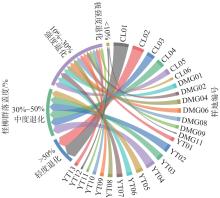
Fig. 2
Classification and assessment of degradation status of Tamarix chinensis communities"
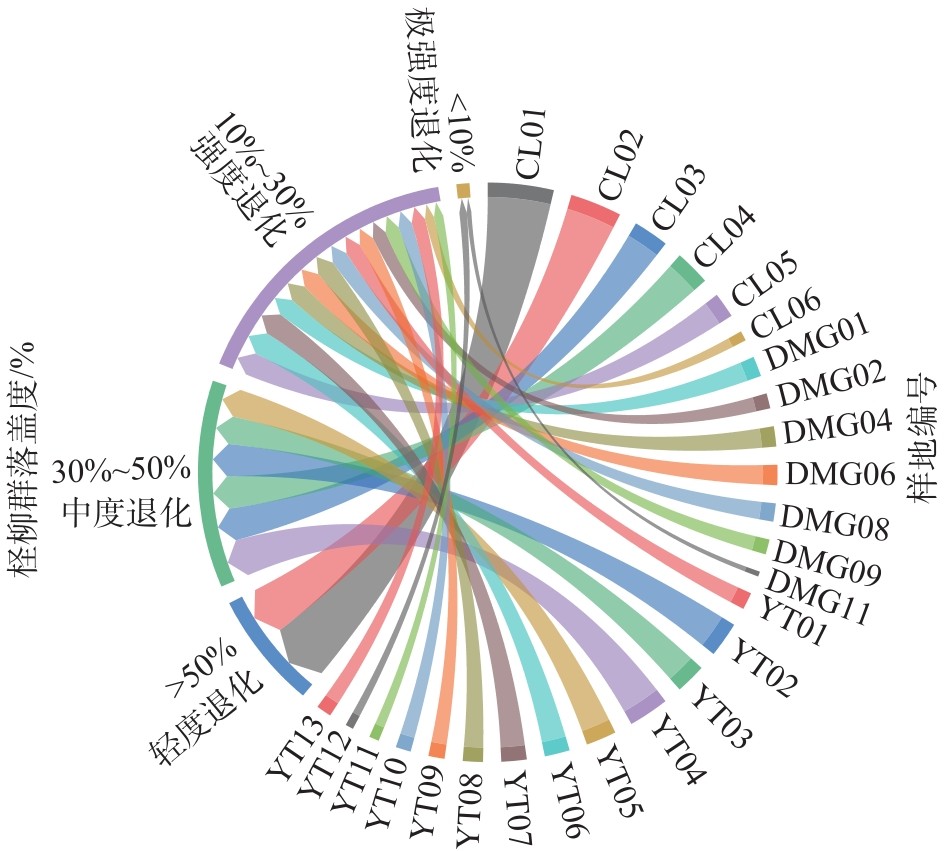
Fig. 3
Correlation between vegetation characteristics and environmental factors"
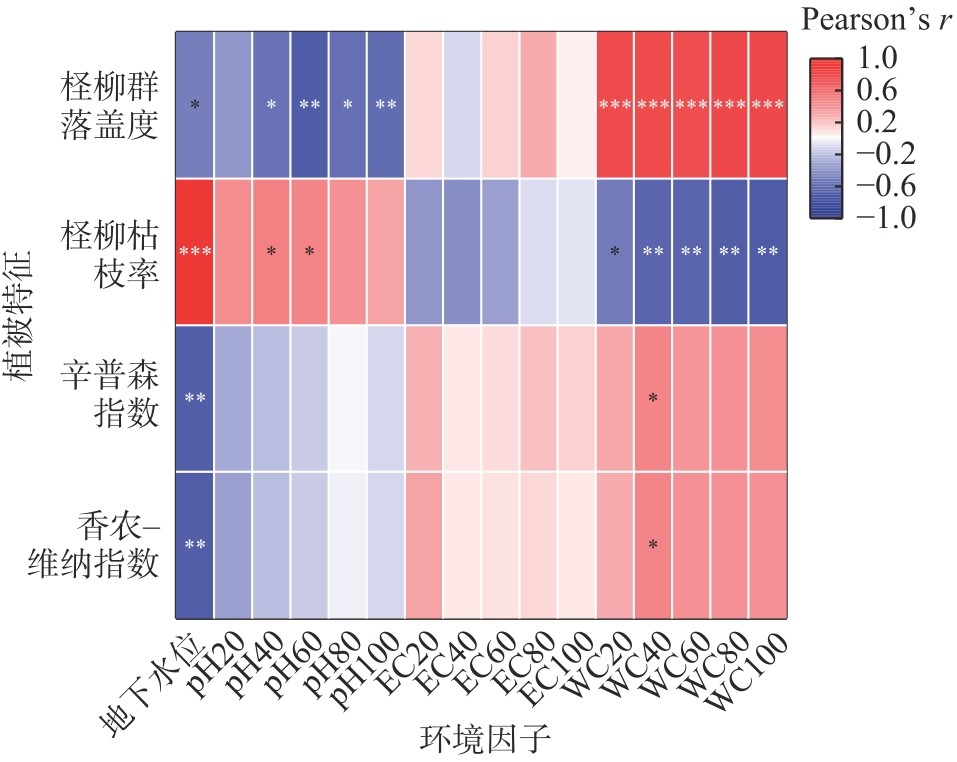
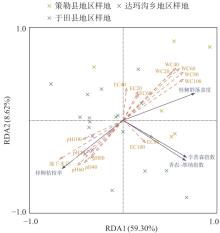
Fig. 4
RDA of vegetation characteristics and environmental factors"
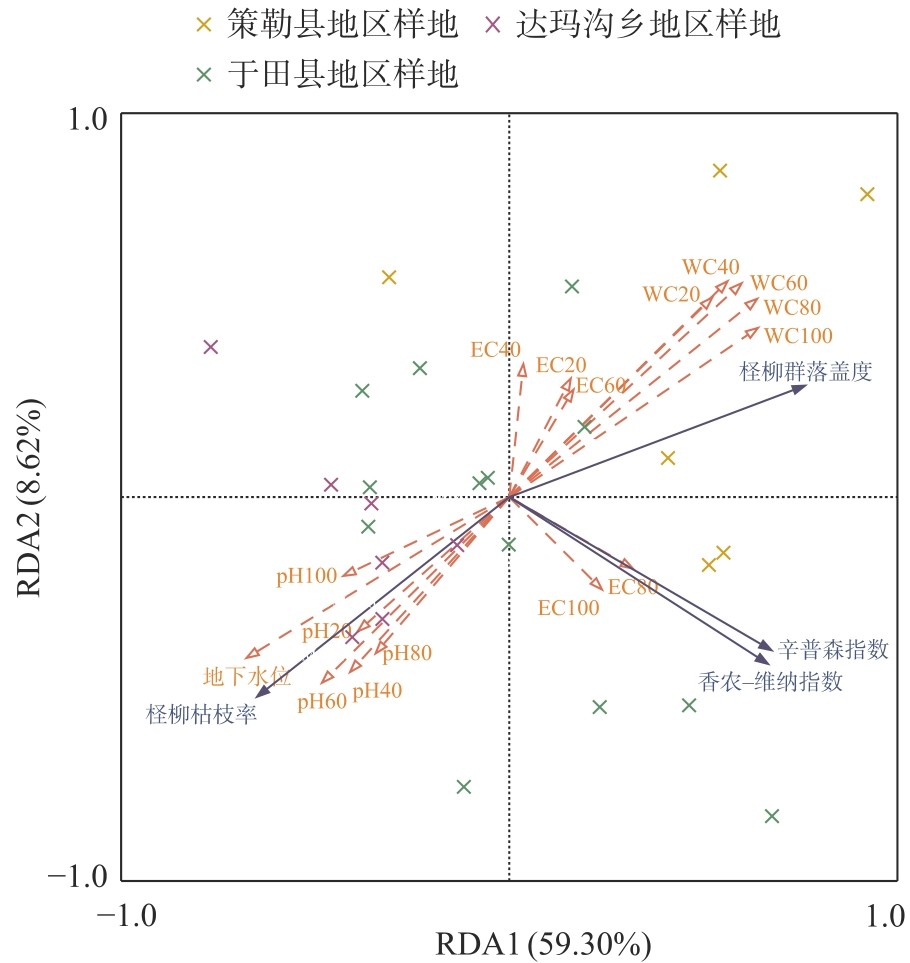
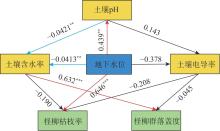
Fig. 5
Structural equation analysis of vegetation characteristics and environmental factors of Tamarix chinensis community"
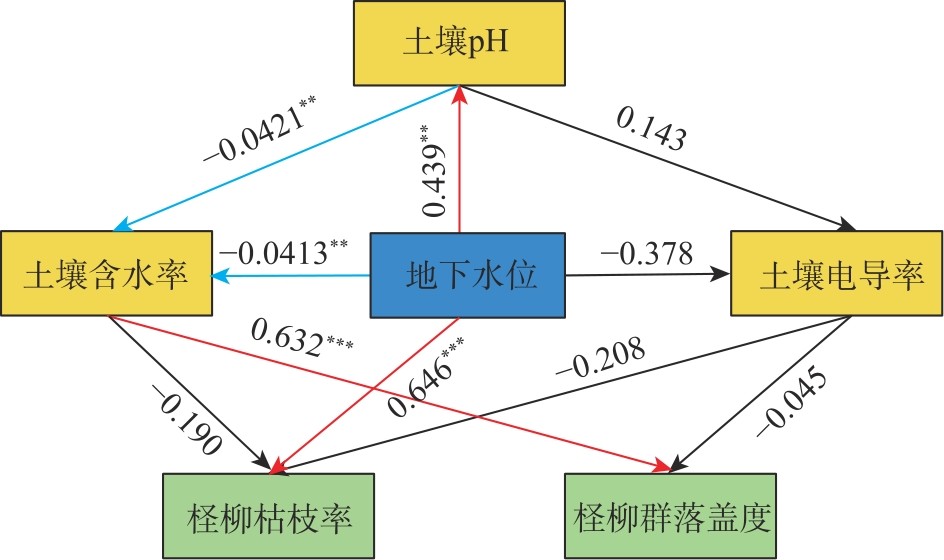
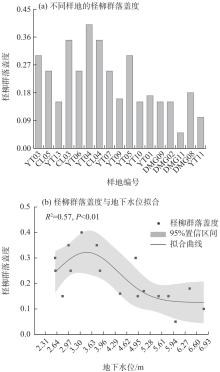
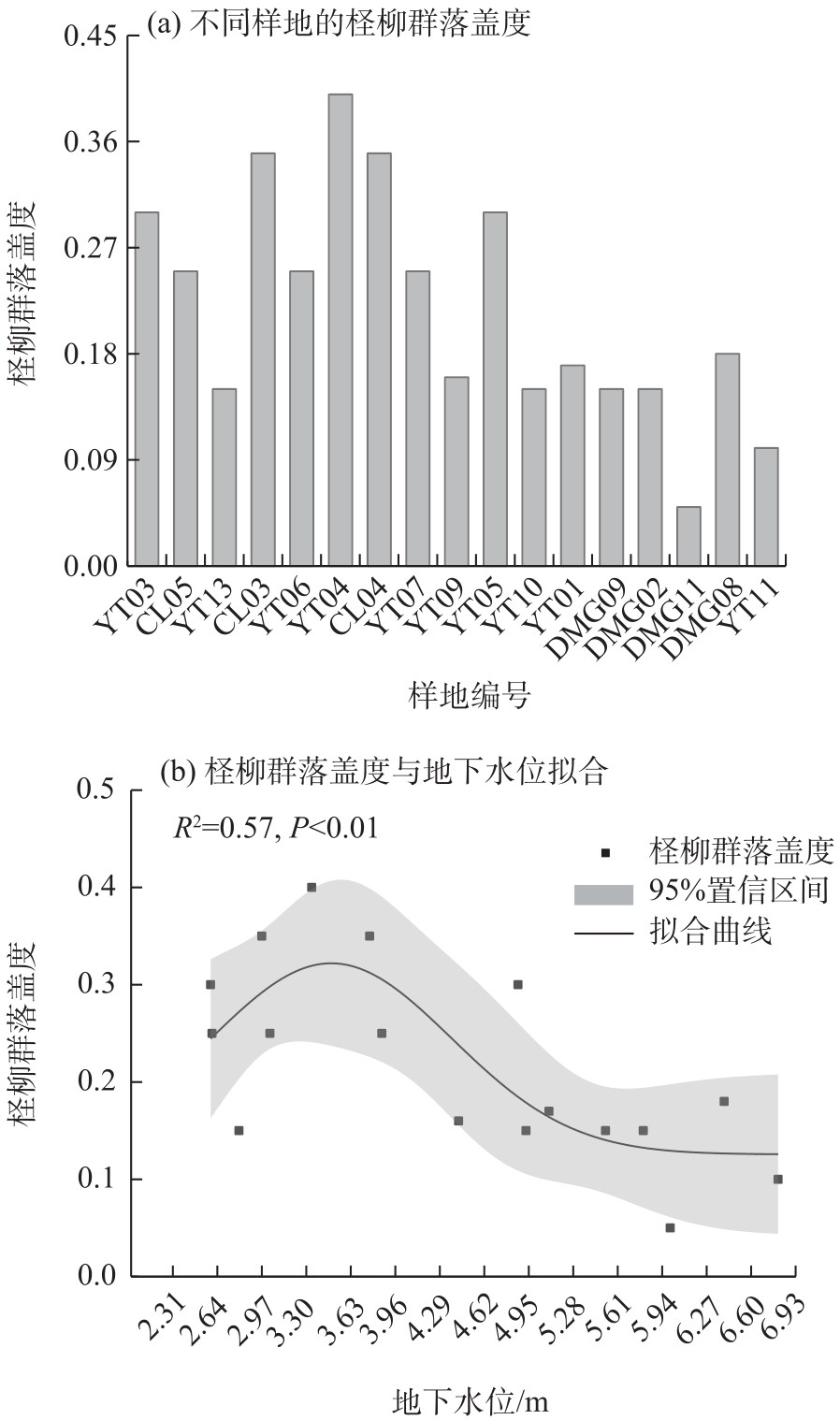
Fig. 6
Fitting curves of community coverage and groundwater level of Tamarix chinensis"
| [1] | Lu J Q, Zhang X F, Liang S M, et al. Spatiotemporal dynamics of vegetation index in an oasis-desert transition zone and relationship with environmental factors[J]. Sustainability, 2023, 15(4): 3503, doi: 10.3390/su15043503. |
| [2] | Sun F, Wang Y, Chen Y N, et al. Historic and simulated desert-oasis ecotone changes in the arid Tarim River Basin, China[J]. Remote Sensing, 2021, 13(4): 647, doi: 10.3390/rs13040647. |
| [3] | Peng M, He H, Wang Z, et al. Responses and comprehensive evaluation of growth characteristics of ephemeral plants in the desert-oasis ecotone to soil types[J]. Journal of Environmental Management, 2022, 316: 115288, doi: 10.1016/j.jenvman.2022.115288. |
| [4] |
Wu L Y, You W B, Ji Z B, et al. Ecosystem health assessment of dongshan island based on its ability to provide ecological services that regulate heavy rainfall[J]. Ecological Indicators, 2018, 84: 393-403.
doi: 10.1016/j.ecolind.2017.09.006 |
| [5] |
Pi H W, Sharratt B, Lei J Q. Windblown sediment transport and loss in a desert-oasis ecotone in the Tarim Basin[J]. Scientific Reports, 2017, 7(1): 7723, doi: 10.1038/s41598-017-07846-3.
pmid: 28798390 |
| [6] |
巩炜, 胡广录, 付鹏程, 等. 干旱区沙漠-绿洲过渡带固沙植物的土壤水分入渗特征[J]. 中国沙漠, 2020, 40(5): 200-208.
doi: 10.7522/j.issn.1000-694X.2020.00098 |
|
[Gong Wei, Hu Guanglu, Fu Pengcheng, et al. Soil moisture infiltration characteristics of different sand-fixing plants in the desert-oasis transition zone in arid region of China[J]. Journal of Desert Research, 2020, 40(5): 200-208.]
doi: 10.7522/j.issn.1000-694X.2020.00098 |
|
| [7] |
Ling H B, Xu H L, Fu J Y, et al. Suitable oasis scale in a typical continental river basin in an arid region of China: A case study of the manas river basin[J]. Quaternary International, 2013, 286: 116-125.
doi: 10.1016/j.quaint.2012.07.027 |
| [8] |
许皓, 李彦, 谢静霞, 等. 光合有效辐射与地下水位变化对柽柳属荒漠灌木群落碳平衡的影响[J]. 植物生态学报, 2010, 34(4): 375-386.
doi: 10.3773/j.issn.1005-264x.2010.04.003 |
| [Xu Hao, Li Yan, Xie Jingxia, et al. Influence of solar radiation and groundwater table on carbon balance of phreatophytic desert shrub Tamarix[J]. Chinese Journal of Plant Ecology, 2010, 34(4): 375-386.] | |
| [9] | Nag S, Sharma A, Rallapalli S, et al. Targeting degraded hotspots in riparian corridors for rehabilitation based on hydrological, ecological, natural and anthropogenic indicators[J]. Journal of Environmental Management, 2022, 317: 128479, doi: 10.1016/j.jenvman.2022.128479. |
| [10] | Hassan M F, Mahmood R, Nasher N M R, et al. Integrated remote sensing and multi-criteria evaluation to assess coastal ecosystem degradation under climate and human pressures: Insights from Bangladesh[J]. Environmental Challenges, 2026, 22: 101403, doi: 10.1016/j.envcha.2025.101403. |
| [11] | Yin D W, Song X N, Zhu X M, et al. Spatiotemporal analysis of soil moisture variability and its driving factor[J]. Remote Sensing, 2023, 15(24): 5768, doi: 10.3390/rs15245768. |
| [12] | 宁虎森, 何苗, 罗青红, 等. 新疆柽柳林生态服务功能及其价值评估分析[J]. 生态科学, 2019, 38(4): 111-118. |
| [Ning Husen, He Miao, Luo Qinghong, et al. Evaluation of ecosystem services of Tamarix chinensis forest in Xinjiang[J]. Ecological Science, 2019, 38(4): 111-118.] | |
| [13] | Tayir M, Dai Y, Shi Q D, et al. Distinct leaf functional traits of Tamarix chinensis at different habitats in the hinterland of the Taklimakan Desert[J]. Frontiers in Plant Science, 2023, 13: 1094049, doi: 10.3389/fpls.2022.1094049. |
| [14] |
Su Y Z, Wang X F, Yang R, et al. Soil fertility, salinity and nematode diversity influenced by Tamarix ramosissima in different habitats in an arid desert oasis[J]. Environmental Management, 2012, 50(2): 226-236.
doi: 10.1007/s00267-012-9872-z |
| [15] | Li J, Hu S J, Sheng Y, et al. Whole-plant water use and hydraulics of Populus euphratica and Tamarix ramosissima seedlings in adaption to groundwater variation[J]. Water, 2022, 14(12): 1869, doi: 10.3390/w14121869. |
| [16] | Wan Y B, Shi Q D, Dai Y, et al. Water use characteristics of Populus euphratica Oliv. and Tamarix chinensis Lour at different growth stages in a desert oasis[J]. Forests, 2022, 13(2): 236, doi: 10.3390/f13020236. |
| [17] | Liu F Y, You Q G, Xue X, et al. The stem sap flow and water sources for Tamarix ramosissima in an artificial shelterbelt with a deep groundwater table in northwest China[J]. Frontiers in Plant Science, 2022, 13: 794084, doi: 10.3389/fpls.2022.794084. |
| [18] | 王雅梅, 张青青, 李骊, 等. 新疆克里雅河下游植被与地下水埋深关系初探[J]. 干旱区研究, 2020, 37(3): 562-569. |
| [Wang Yamei, Zhang Qingqing, Li Li, et al. Preliminary study on the relationship between vegetation and groundwater depth in the lower reaches of the Keriya River[J]. Arid Zone Research, 2020, 37(3): 562-569.] | |
| [19] |
李红阳, 陈天宇, 王圣杰, 等. 1979—2021年新疆昆仑山北坡潜在蒸散时空变化研究[J]. 干旱区地理, 2024, 47(9): 1443-1450.
doi: 10.12118/j.issn.1000-6060.2024.107 |
|
[Li Hongyang, Chen Tianyu, Wang Shengjie, et al. Spatiotemporal variations of potential evapotranspiration on the northern slope of the Kunlun Mountains in Xinjiang from 1979 to 2021[J]. Arid Land Geography, 2024, 47(9): 1443-1450.]
doi: 10.12118/j.issn.1000-6060.2024.107 |
|
| [20] |
Lei Y, Li X Q, Ling H B. Model for calculating suitable scales of oases in a continental river basin located in an extremely arid region, China[J]. Environmental Earth Sciences. 2015, 73(2): 571-580.
doi: 10.1007/s12665-014-3328-0 |
| [21] |
Mamat Z, Halik U, Muhtar P, et al. Temporal variation of significant soil hydrological parameters in the Yutian oasis in northwest China from 2001 to 2010[J]. Environmental Earth Sciences, 2016, 75(4): 1-16.
doi: 10.1007/s12665-015-4873-x |
| [22] | 方精云, 王襄平, 沈泽昊, 等. 植物群落清查的主要内容、方法和技术规范[J]. 生物多样性, 2009, 17(6): 533-548. |
|
[Fang Jingyun, Wang Xiangping, Shen Zehao, et al. Methods and protocols for plant community inventory[J]. Biodiversity Science, 2009, 17(6): 533-548.]
doi: 10.3724/SP.J.1003.2009.09253 |
|
| [23] | 马艳霞, 郭玉川, 李伟旭, 等. 克里雅河地下水埋深空间插值方法优选及影响因素分析[J]. 人民黄河, 2025, 47(4): 77-83. |
| [Ma Yanxia, Guo Yuchuan, Li Weixu, et al. Spatial interpolation method preferences and influencing factors of groundwater depth interpolation in the Keriya River[J]. Yellow River, 2025, 47(4): 77-83.] | |
| [24] | 丁爱强, 徐先英, 张雯, 等. 不同退化程度柽柳灌丛的土壤理化和生物学特性[J]. 草业学报, 2019, 28(2): 1-11. |
| [Ding Aiqiang, Xu Xianying, Zhang Wen, et al. Soil physicochemical and biological characteristics of Tamarix ramosissima nebkhas in different degradation degree[J]. Acta Prataculturae Sinica, 2019, 28(2): 1-11.] | |
| [25] | 许光辉, 郑洪元. 土壤微生物分析方法手册[M]. 北京: 农业出版社, 1986: 314. |
| [Xu Guanghui, Zheng Hongyuan. Handbook of soil microbial analysis methods[M]. Beijing: China Agriculture Press, 1986: 314.] | |
| [26] | 鲍士旦. 土壤农化分析[M]. 第三版. 北京: 中国农业出版社, 2000. |
| [Bao Shidan. Soil agrochemical analysis[M]. 3rd ed. Beijing: China Agriculture Press, 2000.] | |
| [27] | 沈渭寿, 曹学章, 沈发云. 中国土地退化的分类与分级[J]. 生态与农村环境学报, 2006, 22(4): 88-93. |
| [Shen Weishou, Cao Xuezhang, Shen Fayun. Classification and grading of land degradation in China[J]. Journal of Ecology and Rural Environment, 2006, 22(4): 88-93.] | |
| [28] | 王君厚, 孙司衡. 荒漠化类型划分及其数量化评价体系[J]. 干旱环境监测, 1996, 10(3): 129-137, 190. |
| [Wang Junhou, Sun Siheng. Classification of desertification types and its quantitative evaluation system[J]. Arid Environmental Monitoring, 1996, 10(3): 129-137, 190.] | |
| [29] | 朱震达, 吴焕忠, 崔书红. 中国土地荒漠化/土地退化的防治与环境保护[J]. 农村生态环境, 1996, 12(3): 1-6. |
| [Zhu Zhenda, Wu Huanzhong, Cui Shuhong. Combating desertification/land degradation and protecting the environment in China[J]. Journal of Ecology and Rural Environment, 1996, 12(3): 1-6.] | |
| [30] | Mackenzie Aulay. 生态学[M]. 北京: 科学出版社, 2000. |
| [Mackenzie Aulay. Ecology[M]. Beijing: Science Press, 2000.] | |
| [31] | 张丽, 董增川, 黄晓玲. 干旱区典型植物生长与地下水位关系的模型研究[J]. 中国沙漠, 2004, 24(1): 112-115. |
| [Zhang Li, Dong Zengchuan, Huang Xiaoling. Modeling on relation between major plants growthand groundwater depth in arid area[J]. Journal of Desert Research, 2004, 24(1): 112-115.] | |
| [32] | Wang T Y, Wu Z N, Wang P, et al. Plant-groundwater interactions in drylands: A review of current research and future perspectives[J]. Agricultural and Forest Meteorology, 2023, 341: 109636, doi: 10.1016/j.agrformet.2023.109636. |
| [33] |
唐敏, 张峰, 师庆东. 克里雅河尾闾绿洲浅层地下水位埋深变化特征研究[J]. 干旱区地理, 2021, 44(1): 80-88.
doi: 10.12118/j.issn.1000–6060.2021.01.09 |
|
[Tang Min, Zhang Feng, Shi Qingdong. Variations in groundwater table depth at Daliyaboyi oasis, Keriya River, China[J]. Arid Land Geography, 2021, 44(1): 80-88.]
doi: 10.12118/j.issn.1000–6060.2021.01.09 |
|
| [34] |
张静静, 郝海超, 郝兴明, 等. 塔里木河下游生态输水对天然植被NPP的影响[J]. 干旱区地理, 2021, 44(3): 708-717.
doi: 10.12118/j.issn.1000–6060.2021.03.13 |
|
[Zhang Jingjing, Hao Haichao, Hao Xingming, et al. Effects of ecological water conveyance on NPP of natural vegetation in the lower reaches of Tarim River[J]. Arid Land Geography, 2021, 44(3): 708-717.]
doi: 10.12118/j.issn.1000–6060.2021.03.13 |
|
| [35] | 阿拉木萨, 王永翠, 李雪华. 荒漠绿洲典型天然植被与环境水分关系研究进展[J]. 水土保持学报, 2026, 40(2): 1-14. |
| [Alamusa, Wang Yongcui, Li Xuehua. Research progress on relationship between typical natural vegetation and environmental water in desert oases[J]. Journal of Soil and Water Conservation, 2026, 40(2): 1-14.] | |
| [36] | 白元, 徐海量, 张青青, 等. 基于地下水恢复的塔里木河下游生态需水量估算[J]. 生态学报, 2015, 35(3): 630-640. |
| [Bai Yuan, Xu Hailiang, Zhang Qingqing, et al. Evaluation on ecological water requirement in the lower reaches of Tarim River based on groundwater restoration[J]. Acta Ecologica Sinica, 2015, 35(3): 630-640.] | |
| [37] | 闫衡, 谢正辉, 韦文秀, 等. 气候变化与人类用水活动作用背景下黑河流域地下水资源未来预估[J]. 地质学报, 2025, 99(2): 1-20. |
|
[Yan Heng, Xie Zhenghui, Wei Wenxiu, et al. Future projection of groundwater resources in the Heihe River Basin under the background of climate change and human water use activities[J]. Acta Geologica Sinica, 2025, 99(2): 1-20.]
doi: 10.1111/acgs.v99.1 |
|
| [38] | Ma L, Zhu G F, Chen B L, et al. A globally robust relationship between water table decline, subsidence rate, and carbon release from peatlands[J]. Communications Earth & Environment, 2022, 3(1): 254, doi: 10.1038/s43247-022-00474-5. |
| [39] | 陈田田, 王钰茜, 曾兴兰. 西南地区生态系统服务关系特征及其与植被覆盖的约束效应[J]. 生态学报, 2023, 43(6): 2253-2270. |
| [Chen Tiantian, Wang Yuqian, Zeng Xinglan. Characteristics and constraint relationship between ecosystem services and vegetation coverage in southwest China[J]. Acta Geologica Sinica, 2023, 43(6): 2253-2270.] | |
| [40] | 刘雪薇, 肖春萍, 翁丽丽, 等. 两种微生物菌肥介导下北苍术生长发育及栽培土壤微生态响应[J]. 中国实验方剂学杂志, 2025, 31(18): 157-165. |
| [Liu Xuewei, Xiao Chunping, Weng Lili, et al. Growth and development of Atractylodes chinensis and microecological response of cultivated soil mediated by two microbial fertilizers[J]. Chinese Journal of Experimental Traditional Medical Formulae, 2025, 31(18): 157-165.] | |
| [41] | 刘小燕, 张亚雄, 胡兴峰. 不同处理对白刺扦插生根的影响[J]. 分子植物育种, 2025, 23(6): 1953-1960. |
| [Liu Xiaoyan, Zhang Yaxiong, Hu Xingfeng. Effects of different treatments on cutting rooting of Nitraria tangutorum[J]. Molecular Plant Breedin, 2025, 23(6): 1953-1960.] | |
| [42] | 朱绪超, 袁国富, 唐新斋, 等. 一个新的荒漠河岸林需水量估算方法及其在塔里木河下游的应用[J]. 干旱区地理, 2016, 39(2): 368-377. |
| [Zhu Xuchao, Yuan Guofu, Tang Xinzhai, et al. A new method for estimating water requirement of desert riparian forests and its application in the lower reaches of Tarim River[J]. Arid Land Geography, 2016, 39(2): 368-377.] | |
| [43] | 菲鲁然·艾勒肯, 戴岳, 安外尔·阿卜杜热伊木. 克里雅河尾闾不同地下水埋深对多枝柽柳幼苗根系形态和生物量分配的影响[J]. 生态学报, 2025, 45(8): 4036-4045. |
| [Erkin Flora, Dai Yue, Abdureyim Anwar. Effects of different groundwater depths on the root morphology and biomass allocation of Tamarix ramosissima Ledeb. seedlings at the tail of the Keriya River[J]. Acta Ecologica Sinica, 2025, 45(8): 4036-4045.] | |
| [44] | Liu Z H, Wang J J, Ding J L, et al. Analysis of spatial-temporal evolution trends and influential factors of desert-oasis thermal environment in typical arid zone: The case of Turpan-Hami region[J]. Ecological Indicators, 2023, 154: 110747, doi: 10.1016/j.ecolind.2023.110747. |
| [45] | Cui X, Xu G, He X F, et al. Influences of seasonal soil moisture and temperature on vegetation phenology in the Qilian Mountains[J]. Remote Sensing, 2022, 14(15): 3645, doi: 10.3390/rs14153645. |
| [46] | Yan A, Wang J Y, Liu X D, et al. Oasis evolution and human activities in the central Tianshan Mountains of the Asian inland arid zone: Provenance and environmental reconstruction[J]. Catena, 2024, 246: 108410, doi: 10.1016/j.catena.2024.108410. |
| [47] | Zhang W B, Ma L B, Li H B, et al. Trends in the future evolution of rural settlements in oasis-desert areas under water use simulation scenarios: Take the Hexi Corridor region of China as an example[J]. Landscape and Urban Planning, 2024, 248: 105110, doi: 10.1016/j.landurbplan.2024.105110. |
| No related articles found! |
|
||