Arid Land Geography ›› 2026, Vol. 49 ›› Issue (5): 1013-1025.doi: 10.12118/j.issn.1000-6060.2025.405
• Urban Geography • Previous Articles Next Articles
ZHAO Xiaoqin( ), SUN Dehua()
Received:2025-07-14
Revised:2025-11-14
Online:2026-05-25
Published:2026-05-25
Contact:
SUN Dehua
E-mail:zxq_play@163.com;sundehua5210@126.com
ZHAO Xiaoqin, SUN Dehua. Preferences for urban amenity in China’s labor mobility network: Based on Baidu migration big data[J].Arid Land Geography, 2026, 49(5): 1013-1025.

Tab. 1
Explanation of TERGM statistics"
| 类别 | 变量 | 示意图 | 统计意义 |
|---|---|---|---|
| 内生结构变量 | 边 |  | 网络中连边数量,相当于常数项 |
| 互惠性 |  | 两城市间的双向流动关系 | |
| 传递三元组 |  | 开放性:劳动力流动网络中有许多三元开放,即3个地点形成一条链状 结构 | |
| 三循环 |  | 闭合性:劳动力流动模式中存在一种“环流”现象 | |
| 外生变量 | 同配性 |  | 属性相同或相近的城市之间是否劳动力流动更加频繁 |
| 接收者效应 |  | 具备某种属性的城市倾向于吸引人口流入 | |
| 发送者效应 |  | 具备某种属性的城市倾向于致使人口流出 | |
| 网络协变量 | 外生情境因素,城市间的关系对网络形成的影响 | ||
| 时序统计量 | 记忆-二元稳定 | 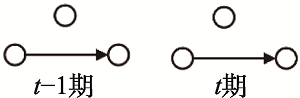 | 网络稳定性,即在t-1时期已经建立(或未建立)的连边,在t时期仍然维持(或未建立)的趋势 |
| 记忆-消融 |  | t-1期存在的网络连带,在t期消失了 | |
| 记忆-创新 |  | t-1期不存在的网络连带,在t期产生了 | |
| 延迟互惠 |  | 存在某种形式的反馈机制,即t-1期城市A与城市B发生A到B的劳动力流动,而t期时城市B流向城市A |
Tab. 2
Exogenous statistics and variable composition of TERGM"
| 统计量 | 变量名称 | 变量内容 | 单位 |
|---|---|---|---|
| 节点属性变量 | 人为舒适度 | 教育、文化、医疗、公共服务、交通和环境指数 | - |
| 自然舒适度 | 年均降水量 | mm | |
| 采暖度日数 | d | ||
| 经济发展 | 人均地区生产总值 | 元 | |
| 数字普惠金融指数 | - | ||
| 人口规模 | 年末户籍人口 | 104人 | |
| 产业结构 | 第三产业产值/第二产业产值 | - | |
| 房价收入比 | 房价/收入 | - | |
| 网络协变量 | 地理距离 | 各城市间实际地理距离 | km |
| 文化距离 | 测算的方言距离,数值范围在0~4之间[ | - |
Tab. 3
Urban amenity evaluation index system"
| 指数名称 | 具体指标 | 载荷系数 |
|---|---|---|
| 教育指数 | 每百生中学教师数/人 | 0.7071 |
| 每百生小学教师数/人 | 0.7071 | |
| 文化指数 | 每百人公共藏书数/本 | 0.7071 |
| 每万人博物馆数/个 | 0.7071 | |
| 医疗指数 | 每百万人医院数/个 | 0.7071 |
| 每万人病床数/张 | 0.7071 | |
| 公共服务指数 | 人均公共预算支出/元 | 0.4592 |
| 城镇职工基本养老保险参保比例/% | 0.5197 | |
| 职工基本医疗保险参保比例/% | 0.4927 | |
| 失业保险参保比例/% | 0.5255 | |
| 交通指数 | 人均铺装道路面积/m2 | 0.7071 |
| 每万人拥有公共汽电车数量/辆 | 0.7071 | |
| 环境指数 | 人均公园绿地面积/m2 | 0.7071 |
| PM2.5年均浓度/μg·m-3 | -0.7071 | |
| 人为舒适度 | 教育指数 | 0.2387 |
| 文化指数 | 0.4943 | |
| 医疗指数 | 0.4700 | |
| 公共服务指数 | 0.4975 | |
| 交通指数 | 0.3877 | |
| 环境指数 | 0.2829 | |
| 自然舒适度 | 年均降水量/mm | 0.7071 |
| 采暖度日数/d | -0.7071 |
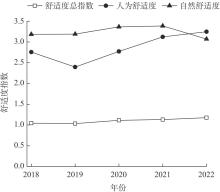
Fig. 1
Urban amenity from 2018 to 2022"
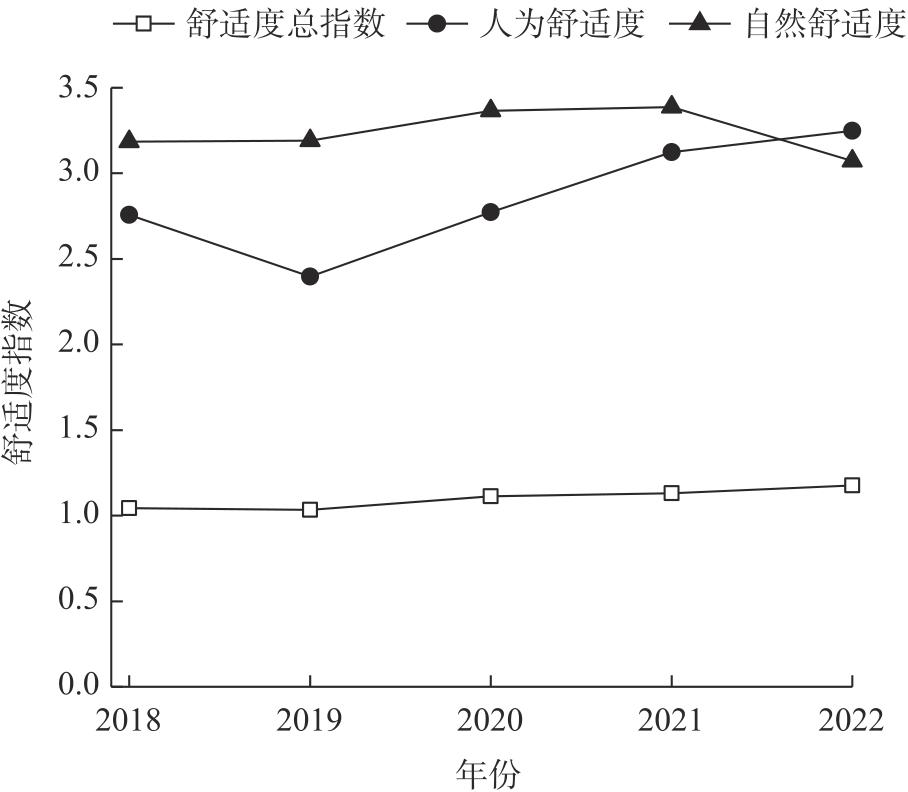
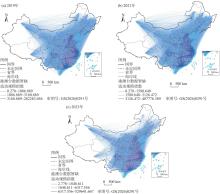
Fig. 2
Spatial patterns of labor migration network from 2019 to 2023"
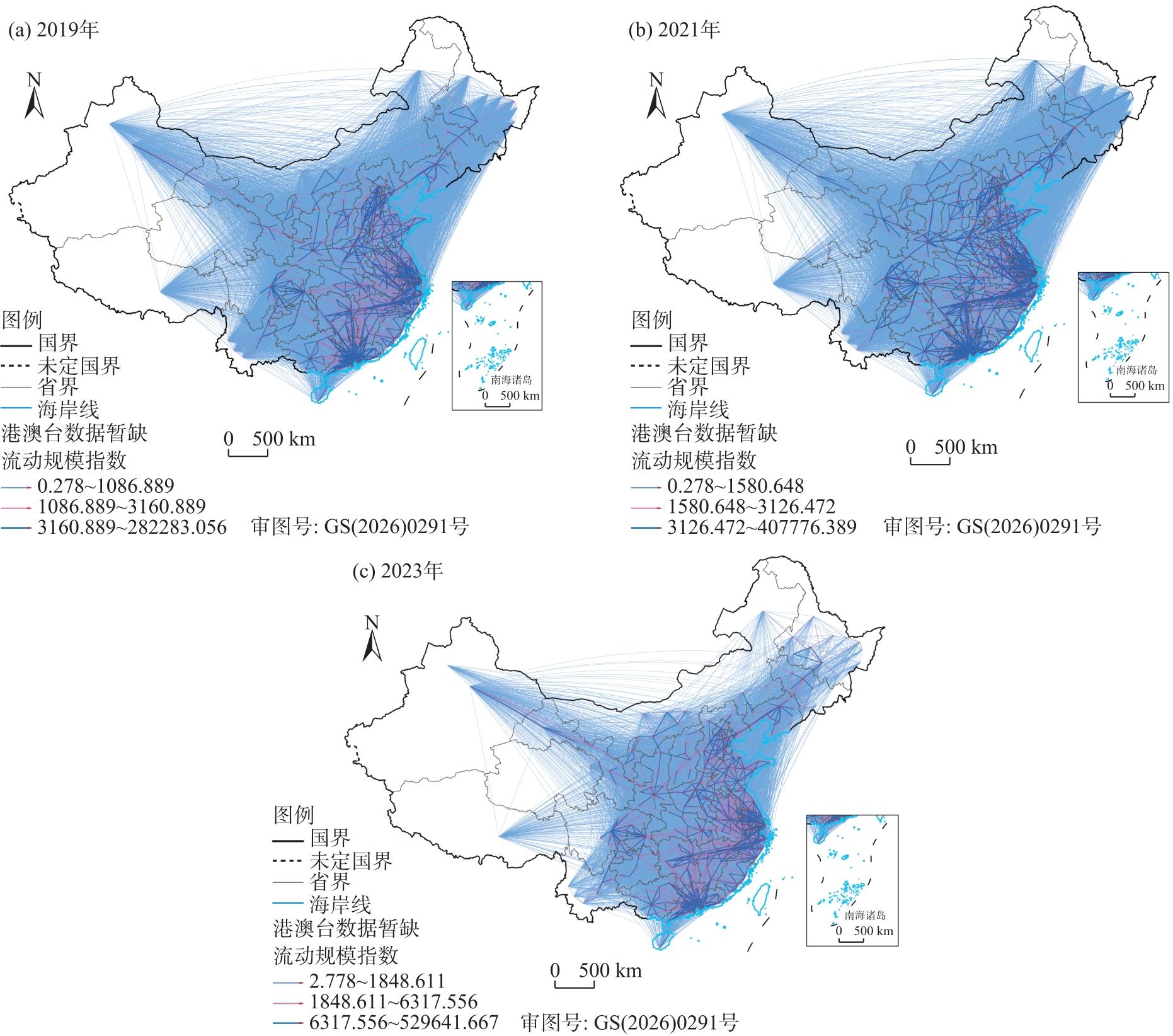
Fig. 3
Importance analysis of nodes in labor migration network from 2019 to 2023"
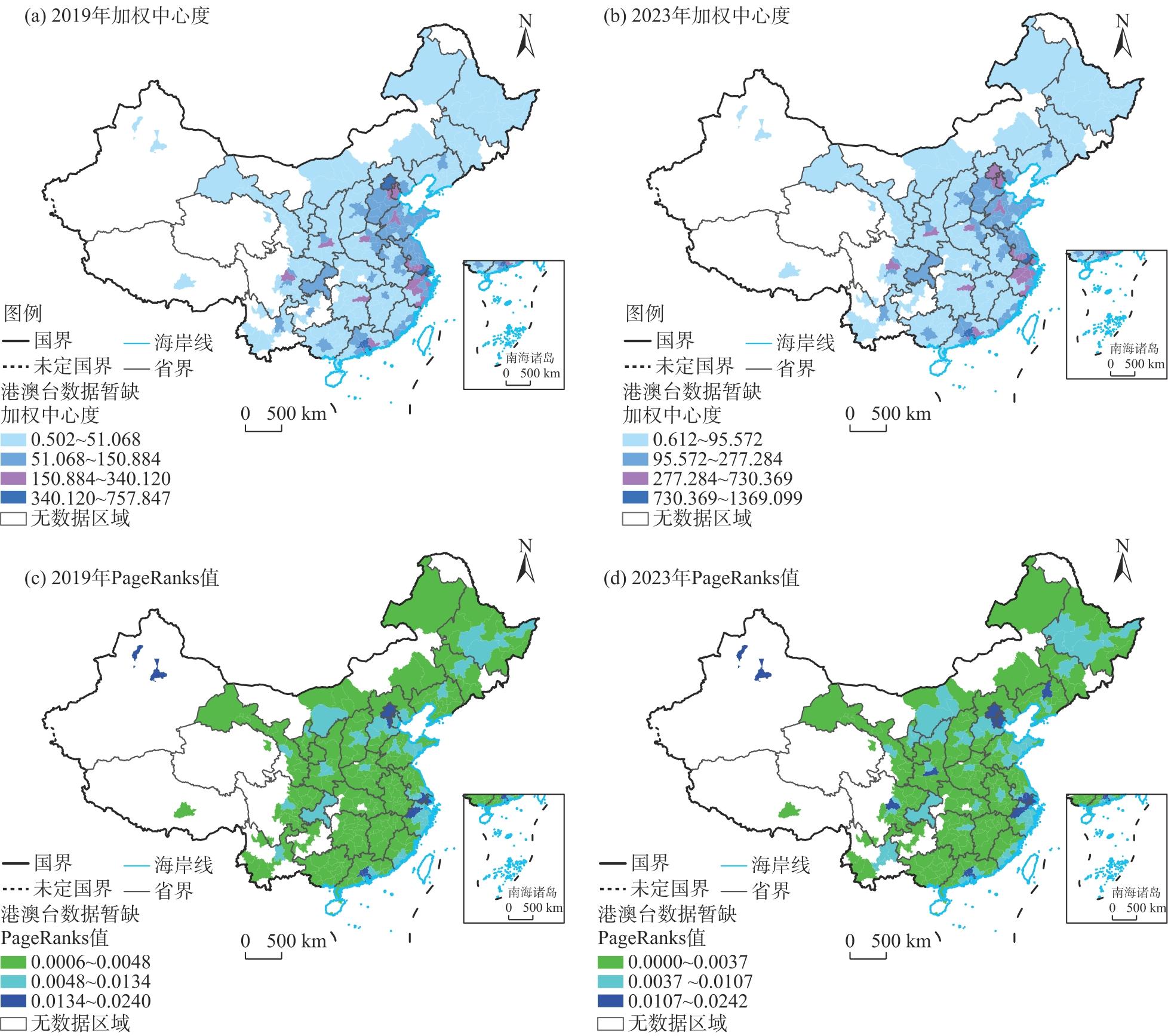

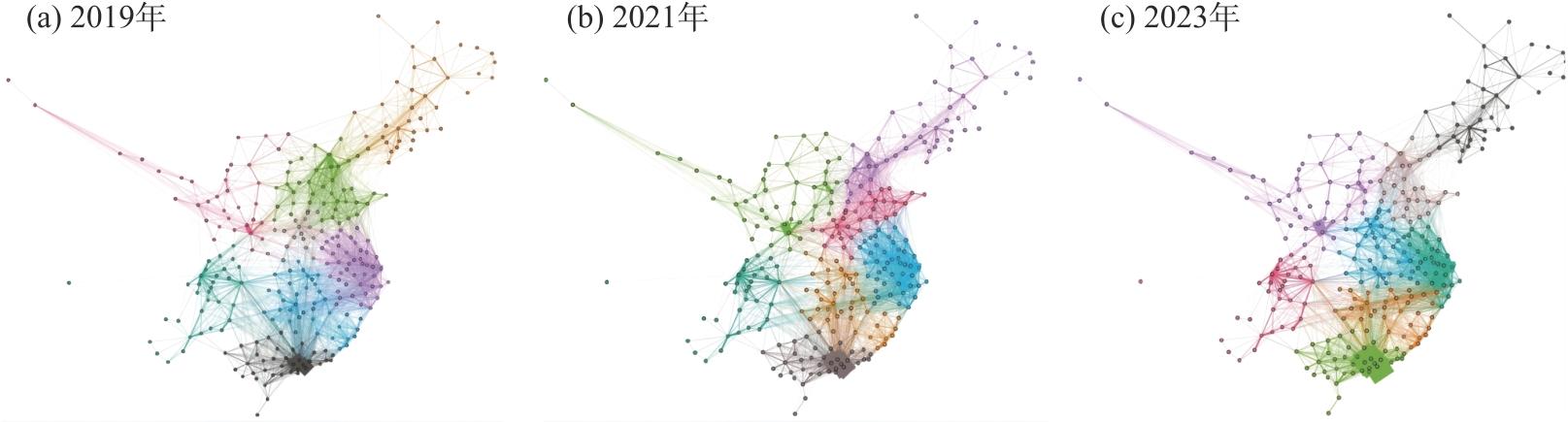
Fig. 4
Schematic diagrams of subgroup structure of labor migration networks from 2019 to 2023"
Tab. 4
TERGM regression results"
| 变量名称 | 模型1 | 模型 2 | 模型3 | 模型4 | 模型5 | 模型6 | 模型7 | |
|---|---|---|---|---|---|---|---|---|
| 内生 结构 变量 | 边 | -5.67***(0.235) | -23.77***(1.005) | -14.30***(1.143) | -7.89***(0.837) | -9.14***(1.066) | -9.14***(1.227) | -6.64***(0.811) |
| 互惠性 | 2.41***(0.107) | - | 2.02***(0.077) | 1.76***(0.117) | 1.76***(0.099) | 1.76***(0.117) | 1.76***(0.097) | |
| 传递三元组 | 0.03***(0.003) | - | 0.03***(0.003) | 0.03***(0.000) | 0.03***(0.000) | 0.03***(0.000) | 0.03***(0.000) | |
| 三循环 | -0.06***(0.005) | - | -0.04***(0.005) | -0.03***(0.005) | -0.03***(0.005) | -0.03***(0.005) | -0.03***(0.005) | |
| 节点 属性 变量 | 人为舒适度-接收 | - | 0.29***(0.038) | 0.37***(0.036) | 0.36***(0.013) | 0.36***(0.010) | 0.36***(0.018) | 0.36***(0.013) |
| 人为舒适度-发送 | - | 0.18***(0.036) | 0.12***(0.038) | 0.15***(0.023) | 0.15***(0.023) | 0.15***(0.026) | 0.15***(0.020) | |
| 自然舒适度-接收 | - | -0.03(0.028) | -0.06(0.038) | -0.05(0.054) | -0.05(0.054) | -0.05(0.056) | -0.05(0.056) | |
| 自然舒适度-发送 | - | -0.01(0.028) | -0.09***(0.031) | -0.11***(0.038) | -0.11***(0.036) | -0.11***(0.041) | -0.11***(0.041) | |
| 人口规模-接收 | - | 0.88***(0.084) | 1.17***(0.115) | 0.39***(0.153) | 0.39***(0.140) | 0.39***(0.173) | 0.39***(0.171) | |
| 人口规模-发送 | - | 0.70***(0.000) | 0.35***(0.001) | -0.12(0.001) | -0.12(0.001) | -0.12(0.001) | -0.12(0.001) | |
| 产业结构-接收 | - | 0.23***(0.020) | 0.18***(0.031) | 0.12***(0.043) | 0.12***(0.038) | 0.12***(0.038) | 0.12***(0.043) | |
| 产业结构-发送 | - | 0.13***(0.023) | 0.07***(0.031) | 0.11***(0.018) | 0.11***(0.018) | 0.11***(0.018) | 0.11***(0.018) | |
| 房价收入比-接收 | - | -0.40(0.357) | -0.20(0.589) | -1.59(1.469) | -1.59(1.429) | -1.59(1.548) | -1.59(1.622) | |
| 房价收入比-发送 | - | -0.40(0.311) | -0.58(0.587) | -1.20(1.574) | -1.20(1.495) | -1.20(1.617) | -1.20(1.617) | |
| 经济发展-接收 | - | -0.03(0.084) | 0.18(0.138) | -0.08(0.133) | -0.08(0.105) | -0.08(0.110) | -0.08(0.125) | |
| 经济发展-发送 | - | -0.16***(0.061) | -0.34***(0.112) | -0.44***(0.102) | -0.44***(0.102) | -0.44***(0.115) | -0.44***(0.107) | |
| 经济发展匹配性 | - | 0.04***(0.015) | -0.15***(0.026) | -0.13***(0.048) | -0.13***(0.041) | -0.13***(0.041) | -0.13***(0.046) | |
| 网络协变量 | 地理距离 | - | -0.001***(0.000) | -0.001**(0.000) | -0.001**(0.000) | -0.001***(0.000) | -0.001***(0.000) | -0.001***(0.000) |
| 文化距离 | - | -0.30***(0.010) | -0.24***(0.023) | -0.27***(0.054) | -0.27***(0.054) | -0.27***(0.054) | -0.27***(0.046) | |
| 时序 统计 变量 | 延迟互惠性 | 0.09(0.217) | - | - | 0.13(0.189) | 0.13(0.194) | 0.13(0.222) | 0.13(0.209) |
| 二元稳定性 | 1.34***(0.296) | - | - | 1.25***(0.291) | - | - | - | |
| 自聚集性 | - | - | - | - | 2.50***(0.474) | - | - | |
| 消融/创新 | - | - | - | - | - | -2.50***(0.533) | -2.50***(0.536) | |
| 样本量 | 323760 | 404700 | 404700 | 323760 | 323760 | 323760 | 323760 | |
| 赤池信息准则(AIC) | 125249.54 | 254505.66 | 163069.05 | 110344.32 | 110344.32 | 110344.32 | 110344.32 | |
| 贝叶斯信息准则(BIC) | 125313.67 | 254702.06 | 163298.18 | 110590.14 | 110590.14 | 110590.14 | 110590.14 | |
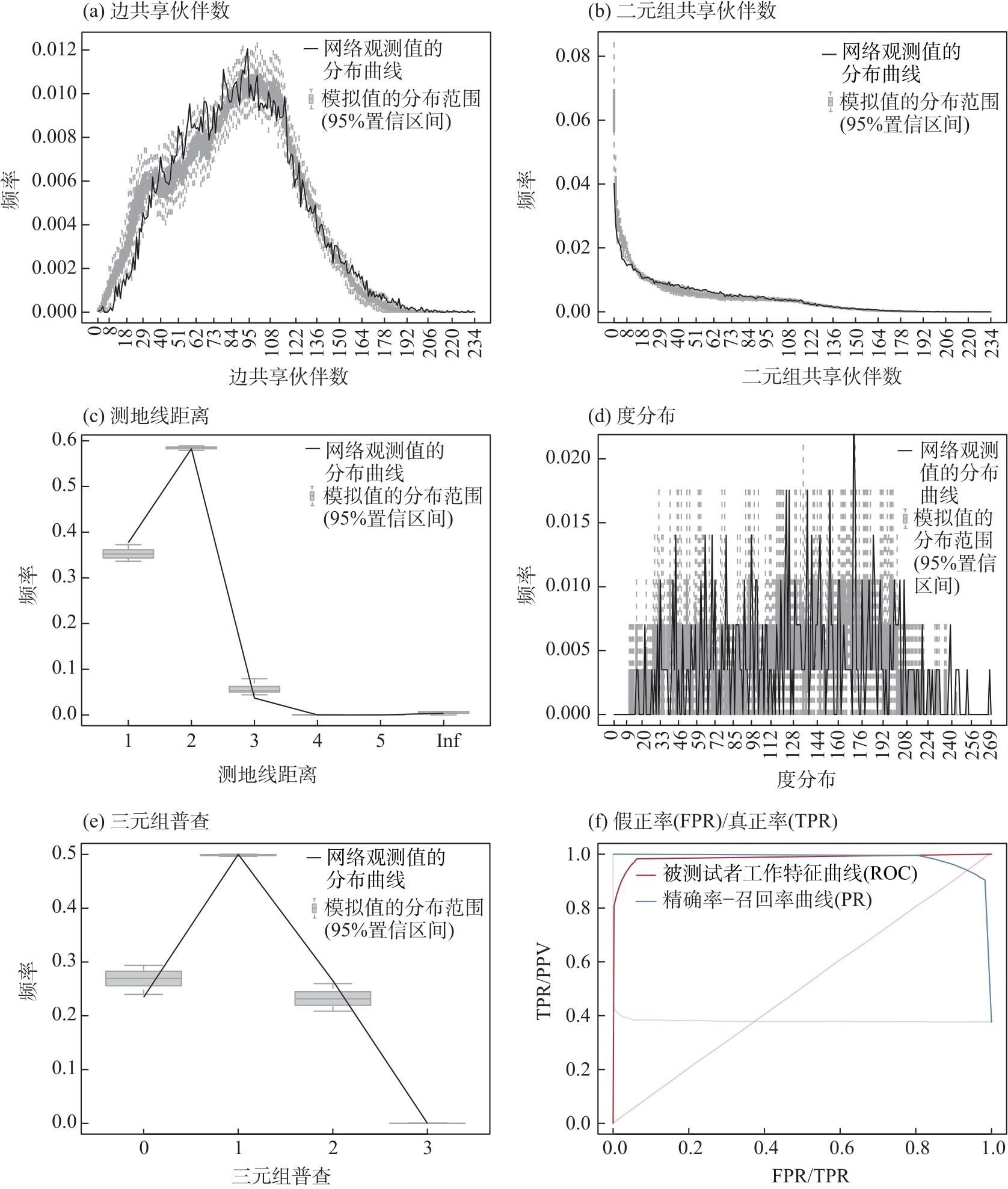
Fig. 5
Goodness-of-fit tests"
Tab. 5
Global spatial autocorrelation test"
| 变量 | 2019年 | 2020年 | 2021年 | 2022年 | 2023年 |
|---|---|---|---|---|---|
| 城市舒适度 | 0.34***(0.027) | 0.35***(0.027) | 0.22**(0.027) | 0.38***(0.027) | 0.38***(0.027) |
| 劳动力流动强度 | 0.21***(0.027) | 0.32***(0.027) | 0.20***(0.027) | 0.21***(0.027) | 0.18***(0.027) |
Tab. 6
Regression results of spatial effect"
| 变量 | 劳动力流动强度 |
|---|---|
| 城市舒适度 | 4.92*(2.553) |
| W×城市舒适度 | 13.48**(6.223) |
| 控制变量 | 控制 |
| rho | 0.15***(0.048) |
| LM-lag | 4.63** |
| LM-error | 3.63* |
| Wald-lag | 40.2*** |
| Wald-error | 51.78*** |
| 样本量 | 1425 |
| R2 | 0.226 |
Tab. 7
Regeression results of spatial spillover effect"
| 变量 | 直接效应 | 间接效应 | 总效应 |
|---|---|---|---|
| 城市舒适度 | 5.32**(2.605) | 16.20**(6.778) | 21.52***(7.175) |
| 控制变量 | 控制 | 控制 | 控制 |
| 样本量 | 1425 | 1425 | 1425 |
| R2 | 0.226 | 0.226 | 0.226 |
| [1] |
朱宇, 林李月. 中国人口迁移流动的时间过程及其空间效应研究: 回顾与展望[J]. 地理科学, 2016, 36(6): 820-828.
doi: 10.13249/j.cnki.sgs.2016.06.003 |
| [Zhu Yu, Lin Liyue. Studies on the temporal processes of migration and their spatial effects in China: Progress and prospect[J]. Geographical Science, 2016, 36(6): 820-828.] | |
| [2] |
古恒宇, 沈体雁, 刘子亮, 等. 基于空间滤波方法的中国省际人口迁移驱动因素[J]. 地理学报, 2019, 74(2): 222-237.
doi: 10.11821/dlxb201902002 |
|
[Gu Hengyu, Shen Tiyan, Liu Ziliang, et al. Driving mechanism of interprovincial population migration flows in China based on spatial filtering[J]. Acta Geographica Sinica, 2019, 74(2): 222-237.]
doi: 10.11821/dlxb201902002 |
|
| [3] | 王洁晶, 张沐华, 王霓霓. 中国流动人口分布的空间格局和影响因素——基于人口普查分县数据的研究[J]. 人口学刊, 2023, 45(4): 82-96. |
| [Wang Jiejing, Zhang Muhua, Wang Nini. Spatial pattern and influencing factors of China’s migrant population distribution: A study based on county level data from national population censuses[J]. Population Journal, 2023, 45(4): 82-96.] | |
| [4] | 周颖刚, 蒙莉娜, 卢琪. 高房价挤出了谁?——基于中国流动人口的微观视角[J]. 经济研究, 2019, 54(9): 106-122. |
| [Zhou Yinggang, Meng Lina, Lu Qi. Who is crowded out by high housing prices? Evidence from microdata in China[J]. Economic Research Journal, 2019, 54(9): 106-122.] | |
| [5] | 高波, 陈健, 邹琳华. 区域房价差异、劳动力流动与产业升级[J]. 经济研究, 2012, 47(1): 66-79. |
| [Gao Bo, Chen Jian, Zou Linhua. Housing price regional differences, labor mobility and industrial upgrading[J]. Economic Research Journal, 2012, 47(1): 66-79.] | |
| [6] | 夏怡然, 陆铭. 城市间的“孟母三迁”——公共服务影响劳动力流向的经验研究[J]. 管理世界, 2015(10): 78-90. |
| [Xia Yiran, Lu Ming. The “three moves of meng mother” among cities: An empirical study on the impact of public services on labor force mobility[J]. Journal of Management World, 2015(10): 78-90.] | |
| [7] | 张亚丽, 方齐云. 城市舒适度对劳动力流动的影响[J]. 中国人口·资源与环境, 2019, 29(3): 118-125. |
| [Zhang Yali, Fang Qiyun. The impact of city amenity on labor migration[J]. China Population, Resources and Environment, 2019, 29(3): 118-125.] | |
| [8] |
Greenwood M J, Hunt G L. Jobs versus amenities in the analysis of metropolitan migration[J]. Journal of Urban Economics, 1989, 25(1): 1-16.
pmid: 12281691 |
| [9] |
马凌, 李丽梅, 朱竑. 中国城市舒适物评价指标体系构建与实证[J]. 地理学报, 2018, 73(4): 755-770.
doi: 10.11821/dlxb201804012 |
|
[Ma Ling, Li Limei, Zhu Hong. The construction of urban amenities index in China: An empirical research based on a statistical analysis of 26 Chinese major cities[J]. Acta Geographica Sinica, 2018, 73(4): 755-770.]
doi: 10.11821/dlxb201804012 |
|
| [10] |
王毅, 苗转莹, 陆玉麒, 等. 经济发展对城市宜居性的影响——基于中国40个大中城市的实证分析[J]. 地理学报, 2022, 77(10): 2529-2546.
doi: 10.11821/dlxb202210008 |
|
[Wang Yi, Miao Zhuanying, Lu Yuqi, et al. The impact of economic development on urban livability: Evidence from 40 large and medium-sized cities of China[J]. Acta Geographica Sinica, 2022, 77(10): 2529-2546.]
doi: 10.11821/dlxb202210008 |
|
| [11] |
刘嘉杰, 刘涛, 曹广忠. 舒适性迁移研究进展与启示[J]. 地理科学进展, 2023, 42(6): 1216-1228.
doi: 10.18306/dlkxjz.2023.06.016 |
|
[Liu Jiajie, Liu Tao, Cao Guangzhong. Amenity migration: An international review and inspiration[J]. Progress in Geography, 2023, 42(6): 1216-1228.]
doi: 10.18306/dlkxjz.2023.06.016 |
|
| [12] | 刘涛, 彭荣熙, 曹广忠. 流动人口居留稳定性的群体分异与空间格局[J]. 人文地理, 2021, 36(3): 37-46. |
| [Liu Tao, Peng Rongxi, Cao Guangzhong. Duration of residence at destination among China’s internal migrants: Group differences and spatial variations[J]. Human Geography, 2021, 36(3): 37-46.] | |
| [13] |
温婷, 林静, 蔡建明, 等. 城市舒适性: 中国城市竞争力评估的新视角及实证研判[J]. 地理研究, 2016, 35(2): 214-226.
doi: 10.11821/dlyj201602002 |
| [Wen Ting, Lin Jing, Cai Jianming, et al. Urban amenity: A new perspective and empirical testimony on China’s city competitiveness assessment[J]. Geographical Research, 2016, 35(2): 214-226.] | |
| [14] |
喻忠磊, 唐于渝, 张华, 等. 中国城市舒适性的空间格局与影响因素[J]. 地理研究, 2016, 35(9): 1783-1798.
doi: 10.11821/dlyj201609015 |
| [Yu Zhonglei, Tang Yuyu, Zhang Hua, et al. Spatial pattern and driving factors of Chinese urban amenities[J]. Geographical Research, 2016, 35(9): 1783-1798.] | |
| [15] |
Watts D J, Strogatz S H. Collective dynamics of ‘small-world’ networks[J]. Nature, 1998, 393(6684): 440-442.
doi: 10.1038/30918 |
| [16] | 王群勇, 孙倩. 中国城市劳动力流动的网络特征——基于百度迁徙大数据的研究[J]. 南方人口, 2023, 38(6): 51-67. |
| [Wang Qunyong, Sun Qian. The characteristics of urban labor mobility network in China: An analysis of Baidu migration big data[J]. South China Population, 2023, 38(6): 51-67.] | |
| [17] | Zhang W L, Chong Z H, Li X J, et al. Spatial patterns and determinant factors of population flow networks in China: Analysis on Tencent location big data[J]. Cities, 2020, 99: 102640, doi: 10.1016/j.cities.2020.102640. |
| [18] | Zhang F, Ning Y M, Lou X Y. The evolutionary mechanism of China’s urban network from 1997 to 2015: An analysis of air passenger flows[J]. Cities, 2021, 109: 103005, doi: 10.1016/j.cities.2020.103005. |
| [19] | 张伟丽, 晏晶晶, 聂桂博. 中国城市人口流动格局演变及影响因素分析[J]. 中国人口科学, 2021, 2: 76-87, 127-128. |
| [Zhang Weili, Yan Jingjing, Nie Guibo. Evolution of the pattern of China’s urban population flows and its proximate determinants[J]. Chinese Journal of Population Science, 2021, 2: 76-87, 127-128.] | |
| [20] | Zhao Y T Z, Gao Y. Spatial patterns and trends of inter-city population mobility in China: Based on Baidu migration big data[J]. Cities, 2024, 151: 105124, doi: 10.1016/j.cities.2024.105124. |
| [21] | 林赛南, 彭馨雨, 冯馨, 等. 中国城市人口再流动的网络特征及影响因素[J]. 现代城市研究, 2025, 3: 97-104. |
| [Lin Sainan, Peng Xinyu, Feng Xin, et al. Network features and mechanisms of onward migration in urban China[J]. Modern Urban Research, 2025, 3: 97-104.] | |
| [22] |
赵梓渝, 王士君, 李卓伟, 等. 中国人口流动网络中的语言纽带效应[J]. 地理学报, 2024, 79(4): 873-889.
doi: 10.11821/dlxb202404004 |
| [Zhao Ziyu, Wang Shijun, Li Zhuowei, et al. A study on the effect of language ties in China’s population flow network[J]. Acta Geographica Sinica, 2024, 79(4): 873-889.] | |
| [23] |
雷玮倩, 焦利民. 城市人口集聚与城市间人口流动对经济产出的影响[J]. 地理学报, 2023, 78(8): 1969-1982.
doi: 10.11821/dlxb202308008 |
|
[Lei Weiqian, Jiao Limin. The impacts of urban population agglomeration and human mobility on economic performance[J]. Acta Geographica Sinica, 2023, 78(8): 1969-1982.]
doi: 10.11821/dlxb202308008 |
|
| [24] |
Brin S, Page L. The anatomy of a large-scale hypertextual web search engine[J]. Computer Networks and ISDN Systems, 1998, 30: 107-117.
doi: 10.1016/S0169-7552(98)00110-X |
| [25] |
Newman M E. Modularity and community structure in networks[J]. Proceedings of the National Academy of Sciences, 2006, 103(23): 8577-8582.
doi: 10.1073/pnas.0601602103 |
| [26] | Hanneke S, Fu W, Xing E P. Discrete temporal models of social networks[J]. Electronic Journal of Statistics, 2010, 4: 585-605. |
| [27] | 刘毓芸, 徐现祥, 肖泽凯. 劳动力跨方言流动的倒U型模式[J]. 经济研究, 2015, 50(10): 134-146, 162. |
| [Liu Yuyun, Xu Xianxiang, Xiao Zekai. The pattern of labor cross dialects migration[J]. Economic Research Journal, 2015, 50(10): 134-146, 162.] | |
| [28] |
Anselin L. Model validation in spatial econometrics: A review and evaluation of alternative approaches[J]. International Regional Science Review, 1988, 11(3): 279-316.
doi: 10.1177/016001768801100307 |
| [29] |
Diamond R. The determinants and welfare implication of US workers’ diverging location choice by skill: 1980—2000[J]. American Economic Review, 2016, 106(3): 479-524.
doi: 10.1257/aer.20131706 |
| [30] |
Graves P E. Migration and climate[J]. Journal of Regional Science, 1980, 20(2): 227-237.
pmid: 12263179 |
| [31] |
李积宏, 周刊社, 张东东, 等. 西藏高原人体舒适度指数时空变化特征分析[J]. 干旱区地理, 2024, 47(6): 980-992.
doi: 10.12118/j.issn.1000-6060.2023.224 |
|
[Li Jihong, Zhou Kanshe, Zhang Dongdong, et al. Spatial and temporal variation characteristics of comfort index of human body in Xizang Plateau[J]. Arid Land Geography, 2024, 47(6): 980-992.]
doi: 10.12118/j.issn.1000-6060.2023.224 |
|
| [32] | 李科洋. 人口流动对城市经济韧性的影响及对策研究[D]. 郑州: 郑州轻工业大学, 2023. |
| [Li Keyang. Study on the influence of population mobility on urban economic resilience and measures[D]. Zhengzhou: Zhengzhou University of Light Industry, 2023.] | |
| [33] | 张勋, 杨紫, 谭莹. 数字经济、家庭分工与性别平等[J]. 经济学(季刊), 2023, 23(1): 125-141. |
| [Zhang Xun, Yang Zi, Tan Ying. Digital economy, household labor division, and gender equality[J]. China Economic Quarterly, 2023, 23(1): 125-141.] | |
| [34] |
郭卫东, 钟业喜, 李炜. 基于不同交通方式的中国城市间人口流动网络比较研究[J]. 世界地理研究, 2023, 32(7): 102-112.
doi: 10.3969/j.issn.1004-9479.2023.07.2021377 |
|
[Guo Weidong, Zhong Yexi, Li Wei. A comparative study on the population flow network between Chinese cities based on different transportation modes[J]. World Regional Studies, 2023, 32(7): 102-112.]
doi: 10.3969/j.issn.1004-9479.2023.07.2021377 |
|
| [35] | 蒋小荣, 汪胜兰, 杨永春. 中国城市人口流动网络研究——基于百度LBS大数据分析[J]. 人口与发展, 2017, 23(1): 13-23. |
| [Jiang Xiaorong, Wang Shenglan, Yang Yongchun. Research on China’s urban population mobility network: Based on Baidu LBS big data[J]. Population and Development, 2017, 23(1): 13-23.] | |
| [36] |
Guo H W, Han J, Wang J. Population mobility, urban centrality and subnetworks in China revealed by social sensing big data[J]. Environment and Planning A: Economy and Space, 2021, 53(8): 1855-1858.
doi: 10.1177/0308518X211035400 |
| [37] | 邓仲良, 程杰. 流动人口空间分布与公共服务可及性[J]. 经济学动态, 2024(6): 114-131. |
| [Deng Zhongliang, Cheng Jie. Spatial distribution of internal migrants and public service accessibility[J]. Economic Perspectives, 2024(6): 114-131.] | |
| [38] | Li Z H, Li C, Gibson J, et al. Two decades of inter-city migration in China: The role of economic, natural and social amenities[EB/OL]. [2024-07-23]. https://econpapers.repec.org/paper/waieconwp/24_2f05.htm. |
| [39] |
Liu W B, Chen R R. Migration networks pattern of China’s floating population from the perspective of complex network[J]. Chinese Geographical Science, 2024, 34(2): 327-341.
doi: 10.1007/s11769-023-1402-9 |
| [40] | Liu J J, Liu T, Cao G Z. Emerging amenity migration in China: The spatially heterogeneous process[J]. Applied Geography, 2025, 178: 103577, doi: 10.1016/j.apgeog.2025.103577. |
| [1] |
MI Rui-hua, GAO Xiang-dong.
Factors influencing population distribution in Shaanxi Province using spatial econometric analysis [J]. Arid Land Geography, 2020, 43(2): 491-498. |
|
||

