Arid Land Geography ›› 2026, Vol. 49 ›› Issue (11): 2437-2450.doi: 10.12118/j.issn.1000-6060.2025.845
• Regional Development • Previous Articles
ZONG Xin1,2( ), ZHAO Jiaqi1(), ZHANG Xiaolong1, ZHOU Yan1,2
Received:2025-12-24
Revised:2026-02-02
Online:2026-11-25
Published:2026-11-13
Contact:
ZHAO Jiaqi
E-mail:zongxin85@126.com;zjq_10080717@126.com
ZONG Xin, ZHAO Jiaqi, ZHANG Xiaolong, ZHOU Yan. How does livelihood resilience affect farmers’ green production behavior: An econometric analysis and simulation based on a farmer survey in Ningxia[J].Arid Land Geography, 2026, 49(11): 2437-2450.
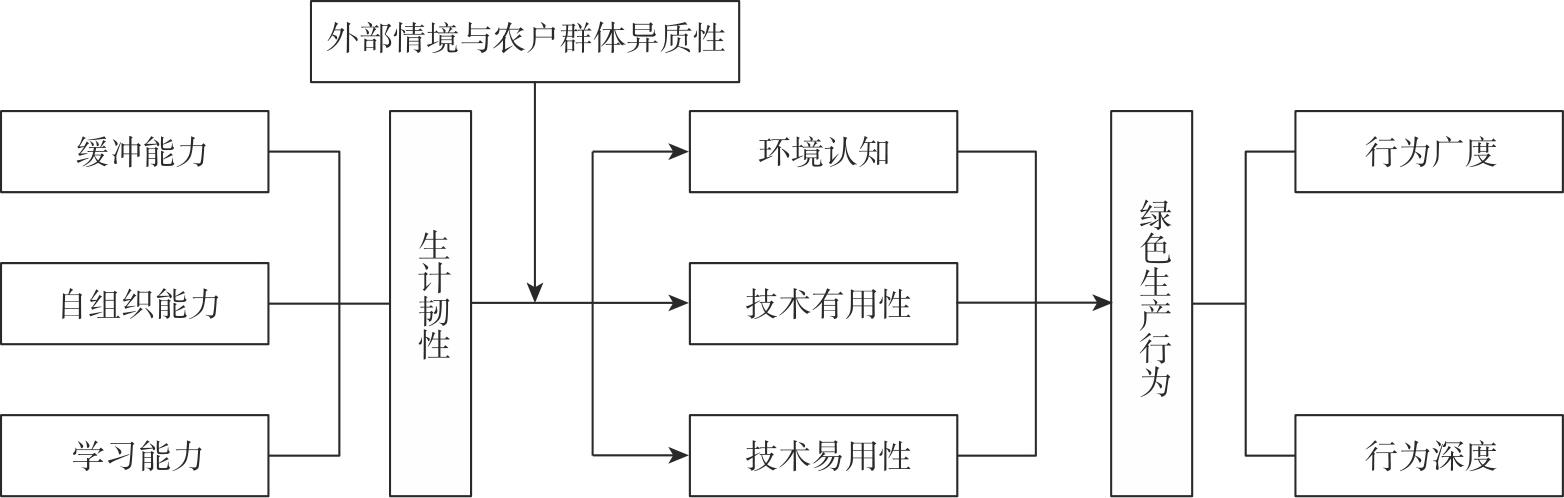
Fig. 1
Analytical framework"

Tab. 1
Evaluation indicator system"
| 变量 | 维度 | 维度权重 | 指标 | 指标权重 | 指标定义 |
|---|---|---|---|---|---|
| 绿色生产行为 | 行为广度 | 0.3750 | 采用绿色农业 技术种类 | 0.3750 | 目前采用的绿色农业技术数量/种 |
| 行为深度 | 0.6251 | 化肥使用情况 | 0.1927 | 您家上年每公顷实际化肥施用量比当地推荐标准/周边农户平均水平大约减少了多少?未减少=1,减少1%~10%=2,减少11%~20%=3,减少21%~30%=4,减少30%以上=5 | |
| 农药使用情况 | 0.2040 | 您家上年每公顷实际农药施用量比当地推荐标准/周边农户平均水平大约减少了多少?未减少=1,减少1%~10%=2,减少11%~20%=3,减少21%~30%=4,减少30%以上=5 | |||
| 废弃物处理 | 0.2284 | 您家对农药瓶、化肥袋等废弃物的处理方式是?随意丢弃=1,焚烧/填埋=2,部分回收=3,大部分回收=4,全部回收=5 | |||
| 生计韧性 | 缓冲能力 | 0.5871 | 耕地面积 | 0.1197 | 家庭拥有耕地面积/hm2 |
| 劳动力数量 | 0.0292 | 家庭具有劳动能力人数/人 | |||
| 家庭总收入 | 0.0603 | 家庭年总收入/元 | |||
| 固定资产数量 | 0.0539 | 家庭固定资产数量/个 | |||
| 社会资本 | 0.3240 | 家庭成员是否为村干部或在相关组织(例如:政府、企事业单位、合作社等)任职:是=1,否=0 | |||
| 自组织能力 | 0.0837 | 邻里信任度 | 0.0257 | 对邻居的信任程度:很不信任=1,不太信任=2,一般=3,比较信任=4,非常信任=5 | |
| 组织信任度 | 0.0138 | 对村委会或相关组织(政府、企事业单位、合作社等)的信任程度:很不信任=1,不太信任=2,一般=3,比较信任=4,非常信任=5 | |||
| 亲戚信任度 | 0.0242 | 对亲戚的信任程度:很不信任=1,不太信任=2,一般=3,比较信任=4,非常信任=5 | |||
| 交通便利度 | 0.0129 | 对村交通便利情况评价:很不满意=1,不太满意=2,一般=3,比较满意=4,非常满意=5 | |||
| 人居环境满意度 | 0.0071 | 对居住环境满意程度:很不满意=1,不太满意=2,一般=3,比较满意=4,非常满意=5 | |||
| 学习能力 | 0.3292 | 农业技术培训 | 0.0810 | 是否接受过农业技术培训:是=1,否=0 | |
| 户主受教育程度 | 0.0521 | 户主受教育程度:未读过书=1,小学=2,初中=3,高中/中专=4,大专/本科及以上=5 | |||
| 信息获取 | 0.0778 | 获得农业信息的渠道数量/个 | |||
| 学习意识 | 0.0236 | 学习新技术的主动性:很不主动=1,不太主动=2,一般=3,比较主动=4,非常主动=5 | |||
| 技术分享 | 0.0947 | 与邻里交流农业技术的频率:从不=1,很少=2,有时=3,经常=4,总是=5 |
Tab. 2
Variable definitions and descriptive statistics"
| 类别 | 变量 | 变量定义 | 均值 | 标准差 | 观测值 |
|---|---|---|---|---|---|
| 被解释变量 | 绿色生产行为 | 基于 | 0.408 | 0.199 | 614 |
| 核心解释变量 | 生计韧性 | 基于 | 0.241 | 0.123 | 614 |
| 中介变量 | 环境认知 | 您了解当前农业面源污染对环境的危害吗?完全不了解=1,不太了解=2,一般了解=3,比较了解=4,非常了解=5 | 3.565 | 1.304 | 614 |
| 技术有用性 | 您听说过绿色农业技术(如有机肥、生物农药等)在增产或节本方面的实际效果吗?没听过=1,很少听=2,偶尔听=3,经常听=4,总是听到=5 | 3.422 | 1.129 | 614 | |
| 技术易用性 | 您认为自己有能力掌握绿色农业技术吗?不能=1,不太能=2,一般=3,比较能=4,完全能=5 | 3.290 | 1.157 | 614 | |
| 控制变量 | 年龄 | 年龄/岁 | 57.607 | 12.124 | 614 |
| 性别 | 女性=1,男性=2 | 1.472 | 0.500 | 614 | |
| 健康状况 | 身体健康=1,偶有疾病=2,大病缠身=3 | 1.394 | 0.672 | 614 | |
| 家庭总人口 | 家庭总人口/人 | 5.088 | 2.588 | 614 | |
| 抚养比 | (65岁以上老人数量+15岁以下孩童数量)/家庭劳动力数量 | 1.089 | 1.101 | 614 |
Tab. 3
Baseline regression results"
| 变量 | 绿色生产行为 | ||||||
|---|---|---|---|---|---|---|---|
| 回归1 | 回归2 | 回归3 | 回归4 | 回归5 | 回归6 | 回归7 | |
| 生计韧性 | 0.181*** (0.0563) | 0.177*** (0.0568) | 0.214*** (0.0553) | - | - | - | - |
| 年龄 | - | -0.00111 (0.000777) | -0.00104 (0.000750) | -0.00127* (0.000754) | -0.00142** (0.000663) | -0.00121 (0.000750) | -0.00146** (0.000670) |
| 性别 | - | -0.00522 (0.0163) | 0.00638 (0.0160) | 0.00541 (0.0161) | 0.00619 (0.0143) | 0.00339 (0.0160) | 0.00680 (0.0143) |
| 健康状况 | - | 0.0326*** (0.0116) | 0.0267** (0.0116) | 0.0269** (0.0117) | 0.0204* (0.0107) | 0.0248** (0.0117) | 0.0210* (0.0108) |
| 家庭总人口 | - | - | -0.00921** (0.00396) | -0.00868** (0.00395) | -0.00712* (0.00363) | -0.00766* (0.00394) | -0.00741** (0.00365) |
| 抚养比 | - | - | 0.0412*** (0.00819) | 0.0392*** (0.00821) | 0.0258*** (0.00765) | 0.0401*** (0.00829) | 0.0252*** (0.00778) |
| 缓冲能力 | - | - | - | 0.103 (0.0679) | - | - | 0.0263 (0.0578) |
| 自组织能力 | - | - | - | - | 6.136*** (0.541) | - | 6.200*** (0.551) |
| 学习能力 | - | - | - | - | - | 0.285** (0.138) | -0.104 (0.124) |
| 常数项 | 0.364*** (0.0169) | 0.391*** (0.0537) | 0.372*** (0.0535) | 0.431*** (0.0497) | 0.137*** (0.0502) | 0.395*** (0.0553) | 0.148*** (0.0537) |
| 观测值 | 614 | 614 | 614 | 614 | 614 | 614 | 614 |
| R2 | 0.013 | 0.025 | 0.064 | 0.049 | 0.263 | 0.052 | 0.264 |
Tab. 4
Robustness test"
| 变量 | 生计韧性 回归8 | 绿色生产行为 回归9 | 稳健回归 回归10 | 分位数回归 回归11 | 1%缩尾 回归12 |
|---|---|---|---|---|---|
| 工具变量 | 0.008*** (0.0020) | - | - | - | - |
| 生计韧性 | - | 2.936*** (0.8830) | 0.193*** (0.0665) | 0.176** (0.0715) | 0.213*** (0.0559) |
| 控制变量 | 是 | 是 | 是 | 是 | 是 |
| 常数项 | 0.321*** (0.031) | -0.541* (0.3030) | 0.387*** (0.0531) | 0.393*** (0.0570) | 0.371*** (0.0532) |
| 观测值 | 614 | 614 | 614 | 614 | 614 |
| R2 | 0.061 | - | 0.059 | - | 0.064 |
Tab. 5
Mediation effect test"
| 变量 | 环境认知 回归13 | 技术有用性 回归14 | 技术易用性 回归15 |
|---|---|---|---|
| 生计韧性 | 1.642***(0.404) | 1.016***(0.393) | 1.134***(0.352) |
| 控制变量 | 是 | 是 | 是 |
| 常数项 | 3.236***(0.355) | 2.848***(0.306) | 2.896***(0.313) |
| 观测值 | 614 | 614 | 614 |
| R2 | 0.051 | 0.050 | 0.048 |
Tab. 6
Moderating effect test"
| 变量 | 企业规制调节 回归16 | 合作社调节 回归17 | 双调节模型 回归18 |
|---|---|---|---|
| 生计韧性 | 0.492***(0.188) | 0.216***(0.058) | 0.492***(0.189) |
| 企业规制 | 0.106***(0.014) | - | 0.105***(0.014) |
| 生计韧性× 企业规制 | -0.107**(0.052) | - | -0.106**(0.052) |
| 合作社参与 | - | 0.137***(0.043) | 0.104***(0.039) |
| 生计韧性× 合作社 | - | -0.261**(0.116) | -0.209*(0.110) |
| 控制变量 | 是 | 是 | 是 |
| 常数项 | 0.017(0.063) | 0.369***(0.053) | 0.018(0.063) |
| 观测值 | 614 | 614 | 614 |
| R2 | 0.285 | 0.072 | 0.290 |
Tab. 7
Heterogeneity test"
| 变量 | 纯农户 回归19 | 兼业户 回归20 | 高连片组 回归21 | 低连片组 回归22 | 加入合作社 回归23 | 未加入合作社 回归24 |
|---|---|---|---|---|---|---|
| 生计韧性 | 0.169* (0.0971) | 0.285** (0.0964) | 0.230*** (0.0815) | 0.159* (0.0944) | -0.142 (0.1590) | 0.215*** (0.0580) |
| 控制变量 | 是 | 是 | 是 | 是 | 是 | 是 |
| 常数项 | 0.406*** (0.0645) | 0.340*** (0.0928) | 0.385*** (0.0625) | 0.312*** (0.0836) | 0.731*** (0.1850) | 0.361*** (0.0559) |
| 观测值 | 378 | 236 | 453 | 161 | 44 | 570 |
| R2 | 0.038 | 0.102 | 0.070 | 0.079 | 0.189 | 0.061 |
Tab. 8
Correspondence framework for cross-validation between measurement and simulation"
| 计量分析发现 | 仿真验证目的 | 关键动态机制参数 | 验证意义 |
|---|---|---|---|
| 自组织能力效应最强 | 验证社会网络在技术扩散初期的启动优势 | 网络效应乘数基于相对强度校准;影响半径3户 | 识别网络建设的最佳时机与关键节点 |
| 3条中介路径均显著 | 比较不同认知路径的传导效率与衰减特征 | 传导速度技术易用性最快;衰减率环境认知最慢 | 优化认知培育与技术培训的时序组合 |
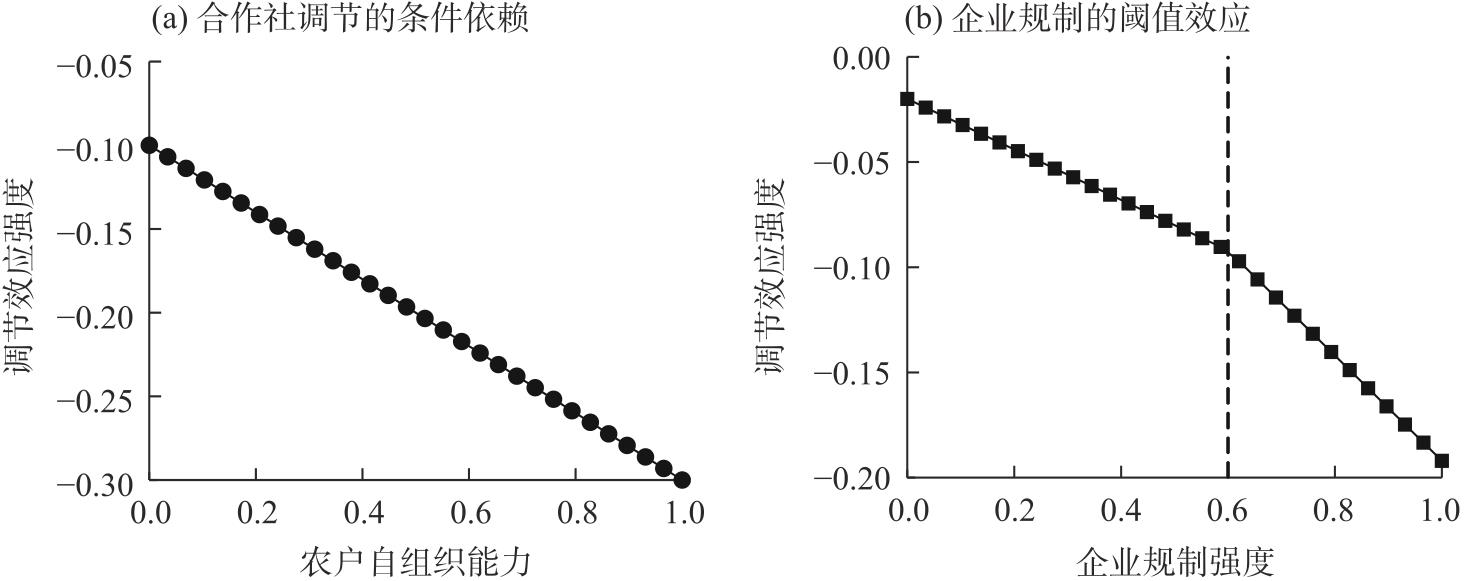
| 合作社存在替代效应 | 识别替代效应发生的条件边界 | 条件依赖系数随农户自组织能力提高而线性减弱 | 明确合作社功能优化的优先对象 |
| 群体异质性显著 | 量化不同群体的动态转化效率差异 | 转化速率兼业户快但增速渐缓;纯农户增长平稳但持续 | 制定群体差异化的精准支持策略 |
Fig. 2
Heterogeneity in the dynamic effects across dimensions of livelihood resilience"
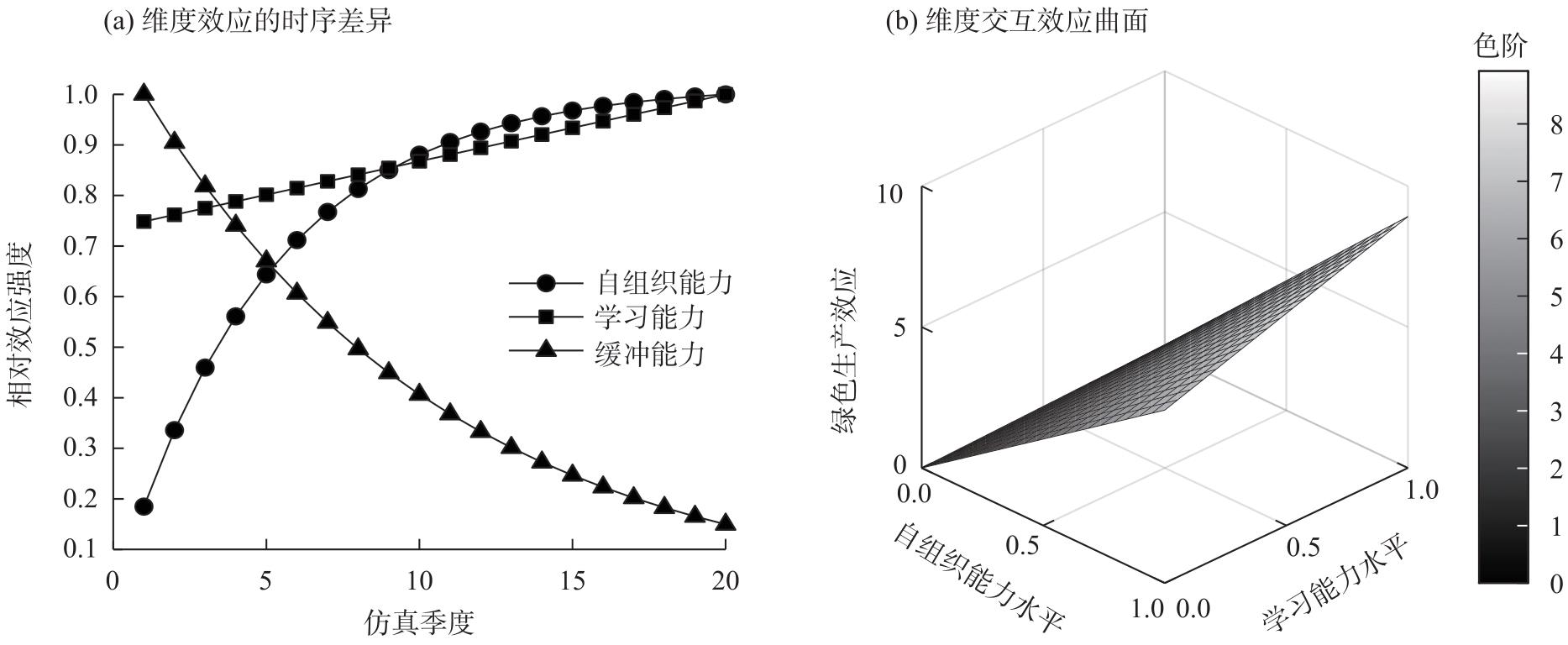
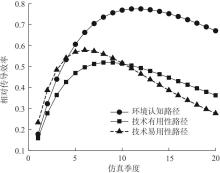
Fig. 3
Speed-attenuation trade off of mediated effects"
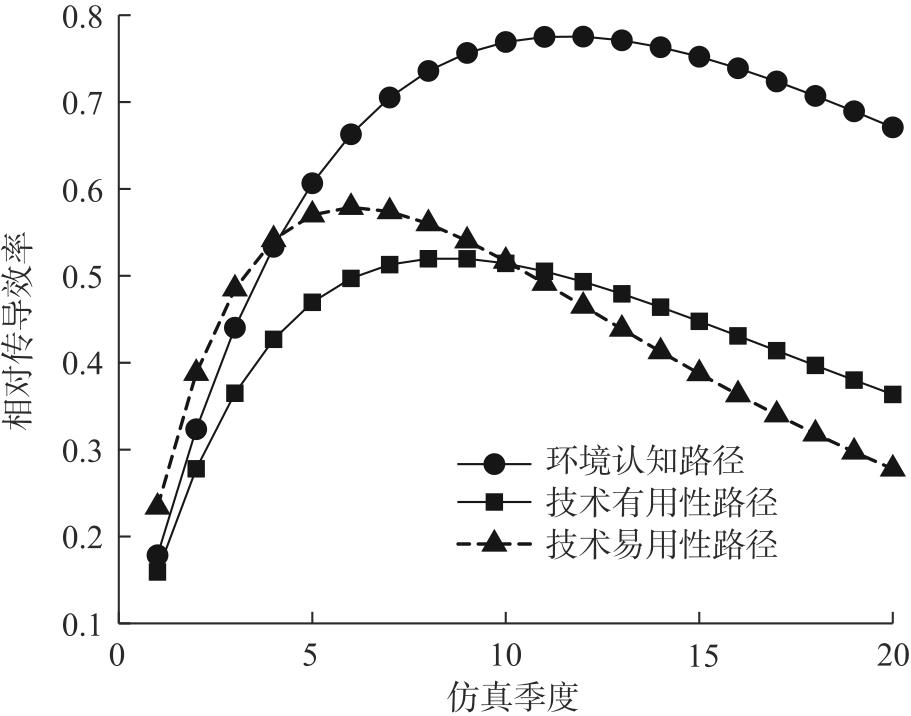
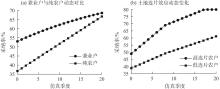
Fig. 4
Dynamic-convergence disparities in group heterogeneity"
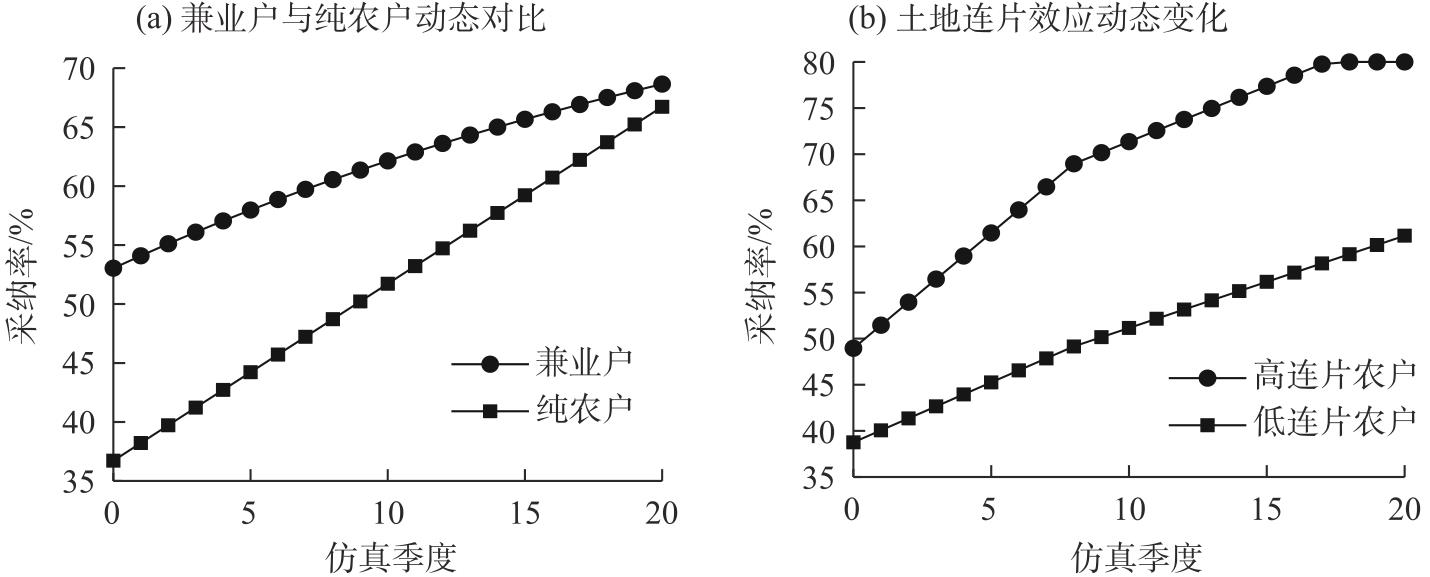
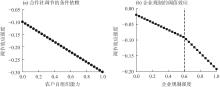
Fig. 5
Testing the conditional dependency of moderating effects"
| [1] | 熊爱华, 宋婷婷. 社会资本对农户绿色生产意愿的影响研究[J]. 统计与决策, 2020, 36(5): 76-80. |
| [Xiong Aihua, Song Tingting. Research on the influence of social capital on farmers’ green production willingness[J]. Statistics & Decision, 2020, 36(5): 76-80.] | |
| [2] | 唐小清, 杨立敏, 刘晶, 等. 资本禀赋、感知价值、政府规制对农户绿色技术采纳行为的影响——基于四川省大竹县422份农户调查数据[J]. 中国农机化学报, 2024, 45(8): 330-337. |
| [Tang Xiaoqing, Yang Limin, Liu Jing, et al. Impact of capital endowment, perceived value and government regulation on farmers’ green technology adoption behavior: Based on 422 household survey data in Dazhu County, Sichuan Province[J]. Journal of Chinese Agricultural Mechanization, 2024, 45(8): 330-337.] | |
| [3] | 刘铮, 葛立群, 潘荣光, 等. 碳中和背景下水稻种植户生产绿色转型研究[J]. 农业经济, 2022(3): 12-14. |
| [Liu Zheng, Ge Liqun, Pan Rongguang, et al. Research on green production transformation of rice farmers under the background of carbon neutrality[J]. Agricultural Economy, 2022(3): 12-14.] | |
| [4] | 李晓晓, 高汉, 胡南燕, 等. 数字素养对农户绿色生产技术采纳的影响及机制分析——基于6省1585户蔬菜种植户的实证分析[J]. 中国农业大学学报, 2025, 30(9): 336-349. |
| [Li Xiaoxiao, Gao Han, Hu Nanyan, et al. Impact of digital literacy on the adoption of green production technology by farm households and its mechanism: An empirical analysis based on 1585 vegetable-growing households in 6 provinces[J]. Journal of China Agricultural University, 2025, 30(9): 336-349.] | |
| [5] | Mao H, Zhou L, Ying R Y, et al. Time preferences and green agricultural technology adoption: Field evidence from rice farmers in China[J]. Land Use Policy, 2021, 109: 105627, doi: 10.1016/j.landusepol.2021.105627. |
| [6] | 于艳丽, 李桦. 社区监督、风险认知与农户绿色生产行为——来自茶农施药环节的实证分析[J]. 农业技术经济, 2020(12): 109-121. |
| [Yu Yanli, Li Hua. Community supervision, risk perception and farmers’ green production: Empirical analysis from the application of tea growers[J]. Journal of Agrotechnical Economics, 2020(12): 109-121.] | |
| [7] |
Oyetunde-Usman Z, Olagunju K O, Ogunpaimo O R. Determinants of adoption of multiple sustainable agricultural practices among smallholder farmers in Nigeria[J]. International Soil and Water Conservation Research, 2021, 9(2): 241-248.
doi: 10.1016/j.iswcr.2020.10.007 |
| [8] | 郭岩, 汪兴东. 土地禀赋、务农黏性与农户绿色生产行为——基于江西省“百村千户”面板数据[J]. 中国生态农业学报(中英文), 2025, 33(7): 1419-1429. |
| [Guo Yan, Wang Xingdong. Land endowment, farming stickiness, and green production behavior: Based on panel data of “hundreds of villages and thousands of households” in Jiangxi Province[J]. Chinese Journal of Eco-Agriculture, 2025, 33(7): 1419-1429.] | |
| [9] | 孙小燕, 刘雍. 土地托管能否带动农户绿色生产?[J]. 中国农村经济, 2019(10): 60-80. |
| [Sun Xiaoyan, Liu Yong. Can land trusteeship improve farmers’ green production?[J]. Chinese Rural Economy, 2019(10): 60-80.] | |
| [10] |
谢宇, 薛选登. 数字经济赋能绿色发展福利——基于黄河流域资源型城市的经验证据[J]. 干旱区地理, 2025, 48(6): 1127-1139.
doi: 10.12118/j.issn.1000-6060.2024.406 |
|
[Xie Yu, Xue Xuandeng. Digital economy empowers green development welfare: Empirical evidence based on resource-based cities in the Yellow River Basin[J]. Arid Land Geography, 2025, 48(6): 1127-1139.]
doi: 10.12118/j.issn.1000-6060.2024.406 |
|
| [11] |
任诗琦, 王永瑜. 黄河流域地级市绿色发展水平测度与空间收敛性研究[J]. 干旱区地理, 2025, 48(6): 1031-1042.
doi: 10.12118/j.issn.1000-6060.2024.702 |
|
[Ren Shiqi, Wang Yongyu. Measurement and spatial convergence of green development level of prefecture-level cities in the Yellow River Basin[J]. Arid Land Geography, 2025, 48(6): 1031-1042.]
doi: 10.12118/j.issn.1000-6060.2024.702 |
|
| [12] | 高帅, 程炜, 唐建军. 风险冲击视角下革命老区农户生计韧性研究——以太行革命老区为例[J]. 中国农村经济, 2024(3): 107-125. |
| [Gao Shuai, Cheng Wei, Tang Jianjun. Research on the livelihood resilience of farmers in old revolutionary base areas from the perspective of risk shocks: Taking the Taihang Old Revolutionary Base area as an example[J]. Chinese Rural Economy, 2024(3): 107-125.] | |
| [13] |
Speranza C I, Wiesmann U, Rist S. An indicator framework for assessing livelihood resilience in the context of social-ecological dynamics[J]. Global Environmental Change, 2014, 28: 109-119.
doi: 10.1016/j.gloenvcha.2014.06.005 |
| [14] |
Cissé J D, Barrett C B. Estimating development resilience: A conditional moments-based approach[J]. Journal of Development Economics, 2018, 135: 272-284.
doi: 10.1016/j.jdeveco.2018.04.002 |
| [15] | Mihunov V V, Lam N S N, Rohli R V, et al. Emerging disparities in community resilience to drought hazard in south-central United States[J]. International Journal of Disaster Risk Reduction, 2019, 41: 101302, doi: 10.1016/j.ijdrr.2019.101302. |
| [16] | Ma L, Zhang Y N, Li T, et al. Livelihood capitals and livelihood resilience: Understanding the linkages in China’s government-led poverty alleviation resettlement[J]. Habitat International, 2024, 147: 103057, doi: l0.1016/j.habitatint.2024.103057. |
| [17] | 刘伟, 于倩倩. 易地搬迁对陕南农户生计弹性的影响研究[J]. 地理与地理信息科学, 2023, 39(1): 105-110. |
| [Liu Wei, Yu Qianqian. Impact of poverty alleviation resettlement on rural household livelihood resilience in southern Shaanxi[J]. Geography and Geo-Information Science, 2023, 39(1): 105-110.] | |
| [18] | 刘蓉, 王艳伟, 任飞武, 等. 农村基础设施投入对农民生计韧性的影响效应及作用机制[J]. 南方农业学报, 2025, 56(4): 1326-1340. |
| [Liu Rong, Wang Yanwei, Ren Feiwu, et al. The impact of rural infrastructure investment on farmers’ livelihood resilience: Effects and its mechanism[J]. Journal of Southern Agriculture, 2025, 56(4): 1326-1340.] | |
| [19] | 董玥, 杨忍, 邓颖贤, 等. 粮食主产区典型镇域的农业系统变化与农户生计韧性评价——以河南省高杨店镇为例[J]. 农业资源与环境学报, 2023, 40(5): 1208-1222. |
| [Dong Yue, Yang Ren, Deng Yingxian, et al. Changes in the agricultural system and evaluation of the livelihood resilience of farmers in a typical town in a major grain-producing area of China: A case study of Gaoyangdian Town, Henan Province[J]. Journal of Agricultural Resources and Environment, 2023, 40(5): 1208-1222.] | |
| [20] | 洪名勇, 姜月. 农地确权对农户生计韧性的影响研究[J]. 农业经济与管理, 2025(4): 43-52. |
| [Hong Mingyong, Jiang Yue. Research on influencing mechanism of farmland rights confirmation on livelihood resilience of rural households[J]. Agricultural Economics and Management, 2025(4): 43-52.] | |
| [21] | 吴诗嫚, 祝浩, 卢新海. 土地综合整治对农户生计韧性的影响效应及机制分析——以湖北省部分县市为例[J]. 农业现代化研究, 2023, 44(6): 1002-1013. |
| [Wu Shiman, Zhu Hao, Lu Xinhai. Impact effects and mechanisms of comprehensive land consolidation on farmers’ livelihood resilience: A case study of some counties in Hubei Province[J]. Research of Agricultural Modernization, 2023, 44(6): 1002-1013.] | |
| [22] |
孙彦, 赵雪雁. 山区农户的生计干预效率及其影响因素——以陇南山区为例[J]. 地理研究, 2023, 42(7): 1874-1891.
doi: 10.11821/dlyj020220867 |
| [Sun Yan, Zhao Xueyan. Efficiency and influencing factors of livelihood interventions of farming households in mountainous areas: A case study of Longnan mountainous areas[J]. Geographical Research, 2023, 42(7): 1874-1891.] | |
| [23] |
邰秀军, 封峰. 数字金融对脱贫农户生计韧性的影响——基于乌兰察布市的调查分析[J]. 干旱区地理, 2026, 49(7): 1509-1519.
doi: 10.12118/j.issn.1000-6060.2025.513 |
|
[Tai Xiujun, Feng Feng. Impact of digital finance on the livelihood resilience of poverty alleviated farmers: A survey analysis based on Ulanqab City[J]. Arid Land Geography, 2026, 49(7): 1509-1519.]
doi: 10.12118/j.issn.1000-6060.2025.513 |
|
| [24] | 喻立凡, 曹大宇, 廖冰. 生计资本、生态认知对农户绿色生产技术采纳意愿的影响研究[J]. 中国农业资源与区划, 2024, 45(12): 27-39. |
| [Yu Lifan, Cao Dayu, Liao Bing. Research on the impact of livelihood capital and ecological cognition on farmers’ willingness to adopt green technologies[J]. Chinese Journal of Agricultural Resources and Regional Planning, 2024, 45(12): 27-39.] | |
| [25] | 王晓焕, 李桦, 张罡睿. 生计资本如何影响农户亲环境行为?——基于价值认知的中介效应[J]. 农林经济管理学报, 2021, 20(5): 610-620. |
| [Wang Xiaohuan, Li Hua, Zhang Gangrui. How does livelihood capital affect farmers’ pro-environment behavior? Mediating effect based on value perception[J]. Journal of Agro-Forestry Economics and Management, 2021, 20(5): 610-620.] | |
| [26] |
Folke C. Resilience: The emergence of a perspective for social-ecological systems analyses[J]. Global Environmental Change, 2006, 16(3): 253-267.
doi: 10.1016/j.gloenvcha.2006.04.002 |
| [27] |
翟彬, 王宇阁, 朱芳芳, 等. 生计策略下黄河流域农户生计韧性差异及其影响因素——以河南省为例[J]. 经济地理, 2024, 44(2): 156-165.
doi: 10.15957/j.cnki.jjdl.2024.02.016 |
| [Zhai Bin, Wang Yuge, Zhu Fangfang, et al. Differences in livelihood resilience of farm households in the Yellow River Basin under the background of livelihood strategies and its influencing factors: Taking Henan Province as an example[J]. Economic Geography, 2024, 44(2): 156-165.] | |
| [28] |
Liu W, Li J, Ren L J, et al. Exploring livelihood resilience and its impact on livelihood strategy in rural China[J]. Social Indicators Research, 2020, 150(3): 977-998.
doi: 10.1007/s11205-020-02347-2 |
| [29] |
Kahneman D, Tversky A. Prospect theory: An analysis of decision under risk[J]. Econometrica, 1979, 47(2): 263-291.
doi: 10.2307/1914185 |
| [30] | 魏浩冉, 姚娟, 李睿. 社会支持对农户秸秆持续资源化利用意愿的影响——基于感知有用性、感知易用性的中介效应[J]. 干旱区资源与环境, 2025, 39(12): 99-109. |
| [Wei Haoran, Yao Juan, Li Rui. The impact of social support on farmers’ willingness to continuously reuse straw: The mediating role of perceived usefulness and perceived ease of use[J]. Journal of Arid Land Resources and Environment, 2025, 39(12): 99-109.] | |
| [31] | 吴晔, 黎樟浩, 马连婧. 从回避到参与: 社会规范重构新闻消费行为的实证研究[J]. 新闻与写作, 2025(5): 29-40. |
| [Wu Ye, Li Zhanghao, Ma Lianjing. From avoidance to participation: An empirical study on social norm reconstruction of news consumption behavior[J]. News and Writing, 2025(5): 29-40.] | |
| [32] | 李琳, 韩继良, 朱玉春. 农业科技服务促进了农户绿色生产技术采纳吗?——基于激励措施的调节效应[J]. 中国农业大学学报, 2023, 28(12): 232-247. |
| [Li Lin, Han Jiliang, Zhu Yuchun. Does agricultural science and technology service promote farmers’ adoption of green production technology? Moderating effect based on incentive measure[J]. Journal of China Agricultural University, 2023, 28(12): 232-247.] | |
| [33] |
吕晓, 张启岚, 张学波, 等. 共同富裕目标下农地流转对农户生计韧性的影响——基于沈阳市典型农户的实证研究[J]. 自然资源学报, 2025, 40(3): 636-651.
doi: 10.31497/zrzyxb.20250305 |
|
[Lü Xiao, Zhang Qilan, Zhang Xuebo, et al. The impact of farmland transfer on farmers’ livelihood resilience under the goal of common prosperity: An empirical study of typical farmers in Shenyang[J]. Journal of Natural Resources, 2025, 40(3): 636-651.]
doi: 10.31497/zrzyxb.20250305 |
|
| [34] | 江艇. 因果推断经验研究中的中介效应与调节效应[J]. 中国工业经济, 2022(5): 100-120. |
| [Jiang Ting. Mediating effects and moderating effects in causal inference[J]. China Industrial Economics, 2022(5): 100-120.] | |
| [35] | 张红丽, 李洁艳, 史丹丹. 环境规制、生态认知对农户有机肥采纳行为影响研究[J]. 中国农业资源与区划, 2021, 42(11): 42-50. |
| [Zhang Hongli, Li Jieyan, Shi Dandan. Research on the influence of environmental regulation and ecological cognition on farmers’ organic fertilizer adoption behavior[J]. Chinese Journal of Agricultural Resources and Regional Planning, 2021, 42(11): 42-50.] | |
| [36] | 李昊, 曹辰, 李林哲. 绿色认知能促进农户绿色生产行为吗?——基于社会规范锁定效应的分析[J]. 干旱区资源与环境, 2022, 36(9): 18-25. |
| [Li Hao, Cao Chen, Li Linzhe. Can green cognition promote farmers’ green production behavior? Analysis of lock-in effect based on social norms[J]. Journal of Arid Land Resources and Environment, 2022, 36(9): 18-25.] | |
| [37] | 陈凯, 朱伟丽. 农户绿色生产驱动机制构建研究——基于TAM-SLA理论框架[J]. 中国特色社会主义研究, 2023(3): 71-79. |
| [Chen Kai, Zhu Weili. Research on the construction of driving mechanism for farmers’ green production: Based on the TAM-SLA theoretical framework[J]. Studies on Socialism with Chinese Characteristics, 2023(3): 71-79.] |
|
||