Arid Land Geography ›› 2026, Vol. 49 ›› Issue (11): 2389-2400.doi: 10.12118/j.issn.1000-6060.2026.043
• Regional Development • Previous Articles Next Articles
YANG Wenjuan( ), PANG Zhiqiang()
Received:2026-01-16
Revised:2026-03-13
Online:2026-11-25
Published:2026-11-13
Contact:
PANG Zhiqiang
E-mail:yangwj27779389@163.com;pangzhq@lzufe.edu.cn
YANG Wenjuan, PANG Zhiqiang. Measurement, regional differences and formation mechanism of rural governance modernization level in China[J].Arid Land Geography, 2026, 49(11): 2389-2400.
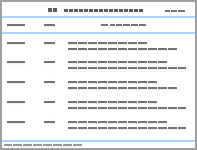
Tab. 1
Evaluation index system of rural governance modernization"
| 准则层 | 指标层 | 指标说明 |
|---|---|---|
| 基层组织治理 | 每万人村委会数/个 | 村委会数/乡村人口 |
| 主任书记“一肩挑”比例/% | 村书记与村委会主任“一肩挑”/村委会主任 | |
| 村委会成员中党员占比/% | 村委会中党员/村委会成员 | |
| 村委会成员大学本科及以上占比/% | 村委会大学本科及以上成员/村委会成员 | |
| 农村社区综合服务设施覆盖率/% | 统计调查数据 | |
| 生活环境治理 | 乡村绿化覆盖率/% | 统计调查数据 |
| 农药投入强度/kg·hm-2 | 农药使用量/土地使用面积 | |
| 生活垃圾无害化处理率/% | 统计调查数据 | |
| 生活污水处理的村占比/% | 统计调查数据 | |
| 供水普及率/% | 统计调查数据 | |
| 环境卫生投入占比/% | 环境卫生投入/村庄建设投入 | |
| 城乡融合治理 | 城乡人口密度比 | 城市人口密度/农村人口密度 |
| 城乡居民收入水平对比 | 城镇居民可支配收入/农村居民可支配收入 | |
| 城乡居民消费水平对比 | 城镇居民消费支出/农村居民消费支出 | |
| 城乡恩格尔系数比 | 城镇恩格尔系数/农村恩格尔系数 | |
| 城乡人均医疗保健对比 | 城镇人均医疗保健支出/农村人均医疗保健支出 | |
| 民生福祉治理 | 村民人均可支配收入/元 | 统计调查数据 |
| 每千人乡村卫生技术人员数/人 | 统计调查数据 | |
| 乡村道路硬化率/% | 硬化道路/村庄内道路 | |
| 农村人均住宅建筑面积/m2 | 统计调查数据 | |
| 农村特困人员供养支出水平/元 | 统计调查数据 | |
| 农村居民人均文化娱乐消费支出占比/% | 农村居民人均文化娱乐消费支出/消费支出 |
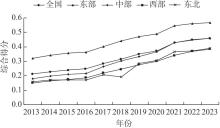
Fig. 1
Rural governance modernization levels in China and its four regions"
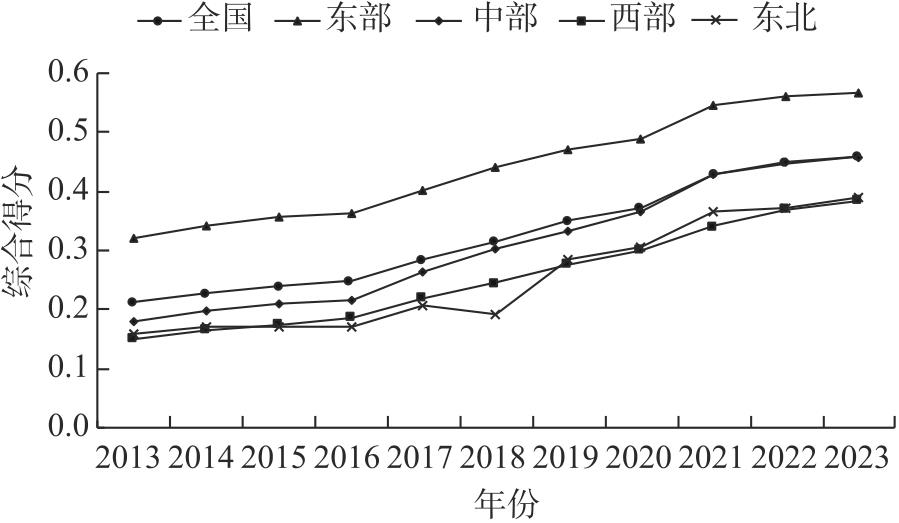
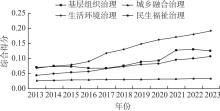
Fig. 2
Change trends in rural governance modernization levels across various dimensions"
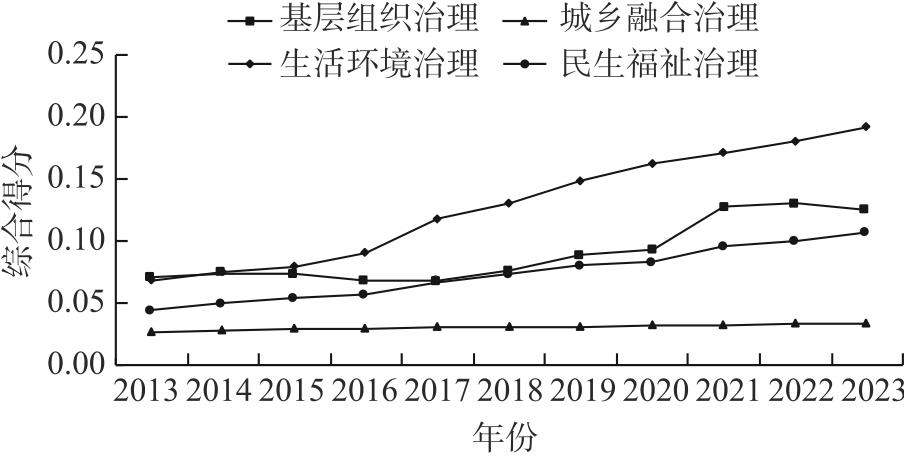
Fig. 3
Radar chart of rural governance modernization levels across various dimensions in the four regions"
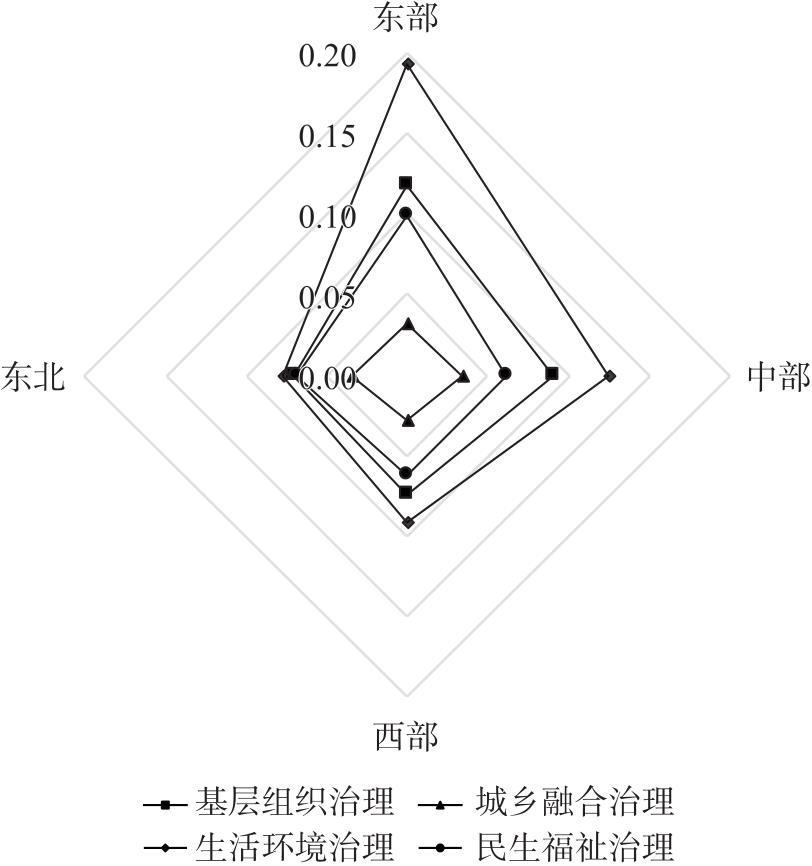
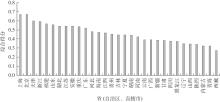
Fig. 4
Rural governance modernization levels in provincial regions of China in 2023"
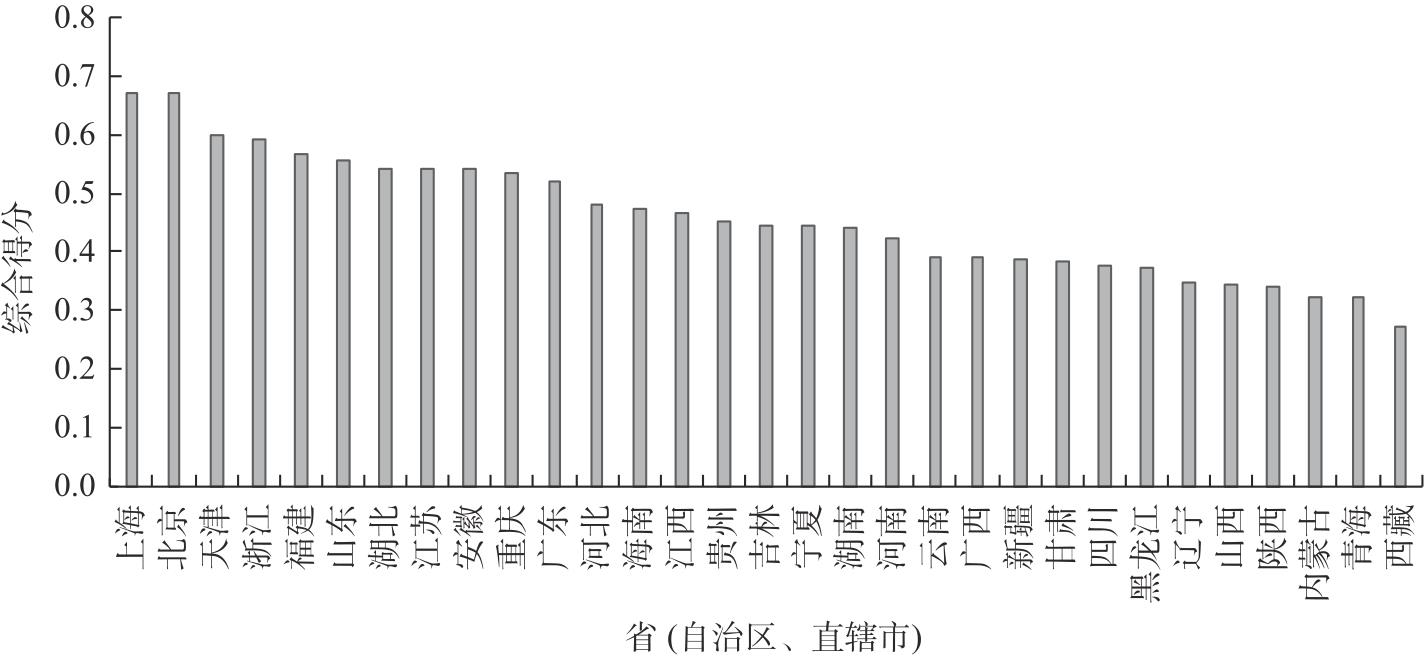
Tab. 2
Distribution of rural governance modernization levels across four types"
| 类型 | 东部地区 | 中部地区 | 西部地区 | 东北地区 |
|---|---|---|---|---|
| 领先型 | 上海、北京、天津、浙江、福建、山东、江苏、广东 | 湖北、安徽 | 重庆 | - |
| 进步型 | 河北、海南 | 江西 | - | - |
| 追赶型 | - | 湖南、河南 | 贵州、宁夏 | 吉林 |
| 落后型 | - | 山西 | 云南、广西、新疆、甘肃、四川、陕西、内蒙古、青海、西藏 | 黑龙江、辽宁 |
Fig. 5
Gini coefficient and decomposition of rural governance modernization levels"
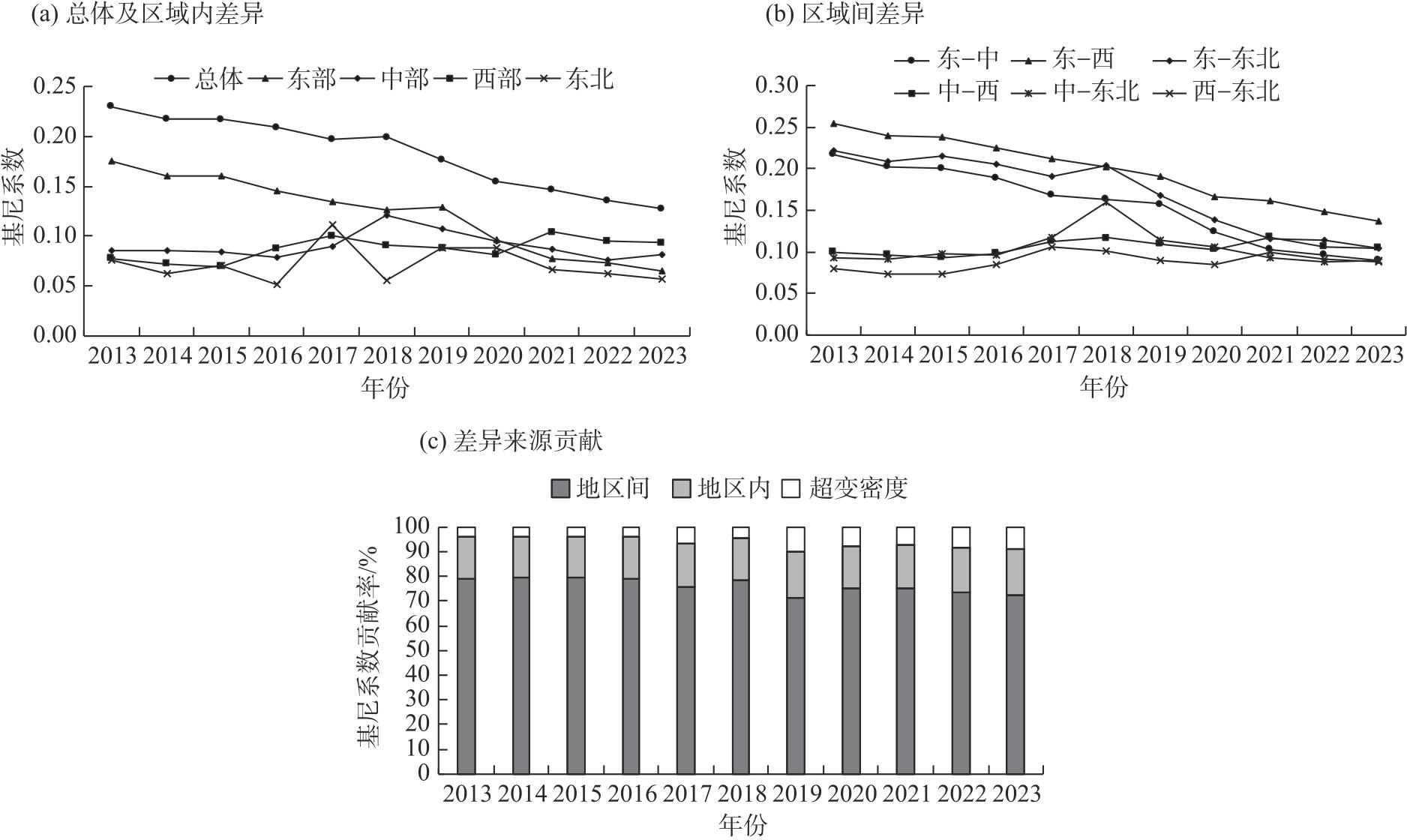
Tab. 3
Structural sources of differences in rural governance modernization levels /%"
| 指标 | 2013年 | 2014年 | 2015年 | 2016年 | 2017年 | 2018年 | 2019年 | 2020年 | 2021年 | 2022年 | 2023年 |
|---|---|---|---|---|---|---|---|---|---|---|---|
| 基层组织治理 | 21.04 | 21.51 | 22.93 | 17.63 | 18.37 | 21.90 | 22.78 | 23.33 | 25.45 | 23.90 | 23.79 |
| 生活环境治理 | 56.33 | 57.61 | 56.47 | 60.63 | 59.53 | 57.11 | 56.63 | 56.39 | 56.00 | 55.43 | 57.17 |
| 城乡融合治理 | 2.21 | 1.96 | 1.61 | 1.59 | 1.26 | 0.94 | 0.71 | 0.31 | 0.60 | 0.69 | 0.18 |
| 民生福祉治理 | 20.42 | 18.92 | 18.99 | 20.16 | 20.84 | 20.06 | 19.88 | 19.97 | 17.95 | 19.99 | 18.87 |
Tab. 4
Results of correlation analysis for the QAP"
| 变量 | 乡村治理现代化 | 基层组织治理 | 生活环境治理 | 城乡融合治理 | 民生福祉治理 |
|---|---|---|---|---|---|
| 乡村治理现代化 | 1.000*** | 0.629*** | 0.891*** | 0.074 | 0.784*** |
| 基层组织治理 | 0.629*** | 1.000*** | 0.350*** | -0.057 | 0.544*** |
| 生活环境治理 | 0.891*** | 0.352*** | 1.000*** | 0.017 | 0.554*** |
| 城乡融合治理 | 0.074 | -0.057 | 0.017 | 1.000*** | 0.104 |
| 民生福祉治理 | 0.784*** | 0.544*** | 0.554*** | 0.104 | 1.000*** |
Tab. 5
Results of the QAP regression"
| 变量 | 全国 | 东部 | 中部 | 西部 | 东北 |
|---|---|---|---|---|---|
| 基层组织治理 | 0.249*** | 0.144** | 0.359 | 0.071 | -0.001 |
| 生活环境治理 | 0.643*** | 0.609*** | 0.748** | 0.923*** | 0.782 |
| 城乡融合治理 | 0.047*** | 0.034 | 0.002 | 0.132** | -0.009 |
| 民生福祉治理 | 0.287*** | 0.542*** | 0.011 | -0.125** | 0.200 |
| [1] | 王浦劬. 新时代乡村治理现代化的根本取向、核心议题和基本路径[J]. 华中师范大学学报(人文社会科学版), 2022, 61(1): 18-24. |
| [Wang Puqu. The fundamental orientation, core issues and basic path of the modernization of rural governance in the new era[J]. Journal of Central China Normal University (Humanities and Social Sciences Edition), 2022, 61(1): 18-24.] | |
| [2] | 李三辉. 乡村治理现代化: 基本内涵、发展困境与推进路径[J]. 中州学刊, 2021(3): 75-81. |
| [Li Sanhui. The modernization of rural governance: Basic connotation, development dilemma and promotion path[J]. Academic Journal of Zhongzhou, 2021(3): 75-81.] | |
| [3] | 朱新武, 王智垚. 中国式乡村治理现代化的政策演进、理论逻辑与实践路径[J]. 云南社会科学, 2023(5): 19-29. |
| [Zhu Xinwu, Wang Zhiyao. Policy evolution, theoretical logic and practical path to Chinese rural governance modernization[J]. Social Sciences in Yunnan, 2023(5): 19-29.] | |
| [4] | 丁志刚, 王杰. 中国乡村治理70年: 历史演进与逻辑理路[J]. 中国农村观察, 2019(4): 18-34. |
| [Ding Zhigang, Wang Jie. Seventy years of rural governance in China: Historical evolution and logical path[J]. China Rural Survey, 2019(4): 18-34.] | |
| [5] | 冯献, 李瑾. 乡村治理现代化水平评价[J]. 华南农业大学学报(社会科学版), 2022, 21(3): 127-140. |
| [Feng Xian, Li Jin. An evaluation of rural governance modernization level[J]. Journal of South China Agricultural University (Social Science Edition), 2022, 21(3): 127-140.] | |
| [6] | 蔡雪玲, 庞智强. 中国式乡村治理现代化测度与空间收敛性研究[J]. 中国农业资源与区划, 2024, 45(4): 88-102. |
| [Cai Xueling, Pang Zhiqiang. Measurement and spatial convergence of Chinese modernization of rural governance[J]. Chinese Journal of Agricultural Resources and Regional Planning, 2024, 45(4): 88-102.] | |
| [7] | 高道明, 赵一夫, 潘彪. 我国乡村治理水平评价及影响机制研究[J]. 农业技术经济, 2024(3): 94-113. |
| [Gao Daoming, Zhao Yifu, Pan Biao. Research on China rural governance evaluation and its influence mechanisms[J]. Journal of Agrotechnical Economics, 2024(3): 94-113.] | |
| [8] | 陆益龙, 李光达. 中国式乡村治理现代化的本质要求与路径选择[J]. 江苏社会科学, 2023(2): 78-86, 242. |
| [Lu Yilong, Li Guangda. The essential requirement and path selection for modernizing Chinese rural governance[J]. Jiangsu Social Sciences, 2023(2): 78-86, 242.] | |
| [9] | 秦中春. 乡村振兴背景下乡村治理的目标与实现途径[J]. 管理世界, 2020, 36(2): 1-6, 16, 213. |
| [Qi Zhongchun. The goal and path to achieve rural governance at the background of rural revitalization[J]. Journal of Management World, 2020, 36(2): 1-6, 16, 213.] | |
| [10] |
戈大专, 龙花楼. 论数字乡村空间治理与中国乡村现代化[J]. 地理学报, 2025, 80(2): 288-303.
doi: 10.11821/dlxb202502003 |
|
[Ge Dazhuan, Long Hualou. Digital rural spatial governance and rural modernization in China[J]. Acta Geographica Sinica, 2025, 80(2): 288-303.]
doi: 10.11821/dlxb202502003 |
|
| [11] | 贺雪峰. 乡村治理现代化: 村庄与体制[J]. 求索, 2017(10): 4-10. |
| [He Xuefeng. Modernization of rural governance: Villages and institutions[J]. Seeker, 2017(10): 4-10.] | |
| [12] | 桂华. 面对社会重组的乡村治理现代化[J]. 政治学研究, 2018(5): 2-5. |
| [Gui Hua. Modernization of rural governance in the face of social restructuring[J]. CASS Journal of Political Science, 2018(5): 2-5.] | |
| [13] | 汪义力, 陈文胜. 乡村治理现代化的时代意涵、价值遵循与实践样态[J]. 中南民族大学学报(人文社会科学版), 2023, 43(12): 135-143, 209-210. |
| [Wang Yili, Chen Wensheng. Contemporary implications, value adherence, and practice patterns of rural governance modernization[J]. Journal of South-Central Minzu University (Humanities and Social Sciences Edition), 2023, 43(12): 135-143, 209-210.] | |
| [14] | 史云贵, 孙宇辰. 我国农村社会治理效能评价指标体系的构建与运行论析[J]. 公共管理与政策评论, 2016, 5(1): 17-25. |
| [Shi Yungui, Sun Yuchen. Analysis on construction and operation of the efficiency evaluation index system in China’s rural social administration[J]. Public Administration and Policy Review, 2016, 5(1): 17-25.] | |
| [15] | 张传, 郭贯成, 韩述, 等. 从产权明晰到治理优化: 宅基地确权对乡村治理绩效的影响研究[J]. 中国土地科学, 2025, 39(1): 8-18. |
| [Zhang Chuan, Guo Guancheng, Han Shu, et al. From property rights clarification to governance optimization: A study on the impact of rural residential land rights confirmation on rural governance performance[J]. China Land Science, 2025, 39(1): 8-18.] | |
| [16] | 詹国辉. 乡村治理质量提升与村民幸福感的关联效应——基于村庄调查的经验证据[J]. 探索, 2021(5): 151-163. |
| [Zhan Guohui. The effect of rural governance quality improvement on villagers’happiness: Empirical evidence from village survey[J]. Probe, 2021(5): 151-163.] | |
| [17] | 杨义武, 芦千文. 村级组织负责人“一肩挑”能否提升农村居民生活满意度——基于中国乡村振兴调查数据的经验证据[J]. 中国农村观察, 2024(1): 161-183. |
| [Yang Yiwu, Lu Qianwen. Do village leaders “one shoulder multitasking” improve rural residents’ life satisfaction: Empirical evidence from the data of China rural revitalization survey[J]. China Rural Survey, 2024(1): 161-183.] | |
| [18] | 新华社. 习近平在农村改革座谈会上强调加大推进新形势下农村改革力度促进农业基础稳固农民安居乐业[EB/OL]. [2016-04-28]. https://www.gov.cn/xinwen/2016-04/28/content_5068843.htm. |
| [Xinhua News Agency. At a symposium on rural reform, Xi Jinping emphasised the need to step up efforts to advance rural reform in the new context, thereby strengthening the agricultural foundation and ensuring that farmers can live and work in peace and contentment[EB/OL]. [2016-04-28]. https://www.gov.cn/xinwen/2016-04/28/content_5068843.htm.] | |
| [19] | 中共中央办公厅, 国务院办公厅. 关于加强和改进乡村治理的指导意见[EB/OL]. [2019-06-23]. https://www.gov.cn/zhengce/2019-06/23/content_5402625.htm. |
| [General Office of the Central Committee of the Communist Party of China, General Office of the State Council. Guidelines on strengthening and improving rural governance[EB/OL]. [2019-06-23]. https://www.gov.cn/zhengce/2019-06/23/content_5402625.htm.] | |
| [20] | 王杰, 丁志刚. 中国式乡村治理现代化: 理论内涵、演化逻辑与实践启示[J]. 农村经济, 2023(10): 50-60. |
| [Wang Jie, Ding Zhigang. Modernization of Chinese rural governance: Theoretical connotation, evolutionary logic and practical enlightenment[J]. Rural Economy, 2023(10): 50-60.] | |
| [21] | 韩鹏云. 乡村治理现代化的实践检视与理论反思[J]. 西北农林科技大学学报(社会科学版), 2020, 20(1): 102-110. |
| [Han Pengyun. The practice review and theoretical reflection on rural governance modernization[J]. Journal of Northwest A & F University (Social Science Edition), 2020, 20(1): 102-110.] | |
| [22] |
彭文英, 赵爽, 单子溢, 等. 黄河流域新质生产力生态化水平测度与障碍因子[J]. 干旱区地理, 2025, 48(9): 1648-1659.
doi: 10.12118/j.issn.1000-6060.2024.543 |
|
[Peng Wenying, Zhao Shuang, Shan Ziyi, et al. Measurement and obstacle factors of ecological level of new quality productive forces in the Yellow River Basin[J]. Arid Land Geography, 2025, 48(9): 1648-1659.]
doi: 10.12118/j.issn.1000-6060.2024.543 |
|
| [23] |
Dagum C. A new approach to the decomposition of the Gini income inequality ratio[J]. Empirical Economics, 1997, 22(4): 515-531.
doi: 10.1007/BF01205777 |
| [24] | 吕承超, 崔悦. 乡村振兴发展: 指标评价体系、地区差距与空间极化[J]. 农业经济问题, 2021(5): 20-32. |
| [Lü Chengchao, Cui Yue. Rural vitalization and development: Evaluation index system, regional disparity and spatial polarization[J]. Issues in Agricultural Economy, 2021(5): 20-32.] | |
| [25] | 陈明华, 刘玉鑫, 刘文斐, 等. 中国城市民生发展的区域差异测度、来源分解与形成机理[J]. 统计研究, 2020, 37(5): 54-67. |
| [Chen Minghua, Liu Yuxin, Liu Wenfei, et al. Measurement, source decomposition and formation mechanism of regional differences in urban livelihood development in China[J]. Statistical Research, 2020, 37(5): 54-67.] | |
| [26] | 郝佳馨, 胡健, 张文彬. 长江经济带和黄河流域资源环境水平差异及成因测度[J]. 中国人口·资源与环境, 2023, 33(5): 40-48. |
| [Hao Jiaxin, Hu Jian, Zhang Wenbin. Differences in the resource environment level between the Yangtze River Economic Belt and the Yellow River Basin and evaluation of their causes[J]. China Population, Resources and Environment, 2023, 33(5): 40-48.] |
|
||