Arid Land Geography ›› 2025, Vol. 48 ›› Issue (6): 1103-1114.doi: 10.12118/j.issn.1000-6060.2024.512
• Regional Development • Previous Articles Next Articles
XUE Chenhao1,2( ), BAI Yongping1(), WANG Shengpeng2
Received:2024-08-24
Revised:2024-11-24
Online:2025-06-25
Published:2025-06-18
Contact:
BAI Yongping
E-mail:xuechenhaovip@126.com;baiyp@nwnu.edu.cn
XUE Chenhao, BAI Yongping, WANG Shengpeng. Spatio-temporal differentiation of economic resilience in the Yellow River region based on multidimensional evaluation methods[J].Arid Land Geography, 2025, 48(6): 1103-1114.
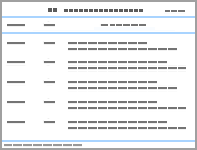
Tab. 1
Evaluation index system for economic resilience in the Yellow River region"
| 目标层 | 系统层 | 准则层 | 指标层 | 单位 | 指标方向 |
|---|---|---|---|---|---|
| 沿黄地区经济韧性 | 抵抗力 | 经济发展水平 | 人均GDP | 元 | + |
| 人均固定资产投资 | 元 | + | |||
| 财政自给率 | % | + | |||
| 产业链结构与水平 | 制造业总产值 | 104元 | + | ||
| 第一产业增加值占GDP的比重 | % | - | |||
| 劳动密集型制造业产业链占比 | % | - | |||
| 恢复力 | 产业调整能力 | 地区工业规模 | 104元 | + | |
| 单位GDP能耗 | 104 tce | - | |||
| 产业结构高级化指数 | — | + | |||
| 产业结构多样化指数 | — | + | |||
| 经济普惠水平 | 人均可支配收入 | 元 | + | ||
| 外贸结构 | 外贸依存度 | % | + | ||
| 就业水平 | 就业人员占总人口比重 | % | + | ||
| 转型力 | 创新支撑能力 | R&D支出占GDP的比重 | % | + | |
| 规上工业企业有效专利数 | 件 | + | |||
| 高技术产业企业数 | 个 | + | |||
| 人力资本支持 | 万人在校大学生数 | 人 | + | ||
| 绿色转型能力 | 区域旅游收入 | 108元 | + |
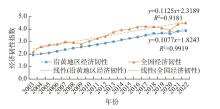
Fig. 1
Comparison of economic resilience between China and the Yellow River region from 2003 to 2022"
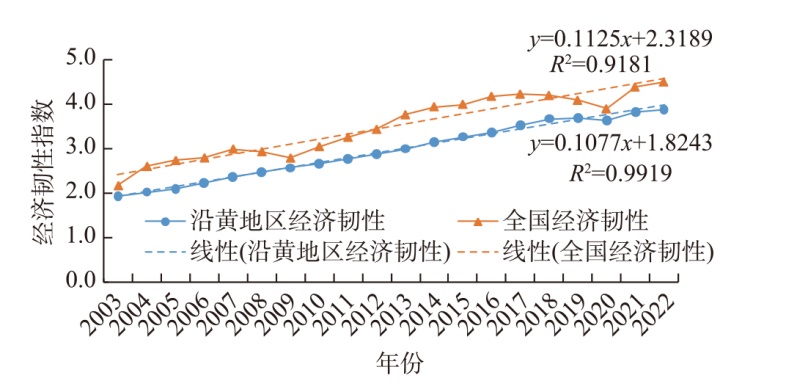
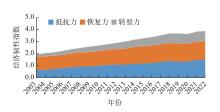
Fig. 2
Evolution of economic resilience subsystems in the Yellow River region from 2003 to 2022"
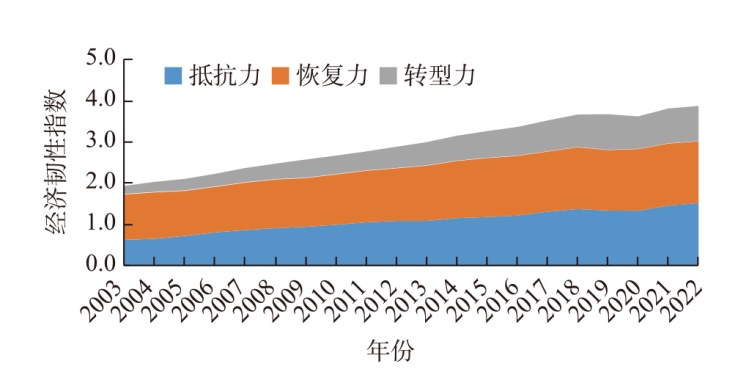
Fig. 3
Economic resilience index of provinces (regions) in the Yellow River from 2003 to 2022"
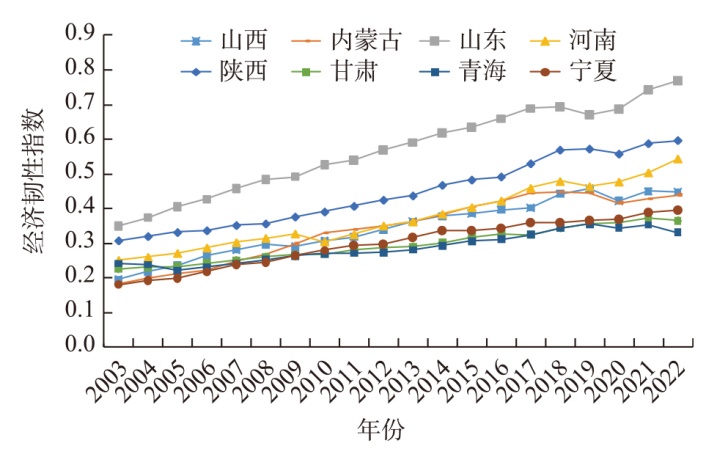
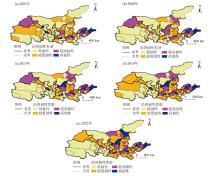
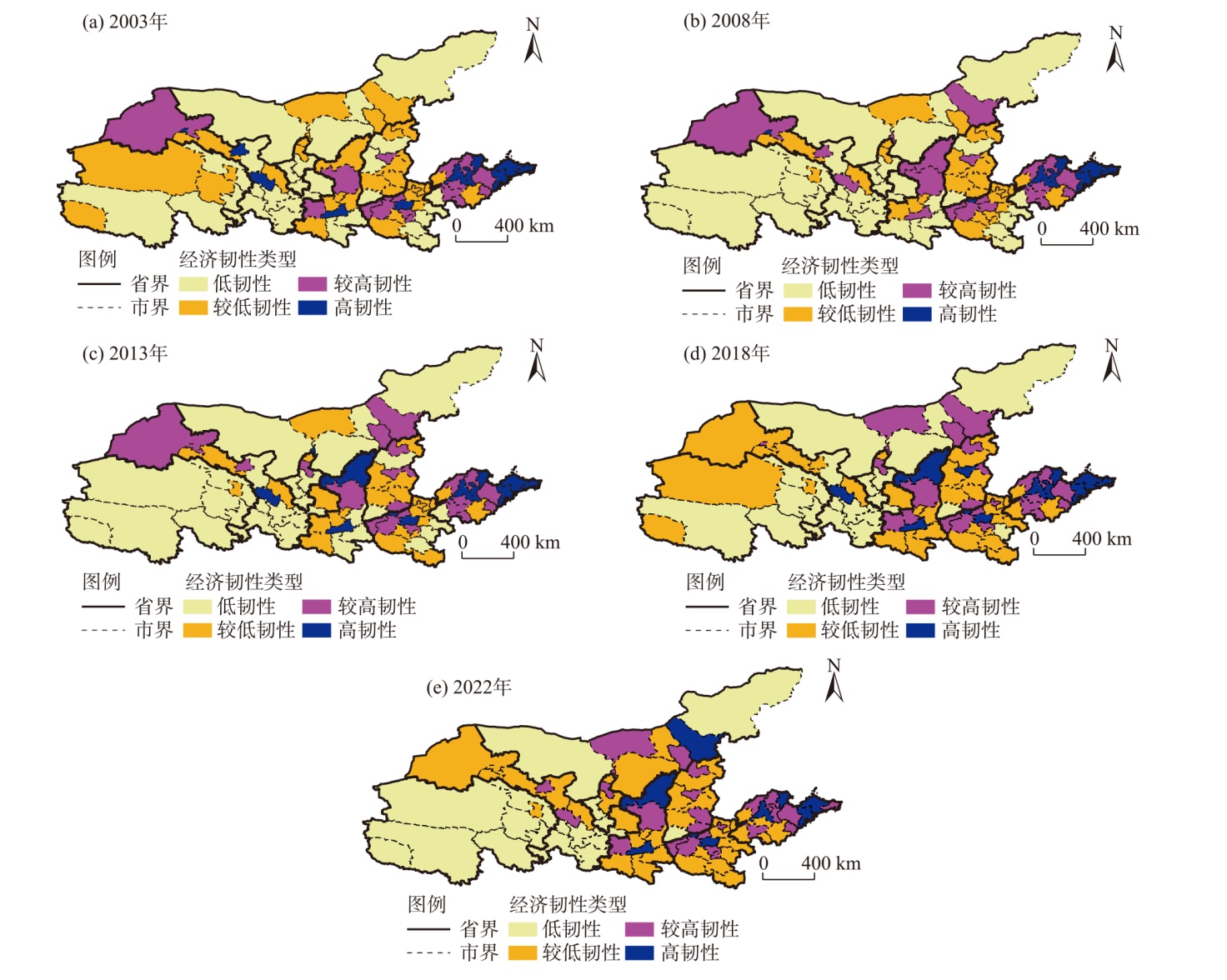
Fig. 4
Spatial patterns of economic resilience types in the Yellow River region from 2003 to 2022"
Tab. 2
Theil index and contribution rates of economic resilience in the Yellow River region from 2003 to 2022"
| 年份 | 总体差异 | 区域间差异 | 区域间差异贡献率/% | 区域内差异 | 区域内差异贡献率/% | |||||||
|---|---|---|---|---|---|---|---|---|---|---|---|---|
| 总体 | 上游 | 中游 | 下游 | 总体 | 上游 | 中游 | 下游 | |||||
| 2003 | 0.22 | 0.03 | 15.82 | 0.18 | 0.09 | 0.03 | 0.07 | 84.18 | 39.93 | 11.76 | 32.49 | |
| 2004 | 0.22 | 0.04 | 19.24 | 0.18 | 0.08 | 0.03 | 0.07 | 80.76 | 35.05 | 12.03 | 33.68 | |
| 2005 | 0.22 | 0.05 | 20.92 | 0.18 | 0.07 | 0.03 | 0.08 | 79.08 | 32.54 | 11.89 | 34.65 | |
| 2006 | 0.21 | 0.05 | 22.48 | 0.16 | 0.07 | 0.03 | 0.07 | 77.52 | 31.16 | 13.36 | 33.00 | |
| 2007 | 0.20 | 0.05 | 22.87 | 0.16 | 0.06 | 0.03 | 0.07 | 77.13 | 29.49 | 14.25 | 33.38 | |
| 2008 | 0.20 | 0.04 | 22.04 | 0.15 | 0.06 | 0.03 | 0.06 | 77.96 | 30.30 | 15.21 | 32.45 | |
| 2009 | 0.16 | 0.02 | 12.83 | 0.14 | 0.07 | 0.03 | 0.04 | 87.17 | 42.07 | 18.19 | 26.91 | |
| 2010 | 0.16 | 0.02 | 11.72 | 0.14 | 0.07 | 0.03 | 0.05 | 88.28 | 41.00 | 16.56 | 30.72 | |
| 2011 | 0.15 | 0.02 | 11.47 | 0.14 | 0.07 | 0.03 | 0.04 | 88.53 | 43.35 | 16.47 | 28.72 | |
| 2012 | 0.15 | 0.02 | 13.45 | 0.13 | 0.06 | 0.03 | 0.04 | 86.55 | 41.52 | 16.90 | 28.13 | |
| 2013 | 0.15 | 0.02 | 16.58 | 0.12 | 0.06 | 0.02 | 0.04 | 83.42 | 39.64 | 15.21 | 28.57 | |
| 2014 | 0.14 | 0.03 | 20.20 | 0.11 | 0.05 | 0.02 | 0.04 | 79.80 | 35.76 | 15.06 | 28.99 | |
| 2015 | 0.13 | 0.03 | 21.84 | 0.10 | 0.05 | 0.02 | 0.04 | 78.16 | 35.30 | 13.43 | 29.43 | |
| 2016 | 0.13 | 0.03 | 21.97 | 0.10 | 0.05 | 0.02 | 0.04 | 78.03 | 35.69 | 13.55 | 28.79 | |
| 2017 | 0.14 | 0.03 | 24.34 | 0.11 | 0.05 | 0.02 | 0.04 | 75.66 | 33.98 | 14.25 | 27.43 | |
| 2018 | 0.13 | 0.03 | 22.69 | 0.10 | 0.05 | 0.02 | 0.04 | 77.31 | 34.99 | 13.87 | 28.45 | |
| 2019 | 0.12 | 0.03 | 21.97 | 0.09 | 0.04 | 0.02 | 0.03 | 78.03 | 36.21 | 15.01 | 26.82 | |
| 2020 | 0.11 | 0.03 | 22.95 | 0.09 | 0.04 | 0.02 | 0.03 | 77.05 | 34.24 | 14.68 | 28.13 | |
| 2021 | 0.12 | 0.03 | 21.46 | 0.09 | 0.04 | 0.02 | 0.03 | 78.54 | 36.11 | 15.77 | 26.66 | |
| 2022 | 0.13 | 0.03 | 21.61 | 0.10 | 0.05 | 0.02 | 0.03 | 78.39 | 37.92 | 17.06 | 23.41 | |
Tab. 3
Global Moran’s I of economic resilience in the Yellow River region from 2003 to 2022"
| 年份 | Moran’s I | P值 | 年份 | Moran’s I | P值 |
|---|---|---|---|---|---|
| 2003 | 0.19 | 0.000 | 2013 | 0.20 | 0.000 |
| 2004 | 0.22 | 0.000 | 2014 | 0.22 | 0.000 |
| 2005 | 0.24 | 0.000 | 2015 | 0.22 | 0.000 |
| 2006 | 0.25 | 0.000 | 2016 | 0.22 | 0.000 |
| 2007 | 0.27 | 0.000 | 2017 | 0.23 | 0.000 |
| 2008 | 0.29 | 0.000 | 2018 | 0.21 | 0.000 |
| 2009 | 0.16 | 0.000 | 2019 | 0.14 | 0.000 |
| 2010 | 0.18 | 0.000 | 2020 | 0.17 | 0.000 |
| 2011 | 0.17 | 0.000 | 2021 | 0.18 | 0.000 |
| 2012 | 0.18 | 0.000 | 2022 | 0.20 | 0.000 |
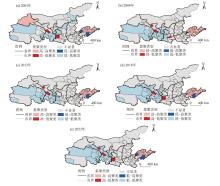
Fig. 5
Spatial agglomeration types of economic resilience in the Yellow River region from 2003 to 2022"

| [1] | Holling C S. Resilience and stability of ecological systems[J]. Annual Review of Ecology and Systematics, 1973, 4(4): 1-23. |
| [2] | Berkes F, Folke C. Linking social and ecological systems: Management practices and social mechanisms for building resilience[M]. Cambridge: Cambridge University Press, 1998: 13-20. |
| [3] | Folke C. Resilience: The emergence of a perspective for social-ecological systems analyses[J]. Global Environmental Change, 2006, 16(3): 253-267. |
| [4] | Martin R. Roepke lecture in economic geography: Rethinking regional path dependence: Beyond lock-in to evolution[J]. Economic Geography, 2010, 86(1): 1-27. |
| [5] | Martin R. Regional economic resilience, hysteresis and recessionary shocks[J]. Journal of Economic Geography, 2012, 12(1): 1-32. |
| [6] | Boschma R. Towards an evolutionary perspective on regional resilience[J]. Regional Studies, 2014, 49(5): 733-751. |
| [7] | 贺灿飞, 盛涵天. 区域经济韧性: 研究综述与展望[J]. 人文地理, 2023, 38(1): 1-10. |
| [He Canfei, Sheng Hantian. Regional economic resilience: A review and future development outlook[J]. Human Geography, 2023, 38(1): 1-10. ] | |
| [8] | Simmie J, Martin R. The economic resilience of regions: Towards an evolutionary approach[J]. Cambridge Journal of Regions, Economy and Society, 2010, 3(1): 27-43. |
| [9] |
Martin R, Gardiner B. The resilience of cities to economic shocks: A tale of four recessions (and the challenge of Brexit)[J]. Papers in Regional Science, 2019, 98(4): 1801-1832.
doi: 10.1111/pirs.12430 |
| [10] |
陈梦远. 国际区域经济韧性研究进展——基于演化论的理论分析框架介绍[J]. 地理科学进展, 2017, 36(11): 1435-1444.
doi: 10.18306/dlkxjz.2017.11.012 |
|
[Chen Mengyuan. An international literature review of regional economic resilience: Theories and practices based on the evolutionary perspective[J]. Progress in Geography, 2017, 36(11): 1435-1444. ]
doi: 10.18306/dlkxjz.2017.11.012 |
|
| [38] |
张学波, 李亚宁, 马海涛, 等. 基于适应性循环的环渤海地区经济韧性演化分异机制[J]. 地理研究, 2024, 43(5): 1126-1145.
doi: 10.11821/dlyj020230818 |
| [Zhang Xuebo, Li Yaning, Ma Haitao, et al. Evolution differentiation mechanism of economic resilience in the Bohai Rim region based on the adaptive cycle theory[J]. Geographical Research, 2024, 43(5): 1126-1145. ] | |
| [39] |
杨永春, 穆焱杰, 张薇. 黄河流域高质量发展的基本条件与核心策略[J]. 资源科学, 2020, 42(3): 409-423.
doi: 10.18402/resci.2020.03.01 |
|
[Yang Yongchun, Mu Yanjie, Zhang Wei. Basic conditions and core strategies of high-quality development in the Yellow River Basin[J]. Resources Science, 2020, 42(3): 409-423. ]
doi: 10.18402/resci.2020.03.01 |
|
| [40] | 任保平, 邹起浩. 新发展阶段中国经济发展的韧性: 评价、影响因素及其维护策略[J]. 中国软科学, 2024(3): 15-25. |
| [Ren Baoping, Zou Qihao. Resilience of China’s economic development in the new development stage: Evaluation, influencing factors and maintenance strategies[J]. China Soft Science, 2024(3): 15-25. ] | |
| [41] | 石玉堂, 王晓丹, 陈凯旋. 新质生产力与城市经济韧性: 理论逻辑与经验证据[J]. 重庆大学学报(社会科学版), 2024, 30(5): 29-45. |
| [Shi Yutang, Wang Xiaodan, Chen Kaixuan. New quality productivity and urban economic resilience: Theoretical logic and empirical evidence[J]. Journal of Chongqing University (Social Science Edition), 2024, 30(5): 29-45. ] | |
| [11] | Christopherson S, Michie J, Tyler P. Regional resilience: Theoretical and empirical perspectives[J]. Cambridge Journal of Regions, Economy and Society, 2010, 3(1): 3-10. |
| [12] | Martin R, Gardiner B, Pike A, et al. Economic shocks and the differential resilience of places[J]. Regional Studies Policy Impact Books, 2021, 3(2): 73-85. |
| [13] |
胡晓辉, 董柯, 杨宇. 战略耦合演化视角下的区域经济韧性分析框架[J]. 地理研究, 2021, 40(12): 3272-3286.
doi: 10.11821/dlyj020210293 |
| [Hu Xiaohui, Dong Ke, Yang Yu. An analytical framework on regional economic resilience from the perspective of evolutionary strategic coupling[J]. Geographical Research, 2021, 40(12): 3272-3286. ] | |
| [14] |
生延超, 谭左思, 李倩, 等. 数字经济能否促进黄河流域旅游经济韧性提升?[J]. 干旱区地理, 2023, 46(10): 1704-1713.
doi: 10.12118/j.issn.1000-6060.2023.090 |
|
[Sheng Yanchao, Tan Zuosi, Li Qian, et al. Can the digital economy promote the resilience of the tourism economy in the Yellow River Basin?[J]. Arid Land Geography, 2023, 46(10): 1704-1713. ]
doi: 10.12118/j.issn.1000-6060.2023.090 |
|
| [15] |
王松茂, 牛金兰. 山东省旅游经济与城市生态韧性协同演化研究[J]. 地理学报, 2023, 78(10): 2591-2608.
doi: 10.11821/dlxb202310013 |
|
[Wang Songmao, Niu Jinlan. Co-evolution of tourism economy and urban ecological resilience in Shandong Province[J]. Acta Geographica Sinica, 2023, 78(10): 2591-2608. ]
doi: 10.11821/dlxb202310013 |
|
| [16] |
朱静敏, 卢小丽. 数字经济提升旅游经济韧性的作用机制及空间效应[J]. 地理科学进展, 2024, 43(10): 2004-2020.
doi: 10.18306/dlkxjz.2024.10.008 |
|
[Zhu Jingmin, Lu Xiaoli. Mechanism of impact and spatial effects of digital economy in enhancing tourism economic resilience[J]. Progress in Geography, 2024, 43(10): 2004-2020. ]
doi: 10.18306/dlkxjz.2024.10.008 |
|
| [17] |
张路, 林国栋, 吕晓. 产业结构升级视角下城市经济韧性空间分异及其驱动因素[J]. 地理科学, 2024, 44(9): 1577-1586.
doi: 10.13249/j.cnki.sgs.20230239 |
|
[Zhang Lu, Lin Guodong, Lü Xiao. Spatial differentiation and driving factors of urban economic resilience from the perspective of industrial structure upgrading[J]. Scientia Geographica Sinica, 2024, 44(9): 1577-1586. ]
doi: 10.13249/j.cnki.sgs.20230239 |
|
| [18] |
谭俊涛, 赵宏波, 刘文新, 等. 中国区域经济韧性特征与影响因素分析[J]. 地理科学, 2020, 40(2): 173-181.
doi: 10.13249/j.cnki.sgs.2020.02.002 |
|
[Tan Juntao, Zhao Hongbo, Liu Wenxin, et al. Regional economic resilience and influential mechanism during economic crises in China[J]. Scientia Geographica Sinica, 2020, 40(2): 173-181. ]
doi: 10.13249/j.cnki.sgs.2020.02.002 |
|
| [19] |
宁静, 朱冉, 张馨元, 等. 内蒙古区县城市韧性评价与分析[J]. 干旱区地理, 2023, 46(7): 1217-1226.
doi: 10.12118/j.issn.1000-6060.2022.537 |
|
[Ning Jing, Zhu Ran, Zhang Xinyuan, et al. Evaluation and analysis of urban resilience of districts and counties in Inner Mongolia[J]. Arid Land Geography, 2023, 46(7): 1217-1226. ]
doi: 10.12118/j.issn.1000-6060.2022.537 |
|
| [20] |
关皓明, 杨青山, 浩飞龙, 等. 基于“产业-企业-空间”的沈阳市经济韧性特征[J]. 地理学报, 2021, 76(2): 415-427.
doi: 10.11821/dlxb202102012 |
|
[Guan Haoming, Yang Qingshan, Hao Feilong, et al. Economic resilience characteristics of Shenyang City based on a perspective of industry-enterprise-space[J]. Acta Geographica Sinica, 2021, 76(2): 415-427. ]
doi: 10.11821/dlxb202102012 |
|
| [21] | 李博, 曲艺. 中国沿海地区产业演化路径依赖及突破对区域经济韧性的影响[J]. 地理学报, 2023, 78(4): 824-839. |
|
[Li Bo, Qu Yi. Influence of industrial evolution path dependence and path creation on regional economic resilience: Taking the coastal areas of China as an example[J]. Acta Geographica Sinica, 2023, 78(4): 824-839. ]
doi: 10.11821/dlxb202304004 |
|
| [22] |
彭荣熙, 刘涛, 曹广忠. 中国东部沿海地区城市经济韧性的空间差异及其产业结构解释[J]. 地理研究, 2021, 40(6): 1732-1748.
doi: 10.11821/dlyj020200486 |
| [Peng Rongxi, Liu Tao, Cao Guangzhong. Spatial pattern of urban economic resilience in eastern coastal China and industrial explanation[J]. Geographical Research, 2021, 40(6): 1732-1748. ] | |
| [23] |
李连刚, 张平宇, 程钰, 等. 黄河流域经济韧性时空演变与影响因素研究[J]. 地理科学, 2022, 42(4): 557-567.
doi: 10.13249/j.cnki.sgs.2022.04.001 |
|
[Li Liangang, Zhang Pingyu, Cheng Yu, et al. Spatio-temporal evolution and influencing factors of economic resilience in the Yellow River Basin[J]. Scientia Geographica Sinica, 2022, 42(4): 557-567. ]
doi: 10.13249/j.cnki.sgs.2022.04.001 |
|
| [24] |
仇方道, 尹鹏星, 谭俊涛, 等. 沿海城市经济韧性演化特征及影响机理——以连云港市为例[J]. 地理科学, 2023, 43(11): 1944-1955.
doi: 10.13249/j.cnki.sgs.2023.11.007 |
|
[Qiu Fangdao, Yin Pengxing, Tan Juntao, et al. Evolution characteristics and influence mechanism of economic resilience in coastal cities: A case study of Lianyungang[J]. Scientia Geographica Sinica, 2023, 43(11): 1944-1955. ]
doi: 10.13249/j.cnki.sgs.2023.11.007 |
|
| [25] |
张学波, 吴江楠, 王振波, 等. 中国地级以上城市医疗服务韧性的时空分异与驱动力分析[J]. 地理科学进展, 2024, 43(7): 1273-1289.
doi: 10.18306/dlkxjz.2024.07.002 |
|
[Zhang Xuebo, Wu Jiangnan, Wang Zhenbo, et al. Spatial-temporal differentiation and driving forces of medical service resilience of prefecture-level cities in China[J]. Progress in Geography, 2024, 43(7): 1273-1289. ]
doi: 10.18306/dlkxjz.2024.07.002 |
|
| [26] | 叶飞文. 经济韧性测度指标体系设计与实证研究[J]. 调研世界, 2024(11): 17-26. |
| [Ye Feiwen. Design and empirical study of an economic resilience measurement index system[J]. The World of Survey and Research, 2024(11): 17-26. ] | |
| [27] | 齐昕, 张景帅, 徐维祥. 浙江省县域经济韧性发展评价研究[J]. 浙江社会科学, 2019(5): 40-46. |
| [Qi Xin, Zhang Jingshuai, Xu Weixiang. A study on the evaluation of the development of county economic resilience in Zhejiang Province[J]. Zhejiang Social Sciences, 2019(5): 40-46. ] | |
| [28] | 刘晓星, 张旭, 李守伟. 中国宏观经济韧性测度——基于系统性风险的视角[J]. 中国社会科学, 2021(1): 12-32. |
| [Liu Xiaoxing, Zhang Xu, Li Shouwei. Measurement of China’s macroeconomic resilience: A systemic risk perspective[J]. Social Sciences in China, 2021(1): 12-32. ] | |
| [29] |
胡志强, 苗长虹, 熊雪蕾, 等. 产业集聚对黄河流域工业韧性的影响研究[J]. 地理科学, 2021, 41(5): 824-831.
doi: 10.13249/j.cnki.sgs.2021.05.010 |
|
[Hu Zhiqiang, Miao Changhong, Xiong Xuelei, et al. Influence of industrial agglomeration on the industrial resilience of the Yellow River Basin[J]. Scientia Geographica Sinica, 2021, 41(5): 824-831. ]
doi: 10.13249/j.cnki.sgs.2021.05.010 |
|
| [30] |
孙久文, 陈超君, 孙铮. 黄河流域城市经济韧性研究和影响因素分析——基于不同城市类型的视角[J]. 经济地理, 2022, 42(5): 1-10.
doi: 10.15957/j.cnki.jjdl.2022.05.001 |
|
[Sun Jiuwen, Chen Chaojun, Sun Zheng. Urban economic resilience and its influencing factors in the Yellow River Basin: From the perspective of different types of city[J]. Economic Geography, 2022, 42(5): 1-10. ]
doi: 10.15957/j.cnki.jjdl.2022.05.001 |
|
| [31] | 张跃胜, 谭宇轩, 金文俊. 黄河流域城市经济韧性影响因素分析与路径识别: 基于动态QCA的考察[J]. 现代财经(天津财经大学学报), 2024, 44(3): 37-53. |
| [Zhang Yuesheng, Tan Yuxuan, Jin Wenjun. Grouping analysis and path identification of factors influencing the economic resilience of cities in the Yellow River Basin: An examination based on dynamic QCA[J]. Modern Finance and Economics-Journal of Tianjin University of Finance and Economics, 2024, 44(3): 37-53. ] | |
| [32] | 叶文显. 黄河流域经济韧性的时空演变特征与影响因素[J]. 统计与决策, 2024, 40(17): 132-137. |
| [Ye Wenxian. The spatiotemporal evolution characteristics and influencing factors of economic resilience in the Yellow River Basin[J]. Statistics & Decision, 2024, 40(17): 132-137. ] | |
| [33] | 王兆峰, 张先甜. 黄河流域旅游经济系统韧性的时空差异特征及其影响因素[J]. 地理与地理信息科学, 2023, 39(3): 112-121. |
| [Wang Zhaofeng, Zhang Xiantian. Spatio-temporal differences and influencing factors of resilience of tourism economic system in the Yellow River Basin[J]. Geography and Geo-information Science, 2023, 39(3): 112-121. ] | |
| [34] | 周文慧, 钞小静. 黄河流域数字基础设施、经济发展韧性与生态环境保护的耦合协调发展分析——基于三元系统耦合协调模型[J]. 干旱区资源与环境, 2023, 37(9): 1-9. |
| [Zhou Wenhui, Chao Xiaojing. Coupling coordinated development of digital infrastructure, economic resilience and environmental protection in the Yellow River Basin: An approach of ternary system coupling coordination model[J]. Journal of Arid Land Resources and Environment, 2023, 37(9): 1-9. ] | |
| [35] | 史佳璐. 绿色发展视域下黄河流域城市群经济韧性研究[D]. 济南: 山东师范大学, 2023. |
| [Shi Jialu. Study on the economic resilience of the Yellow River Basin urban agglomeration under the perspective of green development[D]. Jinan: Shandong Normal University, 2023. ] | |
| [36] | Haining R. Spatial data analysis: Theory and practice[M]. Cambridge: Cambridge University, 2003: 53-78. |
| [37] | 刘虹, 薛东前, 马蓓蓓. 基于ESDA分析的关中城市群县域经济空间分析研究[J]. 干旱区资源与环境, 2012, 26(4): 55-60. |
| [Liu Hong, Xue Dongqian, Ma Beibei. Spatial variability of county economies in Guanzhong City Agglomeration based on ESDA[J]. Journal of Arid Land Resources and Environment, 2012, 26(4): 55-60. ] |
|
||