Arid Land Geography ›› 2025, Vol. 48 ›› Issue (12): 2220-2231.doi: 10.12118/j.issn.1000-6060.2024.788
• Regional Development • Previous Articles Next Articles
LI Jin( ), PU Juan(), LI Mingliang, ZHAO Lanlan, YU Guoxin
Received:2024-12-25
Revised:2025-02-16
Online:2025-12-25
Published:2025-12-30
Contact:
PU Juan
E-mail:18306181665@163.com;pujuan0310@126.com
LI Jin, PU Juan, LI Mingliang, ZHAO Lanlan, YU Guoxin. Measurement, regional differences and dynamic evolution of the coupled coordinated development level of new urbanization and harmonious villages[J].Arid Land Geography, 2025, 48(12): 2220-2231.
Tab. 1
Evaluation indices system for new urbanization"
| 目标层 | 分层项 | 具体指标层 | 计算方法 | 指标性质 |
|---|---|---|---|---|
| 新型城镇化 | 人口城镇化 | 城镇人口占比/% | 城镇人口/总人口 | 正 |
| 非农从业人口占比/% | 二、三产业从业人员/总就业人员 | 正 | ||
| 城镇人口密度/人·km-2 | 城镇人口数/建成区面积 | 正 | ||
| 经济城镇化 | 人均GDP/元 | GDP/总人口 | 正 | |
| 人均可支配收入/元 | 人均可支配收入 | 正 | ||
| 第二、三产业产值占比/% | 二、三产业产值/地区生产总值 | 正 | ||
| 社会城镇化 | 城镇失业率/% | 城镇失业人口/总从业人口 | 负 | |
| 城镇教育水平/a | 平均年限法计算得来 | 正 | ||
| 城镇医疗水平/张 | 城市每千人口医疗卫生机构床位 | 正 | ||
| 土地城镇化 | 人均城市建设用地面积/km2·人-1 | 城市建设用地面积/城镇人口数 | 正 | |
| 建成区经济密度/104元·km-2 | 二、三产业产值/建成区面积 | 正 | ||
| 人均拥有道路面积/km2·人-1 | 城市道路面积/城镇总人口 | 正 | ||
| 绿色城镇化 | 人均公园绿地面积/km2·人-1 | 公园绿地面积/城镇总人口 | 正 | |
| 生活垃圾无害化处理率/% | 无害化生活垃圾处理量/生活垃圾总量 | 正 | ||
| 污水处理厂集中处理率/% | 达标城市生活污水排量/总排量 | 正 |
Tab. 2
Evalution indices system for harmonious villages"
| 目标层 | 分层项 | 具体指标层 | 计算方法 | 指标性质 |
|---|---|---|---|---|
| 和美乡村 | 基础设施建设 | 供水普及率/% | 供水普及率 | 正 |
| 村人均用电量/kWh·人-1 | 农村用电量/乡村人口 | 正 | ||
| 村均道路长度/km·村-1 | 村庄道路长度/行政村数 | 正 | ||
| 燃气普及率/% | 燃气普及率 | 正 | ||
| 村均宽带接入户数/户·村-1 | 村宽带接入用户数/行政村数 | 正 | ||
| 单位面积农机投入/kW·hm-2 | 农业机械总动力/农作物播种面积 | 正 | ||
| 有效灌溉率/% | 有效灌溉面积/农作物播种面积 | 正 | ||
| 村庄规划建设 | 人均生产建筑面积/km2·人-1 | 生产建筑面积/乡村人口 | 正 | |
| 人均住宅建筑面积/km2·人-1 | 住宅建筑面积/乡村人口 | 正 | ||
| 人均公共建筑面积/km2·人-1 | 公共建筑面积/乡村人口 | 正 | ||
| 人居环境整治 | 单位面积农药使用量/kg·hm-2 | 农药施用量/农作物播种面积 | 负 | |
| 单位面积化肥使用量/kg·hm-2 | 化肥施用量/农作物播种面积 | 负 | ||
| 单位面积农膜使用量/kg·hm-2 | 农膜使用量/农作物播种面积 | 负 | ||
| 每千人口乡镇公厕数/座·(103人)-1 | 乡镇公厕数/乡村人口 | 正 | ||
| 村均园林绿化投入/元·村-1 | 园林绿化投入/行政村数 | 正 | ||
| 村均垃圾处理投入/元·村-1 | 垃圾处理投入/行政村数 | 正 | ||
| 村均污水处理投入/元·村-1 | 污水处理投入/行政村数 | 正 | ||
| 公共服务治理 | 村业务教育水平/人·村-1 | 农村业务教育在校生数/行政村数 | 正 | |
| 村医疗水平/人·村-1 | 乡村医生、卫生员数/行政村数 | 正 | ||
| 每千人口乡镇文化站数/个·(103人)-1 | 乡镇文化站数/乡村人口 | 正 | ||
| 每千人口村民委员会数/个·(103人)-1 | 村民委员会数/乡村人口 | 正 | ||
| 人均最低生活收入保障/元·人-1 | 农村居民最低生活保障支出/农村居民最低生活保障人数 | 正 |
Tab. 3
Classification of coupling coordination degree levels"
| 范围 | 耦合等级 | 范围 | 耦合等级 |
|---|---|---|---|
| [0.0, 0.1) | 极度失调 | [0.5, 0.6) | 勉强协调 |
| [0.1, 0.2) | 严重失调 | [0.6, 0.7) | 初级协调 |
| [0.2, 0.3) | 中度失调 | [0.7, 0.8) | 中级协调 |
| [0.3, 0.4) | 轻度失调 | [0.8, 0.9) | 良好协调 |
| [0.4, 0.5) | 濒临失调 | [0.9, 1.0] | 优质协调 |
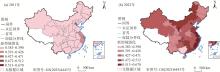
Fig. 1
Spatio-temporal evolution of new urbanization"

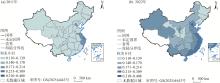
Fig. 2
Spatio-temporal evolution of harmonious villages"
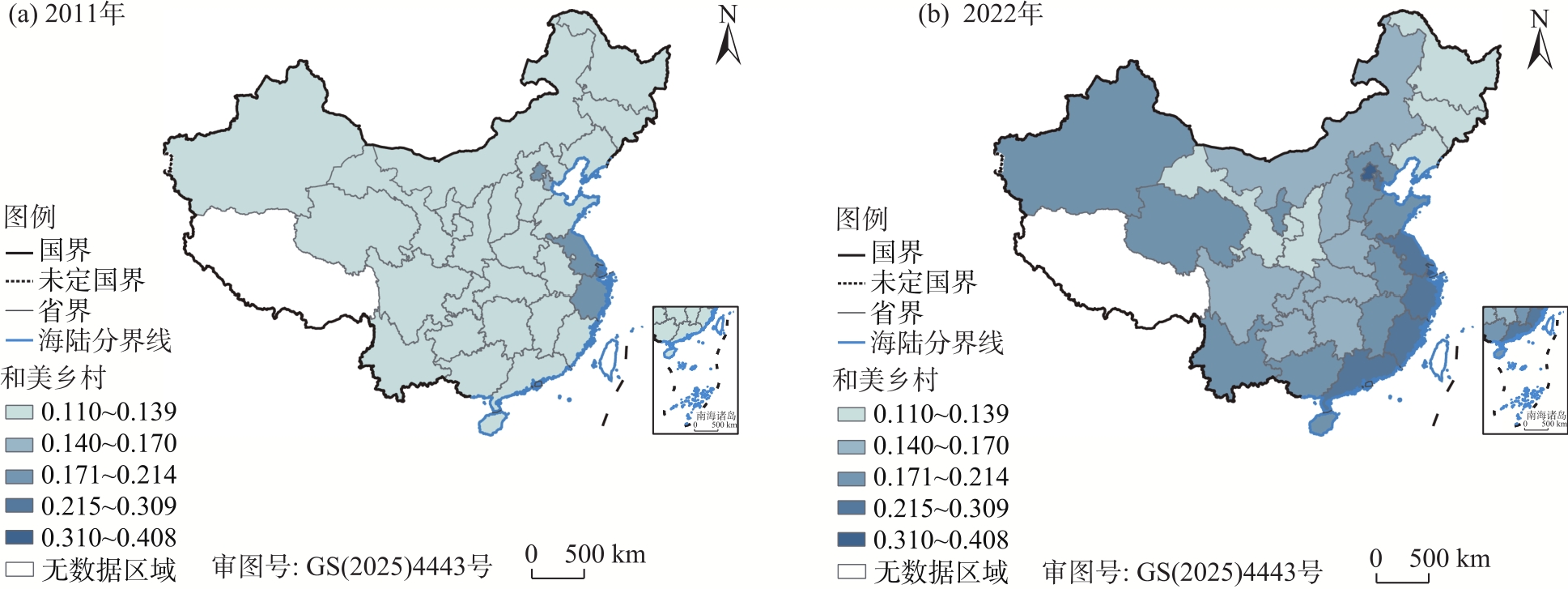
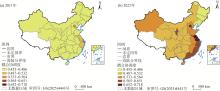
Fig. 3
Spatio-temporal evolution of coupling coordination degree"

Tab. 4
Decomposition results of Dagum Gini coefficient"
| 年份 | 总体 | 区域内差距 | 区域间差距 | 贡献率/% | 超变密度 | |||||||
|---|---|---|---|---|---|---|---|---|---|---|---|---|
| 东 | 中 | 西 | 东中 | 东西 | 中西 | 地区内 | 地区间 | |||||
| 2011 | 0.069 | 0.060 | 0.029 | 0.030 | 0.076 | 0.072 | 0.030 | 21.402 | 71.950 | 6.648 | ||
| 2012 | 0.074 | 0.069 | 0.031 | 0.031 | 0.084 | 0.078 | 0.031 | 21.968 | 71.952 | 6.080 | ||
| 2013 | 0.074 | 0.071 | 0.040 | 0.029 | 0.082 | 0.079 | 0.034 | 23.050 | 67.300 | 9.649 | ||
| 2014 | 0.071 | 0.069 | 0.026 | 0.028 | 0.081 | 0.076 | 0.027 | 21.977 | 71.383 | 6.634 | ||
| 2015 | 0.073 | 0.070 | 0.030 | 0.026 | 0.084 | 0.077 | 0.028 | 21.818 | 72.053 | 6.119 | ||
| 2016 | 0.071 | 0.068 | 0.030 | 0.028 | 0.082 | 0.074 | 0.029 | 22.274 | 71.855 | 5.871 | ||
| 2017 | 0.066 | 0.066 | 0.031 | 0.020 | 0.077 | 0.070 | 0.025 | 21.963 | 70.210 | 7.827 | ||
| 2018 | 0.067 | 0.070 | 0.032 | 0.022 | 0.078 | 0.070 | 0.027 | 23.124 | 68.461 | 8.415 | ||
| 2019 | 0.070 | 0.077 | 0.035 | 0.023 | 0.083 | 0.074 | 0.029 | 24.011 | 66.421 | 9.567 | ||
| 2020 | 0.061 | 0.067 | 0.033 | 0.025 | 0.072 | 0.062 | 0.029 | 25.021 | 64.432 | 10.547 | ||
| 2021 | 0.059 | 0.062 | 0.033 | 0.021 | 0.069 | 0.061 | 0.027 | 24.099 | 63.666 | 12.235 | ||
| 2022 | 0.061 | 0.066 | 0.036 | 0.023 | 0.072 | 0.062 | 0.029 | 24.838 | 63.136 | 12.026 | ||
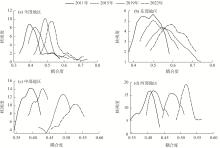
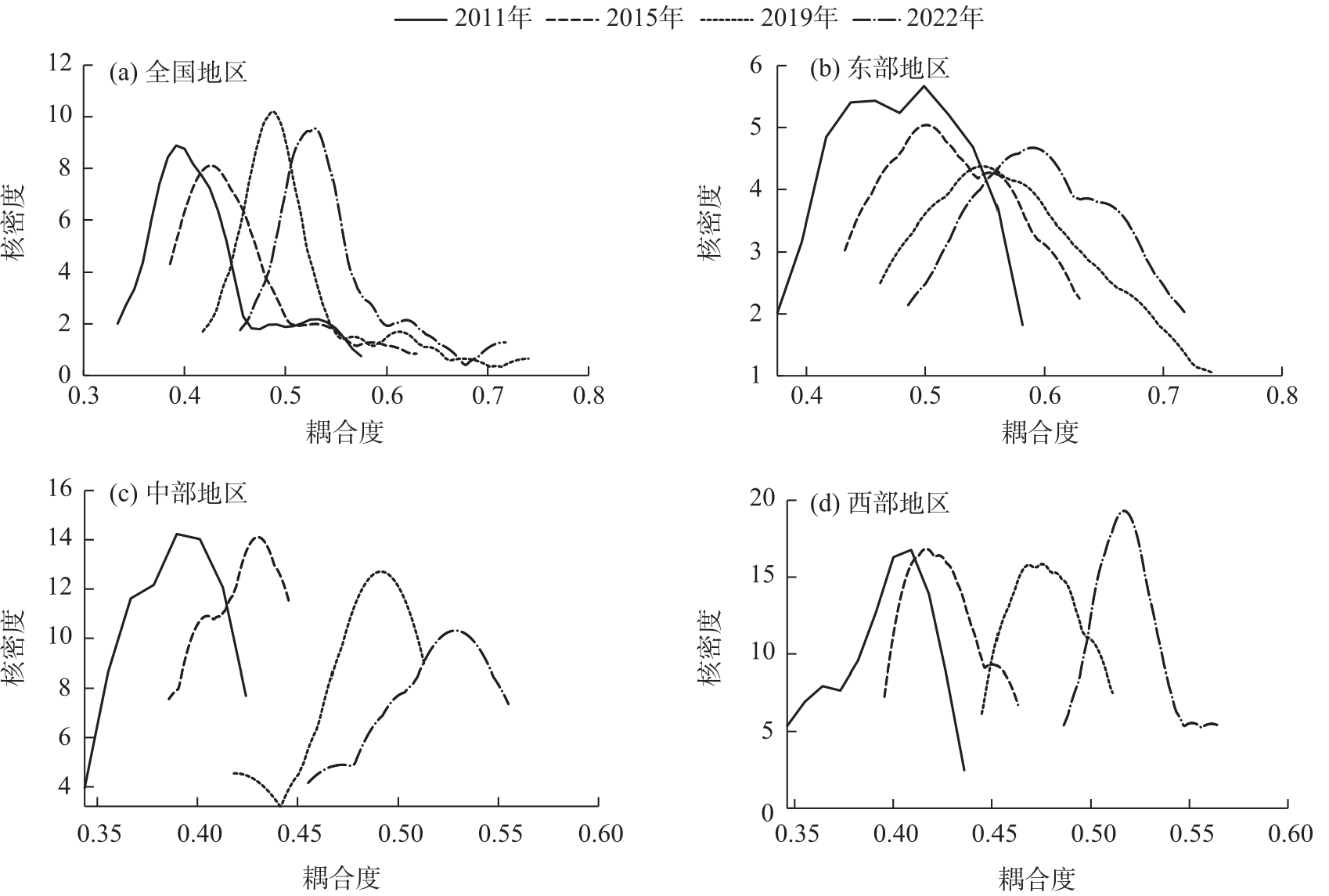
Fig. 4
Kernel density estimation results"
Tab. 5
Traditional Markov transfer probability matrix"
| 类型 | Ⅰ(低水平) | Ⅱ(中低水平) | Ⅲ(中高水平) | Ⅳ(高水平) | 观测值 |
|---|---|---|---|---|---|
| Ⅰ(低水平) | 0.756 | 0.244 | 0.000 | 0.000 | 90 |
| Ⅱ(中低水平) | 0.011 | 0.716 | 0.273 | 0.000 | 88 |
| Ⅲ(中高水平) | 0.000 | 0.012 | 0.787 | 0.200 | 80 |
| Ⅳ(高水平) | 0.000 | 0.000 | 0.013 | 0.986 | 72 |
Tab. 6
Spatial Markov transfer probability matrix"
| 空间滞后类型 | 类型 | Ⅰ(低水平) | Ⅱ(中低水平) | Ⅲ(中高水平) | Ⅳ(高水平) | 观测值 |
|---|---|---|---|---|---|---|
| Ⅰ(低水平) | Ⅰ | 0.842 | 0.157 | 0.000 | 0.000 | 57 |
| Ⅱ | 0.050 | 0.850 | 0.100 | 0.000 | 20 | |
| Ⅲ | 0.000 | 0.000 | 0.000 | 0.000 | 0 | |
| Ⅳ | 0.000 | 0.000 | 0.000 | 0.000 | 0 | |
| Ⅱ(中低水平) | Ⅰ | 0.612 | 0.387 | 0.000 | 0.000 | 31 |
| Ⅱ | 0.000 | 0.725 | 0.275 | 0.000 | 40 | |
| Ⅲ | 0.000 | 0.056 | 0.833 | 0.111 | 18 | |
| Ⅳ | 0.000 | 0.000 | 0.000 | 1.000 | 2 | |
| Ⅲ(中高水平) | Ⅰ | 0.500 | 0.500 | 0.000 | 0.000 | 2 |
| Ⅱ | 0.000 | 0.607 | 0.392 | 0.000 | 28 | |
| Ⅲ | 0.000 | 0.000 | 0.823 | 0.176 | 51 | |
| Ⅳ | 0.000 | 0.000 | 0.043 | 0.957 | 23 | |
| Ⅳ(高水平) | Ⅰ | 0.000 | 0.000 | 0.000 | 0.000 | 0 |
| Ⅱ | 0.000 | 0.000 | 0.000 | 0.000 | 0 | |
| Ⅲ | 0.000 | 0.000 | 0.545 | 0.455 | 11 | |
| Ⅳ | 0.000 | 0.000 | 0.000 | 1.000 | 47 |
| [1] | 魏后凯. 准确把握统筹新型城镇化和乡村全面振兴的科学内涵[J/OL]. 中国农村经济. [2024-03-05]. https://doi.org/10.20077/j.cnki.11-1262/f.2024.01.012. |
| [Wei Houkai. Accurately grasping the scientific connotation of coordinating new urbanization and comprehensive revitalization of the countryside[J/OL]. Chinese Rural Economy. [2024-03-05]. https://doi.org/10.20077/j.cnki.11-1262/f.2024.01.012.] | |
| [2] |
周闯, 郑旭刚, 杨苘菲. 新型城镇化与乡村振兴的共同演化及其市民化效应[J]. 地理研究, 2024, 43(12): 3265-3288.
doi: 10.11821/dlyj020240177 |
| [Zhou Chuang, Zheng Xugang, Yang Tongfei. Coevolution of new urbanization and rural revitalization and its citizenization effect[J]. Geographical Research, 2024, 43(12): 3265-3288.] | |
| [3] | 马彦瑞, 刘强. 新型城镇化建设的减污降碳效应[J]. 中国人口·资源与环境, 2024, 34(1): 33-45. |
| [Ma Yanrui, Liu Qiang. Effect of the reduction of pollution and carbon emissions in China’s new urbanization construction[J]. China Population, Resources and Environment, 2024, 34(1): 33-45.] | |
| [4] | 韩媛媛, 刘维奇. 劳动力流动、产业空间布局与城乡融合发展[J]. 财经科学, 2024(5): 118-131. |
| [Han Yuanyuan, Liu Weiqi. Labor mobility, industrial spatial distribution and rural-urban integrated development[J]. Finance & Economics, 2024(5): 118-131.] | |
| [5] | 豆书龙, 朱晴和, 丁大增. 宜居宜业和美乡村: 谁在谈? 谈什么?[J]. 南京农业大学学报(社会科学版), 2024, 24(2): 38-50. |
| [Dou Shulong, Zhu Qinghe, Ding Dazeng. A village with employment opportunities and social harmony: Who are talking about it,and about what[J]. Journal of Nanjing Agricultural University (Social Sciences Edition), 2024, 24(2): 38-50.] | |
| [6] | 徐雪. 新型城镇化高质量发展的多维测度、空间差异及动态演进[J]. 统计与决策, 2024, 40(10): 100-105. |
| [Xu Xue. Multidimensional measurement, spatial differences and dynamic evolution of high-quality development of new-type urbanization[J]. Statistics & Decision, 2024, 40(10): 100-105.] | |
| [7] |
尹君锋, 宋长青, 石晶, 等. 和美乡村发展水平评价及其影响因素研究——以甘肃省1230个乡镇为例[J]. 地理科学进展, 2024, 43(7): 1389-1402.
doi: 10.18306/dlkxjz.2024.07.009 |
|
[Yin Junfeng, Song Changqing, Shi Jing, et al. Development level of beautiful and harmonious villages and its influencing factors: A case study of 1230 township in Gansu Province[J]. Progress in Geography, 2024, 43(7): 1389-1402.]
doi: 10.18306/dlkxjz.2024.07.009 |
|
| [8] | 刘翔. 河南省新型城镇化与美丽乡村建设耦合研究[J]. 中国农业资源与区划, 2019, 40(1): 74-78. |
| [Liu Xiang. Research on the coupling of new urbanization and beautiful rural construction in Henan Province[J]. Chinese Journal of Agricultural Resources and Regional Planning, 2019, 40(1): 74-78.] | |
| [9] |
谭佳欣, 王凯. 和美乡村建设与旅游城镇化协调关系及障碍因子识别——以武陵山区为例[J]. 自然资源学报, 2024, 39(4): 768-787.
doi: 10.31497/zrzyxb.20240402 |
|
[Tan Jiaxin, Wang kai. Coordination relationship and identificatin of obstacle factors between harmonious and beautiful rural construction and tourism urbanization: Taking wuling mountain area as an example[J]. Journal of Natural Resources, 2024, 39(4): 768-787.]
doi: 10.31497/zrzyxb.20240402 |
|
| [10] | 陈景帅, 张东玲. 城乡融合中的耦合协调: 新型城镇化与乡村振兴[J]. 中国农业资源与区划, 2022, 43(10): 209-219. |
| [Chen Jingshuai, Zhang Dongling. Coupling and coordination in urban-rural integration: New-type urbanization and rural vitalization[J]. Chinese Journal of Agricultural Resources and Regional Planning, 2022, 43(10): 209-219.] | |
| [11] |
邓毛颖, 韦晓莉, 张国俊. 中国新型城镇化与绿色发展协调演进关系研究[J]. 自然资源学报, 2024, 39(7): 1682-1697.
doi: 10.31497/zrzyxb.20240711 |
|
[Deng Maoying, Wei Xiaoli, Zhang Guojun. Research on the coordinated evaluation relationship between new urbanization and green development in China[J]. Journal of Natural Resources, 2024, 39(7): 1682-1697.]
doi: 10.31497/zrzyxb.20240711 |
|
| [12] |
刘彦随. 中国新时代城乡融合与乡村振兴[J]. 地理学报, 2018, 73(4): 637-650.
doi: 10.11821/dlxb201804004 |
|
[Liu Yansui. Research on the urban-rural integration and rural revitalization in the new era in China[J]. Acta Geographica Sinica, 2018, 73(4): 637-650.]
doi: 10.11821/dlxb201804004 |
|
| [13] | 谢地, 张巧玲. 以人为核心的新型城镇化战略: 理论基础、内涵特征及实践路径[J]. 经济纵横, 2023(11): 27-34. |
| [Xie Di, Zhang Qiaoling. Peole-centered urbanization strategy: Theoretical basis, connotation characteristics, and practical path[J]. Economic Review Journal, 2023(11): 27-34.] | |
| [14] |
刘苗苗, 吴卫东. 陕西省新型城镇化与乡村振兴耦合性实证研究[J]. 干旱区地理, 2024, 47(8): 1420-1430.
doi: 10.12118/j.issn.1000-6060.2024.030 |
|
[Liu Miaomiao, Wu Weidong. Empirical study of the coupling of new urbanization and rural revitalization in Shaanxi Province[J]. Arid Land Geography, 2024, 47(8): 1420-1430.]
doi: 10.12118/j.issn.1000-6060.2024.030 |
|
| [15] | 莫神星, 张平. 新型城镇化绿色发展面临的几个重要问题及应对之策[J]. 兰州学刊, 2021(1): 152-167. |
| [Mo Shenxing, Zhang Ping. Several important issues and responses to the green development of new urbanization[J]. Lanzhou Academic Journal, 2021(1): 152-167.] | |
| [16] | 杨茜, 石大千. 交通基础设施、要素流动与城乡收入差距[J]. 南方经济, 2019(9): 35-50. |
| [Yang Xi, Shi Daqian. Transportation infrastructure, factors mobility and urban-rural income gap[J]. South China Journal of Economics, 2019(9): 35-50.] | |
| [17] | 豆书龙, 朱晴和, 李越. 农民视角的宜居宜业和美乡村[J]. 中国农业大学学报(社会科学版), 2024, 41(1): 172-197. |
| [Dou Shulong, Zhu Qinghe, Li Yue. Beautiful and harmonious village that are suitable for living and working from farmers’ perspective[J]. Journal of China Agricultural University (Social Sciences Edition), 2024, 41(1): 172-197.] | |
| [18] | 李明贤, 徐豫湘. 绿色金融支持和美乡村建设的机制与路径研究[J]. 世界农业, 2024(4): 72-82. |
| [Li Mingxian, Xu Yuxiang. Mechanism and path research on green finance support for the construction of harmonious and beautiful countryside[J]. World Agriculture, 2024(4): 72-82.] | |
| [19] |
王成, 代蕊莲, 豆浩健, 等. 中国建设宜居宜业和美乡村: 学理认知与实现方略[J]. 经济地理, 2024, 44(5): 144-150.
doi: 10.15957/j.cnki.jjdl.2024.05.015 |
|
[Wang Cheng, Dai Ruilian, Dou Haojian, et al. Building livable, workable and harmonious villages in China: Theoretical cognition and implementation strategy[J]. Economic Geography, 2024, 44(5): 144-150.]
doi: 10.15957/j.cnki.jjdl.2024.05.015 |
|
| [20] |
乔家君, 肖杰. 黄河中下游乡村振兴与新型城镇化耦合协调机制研究[J]. 地理科学进展, 2024, 43(3): 417-433.
doi: 10.18306/dlkxjz.2024.03.001 |
|
[Qiao Jiajun, Xiao Jie. Spatial pattern and driving mechanism of the coordinated development of rural revitalization and new urbanization in the middle and lower reaches of the Yellow River[J]. Progress in Geography, 2024, 43(3): 417-433.]
doi: 10.18306/dlkxjz.2024.03.001 |
|
| [21] | 崔钊达, 余志刚. 中国和美乡村发展水平指标体系构建、测度及评价[J]. 农业经济问题, 2024(4): 104-120. |
| [Cui Zhaoda, Yu Zhigang. Index system construction, measurement and evaluation of the development of harmonious and beautiful villages in China[J]. Issues in Agricultural Economy, 2024(4): 104-120.] | |
| [22] | 张红宇, 周二翠. 宜居宜业和美乡村建设: 现实基础与实现路径[J]. 中国农村经济, 2023(9): 36-47. |
| [Zhang Hongyu, Zhou Ercui. Building a beautiful and harmonious countryside that is desirable to live and work in: Realistic basis and implementation path[J]. Chinese Rural Economy, 2023(9): 36-47.] |
|
||