Arid Land Geography ›› 2025, Vol. 48 ›› Issue (10): 1736-1746.doi: 10.12118/j.issn.1000-6060.2024.652
• Climatology and Hydrology • Previous Articles Next Articles
YI Junlan1( ), ZHANG Xian2(), QI Donglin3, XU wei2, XIN Pingping4
Received:2024-10-24
Revised:2025-01-18
Online:2025-10-25
Published:2025-10-27
Contact:
ZHANG Xian
E-mail:Yijunlan_1017@163.com;bw101010@163.com
YI Junlan, ZHANG Xian, QI Donglin, XU wei, XIN Pingping. Spatio-temporal variations of atmospheric precipitable water in the Qinghai Plateau in the past 60 years[J].Arid Land Geography, 2025, 48(10): 1736-1746.
Fig. 1
Schematic diagram of the study area"
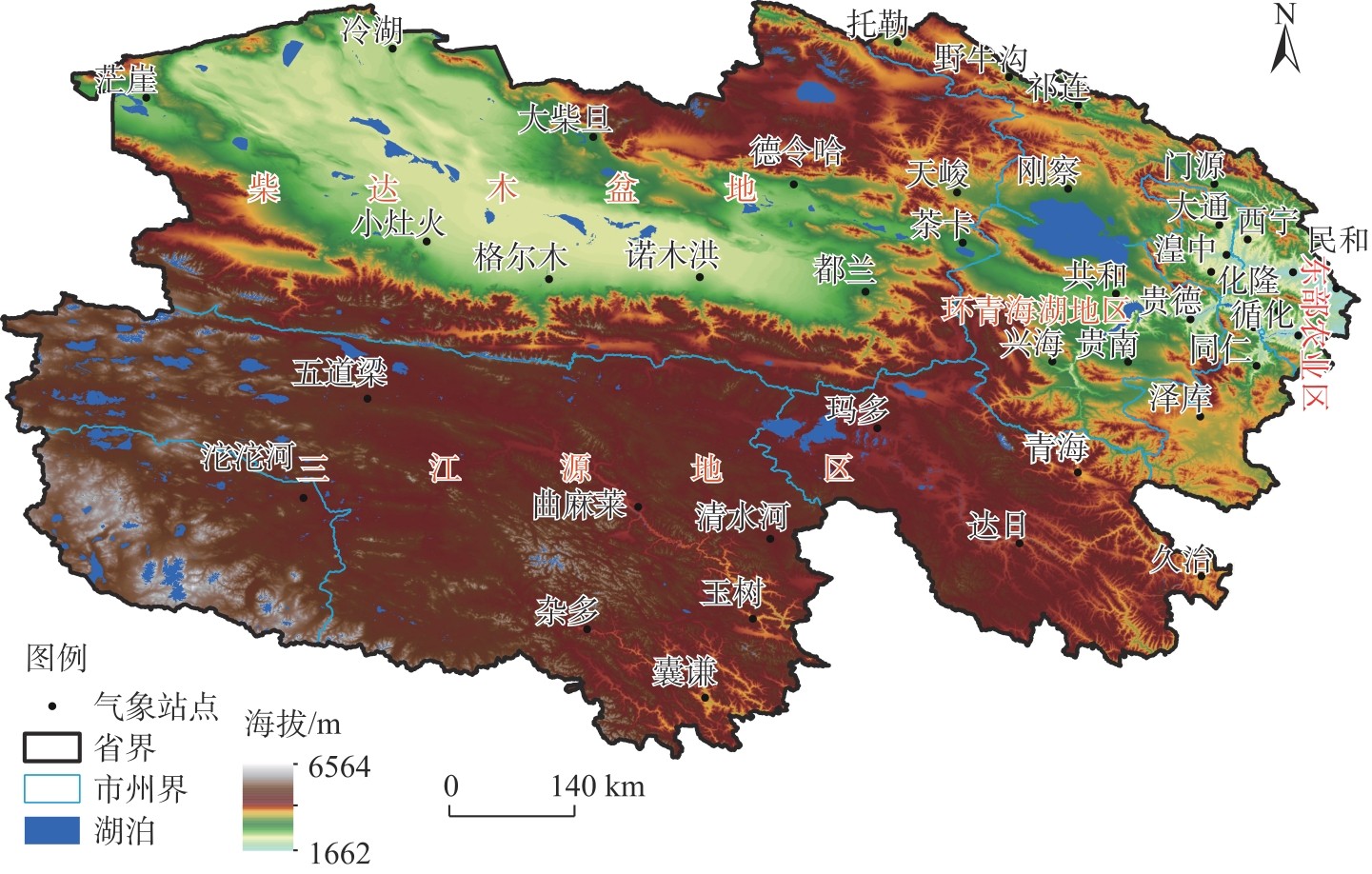
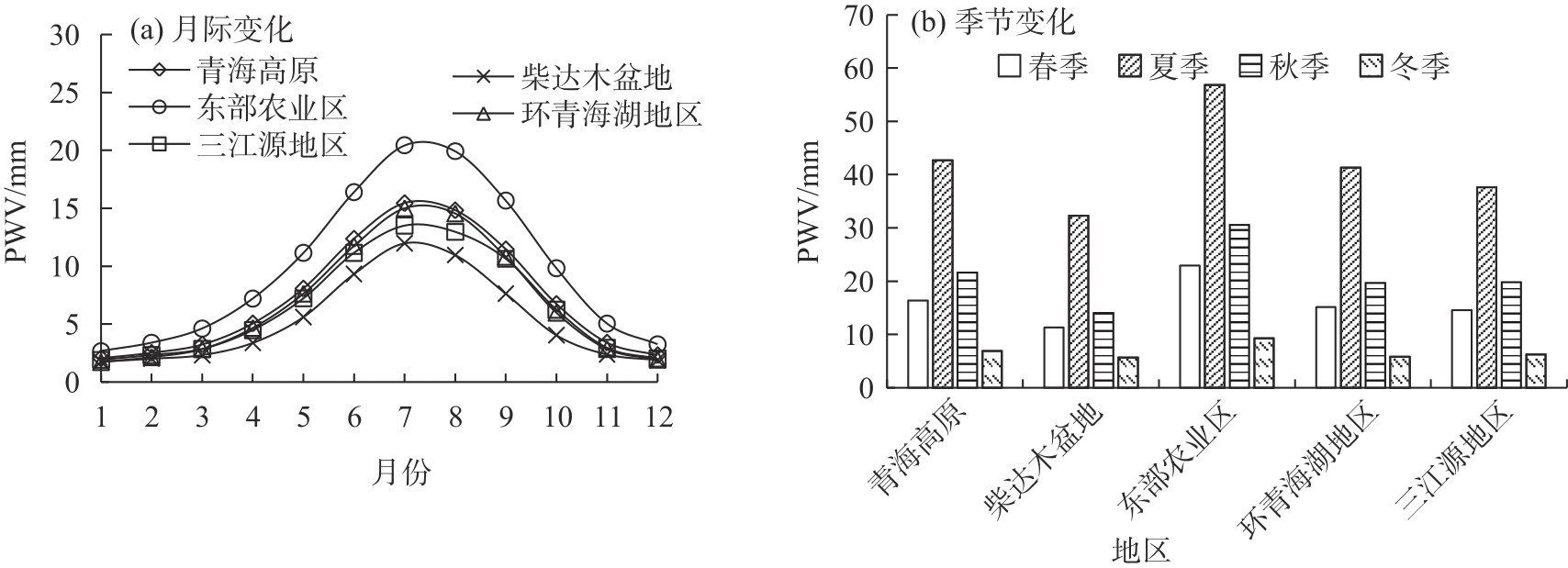
Fig. 2
Variations of precipitable water vapor (PWV) in the Qinghai Plateau from 1961 to 2020"
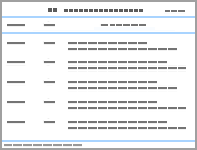
Tab. 1
Statistics of annual and four-season precipitable water vapor (PWV) in the Qinghai Plateau"
| 时间 尺度 | 平均值 /mm | 最大值 /mm | 最小值 /mm | 气候倾向率 /mm·(10a)-1 | 相关系数(r) |
|---|---|---|---|---|---|
| 全年 | 87.6 | 97.6 | 80.1 | 1.01 | 0.46** |
| 春季 | 16.4 | 20.1 | 14.2 | -0.02 | -0.02 |
| 夏季 | 42.7 | 50.0 | 39.0 | 0.49 | 0.36** |
| 秋季 | 21.6 | 24.5 | 17.6 | 0.36 | 0.37** |
| 冬季 | 6.9 | 8.6 | 5.2 | 0.17 | 0.43** |
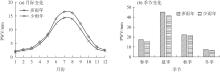
Fig. 3
Variations of PWV in wet years and dry years in the Qinghai Plateau from 1961 to 2020"
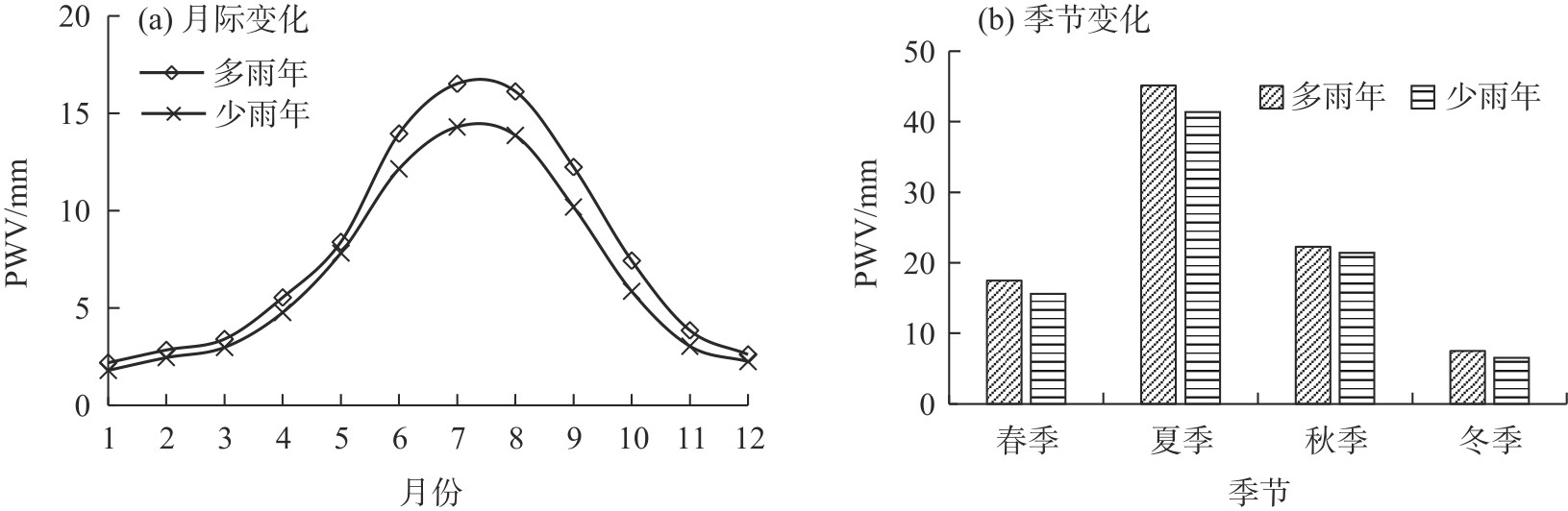
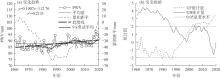
Fig. 4
Annual PWV variation trend and Mann-Kendall mutation tests in the Qinghai Plateau from 1961 to 2020"
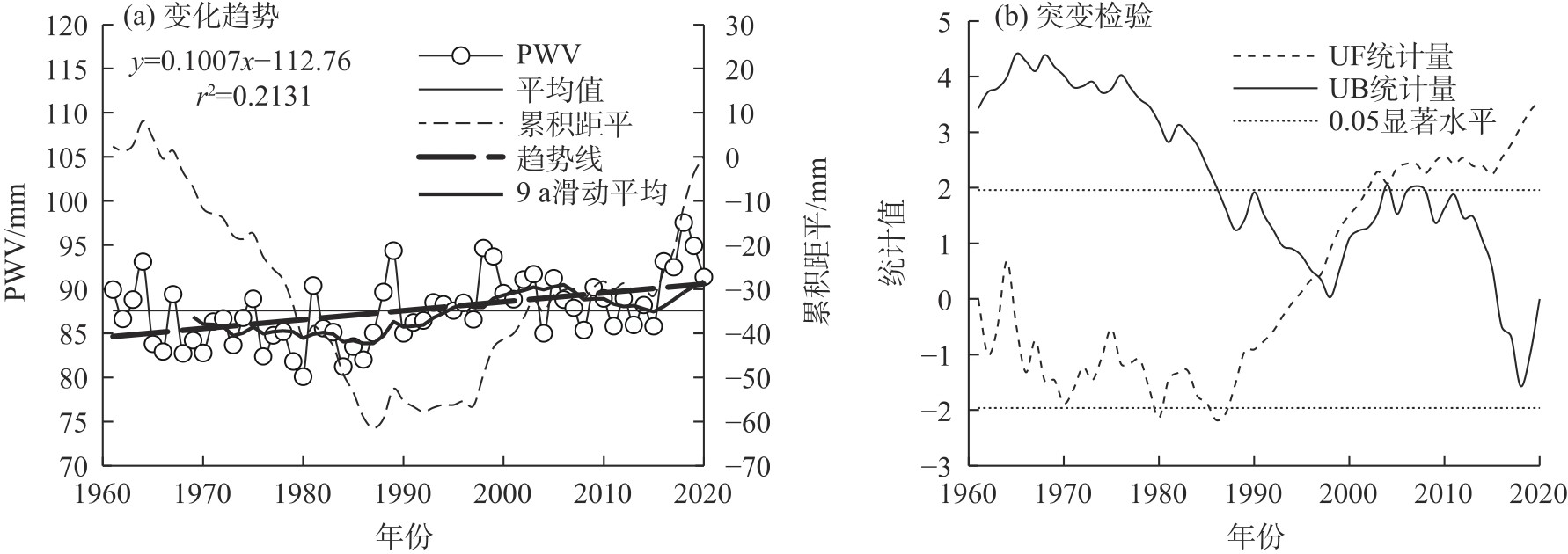
Fig. 5
Spatial distributions of PWV and climatic tendency rates in the Qinghai Plateau"
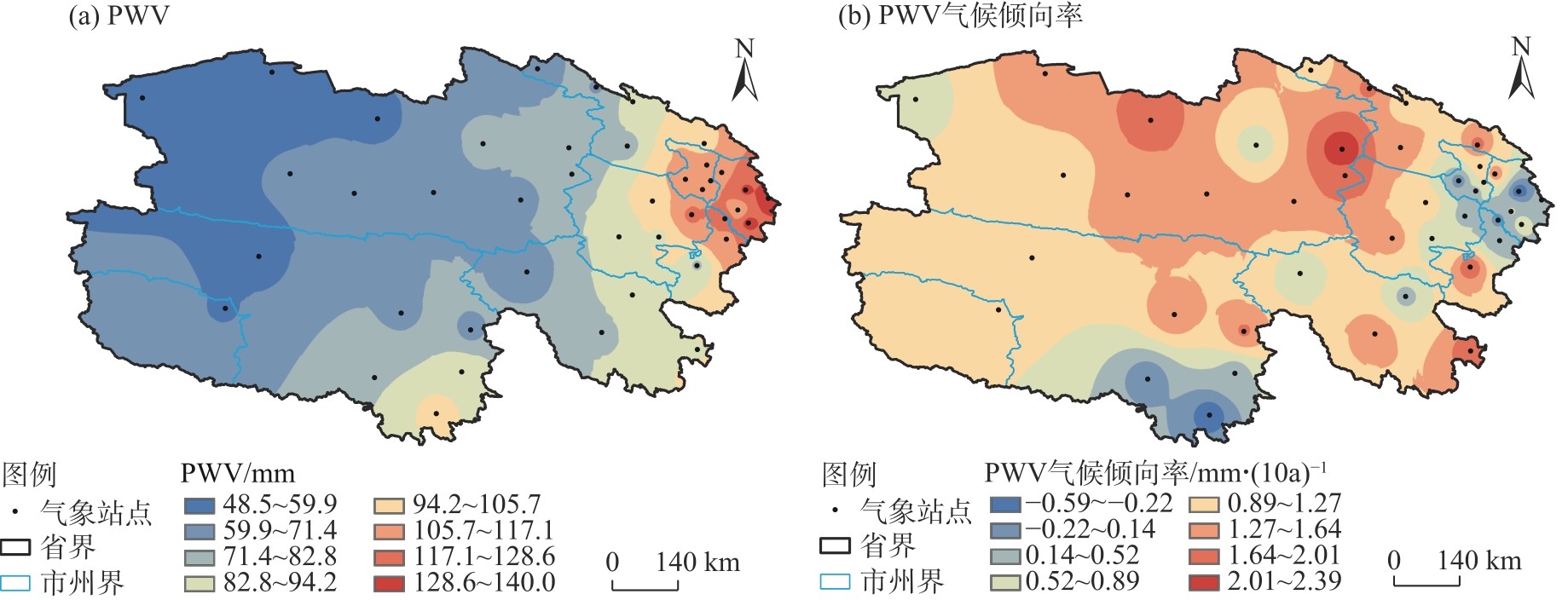
Fig. 6
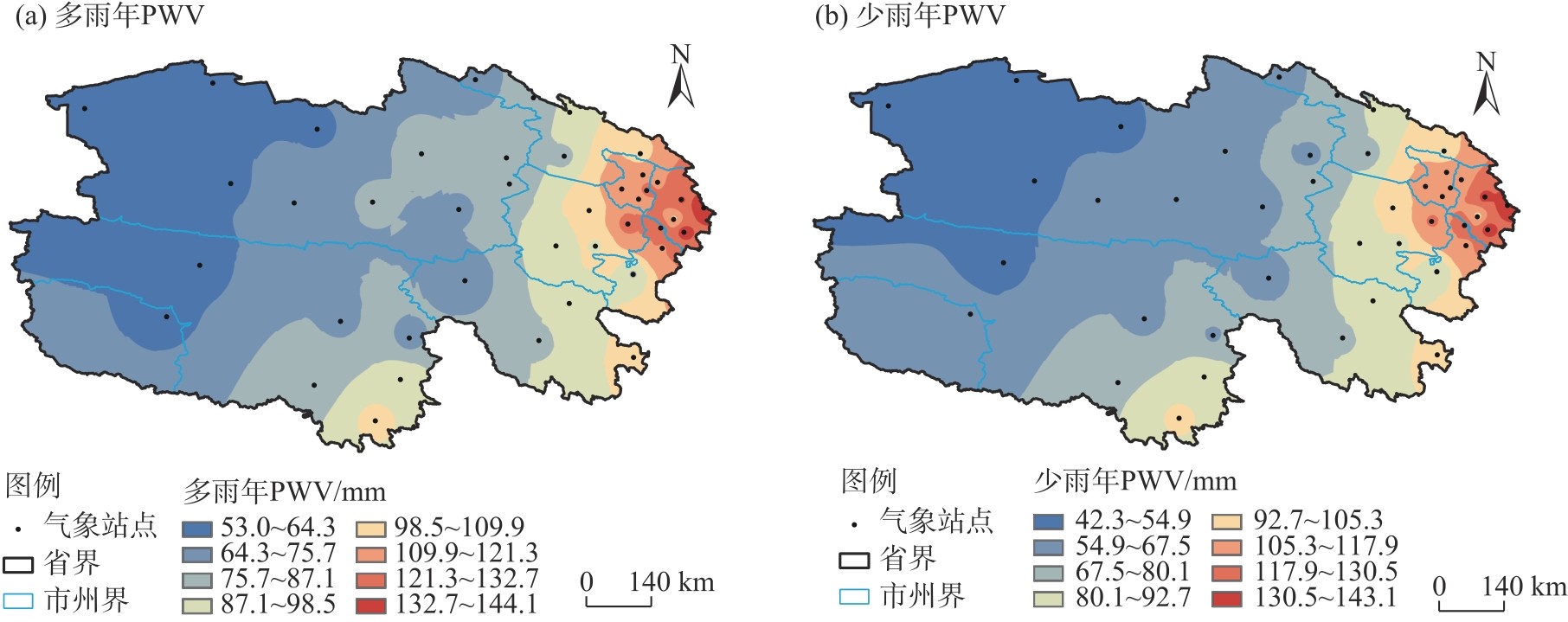
Spatial distributions of PWV in wet years and dry years in the Qinghai Plateau"
Tab. 2
Relationship between PWV and altitude (HB), latitude (WD), and longitude (JD) in Qinghai Plateau"
| 年份类型 | 回归方程 | 复相关系数 | F |
|---|---|---|---|
| 多年 平均 | PWV=67.791+3.689WD-7.537JD-0.023HB | 0.949 | 115.440 |
| 多雨年 | PWV=52.185+3.833WD-7.313JD-0.023HB | 0.955 | 129.785 |
| 少雨年 | PWV=46.880+4.180WD-8.296JD-0.025HB | 0.947 | 109.588 |
Fig. 7
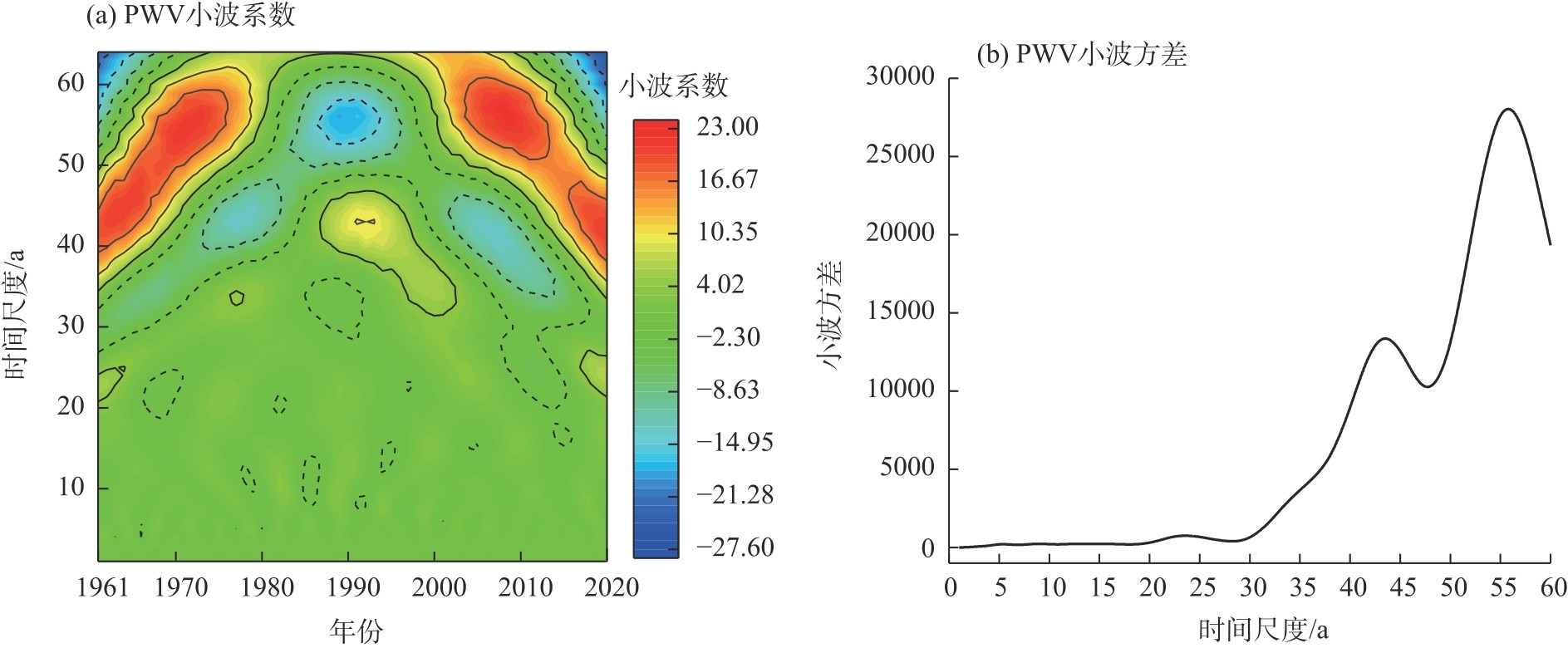
Periodic variation of PWV in the Qinghai Plateau from 1961 to 2020"
Tab. 3
Annual and seasonal Hurst indices of PWV in the Qinghai Plateau"
| 指数 | 全年 | 春季 | 夏季 | 秋季 | 冬季 |
|---|---|---|---|---|---|
| Hurst指数 | 0.910 | 0.593 | 0.825 | 0.802 | 0.904 |
Tab. 4
Correlation coefficient between annual PWV and atmospheric circulation index in the Qinghai Plateau"
| 指标 | 年降 水量 | 年平均 气温 | 亚洲纬向 环流指数 | 亚洲经向 环流指数 | 西藏高原 -2指数 | 北极涛 动指数 |
|---|---|---|---|---|---|---|
| 相关系数 | 0.58** | 0.52** | -0.037 | -0.064 | 0.103 | 0.261* |
Tab. 5
Trends in PWV and climate factors in the Qinghai Plateau"
| 要素 | 1961—1997年 | 1997—2020年 | |||
|---|---|---|---|---|---|
| 平均值 | 气候倾向率 | 平均值 | 气候倾向率 | ||
| PWV | 86.1 mm | 0.15 mm·(10a)-1 | 89.9 mm | 0.75 mm·(10a)-1 | |
| 北极涛动 | 5.0 | -5.0 | 23.6 | 9.4 | |
| 平均气温 | 1.8 ℃ | 0.21 ℃·(10a)-1 | 3.1 ℃ | 0.31 ℃·(10a)-1 | |
| 降水量 | 348.2 mm | 1.4 mm·(10a)-1 | 375.2 mm | 39.3 mm·(10a)-1 | |
| [1] |
姜萍, 胡列群, 许婷婷. 近60 a新疆大气水分亏缺的时空变化特征[J]. 干旱区地理, 2023, 46(1): 1-10.
doi: 10.12118/j.issn.1000-6060.2022.167 |
|
[Jiang Ping, Hu Liequn, Xu Tingting. Spatiotemporal variations of vapor pressure deficit in Xinjiang in recent 60 years[J]. Arid Land Geography, 2023, 46(1): 1-10.]
doi: 10.12118/j.issn.1000-6060.2022.167 |
|
| [2] | 刘晶, 周雅蔓, 杨莲梅, 等. 2016年伊犁河谷大气可降水量变化特征及其与降水的关系[J]. 干旱气象, 2019, 37(4): 565-576. |
| [Liu Jing, Zhou Yaman, Yang Lianmei, et al. Temporal variation characteristics of precipitable water vapor based on GPS data and its relation with precipitation at Yili River Valley in 2016[J]. Journal of Arid Meteorology, 2019, 37(4): 565-576.] | |
| [3] | 黄露, 范广洲, 赖欣, 等. 1978—2015年青藏高原大气可降水量的变化特征[J]. 西南大学学报(自然科学版), 2018, 40(2): 94-103. |
| [Huang Lu, Fan Guangzhou, Lai Xin, et al. Change characteristics of precipitable water vapor over Qinghai-Tibet Plateau during 1978—2015[J]. Journal of Southwest University (Natural Science Edition), 2018, 40(2): 94-103.] | |
| [4] | 王继昌, 姚永强, 杨国安. 西藏物玛与新疆卡拉苏天文候选点的气象条件[J]. 天文研究与技术, 2008, 5(4): 404-414. |
| [Wang Jichang, Yao Yongqiang, Yang Guo'an. Meteorological conditions at the astronomical candidate sites in Oma, Tibet and Kalasu, Pamirs[J]. Astronomical Techniques and Instruments, 2008, 5(4): 404-414.] | |
| [5] | 王晶星, 刘煜, 宋腾飞, 等. 大理洱海东岸山区天文气象条件初步统计分析: 2016至2017年大气季节特征[J]. 大理大学学报, 2018, 3(6): 30-33. |
| [Wang Jingxing, Liu Yu, Song Tengfei, et al. A preliminary statistical analysis of the astronomical meteorological conditions in mountainous areas in the east coast of Erhai Lake in Dali: The characteristics of the atmospheric season from 2016 to 2017[J]. Journal of Dali University, 2018, 3(6): 30-33.] | |
| [6] | 刘浩, 詹杰, 李建玉, 等. 青海德令哈大气气溶胶光学特征及可降水量分析[J]. 大气与环境光学学报, 2016, 60(3): 172-181. |
| [Liu Hao, Zhan Jie, Li Jianyu, et al. Analysis of optical characteristics of atmospheric aerosol and precipitable water vapor in Delingha, Qinghai[J]. Journal of Atmospheric and Environmental Optics, 2016, 60(3): 172-181.] | |
| [7] | 张永婧, 王盘兴, 姚永强, 等. 中国天文气象条件的地域分布[J]. 中国科学: 物理学力学天文学, 2010, 40(10): 1302-1314. |
| [Zhang Yongjing, Wang Panxing, Yao Yongqiang, et al. Climate regionalization in China for astronomical observations[J]. Scientia Sinica Physica, Mechanica & Astronomica, 2010, 40(10): 1302-1314.] | |
| [8] | 邓李才, 杨帆, 何飞, 等. 冷湖赛什腾山光学天文台址勘选结果及暗夜保护[J]. 青海科技, 2022, 29(3): 46-59. |
| [Deng Licai, Yang Fan, He Fei, et al. Lenghu astronomical observing site and dark sky protection[J]. Qinghai Science and Teachnology, 2022, 29(3): 46-59.] | |
| [9] | 方文维, 朱紫云, 林日新. 我国大气可降水量变化特征分析[J]. 海峡科学, 2019, 151(7): 19-24, 32. |
| [Fang Wenwei, Zhu Ziyun, Lin Rixin. Analysis of the characteristics of changes in atmospheric precipitation in China[J]. Strait Science, 2019, 151(7): 19-24, 32.] | |
| [10] | 黄小燕, 王圣杰, 王小平. 1960—2015年中国西北地区大气可降水量变化特征[J]. 气象, 2018, 44(9): 1191-1199. |
| [Huang Xiaoyan, Wang Shengjie, Wang Xiaoping. Variations of precipitable water in northwest China during 1960—2015[J]. Meteorological Monthly, 2018, 44(9): 1191-1199.] | |
| [11] |
张扬, 李宝富, 陈亚宁. 1970—2013年西北干旱区空中水汽含量时空变化与降水量的关系[J]. 自然资源学报, 2018, 33(6): 1043-1055.
doi: 10.31497/zrzyxb.20170518 |
|
[Zhang Yang, Li Baofu, Chen Yaning. The temporal and spatial variation of water vapor content and its relationship with precipitation in the arid region of northwest China from 1970 to 2013[J]. Journal of Natural Resources, 2018, 33(6): 1043-1055.]
doi: 10.31497/zrzyxb.20170518 |
|
| [12] |
赵世康, 穆振侠, 李刚, 等. 新疆大气可降水量时空演变特征及其与降水转化关系[J]. 干旱区研究, 2025, 42(2): 191-201.
doi: 10.13866/j.azr.2025.02.01 |
|
[Zhao Shikang, Mu Zhenxia, Li Gang, et al. Spatial and temporal evolution characteristics of atmospheric precipitable water vapor in Xinjiang and its relationship with precipitation conversion[J]. Arid Zone Research, 2025, 42(2): 191-201.]
doi: 10.13866/j.azr.2025.02.01 |
|
| [13] | 唐仲涛, 李甫, 张青, 等. 1961年—2020年祁连山地区大气可降水量变化分析[J]. 青海科技, 2021, 28(6): 113-118, 124. |
| [Tang Zhongtao, Li Fu, Zhang Qing, et al. Analysis of atmospheric precipitable water vapor changes in the Qilian Mountains from 1961 to 2020[J]. Qinghai Science and Technology, 2021, 28(6): 113-118, 124.] | |
| [14] | 鲁同所, 舒善杰, 廖偲含, 等. 近30年拉萨市大气可降水量变化特征研究[J]. 昆明理工大学学报(自然科学版), 2021, 46(3): 47-55. |
| [Lu Tongsuo, Shu Shanjie, Liao Sihan, et al. Variation characteristics of precipitable water vapor during the recent 30 years in Lhasa[J]. Journal of Kunming University of Science and Technology (Natural Sciences), 2021, 46(3): 47-55.] | |
| [15] | 强安丰, 汪妮, 解建仓, 等. 三江源区大气可降水量时空特征及其与降水关系[J]. 干旱气象, 2019, 37(1): 22-30. |
| [Qiang Anfeng, Wang Ni, Jie Jiancang, et al. Spatial-temporal characteristics and relations of precipitable water vapor with precipitation in the Three Rivers Source Region[J]. Journal of Arid Meteorology, 2019, 37(1): 22-30.] | |
| [16] |
校瑞香, 祁栋林, 周万福, 等. 1971—2010年青海高原不同功能区可降水量的变化特征[J]. 冰川冻土, 2014, 36(6): 1456-1464.
doi: 10.7522/j.issn.1000-0240.2014.0173 |
|
[Xiao Ruixiang, Qi Donglin, Zhou Wanfu, et al. The variation of precipitable water in different ecological function regions of Qinghai Plateau from 1971 to 2010[J]. Journal of Glaciology and Geocryology, 2014, 36(6): 1456-1464.]
doi: 10.7522/j.issn.1000-0240.2014.0173 |
|
| [17] | 张娟, 肖宏斌, 徐维新, 等. 1971—2010年柴达木盆地可降水量变化特征及其与气象条件分析[J]. 资源科学, 2013, 35(11): 2289-2297. |
| [Zhang Juan, Xiao Hongbin, Xu Weixin, et al. Precipitable water variation and its impact factors in recent 40 years in Qaidam Basin[J]. Resource Science, 2013, 35(11): 2289-2297.] | |
| [18] | 梅成红, 胡垚, 管琴, 等. 青海地区ERA5大气可降水量分布特征及性能分析[J]. 青海科技, 2023, 30(3): 164-170. |
| [Mei Chenghong, Hu Yao, Guan Qin, et al. Distribution characteristics and performance evaluation of ERA5 atmospheric precipitable water vapor in Qinghai Province[J]. Qinghai Science and Technology, 2023, 30(3): 164-170.] | |
| [19] | 秦鑫, 赵姝慧, 马嘉理, 等. 辽宁地区大气可降水量与降水关系的研究[J]. 气象, 2020, 46(1): 80-88. |
| [Qin Xin, Zhao Shuhui, Ma Jiali, et al. Relationship between atmospheric precipitable water vapor and precipitation in Liaoning Province[J]. Meteorological Monthly, 2020, 46(1): 80-88.] | |
| [20] | 徐爽, 胡鹏宇, 贾越, 等. 2020—2021年沈阳地区4次短时强降水过程的大气可降水量变化对比分析[J]. 气象与环境学报, 2023, 39(2): 28-34. |
| [Xu Shuang, Hu Pengyu, Jia Yue, et al. Comparative analysis of changes in atmospheric precipitable water vapor during four short-term heavy rainfall processes in Shenyang from 2020 to 2021[J]. Journal of Meteorology and Environment, 2023, 39(2): 28-34.] | |
| [21] | 李红梅, 李作伟, 王振宇, 等. 青海高原不同生态功能区气候突变时间的比较分析[J]. 冰川冻土, 2012, 34(6): 1388-1393. |
| [Li Hongmei, Li Zuowei, Wang Zhenyu, et al. Comparative analysis of climate abrupt changing time in different ecological functional regiong of Qinghai Province[J]. Journal of Glaciology and Geocryology, 2012, 34(6): 1388-1393.] | |
| [22] | 杨景梅, 邱金桓. 用地面湿度参量计算我国整层大气可降水量及有效水汽含量方法的研究[J]. 大气科学, 2002, 26(1): 9-22. |
| [Yang Jingmei, Qiu Jinhuan. Study on the method of calculating total column atmospheric precipitable water and effective water vapor content over China using surface humidity parameters[J]. Chinese Journal of Atmospheric Science, 2002, 26(1): 9-22.] | |
| [23] | 张学文. 可降水量与地面水汽压力的关系[J]. 气象, 2004, 30(2): 9-11. |
| [Zhang Xuewen. A relationship between precipitable water and surface vapor pressure[J]. Meteorological Monthly, 2004, 30(2): 9-11.] | |
| [24] | 魏凤英. 现代气候统计诊断与预测技术[M]. 北京: 气象出版社, 2007: 18, 63-66, 99-104. |
| [Wei Fengying. Statistics diagnosis and prediction of modern climate[M]. Beijing: Meteorological Press, 2007: 18, 63-66, 99-104.] | |
| [25] | 汤国安, 杨昕. ArcGIS地理信息系统空间分析试验教程[M]. 2版. 北京: 科学出版社, 2012: 289-291. |
| [Tang Guo'an, Yang Xin. ArcGIS geographic information system spatial analysis experimental tutorial[M]. 2nd Edition. Beijing: Science Press, 2012: 289-291.] | |
| [26] | 顾骏强, 施能, 薛根元. 近40年浙江省降水量、雨日的气候变化[J]. 应用气象学报, 2002, 13(3): 322-329. |
| [Gu Junqiang, Shi Neng, Xue Genyuan. Climatic variation of rainfall and wet days in Zhejiang[J]. Journal of Applied Meteorological Science, 2002, 13(3): 322-329.] | |
| [27] | 杜军, 高佳佳, 陈涛, 等. 1981—2023年雅鲁藏布江流域大气饱和水汽压差变化及影响因素[J]. 气候变化研究进展, 2024, 20(5): 544-557. |
| [Du Jun, Gao Jiajia, Chen Tao, et al. Spatio-temporal variation of vapor pressure deficit and impact factors in the Yalung Zangbo River Basin from 1981 to 2023[J]. Climate Change Research, 2024, 20(5): 544-557.] | |
| [28] |
顾玮, 古丽·加帕尔, 尹瀚民, 等. 新疆南疆地区太阳能资源时空分布特征及区划研究[J]. 干旱区地理, 2021, 44(6): 1665-1675.
doi: 10.12118/j.issn.1000–6060.2021.06.15 |
|
[Gu Wei, Jiapaer Guli, Yin Hanmin, et al. Spatial and temporal distribution characteristic and division research of solar energy resources in southern Xinjiang[J]. Arid Land Geography, 2021, 44(6): 1665-1675.]
doi: 10.12118/j.issn.1000–6060.2021.06.15 |
|
| [29] | 杨清, 陈伟, 王俊, 等. 气候变暖背景下安徽省地震时空特征与气象因子关系研究[J]. 安徽农学通报, 2022, 28(3): 169-172. |
| [Yang Qing, Chen Wei, Wang Jun, et al. Study on the relationship between spatiotemporal characteristics of earthquakes and meteorological factors in Anhui Province under the background of climate warming[J]. Anhui Agricultural Science Bulletin, 2022, 28(3): 169-172.] | |
| [30] |
燕振宁, 马学谦. 青海高原不同地区大气水汽含量的对比分析[J]. 干旱气象, 2018, 36(3): 365-372, 422.
doi: 10.11755/j.issn.1006-7639(2018)-03-0365 |
| [Yan Zhenning, Ma Xueqian. Comparison and analysis of precipitable water vapor in different regions of the Qinghai Plateau[J]. Journal of Arid Meteorology, 2018, 36(3): 365-372, 422.] | |
| [31] | 刘凯, 聂格格, 张森. 中国1951—2018年气温和降水的时空演变特征研究[J]. 地球科学进展, 2020, 313(11): 1113-1126. |
|
[Liu Kai, Nie Gege, Zhang Sen. Study on the spatiotemporal evolution of temperature and precipitation in China from 1951 to 2018[J]. Advances in Earth Science, 2020, 35(11): 1113-1126.]
doi: 10.11867/j.issn.1001-8166.2020.102 |
| [1] | ZOU Xiang, ZHANG Yuting, XU Lu. Spatio-temporal patterns of vegetation cover and its responses to climatic factors in Hulun Buir from 2000 to 2022 [J]. Arid Land Geography, 2025, 48(6): 963-972. |
| [2] | XING Mengxiang, ZHENG Jianghua, LI Gangyong, PENG Jian, Kaisa MIJITI, LIU Liang, ZHANG Jianli, MA Lisha, LU Jiantao. Spatiotemporal dynamics and driving forces of grassland health in Tacheng Prefecture from 2001 to 2020 [J]. Arid Land Geography, 2025, 48(4): 673-688. |
| [3] | ZHOU Dan, BAO Guangyu, SU Xianfeng, WANG Li, LI Baohua. Spatiotemporal variation characteristics of sunshine hours in Qinghai Plateau from 1961 to 2020 [J]. Arid Land Geography, 2023, 46(1): 36-46. |
| [4] | HU Yanan,TAO Shiyin,GONG Meizhu,MA Hailing. Influence analysis of geographic parameters on lightning in plateau [J]. Arid Land Geography, 2022, 45(3): 746-753. |
| [5] | WU Yingjie, QUAN Qiang, CHEN Xiaojun, WANG Wenjun, ZHOU Quancheng, YIN Hang, LI Wei. Temporal and spatial variations of drought and climatic response in the Xilingol grassland from 2000 to 2018 [J]. Arid Land Geography, 2020, 43(5): 1289-1397. |
| [6] | CHENG Peng, KONG Xiang-wei, LUO Han, LI Bao-zi, WANG Yan-feng. Climate change and its runoff response in the middle section of the Qilian Mountains in the past 60 years [J]. Arid Land Geography, 2020, 43(5): 1192-1201. |
| [7] | HAN Fei-fei, YAN Jun-jie, GUO Bin. Response of vegetation cover and ET to temperature variation in Altay Prefecture [J]. Arid Land Geography, 2019, 42(6): 1436-1444. |
| [8] | LIU Mengmeng, LONG Yonglan. Climatic variation characteristics in Bayinbuluk during the past 58 years [J]. Arid Land Geography, 2019, 42(4): 715-723. |
| [9] | ZHENG Ning,LIU Qiong, HUANG Guan,CHEN Yong-hang,YANG Lian-mei,XIN Yu,LI Man,JU Chen-xiang,WANG Zhi-min. Temporal and spatial distribution characteristics of total precipitable water vapor in Three Mountain Areas of Xinjiang [J]. 干旱区地理, 2019, 42(1): 77-84. |
| [10] | HUANG Xiao-mei, XIAO Ding-mu, QIN Ning-sheng. Tree-ring based reconstruction of relative humidity from May to September in southern Qinghai Plateau during AD 1639-2013 [J]. 干旱区地理, 2018, 41(5): 1001-1008. |
| [11] | MA Ri-xin, HUANG Jin-ting, TIAN Hua, CUI Xu-dong, WANG Dong. Characteristics of precipitation, evaporation and temperature at the Golmud River Catchment in recent 60 years [J]. , 2017, 40(5): 1005-1012. |
| [12] | LIU Yu-feng, YUAN Zhi-hua, FENG Jian-min, ZHANG Li, WU Lin. Dry-wet condition of Shaanxi Province in recent 56 years based on surface humidity index [J]. , 2016, 39(6): 1186-1196. |
| [13] | LIU Yu-feng, YUAN Zhi-hua, FENG Jian-min, ZHANG Li, WU Lin. Dry-wet condition of Shaanxi Province in recent 56 years based on surface humidity index [J]. , 2016, 39(6): 1186-1196. |
| [14] | HAN Yu-ping, ZHANG Bing, HUANG Hui-ping, XIAO Heng. Spatial-temporal characteristics of aridity index and its influencing factors in North China Plain from 1960 to 2014 [J]. , 2016, 39(4): 695-703. |
| [15] | XU Ting,SHAO hua,ZHANG Chi. Temporal pattern analysis of air temperature change in Central Asia during 1980-2011 [J]. , 2015, 38(1): 25-35. |
|
||