Arid Land Geography ›› 2025, Vol. 48 ›› Issue (10): 1747-1759.doi: 10.12118/j.issn.1000-6060.2024.796
• Climatology and Hydrology • Previous Articles Next Articles
YANG Yang1( ), CHANG Wei1(), ZHANG Xingdong2
Received:2024-12-27
Revised:2025-03-06
Online:2025-10-25
Published:2025-10-27
Contact:
CHANG Wei
E-mail:20222316113@stu.shzu.edu.cn;changw@shzu.edu.cn
YANG Yang, CHANG Wei, ZHANG Xingdong. Historical changes and future scenario projections of extreme temperature cold (warm) index in Xinjiang[J].Arid Land Geography, 2025, 48(10): 1747-1759.
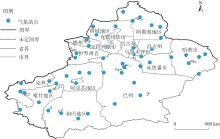
Fig. 1
Spatial distribution of meteorological stations in Xinjiang"


Tab. 1
Overview of the 12 CMIP6 climate models"
| 模式名称 | 所属研究中心 | 所属国家 | 水平分辨率 (经纬向格点数) | 大气模式分辨率 |
|---|---|---|---|---|
| ACCESS-CM2 | 澳大利亚联邦科学与工业研究组织和澳大利亚气象局 | 澳大利亚 | 360×300 | 1.9°×1.3° |
| ACCESS-ESM1-5 | 澳大利亚联邦科学与工业研究组织和澳大利亚气象局 | 澳大利亚 | 360×300 | 1.9°×1.3° |
| BCC-CSM2-MR | 中国国家气候中心 | 中国 | 360×232 | 1.0°×1.0° |
| CanESM5 | 加拿大气候模拟与分析中心 | 加拿大 | 361×290 | 2.8°×2.8° |
| FIO-ESM-2-0 | 中国海洋研究所 | 中国 | 320×384 | 1.0°×1.0° |
| GFDL-ESM4 | 美国国家海洋和大气管理局地球物理流体动力学实验室 | 美国 | 720×576 | 1.0°×1.0° |
| INM-CM4-8 | 俄罗斯科学院数值数学研究所 | 俄罗斯 | 360×318 | 2.0°×1.5° |
| INM-CM5-0 | 俄罗斯科学院数值数学研究所 | 俄罗斯 | 720×720 | 2.0°×1.5° |
| IPSL-CM6A-LR | 法国皮埃尔·西蒙·拉普拉斯研究所 | 法国 | 362×332 | 2.5°×1.3° |
| MIROC6 | 日本东京大学气候系统研究中心 | 日本 | 360×256 | 1.4°×1.4° |
| MRI-ESM2-0 | 日本气象研究所 | 日本 | 360×364 | 1.9°×1.9° |
| NESM3 | 中国南京信息工程大学 | 中国 | 362×292 | 1.9°×1.9° |
Tab. 2
Indices of cold (warm) extreme temperature"
| 分类 | 指数名称 | 定义 |
|---|---|---|
| 冷指数 | 霜冻日数 | 日最低气温<0 ℃的日数 |
| 结冰日数 | 日最高气温<0 ℃的日数 | |
| 冷夜日数 | 日最低气温<10%分位值的日数 | |
| 冷昼日数 | 日最高气温<10%分位值的日数 | |
| 暖指数 | 生长季长度 | 生长季结束日和开始日之差 |
| 夏天日数 | 日最高气温>25 ℃的日数 | |
| 暖夜日数 | 日最低气温>90%分位值的日数 | |
| 暖昼日数 | 日最高气温>90%分位值的日数 |
Tab. 3
Historical temporal trends of cold (warm) extreme temperature indices"
| 分类 | 指数名称 | 气候倾向率/d·(10a)-1 | P值 |
|---|---|---|---|
| 冷指数 | 霜冻日数 | -3.328 | 0.000 |
| 结冰日数 | -0.952 | 0.079 | |
| 冷夜日数 | -3.749 | 0.000 | |
| 冷昼日数 | -0.875 | 0.000 | |
| 暖指数 | 生长季长度 | 2.628 | 0.000 |
| 夏天日数 | 1.645 | 0.000 | |
| 暖夜日数 | 3.678 | 0.000 | |
| 暖昼日数 | 1.836 | 0.000 |
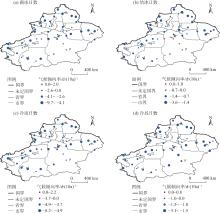
Fig. 2
Historical spatial variation trends of cold extreme temperature indices"
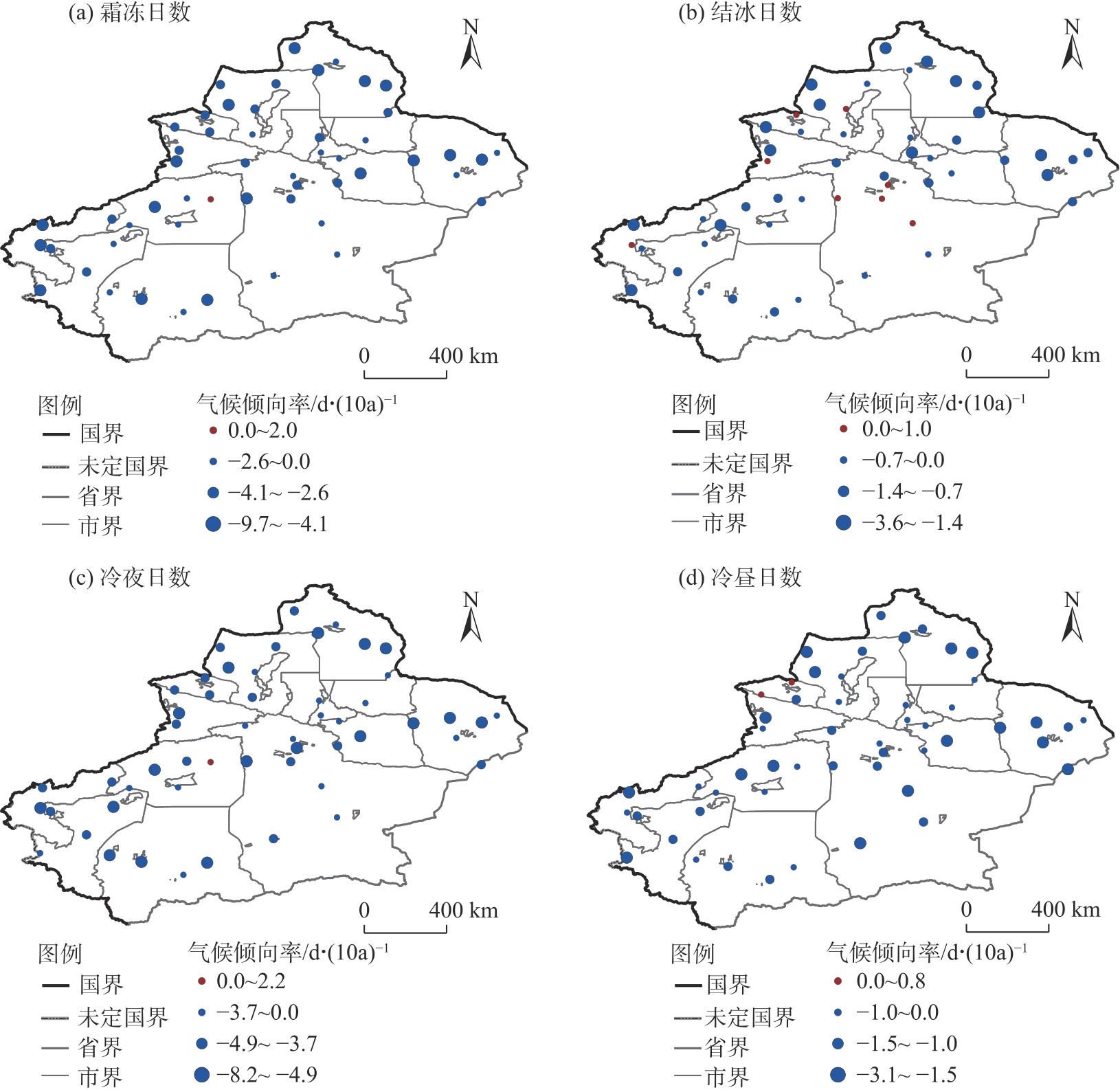
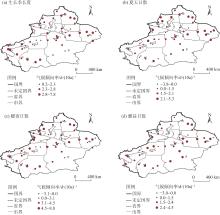
Fig. 3
Historical spatial variation trends of warm extreme temperature indices"

Tab. 4
Evaluation of simulation performances of 12 CMIP6 climate models"
| 模式名称 | 相关系数 | 相对误差 | 相对均方根误差 |
|---|---|---|---|
| ACCESS-CM2 | 0.904 | 3.691 | -0.059 |
| ACCESS-ESM1-5 | 0.912 | 3.800 | -0.094 |
| BCC-CSM2-MR | 0.913 | 2.776 | -0.020 |
| CanESM5 | 0.884 | 4.013 | 0.462 |
| FIO-ESM-2-0 | 0.906 | 1.991 | 0.462 |
| GFDL-ESM4 | 0.913 | 2.109 | -0.135 |
| INM-CM4-8 | 0.924 | 2.903 | -0.107 |
| INM-CM5-0 | 0.922 | 3.822 | -0.078 |
| IPSL-CM6A-LR | 0.880 | 8.578 | 0.317 |
| MIROC6 | 0.908 | 2.176 | -0.035 |
| MRI-ESM2-0 | 0.895 | 3.054 | -0.071 |
| NESM3 | 0.904 | 2.231 | -0.103 |
Tab. 5
Future temporal trends of cold (warm) extreme temperature indices"
| 分类 | 指数名称 | SSP1-2.6 | SSP2-4.5 | SSP5-8.5 | |||||
|---|---|---|---|---|---|---|---|---|---|
| 气候倾向率/d·(10a)-1 | P | 气候倾向率/d·(10a)-1 | P | 气候倾向率/d·(10a)-1 | P | ||||
| 冷指数 | 霜冻日数 | -0.531 | 0.031 | -2.177 | 0.000 | -5.188 | 0.000 | ||
| 结冰日数 | -0.509 | 0.095 | -2.400 | 0.000 | -5.227 | 0.000 | |||
| 冷夜日数 | -1.387 | 0.000 | -5.089 | 0.000 | -8.734 | 0.000 | |||
| 冷昼日数 | -1.395 | 0.000 | -4.367 | 0.000 | -6.146 | 0.000 | |||
| 暖指数 | 生长季长度 | 0.730 | 0.016 | 1.467 | 0.000 | 4.488 | 0.000 | ||
| 夏天日数 | 0.562 | 0.004 | 2.193 | 0.000 | 5.047 | 0.000 | |||
| 暖夜日数 | 1.029 | 0.007 | 6.050 | 0.000 | 12.384 | 0.000 | |||
| 暖昼日数 | 1.269 | 0.001 | 5.071 | 0.000 | 8.500 | 0.000 | |||
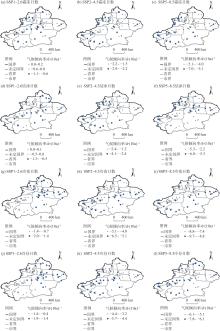
Fig. 4
Future spatial variation trends of cold extreme temperature indices"

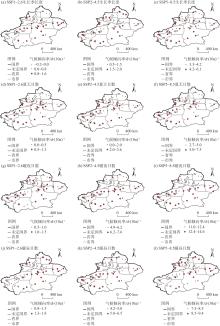
Fig. 5
Future spatial variation trends of warm extreme temperature indices"

| [1] | IPCC(Intergovernmental Panel on Climate Change). Climate change 2013: Managing the risks of extreme events and disaster to advance climate change adaptation[M]. Cambridge: Cambridge University Press, 2013. |
| [2] | IPCC(Intergovernmental Panel on Climate Change). Climate change 2021: The physical science basis. Contribution of working group I to the sixth assessment report of the intergovernmental panel on climate change[M]. New York: Cambridge University Press, 2021. |
| [3] | Katz R W, Brown B G. Extreme events in a changing climate: Variability is more important than averages[J]. Climatic Change, 1992, 21(3): 289-302. |
| [4] | Lobell D B, Hammer G L, Mclean G, et al. The critical role of extreme heat for maize production in the United States[J]. Nature Climate Change, 2013, 3(5): 497-501. |
| [5] | 杨扬, 常伟, 张兴东. 新疆极端气候时空变化及其与棉花生产关联研究[J]. 中国农业资源与区划, 2024, 45(12): 60-74. |
| [Yang Yang, Chang Wei, Zhang Xingdong. Spatiotemporal variation of extreme climate and its correlation with cotton production in Xinjiang[J]. China Agricultural Resources and Zoning, 2024, 45(12): 60-74.] | |
| [6] | Stott P A, Christidis N, Oto F, et al. Attribution of extreme weather and climate-related events[J]. Wiley Interdisciplinary Reviews Climate Change, 2016, 7(1): 23-41. |
| [7] | Founda D, Pierros F, Petrakis M, et al. Variations and trends of the urban heat island in Athens (Greece) and its response to heat waves[J]. Atmospheric Research, 2015, 161: 1-13. |
| [8] | Alfieri L, Feyen L, Dottori F, et al. Ensemble flood risk assessment in Europe under high end climate scenarios[J]. Global Environmental Change, 2015, 35: 199-212. |
| [9] | Seneviratne S l, Donat M G, Mueller B, et al. No pause in the increase of hot temperature extremes[J]. Nature Climate Change, 2014, 4(3): 161-163. |
| [10] | Zhang W, Furtado K, Wu P, et al. Increasing precipitation variability on daily-to-multiyear time scales in a warmer world[J]. Science Advances, 2021, 7(31): eabf8021, doi: 10.1126/sciadv.abf8021. |
| [11] | 任晨辰, 段明铿, 智协飞. 不同气候背景下我国冬夏两季极端气温特征分析[J]. 大气科学学报, 2017, 40(6): 803-813. |
| [Ren Chenchen, Duan Mingkeng, Zhi Xiefei. Characteristics of extreme surface air temperature in winter and summer over China under different climate backgrounds[J]. Journal of Atmospheric Sciences, 2017, 40(6): 803-813.] | |
| [12] | 任福民, 翟盘茂. 1951—1990年中国极端气温变化分析[J]. 大气科学, 1998, 22(2): 89-96. |
| [Ren Fumin, Zhai Panmao. Study on changes of China's extreme temperatures during 1951—1990[J]. Chinese Journal of Atmospheric Sciences, 1998, 22(2): 89-96.] | |
| [13] | 索朗塔杰, 施宁, 王艺橙, 等. 我国冬季极端低温指数的年代际变化特征[J]. 大气科学, 2020, 44(5): 1125-1140. |
| [Suolang Tajie, Shi Ning, Wang Yicheng, et al. Interdecadal variation characteristics of extreme low temperature index in winter in China[J]. Chinese Journal of Atmospheric Sciences, 2020, 44(5): 1125-1140.] | |
| [14] |
李娟, 闫会平, 朱志伟. 中国夏季极端气温与降水事件日数随平均气温变化的定量分析[J]. 高原气象, 2020, 39(3): 532-542.
doi: 10.7522/j.issn.1000-0534.2019.00042. |
|
[Li Juan, Yan Huiping, Zhu Zhiwei. Quantitative analysis of changes of summer extremes temperature and and precipitation days over China with respect to the mean temperature increase[J]. Plateau Meteorology, 2020, 39(3): 532-542.]
doi: 10.7522/j.issn.1000-0534.2019.00042. |
|
| [15] | 李洋, 王玉辉, 吕晓敏, 等. 1961—2013年东北三省极端气候事件时空格局及变化[J]. 资源科学, 2015, 37(12): 2501-2513. |
| [Li Yang, Wang Yuhui, Lü Xiaomin, et al. Spatial distribution and temporal change in extreme weather events in three provinces in northeast China[J]. Resources Science, 2015, 37(12): 2501-2513.] | |
| [16] | 王琼, 张明军, 王圣杰, 等. 1962—2011年长江流域极端气温事件分析[J]. 地理学报, 2013, 68(5): 611-625. |
| [Wang Qiong, Zhang Mingjun, Wang Shengjie, et al. Extreme temperature events in Yangtze River Basin during 1962—2011[J]. Acta Geographica Sinica, 2013, 68(5): 611-625.] | |
| [17] |
于水, 张晓龙, 刘志娟, 等. 1961—2020年松花江流域极端气候指数的时空变化特征[J]. 应用生态学报, 2023, 34(4): 1091-1101.
doi: 10.13287/j.1001-9332.202304.024 |
| [Yu Shui, Zhang Xiaolong, Liu Zhijuan, et al. Spatial and temporal variations of extreme climate index in the Songhua River Basin during 1961—2020[J]. Chinese Journal of Applied Ecology, 2023, 34(4): 1091-1101.] | |
| [18] |
汪宝龙, 张明军, 魏军林, 等. 西北地区近50 a气温和降水极端事件的变化特征[J]. 自然资源学报, 2012, 27(10): 1720-1733.
doi: 10.11849/zrzyxb.2012.10.010 |
|
[Wang Baolong, Zhang Mingjun, Wei Junlin, et al. The change in extreme events of temperature and precipitation over northwest China in recent 50 years[J]. Journal of Natural Resources, 2012, 27(10): 1720-1733.]
doi: 10.11849/zrzyxb.2012.10.010 |
|
| [19] | 姚遥, 罗勇, 黄建斌. 8个CMIP5模式对中国极端气温的模拟和预估[J]. 气候变化研究进展, 2012, 8(4): 250-256. |
| [Yao Yao, Luo Yong, Huang Jianbin. Evaluation and projection of temperature extremes over China based on 8 modeling data from CMIP5[J]. Advances in Climate Change Research, 2012, 8(4): 250-256.] | |
| [20] | 王慧, 肖登攀, 赵彦茜, 等. 基于CMIP6气候模式的华北平原极端气温指数评估和预测[J]. 地理与地理信息科学, 2021, 37(5): 86-94, 142. |
| [Wang Hui, Xiao Dengpan, Zhao Yanqian, et al. Evaluation and projection of extreme temperature indices in the North China Plain based on CMIP6 models[J]. Geography and Geo-Information Science, 2021, 37(5): 86-94, 142.] | |
| [21] |
李宛鸿, 徐影. CMIP6模式对青藏高原极端气温指数模拟能力评估及预估[J]. 高原气象, 2023, 42(2): 305-319.
doi: 10.7522/j.issn.1000-0534.2022.00032 |
|
[Li Wanhong, Xu Ying. Evaluation and projection of extreme temperature indices over the Qinghai-Xizang Plateau by CMIP6 models[J]. Plateau Meteorology, 2023, 42(2): 305-319.]
doi: 10.7522/j.issn.1000-0534.2022.00032 |
|
| [22] |
李纯, 姜彤, 王艳君, 等. 基于CMIP6模式的黄河上游地区未来气温模拟预估[J]. 冰川冻土, 2022, 44(1): 171-178.
doi: 10.7522/j.issn.1000-0240.2022.0028 |
|
[Li Chun, Jiang Tong, Wang Yanjun, et al. Simulation and estimation of future air temperature in upper basin of the Yellow River based on CMIP6 models[J]. Journal of Glaciology and Geocryology, 2022, 44(1): 171-178.]
doi: 10.7522/j.issn.1000-0240.2022.0028 |
|
| [23] | 晋程绣, 姜超, 张曦月. CMIP6模式对中国西南地区气温的模拟与预估[J]. 中国农业气象, 2022, 43(8): 597-611. |
| [Jin Chengxiu, Jiang Chao, Zhang Xiyue. Evaluation and projection of temperature in southwestern China by CMIP6 models[J]. Chinese Journal of Agrometeorology, 2022, 43(8): 597-611.] | |
| [24] |
舒章康, 李文鑫, 张建云, 等. 中国极端降水和高温历史变化及未来趋势[J]. 中国工程科学, 2022, 24(5): 116-125.
doi: 10.15302/J-SSCAE-2022.05.014 |
| [Shu Zhangkang, Li Wenxin, Zhang Jianyun, et al. Historical changes and future trends of extreme precipitation and high temperature in China[J]. China Engineering Science, 2022, 24(5): 116-125.] | |
| [25] |
康紫薇, 张正勇, 刘琳, 等. 基于MODIS的新疆地表温度时空变化特征分析[J]. 地理研究, 2022, 41(4): 997-1017.
doi: 10.11821/dlyj020210232 |
| [Kang Ziwei, Zhang Zhengyong, Liu Lin, et al. Spatio-temporal variation characteristics of land surface temperature in Xinjiang based on MODIS[J]. Geographical Research, 2022, 41(4): 997-1017.] | |
| [26] | 普宗朝, 张山清, 赵逸舟, 等. 气候变暖对新疆冬季采暖的影响[J]. 干旱区资源与环境, 2017, 31(6): 110-116. |
| [Pu Zongchao, Zhang Shanqing, Zhao Yizhou, et al. Effects of climate warming on winter heating in Xinjiang during 1961—2014[J]. Journal of Arid Land Resources and Environment, 2017, 31(6): 110-116.] | |
| [27] | 玉苏甫·买买提, 买合皮热提·吾拉木, 满苏尔·沙比提. 气候变暖对渭干河—库车河三角洲绿洲棉花生产的影响[J]. 地理研究, 2014, 33(2): 251-259. |
| [Mammut Yusufu, Uram Mahpet, Sabit Mansur. Impact of climate warming on cotton production of Ugan-Kuqa River delta oasis[J]. Geographical Research, 2014, 33(2): 251-259.] | |
| [28] |
刘璐, 刘普幸, 张旺雄, 等. 1961—2017年新疆极端暖事件变化特征及其未来情景预估[J]. 干旱区研究, 2021, 38(6): 1590-1600.
doi: 10.13866/j.azr.2021.06.11 |
|
[Liu Lu, Liu Puxing, Zhang Wangxiong, et al. Variation characteristics of extreme warm events from 1961 to 2017 and projection for future scenarios in Xinjiang, China[J]. Arid Zone Research, 2021, 38(6): 1590-1600.]
doi: 10.13866/j.azr.2021.06.11 |
|
| [29] | 李景林, 普宗朝, 张山清. 气候变化对新疆农业的影响及区划[M]. 北京: 气象出版社, 2018. |
| [Li Jinglin, Pu Zongchao, Zhang Shanqing. Impacts of climate change on agriculture and regionalization in Xinjiang[M]. Beijing: China Meteorological Press, 2018.] | |
| [30] | Yang Y, Chang W. Analysis of spatial and temporal distribution and changes in extreme climate events in northwest China from 1960 to 2021: A case study of Xinjiang[J]. Sustainability, 2024, 16, 4960, doi: 10.3390/su16124960. |
| [31] | 吴健, 夏军, 曾思栋, 等. CMIP6全球气候模式对长江流域气候变化的模拟评估与未来预估[J]. 长江流域资源与环境, 2023, 32(1): 137-150. |
| [Wu Jian, Xia Jun, Zeng Sidong, et al. Evaluation of the performance of CMIP6 models and future changes over the Yangtze River Basin[J]. Resources and Environment in the Yangtze Basin, 2023, 32(1): 137-150.] | |
| [32] |
张顺伟, 周自翔, 熊炫晨, 等. 基于WRF模式的无定河流域极端气候特征分析[J]. 干旱区地理, 2024, 47(9): 1482-1495.
doi: 10.12118/j.issn.1000-6060.2023.597 |
|
[Zhang Shunwei, Zhou Zixiang, Xiong Xuanchen, et al. Extreme climate characteristics in the Wuding River Basin based on WRF model[J]. Arid Land Geography, 2024, 47(9): 1482-1495.]
doi: 10.12118/j.issn.1000-6060.2023.597 |
|
| [33] |
陈跃萍, 武胜利, 赵昕, 等. 近60 a哈密市极端气温时空变化特征[J]. 干旱区地理, 2023, 46(6): 868-879.
doi: 10.12118/j.issn.1000-6060.2022.484 |
|
[Chen Yueping, Wu Shengli, Zhao Xin, et al. Spatial and temporal variation characteristics of extreme temperatures in Hami City in the past 60 years[J]. Arid Land Geography, 2023, 46(6): 868-879.]
doi: 10.12118/j.issn.1000-6060.2022.484 |
|
| [34] |
高雁鹏, 陈文俊. 1984—2020年辽宁省极端气温时空变化及粮食产量响应研究[J]. 地理科学, 2021, 41(11): 2052-2062.
doi: 10.13249/j.cnki.sgs.2021.11.018 |
| [Gao Yanpeng, Chen Wenjun. Spatial and temporal variation of extreme temperature and grain yield response in Liaoning Province from 1984 to 2020[J]. Scientia Geographica Sinica, 2021, 41(11): 2052-2062.] | |
| [35] |
赵安周, 刘宪锋, 朱秀芳, 等. 1965—2013年黄土高原地区极端气温趋势变化及空间差异[J]. 地理研究, 2016, 35(4): 639-652.
doi: 10.11821/dlyj201604004 |
| [Zhao Anzhou, Liu Xianfeng, Zhu Xiufang, et al. Trend variations and spatial difference of extreme air temperature events in the Loess Plateau from 1965 to 2013[J]. Geographical Research, 2016, 35(4): 639-652.] | |
| [36] | 李佳瑞, 牛自耕, 冯岚, 等. CMIP5模式对长江和黄河流域极端气温指标的模拟与预估[J]. 地球科学, 2020, 45(6): 1887-1904. |
| [Li Jiarui, Niu Zigeng, Feng Lan, et al. Trend variations and spatial difference of extreme air temperature events in the Loess Plateau from 1965 to 2013[J]. Earth Science, 2020, 45(6): 1887-1904.] | |
| [37] | 任婧宇, 赵俊侠, 马红斌, 等. 2015—2100年黄土高原四季气候变化的时空分布趋势预测[J]. 水土保持通报, 2019, 39(5): 262-271. |
| [Ren Jingyu, Zhao Junxia, Ma Hongbin, et al. Spatiotemporal distribution characteristics of seasonal climate change trends over Loess Plateau during 2015—2100[J]. Soil and Water Conservation Bulletin, 2019, 39(5): 262-271.] | |
| [38] | Miao C Y, Duan Q Y, Sun Q H, et al. Evaluation and application of Bayesian multi-model estimation in temperature simulations[J]. Progress in Physical Geography, 2013, 37(6): 727-744. |
| [39] | 张娇艳, 杨益, 李扬, 等. 优选CMIP6全球气候模式对贵州省未来气温变化的模拟[J]. 中国农业气象, 2024, 45(5): 449-460. |
| [Zhang Jiaoyan, Yang Yi, Li Yang, et al. CMIP6 models optimization in simulating future temperature change over Guizhou Province[J]. China Agricultural Meteorology, 2024, 45(5): 449-460.] |
|
||