Arid Land Geography ›› 2026, Vol. 49 ›› Issue (3): 619-630.doi: 10.12118/j.issn.1000-6060.2025.255
• Regional Development • Previous Articles Next Articles
ZHANG Jiawei( ), PEI Tingting(), CHEN Ying, XIE Baopeng
Received:2025-05-07
Revised:2025-06-24
Online:2026-03-25
Published:2026-03-24
Contact:
PEI Tingting
E-mail:1073324120316@st.gsau.edu.cn;peitt@gsau.edu.cn
ZHANG Jiawei, PEI Tingting, CHEN Ying, XIE Baopeng. Assessment of grain and important agricultural products supply security and influencing factors in Gansu Province under the macro-food concept[J].Arid Land Geography, 2026, 49(3): 619-630.
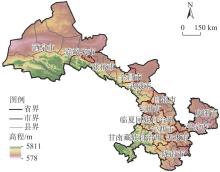
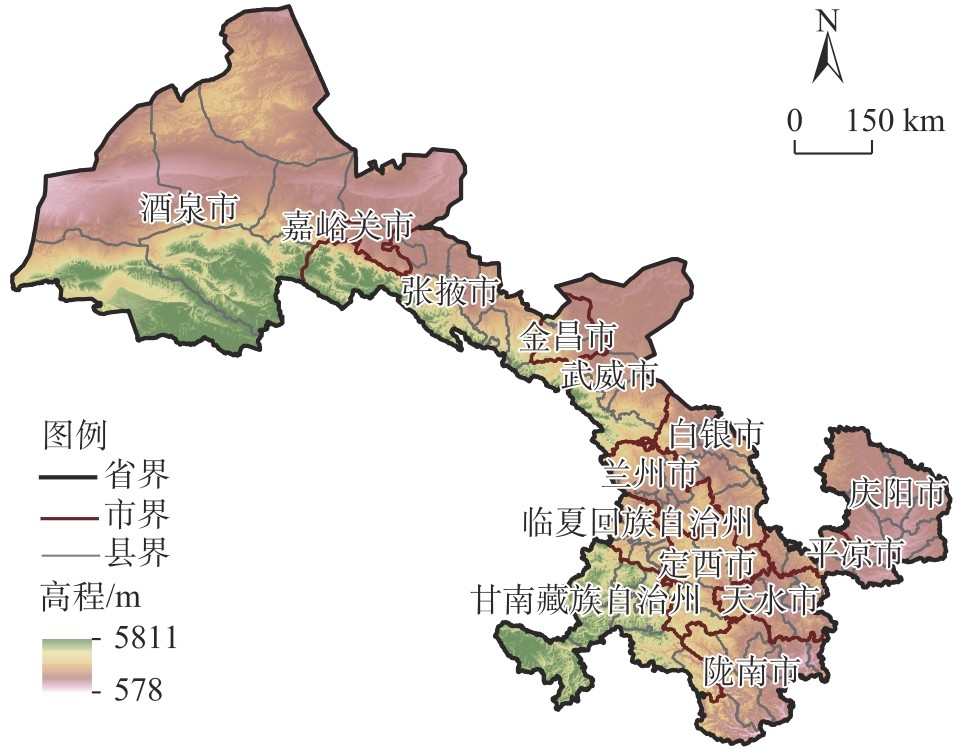
Fig. 1
Schematic diagram of the study area"

Tab. 1
Evaluation index system of the supply security of grain and important agricultural products in Gansu Province under the macro-food concept"
| 准则层 | 子准测层 | 指标层 | 单位 | 指标性质 |
|---|---|---|---|---|
| 供给数量安全 | 传统粮食 | 谷类人均占有量 | kg·人-1 | 正向 |
| 薯类人均占有量 | kg·人-1 | 正向 | ||
| 豆类人均占有量 | kg·人-1 | 正向 | ||
| 畜禽类 | 肉类人均占有量 | kg·人-1 | 正向 | |
| 牛奶人均占有量 | kg·人-1 | 正向 | ||
| 鸡蛋人均占有量 | kg·人-1 | 正向 | ||
| 果蔬类 | 水果人均占有量 | kg·人-1 | 正向 | |
| 蔬菜人均占有量 | kg·人-1 | 正向 | ||
| 渔业 | 水产人均占有量 | kg·人-1 | 正向 | |
| 供给结构安全 | 作物种植结构 | 年末耕地面积 | 104 hm2 | 正向 |
| 粮食作物播种面积占比 | % | 正向 | ||
| 传统粮食产量波动率 | % | 正向 | ||
| 生产力结构 | 农林牧渔业从业人员数 | 104人 | 正向 | |
| 农业机械总动力 | kW | 正向 | ||
| 农村用电量 | 104 kWh | 正向 | ||
| 供给生态安全 | 气候条件 | 粮食作物成灾面积 | 104 hm2 | 负向 |
| 保证灌溉与有效灌溉面积之比 | - | 正向 | ||
| 荒山荒(沙)地造林面积 | 104 hm2 | 正向 | ||
| 面源污染 | 塑料薄膜使用量 | t | 负向 | |
| 污水集中处理的村占比 | % | 正向 | ||
| 农用化肥施用实物量 | t | 负向 |
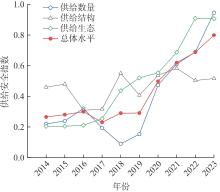
Fig. 2
Overall level and each dimensional level of grain and important agricultural products supply security in Gansu Province from 2014 to 2023"
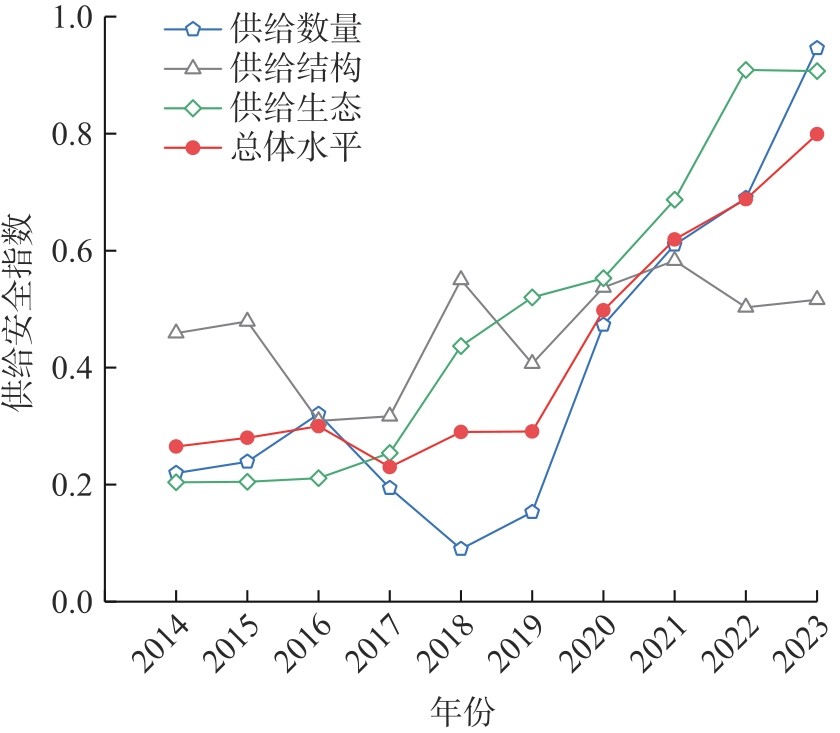
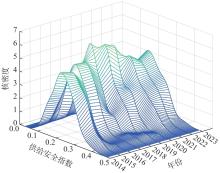
Fig. 3
Temporal kernel density of the level of grain and important agricultural products supply security in counties and districts of Gansu Province from 2014 to 2023"
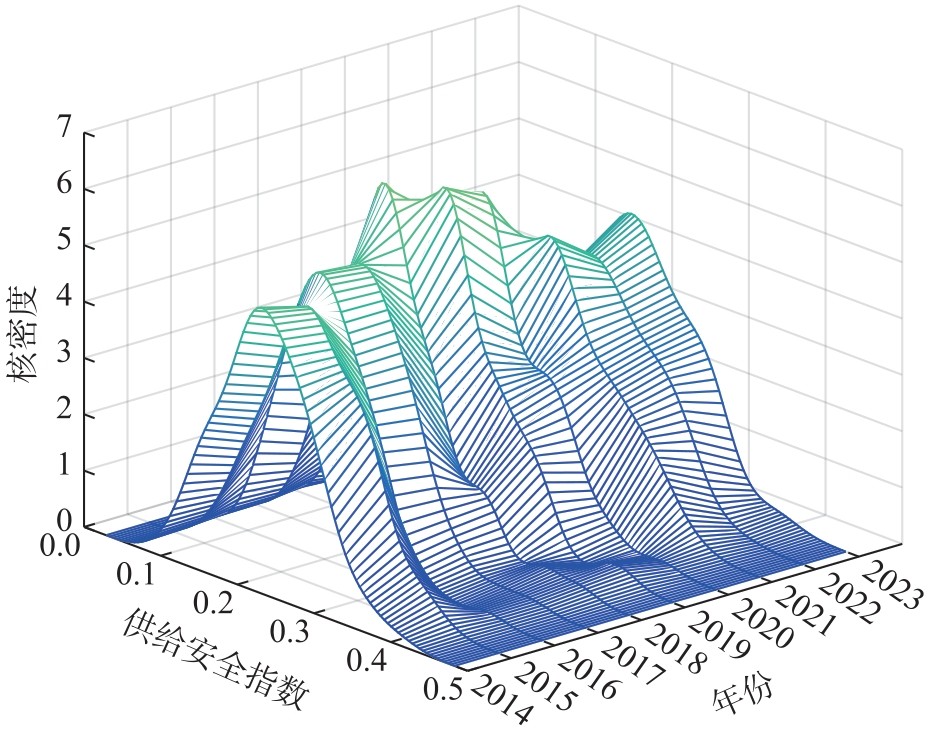
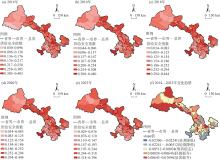
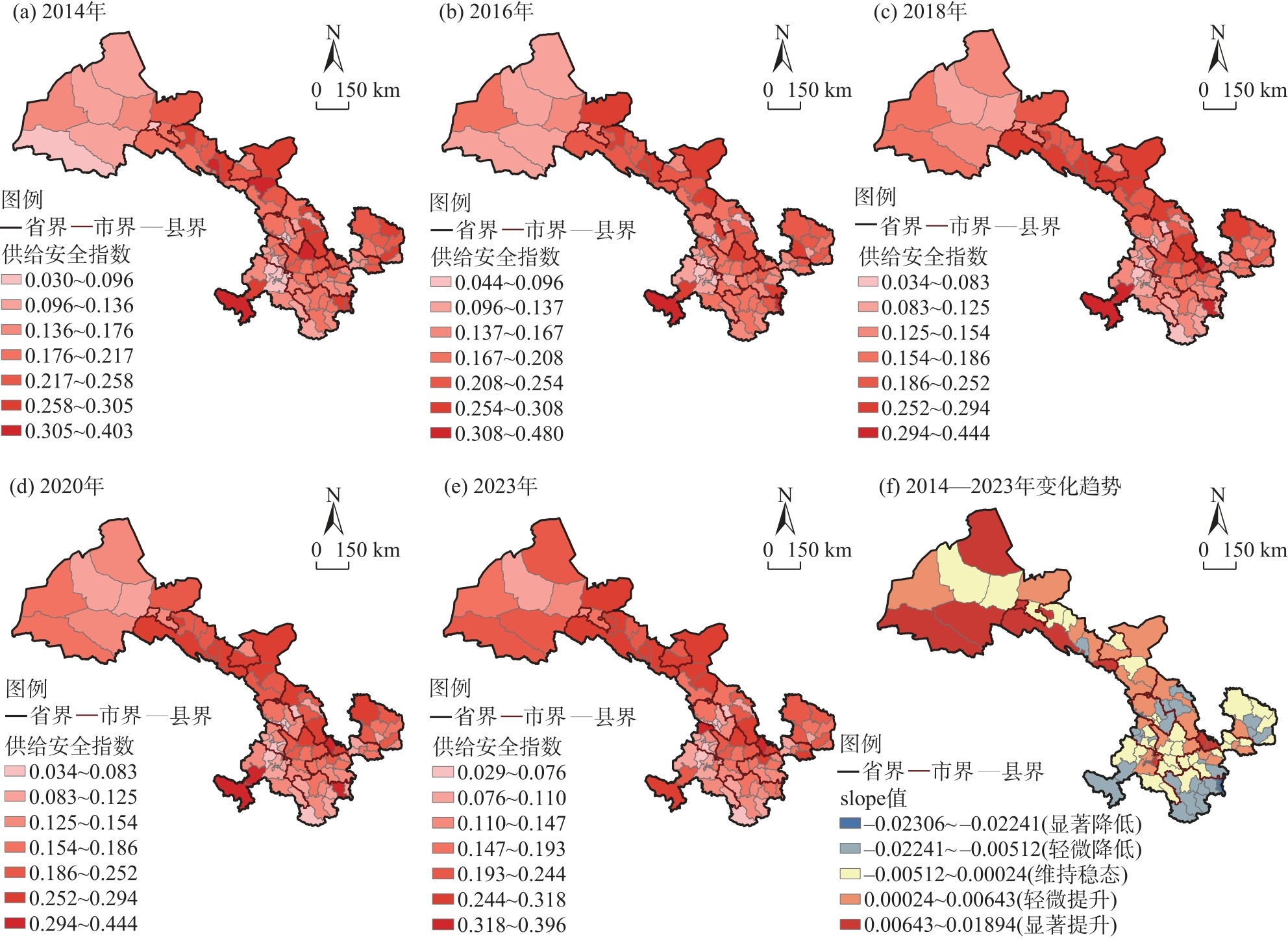
Fig. 4
Spatial distributions and changing trends of the overall level of grain and important agricultural products supply security in Gansu Province from 2014 to 2023"
Tab. 2
Global autocorrelation analysis of the overall level and each dimensional level of grain and important agricultural products supply security in Gansu Province"
| 空间自相 关统计量 | 供给安全 总体水平 | 供给数量 安全 | 供给结构 安全 | 供给生态 安全 |
|---|---|---|---|---|
| Moran’s I | 0.42 | 0.34 | 0.35 | 0.46 |
| 方差 | 0.01 | 0.01 | 0.01 | 0.01 |
| Z得分 | 5.95 | 4.90 | 5.09 | 6.68 |
| P值 | 0.00 | 0.00 | 0.00 | 0.00 |
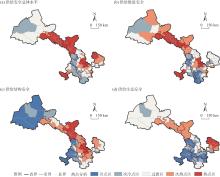
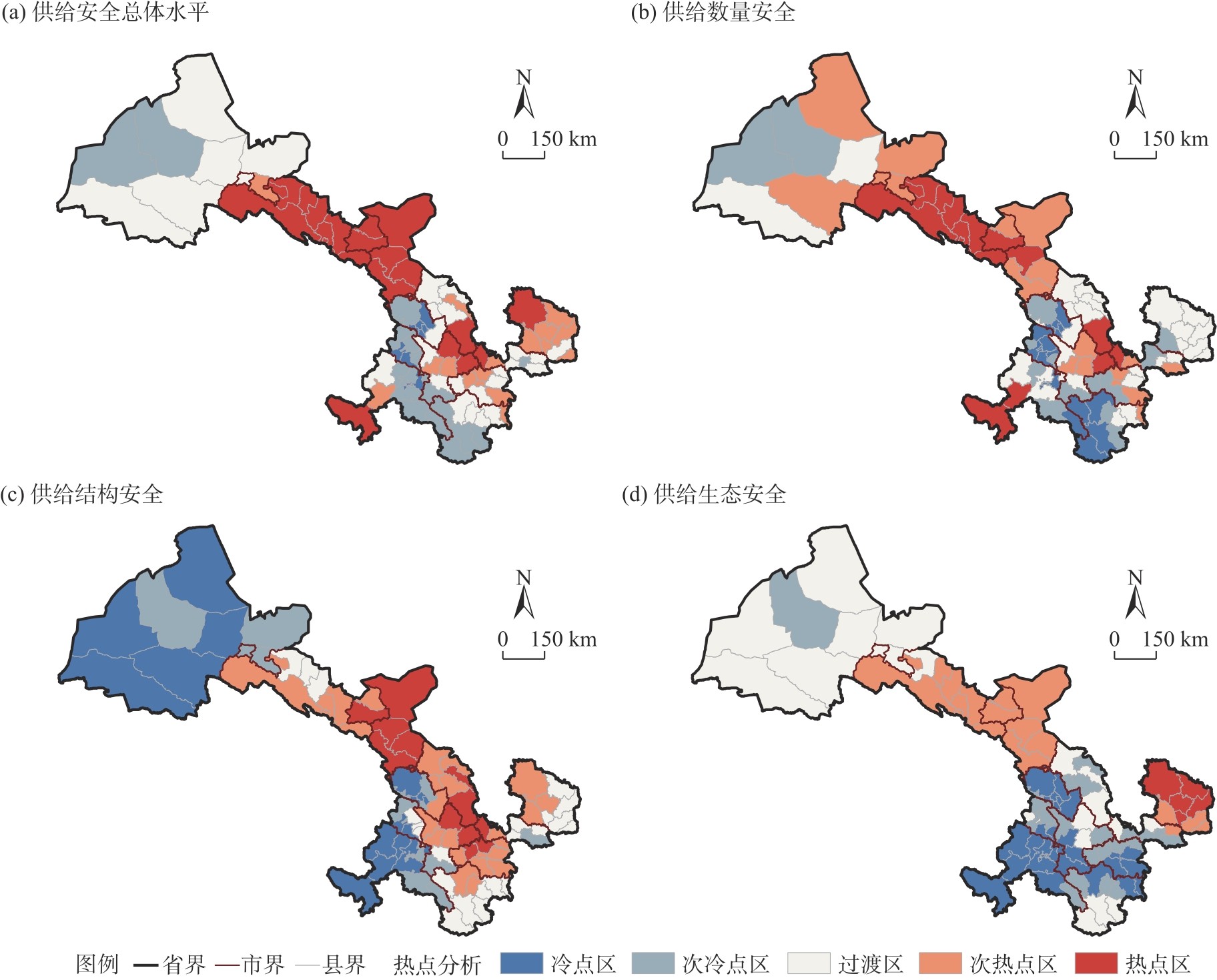
Fig. 5
Spatial hotspot analysis of the overall level and each dimensional level of supply security of grain and important agricultural products in Gansu Province"
Tab. 3
Influencing factors of the supply security level of grain and important agricultural products in Gansu Province"
| 因变量 | 维度 | 自变量 | 指标说明 |
|---|---|---|---|
| 粮食及重要农产品供给安全总体水平 | 经济发展 | 人均地区生产总值/104元·人-1 | 生产总值/人口数量 |
| 农业机械原值/104元 | 农业机械原值 | ||
| 基层治理 | 农村基层组织服务负荷/104人·个-1 | 农村人口数量/村委会数量 | |
| 农村基层经济组织管理人数/人 | 农村基层经济组织管理(乡务)人员数量 | ||
| 劳动力支持 | 农牧渔林从业率/% | 农牧渔林从业人数/就业人数 | |
| 农业劳动生产率/104元·人-1 | 农业总产值/人口数量 |
Tab. 4
Intermediate process values of the FE model"
| 解释变量 | 回归系数 | 标准误 | t值 | P值 | 95%置信区间 |
|---|---|---|---|---|---|
| 截距 | 0.18 | 0.02 | 7.74 | 0.000 | 0.134~0.225 |
| 人均地区生产总值 | 0.03 | 0.02 | 2.14 | 0.032 | 0.003~0.061 |
| 农业机械原值 | 0.01 | 0.02 | 0.44 | 0.663 | -0.036~0.056 |
| 农村基层组织服务负荷 | -0.07 | 0.03 | -2.11 | 0.036 | -0.138~-0.005 |
| 农村基层经济组织管理人数 | 0.01 | 0.01 | 0.66 | 0.510 | -0.016~0.033 |
| 农牧渔林从业率 | 0.06 | 0.02 | 2.62 | 0.009 | 0.015~0.108 |
| 农业劳动生产率 | -0.01 | 0.01 | -0.10 | 0.318 | -0.035~0.011 |
| [1] | 习近平. 高举中国特色社会主义伟大旗帜为全面建设社会主义现代化国家而团结奋斗——在中国共产党第二十次全国代表大会上的报告[J]. 党建, 2022(11): 4-28. |
| [Xi Jinping. Hold high the great banner of socialism with Chinese characteristics and strive in unity to build a modern socialist country in all respects: Report to the 20th National Congress of the Communist Party of China[J]. Party Building, 2022(11): 4-28.] | |
| [2] | 韩忠全, 孙鑫. 大食物观科学内涵、生成逻辑及时代价值探析[J]. 农业经济, 2025(1): 27-29. |
| [Han Zhongquan, Sun Xin. Analysis of the scientific connotation, generation logic and era value of the macro-food concept[J]. Agricultural Economy, 2025(1): 27-29.] | |
| [3] | 孙炜琳. 建设高效农技推广服务体系保障粮食和重要农产品稳定安全供给[J]. 农村工作通讯, 2024(4): 19-20. |
| [Sun Weilin. Building an efficient agricultural technology extension service system to ensure the stable and secure supply of grain and important agricultural products[J]. Newsletter of Rural Work, 2024(4): 19-20.] | |
| [4] | 王波, 刘同山. 大食物观下建设农业强国保障粮食安全的挑战及其应对[J]. 农村经济, 2023(4): 1-9. |
| [Wang Bo, Liu Tongshan. Challenges and countermeasures for building an agricultural power and ensuring food security under the macro-food concept[J]. Rural Economy, 2023(4): 1-9.] | |
| [5] | 武拉平. 科学认识大食物观视角下我国的粮食安全问题[J]. 社会科学辑刊, 2023(6): 191-200, 2, 239. |
| [Wu Laping. Full understanding of China’s food security from perspective of the greater food approach[J]. Social Science Journal, 2023(6): 191-200, 2, 239.] | |
| [6] | 涂圣伟. 我国保障粮食和重要农产品稳定安全供给的路径研究[J]. 学习与探索, 2024(7): 87-97, 180. |
| [Tu Shengwei. Research on the path to ensuring stable and secure supply of grain and important agricultural products in China[J]. Study & Exploration, 2024(7): 87-97, 180.] | |
| [7] | 尹春凤, 张利庠. 大食物观背景下粮食产业韧性发展研究[J]. 现代经济探讨, 2025(1): 123-132. |
| [Yin Chunfeng, Zhang Lixiang. Research on the resilience development of the grain industry chain under the background of the big food concept[J]. Digital Economy and Regional Development, 2025(1): 123-132.] | |
| [8] | 郭耀辉, 谢蕾, 杜兴端. 粮食安全韧性评价: 体系构建、发展差异及障碍度分析[J]. 农村经济, 2025(1): 29-37. |
| [Guo Yaohui, Xie Lei, Du Xingduan. Evaluation on food security resilience: System construction, development disparities, and obstacle analysis[J]. Rural Economy, 2025(1): 29-37.] | |
| [9] |
杨川, 卢新海, 许进龙. 基于“大食物观”的中国粮食安全水平评价与动态演进[J]. 经济地理, 2024, 44(2): 166-174.
doi: 10.15957/j.cnki.jjdl.2024.02.017 |
|
[Yang Chuan, Lu Xinhai, Xu Jinlong. Evaluation and dynamic evolution of food security level based on big food concept[J]. Economic Geography, 2024, 44(2): 166-174.]
doi: 10.15957/j.cnki.jjdl.2024.02.017 |
|
| [10] | 杨月元, 祁春节, 董亚妮, 等. 大食物观下中国食物安全的综合评价: 基于熵权TOPSIS模型[J]. 中国农业大学学报, 2025, 30(4): 230-243. |
| [Yang Yueyuan, Qi Chunjie, Dong Yani, et al. Comprehensive evaluation of China’s food security underthe greater food approach: Based on entropy TOPSIS model[J]. Journal of China Agricultural University, 2025, 30(4): 230-243.] | |
| [11] |
熊学振, 王明利. 大食物观下中国食物缺口规模估算与破解路径[J]. 自然资源学报, 2025, 40(3): 750-766.
doi: 10.31497/zrzyxb.20250311 |
|
[Xiong Xuezhen, Wang Mingli. Estimation of the scale of China’s food gap and solutions under the macro-food concept[J]. Journal of Natural Resources, 2025, 40(3): 750-766.]
doi: 10.31497/zrzyxb.20250311 |
|
| [12] | 赵文智, 任珩, 杜军, 等. 河西走廊绿洲生态建设和农业发展的若干思考与建议[J]. 中国科学院院刊, 2023, 38(3): 424-434. |
| [Zhao Wenzhi, Ren Heng, Du Jun, et al. Thoughts and suggestionson oasis ecological construction and agricultural development in Hexi Corridor[J]. Bulletin of the Chinese Academy of Sciences, 2023, 38(3): 424-434.] | |
| [13] |
焦润安, 李旭华, 齐月, 等. 黄土高原半干旱雨养农业区冬小麦气候适宜度评价——以通渭县为例[J]. 中国农学通报, 2024, 40(17): 73-80.
doi: 10.11924/j.issn.1000-6850.casb2023-0419 |
|
[Jiao Run’an, Li Xuhua, Qi Yue, et al. Climate suitability evaluation of winter wheat in semi-arid area of Loess Plateau: A case study of Tongwei County[J]. Chinese Agricultural Science Bulletin, 2024, 40(17): 73-80.]
doi: 10.11924/j.issn.1000-6850.casb2023-0419 |
|
| [14] | 赵梅. 甘肃陇南特色山地农业提质增效[N]. 经济日报, 2024-08-29(001). |
| [Zhao Mei. Improving the quality and efficiency of characteristic mountainous agriculture in Longnan Gansu Province[N]. Economic Daily, 2024-08-29(001).] | |
| [15] | 南杰草. 甘肃省甘南州草原畜牧业发展现状研究[J]. 现代畜牧科技, 2024(4): 180-183. |
| [Nan Jiecao. Study on the current situation of grassland animal husbandry development in Gannan Prefecture, Gansu Province[J]. Modern Animal Husbandry Science & Technology, 2024(4): 180-183.] | |
| [16] | 周腰华, 王枫, 王瑾. 树立大食物观构建多元化食物供给体系——以辽宁省为例[J]. 农业经济, 2024(11): 10-12. |
| [Zhou Yaohua, Wang Feng, Wang Jin. Establishing the macro-food concept and building a diversified food supply system: A case study of Liaoning Province[J]. Agricultural Economy, 2024(11): 10-12.] | |
| [17] | 本刊讯. 国务院办公厅印发《关于践行大食物观构建多元化食物供给体系的意见》[J]. 中国水产, 2024(10): 12-15. |
| [Report from this magazine. The general office of the state council issued the “Opinions on practicing the macro-food concept and building a diversified food supply system”[J]. China Fisheries, 2024(10): 12-15.] | |
| [18] | 汤瑛芳, 李红霞, 尹嘉德, 等. 产销平衡区粮食安全评价及形势分析——以甘肃省为例[J]. 中国农业资源与区划, 2023, 44(5): 176-186. |
| [Tang Yingfang, Li Hongxia, Yin Jiade, et al. Analysis on the evaluation and situation of food security in supplying-consumption balance region: Taking Gansu Province as an example[J]. Chinese Journal of Agricultural Resources and Regional Planning, 2023, 44(5): 176-186.] | |
| [19] | 王芳, 贾晋. 大食物观视角下的食物安全: 理论内涵、指数测度与远景模拟[J]. 农业经济问题, 2024(10): 68-83. |
| [Wang Fang, Jia Jin. Food security in the greater food approach: Theoretical connotation, index measurement and long-range simulation[J]. Issues in Agricultural Economy, 2024(10): 68-83.] | |
| [20] | 王颜齐, 何洋. 大食物观视域下粮食产业链韧性的时代价值、现实研判与提升路径[J]. 农村经济, 2024(8): 53-62. |
| [Wang Yanqi, He Yang. The time value, realistic analysis and improvement path for the resilience of the grain industry chain from the perspective of the great food concept[J]. Rural Economy, 2024(8): 53-62.] | |
| [21] |
吴一帆, 邢培学, 郑伟伟, 等. 粮食产销平衡区耕地非粮化动态演变及分区管控——以陕西省为例[J]. 干旱区地理, 2025, 48(1): 153-167.
doi: 10.12118/j.issn.1000-6060.2024.121 |
|
[Wu Yifan, Xing Peixue, Zheng Weiwei, et al. Dynamic evolution and zoning control of cultivated land non-grain in grainproduction and marketing balance area: A case of Shaanxi Province[J]. Arid Land Geography, 2025, 48(1): 153-167.]
doi: 10.12118/j.issn.1000-6060.2024.121 |
|
| [22] | 王火根, 胡梦婷, 刘小春. 基于机器学习和SHAP算法的我国粮食安全水平测度重构及可解释性分析[J]. 中国农业大学学报, 2025, 30(7): 264-274. |
| [Wang Huogen, Hu Mengting, Liu Xiaochun. Reconstruction and interpretability analysis of China’s foodsecurity level based on machine learning and SHAP algorithm[J]. Journal of China Agricultural University, 2025, 30(7): 264-274.] | |
| [23] |
李惠敏, 陈子文, 张亦弛, 等. 大食物观视域下耕地“非粮化”治理: 逻辑、挑战与策略[J]. 自然资源学报, 2025, 40(5): 1194-1211.
doi: 10.31497/zrzyxb.20250504 |
|
[Li Huimin, Chen Ziwen, Zhang Yichi, et al. The governance of “non-grain conversion” of cultivated landfrom the perspective of the greater food approach: Logic, challenges and strategies[J]. Journal of Natural Resources, 2025, 40(5): 1194-1211.]
doi: 10.31497/zrzyxb.20250504 |
|
| [24] | 张小允, 鲍洁, 许世卫. 基于熵权TOPSIS模型的中国粮食安全评价研究[J]. 中国农业资源与区划, 2023, 44(4): 35-44. |
| [Zhang Xiaoyun, Bao Jie, Xu Shiwei. Research on the evaluation of China’s food security based on the entropy weight TOPSIS model[J]. Chinese Journal of Agricultural Resources and Regional Planning, 2023, 44(4): 35-44.] | |
| [25] | 彭子琛, 王宏亮, 李宏伟, 等. 基于熵权TOPSIS法的中国30个省份生态文明建设绩效评价[J]. 生态经济, 2024, 40(10): 222-229. |
| [Peng Zichen, Wang Hongliang, Li Hongwei, et al. The performance evaluation of eco-civilization construction in 30 provinces of China based on entropy-weighted TOPSIS method[J]. Ecological Economy, 2024, 40(10): 222-229.] | |
| [26] | 张丽明. “粮改饲”政策实施现状探究——以甘肃为例[J]. 甘肃农业, 2020(5): 61-62. |
| [Zhang Liming. “grain for feed” Exploration of the implementation status of the “grain for feed” policy: A case study of Gansu[J]. Gansu Agriculture, 2020(5): 61-62.] | |
| [27] | 王建连, 魏胜文, 张邦林, 等. 乡村振兴战略背景下甘肃农业绿色转型发展思路研究[J]. 农业经济, 2022(2): 19-21. |
| [Wang Jianlian, Wei Shengwen, Zhang Banglin, et al. Research on the green transformation and development of Gansu agriculture under the background of the rural revitalization strategy[J]. Agricultural Economy, 2022(2): 19-21.] | |
| [28] |
仲嘉维, 郑军, 张明月. 农业社会化服务如何影响粮食生态效率——以黄河流域71个地级市为例[J]. 干旱区地理, 2025, 48(8): 1385-1395.
doi: 10.12118/j.issn.1000-6060.2024.542 |
|
[Zhong Jiawei, Zheng Jun, Zhang Mingyue. How does agricultural socialization service affect grain ecoefficiency: A case study of 71 prefecture-level cities in the Yellow River Basin[J]. Arid Land Geography, 2025, 48(8): 1385-1395.]
doi: 10.12118/j.issn.1000-6060.2024.542 |
|
| [29] | 韩群柱, 冯起, 高海东, 等. 基于主成分分析的关中地区农业粮食生产变化的影响因素研究[J]. 干旱区地理, 2020, 43(2): 474-480. |
| [Han Qunzhu, Feng Qi, Gao Haidong, et al. Influencing factors of agricultural production changes in Guanzhong based on PCA[J]. Arid Land Geography, 2020, 43(2): 474-480.] | |
| [30] |
李炳坤, 张晓克, 骆占斌, 等. 基于“水-能源-粮食”关系的生态系统服务供需匹配研究——以天山北坡城市群为例[J]. 干旱区地理, 2025, 48(4): 571-585.
doi: 10.12118/j.issn.1000-6060.2024.522 |
|
[Li Bingkun, Zhang Xiaoke, Luo Zhanbin, et al. Matching between supply and demand of ecosystem services based on the“water-energy-food”nexus: A case of the urban agglomeration on the northernslope of Tianshan Mountains[J]. Arid Land Geography, 2025, 48(4): 571-585.]
doi: 10.12118/j.issn.1000-6060.2024.522 |
|
||