Arid Land Geography ›› 2025, Vol. 48 ›› Issue (12): 2247-2259.doi: 10.12118/j.issn.1000-6060.2025.060
• Regional Development • Previous Articles Next Articles
WANG Lucang1,2( ), LIAO Ting1
Received:2025-02-09
Revised:2025-05-15
Online:2025-12-25
Published:2025-12-30
WANG Lucang, LIAO Ting. Impact of ecological migration on habitat fragmentation in resettlement areas: Take the Shule River Resettlement Project as an example[J].Arid Land Geography, 2025, 48(12): 2247-2259.
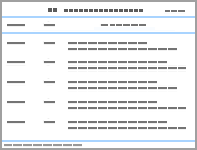
Tab. 1
Migrant situation of the Shule River Ecological Resettlement Area from 1997 to 2006"
| 灌区名称 | 乡镇、农场名称 | 迁入户数/户 | 迁入人数/人 |
|---|---|---|---|
| 昌马灌区 | 双塔乡 | 2762 | 12988 |
| 七墩乡 | 1467 | 7103 | |
| 七道沟分场 | 1568 | 8755 | |
| 黄花农场 | 770 | 3861 | |
| 饮马农场 | 429 | 2667 | |
| 扎花村 | 459 | 2534 | |
| 双塔灌区 | 梁湖分场 | 1575 | 7769 |
| 环城乡 | 342 | 1650 | |
| 花海灌区 | 毕家滩乡 | 1390 | 6301 |
| 独山子分场 | 1823 | 8372 | |
| 合计 | 12585 | 62000 |
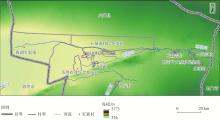
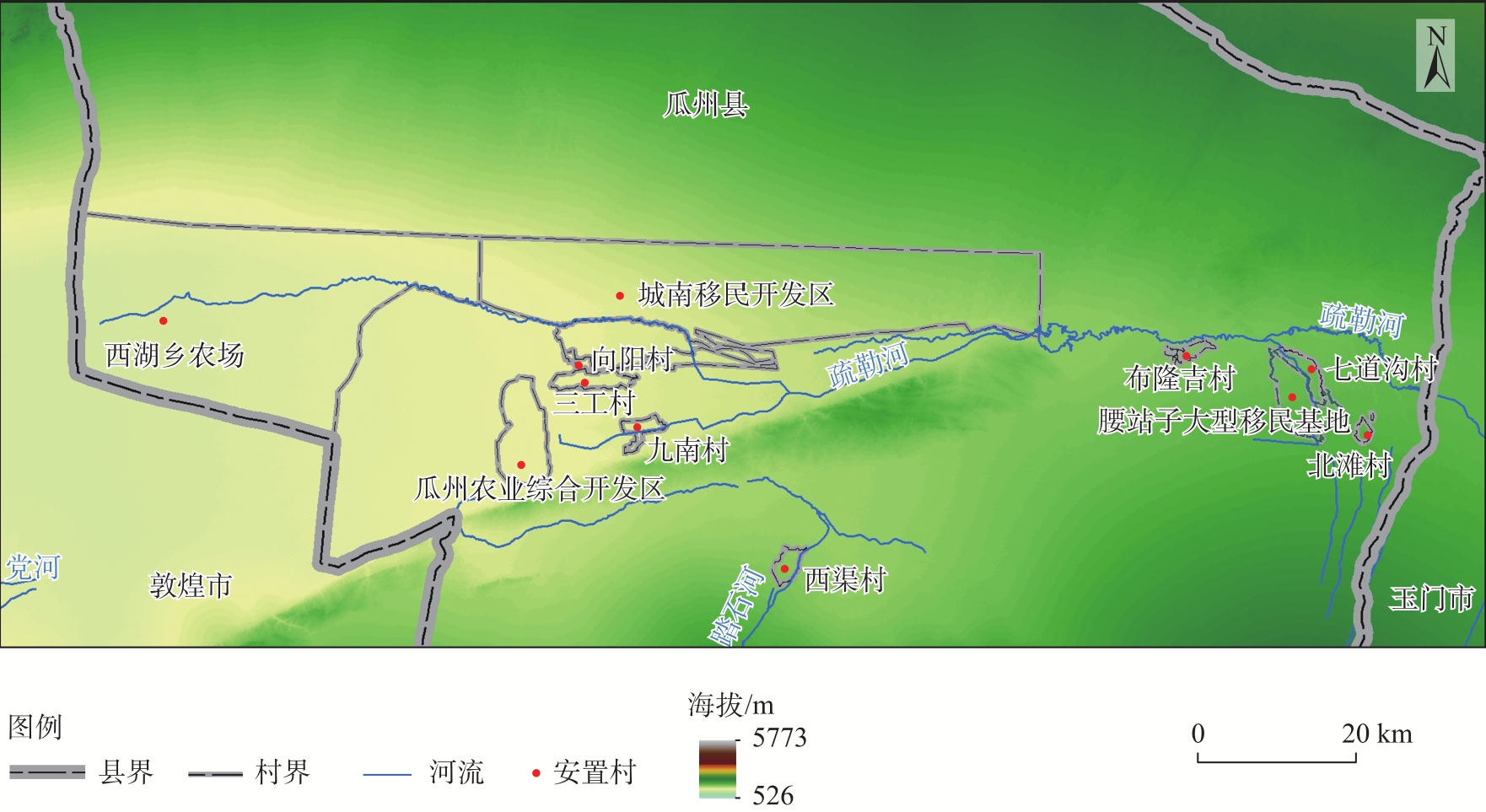
Fig. 1
Schematic diagram of the study area"
Tab. 2
Landscape pattern index"
| 名称 | 计算公式 | 公式说明 | 表征意义 |
|---|---|---|---|
| 总斑块数(NP) | ni为i类生境的斑块指数 | 数值越大,破碎度越高 | |
| 斑块密度(PD) | NP为第i类生境的斑块数;Ai为i类生境的总面积(km2) | 表征破碎化程度和空间分布格局的不均匀性与复杂性。数值越大,破碎度越高 | |
| 边界密度(ED) | eik为i类生境第k斑块的边缘长度(km);A为生境总面积(km2) | 反映生境类型的边界特征和边缘效应。值越大,异质斑块越多,生境越破碎 | |
| 蔓延度(C) | m为斑块类型总数;Pi为i类斑块面积占总面积的比例;gik为第i类斑块与第k类斑块相邻的边数(基于像元邻域,通常为8邻域) | 反映不同生境类型的延展程度。指数高说明某类斑块形成良好的连接性;反之则说明该处的生境由多种斑块共同构成,具有复杂性且破碎化程度高 | |
| 聚合度(AI) | gii为第i斑块中,同类斑块像元间相邻的公共边界长度,AI⊆(0,100] | 值越大,同类生境斑块越聚集,破碎度越低。高值表明生境由大簇组成,低值表明生境由许多小块组成 | |
| 多样性(SHDI) | Pi为第i类生境占全部生境面积之比;m为生境类型数 | SHDI=0,表明整个生境由一种组成;SHDI逐渐增大,表明不同类型生境斑块增多并且趋于均衡化,反映生境类型的丰富度和复杂度 | |
| 均匀度 (SHEI) | m为生境类型数 | 当SHEI=0,无多样性;当SHEI=1,表明各生境面积均匀分布,有最大多样性 | |
| 分维数 (FRAC) | Pi为斑块i的周长;Ai为斑块i的面积 | 数值越小,斑块边界越近于直线;反之则表示边界形状越复杂 |
Tab. 3
Area changes of different habitat types in migrant resettlement areas from 1996 to 2020 /km2"
| 生境类型 | 安置区类型 | 移民初期 | 移民中期 | 移民末期 | 后移民期 | 1996—2020年 |
|---|---|---|---|---|---|---|
| 耕地 | 大型移民安置基地 | 4.078 | 3.594 | 3.795 | 4.782 | 20.559 |
| 4个小型移民安置基地 | 1.656 | 3.485 | 4.184 | 9.992 | 24.905 | |
| 6个移民安置点 | 17.612 | 14.316 | 14.405 | 2.463 | 62.028 | |
| 小计 | 23.346 | 21.395 | 22.384 | 17.237 | 107.492 | |
| 建设用地 | 大型移民安置基地 | 0.618 | 0.010 | 0.001 | 0.016 | 0.027 |
| 4个小型移民安置基地 | 0.005 | 0.086 | 0.220 | 0.108 | 1.100 | |
| 6个移民安置点 | 2.176 | 0.082 | 0.051 | -0.378 | 0.000 | |
| 小计 | 8.241 | 0.178 | 0.272 | -0.254 | 1.127 | |
| 草地 | 大型移民安置基地 | 49.740 | -0.981 | -3.069 | -4.238 | -8.975 |
| 4个小型移民安置基地 | 0.007 | 5.199 | 3.812 | -7.037 | 13.941 | |
| 6个移民安置点 | 0.023 | 10.102 | -5.638 | -55.519 | 0.000 | |
| 小计 | 49.770 | 14.320 | -4.895 | -66.794 | 4.966 | |
| 水域 | 大型移民安置基地 | -6.261 | -0.006 | 0.000 | 0.030 | 0.031 |
| 4个小型移民安置基地 | -10.537 | 0.025 | 0.000 | -0.043 | 0.008 | |
| 6个移民安置点 | -67.357 | 0.017 | 0.000 | -0.017 | 0.000 | |
| 小计 | -84.155 | 0.036 | 0.000 | -0.030 | 0.039 | |
| 荒地 | 大型移民安置基地 | 1.656 | -2.618 | -0.726 | -0.596 | -11.649 |
| 4个小型移民安置基地 | 17.612 | -8.795 | -8.217 | -169.878 | -206.810 | |
| 6个移民安置点 | 0.000 | -24.518 | -8.817 | 115.478 | 0.000 | |
| 小计 | 19.268 | -35.931 | -17.760 | -54.996 | -218.459 |
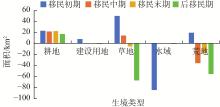
Fig. 2
Area changes of habitat types from 1996 to 2020"
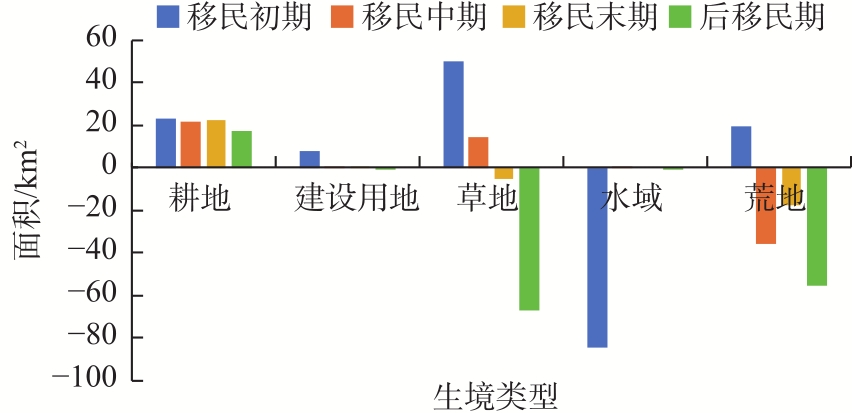
Fig. 3
Area changes of different habitat types in migrant resettlement areas from 1996 to 2020"
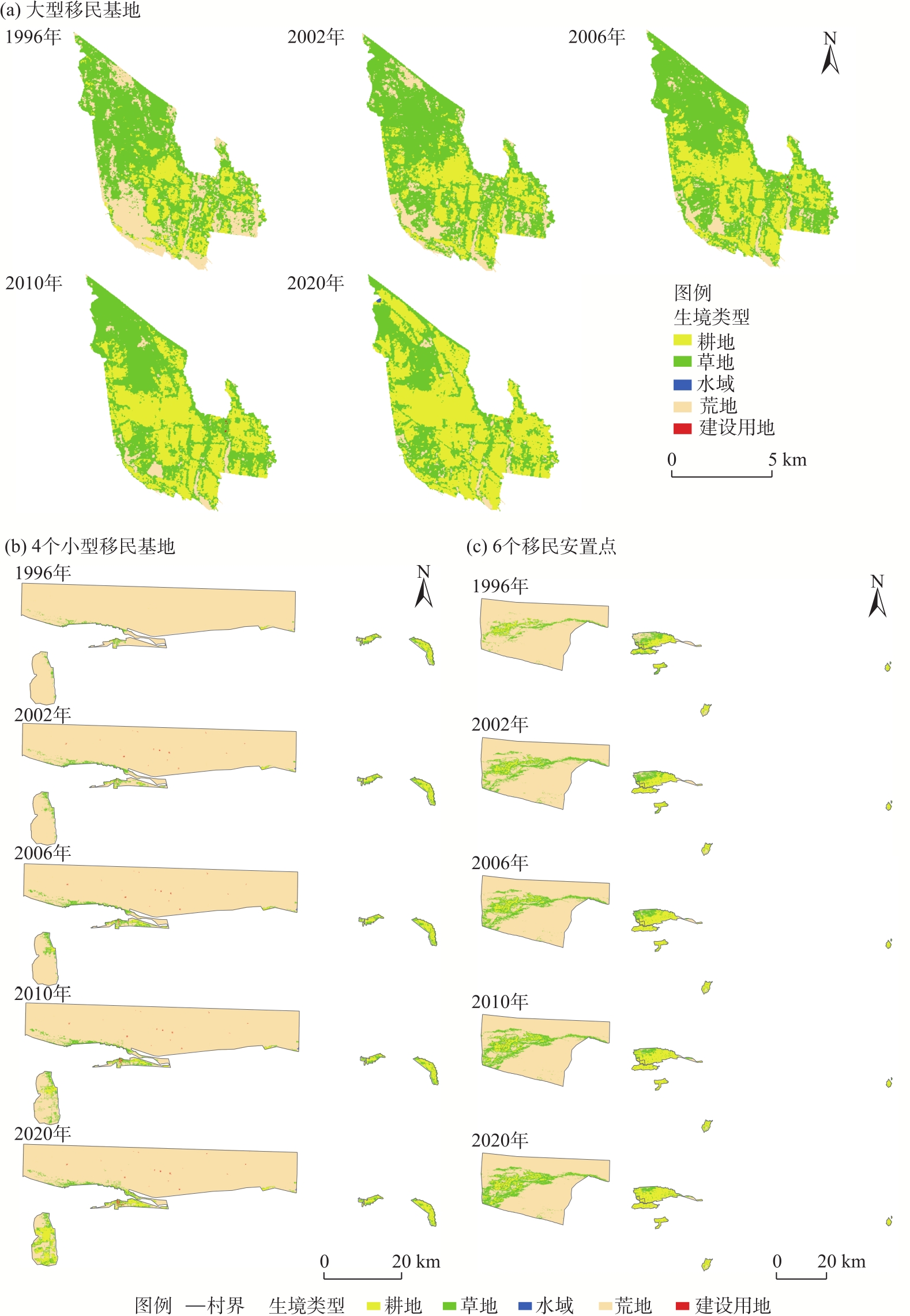
Fig. 4
Map of habitat type transfer in migrant resettlement areas"

Tab. 4
Changes in the landscape pattern index of different resettlement areas"
| 景观格局指数 | 安置区类型 | 1996年 | 2002年 | 2003年 | 2007年 | 2010年 | 2015年 | 2021年 |
|---|---|---|---|---|---|---|---|---|
| NP | 大型移民安置基地 | 24.00 | 25.00 | 27.00 | 21.00 | 24.00 | 26.00 | 22.00 |
| 4个小型移民安置基地 | 170.00 | 157.00 | 158.00 | 159.00 | 171.00 | 185.00 | 196.00 | |
| 6个移民安置点 | 378.00 | 355.00 | 353.00 | 399.00 | 396.00 | 406.00 | 454.00 | |
| ED | 大型移民安置基地 | 5.78 | 5.37 | 5.59 | 5.48 | 5.96 | 5.91 | 6.22 |
| 4个小型移民安置基地 | 1.36 | 1.32 | 1.32 | 1.38 | 1.45 | 1.64 | 1.64 | |
| 6个移民安置点 | 2.37 | 2.47 | 2.49 | 2.59 | 2.61 | 2.53 | 2.62 | |
| C | 大型移民安置基地 | 46.35 | 43.13 | 42.66 | 41.41 | 40.16 | 40.67 | 41.37 |
| 4个小型移民安置基地 | 85.04 | 86.60 | 86.51 | 85.80 | 85.46 | 84.37 | 84.36 | |
| 6个移民安置点 | 81.46 | 80.16 | 80.01 | 78.87 | 78.73 | 78.23 | 78.72 | |
| SHDI | 大型移民安置基地 | 0.73 | 0.81 | 0.82 | 0.88 | 0.90 | 0.91 | 0.91 |
| 4个小型移民安置基地 | 0.29 | 0.31 | 0.31 | 0.33 | 0.34 | 0.36 | 0.36 | |
| 6个移民安置点 | 0.39 | 0.43 | 0.43 | 0.46 | 0.46 | 0.48 | 0.46 | |
| SHEI | 大型移民安置基地 | 0.66 | 0.74 | 0.74 | 0.80 | 0.82 | 0.83 | 0.83 |
| 4个小型移民安置基地 | 0.21 | 0.19 | 0.19 | 0.20 | 0.21 | 0.22 | 0.22 | |
| 6个移民安置点 | 0.24 | 0.26 | 0.27 | 0.28 | 0.29 | 0.30 | 0.28 | |
| AI | 大型移民安置基地 | 82.34 | 83.63 | 83.01 | 83.49 | 82.24 | 82.58 | 81.50 |
| 4个小型移民安置基地 | 95.85 | 95.98 | 95.97 | 95.83 | 95.64 | 95.16 | 95.18 | |
| 6个移民安置点 | 93.56 | 93.32 | 93.29 | 93.03 | 92.99 | 93.20 | 92.97 | |
| FRAC | 大型移民安置基地 | 1.03 | 1.03 | 1.03 | 1.03 | 1.03 | 1.03 | 1.04 |
| 4个小型移民安置基地 | 1.02 | 1.02 | 1.02 | 1.03 | 1.03 | 1.03 | 1.03 | |
| 6个移民安置点 | 1.02 | 1.03 | 1.03 | 1.02 | 1.02 | 1.02 | 1.02 |
| [1] |
贾耀锋. 中国生态移民效益评估研究综述[J]. 资源科学, 2016, 38(8): 1550-1560.
doi: 10.18402/resci.2016.08.13 |
|
[Jia Yaofeng. Review of benefit evaluation research on ecological migration in China[J]. Resources Science, 2016, 38(8): 1550-1560.]
doi: 10.18402/resci.2016.08.13 |
|
| [2] | International Organization for Migration (IOM). Glossary on migration (2nd ed)[DB/OL]. [2025-05-01]. https://publications.iom.int/system/files/pdf/iml_34_glossary.pdf. |
| [3] |
Swain A. Environmental migration and conflict dynamics: Focus on developing regions[J]. Third World Quarterly, 1996, 17(5): 959-973.
pmid: 12321041 |
| [4] | Li J T, Dong H R, Li S X. Economic development and optimal allocation of land use in ecological emigration area in China[J]. Land Use Policy, 2024, 142: 107178, doi: 10.1016/j.landusepol.2024.107178. |
| [5] |
Hu Y C, Zhou W, Yuan T. Environmental impact assessment of ecological migration in China: A survey of immigrant resettlement regions[J]. Journal of Zhejiang University-Science A, 2018, 19(3): 240-254.
doi: 10.1631/jzus.A1600669 |
| [6] |
Myers N. Environmental refugees in a globally warmed world estimating the scope of what could well become a prominent international phenomenon[J]. Bioscience, 1993, 43(11): 752-761.
doi: 10.2307/1312319 |
| [7] |
Tolba M K. Our biological heritage under siege[J]. Bioscience, 1989, 39(10): 725-728.
doi: 10.1093/bioscience/39.10.725 |
| [8] | Jäger J. Environmental change and forced migration[J]. Environment, 2009, 51(5): 4-4. |
| [9] |
Hugo G. Environmental concerns and international migration[J]. International Migration Review, 1996, 30(1): 105-131.
pmid: 12291410 |
| [10] | Black R. Environmental refugees: Myth or reality?[J]. Un High Commissioner for Refugees, 2001, 19(2): 167-182. |
| [11] | Dun O, Gemenne F. Defining environmental migration[J]. Forced Migration Review, 2008, 31: 10-11. |
| [12] | Woube M. Effects of resettlement schemes on the biophysical and human environments: The case of the Gambela Region, Ethiopia[M]. Boca Raton, Florida USA: Universal-Publishers, 2005:14-18. |
| [13] | Correa E. Preventive resettlement of populations at risk of disaster: Experiences from Latin America[M]. Washington: World Bank, 2011: 85-106. |
| [14] |
William M J. Understanding the relationship between environmental change and migration: The development of an effects framework based on the case of northern Ethiopia[J]. Global Environmental Change, 2013, 23(6): 1501-1510.
doi: 10.1016/j.gloenvcha.2013.07.021 |
| [15] |
Adamo S B. Environmental migration and cities in the context of global environmental change[J]. Current Opinion in Environmental Sustainability, 2010, 2(3): 161-165.
doi: 10.1016/j.cosust.2010.06.005 |
| [16] | Tan Y. Development-induced displacement and resettlement: An overview of issues and interventions[J]. Routledge Handbook of Migration and Development, 2020: 373-381. |
| [17] | Zhou Z F, Feng Q, Zhu C L, et al. The spatial and temporal evolution of ecological environment quality in karst ecologically fragile areas driven by poverty alleviation resettlement[J]. Land, 2022, 11(8): 1150, doi: 10.3390/land11081150. |
| [18] |
Mao X F, Wei X Y, Xia J X. Evaluation of ecological migrants’adaptation to their new living area in Three-River Headwater wetlands, China[J]. Procedia Environmental Sciences, 2012, 13: 1346-1353.
doi: 10.1016/j.proenv.2012.01.127 |
| [19] |
Kura Y, Joffre O, Laplante B, et al. Coping with resettlement: A livelihood adaptation analysis in the Mekong River Basin[J]. Land Use Policy, 2017, 60(1): 139-149.
doi: 10.1016/j.landusepol.2016.10.017 |
| [20] |
Platt R V, Ogra M V, Badola R, et al. Conservation-induced resettlement as a driver of land cover change in India: An object-based trend analysis[J]. Applied Geography, 2016, 69(4): 75-86.
doi: 10.1016/j.apgeog.2016.02.006 |
| [21] |
Reuveny R. Ecomigration and violent conflict: Case studies and public policy implications[J]. Human Ecology, 2008, 36(1): 1-13.
doi: 10.1007/s10745-007-9142-5 |
| [22] |
Warner K. Global environmental change and migration: Governance challenges[J]. Global Environmental Change, 2010, 20(3): 402-413.
doi: 10.1016/j.gloenvcha.2009.12.001 |
| [23] |
Ocello C, Petrucci A, Testa M R. Environmental aspects of internal migration in Tanzania[J]. Population and Environment, 2015, 37(1): 99-108.
doi: 10.1007/s11111-014-0229-9 |
| [24] |
Wilmsen B, Van Hulten A. Following resettled people over time: The value of longitudinal data collection for understanding the livelihood impacts of the Three Gorges Dam, China[J]. Impact Assessment and Project Appraisal, 2017, 35(1): 94-105.
doi: 10.1080/14615517.2016.1271542 |
| [25] |
Miller F, Ha T T P, Van Da H, et al. Double displacement-Interactions between resettlement, environmental change and migration[J]. Geoforum, 2022, 129: 13-27.
doi: 10.1016/j.geoforum.2021.12.016 |
| [26] |
Evrard O, Goudineau Y. Planned resettlement, unexpected migrations and cultural trauma in Laos[J]. Development and Change, 2004, 35(5): 937-962.
doi: 10.1111/dech.2004.35.issue-5 |
| [27] |
Bossio D, Geheb K, CriEngle N L. Adaptive capacity and its assessment[J]. Global Environmental Change, 2011, 21(2): 647-656.
doi: 10.1016/j.gloenvcha.2011.01.019 |
| [28] | Gardner R H, Turner M G. Quantitative Methods in Landscape Ecology: The Analysis and Interpretation of Landscape Heterogeneity[M]. New York: Springer, 1991: 1-25. |
| [29] | Li W J, Kang J W, Wang Y. Effects of habitat fragmentation on ecosystem services and their trade-offs in southwest China: A multi-perspective analysis[J]. Ecological Indicators, 2024, 167: 112699, doi: 10.1016/j.ecolind.2024.112699. |
| [30] | Haddad N M, Brudvig L A, Clobert J, et al. Habitat fragmentation and its lasting impact on Earth’s ecosystems[J]. Science Advances, 2015, 1(2): e1500052, doi: 10.1126/sciadv.1500052. |
| [31] |
Teckentrup L, Kramer-Schadt S, Jeltsch F. The risk of ignoring fear: Underestimating the effects of habitat loss and fragmentation on biodiversity[J]. Landscape Ecology, 2019, 34(12): 2851-2868.
doi: 10.1007/s10980-019-00922-8 |
| [32] | Tang J J, Zhou L, Dang X W, et al. Impacts and predictions of urban expansion on habitat quality in the densely populated areas: A case study of the Yellow River Basin, China[J]. Ecological Indicators, 2023, 151: 110320, doi: 10.1016/j.ecolind.2023.110320. |
| [33] | Tao Y, Hastings A, Lafferty K D, et al. Landscape fragmentation overturns classical metapopulation thinking[J]. Proceedings of the National Academy of Sciences, 2024, 121(20): e2303846121, doi: 10.1073/pnas.2303846121. |
| [34] |
Bozkurt S G, Basaraner M. Spatio-temporal investigation of urbanization and its impact on habitat fragmentation in natural ecosystems of istanbul using Shannon’s entropy and landscape metrics in GIS[J]. Environment, Development and Sustainability, 2024, 26(10): 26879-26907.
doi: 10.1007/s10668-023-04410-7 |
| [35] | 王鹏, 王亚娟, 刘小鹏, 等. 干旱区生态移民土地利用景观格局变化分析——以宁夏红寺堡区为例[J]. 干旱区资源与环境, 2018, 32(12): 69-74. |
| [Wang Peng, Wang Yajuan, Liu Xiaopeng, et al. Change of land use and landscape pattern in ecological resettlement area in central Ningxia[J]. Journal of Arid Land Resources and Environment, 2018, 32(12): 69-74.] | |
| [36] | Yang Y, Sherbinin A D, Liu Y. China’s poverty alleviation resettlement: Progress, problems and solutions[J]. Habitat International, 2020, 98: 102-135. |
| [37] | 包智明. 关于生态移民的定义、分类及若干问题[J]. 中央民族大学学报: 哲学社会科学版, 2006, 33(1): 27-31. |
| [Bao Zhiming. The definition, category and some other issues about ecological migration[J]. Journal of Minzu University of China (Philosophy and Social Sciences Edition), 2006, 33(1): 27-31.] | |
| [38] | World Bank. Resettlement action plan (RAP) of the proposed China: Gansu Cultural and Natural Heritage Protection and Development Project[R]. Washington: Word Bank, 2007. |
| [39] | 王军德, 程玉菲, 金彦兆. 移民安置综合开发区土地利用变化及驱动力分析——以疏勒河中游干流区为例[J]. 水利水电技术, 2018, 49(10): 46-51. |
| [Wang Junde, Cheng Yufei, Jin Yanzhao. Analysis on land use variation and its driving force of comprehensive development region for immigrant settlement: A case of main stream region of Mid-Shulehe River[J]. Water Resources and Hydropower Engineering, 2018, 49(10): 46-51.] | |
| [40] | 马晴, 李丁, 廖杰, 等. 疏勒河中下游绿洲土地利用变化及其驱动力分析[J]. 经济地理, 2014, 34(1): 148-155. |
| [Ma Qing, Li Ding, Liao Jie, et al. Analysis of land use change and its driving forces in the oasis of Shule River middle and lower reaches[J]. Economic Geography, 2014, 34(1): 148-155.] | |
| [41] | 马利邦, 李晓阳, 成文娟, 等. 基于灌区面板数据的流域土地利用强度及其影响因素时空差异识别[J]. 生态学杂志, 2019, 38(3): 908-918. |
| [Ma Libang, Li Xiaoyang, Cheng Wenjuan, et al. Basin land use intensity based on panel data of irrigation district and the identification of spatiotemporal difference of influencing factors[J]. Chinese Journal of Ecology, 2019, 38(3): 908-918.] | |
| [42] | 谢霞, 杨国靖, 王增如, 等. 疏勒河上游山区不同海拔梯度的景观格局变化[J]. 生态学杂志, 2010, 29(7): 1420-1426. |
| [Xie Xia, Yang Guojing, Wang Zengru, et al. Landscape pattern change in mountainous areas along an altitude gradient in the upper reaches of Shule River[J]. Chinese Journal of Ecology, 2010, 29(7): 1420-1426.] | |
| [43] |
张齐飞, 陈亚宁, 孙从建, 等. 塔里木河流域水储量变化及绿洲生态安全评估[J]. 干旱区地理, 2024, 47(1): 1-14.
doi: 10.12118/j.issn.1000-6060.2023.247 |
|
[Zhang Qifei, Chen Yaning, Sun Congjian, et al. Changes in terrestrial water storage and evaluation of oasis ecological security in the Tarim River Basin[J]. Arid Land Geography, 2024, 47(1): 1-14.]
doi: 10.12118/j.issn.1000-6060.2023.247 |
|
| [44] | 张幸福, 徐当会, 王辉, 等. 疏勒河流域中下游景观格局动态变化分析研究[J]. 兰州大学学报: 自然科学版, 2004, 40(4): 81-85. |
| [Zhang Xingfu, Xu Danghui, Wang Hui, et al. Study on the dynamic variation of landscape pattern in the middle and lower reaches of the Shule River Basin[J]. Journal of Lanzhou University (Natural Sciences), 2004, 40(4): 81-85.] | |
| [45] | Ma L B, Cheng W J, Bo J, et al. Spatio-temporal variation of land-use intensity from a multi-perspective-taking the middle and lower reaches of Shule River Basin in China as an example[J]. Sustainability, 2018, 10(3): 771, doi: 10.3390/su10030771. |
| [46] | 程水英. 疏勒河流域景观动态变化研究[D]. 西安: 西北大学, 2004. |
| [Cheng Shuiying. Study on dynamic change of landscape in Shule River Basin[D]. Xi’an: Northwest University, 2004.] | |
| [47] | 潘竟虎, 苏有才, 黄永生, 等. 疏勒河中游景观与景观格局动态[J]. 应用生态学报, 2012, 23(4): 1090-1096. |
|
[Pan Jinghu, Su Youcai, Huang Yongsheng, et al. Dynamic changes of land use and landscape patterns in middle reaches of Shule River, northwest China[J]. Chinese Journal of Applied Ecology, 2012, 23(4): 1090-1096.]
pmid: 22803479 |
|
| [48] | 孙旭伟, 李森, 王亚晖, 等. 1975—2020年疏勒河流域绿洲时空变化研究[J]. 生态学报, 2022, 42(22): 9111-9120. |
| [Sun Xuwei, Li Sen, Wang Yahui, et al. Spatiotemporal change of oasis in Shule River Basin during 1975—2020[J]. Acta Ecologica Sinica, 2022, 42(22): 9111-9120.] | |
| [49] | 常跟应, 张文侠. 基于生态文明的疏勒河流域大规模移民反思[J]. 兰州大学学报(自然科学版), 2014, 50(3): 405-409. |
| [Chang Gengying, Zhang Wenxia. Ecological civilization-based rethinking of large-scale immigration and land development along Shule River[J]. Journal of Lanzhou University (Natural Sciences), 2014, 50(3): 405-409.] | |
| [50] |
杨静, 周冬梅, 马静, 等. 疏勒河流域农业水土资源时空匹配特征分析[J]. 干旱区地理, 2023, 46(6): 982-992.
doi: 10.12118/j.issn.1000-6060.2022.474 |
|
[Yang Jing, Zhou Dongmei, Ma Jing, et al. Spatial and temporal matching characteristics of agricultural land and water resources in the Shule River Basin[J]. Arid Land Geography, 2023, 46(6): 982-992.]
doi: 10.12118/j.issn.1000-6060.2022.474 |
|
| [51] | 贾芳. 重构绿洲生态系统的理性思考——以疏勒河流域酒泉移民区为例[J]. 全国商情(理论研究), 2013(7): 7-9. |
| [Jia Fang. Rational thinking on reconstructing the oasis ecosystem: A case study of Jiuquan resettlement area in Shule River Basin[J]. China Circulation Economy, 2013(7): 7-9.] | |
| [52] | 刘强, 艾学山. 疏勒河灌区三大水库联合调度研究[J]. 中国农村水利水电, 2008(4): 42-45. |
| [Liu Qiang, Ai Xueshan. Research on combined operation of the three reservoirs in the Shule River irrigation[J]. China Rural Water and Hydropower, 2008(4): 42-45.] |
|
||