干旱区地理 ›› 2026, Vol. 49 ›› Issue (5): 963-974.doi: 10.12118/j.issn.1000-6060.2025.393 cstr: 32274.14.ALG2025393
盖微微1,2( ), 姜钰1()
收稿日期:2025-07-09
修回日期:2025-09-24
出版日期:2026-05-25
发布日期:2026-05-25
通讯作者:
姜钰(1978-),博士,教授,主要从事林业经济等方面的研究. E-mail: jy666abc@126.com作者简介:盖微微(1983-),女,博士研究生,副教授,主要从事资源与生态经济等方面的研究. E-mail: gaiwei@nefu.edu.cn
基金资助:
GAI Weiwei1,2(), JIANG Yu1()
Received:2025-07-09
Revised:2025-09-24
Published:2026-05-25
Online:2026-05-25
摘要:
环塔里木经济带作为我国西北关键生态功能区,其生态系统服务功能对区域可持续发展至关重要。基于2000—2023年气象、地形与遥感数据,综合运用修正风蚀方程(RWEQ)模型与InVEST模型,定量评估了该地区防风固沙量、土壤保持量、碳储量、产水量及生境质量5项生态系统服务的时空演变规律,并借助空间叠置分析与双变量空间自相关方法深入探究了服务间权衡协同关系的空间格局。结果表明:(1) 2000—2023年研究区土壤保持量和碳储量总体呈上升趋势,防风固沙量和产水量总体呈下降趋势,生境质量基本稳定;空间上,各项服务均表现出显著异质性,增长区主要集中于西部和南部。(2) 基于1 km×1 km栅格尺度的空间叠置分析显示,生态系统服务间关系以低协同与强权衡为主导,且该主导格局在2005年发生根本性逆转,由强权衡绝对优势转变为低协同主导。(3) 在10 km×10 km栅格尺度上,双变量空间自相关分析揭示两两服务间关系以协同为主,仅防风固沙量与产水量之间以权衡关系为主导。
盖微微, 姜钰. 环塔里木经济带生态系统服务功能时空演变及权衡协同研究[J]. 干旱区地理, 2026, 49(5): 963-974.
GAI Weiwei, JIANG Yu. Spatiotemporal evolution and trade-off synergy of ecosystem service functions in the Tarim Basin Economic Belt[J]. Arid Land Geography, 2026, 49(5): 963-974.
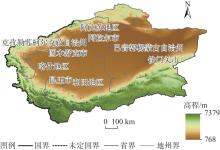
图1
研究区示意图 注:基于自然资源部标准地图服务网站审图号为GS(2023)2767号的标准地图制作,底图边界无修改。下同。"
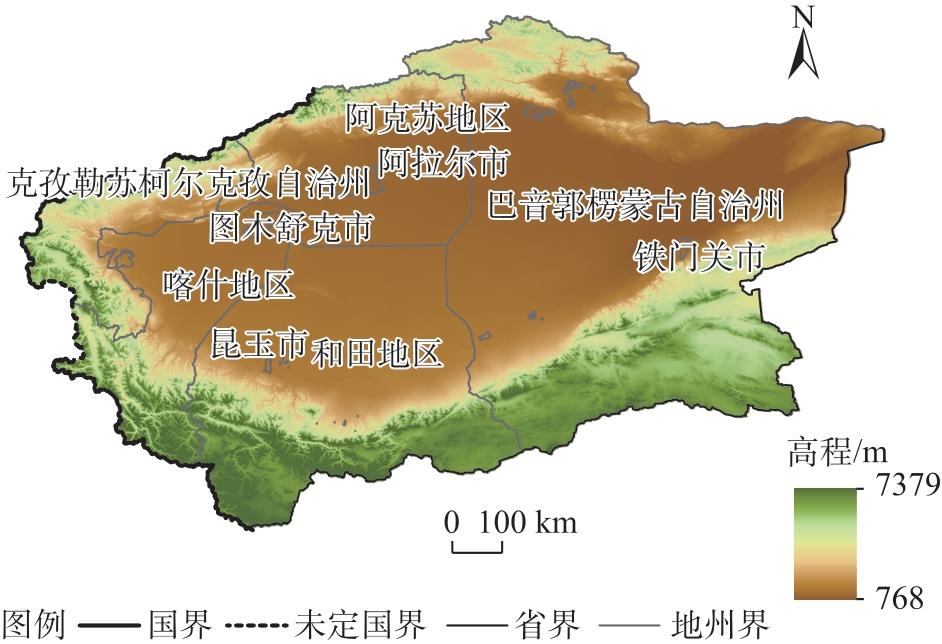

表1
数据来源"
| 数据类型 | 基础数据 | 来源 | 分辨率 |
|---|---|---|---|
| 气象数据 | 年平均降水量 | 国家地球系统科学数据中心( | 1 km |
| 年平均气温 | 国家地球系统科学数据中心( | 1 km | |
| 年平均潜在蒸散发量 | 国家地球系统科学数据中心( | 1 km | |
| 逐日风速 | 国家气象科学数据共享服务网( | 500 m | |
| 雪盖因子数据集 | 国家青藏高原科学数据中心( | 1 km | |
| 地形数据 | DEM | 地理空间数据云( | 12.5 m |
| 土壤数据 | 世界和谐土壤数据库( | 1 km | |
| 土壤湿度 | 国家青藏高原科学数据中心( | 1 km | |
| 水系数据 | Open Street Map( | 100 m | |
| 遥感数据 | NDVI | 资源环境科学与数据中心( | 30 m |
| 土地利用 | 资源环境科学与数据中心( | 30 m |
表2
生态系统服务权衡/协同划分标准及统计"
| 服务关系 | 亚类 | 供给能力组合 | 组合个数 | 组合示例 |
|---|---|---|---|---|
| 权衡 | 强权衡 | 1高4低 | 5 | 31111、13111 |
| 1高1中3低 | 20 | 32111、12311 | ||
| 1高2中2低 | 30 | 32211、31221 | ||
| 1高3中1低 | 20 | 32221、13222 | ||
| 弱权衡 | 2高3低 | 10 | 33111、13311 | |
| 2高1中2低 | 30 | 33211、21133 | ||
| 2高2中1低 | 30 | 33221、12323 | ||
| 3高2低 | 10 | 31313、13331 | ||
| 3高1中1低 | 20 | 33231、12333 | ||
| 4高1低 | 5 | 13333、31333 | ||
| 协同 | 高协同 | 5高 | 1 | 33333 |
| 4高1中 | 5 | 23333、32333 | ||
| 3高2中 | 10 | 22333、32323 | ||
| 2高3中 | 10 | 22332、32322 | ||
| 1高4中 | 5 | 32222、23222 | ||
| 5中 | 1 | 22222 | ||
| 低协同 | 5低 | 1 | 11111 | |
| 4低1中 | 5 | 12111、11112 | ||
| 3低2中 | 10 | 11122、21121 | ||
| 2低3中 | 10 | 22211、11222 | ||
| 1低4中 | 5 | 12222、22122 |
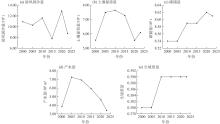
图2
2000—2023年环塔里木经济带5项生态系统服务功能量年变化"
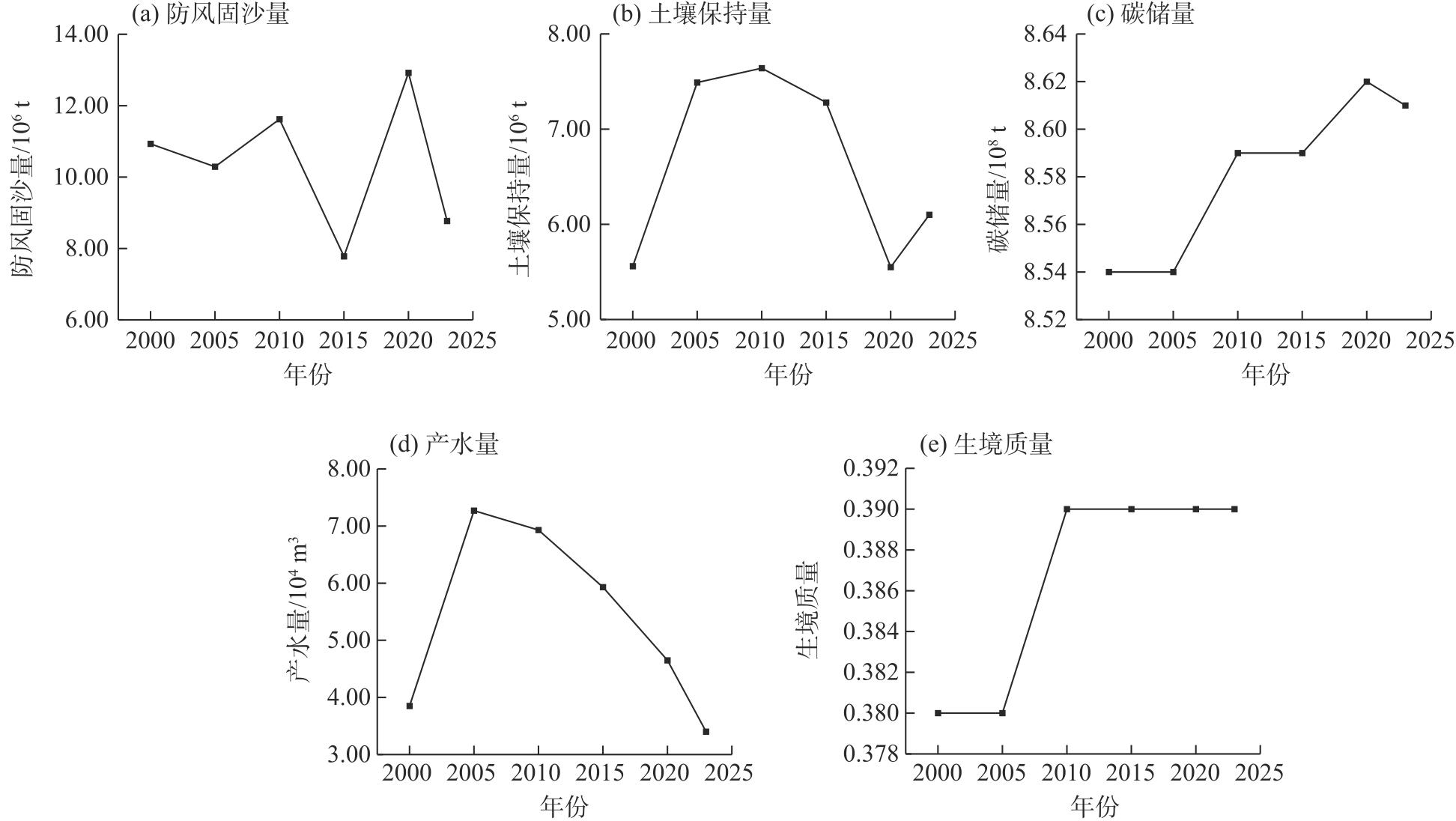
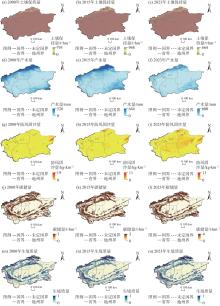
图3
2000—2023年环塔里木经济带生态系统服务空间变化"
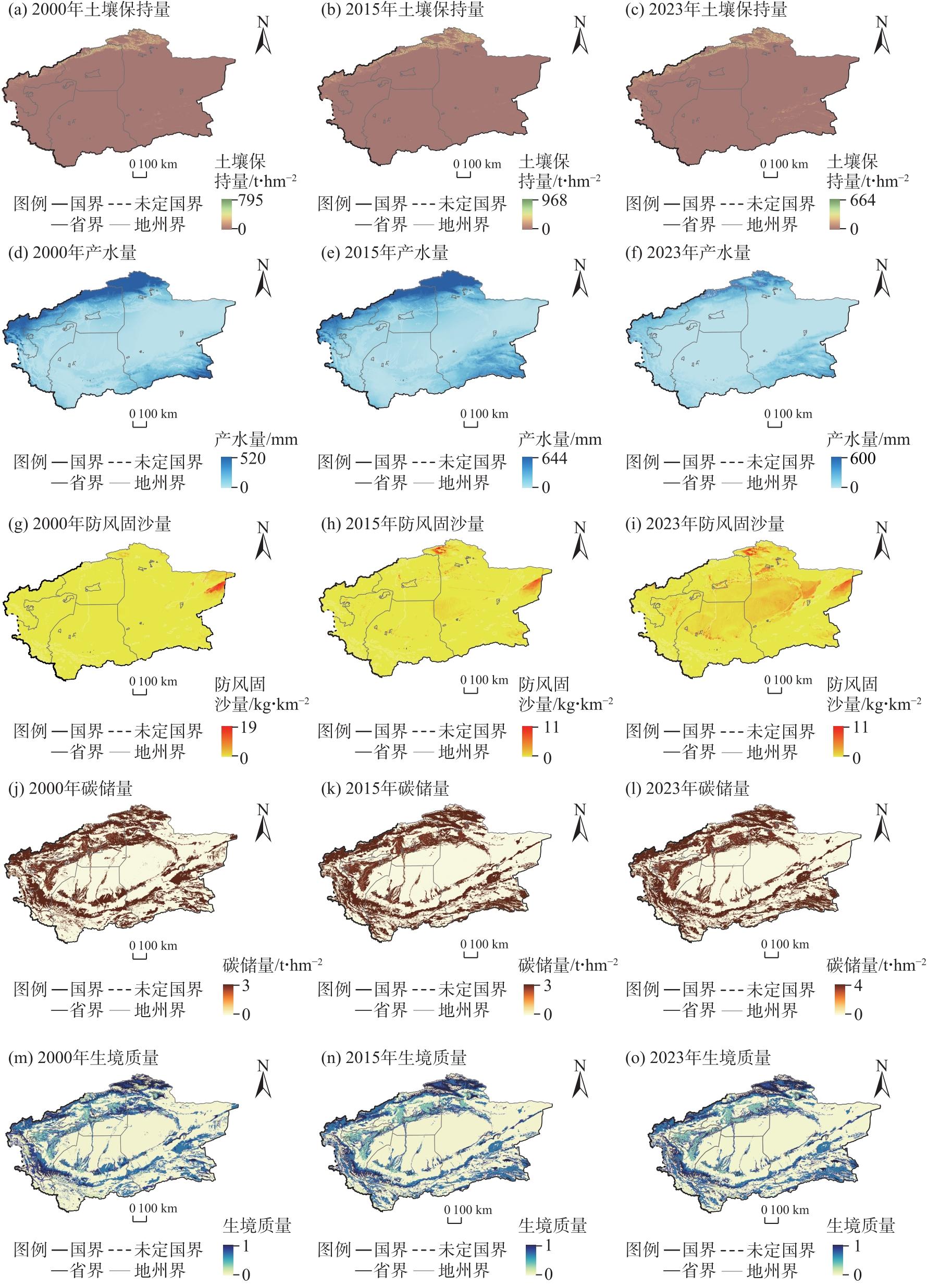
表3
环塔里木经济带生态系统服务权衡与协同关系面积占比"
| 年份 | 弱权衡 | 强权衡 | 高协同 | 低协同 |
|---|---|---|---|---|
| 2000 | 14.67 | 84.05 | 0.09 | 1.19 |
| 2005 | 12.83 | 23.11 | 0.04 | 64.02 |
| 2010 | 13.23 | 23.21 | 0.31 | 63.25 |
| 2015 | 11.92 | 23.45 | 0.70 | 63.93 |
| 2020 | 13.13 | 22.27 | 0.58 | 64.02 |
| 2023 | 12.82 | 22.80 | 0.66 | 63.72 |
图4
2000—2023年环塔里木经济带生态系统服务权衡与协同关系空间分布"
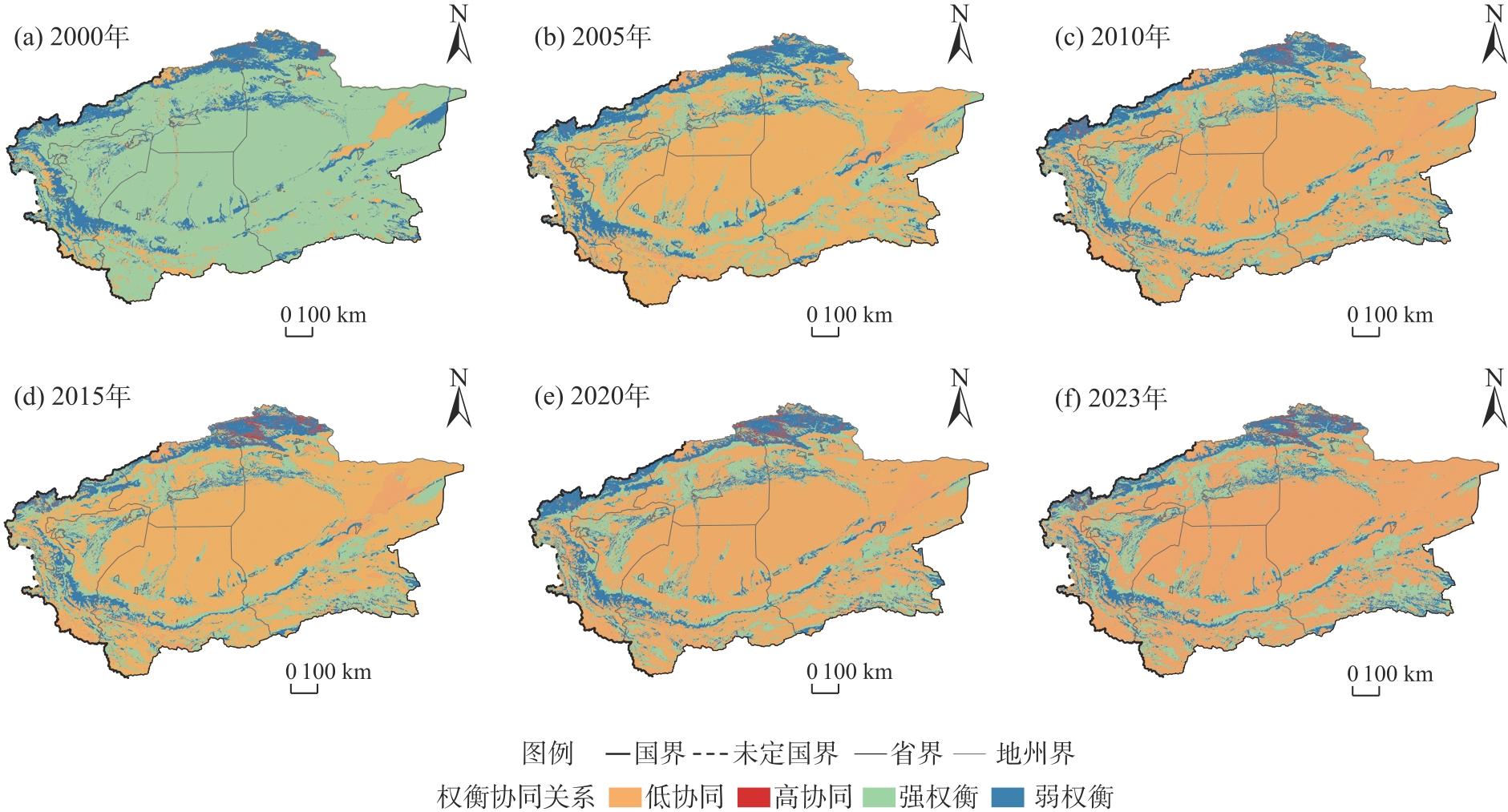
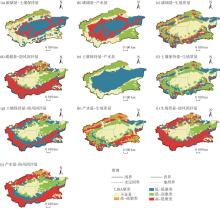
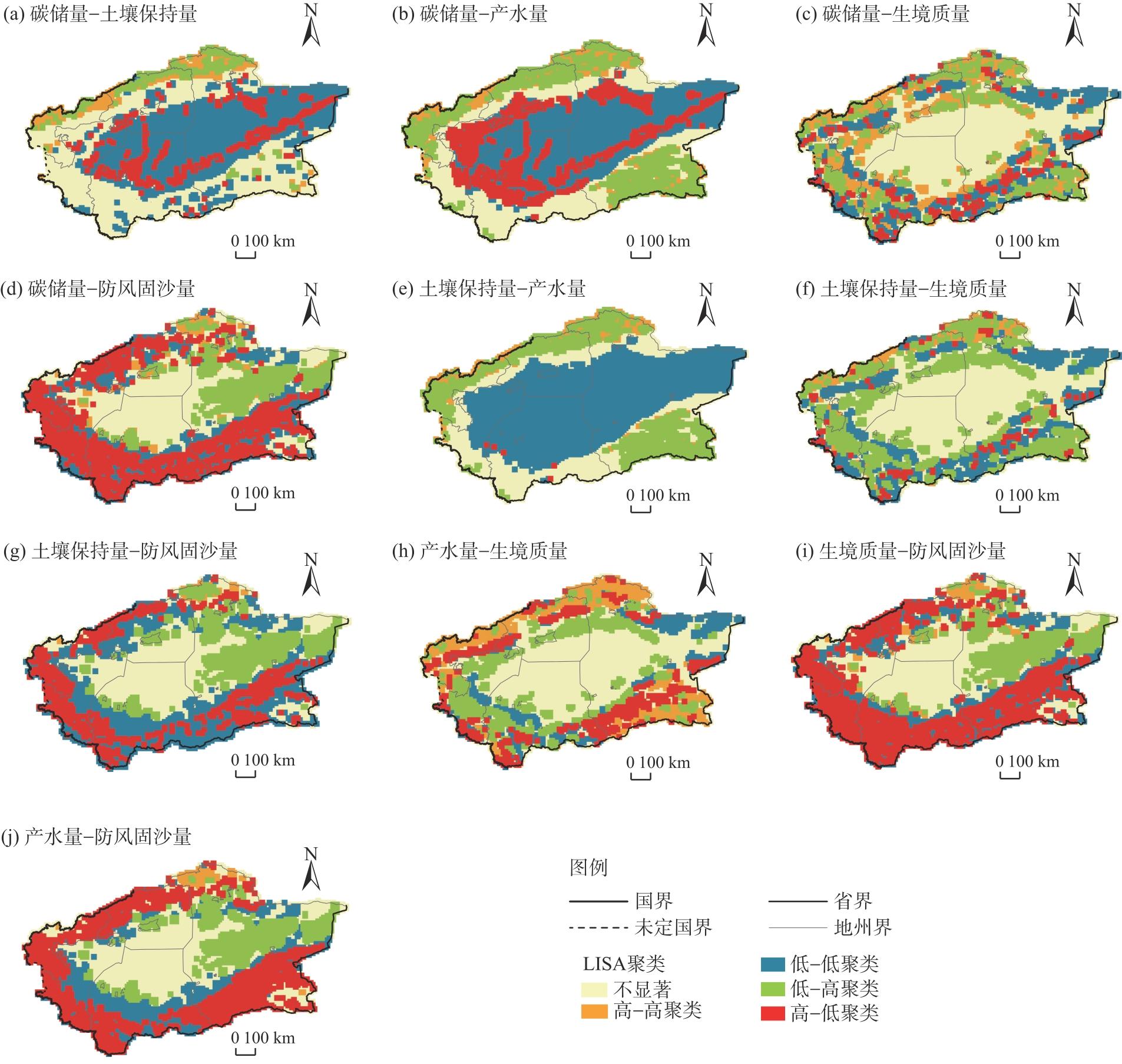
图5
2023年环塔里木经济带生态系统服务间权衡与协同关系的空间分布"
| [1] | 王金凤, 徐洁, 徐基良, 等. 黄河流域国家级自然保护区生态系统服务功能评估[J]. 北京林业大学学报, 2024, 46(7): 90-100. |
| [Wang Jinfeng, Xu Jie, Xu Jiliang, et al. Evaluation of ecosystem service function of national nature reserves of the Yellow River Basin[J]. Journal of Beijing Forestry University, 2024, 46(7): 90-100.] | |
| [2] |
Palmer M, Bernhardt E, Chornesky E. Ecology for a crowded planet[J]. Science, 2004, 304(5675): 1251-1252.
doi: 10.1126/science.1095780 |
| [3] | 庞彩艳, 文琦, 丁金梅, 等. 黄河上游流域生态系统服务变化及其权衡协同关系[J]. 生态学报, 2024, 44(12): 5003-5013. |
| [Pang Caiyan, Wen Qi, Ding Jinmei, et al. Ecosystem services and their trade-offs and synergies in the upper reaches of the Yellow River Basin[J]. Acta Ecologica Sinica, 2024, 44(12): 5003-5013.] | |
| [4] | 孙才志, 于涵, 郝帅. 辽河流域生态系统服务权衡-协同效应及其驱动因素[J]. 生态学报, 2025, 45(6): 2952-2967. |
| [Sun Caizhi, Yu Han, Hao Shuai. Analysis of the trade-off synergy effergy and driving factors of ecosystem services in the Liao River Basin[J]. Acta Ecologica Sincia, 2025, 45(6): 2952-2967.] | |
| [5] | 李双成, 张才玉, 刘金龙, 等. 生态系统服务权衡与协同研究进展及地理学研究议题[J]. 地理研究, 2013, 32(8): 1379-1390. |
| [Li Shuangcheng, Zhang Caiyu, Liu Jinlong, The tradeoffs and synergies of ecosystem services: Research progress, development trend, and themes of geography[J]. Geographical Research, 2013, 32(8): 1379-1390.] | |
| [6] |
Power A G. Ecosystem services and agriculture: Tradeoffs and synergies[J]. Philosophical Transactions of the Royal Society B: Biological Sciences, 2010, 365(1554): 2959-2971.
doi: 10.1098/rstb.2010.0143 |
| [7] | 石金鑫, 梁小英, 李辉蔷, 等. 陕北黄土高原景观格局对生态系统服务权衡关系的影响[J]. 生态学报, 2023, 43(21): 8958-8972. |
| [40] | [Zhu Mengyuan, Tian Yichen, Jin Lei, et al. Temporal and spatial changes of wind reduction and sand fixation function of ecological barrier zone on the southern edge of Horqin Sandy Land and influencing factors[J]. Chinese Journal of Ecology, 2025, 44(6): 1857-1865.] |
| [41] | 熊茂秋, 刘晓煌, 张雪辉, 等. 基于RUSLE模型的塔里木河流域上游土壤保持时空变化研究[J]. 地质通报, 2024, 43(4): 641-650. |
| [Xiong Maoqiu, Liu Xiaohuang, Zhang Xuehui, et al. Spatio-temporal variation of soil conservation in the upper reaches of the Tarim River Basin based on RUSLE model[J]. Geological Bulletin of China, 2024, 43(4): 641-650.] | |
| [42] | 郭丽洁, 尹小君, 苟贞珍, 等. 基于InVEST模型的阿克苏河流域产水量评估及环境因素影响研究[J]. 石河子大学学报(自然科学版), 2020, 38(2): 216-224. |
| [Guo Lijie, Yin Xiaojun, Gou Zhenzhen, et al. Evaluation on water yield and analysis of its variation characteristics of Arku River Basin based on InVEST model[J]. Journal of Shihezi University (Natural Science Edition), 2020, 38(2): 216-224.] | |
| [43] | 陈田田, 黄强, 王强. 基于地理探测器的喀斯特山区生态系统服务关系分异特征及驱动力解析——以贵州省为例[J]. 生态学报, 2022, 42(17): 6959-6972. |
| [Chen Tiantian, Huang Qiang, Wang Qiang. Differentiation characteristics and driving factors of ecosystem services relationships in karst mountainous area based on geographic detector modeling: A case study of Guizhou Province[J]. Acta Ecologica Sinica, 2022, 42(17): 6959-6972.] | |
| [7] | [Shi Jinxin, Liang Xiaoying, Li Huiqiang, et al. Impact of landscape pattern on ecosystem service trade-offs in the Loess Plateau of northern Shaanxi[J]. Acta Ecologica Sinica, 2023, 43(21): 8958-8972.] |
| [8] | 殷允可, 李昊瑞, 张铭, 等. 不同气候区生态系统服务权衡空间异质性及其驱动因素——以川滇-黄土高原生态屏障带为例[J]. 生态学报, 2024, 44(1): 107-116. |
| [Yin Yunke, Li Haorui, Zhang Ming, et al. Spatial heterogeneity of ecosystem service trade-offs in different climatic regions and its driving factors: A case study of the Sichuan-Yunnan-Loess Plateau ecological barrier zone[J]. Acta Ecologica Sinica, 2024, 44(1): 107-116.] | |
| [9] |
徐铭璟, 段宝玲, 冯强, 等. 生态系统服务及其权衡/协同关系多情景模拟——以黄河流域山西段为例[J]. 干旱区地理, 2025, 48(7): 1206-1219.
doi: 10.12118/j.issn.1000-6060.2024.471 |
|
[Xu Mingjing, Duan Baoling, Feng Qiang, et al. Ecological services and their trade-offs/synergistic relationships in multi-scenario simulations: A case of the Shanxi section of the Yellow River Basin[J]. Arid Land Geography, 2025, 48(7): 1206-1219.]
doi: 10.12118/j.issn.1000-6060.2024.471 |
|
| [10] |
王天雯, 罗明良, 白雷超. 嘉陵江流域生态系统服务动态变化及权衡协同分析[J]. 生态环境学报, 2025, 34(6): 888-901.
doi: 10.16258/j.cnki.1674-5906.2025.06.006 |
| [Wang Tianwen, Luo Mingliang, Bai Leichao. Dynamic changes and trade-off-synergy analysis of ecosystem services in the Jialing River Basin[J]. Ecology and Environmental Sciences, 2025, 34(6): 888-901.] | |
| [11] | 孙严超, 戚梦豪, 王伟业, 等. 钱塘江流域生态系统服务时空演变及权衡与协同关系探究[J]. 生态与农村环境学报, 2026, 42(2): 206-218. |
| [Sun Yanchao, Qi Menghao, Wang Weiye, et al. Research on the temporal and spatial evolution, trade-offs and synergistic relationships of ecosystem services in the Qiantang River Basin[J]. Journal of Ecology and Rural Environment, 2026, 42(2): 206-218.] | |
| [12] | 张宇洁, 张晓萍, 孙伟楠, 等. 1970—2020年北洛河流域产水、保土、固碳生态系统服务时空演变特征与权衡/协同关系[J]. 水土保持学报, 2025, 39(2): 365-377. |
|
[Zhang Yujie, Zhang Xiaoping, Sun Weinan, et al. Spatiotemporal evolution characteristics and trade-offs/synergies of water yield, soil conservation, and carbon storage ecosystem services in the Beiluo River Basin from 1970 to 2020[J]. Journal of Soil and Water Conservation, 2025, 39(2): 365-377.]
doi: 10.1080/00224561.1984.12455803 |
|
| [13] |
牛丽楠, 邵全琴, 陈美祺, 等. 2000—2020年长江流域生态系统服务变化及其权衡协同关系[J]. 资源科学, 2024, 46(5): 853-866.
doi: 10.18402/resci.2024.05.01 |
|
[Niu Linan, Shao Quanqin, Chen Meiqi, et al. Changes in ecosystem services and their tradeoffs and synergies in the Yangtze River Basin from 2000 to 2020[J]. Resources Science, 2024, 46(5): 853-866.]
doi: 10.18402/resci.2024.05.01 |
|
| [14] | 殷丽雪, 徐晓龙, 胡保安, 等. 玛纳斯河流域生态系统服务及其权衡关系的驱动因素[J]. 农业资源与环境学报, 2024, 41(5): 1157-1170. |
| [Yin Lixue, Xu Xiaolong, Hu Baoan, et al. The driving factors of ecosystem services and their tradeoffs in the Manas River Basin of Xinjiang, China[J]. Journal of Agricultural Resources and Environment, 2024, 41(5): 1157-1170.] | |
| [15] | 郭荣中, 申海建, 张阔, 等. 长株潭城市群生态系统服务变化及其权衡协同研究[J]. 水土保持研究, 2025, 32(4): 365-374. |
| [Guo Rongzhong, Shen Haijian, Zhang Kuo, et al. Ecosystem services and their trade-offs and synergies in Chang-Zhu-Tan urban agglomeration[J]. Research of Soil and Water Conservation, 2025, 32(4): 365-374.] | |
| [16] | 戴金峰, 乔江波, 朱绪超, 等. 天山北坡经济带生态系统服务评估及权衡协同关系研究[J]. 土壤, 2025, 57(1): 238-246. |
| [Dai Jinfeng, Qiao Jiangbo, Zhu Xuchao, et al. Study on evaluation of ecosystem services and trade-off relationship in economic belt on northern slope of Tianshan Mountains, Xinjiang[J]. Soils, 2025, 57(1): 238-246.] | |
| [17] | 薛永盛, 杨雪梅. 北方防沙带典型县域主要生态系统服务变化及权衡协同关系[J]. 草业科学, 2022, 39(7): 1363-1374. |
| [Xue Yongsheng, Yang Xuemei. Changes in major ecosystem services and their trade-offs and synergy in typical counties of the northern desertbelt[J]. Pratacultural Science, 2022, 39(7): 1363-1374.] | |
| [18] | 田文涛, 都沁军. 河北省生态系统服务权衡协同关系评估与预测[J]. 环境科学, 2025, 46(10): 6378-6392. |
| [Tian Wentao, Du Qinjun. Assessment and prediction of trade-offs and synergies of ecosystem services in Hebei Province[J]. Environmental Science, 2025, 46(10): 6378-6392.] | |
| [19] | 黄贤凤, 勾容, 苏维词. 贵州省生态系统服务权衡/协同与簇情景模拟[J]. 中国环境科学, 2025, 45(2): 966-980. |
| [Huang Xianfeng, Gou Rong, Su Weici. Scenario simulation of ecosystem service tradeoff-synergy and bundles in Guizhou Province[J]. China Environmental Science, 2025, 45(2): 966-980.] | |
| [20] |
Feng Q, Zhao W W, Fu B J. Ecosystem service trade-offs and their influencing factors: A case study in the Loess Plateau of China[J]. Science of the Total Environment, 2017, 607-608: 1250-1263.
doi: 10.1016/j.scitotenv.2017.07.079 |
| [21] | 张娟, 吴世新, 刘美. 新疆的土地覆盖遥感制图[J]. 干旱区研究, 2015, 32(4): 791-796. |
| [Zhang Juan, Wu Shixin, Liu Mei. Land cover remote sensing mapping in Xinjiang[J]. Arid Zone Research, 2015, 32(4): 791-796.] | |
| [22] | 王晓峰, 程昌武, 尹礼唱, 等. 新疆生态系统服务时空变化及权衡协同关系[J]. 生态学杂志, 2020, 39(3): 990-1000. |
| [Wang Xiaofeng, Cheng Changwu, Yin Lichang, et al. Spatial-temporal changes and tradeoff/synergy relationship of ecosystem services in Xinjiang[J]. Chinese Journal of Ecology, 2020, 39(3): 990-1000.] | |
| [23] | 徐洁, 肖玉, 谢高地, 等. 防风固沙型重点生态功能区防风固沙服务的评估与受益区识别[J]. 生态学报, 2019, 39(16): 5857-5873. |
| [Xu Jie, Xiao Yu, Xie Gaodi, et al. Assessment of wind erosion prevention service and its beneficiary areas identification of national keyecological function zone of windbreak and sand fixation type in China[J]. Acta Ecologica Sinica, 2019, 39(16): 5857-5873.] | |
| [24] | 中国人民共和国生态环境部. 全国生态状况调查评估技术规范: 生态系统服务功能评估: HJ 1173-2021[EB/OL]. [2021-05-12]. https://www.mee.gov.cn/ywgz/fgbz/bz/bzwb/stzl/202106/t20210615_839011.shtml. |
| [Ministry of Ecology and Environment of the People’s Republic of China. Technical specification for investigation and assessment of national ecological status: Ecosystem services assessment:HJ 1173-2021[EB/OL]. [2021-05-12]. https://www.mee.gov.cn/ywgz/fgbz/bz/bzwb/stzl/202106/t20210615_839011.shtml.] | |
| [25] | 段如梦, 李晓宇, 张清. 吉林西部生态系统服务功能权衡/协同关系及生态服务簇时空演变[J]. 环境科学, 2025, 46(11): 7222-7233. |
|
[Duan Rumeng, Li Xiaoyu, Zhang Qing. Spatio-temporal variation of ecosystem service trade-offs/synergies and ecosystem service bundles in western Jilin[J]. Environmental Science, 2025, 46(11): 7222-7233.]
doi: 10.1021/es301105e |
|
| [26] | 唐文睿, 曹玉红. 基于InVEST-PLUS模型的皖江流域碳储量时空演变及预测[J]. 环境科学, 2025, 46(6): 3818-3829. |
| [Tang Wenrui, Cao Yuhong. Spatial-temporal evolution and prediction of carbon reserves in Wanjiang River Basin with the InVEST-PLUS model[J]. Environmental Science, 2025, 46(6): 3818-3829.] | |
| [27] |
程晓瑜, 吕洁华. 塔里木河流域碳储量的气候影响机制及地形分异下的归因[J]. 干旱区研究, 2024, 41(5): 865-875.
doi: 10.13866/j.azr.2024.05.14 |
|
[Cheng Xiaoyu, Lü Jiehua. Mechanism of climate influence on carbon storage in the Tarim River Basin and attribution under topographic differentiation[J]. Arid Zone Research, 2024, 41(5): 865-875.]
doi: 10.13866/j.azr.2024.05.14 |
|
| [28] | 滕伦, 张飞云, 李倩, 等. 新疆生态系统服务与用水效率的耦合协调关系研究[J]. 中国环境科学, 2025, 45(3): 1556-1567. |
| [Teng Lun, Zhang Feiyun, Li Qian, et al. Study on the coupling and coordination relationship between ecosystem service and water use efficiency in Xinjiang[J]. China Environmental Science, 2025, 45(3): 1556-1567.] | |
| [29] |
Zhang L, Dawes W R, Walker G R. Response of mean annual evapotranspiration to vegetation changes at catchment scale[J]. Water Resources Research, 2001, 37(3): 701-708.
doi: 10.1029/2000WR900325 |
| [30] | 龙海潇, 袁磊. 三江源生态系统服务时空演化特征及其驱动因素分析[J]. 环境科学, 2025, 46(10): 6366-6377. |
| [Long Haixiao, Yuan Lei. Analysis of the characterization of spatio-temporal evolution of ecosystem services and their driving factors in the Three-River Headwaters region[J]. Environmental Science, 2025, 46(10): 6366-6377.] | |
| [31] | Gao Y, Ma L, Liu J X, et al. Constructing ecological networks based on habitat quality assessment: A case study of Changzhou, China[J]. Scientific Reports, 2017, 7(7): 46073, doi: 10.1038/srep46073. |
| [32] |
李倩茹, 贾彦龙, 王慧军, 等. 基于生态功能区的河北省生态系统服务权衡与协同分析[J]. 地理学报, 2023, 78(11): 2833-2849.
doi: 10.11821/dlxb202311012 |
|
[Li Qianru, Jia Yanlong, Wang Huijun, et al. Analysis of trade-off and synergy effects of ecosystem services in Hebei Province from the perspective of ecological function area[J]. Acta Geographica Sinica, 2023, 78(11): 2833-2849.]
doi: 10.11821/dlxb202311012 |
|
| [33] | 张能能, 刘兆刚. 基于InVEST模型的小兴安岭生态系统服务功能权衡/协同效应[J]. 环境科学, 2025, 46(7): 4628-4640. |
| [Zhang Nengneng, Liu Zhaogang. Trade-offs/synergies of ecosystem services in the Xiaoxing’an Mountains based on the InVEST model[J]. Environmental Science, 2025, 46(7): 4628-4640.] | |
| [34] |
Cademus R, Escobedo F J, Mclaughlin D, et al. Analyzing trade-offs, synergies, and drivers among timber production, carbon sequestration, and water yield in Pinus elliottii forests in southeastern USA[J]. Forests, 2014, 5(6): 1409-1431.
doi: 10.3390/f5061409 |
| [35] | 李鹏, 姜鲁光, 封志明, 等. 生态系统服务竞争与协同研究进展[J]. 生态学报, 2012, 32(16): 5219-5229. |
|
[Li Peng, Jiang Luguang, Feng Zhiming, et al. Research progress on trade-offs and synergies of ecosystem services: An overview[J]. Acta Ecologica Sinica, 2012, 32(16): 5219-5229.]
doi: 10.5846/stxb |
|
| [36] | 张恺, 易桂花, 张廷斌, 等. 川西高原生态系统服务功能权衡协同关系及其归因分析[J]. 水土保持研究, 2025, 32(2): 366-376. |
| [Zhang Kai, Yi Guihua, Zhang Tingbin, et al. Analysis of trade-off and synergistic relationships and attribution of ecosystem services in western Sichuan Plateau[J]. Research of Soil and Water Conservation, 2025, 32(2): 366-376.] | |
| [37] |
巩杰, 柳冬青, 高秉丽, 等. 西部山区流域生态系统服务权衡与协同关系——以甘肃白龙江流域为例[J]. 应用生态学报, 2020, 31(4): 1278-1288.
doi: 10.13287/j.1001-9332.202004.019 |
| [Gong Jie, Liu Dongqing, Gao Bingli, et al. Tradeoffs and aynergies of ecosystem services in western mountainous China: A case study of the Bailongjiang Watershed in Gansu, China[J]. Chinese Journal of Applied Ecology, 2020, 31(4): 1278-1288.] | |
| [38] |
连虎刚, 曲张明, 刘春芳, 等. 北方防沙带河西走廊段景观格局时空演变及其防风固沙服务响应[J]. 应用生态学报, 2023, 34(9): 2518-2526.
doi: 10.13287/j.1001-9332.202309.035 |
| [Lian Hugang, Qu Zhangming, Liu Chunfang, et al. Spatio-temporal variation of landscape pattern and the response of windbreak and sand fixation service in Hexi Corridor of northern sand fixation belt[J]. Chinese Journal of Applied Ecology, 2023, 34(9): 2518-2526.] | |
| [39] | 杨舒慧, 崔雪锋. 新疆生态区的生态系统服务的时空变化特征分析[J]. 气候与环境研究, 2024, 29(3): 302-316. |
| [Yang Shuhui, Cui Xuefeng. Characteristics of spatiotemporal changes in ecosystem services in Xinjiang ecological zones[J]. Climatic and Environmental Research, 2024, 29(3): 302-316.] | |
| [40] | 朱梦媛, 田一辰, 金磊, 等. 科尔沁沙地南缘生态屏障区防风固沙功能时空变化及其影响因素[J]. 生态学杂志, 2025, 44(6): 1857-1865. |
| [1] | 杨蓉欣, 原野, 袁媛, 杨雨青, 武艺超. 陕北黄土高原生态系统服务与人类福祉关系的尺度依赖性——基于生态恢复与社会发展双重驱动[J]. 干旱区地理, 2026, 49(5): 949-962. |
| [2] | 陈磊, 曹一笑, 焦亮. 2000—2020年金昌市碳储量时空动态变化及未来多情景预测[J]. 干旱区地理, 2026, 49(4): 727-739. |
| [3] | 张佳静, 王晓峰, 周潮伟, 周继涛, 白娟. 黄河“几字弯”土地退化中性评估及影响因素分析[J]. 干旱区地理, 2026, 49(4): 856-867. |
| [4] | 曾勇, 毕钰, 张洪彬, 施枫芝, 王鹏. 塔里木河流域生态系统服务价值与土地利用的动态变化[J]. 干旱区地理, 2026, 49(2): 265-274. |
| [5] | 王嘉伟, 董国涛, 蒋晓辉, 聂桐, 李跃红. 生态输水背景下黑河流域生态系统服务的时空演变特征及驱动力研究[J]. 干旱区地理, 2025, 48(8): 1406-1420. |
| [6] | 徐铭璟, 段宝玲, 冯强, 吕萌. 生态系统服务及其权衡/协同关系多情景模拟——以黄河流域山西段为例[J]. 干旱区地理, 2025, 48(7): 1206-1219. |
| [7] | 张晓明, 宿星, 张军, 贾静. 基于PLUS-InVEST模型的甘肃通渭滑坡区生境质量时空变化及预测[J]. 干旱区地理, 2025, 48(7): 1220-1232. |
| [8] | 李智, 苏洋, 舒芹. 基于生态系统服务供需匹配的西北地区生态管理分区[J]. 干旱区地理, 2025, 48(6): 1115-1126. |
| [9] | 李炳坤, 张晓克, 骆占斌, 马静, 杨永均, 陈浮. 基于“水-能源-粮食”关系的生态系统服务供需匹配研究——以天山北坡城市群为例[J]. 干旱区地理, 2025, 48(4): 571-585. |
| [10] | 李潇飞, 龚健, 叶菁, 方鸿嘉, 张世镇, 林家胜. 生态系统服务权衡协同下的甘肃省生态功能分区优化[J]. 干旱区地理, 2025, 48(3): 467-479. |
| [11] | 牛飞飞, 郭靖, 罗杰, 勾雪平, 刘雪薇, 张仁平. 基于GeoSOS-FLUS和InVEST模型的新疆地区土地利用变化模拟及碳储量预测[J]. 干旱区地理, 2025, 48(12): 2169-2182. |
| [12] | 王彦闻, 杨欢, 涂佩玥, 丁昊, 荆莹, 何超. 天山北坡经济带城市扩张对生境质量的影响[J]. 干旱区地理, 2025, 48(12): 2232-2246. |
| [13] | 楚文溪, 杨新军, 李润阳. 关中平原城市群城市韧性与生态系统服务耦合协调关系及影响因素[J]. 干旱区地理, 2025, 48(11): 2005-2018. |
| [14] | 石莹, 别强, 苏晓杰, 李欣璋. 基于InVEST模型的水源涵养功能评价的时空变化——以兰州市为例[J]. 干旱区地理, 2024, 47(9): 1518-1529. |
| [15] | 超宝, 赵媛媛, 武海岩, 李媛, 苏宁. 2000—2020年蒙古高原生态系统服务及其对气候因子的响应[J]. 干旱区地理, 2024, 47(9): 1577-1586. |
|
||