干旱区地理 ›› 2026, Vol. 49 ›› Issue (4): 727-739.doi: 10.12118/j.issn.1000-6060.2025.194 cstr: 32274.14.ALG2025194
陈磊( ), 曹一笑, 焦亮
收稿日期:2025-04-09
修回日期:2025-05-30
出版日期:2026-04-25
发布日期:2026-04-28
作者简介:陈磊(1994-),男,博士,讲师,主要从事干旱区生态学等方面的研究. E-mail: leichen@nwnu.edu.cn
基金资助:
CHEN Lei(), CAO Yixiao, JIAO Liang
Received:2025-04-09
Revised:2025-05-30
Published:2026-04-25
Online:2026-04-28
摘要:
金昌市作为西北干旱区重要的高耗能资源型工矿城市,探索其碳储量时空演变特征及低碳发展路径,对落实“双碳”背景下干旱区矿业城市的可持续发展具有重要价值。为解决既有研究对我国西北地区微观尺度上土地转移与碳储量空间分异、情景预测的复合机制解析较少的问题,基于PLUS-InVEST模型集成方法,利用金昌市2000—2020年土地利用变化数据,综合考虑10项关键驱动因子,建立了自然发展情景、生态保护情景和城镇发展情景,模拟了2020—2030年金昌市土地利用动态调整及碳储量的空间异质性。结果表明:(1) 2000—2020年金昌市土地利用主要以未利用地、草地和耕地为主,其中草地向未利用地转出面积为252.67 km2,未利用地转入建设用地82.10 km2。(2) 2000、2010、2020年研究区碳储量持续下降,分别为5.70×10⁷ t、5.52×10⁷ t、5.50×10⁷ t,空间上形成南部工业区与东北部生态区碳储差异。(3) 2000—2020年土地利用与碳储量时空演变特征显示,草地向未利用地转入面积比重最大,导致3.01×10⁶ t碳支出,未利用地向耕地、建设用地和草地的转化使得转化后整体碳储量提升了1.25×10⁶ t。(4) 多情景预测结果显示,相较于2020年碳储量,自然发展情景、生态保护情景和城镇发展情景分别减少了1.34×10⁵ t、3.13×10⁴ t、8.35×10⁵ t。研究结果为平衡西北干旱区金昌市同类城市的资源开发、生态保护的用地结构调整、土壤侵蚀与水土流失防治及实现产业低碳化转型提供借鉴。
陈磊, 曹一笑, 焦亮. 2000—2020年金昌市碳储量时空动态变化及未来多情景预测[J]. 干旱区地理, 2026, 49(4): 727-739.
CHEN Lei, CAO Yixiao, JIAO Liang. Spatiotemporal dynamics of carbon storage and future multi-scenario prediction in Jinchang City from 2000 to 2020[J]. Arid Land Geography, 2026, 49(4): 727-739.
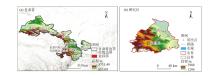
图1
研究区示意图 注:基于自然资源部标准地图服务网站审图号为GS(2024)0650号的标准地图制作,底图边界无修改。"
表1
土地驱动因子及数据来源"
| 数据类型 | 数据名称 | 分辨率 | 数据来源 |
|---|---|---|---|
| 土地利用变化数据 | 2000、2010、2020年土地利用数据 | 30 m | 中国科学院资源环境科学与数据中心( |
| 气象数据 | 年平均气温 | 1 km | 地球资源数据云( |
| 年平均降水量 | 1 km | 地球资源数据云( | |
| 高程数据 | 高程 | 30 m | 地理空间数据云( |
| 坡度 | 30 m | 由ArcGIS计算生成 | |
| 社会经济数据 | 人口密度 | 1 km | 地球资源数据云( |
| GDP | 1 km | 地球资源数据云( | |
| 距主要公路的距离 | 1 km | 全国地理基础信息目录系统( | |
| 距主要铁路的距离 | 1 km | 全国地理基础信息目录系统( | |
| 距水域的距离 | 1 km | 全国地理基础信息目录系统( | |
| 距居民点的距离 | 1 km | 全国地理基础信息目录系统( |
表2
土地利用类型碳密度汇总"
| 土地利用 类型 | 地上生物量碳密度 | 地下生物量碳密度 | 土壤碳密度 | ||||||||
|---|---|---|---|---|---|---|---|---|---|---|---|
| 碳密度 | 参考文献 | 研究范围 | 碳密度 | 参考文献 | 研究范围 | 碳密度 | 参考文献 | 研究范围 | |||
| 耕地 | 5.7 | 李克让等[ | 全国 | 80.7 | 解宪丽等[ | 全国 | 79.5 | 张杰等[ | 西北干旱区 | ||
| 林地 | 42.4 | 解宪丽等[ | 全国 | 115.9 | 解宪丽等[ | 全国 | 158.8 | 张杰等[ | 西北干旱区 | ||
| 草地 | 35.3 | 解宪丽等[ | 全国 | 86.5 | 解宪丽等[ | 全国 | 99.9 | 李克让等[ | 全国 | ||
| 水域 | 3.0 | 陈利军等[ | 全国 | 0.0 | 李克让等[ | 全国 | 0.0 | 张杰等[ | 西北干旱区 | ||
| 建设用地 | 2.5 | 陈利军等[ | 全国 | 0.0 | 包玉斌[ | 西北干旱区 | 0.0 | 张杰等[ | 西北干旱区 | ||
| 未利用地 | 1.3 | 陈利军等[ | 全国 | 0.0 | 包玉斌[ | 西北干旱区 | 21.6 | 张杰等[ | 西北干旱区 | ||
表3
校正后金昌市碳密度数据"
| 土地利用类型 | 植被碳密度 | 根系碳密度 | 土壤碳密度 | 总碳密度 |
|---|---|---|---|---|
| 耕地 | 1.94 | 27.50 | 79.50 | 108.95 |
| 林地 | 14.45 | 39.50 | 158.80 | 212.75 |
| 草地 | 12.03 | 29.48 | 86.62 | 128.13 |
| 水域 | 1.02 | 0.00 | 0.00 | 1.02 |
| 建设用地 | 0.85 | 0.00 | 0.00 | 0.85 |
| 未利用地 | 0.44 | 0.00 | 21.60 | 22.04 |
表4
2030年金昌市多情景预测矩阵"
| 土地利用类型 | 自然发展情景 | 生态保护情景 | 城镇发展情景 | |||||||||||||||
|---|---|---|---|---|---|---|---|---|---|---|---|---|---|---|---|---|---|---|
| 耕地 | 1 | 1 | 1 | 1 | 1 | 1 | 1 | 1 | 1 | 1 | 1 | 1 | 1 | 1 | 1 | 0 | 1 | 1 |
| 林地 | 1 | 1 | 1 | 1 | 1 | 1 | 1 | 1 | 1 | 1 | 0 | 0 | 1 | 1 | 1 | 0 | 1 | 1 |
| 草地 | 1 | 1 | 1 | 1 | 1 | 1 | 1 | 1 | 1 | 1 | 0 | 0 | 1 | 1 | 1 | 1 | 1 | 1 |
| 水域 | 0 | 0 | 0 | 1 | 0 | 0 | 1 | 1 | 1 | 1 | 0 | 0 | 0 | 1 | 1 | 1 | 1 | 0 |
| 建设用地 | 1 | 1 | 1 | 1 | 1 | 1 | 1 | 1 | 1 | 1 | 1 | 1 | 0 | 0 | 0 | 0 | 1 | 0 |
| 未利用地 | 1 | 1 | 1 | 1 | 1 | 1 | 1 | 1 | 1 | 1 | 1 | 1 | 1 | 1 | 1 | 1 | 1 | 1 |
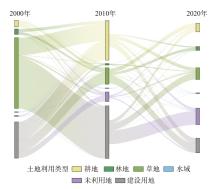
图2
2000—2020年金昌市土地利用转移桑基图"
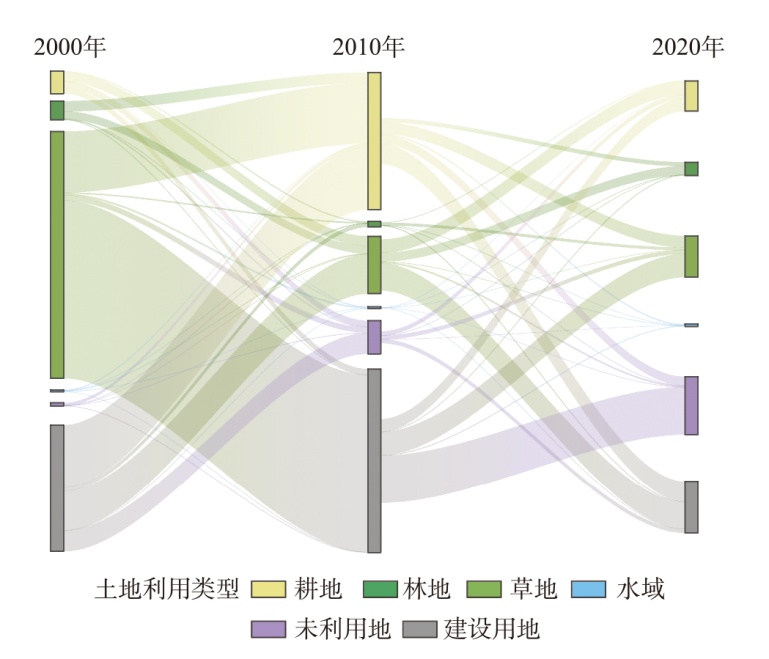
图3
2000—2020年金昌市碳储量分布及变化 注:红框内为碳储量变化明显的区域。"
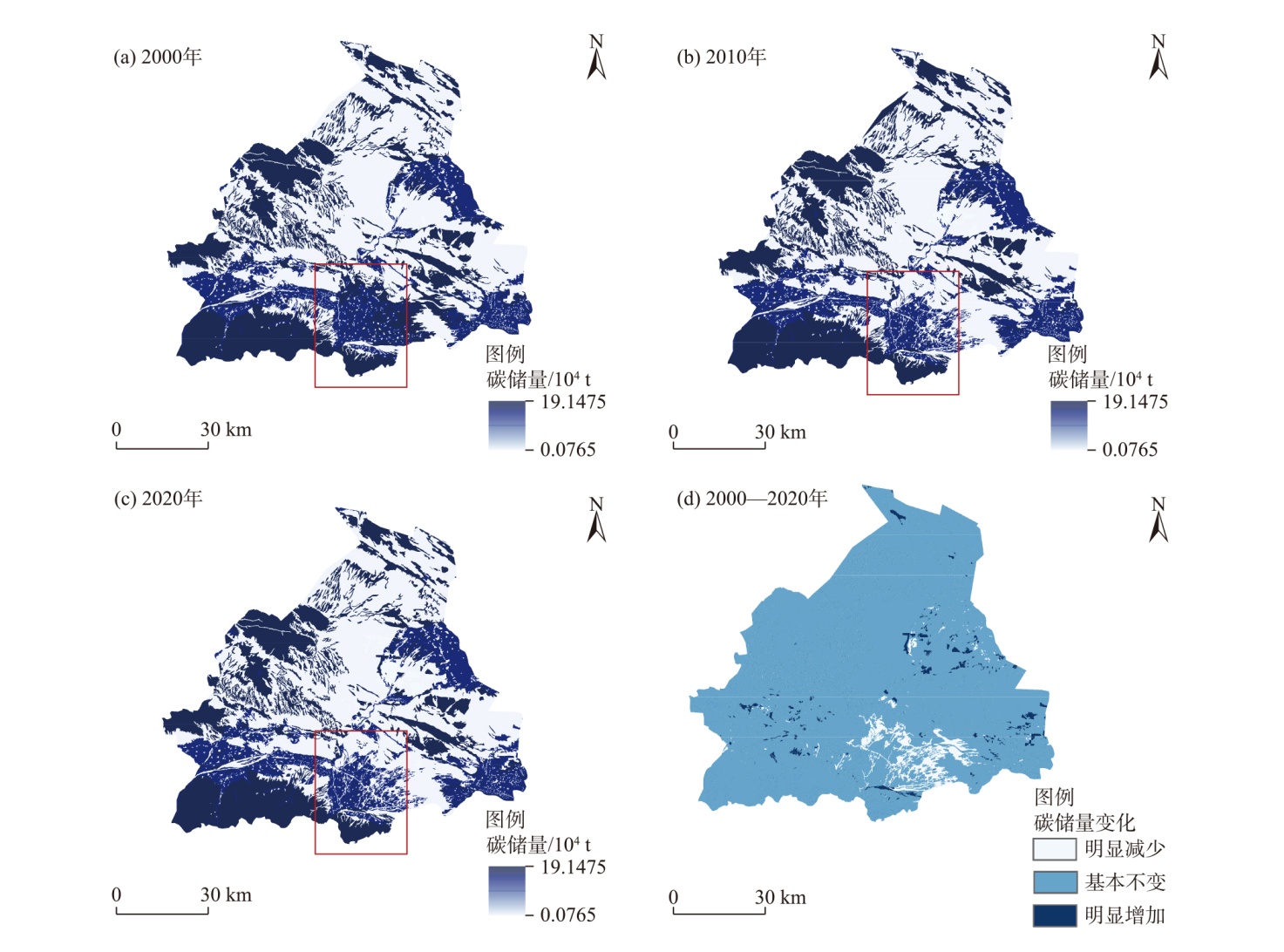
表5
2000—2020年金昌市土地利用变化及其引起的碳储量变化"
| 土地利用变化 | 变化面积/hm2 | 变化面积比例/% | 碳储量变化/104 t | 碳储量小计/104 t | ||
|---|---|---|---|---|---|---|
| 转出 | 转入 | 增加 | 减少 | |||
| 耕地 | 耕地 | 116744.94 | 5.66 | 0.00 | - | -23.35 |
| 林地 | 147.78 | 1.53 | - | |||
| 草地 | 854.64 | 1.64 | - | |||
| 水域 | 88.74 | - | -0.96 | |||
| 建设用地 | 1638.90 | - | -17.72 | |||
| 未利用地 | 903.24 | - | -7.85 | |||
| 林地 | 耕地 | 928.17 | 2.30 | - | -9.64 | -15.73 |
| 林地 | 22474.98 | 0.00 | - | |||
| 草地 | 433.26 | - | -3.67 | |||
| 水域 | 0.90 | - | -0.02 | |||
| 建设用地 | 83.97 | - | -1.78 | |||
| 未利用地 | 33.21 | - | -0.63 | |||
| 草地 | 耕地 | 7913.25 | 54.89 | - | -15.19 | -301.01 |
| 林地 | 406.26 | 3.44 | - | |||
| 草地 | 206308.98 | 0.00 | - | |||
| 水域 | 299.34 | - | -3.81 | |||
| 建设用地 | 1367.01 | - | -17.40 | |||
| 未利用地 | 25266.60 | - | -268.05 | |||
| 水域 | 耕地 | 55.26 | 0.44 | 0.60 | - | 2.12 |
| 林地 | 0.45 | 0.01 | - | |||
| 草地 | 111.24 | 1.41 | - | |||
| 水域 | 5027.13 | 0.00 | - | |||
| 建设用地 | 63.81 | - | -0.001 | |||
| 未利用地 | 49.41 | 0.10 | - | |||
| 建设用地 | 耕地 | 457.47 | 1.15 | 4.95 | - | 7.62 |
| 林地 | 3.60 | 0.08 | - | |||
| 草地 | 189.36 | 2.41 | - | |||
| 水域 | 2.43 | 0.00 | - | |||
| 建设用地 | 13327.29 | 0.00 | - | |||
| 未利用地 | 86.76 | 0.18 | - | |||
| 未利用地 | 耕地 | 8142.12 | 35.57 | 70.76 | - | 124.97 |
| 林地 | 449.91 | 8.58 | - | |||
| 草地 | 5958.09 | 63.21 | - | |||
| 水域 | 84.24 | - | -0.18 | |||
| 建设用地 | 8210.07 | - | -17.40 | |||
| 未利用地 | 333359.01 | 0.00 | - | |||
图4
金昌市驱动因子效果图"
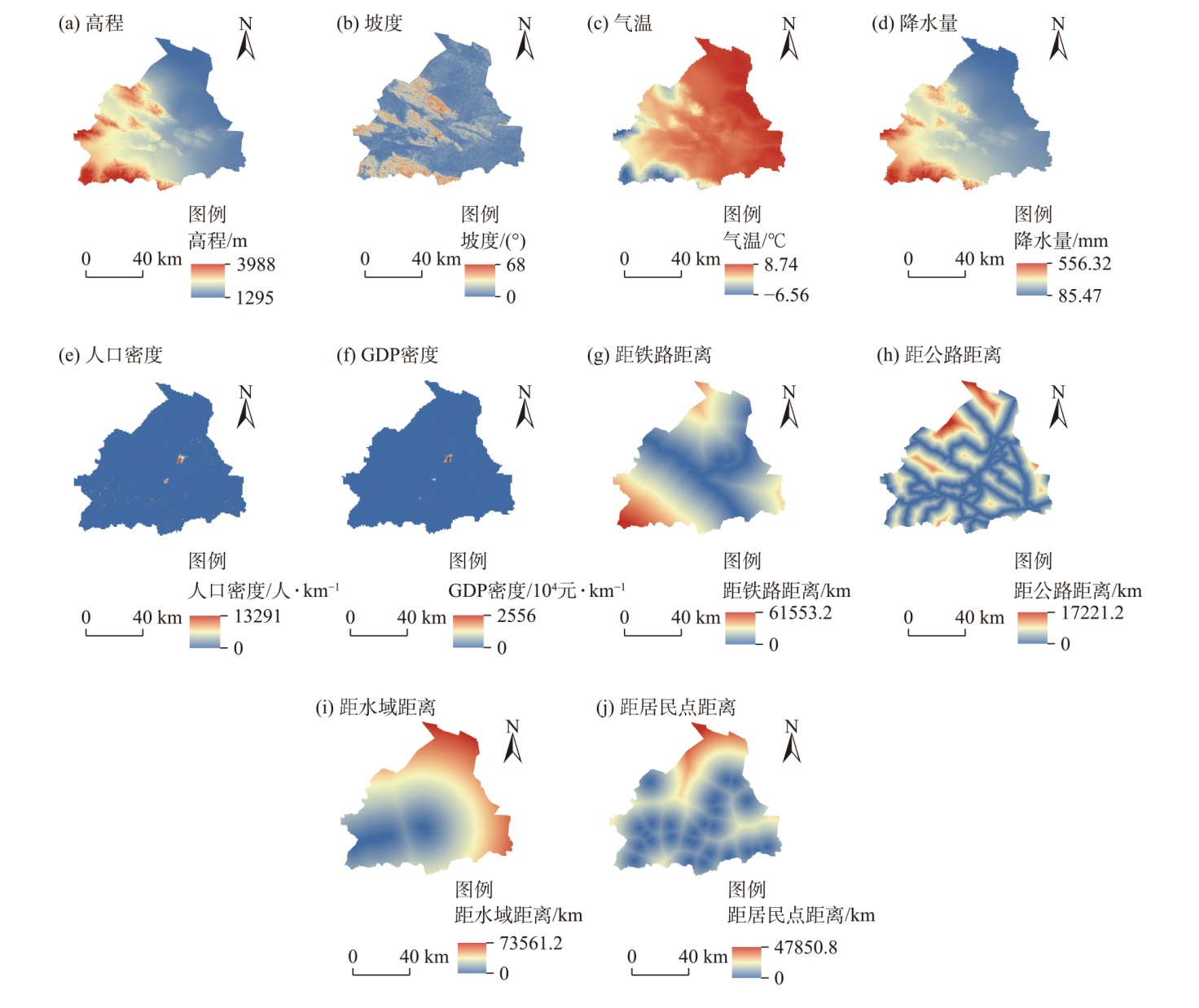
图5
2030年金昌市3种情景下土地利用类型"
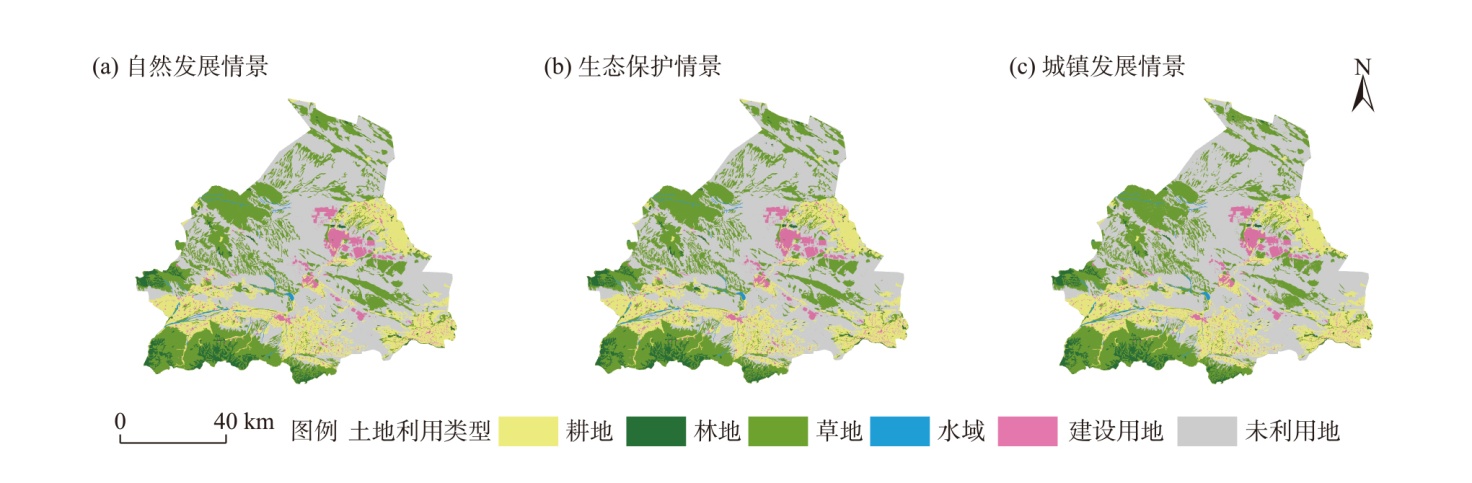
图6
2030年金昌市多情景碳储量分布及变化"
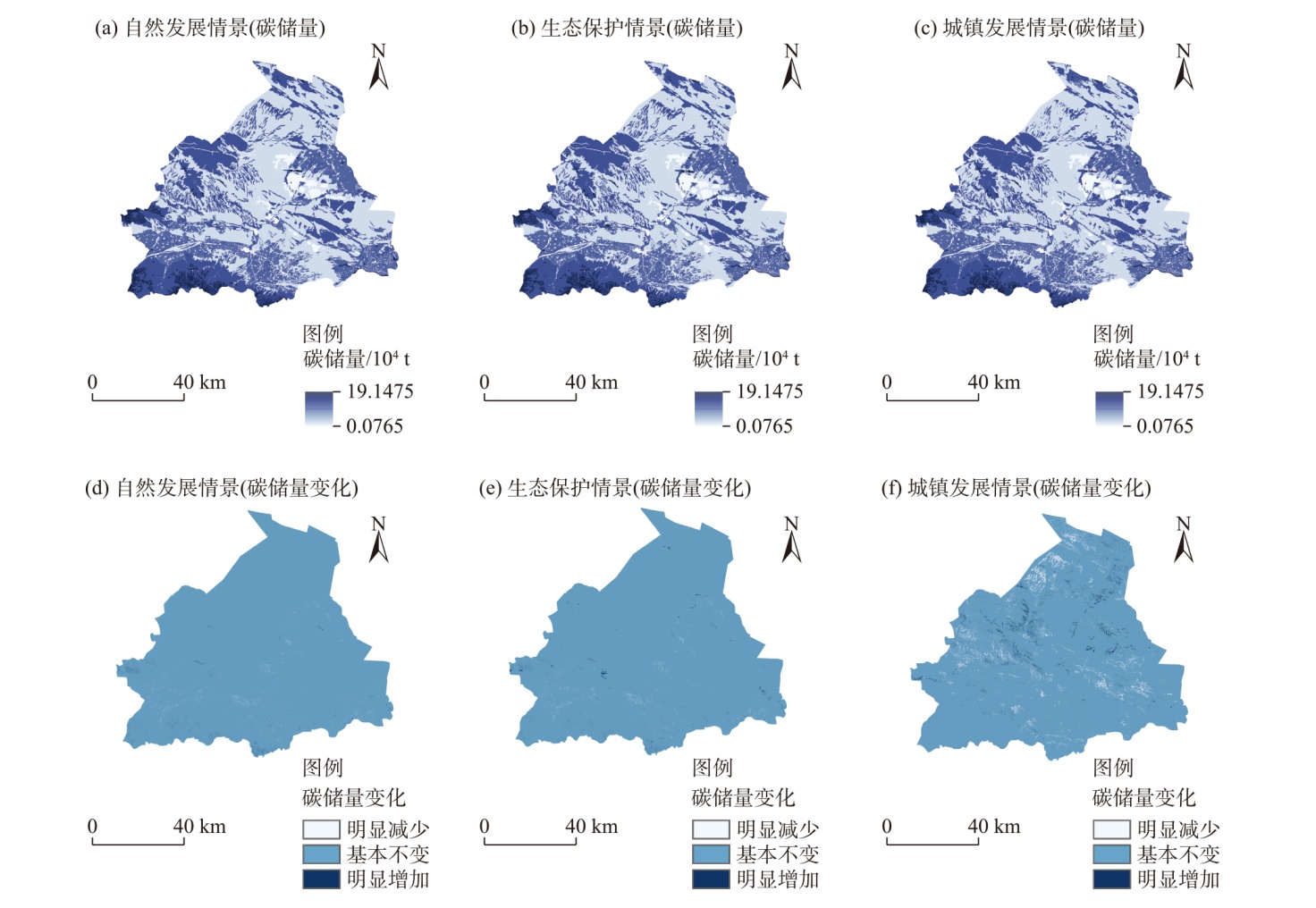
表6
金昌市多情景下各类土地碳储量"
| 土地利用类型 | 2020年碳储量 | 2035年碳储量 | ||
|---|---|---|---|---|
| 自然发展 情景 | 生态保护情景 | 城镇发展情景 | ||
| 耕地 | 146.26 | 144.32 | 143.52 | 145.83 |
| 林地 | 50.05 | 52.75 | 54.02 | 49.37 |
| 草地 | 274.10 | 272.79 | 273.37 | 265.93 |
| 水域 | 0.06 | 0.06 | 0.06 | 0.06 |
| 建设用地 | 0.21 | 0.26 | 0.26 | 0.24 |
| 未利用地 | 79.29 | 78.44 | 78.43 | 80.19 |
| [1] | 石晶, 石培基, 王梓洋, 等. 基于PLUS-InVEST模型的酒泉市生态系统碳储量时空演变与预测[J]. 环境科学, 2024, 45(1): 300-313. |
|
[Shi Jing, Shi Peiji, Wang Ziyang, et al. Spatial-temporal evolution and prediction of carbon storage in Jiuquan City ecosystem based on PLUS-InVEST model[J]. Environmental Science, 2024, 45(1): 300-313.]
doi: 10.1021/es101840s |
|
| [2] | 胡鞍钢. 中国实现2030年前碳达峰目标及主要途径[J]. 北京工业大学学报(社会科学版), 2021, 21(3): 1-15. |
| [Hu Angang. China’s goal of achieving carbon peak by 2030 and its main approaches[J]. Journal of Beijing University of Technology (Social Sciences Edition), 2021, 21(3): 1-15.] | |
| [3] | 刘剑平. 我国资源型城市转型与可持续发展研究[D]. 长沙: 中南大学, 2007. |
| [Liu Jianping. Research on resource-based cities’ transition and sustainable development in China[D]. Changsha: Central South University, 2007.] | |
| [4] | 冯起, 白光祖, 李宗省, 等. 加快构建西北地区生态保护新格局[J]. 中国科学院院刊, 2022, 37(10): 1457-1470. |
| [Feng Qi, Bai Guangzu, Li Zongxing, et al. Accelerate construction of new pattern of ecological protection in northwest China[J]. Bulletin of Chinese Academy of Sciences, 2022, 37(10): 1457-1470.] | |
| [5] |
Wang D, Liu Y, Wu G L, et al. Effect of rest-grazing management on soil water and carbon storage in an arid grassland (China)[J]. Journal of Hydrology, 2015, 527: 754-760.
doi: 10.1016/j.jhydrol.2015.05.036 |
| [6] | Kong J Q, Chen L F. The changes in cropland pattern enhanced carbon storage in northwest China[J]. Agronomy, 2023, 13(11): 2736, doi: 10.3390/agronomy13112736. |
| [7] | 张友国, 白羽洁. 区域差异化“双碳”目标的实现路径[J]. 改革, 2021(11): 1-18. |
| [Zhang Youguo, Bai Yujie. Regional differentiated paths for realizing “double carbon” targets[J]. Reform, 2021(11): 1-18.] | |
| [8] |
张晓明, 宿星, 张军, 等. 基于PLUS-InVEST模型的甘肃通渭滑坡区生境质量时空变化及预测[J]. 干旱区地理, 2025, 48(7): 1220-1232.
doi: 10.12118/j.issn.1000-6060.2024.425 |
|
[Zhang Xiaoming, Su Xing, Zhang Jun, et al. Spatiotemporal variation and prediction of habitat quality in Tongwei landslide area of Gansu Province based on PLUS-InVEST model[J]. Arid Land Geography, 2025, 48(7): 1220-1232.]
doi: 10.12118/j.issn.1000-6060.2024.425 |
|
| [9] |
Yang Y H, Li W H, Zhu C G, et al. Impact of land use/cover changes on carbon storage in a river valley in arid areas of northwest China[J]. Journal of Arid Land, 2017, 9(6): 879-887.
doi: 10.1007/s40333-017-0106-3 |
| [10] |
朱文博, 张静静, 崔耀平, 等. 基于土地利用变化情景的生态系统碳储量评估——以太行山淇河流域为例[J]. 地理学报, 2019, 74(3): 446-459.
doi: 10.11821/dlxb201903004 |
|
[Zhu Wenbo, Zhang Jingjing, Cui Yaoping, et al. Assessment of territorial ecosystem carbon storage based on land use change scenario: A case study in Qihe River Basin[J]. Acta Geographica Sinica, 2019, 74(3): 446-459.]
doi: 10.11821/dlxb201903004 |
|
| [11] | Nelson E, Sander H, Hawthorne P, et al. Projecting global land-use change and its effect on ecosystem service provision and biodiversity with simple models[J]. PloS One, 2010, 5(12): e14327, doi: 10.1371/journal.pone.0014327. |
| [12] | Zhu G F, Qiu D D, Zhang Z X, et al. Land-use changes lead to a decrease in carbon storage in arid region, China[J]. Ecological Indicators, 2021, 127: 107770, doi: 10.1016/j.ecolind.2021.107770. |
| [13] | 郑海岳, 王磊, 魏涛, 等. 基于FLUS-InVEST模型的淮南市土地覆盖模拟与碳储量评估[J/OL]. 环境科学. [2025-03-19]. https://doi.org/10.13227/j.hjkx.202409033. |
| [Zheng Haiyue, Wang Lei, Wei Tao, et al. Land cover simulation and carbon stock assessment in Huainan City based on FLUS-InVEST model[J/OL]. Environmental Science. [2025-03-19]. https://doi.org/10.13227/j.hjkx.202409033.] | |
| [14] | 史名杰, 武红旗, 贾宏涛, 等. 基于MCE-CA-Markov和InVEST模型的伊犁谷地碳储量时空演变及预测[J]. 农业资源与环境学报, 2021, 38(6): 1010-1019. |
| [Shi Mingjie, Wu Hongqi, Jia Hongtao, et al. Temporal and spatial evolution and prediction of carbon stocks in Yili Valley based on MCE-CA-Markov and InVEST models[J]. Journal of Agricultural Resources and Environment, 2021, 38(6): 1010-1019.] | |
| [15] | Wang Z, Zhong A Y, Wei E H, et al. Carbon storage simulation and land use optimization for high-water-table resource-based cities based on the coupled GMOP-PLUS-InVEST model[J]. Remote Sensing, 2024, 16(23): 4480, doi: 10.3390/rs16234480. |
| [16] | 朱志强, 马晓双, 胡洪. 基于耦合FLUS-InVEST模型的广州市生态系统碳储量时空演变与预测[J]. 水土保持通报, 2021, 41(2): 222-229, 239. |
| [Zhu Zhiqiang, Ma Xiaoshuang, Hu Hong. Spatio-temporal evolution and prediction of ecosystem carbon stocks in Guangzhou City by coupling FLUS-InVEST models[J]. Bulletin of Soil and Water Conservation, 2021, 41(2): 222-229, 239.] | |
| [17] | 靳含, 杨爱民, 夏鑫鑫, 等. 基于CA-Markov模型的多时间跨度土地利用变化模拟[J]. 干旱区地理, 2019, 42(6): 1415-1426. |
| [Jin Han, Yang Aimin, Xia Xinxin, et al. Simulation of land use change at different time spans based on CA-Markov model[J]. Arid Land Geography, 2019, 42(6): 1415-1426.] | |
| [18] | 高宇, 刘欢, 鲍立佳, 等. 基于格网和PLUS模型的大西安地区碳排放量估算与模拟[J]. 中国生态农业学报(中英文), 2023, 31(10): 1553-1564. |
| [Gao Yu, Liu Huan, Bao Lijia, et al. Estimation and simulation of carbon emissions in Great Xi’an based on grid and patch-generated land-use simulation models[J]. Chinese Journal of Eco-Agriculture, 2023, 31(10): 1553-1564.] | |
| [19] | 张凯琪, 陈建军, 侯建坤, 等. 耦合InVEST与GeoSOS-FLUS模型的桂林市碳储量可持续发展研究[J]. 中国环境科学, 2022, 42(6): 2799-2809. |
| [Zhang Kaiqi, Chen Jianjun, Hou Jiankun, et al. Study on sustainable development of carbon storage in Guilin coupled with InVEST and GeoSOS-FLUS model[J]. China Environmental Science, 2022, 42(6): 2799-2809.] | |
| [20] | 李建强, 张飞云, 李倩, 等. 基于 PLUS-InVEST模型的新疆土地利用碳排放与碳储量时空演变分析及模拟[J/OL]. 农业资源与环境学报. [2025-03-23]. https://doi.org/10.13254/j.jare.2024.0732. |
| [Li Jianqiang, Zhang Feiyun, Li Qian, et al. Analysis and simulation of the spatial-temporal evolution of carbon emission/storage of land use in Xinjiang based on PLUS-InVEST model[J/OL]. Journal of Agricultural Resources and Environment. [2025-03-23]. https://doi.org/10.13254/j.jare.2024.0732.] | |
| [21] |
李语诗, 夏志业, 张蕾. 基于SSPs多情景目标的2030年成渝经济圈土地利用碳排放预测及其空间优化[J]. 生态环境学报, 2023, 32(3): 535-544.
doi: 10.16258/j.cnki.1674-5906.2023.03.011 |
| [Li Yushi, Xia Zhiye, Zhang Lei. Carbon emission prediction and spatial optimization of land use in Chengdu-Chongqing economic circle in 2030 based on SSPs multi-scenarios[J]. Ecology and Environmental Sciences, 2023, 32(3): 535-544.] | |
| [22] |
付玮, 夏文浩, 樊童生, 等. 塔里木河流域生态系统碳储量的情景预测分析[J]. 干旱区地理, 2024, 47(4): 634-647.
doi: 10.12118/j.issn.1000-6060.2023.274 |
|
[Fu Wei, Xia Wenhao, Fan Tongsheng, et al. Scenario projection analysis of ecosystem carbon stocks in the Tarim River Basin[J]. Arid Land Geography, 2024, 47(4): 634-647.]
doi: 10.12118/j.issn.1000-6060.2023.274 |
|
| [23] | 智菲, 周振宏, 赵铭, 等. 基于PLUS和InVEST模型的合肥市生态系统碳储量时空演变特征[J]. 水土保持学报, 2024, 38(2): 205-215. |
| [Zhi Fei, Zhou Zhenhong, Zhao Ming, et al. Temporal and spatial evolution characteristics of carbon storage in Hefei ecosystem based on PLUS and InVEST models[J]. Journal of Soil and Water Conservation, 2024, 38(2): 205-215.] | |
| [24] | 鲍超, 方创琳. 干旱区水资源对城市化约束强度的时空变化分析[J]. 地理学报, 2008, 63(11): 1140-1150. |
|
[Bao Chao, Fang Chuanglin. Temporal and spatial variations of water resources constraint intensity on urbanization in arid area[J]. Acta Geographica Sinica, 2008, 63(11): 1140-1150.]
doi: 10.11821/xb200811003 |
|
| [25] | Chang G, Liu H, Yin Z, et al. Agricultural production can be a carbon sink: A case study of Jinchang City[J]. Sustainability, 2023, 15(17): 12872, doi: 10.3390/su151712872. |
| [26] | 丛自立. 金昌市尾矿沙漠化土地的综合治理[J]. 中国沙漠, 1997(3): 99-103. |
| [Cong Zili. The control of desertified land with tailings from excavating minerals in Jinchang City[J]. Journal of Desert Research, 1997(3): 99-103.] | |
| [27] | 杲立涛. 河西走廊不同灌溉模式的苜蓿生产效率与效益分析[D]. 兰州: 兰州大学, 2023. |
| [Gao Litao. Analysis of the production efficiency and effectiveness for different irrigation patterns of Alfalfa in Hexi Corridor[D]. Lanzhou: Lanzhou University, 2023.] | |
| [28] | 李克让, 王绍强, 曹明奎. 中国植被和土壤碳贮量[J]. 中国科学(D辑: 地球科学), 2003(1): 72-80. |
| [Li Kerang, Wang Shaoqiang, Cao Mingkui. Vegetation and soil carbon storage in China[J]. Scientia Sinica (Terrae), 2003(1): 72-80.] | |
| [29] | 解宪丽, 孙波, 周慧珍, 等. 中国土壤有机碳密度和储量的估算与空间分布分析[J]. 土壤学报, 2004, 41(1): 35-43. |
| [Xie Xianli, Sun Bo, Zhou Huizhen, et al. Organic carbon density and storage in soils of China and spatial analysis[J]. Acta Pedologica Sinica, 2004, 41(1): 35-43.] | |
| [30] | 陈利军, 刘高焕, 励惠国. 中国植被净第一性生产力遥感动态监测[J]. 遥感学报, 2002, 6(2): 129-135. |
| [Chen Lijun, Liu Gaohuan, Li Huiguo. Estimating net primary productivity of terrestrial vegetation in China using remote sensing[J]. Journal of Remote Sensing, 2002, 6(2): 129-135.] | |
| [31] | 包玉斌. 基于InVEST模型的陕北黄土高原生态服务功能时空变化研究[D]. 西安: 西北大学, 2015. |
| [Bao Yubin. Temporal and spatial changes of ecological services on Loess Plateau of Shaanxi by InVEST model[D]. Xi’an: Northwestern University, 2015.] | |
| [32] | 张杰, 李敏, 敖子强, 等. 中国西部干旱区土壤有机碳储量估算[J]. 干旱区资源与环境, 2018, 32(9): 132-137. |
| [Zhang Jie, Li Min, Ao Ziqiang, et al. Estimation of soil organic carbon storage of terrestrial ecosystem in arid western China[J]. Journal of Arid Land Resources and Environment, 2018, 32(9): 132-137.] | |
| [33] | Zhou J J, Zhao Y R, Huang P, et al. Impacts of ecological restoration projects on the ecosystem carbon storage of inland river basin in arid area, China[J]. Ecological Indicators, 2020, 118: 106803, doi: 10.1016/j.ecolind.2020.106803. |
| [34] |
Tang X L, Zhao X, Bai Y F, et al. Carbon pools in China’s terrestrial ecosystems: New estimates based on an intensive field survey[J]. Proceedings of the National Academy of Sciences, 2018, 115(16): 4021-4026.
doi: 10.1073/pnas.1700291115 |
| [35] | 王保盛, 廖江福, 祝薇, 等. 基于历史情景的FLUS模型邻域权重设置——以闽三角城市群2030年土地利用模拟为例[J]. 生态学报, 2019, 39(12): 4284-4298. |
| [Wang Baosheng, Liao Jiangfu, Zhu Wei, et al. The weight of neighborhood setting of the FLUS model based on a historical scenario: A case study of land use simulation of urban agglomeration of the Golden Triangle of southern Fujian in 2030[J]. Acta Ecologica Sinica, 2019, 39(12): 4284-4298.] | |
| [36] | 黄韬, 刘素红. 基于PLUS-InVEST模型的福建省土地利用变化与碳储量评估[J]. 水土保持学报, 2024, 38(2): 246-257. |
|
[Huang Tao, Liu Suhong. Evaluation of land use change and carbon storage in Fujian Province based on PLUS-InVEST model[J]. Journal of Soil and Water Conservation, 2024, 38(2): 246-257.]
doi: 10.1080/00224561.1983.12436295 |
|
| [37] |
雷馨, 海新权. 耦合PLUS-InVEST模型的兰州市土地利用变化及碳储量经济价值估算[J]. 地理科学, 2025, 45(2): 339-348.
doi: 10.13249/j.cnki.sgs.20230741 |
|
[Lei Xin, Hai Xinquan. Assessing economic value of carbon storage and land use changes based on the coupled PLUS-InVEST model in Lanzhou City[J]. Scientia Geographica Sinica, 2025, 45(2): 339-348.]
doi: 10.13249/j.cnki.sgs.20230741 |
|
| [38] | 张斌, 李璐, 夏秋月, 等. “三线”约束下土地利用变化及其对碳储量的影响——以武汉城市圈为例[J]. 生态学报, 2022, 42(6): 2265-2280. |
| [Zhang Bin, Li Lu, Xia Qiuyue, et al. Land use change and its impact on carbon storage under the constraints of “three lines”: A case study of Wuhan City circle[J]. Acta Ecologica Sinica, 2022, 42(6): 2265-2280.] | |
| [39] | 岑学华. 基于土地利用变化的兰州市生态系统服务时空变化及多情景模拟[D]. 兰州: 西北师范大学, 2024. |
| [Cen Xuehua. Spatial and temporal changes of ecosystem services and multi-scenario simulation in Lanzhou based on land use change[D]. Lanzhou: Northwest Normal University, 2024.] | |
| [40] | 司马文妮. 中国城市化进程中的土地利用问题研究[D]. 咸阳: 西北农林科技大学, 2011. |
| [Sima Wenni. Study on land use during urbanization: A case study of Gansu Province[D]. Xianyang: Northwest A & F University, 2011.] | |
| [41] | 董建红, 张志斌, 笪晓军, 等. “三生”空间视角下土地利用转型的生态环境效应及驱动力——以甘肃省为例[J]. 生态学报, 2021, 41(15): 5919-5928. |
| [Dong Jianhong, Zhang Zhibin, Da Xiaojun, et al. Eco-environmental effects of land use transformation and its driving forces from the perspective of “production-living-ecological” spaces: A case study of Gansu Province[J]. Acta Ecologica Sinica, 2021, 41(15): 5919-5928.] | |
| [42] | 刘梦园. 基于InVEST模型的河西地区碳储量与生境质量评价[D]. 兰州: 兰州大学, 2023. |
| [Liu Mengyuan. Assessment of carbon storage and habitat quality in Hexi region based on InVEST model[D]. Lanzhou: Lanzhou University, 2023.] | |
| [43] | 任玺锦, 裴婷婷, 陈英, 等. 基于碳密度修正的甘肃省土地利用变化对碳储量的影响[J]. 生态科学, 2021, 40(4): 66-74. |
| [Ren Xijin, Pei Tingting, Chen Ying, et al. Impact of land use change on carbon storage in Gansu Province based on carbon density correction[J]. Ecological Sciences, 2021, 40(4): 66-74.] | |
| [44] | 陈宁, 辛存林, 唐道斌, 等. 中国西北地区多情景土地利用优化与碳储量评估[J]. 环境科学, 2023, 44(8): 4655-4665. |
| [Chen Ning, Xin Cunlin, Tang Daobin, et al. Multi-scenario land use optimization and carbon storage assessment in northwest China[J]. Environmental Science, 2023, 44(8): 4655-4665.] |
| [1] | 吴双梅, 周冬梅, 马静, 朱小燕, 张军, 江晶, DONG Qinghan. 不同气候情景下环县柠条锦鸡儿分布及土壤碳储量特征[J]. 干旱区地理, 2025, 48(5): 812-824. |
| [2] | 牛飞飞, 郭靖, 罗杰, 勾雪平, 刘雪薇, 张仁平. 基于GeoSOS-FLUS和InVEST模型的新疆地区土地利用变化模拟及碳储量预测[J]. 干旱区地理, 2025, 48(12): 2169-2182. |
| [3] | 石莹, 别强, 苏晓杰, 李欣璋. 基于InVEST模型的水源涵养功能评价的时空变化——以兰州市为例[J]. 干旱区地理, 2024, 47(9): 1518-1529. |
| [4] | 付玮, 夏文浩, 樊童生, 邹贞, 霍瑜. 塔里木河流域生态系统碳储量的情景预测分析[J]. 干旱区地理, 2024, 47(4): 634-647. |
| [5] | 韩楚翘, 郑江华, 王哲, 于雯婕. 基于PLUS-InVEST模型吐哈盆地陆地生态系统碳储量时空变化及多情景模拟[J]. 干旱区地理, 2024, 47(2): 260-269. |
| [6] | 姜筱筱, 李雪梅, 韩惠, 许民, 凌红波. 甘肃省土地利用转变对碳储量变化的影响研究[J]. 干旱区地理, 2024, 47(12): 2075-2082. |
| [7] | 罗嘉艳, 张靖, 徐梦冉, 莫宇, 同丽嘎. 浑善达克沙地植被变化定量归因及多情景预测[J]. 干旱区地理, 2023, 46(4): 614-624. |
| [8] | 马丽娜, 张飞云, 翟玉鑫, 滕伦, 康建国. 1980—2020年新疆土地利用变化下生态系统服务价值时空演变分析[J]. 干旱区地理, 2023, 46(2): 253-263. |
| [9] | 吕叶,杨涵,黄粤,包安明,昝婵娟,李文静. 咸海流域陆地水储量时空变化研究[J]. 干旱区地理, 2021, 44(4): 943-952. |
| [10] | 王绍娜,宋孝玉,李蓝君,李怀有,李垚林. 黄土高塬沟壑区绿水变化趋势及驱动因素分析[J]. 干旱区地理, 2021, 44(3): 796-806. |
| [11] | 马新萍, 韩申山, 王磊, 王建兴, 许晓婷. 大西安地区土地利用类型时空演变分析[J]. 干旱区地理, 2020, 43(2): 499-507. |
| [12] | 靳含, 杨爱民, 夏鑫鑫, 朱磊, 张青青. 基于CA-Markov模型的多时间跨度土地利用变化模拟[J]. 干旱区地理, 2019, 42(6): 1415-1426. |
| [13] | 王莺莺, 张依婧, 李 飞, 吕 妍. 作物生产潜力变化的区域差异——以陕西省为例[J]. 干旱区地理, 2019, 42(3): 615-624. |
| [14] | 韩强, 薛联青, 刘远洪, 任磊. 塔里木河中上游土地利用变化的径流响应[J]. 干旱区地理, 2017, 40(6): 1165-1170. |
| [15] | 王丹, 吴世新, 张寿雨. 新疆20世纪80年代末以来耕地与建设用地扩张分析[J]. 干旱区地理, 2017, 40(1): 188-196. |
|
||