干旱区地理 ›› 2026, Vol. 49 ›› Issue (3): 429-439.doi: 10.12118/j.issn.1000-6060.2025.291 cstr: 32274.14.ALG2025291
刘法建( ), 梁婉欣, 黄超群(), 李松渊, 张博涵
收稿日期:2025-05-22
修回日期:2025-07-01
出版日期:2026-03-25
发布日期:2026-03-24
通讯作者:
黄超群(2000-),男,博士研究生,主要从事旅游可持续发展等方面的研究. E-mail: 13095520657@163.com作者简介:刘法建(1982-),男,博士,教授,主要从事区域旅游发展、乡村旅游、旅游创新创业等方面的研究. E-mail: 12027@ahu.edu.cn
基金资助:
LIU Fajian(), LIANG Wanxin, HUANG Chaoqun(), LI Songyuan, ZHANG Bohan
Received:2025-05-22
Revised:2025-07-01
Published:2026-03-25
Online:2026-03-24
摘要:
加快发展旅游新质生产力是实现旅游业高质量发展的有效路径。基于2011—2023年中国30个省(自治区、直辖市)(除西藏和港澳台以外)的面板数据,从旅游高科技、旅游高效能、旅游高质量和旅游绿色化4个维度构建旅游新质生产力发展水平测度指标,运用综合评价法、Dagum基尼系数法及动态定性比较分析(QCA)法分析其时空特征与驱动机制。结果显示:(1)2011—2023年全国各省(自治区、直辖市)旅游新质生产力发展水平呈增长趋势,但区域间不均衡显著,东部地区领先,中部地区次之,西部和东北地区滞后。(2)“十二五”到“十四五”前期,东部、中部、西部及东北地区的旅游新质生产力发展差距不断缩小,但区域内差异仍显著。(3)经济发展水平、技术进步程度是旅游新质生产力发展水平的主要影响因素,形成经济-市场-政策驱动在内的多种驱动模式。研究结果为各区域提高旅游新质生产力发展水平、实现高质量发展提供实践指导。
刘法建, 梁婉欣, 黄超群, 李松渊, 张博涵. 中国旅游新质生产力发展时空演化特征与驱动因素[J]. 干旱区地理, 2026, 49(3): 429-439.
LIU Fajian, LIANG Wanxin, HUANG Chaoqun, LI Songyuan, ZHANG Bohan. Spatiotemporal evolution characteristics and driving factors of tourism new quality productivity development in China[J]. Arid Land Geography, 2026, 49(3): 429-439.
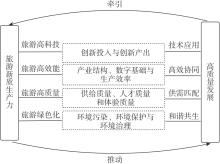
图1
旅游新质生产力理论框架"
表1
旅游新质生产力发展水平测度指标"
| 准则层 | 要素层 | 指标层 | 指标说明 | 属性 |
|---|---|---|---|---|
| 旅游高科技 | 创新投入 | 旅游业R&D经费 | 全社会R&D经费数额×旅游业产值占GDP比重 | + |
| 从事旅游R&D人员数 | R&D人员数×旅游业产值占GDP比重 | + | ||
| 创新产出 | 旅游产业劳动生产率 | 旅游总收入/旅游直接从业人员数 | + | |
| 旅游资本生产率 | 旅游总收入/旅游固定资产投资 | + | ||
| 旅游专利授权数 | 专利授权数×旅游业产值占GDP比重 | + | ||
| 旅游高效能 | 产业结构 | 旅游产业结构合理化指数 | 泰尔指数 | - |
| 旅游产业结构高级化指数 | 第三产业产值/第二产业产值 | + | ||
| 数字基础 | 光缆线路长度 | 光缆铺设总长度 | + | |
| 互联网宽带接入端口数 | 互联网普及情况 | + | ||
| 移动电话普及率 | 电话普及情况 | + | ||
| 生产效率 | 旅游全要素生产率 | 全要素生产率指数 | + | |
| 旅游高质量 | 供给质量 | 旅行社供给 | 旅行社数量 | + |
| 旅游景区供给 | 高级别景区数量 | + | ||
| 四星级和五星级的饭店数量 | 四星级和五星级酒店之和 | + | ||
| 交通供给 | 铁路网络密度+公路网络密度 | + | ||
| 人才质量 | 人才培养机构 | 旅游院校数 | + | |
| 人才培养规模 | 旅游院校在校学生数 | + | ||
| 体验质量 | 游客满意度 | 网络关注度(百度指数) | + | |
| 旅游绿色化 | 环境污染 | 旅游产业废气排放量 | 废气排放量与旅游收入占GDP比重的乘积 | - |
| 旅游产业废水排放量 | 废水排放量与旅游收入占GDP比重的乘积 | - | ||
| 旅游产业固体废物排放量 | 废物排放量与旅游收入占GDP比重的乘积 | - | ||
| 环境保护 | 人均公园绿地面积 | 公园绿地面积人均占有量 | + | |
| 建成区绿地覆盖率 | 绿化覆盖面积占建成区的百分比 | + | ||
| 环境治理 | 生活垃圾无害化处理率 | 生活垃圾无害化处理能力 | + | |
| 污水处理率 | 污水处理能力 | + | ||
| 环保投资率 | 环保投资占地区GDP的比重 | + |
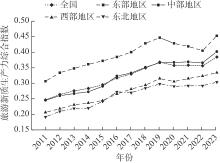
图2
2011—2023年中国旅游新质生产力时序演变"
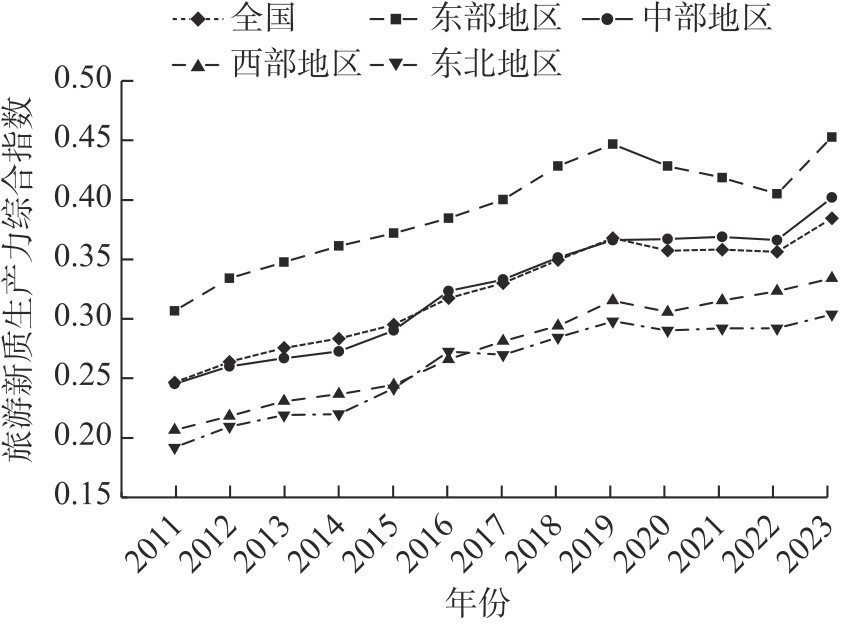
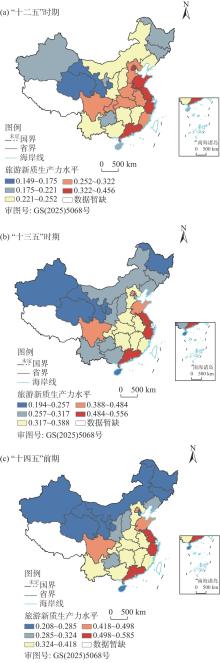
图3
2011—2023年中国旅游新质生产力空间分布"
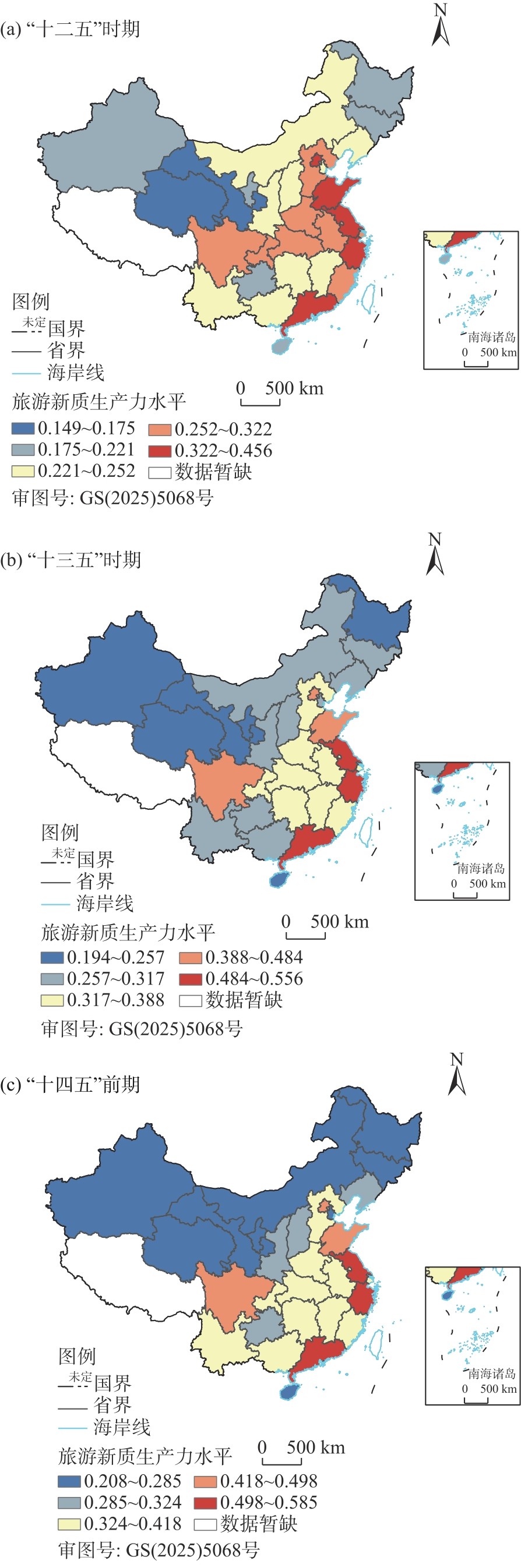
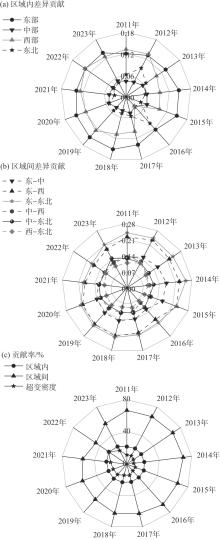
图4
4个区域旅游新质生产力Dagum基尼系数"
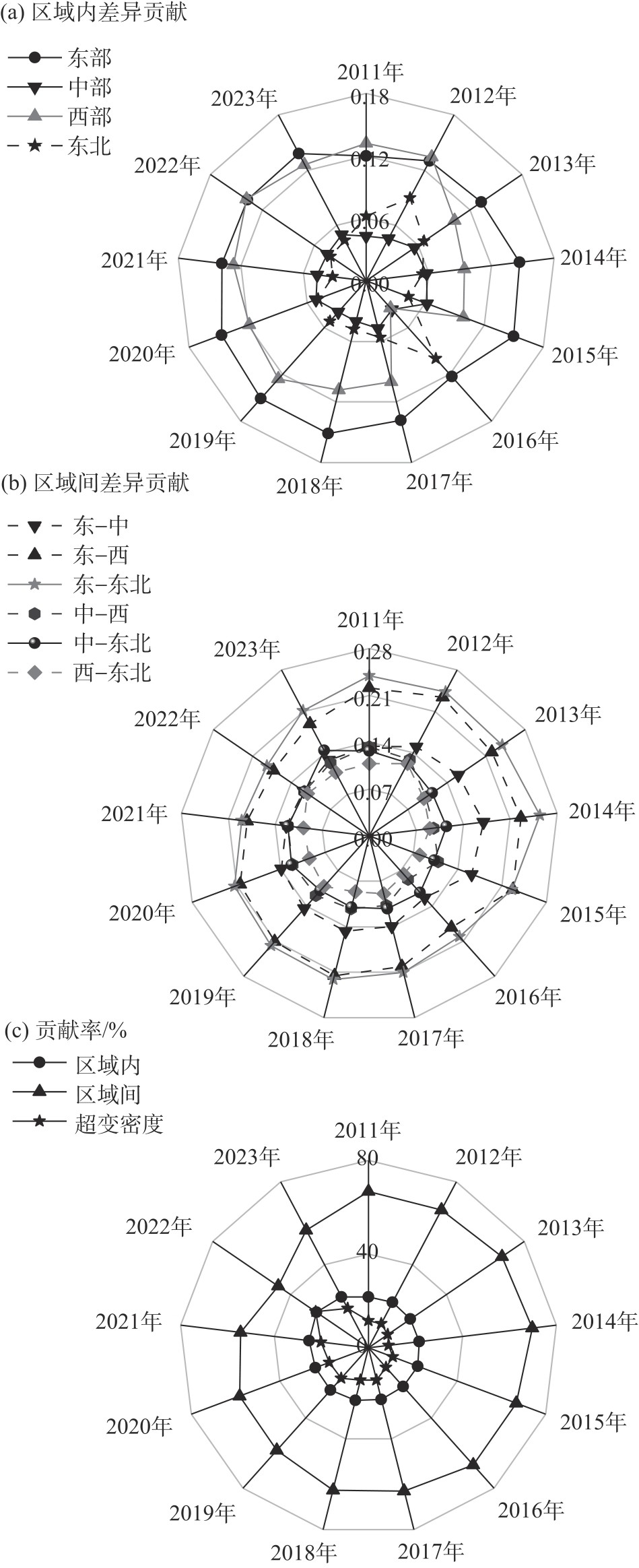
表2
旅游新质生产力影响因素指标选取"
| 变量类型 | 衡量指标 | 指标释义 |
|---|---|---|
| 经济因素 | 人均生产总值(X1) | 地区生产总值/总人口 |
| 产业因素 | 第三产业占比(X2) | 第三产业增加值/地区生产总值 |
| 市场因素 | 樊纲指数(X3) | 通过政府与市场关系、非国有经济发展、产品市场的发育程度、要素市场的发育程度、市场中介组织的发育和法律制度环境计算得出 |
| 政府因素 | 社会固定资产投资额(X4) | 第三产业固定资产投资/地区生产总值 |
| 技术因素 | 信息化水平(X5) | 科研支出/地方财政支出 |
| 政策因素 | 对外开放水平(X6) | 外商直接投资额/地区生产总值 |
表3
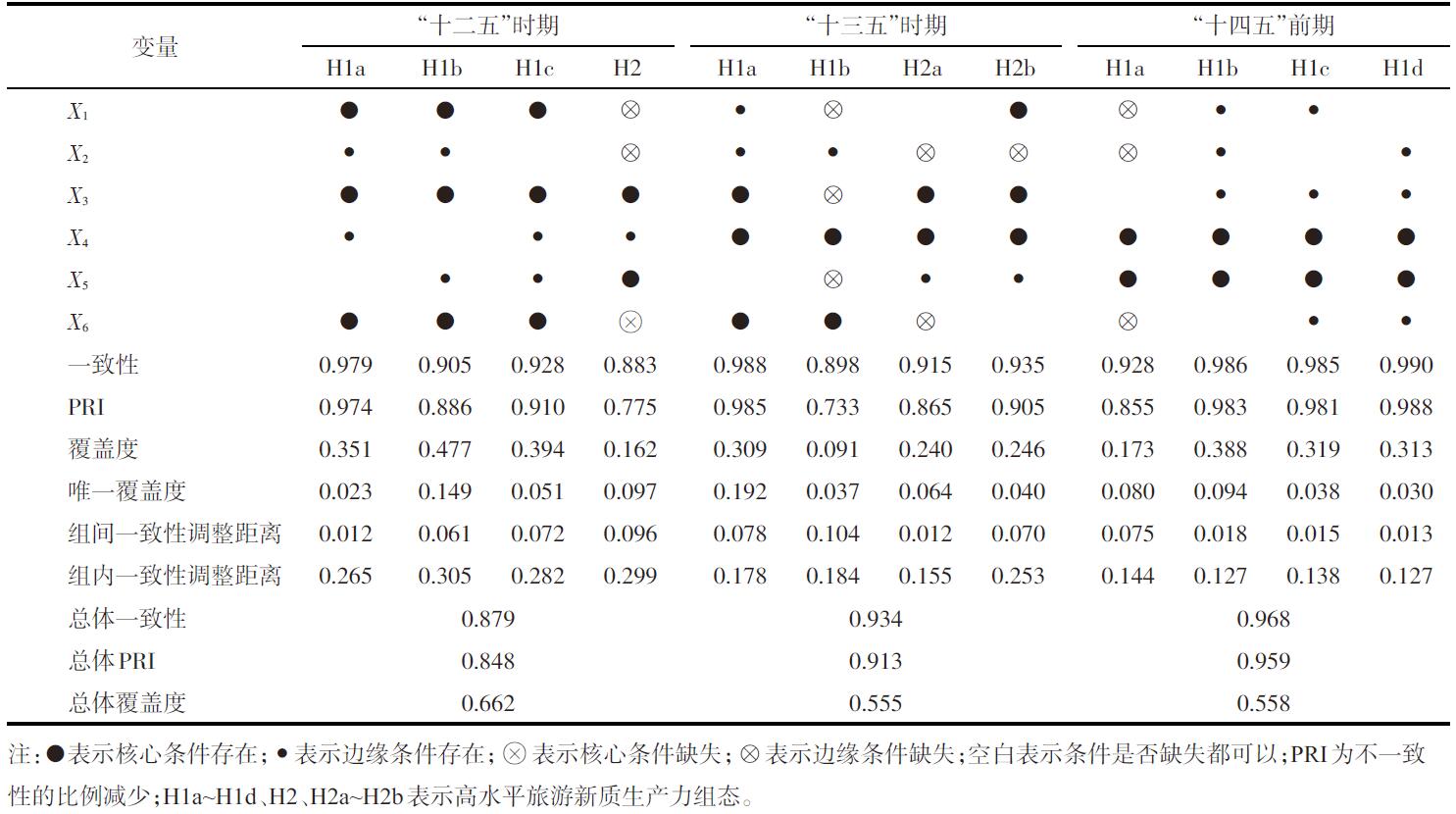
3个时期前因条件组态分析"
 |
| [1] | 李志远, 夏赞才. 长江经济带旅游业高质量发展水平测度及失配度时空格局探究[J]. 南京师大学报(自然科学版), 2021, 44(4): 33-42. |
| [Li Zhiyuan, Xia Zancai. The measurement of high-quality development level of tourism and the spatial-temporal pattern of mismatch degree in the Yangtze River Economic Belt[J]. Journal of Nanjing Normal University (Natural Science Edition), 2021, 44(4): 33-42.] | |
| [2] | 李军, 刘帅芳, 周碧蕾. 新时代协同治理与创新视角下粤澳文旅高质量融合发展的路径探赜[J]. 旅游学刊, 2024, 39(12): 4-7. |
| [Li Jun, Liu Shuaifang, Zhou Bilei. Exploring the path to high-quality integrated development of Guangdong-Macao cultural and tourism from the perspective of collaborative governance and innovation in the new era[J]. Tourism Tribune, 2024, 39(12): 4-7.] | |
| [3] | 厉新建, 曾博伟, 张辉, 等. 新质生产力与旅游业高质量发展[J]. 旅游学刊, 2024, 39(5): 15-29. |
| [Li Xinjian, Zeng Bowei, Zhang Hui, et al. New quality productive forces and high-quality development in tourism: Problems, cognition and optimization direction[J]. Tourism Tribune, 2024, 39(5): 15-29.] | |
| [4] | 任保平, 豆渊博. 新质生产力: 文献综述与研究展望[J]. 经济与管理评论, 2024, 40(3): 5-16. |
| [Ren Baoping, Dou Yuanbo. New quality productivity: Literature review and research outlook[J]. Review of Economy and Management, 2024, 40(3): 5-16.] | |
| [5] | 余正勇. 旅游业新质生产力: 概念内涵、价值意蕴及培育路径[J]. 燕山大学学报(哲学社会科学版), 2024, 25(4): 61-68, 96. |
| [Yu Zhengyong. Restraining mechanism of responsible leadership to silent behavior of civil servants: Mediating regulation model from the perspective of social identity[J]. Journal of Yanshan University (Philosophy and Social Science Edition), 2024, 25(4): 61-68, 96.] | |
| [6] |
杨勇. 旅游新质生产力: 供需特质、创新取向与新旧之辨[J]. 旅游导刊, 2024, 8(3): 48-57.
doi: 10.12054/lydk.bisu.269 |
| [Yang Yong. New quality productive forces of tourism: Supply and demand characteristics, innovation orientation, and the debate over the old and the new[J]. Tourism and Hospitality Prospects, 2024, 8(3): 48-57.] | |
| [7] |
孙九霞, 王钰宁. 数智力视角下的新质生产力与新质旅游目的地塑造[J]. 地理科学, 2025, 45(1): 70-81.
doi: 10.13249/j.cnki.sgs.20240652 |
| [Sun Jiuxia, Wang Yuning. New quality productive forces and the shaping of new quality tourism destinations in the perspective of digital intelligence[J]. Geographical Science, 2025, 45(1): 70-81.] | |
| [8] |
谢晓如, 朱竑, 胡蕊纯, 等. 旅游新质生产力及其对地方的作用机制——基于视频化社交媒体场域的案例研究[J]. 地理科学, 2025, 45(1): 92-105.
doi: 10.13249/j.cnki.sgs.20240655 |
| [Xie Xiaoru, Zhu Hong, Hu Ruichun, et al. New quality productive force of tourism and its mechanism on place: A case study of the field of video-based social media[J]. Geographical Science, 2025, 45(1): 92-105.] | |
| [9] | 杨建春, 李开潮. 新质生产力赋能旅游业高质量发展: 理论逻辑与实践路径[J]. 云南民族大学学报(哲学社会科学版), 2024, 41(6): 139-146. |
| [Yang Jianchun, Li Kaichao. New-quality productivity empowering the high-quality of tourism: Theoretical logic and practical approaches[J]. Journal of Yunnan Minzu University (Philosophy and Social Sciences Edition), 2024, 41(6): 139-146.] | |
| [10] |
王金伟, 陆林, 王兆峰, 等. 新质生产力赋能旅游业高质量发展: 理论内涵与科学问题[J]. 自然资源学报, 2024, 39(7): 1643-1663.
doi: 10.31497/zrzyxb.20240709 |
|
[Wang Jinwei, Lu Lin, Wang Zhaofeng, et al. Empowering the high-quality development of tourism with new quality productive forces[J]. Journal of Natural Resources, 2024, 39(7): 1643-1663.]
doi: 10.31497/zrzyxb.20240709 |
|
| [11] |
朱怡婷, 梁桂仙, 周春山, 等. 新疆文旅新质生产力发展时空演变特征与驱动因素[J]. 干旱区地理, 2026, 49(1): 128-139.
doi: 10.12118/j.issn.1000-6060.2024.785 |
|
[Zhu Yiting, Liang Guixian, Zhou Chunshan, et al. Spatio-temporal evolution characteristics and driving factors of new quality productive forces development of cultural tourism in Xinjiang[J]. Arid Land Geography, 2026, 49(1): 128-139.
doi: 10.12118/j.issn.1000-6060.2024.785 |
|
| [12] | 王明月, 陈大恩. 新质生产力助推新能源产业高质量发展的理论逻辑与创新路径[J]. 中州学刊, 2024(12): 39-46. |
| [Wang Mingyue, Chen Daen. The theoretical logic and innovation path of new quality productivity promoting high-quality development of new energy industry[J]. Academic Journal of Zhongzhou, 2024(12): 39-46.] | |
| [13] |
刘沛林, 徐硕. 文旅新质生产力: 内涵审视、支撑向度与实践路径[J]. 旅游导刊, 2024, 8(3): 34-47.
doi: 10.12054/lydk.bisu.274 |
| [Liu Peilin, Xu Shuo. New quality productive forces of cultural tourism: Connotation review, support dimensions, and practical path[J]. Tourism and Hospitality Prospects, 2024, 8(3): 34-47.] | |
| [14] |
田小波. 黄河流域城市旅游业高质量发展水平测度与空间格局特征[J]. 干旱区地理, 2025, 48(9): 1660-1671.
doi: 10.12118/j.issn.1000-6060.2024.103 |
|
[Tian Xiaobo. Measurement and spatial pattern characteristics of high-quality development level of urban tourism in the Yellow River Basin[J]. Arid Land Geography, 2025, 48(9): 1660-1671.]
doi: 10.12118/j.issn.1000-6060.2024.103 |
|
| [15] | 蒋永穆, 乔张媛. 新质生产力发展评价指标体系构建[J]. 经济体制改革, 2024(3): 5-15. |
| [Jiang Yongmu, Qiao Zhangyuan. Construction of evaluation index system for new quality productive forces development[J]. Reform of Economic System, 2024(3): 5-15.] | |
| [16] |
李旭辉, 陈梦伟, 王经伟. 省域数字化与绿色化协同发展评价、时空特征及其影响因素[J]. 经济地理, 2024, 44(7): 126-134.
doi: 10.15957/j.cnki.jjdl.2024.07.013 |
|
[Li Xuhui, Chen Mengwei, Wang Jingwei. Evaluation, spatiotemporal characteristics and influencing factors of collaborative development between digitalization and greenization at the provincial level[J]. Economic Geography, 2024, 44(7): 126-134.]
doi: 10.15957/j.cnki.jjdl.2024.07.013 |
|
| [17] | 申鹏鹏, 周年兴, 张允翔, 等. 基于DEA-Malmquist指数二次分解模型的江苏省旅游产业效率时空演变及影响因素[J]. 长江流域资源与环境, 2018, 27(1): 53-62. |
| [Shen Pengpeng, Zhou Nianxing, Zhang Yunxiang, et al. Spatio-temporal evolution and influencing factors of tourism industry efficiency in Jiangsu Province based on DEA-malmquist index secondary decomposition model[J]. Resources and Environment in the Yangtze Basin, 2018, 27(1): 53-62.] | |
| [18] | 刘春济, 冯学钢, 高静. 中国旅游产业结构变迁对旅游经济增长的影响[J]. 旅游学刊, 2014, 29(8): 37-49. |
| [Liu Chunji, Feng Xuegang, Gao Jing. Changes in the structure of the tourism industry and their effect on the growth of the tourism economy in China[J]. Tourism Tribune, 2014, 29(8): 37-49.] | |
| [19] |
查建平, 钱醒豹, 赵倩倩, 等. 中国旅游全要素生产率及其分解研究[J]. 资源科学, 2018, 40(12): 2461-2474.
doi: 10.18402/resci.2018.12.13 |
|
[Cha Jianping, Qian Xingbao, Zhao Qianqian, et al. Estimation and decomposition of total factors productivity of China’s tourism[J]. Resources Science, 2018, 40(12): 2461-2474.]
doi: 10.18402/resci.2018.12.13 |
|
| [20] | 张凌云. 困境与超越: 旅游统计问题的几点思考[J]. 旅游学刊, 2016, 31(4): 20-22. |
| [Zhang Lingyun. Dilemma and transcendence: Reflections on tourism statistics issues[J]. Tourism Tribune, 2016, 31(4): 20-22.] | |
| [21] |
生延超, 吴昕阳. 游客满意度的网络关注度演变及空间差异[J]. 经济地理, 2019, 39(2): 232-240.
doi: 10.15957/j.cnki.jjdl.2019.02.028 |
|
[Sheng Yanchao, Wu Xinyang. Temporal and spatial characteristics of network attention on tourist satisfaction in China[J]. Economic Geography, 2019, 39(2): 232-240.]
doi: 10.15957/j.cnki.jjdl.2019.02.028 |
|
| [22] | 项久雨. 美好生活与人的现代化[J]. 马克思主义研究, 2025(3): 30-38, 150-151. |
| [Xiang Jiuyu. Better life and the modernization of human[J]. Studies on Marxism, 2025(3): 30-38, 150-151.] | |
| [23] |
任以胜, 侯颖, 陆林. 中国式现代化建设中文旅深度融合的理论内涵与研究框架[J]. 自然资源学报, 2025, 40(4): 1068-1083.
doi: 10.31497/zrzyxb.20250412 |
|
[Ren Yisheng, Hou Ying, Lu Lin. Theoretical connotation and research framework of deep integration of culture and tourism in Chinese-style modernization construction[J]. Journal of Natural Resources, 2025, 40(4): 1068-1083.]
doi: 10.31497/zrzyxb.20250412 |
|
| [24] | 刘佳, 宋秋月. 中国旅游产业绿色创新效率的空间网络结构与形成机制[J]. 中国人口·资源与环境, 2018, 28(8): 127-137. |
| [Liu Jia, Song Qiuyue. Space network structure and formation mechanism of green innovation efficiency of tourism industry in China[J]. China Population, Resources and Environment, 2018, 28(8): 127-137.] | |
| [25] | 孙超, 武普照, 丁文文. 政府环境治理对区域创新的影响研究[J]. 南开经济研究, 2022(12): 187-208. |
| [Sun Chao, Wu Puzhao, Ding Wenwen. Study on the impact of government environmental governance on regional innovation level: And discuss the incentive and competition of environmental governance of local officials[J]. Nankai Economic Studies, 2022(12): 187-208.] | |
| [26] | 吴忠, 关娇, 何江. 最低工资标准测算实证研究——基于CRITIC-熵权法客观赋权的动态组合测算[J]. 当代经济科学, 2019, 41(3): 103-117. |
| [Wu Zhong, Guan Jiao, He Jiang. An empirical study on the calculation of minimum wage standard-dynamic combination calculation based on objective weight of CRITIC-entropy weight method[J]. Modern Economic Science, 2019, 41(3): 103-117.] | |
| [27] |
Dagum C. A new approach to the decomposition of the Gini income inequality ratio[J]. Empirical Economics, 1997, 22: 515-531.
doi: 10.1007/BF01205777 |
| [28] | 荆玲玲, 黄慧丽. 时空双维下数字创新生态系统对区域创新能力的激发与影响研究——基于省域面板数据的动态QCA分析[J]. 科技进步与对策, 2024, 41(16): 13-23. |
| [Jing Lingling, Huang Huili. The stimulation and impact of digital innovation ecosystem on regional innovation capability in two dimensions of time and space: A dynamic QCA analysis based on provincial panel data[J]. Science & Technology Progress and Policy, 2024, 41(16): 13-23.] | |
| [29] |
方恺, 何坚坚, 张佳琪. 博台线作为中国区域发展均衡线的佐证分析——以城市温室气体排放为例[J]. 地理学报, 2021, 76(12): 3090-3102.
doi: 10.11821/dlxb202112015 |
|
[Fang Kai, He Jianjian, Zhang Jiaqi. Analysis of the Bole-Taipei line as the divide for regional coordinated development: Evidence from greenhouse gas emissions of Chinese cities[J]. Acta Geographica Sinica, 2021, 76(12): 3090-3102.]
doi: 10.11821/dlxb202112015 |
|
| [30] | 王磊, 栗向阳, 王雪利, 等. 长江经济带生活性服务业发展水平的空间格局及驱动因素[J]. 长江流域资源与环境, 2022, 31(10): 2109-2121. |
| [Wang Lei, Li Xiangyang, Wang Xueli, et al. Spatial pattern and driving factors of consumer service industry development in Yangtze River Economic Belt[J]. Resources and Environment in the Yangtze Basin, 2022, 31(10): 2109-2121.] | |
| [31] | 李燕萍, 李乐. 人力资源服务业高质量发展评价指标体系及测度研究——基于2012—2020年中国数据的实证[J]. 宏观质量研究, 2022, 10(5): 1-14. |
| [Li Yanping, Li Le. A study on the evaluation of the high-quality human resource service industry development: An empirical study based on data from 2012—2020 in China[J]. Journal of Macro-quality Research, 2022, 10(5): 1-14.] | |
| [32] | 樊纲, 王小鲁, 马光荣. 中国市场化进程对经济增长的贡献[J]. 经济研究, 2011, 46(9): 4-16. |
| [Fan Gang, Wang Xiaolu, Ma Guangrong. Contribution of marketization to China’s economic growth[J]. Economic Research Journal, 2011, 46(9): 4-16.] | |
| [33] | 刘佳, 安珂珂, 刘宁, 等. 区域旅游产业结构优化的影响因素与组态路径——基于面板回归与fsQCA的分析[J]. 华侨大学学报(哲学社会科学版), 2022(6): 58-73. |
| [Liu Jia, An Keke, Liu Ning, et al. Influencing factors and configuration path of regional tourism industrial structure optimization in China based on panel regression and fsQCA[J]. Journal of Huaqiao University (Philosophy & Social Sciences Edition), 2022(6): 58-73.] | |
| [34] | 王丽丽, 刘笑杰, 李丁, 等. 黄河流域PM2.5时空特征及驱动因素[J]. 兰州大学学报(自然科学版), 2022, 58(4): 427-435, 442. |
| [Wang Lili, Liu Xiaojie, Li Ding, et al. Spatial-temporal characteristics and drivers of PM2.5 in the Yellow River Basin[J]. Journal of Lanzhou University (Natural Sciences Edition), 2022, 58(4): 427-435, 442.] | |
| [35] |
盛亚, 冯媛媛, 施宇. 政府科研机构科技资源配置效率影响因素组态分析[J]. 科技进步与对策, 2022, 39(8): 1-9.
doi: 10.6049/kjjbydc.C202107360 |
| [Sheng Ya, Feng Yuanyuan, Shi Yu. Configuration analysis of influencing factors on allocation efficiency of scientific and technological resources in government scientific research institutions[J]. Science & Technology Progress and Policy, 2022, 39(8): 1-9.] |
| [1] | 白洋, 陈明珠, 周春山, 李亚茹, 唐诚. 中国旅游新质生产力的演化测度与障碍识别[J]. 干旱区地理, 2026, 49(2): 211-223. |
| [2] | 朱怡婷, 梁桂仙, 周春山, 辛龙, 李金雪. 新疆文旅新质生产力发展时空演变特征与驱动因素[J]. 干旱区地理, 2026, 49(1): 128-139. |
| [3] | 刘全渝, 刘馨璐, 李桂真, 李从娟. 新疆表层土壤粒径分形特征及驱动因素分析[J]. 干旱区地理, 2026, 49(1): 56-68. |
| [4] | 张飞, 李建, 李慧融, 谢涛, 张雪红, 王超, 白淑英, 宋正姗. 2001—2024年锡林郭勒盟草原净初级生产力时空特征及对影响因子的响应[J]. 干旱区地理, 2025, 48(9): 1555-1566. |
| [5] | 刘艺欣, 裴婷婷, 陈英, 谢保鹏. 基于县域尺度的甘肃省乡村振兴发展水平测度及时空分异[J]. 干旱区地理, 2025, 48(9): 1683-1693. |
| [6] | 王鑫, 郑芳, 何铃瑶, 何浩亮, 侯迎. 宁夏县域共同富裕水平时空分异格局及驱动因素研究[J]. 干旱区地理, 2025, 48(7): 1293-1303. |
| [7] | 任诗琦, 王永瑜. 黄河流域地级市绿色发展水平测度与空间收敛性研究[J]. 干旱区地理, 2025, 48(6): 1031-1042. |
| [8] | 王佩佩, 王娇, 蔡咏梅. 多尺度视域下中国滑雪场空间分异格局及其驱动因素研究[J]. 干旱区地理, 2025, 48(6): 1080-1088. |
| [9] | 马晓敏, 张志斌, 郭倩倩, 赵学伟, 张宁. 2000—2020年兰州市人口时空格局演变及驱动因素分析[J]. 干旱区地理, 2025, 48(1): 168-178. |
| [10] | 徐晓亮, 刘旭义, 关靖云, 杨晶晶, 王明辰, 暴龙飞. 中国西部边疆民族地区文旅融合高质量发展时空演化及驱动因素分析[J]. 干旱区地理, 2024, 47(9): 1596-1605. |
| [11] | 李稚, 朱成刚, 汪家友, 刘永昌, 王川, 张雪琪, 韩诗茹, 方功焕. 东昆仑库木库里盆地典型湖泊水量蒸发损失估算[J]. 干旱区地理, 2024, 47(8): 1263-1276. |
| [12] | 王剑, 管瑶, 贺兴宏, 代云豪, 陈艺伟, 王育强, 李会文, 范德宝. 2000—2021年图木舒克市生态环境质量动态监测与评价[J]. 干旱区地理, 2024, 47(3): 465-473. |
| [13] | 周成, 赵亚玲, 任敏敏, 靳轶婷, 吕丝丝. 黄河流域国家湿地公园时空分异、重心演化与驱动因素分析[J]. 干旱区地理, 2024, 47(3): 506-514. |
| [14] | 王慧娴, 杨蓓, 杨宁君, 李璐瑶. 黄河流域旅游经济差异及关键驱动因素研究[J]. 干旱区地理, 2024, 47(3): 515-527. |
| [15] | 任子健, 王江林, 徐贺年, 秦春. 祁连山地区过去500 a年代际旱涝事件演化及驱动因素分析[J]. 干旱区地理, 2024, 47(2): 214-227. |
|
||