Arid Land Geography ›› 2026, Vol. 49 ›› Issue (5): 1087-1099.doi: 10.12118/j.issn.1000-6060.2025.363
• Tourism Geography • Previous Articles
DU Shaobo1,2( ), XIE Huichun2,3, JI Hairui4()
Received:2025-06-24
Revised:2025-07-02
Online:2026-05-25
Published:2026-05-25
Contact:
JI Hairui
E-mail:wo827288809@163.com;1002171365@qq.com
DU Shaobo, XIE Huichun, JI Hairui. Research progress of tourism ecological security in domestic and foreign countries based on knowledge map[J].Arid Land Geography, 2026, 49(5): 1087-1099.
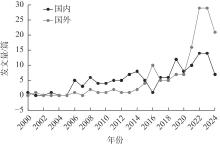
Fig. 1
Number of published literature on tourism ecological security research over the years in domestic and abroad"

Tab. 1
Top 10 organizations in terms of the number of publications on tourism ecological security research in foreign countries"
| 序号 | 机构 | 发文量/篇 | 首发年份 |
|---|---|---|---|
| 1 | 世界自然基金会 | 4 | 2013 |
| 2 | 澳大利亚格里菲斯大学 | 3 | 2023 |
| 3 | 澳大利亚昆士兰大学 | 3 | 2019 |
| 4 | 澳大利亚阿德莱德大学 | 3 | 2014 |
| 5 | 印度农业研究委员会 | 3 | 2015 |
| 6 | 美国阿拉斯加大学 | 2 | 2019 |
| 7 | 澳大利亚悉尼新南威尔士大学 | 2 | 2021 |
| 8 | 葡萄牙新里斯本大学 | 2 | 2011 |
| 9 | 美国亚利桑那州立大学 | 2 | 2022 |
| 10 | 美国阿拉斯加大学费尔班克斯分校 | 2 | 2019 |
Tab. 2
Top 10 organizations in terms of the number of publications on tourism ecological security research in domestic"
| 序号 | 机构 | 发文量/篇 | 首发年份 |
|---|---|---|---|
| 1 | 湖南师范大学旅游学院 | 8 | 2021 |
| 2 | 中国科学院地理科学与资源研究所 | 5 | 2008 |
| 3 | 华侨大学旅游学院 | 4 | 2013 |
| 4 | 新疆大学旅游学院 | 4 | 2019 |
| 5 | 宁夏大学资源环境学院 | 3 | 2020 |
| 6 | 闽江学院旅游系 | 3 | 2010 |
| 7 | 湖南师范大学资源与环境科学学院 | 3 | 2017 |
| 8 | 北京第二外国语学院旅游科学学院 | 3 | 2022 |
| 9 | 贵州财经大学工商管理学院 | 3 | 2022 |
| 10 | 云南大学工商管理与旅游管理学院 | 3 | 2023 |
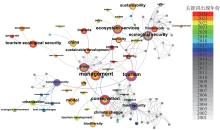
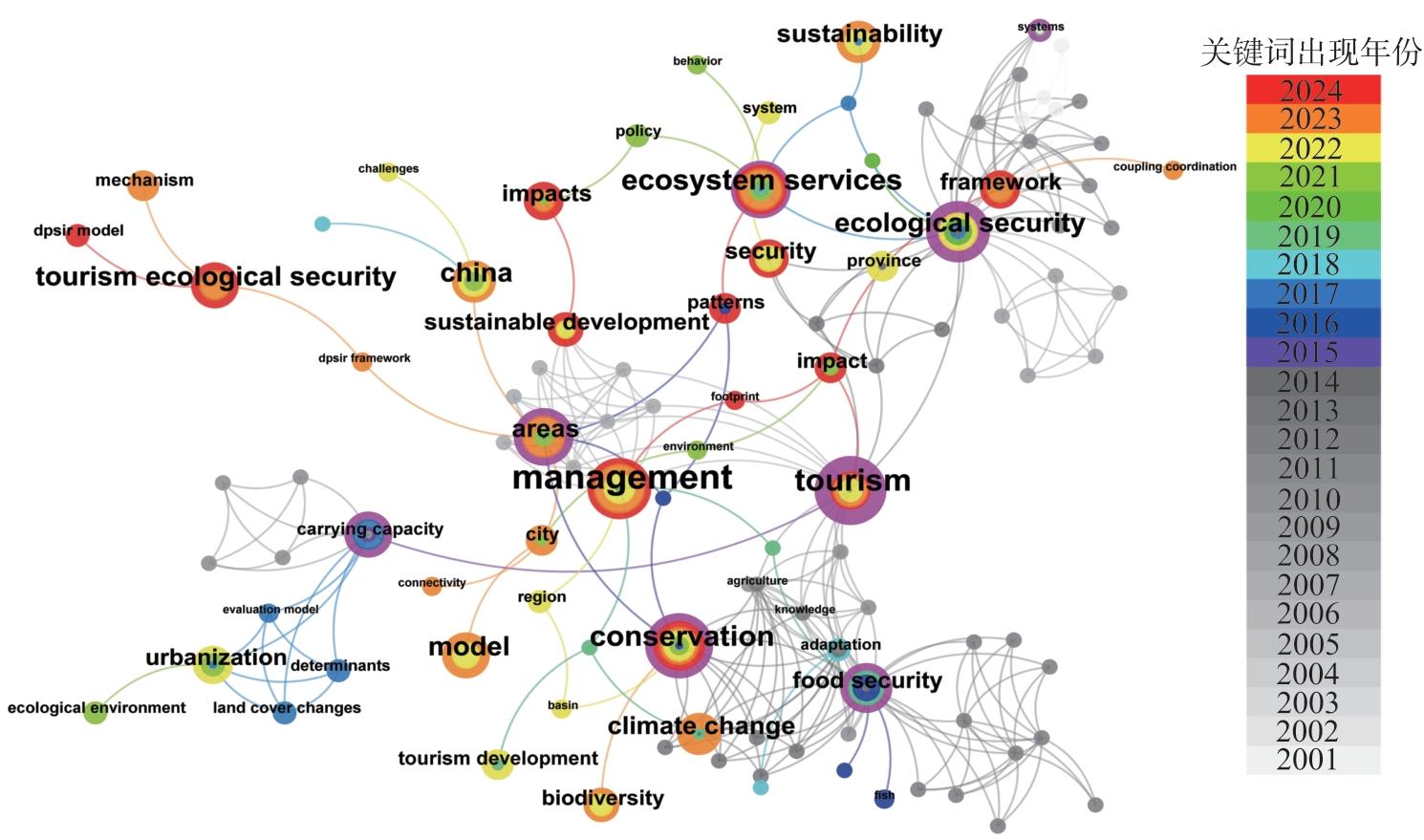
Fig. 2
Co-occurrence map of keywords on tourism ecological security research in foreign countries"
Tab. 3
Statistics of keyword frequency and centrality on tourism ecological security research in foreign countries (Top 10)"
| 排名 | 词频 | 对应关键词 | 中心性 | 对应关键词 |
|---|---|---|---|---|
| 1 | 23 | management | 0.74 | tourism |
| 2 | 18 | tourism | 0.57 | ecological security |
| 3 | 13 | ecosystem services | 0.35 | food security |
| 4 | 13 | conservation | 0.22 | areas |
| 5 | 11 | tourism ecological security | 0.22 | carrying capacity |
| 6 | 10 | ecological security | 0.20 | conservation |
| 7 | 10 | China | 0.14 | ecosystem services |
| 8 | 10 | model | 0.10 | management |
| 9 | 9 | areas | 0.05 | tourism ecological security |
| 10 | 9 | climate change | 0.02 | climate change |
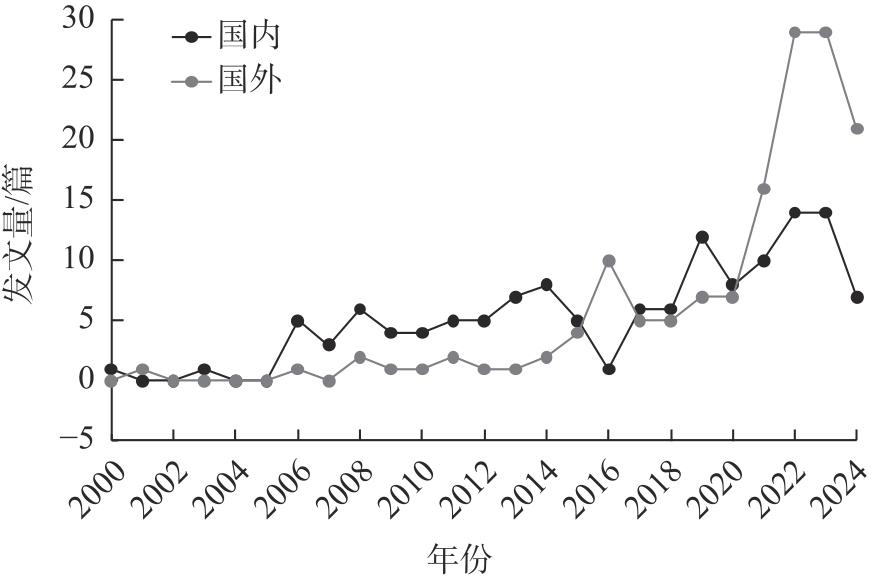
Fig. 3
Clustering map of keywords on tourism ecological security research in foreign countries"
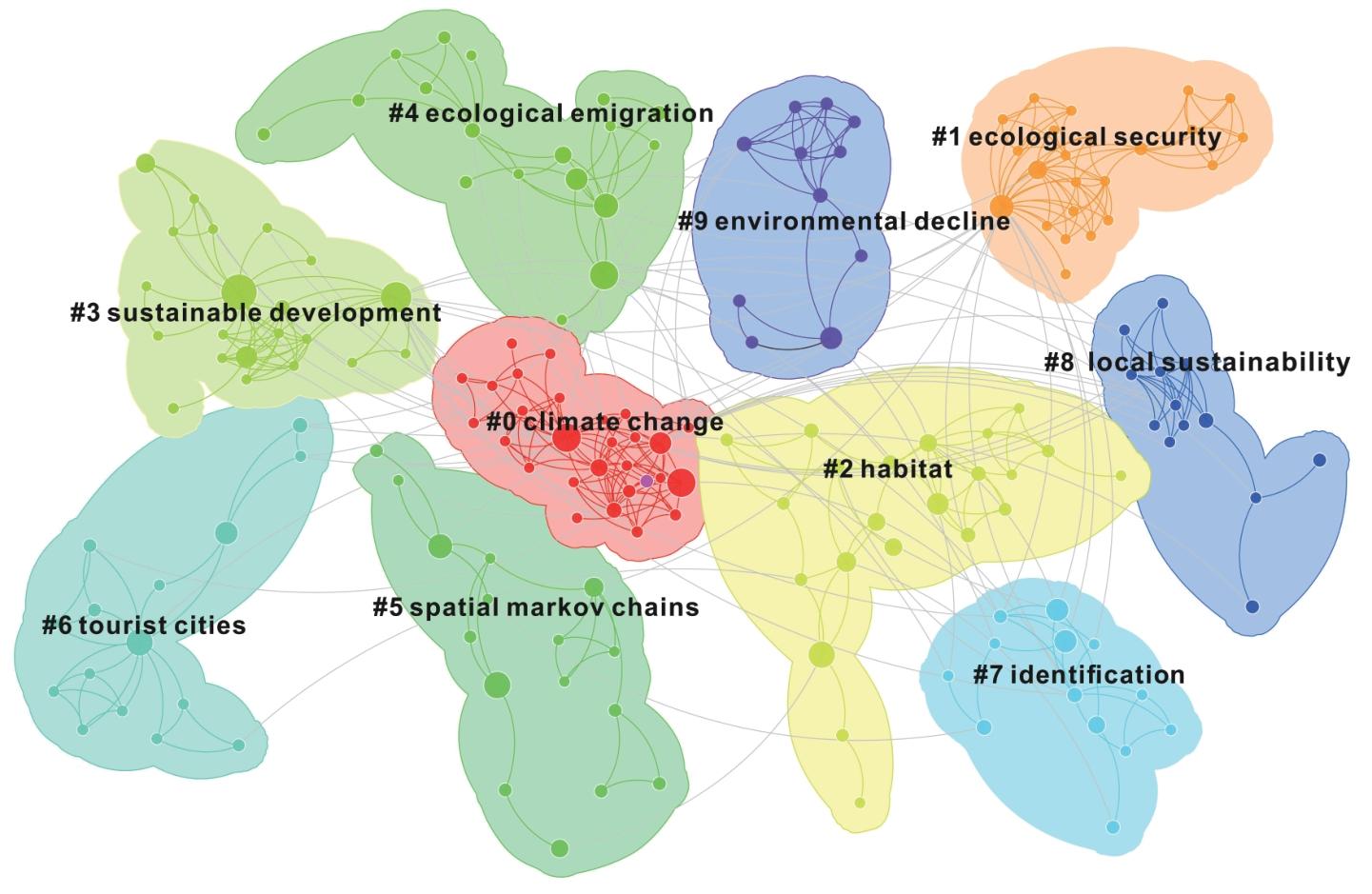
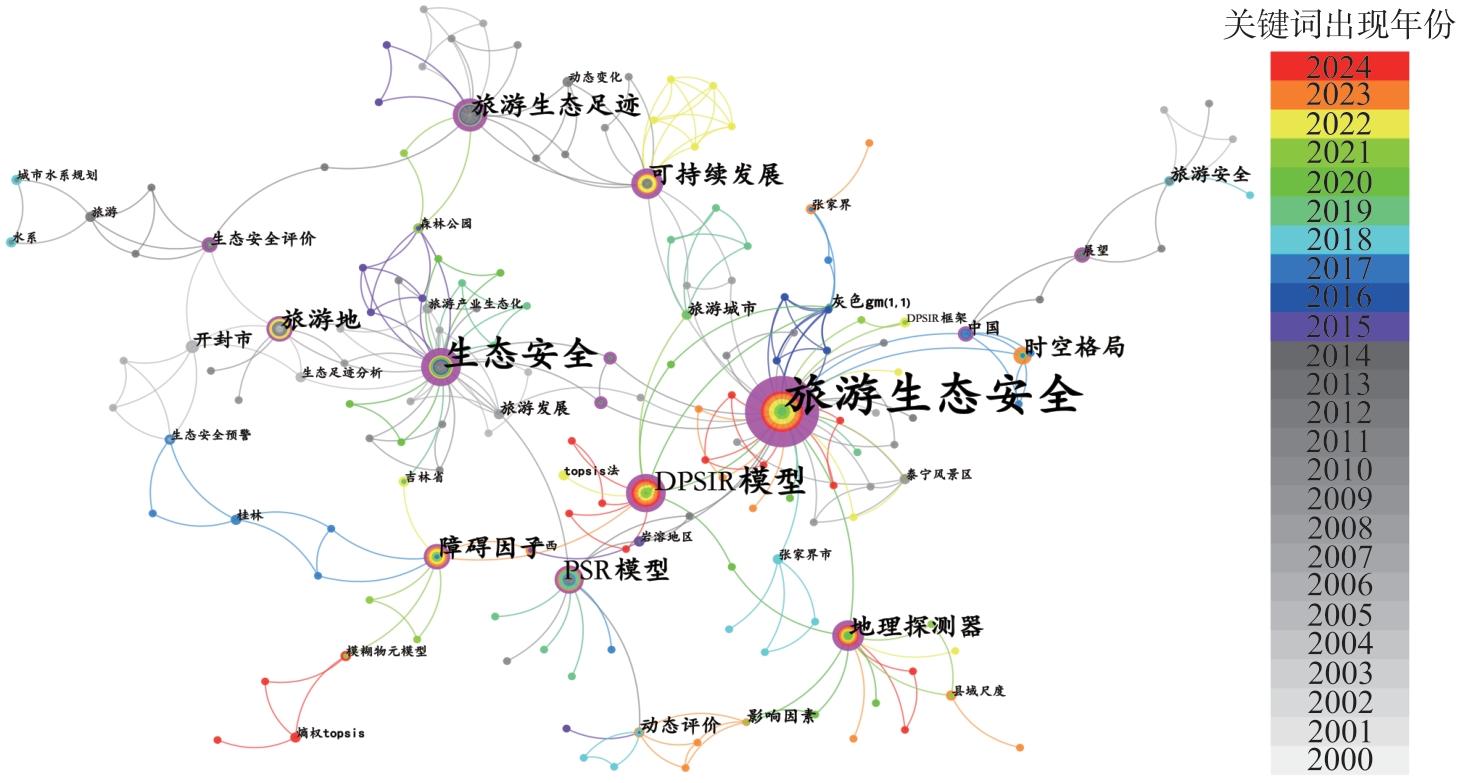
Fig. 4
Co-occurrence map of keywords on tourism ecological security research in domestic"
Tab. 4
Statistics of keyword frequency and centrality on tourism ecological security research in domestic (Top 10)"
| 排名 | 词频 | 对应关键词 | 中心性 | 对应关键词 |
|---|---|---|---|---|
| 1 | 65 | 旅游生态安全 | 1.05 | 旅游生态安全 |
| 2 | 24 | 生态安全 | 0.58 | 生态安全 |
| 3 | 16 | DPSIR模型 | 0.30 | DPSIR模型 |
| 4 | 9 | PSR模型 | 0.29 | 可持续发展 |
| 5 | 9 | 旅游生态足迹 | 0.22 | 地理探测器 |
| 6 | 8 | 旅游地 | 0.21 | 旅游生态足迹 |
| 7 | 8 | 地理探测器 | 0.20 | 障碍因子 |
| 8 | 8 | 可持续发展 | 0.18 | PSR模型 |
| 9 | 8 | 障碍因子 | 0.16 | 中国 |
| 10 | 7 | 时空格局 | 0.15 | 旅游生态安全评价 |
Fig. 5
Clustering map of keywords on tourism ecological security research in domestic"
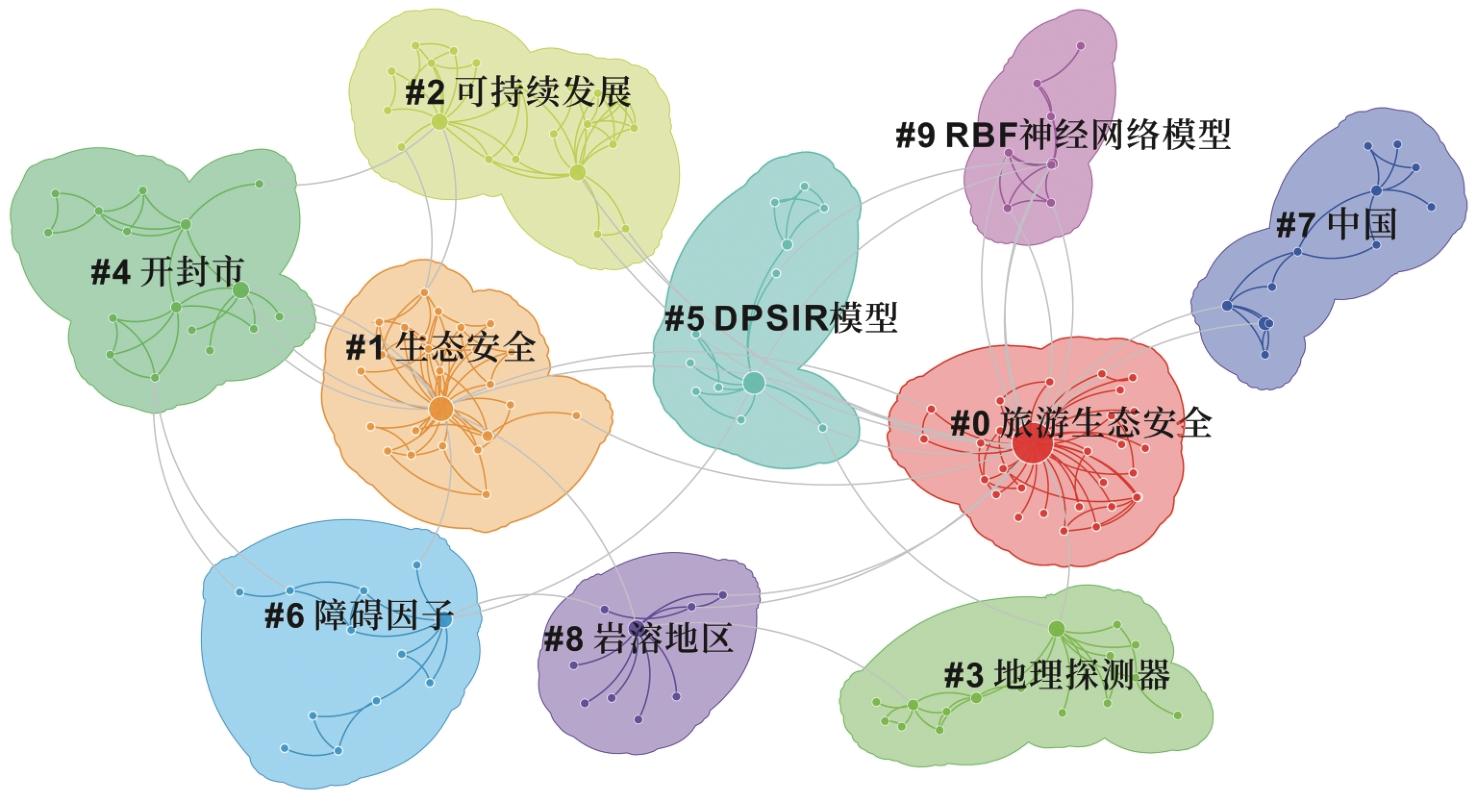
Fig. 6
Knowledge map of keyword emergence on tourism ecological security research in foreign countries"
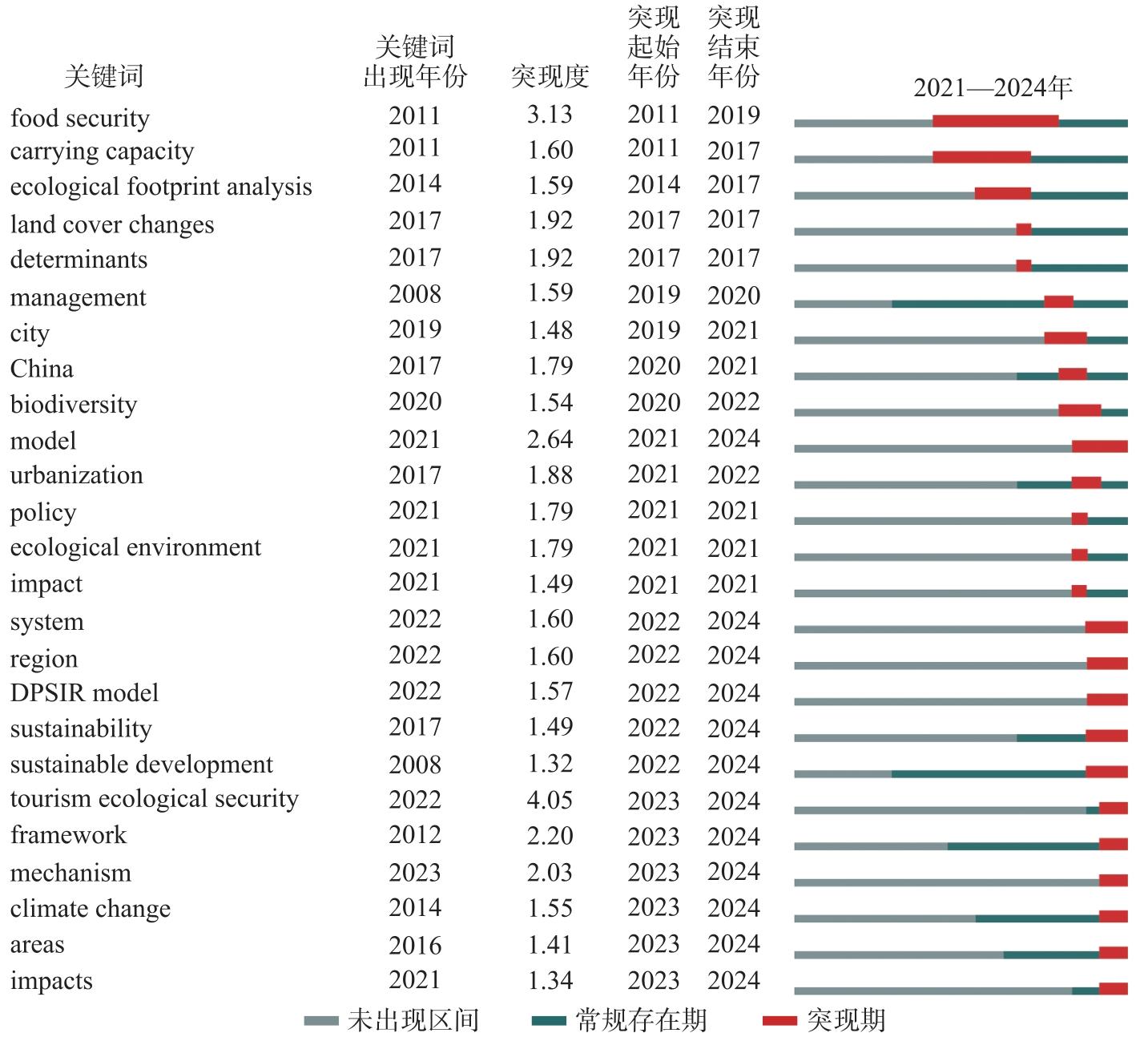
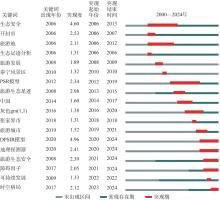
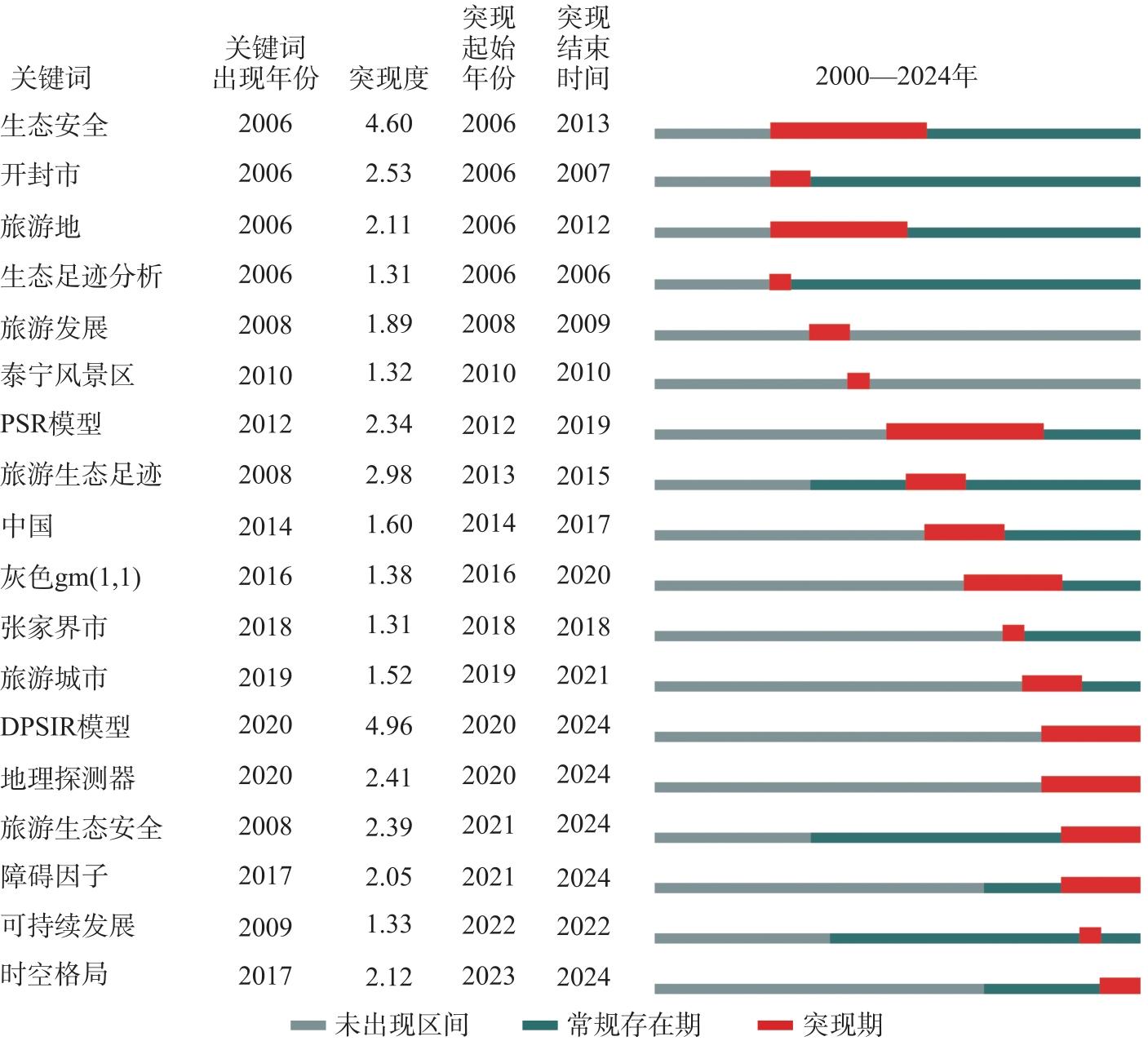
Fig. 7
Knowledge map of keyword emergence on tourism ecological security research in domestic"
| [1] |
查瑞波, 许进鎔, 王善杰. 碳排放视角下入境旅游对共同富裕的影响[J]. 自然资源学报, 2023, 38(5): 1210-1224.
doi: 10.31497/zrzyxb.20230507 |
|
[Cha Ruibo, Xu Jinrong, Wang Shanjie. Impact of inbound tourism on common prosperity under the effect of carbon emissions[J]. Journal of Natural Resources, 2023, 38(5): 1210-1224.]
doi: 10.31497/zrzyxb.20230507 |
|
| [2] | Weaver D, Tang C Z, Zhao Y Z. Facilitating sustainable tourism by endogenization: China as exemplar[J]. Annals of Tourism Research, 2020, 81: 102890, doi: 0.1016/j.annals.2020.102890. |
| [3] |
李亚茹, 白洋, 周春山, 等. 基于PVAR模型的中国快速交通、旅游经济与旅游生态效率关系研究[J]. 干旱区地理, 2026, 49(1): 106-116.
doi: 10.12118/j.issn.1000-6060.2024.789 |
|
[Li Yaru, Bai Yang, Zhou Chunshan, et al. Relationship between rapid transportation, tourism economy and tourism eco-efficiency in China based on PVAR model[J]. Arid Land Geography, 2026, 49(1): 106-116.]
doi: 10.12118/j.issn.1000-6060.2024.789 |
|
| [4] |
Jurado E N, Tejada M T, Garcia F A, et al. Carrying capacity assessment for tourist destinations. Methodology for the creation of synthetic indicators applied in a coastal area[J]. Tourism Management, 2012, 33(6): 1337-1346.
doi: 10.1016/j.tourman.2011.12.017 |
| [5] | Tokarchuk O, Gabriele R, Maurer O. Estimating tourism social carrying capacity[J]. Annals of Tourism Research, 2021, 86: 102971, doi: 0.1016/j.annals.2020.102971. |
| [6] |
Sorice M G, Shafer C S, Ditton R B. Managing endangered species within the use preservation paradox: The Florida manatee (Trichechus manatus latirostris) as a tourism attraction[J]. Environmental Management, 2006, 37(1): 69-83
doi: 10.1007/s00267-004-0125-7 |
| [7] |
Klar N, Hermann M, Henning H M, et al. Between ecological theory and planning practice: (Re-) connecting forest patches for the wildcat in Lower Saxony, Germany[J]. Landscape and Urban Planning, 2012, 105(4): 376-384.
doi: 10.1016/j.landurbplan.2012.01.007 |
| [8] |
Ruan W Q, Li Y Q, Zhang S N, et al. Evaluation and drive mechanism of tourism ecological security based on the DPSIR-DEA model[J]. Tourism Management, 2019, 75(12): 609-625.
doi: 10.1016/j.tourman.2019.06.021 |
| [9] |
Peng J, Yang Y, Liu Y X, et al. Linking ecosystem services and circuit theory to identify ecological security patterns[J]. Science of the Total Environment, 2018, 644: 781-790.
doi: 10.1016/j.scitotenv.2018.06.292 |
| [10] | 邹家红, 赵永华, 王惠琴. 我国旅游生态安全研究[J]. 湘潭师范学院学报(社会科学版), 2008, 30(1): 74-76. |
| [Zou Jiahong, Zhao Yonghua, Wang Huiqin. Research on ecological security of tourism in China[J]. Journal of Xiangtan Normal College (Social Science Edition), 2008, 30(1): 74-76.] | |
| [11] | 李细归, 吴清, 周勇. 中国省域旅游生态安全时空格局与空间效应[J]. 经济地理, 2017, 37(3): 210-217. |
| [Li Xigui, Wu Qing, Zhou Yong. Spatio-temporal pattern and spatial effects of tourism ecological security in Chinese provinces[J]. Economic Geography, 2017, 37(3): 210-217.] | |
| [12] |
秦晓楠, 程钰. 中国旅游城市生态安全系统评估与类型划分研究——基于节点权重约束网络DEA模型[J]. 地理科学, 2019, 39(1): 156-163.
doi: 10.13249/j.cnki.sgs.2019.01.018 |
|
[Qin Xiaonan, Cheng Yu. Research on the assessment and typology of ecological security system in Chinese tourist cities: Based on node weight constraint network DEA model[J]. Scientia Geographica Sinica, 2019, 39(1): 156-163.]
doi: 10.13249/j.cnki.sgs.2019.01.018 |
|
| [13] |
田里, 闫子豪, 张鹏杨. 基于共生理论的中国边境省域旅游生态安全评价[J]. 中国生态旅游, 2024, 14(2): 391-409.
doi: 10.12342/zgstly.20240053 |
|
[Tian Li, Yan Zihao, Zhang Pengyang. Evaluation of tourism ecological security in Chinese border provinces based on symbiosis theory[J]. Journal of Chinese Ecotourism, 2024, 14(2): 391-409.]
doi: 10.12342/zgstly.20240053 |
|
| [14] | 马小宾, 章锦河, 孙怡, 等. 长江经济带旅游生态安全时空格局及影响因素[J]. 水土保持研究, 2024, 31(5): 376-388. |
| [Ma Xiaobin, Zhang Jinhe, Sun Yi, et al. Spatial and temporal patterns of tourism ecological security and influencing factors in the Yangtze River Economic Zone[J]. Soil and Water Conservation Research, 2024, 31(5): 376-388.] | |
| [15] |
徐少癸, 左逸帆, 章牧. 基于模糊物元模型的中国旅游生态安全评价及障碍因子诊断研究[J]. 地理科学, 2021, 41(1): 33-43.
doi: 10.13249/j.cnki.sgs.2021.01.004 |
|
[Xu Shaogui, Zuo Yifan, Zhang Mu. Evaluation of tourism ecological security and diagnosis of obstacle factors in China based on fuzzy elemental model[J]. Scientia Geographica Sinica, 2021, 41(1): 33-43.]
doi: 10.13249/j.cnki.sgs.2021.01.004 |
|
| [16] | 周彬, 虞虎, 钟林生, 等. 普陀山岛旅游生态安全发展趋势预测[J]. 生态学报, 2016, 36(23): 7792-7803. |
| [Zhou Bin, Yu Hu, Zhong Linsheng, et al. Prediction of the development trend of tourism ecological security on Putuoshan Island[J]. Acta Ecologica Sinica, 2016, 36(23): 7792-7803.] | |
| [17] | 武春友, 郭玲玲, 于惊涛. 区域旅游生态安全的动态仿真模拟[J]. 系统工程, 2013, 31(2): 94-99. |
| [Wu Chunyou, Guo Lingling, Yu Jingtao. Dynamic simulation modeling of regional tourism ecological security[J]. Systems Engineering, 2013, 31(2): 94-99.] | |
| [18] | 周彬, 朱宇辰, 虞虎, 等. 旅游生态安全研究现状、评述与展望[J]. 生态学报, 2025, 45(3): 1049-1058. |
| [Zhou Bin, Zhu Yuchen, Yu Hu, et al. Current status, review and prospect of tourism ecological security research[J]. Acta Ecologica Sinica, 2025, 45(3): 1049-1058.] | |
| [19] |
Han Y, Tang C C, Zeng R. Review of tourism ecological security from the perspective of ecological civilization construction[J]. Journal of Resources and Ecology, 2022, 13(4): 734-745.
doi: 10.5814/j.issn.1674-764x.2022.04.018 |
| [20] | 杨秀平, 贾云婷, 刘利利, 等. 国内外旅游生态安全研究动态与前瞻综述[J]. 生态科学, 2022, 41(4): 223-230. |
| [Yang Xiuping, Jia Yunting, Liu Lili, et al. A review of domestic and international research on tourism ecological security[J]. Ecological Science, 2022, 41(4): 223-230.] | |
| [21] | 卢璐, 曾坚, 于天虎. 旅游生态安全研究进展[J]. 生态科学, 2023, 42(2): 238-247. |
| [Lu Lu, Zeng Jian, Yu Tianhu. Progress of tourism ecological security research[J]. Ecological Science, 2023, 42(2): 238-247.] | |
| [22] | 徐秀玉, 陈忠暖. 基于知识图谱可视化的国内外休闲研究的进展与启示[J]. 世界地理研究, 2019, 28(1): 161-174. |
| [Xu Xiuyu, Chen Zhongnuan. Progress and insights of domestic and international leisure research based on knowledge graph visualization[J]. World Regional Studies, 2019, 28(1): 161-174.] | |
| [23] | 陈悦, 陈超美, 刘则渊, 等. CiteSpace知识图谱的方法论功能[J]. 科学学研究, 2015, 33(2): 242-253. |
| [Chen Yue, Chen Chaomei, Liu Zeyuan, et al. Methodological functions of CiteSpace knowledge graph[J]. Studies in Science of Science, 2015, 33(2): 242-253.] | |
| [24] | 彭伟, 赵栩, 赵帅, 等. 基于文献计量的国内外创业失败比较研究[J]. 研究与发展管理, 2019, 31(4): 139-150. |
| [Peng Wei, Zhao Xu, Zhao Shuai, et al. A comparative study of domestic and international entrepreneurial failure based on bibliometrics[J]. Research and Development Management, 2019, 31(4): 139-150.] | |
| [25] | 卞显红, 张光生, 王苏洁. 生态旅游与可持续旅游环境认证研究[J]. 资源开发与市场, 2004, 20(1): 66-69. |
| [Bian Xianhong, Zhang Guangsheng, Wang Sujie. Research on ecotourism and sustainable tourism environmental certification[J]. Resource Development and Market, 2004, 20(1): 66-69.] | |
| [26] |
钟林生, 李猛. 中国生态旅游研究热点演变与趋势: 基于CiteSpace知识图谱分析[J]. 中国生态旅游, 2021, 11(1): 95-110.
doi: 10.12342/zgstly.20210010 |
|
[Zhong Linsheng, Li Meng. Evolution and trends of ecotourism research hotspots in China: An analysis based on CiteSpace knowledge mapping[J]. Journal of Chinese Ecotourism, 2021, 11(1): 95-110.]
doi: 10.12342/zgstly.20210010 |
|
| [27] |
Tong T, Luo Y Y, Qin Y. Knowledge mapping analysis of tourism behavior research based on CiteSpace[J]. Sustainable Development, 2019, 9(1): 83-92.
doi: 10.12677/SD.2019.91011 |
| [28] | Chen C M. Searching for intellectual turning points: Progressive knowledge domain visualization[J]. Proceedings of the National Academy of Sciences of the United States of America, 2004, 101: 5303-5310. |
| [29] | Eladawy A, Mirchell N C, Nakamura T, et al. Towards a combined human-natural system approach in the Northern Red Sea Region: Ecological challenges, sustainable development, and community engagement[J]. Marine Policy, 2024, 159: 105917, doi: 10.1016/j.marpol.2023.105917. |
| [30] | Weatherdob L V, Magnan A K, Rogers A D. Observed and projected impacts of climate change on marine fisheries, aquaculture, coastal tourism, and human health: An update[J]. Frontiers in Marine Science, 2016, 3: 48, doi: 10.3389/fmars.2016.00048. |
| [31] | Cakir H K, Ovali P K. Analysis of sustainability of the railway transport in the trace sub region under the extent of ecological tourism[J]. Journal of Environmental Protection and Ecology, 2008, 9(3): 643-651. |
| [32] | Chand S, Singh S, Parappurathu S, et al. Explaining the status and scope of ecotourism development for livelihood security: Andaman and Nicobar Islands, India[J]. International Journal of Sustainable Development & World Ecology, 2015, 22: 335-345. |
| [33] |
Wabnitz C C C, Cisneros M A M, Hanich Q, et al. Ecotourism, climate change and reef fish consumption in Palau: Benefits, trade-offs and adaptation strategies[J]. Marine Policy, 2018, 88: 323-332.
doi: 10.1016/j.marpol.2017.07.022 |
| [34] | Muntifering J R, Linklater W L, Naidoo R, et al. Black rhinoceros avoidance of tourist infrastructure and activity: Planning and managing for coexistence[J]. Cambridge University Press, 2021, 55(1): 150-159. |
| [35] |
Teh L, Cabanban A S. Planning for sustainable tourism in southern Pulau Banggi: An assessment of biophysical conditions and their implications for future tourism development[J]. Journal of Environmental Management, 2007, 85(4): 999-1008.
pmid: 17204361 |
| [36] | Saveriades A. Establishing the social tourism carrying capacity for the tourist resorts of the east coast of the Republic of Cyprus[J]. Tourism Management, 2000, 2(21): 147-156. |
| [37] | Hall C M, Timothy D J, Duval D T, et al. Security and tourism: Towards a new understanding?[J]. Journal of Travel & Tourism Marketing, 2004, 15(2-3): 1-18. |
| [38] | Brahmasrene T, Lee J W. Assessing the dynamic impact of tourism, industrialization, urbanization, and globalization on growth and environment in Southeast Asia[J]. International Journal of Sustainable Development & World Ecology, 2017, 24(4): 362-371. |
| [39] |
Dey J, Sakhre S, Gupta V, et al. Geo-spatial assessment of tourism impact on land environment of Dehradun, Uttarakhand, India[J]. Environmental Monitoring and Assessment, 2018, 190(4): 181-190.
doi: 10.1007/s10661-018-6535-4 |
| [40] | Neven S, Tihomir L. Marketing and environment management for tourism: Croatian experiences[J]. Academica Turistica-Tourism and Innovation Journal, 2010, 3(1-2): 73-80. |
| [41] | Doronkina I G, Borisova O N, Malyutin G V, et al. Security in tourism[J]. World Applied Sciences Journal, 2014, 30(20): 39-40. |
| [42] | Nwokorie E C. Emerging security challenges for tourism development: Effect on the Nigerian economy[J]. Journal of Women in Technical Education & Employment, 2014, 7(2): 33-40. |
| [43] |
周彬, 钟林生, 陈田, 等. 浙江省旅游生态安全的时空格局及障碍因子[J]. 地理科学, 2015, 35(5): 599-607.
doi: 10.13249/j.cnki.sgs.2015.05.599 |
| [Zhou Bin, Zhong Linsheng, Chen Tian, et al. Spatio-temporal pattern and obstacle factors of tourism ecological security in Zhejiang Province[J]. Scientia Geographica Sinica, 2015, 35(5): 599-607.] | |
| [44] | 章锦河, 张捷, 王群. 旅游地生态安全测度分析——以九寨沟自然保护区为例[J]. 地理研究, 2008, 27(2): 449-458. |
| [Zhang Jinhe, Zhang Jie, Wang Qun. Analysis of ecological safety measurement in tourist sites: Taking Jiuzhaigou nature reserve as an example[J]. Geographical Research, 2008, 27(2): 449-458.] | |
| [45] | 李玲. 新疆旅游生态安全评价及时空演变特征研究[J]. 生态经济, 2021, 37(8): 126-131. |
| [Li Ling. Evaluation of tourism ecological security in Xinjiang and characterization of temporal and spatial evolution[J]. Ecological Economy, 2021, 37(8): 126-131.] | |
| [46] | 王兆峰, 陈青青. 1998年以来长江经济带旅游生态安全时空格局演化及趋势预测[J]. 生态学报, 2021, 41(1): 320-332. |
| [Wang Zhaofeng, Chen Qingqing. Evolution of spatial and temporal patterns and trend prediction of tourism ecological security in the Yangtze River Economic Zone since 1998[J]. Acta Ecologica Sinica, 2021, 41(1): 320-332.] | |
| [47] | 张燕华, 王娜. 西藏旅游生态安全预警系统研究[J]. 全国流通经济, 2019(15): 99-101. |
| [Zhang Yanhua, Wang Na. Research on early warning system of tourism ecological safety in Xizang[J]. China Circulation Economy, 2019(15): 99-101.] | |
| [48] | 杨利, 丁富艳, 杨可欣. 重庆市旅游生态安全评价及趋势预测[J]. 四川旅游学院学报, 2022, 5: 51-57. |
| [Yang Li, Ding Fuyan, Yang Kexin. Evaluation of tourism ecological security and trend prediction in Chongqing[J]. Journal of Sichuan Tourism University, 2022, 5: 51-57.] | |
| [49] | 王凯, 刘美伦, 谭佳欣. 旅游产业集聚与旅游生态安全的互动关系研究——以长江中游城市群为例[J]. 中南林业科技大学学报(社会科学版), 2024, 18(2): 70-82. |
| [Wang Kai, Liu Meilun, Tan Jiaxin. Study on the interaction between tourism industry agglomeration and tourism ecological security: The case of city cluster in the middle reaches of Yangtze River[J]. Journal of Central South University of Forestry & Technology (Social Sciences Edition), 2024, 18(2): 70-82.] | |
| [50] | Amat M, Shabiti M, Zhang X Q. Study on early warning of cultivated land ecological security in Yarkant River Plain oasis[J]. Chinese Journal of Agricultural Resources and Regional Planning, 2019, 40(7): 135-144. |
| [51] | Espin P A, Mena C F, Pizzitutti F. A mode-based approach to study the tourism sustainability in an island environment: The case of Galapagos Islands[M]. Cham: Springer International Publishing, 2018: 97-113. |
| [52] | Hunter G. Sustainable tourism and the touristic ecological footprint[J]. Environment Development & Sustainability, 2002, 4(1): 7-20. |
| [53] |
Hedlund T. The impact of values, environmental concern and willingness to accept economic sacrifices to protect the environment on tourists’ intentions to buy ecologically sustainable tourism alternatives[J]. Tourism and Hospitality Research, 2011, 11(4): 278-288.
doi: 10.1177/1467358411423330 |
| [54] |
Jose U V, Nahar M, Vijayakumar S, et al. Balancing tourism and environment: The ETM model[J]. Current Issues in Tourism, 2009, 6(1): 54-75.
doi: 10.1080/13683500308667944 |
| [55] |
Kuqo A, Mai C. Seagrass leaves: An alternative resource for the production of insulation materials[J]. Materials, 2022, 15(19): 17-31.
doi: 10.3390/ma15010017 |
| [56] |
Francisco B C, Jean H, Nico K. Environmental impacts on the Galapagos Islands: Identification of interactions, perceptions and steps ahead[J]. Ecological Indicators, 2014, 38: 113-123.
doi: 10.1016/j.ecolind.2013.10.019 |
| [57] | Mondal M. SWOT analysis and strategies to develop sustainable tourism in Bangladesh[J]. UTMS Journal of Economics, 2017, 8(2): 159-167. |
| [58] | Kurniawan F, Adrianto L, Bengen D G, et al. Vulnerability assessment of small islands to tourism: The case of the Marine Tourism Park of the Gili Matra Islands, Indonesia[J]. Global Ecology and Conservation, 2016(6): 308-326. |
| [59] |
Blancas F J, Caballero R, Gonzalez M, et al. Goal programming synthetic indicators: An application for sustainable tourism in Andalusian coastal counties[J]. Ecological Economics, 2010, 69(11): 2158-2172.
doi: 10.1016/j.ecolecon.2010.06.016 |
| [60] |
Pueyo R J, Garcia X, Ribas A, et al. Ecological restoration of a coastal wetland at a mass tourism destination. Will the recreational value increase or decrease?[J]. Ecological Economics, 2018, 148: 1-14.
doi: 10.1016/j.ecolecon.2018.02.002 |
| [61] |
Jones C, Munday M. Exploring the environmental consequences of tourism: A satellite account approach[J]. Journal of Travel Research, 2007, 46(2): 164-172.
doi: 10.1177/0047287507299592 |
| [62] |
Hjalager A M, Johansen P H. Food tourism in protected areas-sustainability for producers, the environment and tourism?[J]. Journal of Sustainable Tourism, 2013, 21(3): 417-433.
doi: 10.1080/09669582.2012.708041 |
| [63] | Nurhayati A, Herawati T, Handaka A A, et al. Sustainable marine ecotourism governance based on tourism preferences[J]. IOP Conference Series: Earth and Environmental Science, 2023, 1289(1): 012012, doi: 10.1088/1755-1315/1289/1/012012. |
| [64] | Chakraborty P, Ghosal S. An eco-social exploration of tourism area evolution in mountains through stakeholders’ perspective[J]. Environmental Developmental, 2024, 49: 100963, doi: 10.1016/j.envdev.2024.100963. |
| [65] | Morteza Z, Reza F M, Seddiq M M, et al. Selection of the optimal tourism site using the ANP and fuzzy TOPSIS in the framework of integrated coastal zone management: A case of Qeshm Island[J]. Ocean & Coastal Management, 2016, 130(9): 179-187. |
| [66] |
肖钊富, 李瑞, 吕宛青. 成渝城市群旅游生态安全时空格局演化研究[J]. 世界地理研究, 2023, 32(10): 122-133.
doi: 10.3969/j.issn.1004-9479.2023.10.2021806 |
|
[Xiao Zhaofu, Li Rui, Lü Wanqing. Study on the evolution of spatial and temporal patterns of tourism ecological security in the Chengdu-Chongqing urban agglomeration[J]. World Regional Studies, 2023, 32(10): 122-133.]
doi: 10.3969/j.issn.1004-9479.2023.10.2021806 |
|
| [67] |
杨荣美, 周宏, 张燕妮, 等. 基于熵权TOPSIS方法与模糊物元模型的河西走廊地区旅游生态安全评估[J]. 干旱区地理, 2024, 47(1): 117-126.
doi: 10.12118/j.issn.1000-6060.2023.321 |
| [Yang Runmei, Zhou Hong, Zhang Yanni, et al. Tourism ecological security assessment of the Hexi Corridor region based on entropy-weighted TOPSIS method and fuzzy material element model[J]. Arid Land Geography, 2024, 47(1): 117-126.] | |
| [68] | 余正军, 杨梦妮, 韩朝阳. 基于PSR模型的西藏旅游生态安全分析[J]. 西藏民族大学学报(哲学社会科学版), 2023, 44(1): 140-146. |
| [Yu Zhengjun, Yang Mengni, Han Chaoyang. Analysis of tourism ecological security in Xizang based on PSR model[J]. Journal of Xizang Minzu University (Philosophy and Social Sciences Edition), 2023, 44(1): 140-146.] | |
| [69] | 石丹, 关婧文. 基于DPSIR-物元的吉林省旅游生态安全时空格局测度及障碍诊断[J]. 生态学杂志, 2022, 41(8): 1653-1664. |
| [Shi Dan, Guan Jingwen. Measurement of spatio-temporal pattern of tourism ecological security and diagnosis of obstacles in Jilin Province based on DPSIR-objective elements[J]. Chinese Journal of Ecology, 2022, 41(8): 1653-1664.] | |
| [70] |
时卉, 杨兆萍, 韩芳, 等. 新疆天池景区生态安全度时空分异特征与驱动机制[J]. 地理科学进展, 2013, 32(3): 475-485.
doi: 10.11820/dlkxjz.2013.03.017 |
| [Shi Hui, Yang Zhaoping, Han Fang, et al. Characteristics and driving mechanism of spatial and temporal variability of ecological security in Tianchi Scenic Area, Xinjiang[J]. Progress in Geography, 2013, 32(3): 475-485.] | |
| [71] | 刘佳, 李煜轩, 张樱夕, 等. 海洋旅游高质量发展系统仿真与情景模拟研究[J]. 旅游学刊, 2026, 41(3): 142-160. |
| [Liu Jia, Li Yuxuan, Zhang Yingxi, et al. Research on system simulation and scenario simulation for high-quality development of marine tourism[J]. Tourism Tribune, 2026, 41(3): 142-160.] | |
| [72] | 郑永贤, 薛菲, 张智光. 森林旅游景区生态安全IRDS模型实证研究[J]. 资源科学, 2015, 37(12): 2350-2361. |
| [Zheng Yongxian, Xue Fei, Zhang Zhiguang. Empirical study on IRDS model of ecological security in forest tourism scenic spots[J]. Resource Science, 2015, 37(12): 2350-2361.] | |
| [73] | 徐美, 刘春腊. 张家界市旅游生态安全评价及障碍因子分析[J]. 长江流域资源与环境, 2018, 27(3): 605-614. |
| [Xu Mei, Liu Chunla. Evaluation of tourism ecological security and analysis of obstacle factors in Zhangjiajie[J]. Resources and Environment in the Yangtze Basin, 2018, 27(3): 605-614.] | |
| [74] | 朱东国, 熊鹏, 方世敏. 旅游生态安全约束下张家界市土地利用优化[J]. 生态学报, 2018, 38(16): 5904-5913. |
| [Zhu Dongguo, Xiong Peng, Fang Shimin. Optimization of land use in Zhangjiajie City under the constraint of tourism ecological security[J]. Acta Ecologica Sinica, 2018, 38(16): 5904-5913.] | |
| [75] | 闫云平, 余卓渊, 富佳鑫, 等. 西藏景区旅游承载力评估与生态安全预警系统研究[J]. 重庆大学学报, 2012, 35(增刊1): 92-98. |
| [Yan Yunping, Yu Zhuoyuan, Fu Jiaxin, et al. Research on tourism carrying capacity assessment and ecological safety early warning system of scenic spots in Xizang[J]. Journal of Chongqing University, 2012, 35(Suppl. 1): 92-98.] | |
| [76] | 袁宏瑞, 王群. 旅游与生态共生演进模式与生态安全判定——以国家重点生态功能区安徽省黄山区为例[J]. 旅游学刊, 2022, 37(12): 25-38. |
| [Yuan Hongrui, Wang Qun. Tourism and ecological symbiosis evolution model and ecological security determination: A case study of Huangshan District, Anhui Province, a national key ecological function area[J]. Tourism Tribune, 2022, 37(12): 25-38.] | |
| [77] | 曹新向. 基于生态足迹分析的旅游地生态安全评价研究——以开封市为例[J]. 中国人口·资源与环境, 2006, 16(2): 70-75. |
| [Cao Xinxiang. Evaluation of ecological safety of tourist places based on ecological footprint analysis: Taking Kaifeng City as an example[J]. China Population, Resources and Environment, 2006, 16(2): 70-75.] | |
| [78] | 鲍青青, 刘胜峰. 喀斯特旅游地生态安全动态评价与障碍因子分析: 以桂林为例[J]. 中国岩溶, 2017, 36(3): 407-414. |
| [Bao Qingqing, Liu Shengfeng. Dynamic evaluation of ecological security and analysis of obstacle factors in karst tourist sites: Taking Guilin as an example[J]. Carsologica Sinica, 2017, 36(3): 407-414.] | |
| [79] | 杨良健, 曹开军. 基于DPSIR模型的伊犁河谷旅游生态安全评价及动态预警分析[J]. 生态经济, 2020, 36(11): 111-117. |
| [Yang Liangjian, Cao Kaijun. Evaluation of tourism ecological security and dynamic early warning analysis in Ili River Valley based on DPSIR model[J]. Ecological Economy, 2020, 36(11): 111-117.] | |
| [80] |
Mazur I, Aliyev R, Zhelizko Y. The safety and security of the tourism entrepreneurship potential realization in modern conditions[J]. Baltic Journal of Economic Studies, 2020, 6(5): 203-208.
doi: 10.30525/2256-0742/2020-6-5-203-208 |
| [81] | Sobhani P, Esmaeilzadeh H, Wolf I D, et al. Evaluating the ecological security of ecotourism in protected area based on the DPSIR model[J]. Ecological Indicators, 2023, 155: 110957, doi: 10.1016/j.ecolind.2023.110957. |
| [82] | 杨良健, 曹开军. 新疆85个县市旅游生态安全时空格局演变及驱动机制[J]. 生态学报, 2021, 41(23): 9239-9252. |
| [Yang Liangjian, Cao Kaijun. Evolution of spatial and temporal patterns and driving mechanisms of tourism ecological security in 85 counties and cities in Xinjiang[J]. Acta Ecologica Sinica, 2021, 41(23): 9239-9252.] | |
| [83] |
穆学青, 郭向阳, 明庆忠, 等. 黄河流域旅游生态安全的动态演变特征及驱动因素[J]. 地理学报, 2022, 77(3): 714-735.
doi: 10.11821/dlxb202203015 |
|
[Mu Xueqing, Guo Xiangyang, Ming Qinzhong, et al. Dynamic evolution of tourism ecological security in the Yellow River Basin and its driving factors[J]. Acta Geographica Sinica, 2022, 77(3): 714-735.]
doi: 10.11821/dlxb202203015 |
|
| [84] | 田里, 闫子豪, 王桀. 边境旅游生态安全时空格局及影响因素分析[J]. 生态经济, 2023, 39(7): 149-156. |
| [Tian Li, Yan Zihao, Wang Jie. Analysis of spatial and temporal patterns and influencing factors of border tourism ecological security[J]. Ecological Economy, 2023, 39(7): 149-156.] | |
| [85] | 张鹏, 丘萍. 岩溶地区旅游生态安全评价及趋势分析——以广西为例[J]. 中国岩溶, 2014, 33(4): 483-489. |
| [Zhang Peng, Qiu Ping. Evaluation and trend analysis of tourism ecological safety in karst areas: Taking Guangxi as an example[J]. Carsologica Sinica, 2014, 33(4): 483-489.] | |
| [86] | 唐健雄, 蔡超岳, 陕颖颖. 黄土高原旅游生态安全的时空动态演进及驱动机制[J]. 中南林业科技大学学报(社会科学版), 2023, 17(2): 90-102. |
| [Tang Jianxiong, Cai Chaoyue, Shan Yingying. Spatio-temporal dynamics and driving mechanism of tourism ecological security in the Loess Plateau[J]. Journal of Central South University of Forestry & Technology (Social Sciences Edtion), 2023, 17(2): 90-102.] | |
| [87] | 潘慧琴, 黄少辉, 叶玉瑶. 海岛型旅游地生态安全评价——以海陵岛为例[J]. 广东农业科学, 2013, 40(20): 171-177. |
| [Pan Huiqin, Huang Shaohui, Ye Yuyao. Evaluation of ecological safety of island-type tourist sites: Taking Hailing Island as an example[J]. Guangdong Agricultural Sciences, 2013, 40(20): 171-177.] | |
| [88] | 李梦程, 李世泰, 王成新, 等. 中国海岛型旅游目的地生态安全综合评价与障碍因素研究[J]. 海洋科学, 2020, 44(5): 76-86. |
| [Li Mengcheng, Li Shitai, Wang Chengxin, et al. Comprehensive evaluation of ecological security and obstacles of island-type tourist destinations in China[J]. Marine Science, 2020, 44(5): 76-86.] | |
| [89] | 付业勤, 郑向敏, 王新建. 厦门市滨海城市旅游地生态安全评价研究[J]. 科技管理研究, 2013, 33(3): 41-45. |
| [Fu Yeqin, Zheng Xiangmin, Wang Xinjian. Evaluation of ecological safety of coastal urban tourism sites in Xiamen[J]. Science and Technology Management Research, 2013, 33(3): 41-45.] | |
| [90] | 汤傅佳, 黄震方, 徐冬, 等. 水库型旅游地生态安全时空分异及其关键影响因子分析——以溧阳市天目湖为例[J]. 长江流域资源与环境, 2018, 27(5): 1114-1123. |
| [Tang Fujia, Huang Zhenfang, Xu Dong, et al. Analysis of spatio-temporal divergence of ecological security and its key influencing factors in reservoir-type tourist sites: Taking Tianmu Lake in Liyang City as an example[J]. Resources and Environment in the Yangtze Basin, 2018, 27(5): 1114-1123.] | |
| [91] | 刘辉. 淮北矿山湿地旅游生态安全影响因素及其评价模型构建研究[J]. 遵义师范学院学报, 2020, 22(5): 51-55. |
| [Liu Hui. Research on the factors influencing the ecological safety of tourism in Huaibei mine wetland and the construction of its evaluation model[J]. Journal of Zunyi Normal University, 2020, 22(5): 51-55.] | |
| [92] |
Liu X L, Yang Z P, Di F, et al. Evaluation on tourism ecological security in nature heritage sites: Case of Kanas Nature Reserve of Xinjiang, China[J]. Chinese Geographical Science, 2009, 19(3): 265-273.
doi: 10.1007/s11769-009-0265-z |
| [93] |
Wang Y, Wu C S, Wang F F, et al. Comprehensive evaluation and prediction of tourism ecological security in droughty area national parks: A case study of Qilian Mountain of Zhangye section, China[J]. Environmental Science and Pollution Research, 2021, 28: 16816-16829.
doi: 10.1007/s11356-020-12021-2 |
| [94] | 游巍斌, 何东进, 覃德华, 等. 世界双遗产地生态安全预警体系构建及应用——以武夷山风景名胜区为例[J]. 应用生态学报, 2014, 25(5): 1455-1467. |
|
[You Weibin, He Dongjin, Qin Dehua, et al. Construction and application of an ecological security early warning system for a world dual heritage site: A case study of Wuyi Mountain Scenic and Historic Interest Area[J]. Chinese Journal of Applied Ecology, 2014, 25(5): 1455-1467.]
pmid: 25129949 |
|
| [95] | 杨选辉, 蔡志强. 基于突变检测与共词分析的关联数据新兴趋势探测[J]. 情报科学, 2018, 36(11): 164-168. |
| [Yang Xuanhui, Cai Zhiqiang. Emerging trend detection of linked data based on mutation detection and co-word analysis[J]. Intelligence Science, 2018, 36(11): 164-168.] |
|
||