Arid Land Geography ›› 2026, Vol. 49 ›› Issue (3): 594-606.doi: 10.12118/j.issn.1000-6060.2025.199
• Regional Development • Previous Articles Next Articles
TU Zhengwei( ), ZHANG Pei(), ZHANG Zhonghua
Received:2025-04-14
Revised:2025-05-22
Online:2026-03-25
Published:2026-03-24
Contact:
ZHANG Pei
E-mail:tuzhengwei1898@xauat.edu.cn;tianxingjiansmx@126.com
TU Zhengwei, ZHANG Pei, ZHANG Zhonghua. Evolutionary characteristics and influencing factors of conflict patterns of rural “production-living-ecological spaces” in the Yinchuan metropolitan coordinating region[J].Arid Land Geography, 2026, 49(3): 594-606.
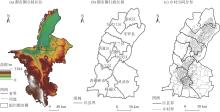
Fig. 1
Overview of the study area"
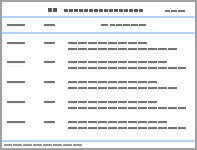
Tab. 1
Data sources"
| 类型 | 名称 | 年份 | 来源 |
|---|---|---|---|
| 空间数据 | 15 m分辨率多波段遥感影像数据 | 2013、2018、2023 | 中国遥感数据网( |
| 30 m分辨率数字高程数据 | 2013、2018、2023 | 阿拉斯加卫星设施网站( | |
| 气象数据 | 2013、2018、2023 | 中国气象网(http:∥data.cma.cn) | |
| 道路数据 | 2013、2018、2023 | Open Street Map网站( | |
| 1 km分辨率人口密度数据 | 2013、2018、2023 | 美国能源部橡树岭国家实验室网站( | |
| 乡镇级行政区划矢量数据 | 2021 | 百度地图( | |
| 省市县级行政区划矢量数据 | 2024 | 国家地理信息公共服务平台( | |
| 统计数据 | 社会经济数据 | 2013、2018、2023 | 《宁夏回族自治区统计年鉴》 |
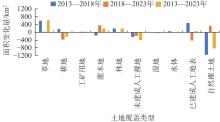
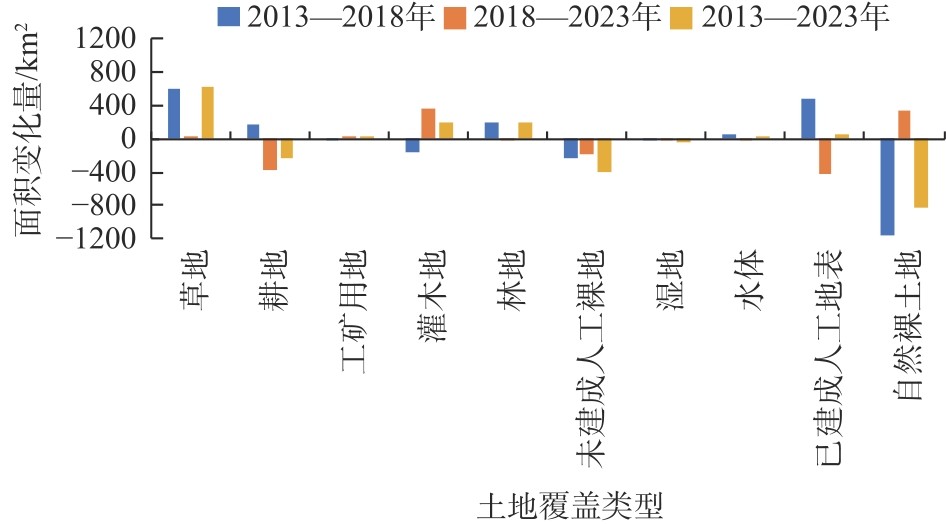
Fig. 2
Area changes of 10 types of land cover in two stages"
Tab. 2
Area and its changes of rural “production-living-ecological spaces” in the Yinchuan metropolitan coordinating region from 2013 to 2023"
| 空间类型 | 面积/km2 | 面积变化量/km2 | |||||
|---|---|---|---|---|---|---|---|
| 2013年 | 2018年 | 2023年 | 2013—2018年 | 2018—2023年 | 2013—2023年 | ||
| 生产空间 | 2812.57 | 2950.98 | 2595.94 | 138.41 | -355.04 | -216.63 | |
| 生活空间 | 1835.75 | 2192.39 | 1846.96 | 356.64 | -345.43 | 11.20 | |
| 生态空间 | 4968.92 | 4473.87 | 5174.27 | -495.05 | 700.40 | 205.35 | |
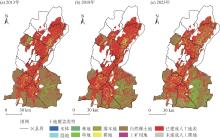
Fig. 3
Distribution patterns of rural “production-living-ecological spaces” in the Yinchuan metropolitan coordinating region from 2013 to 2023"
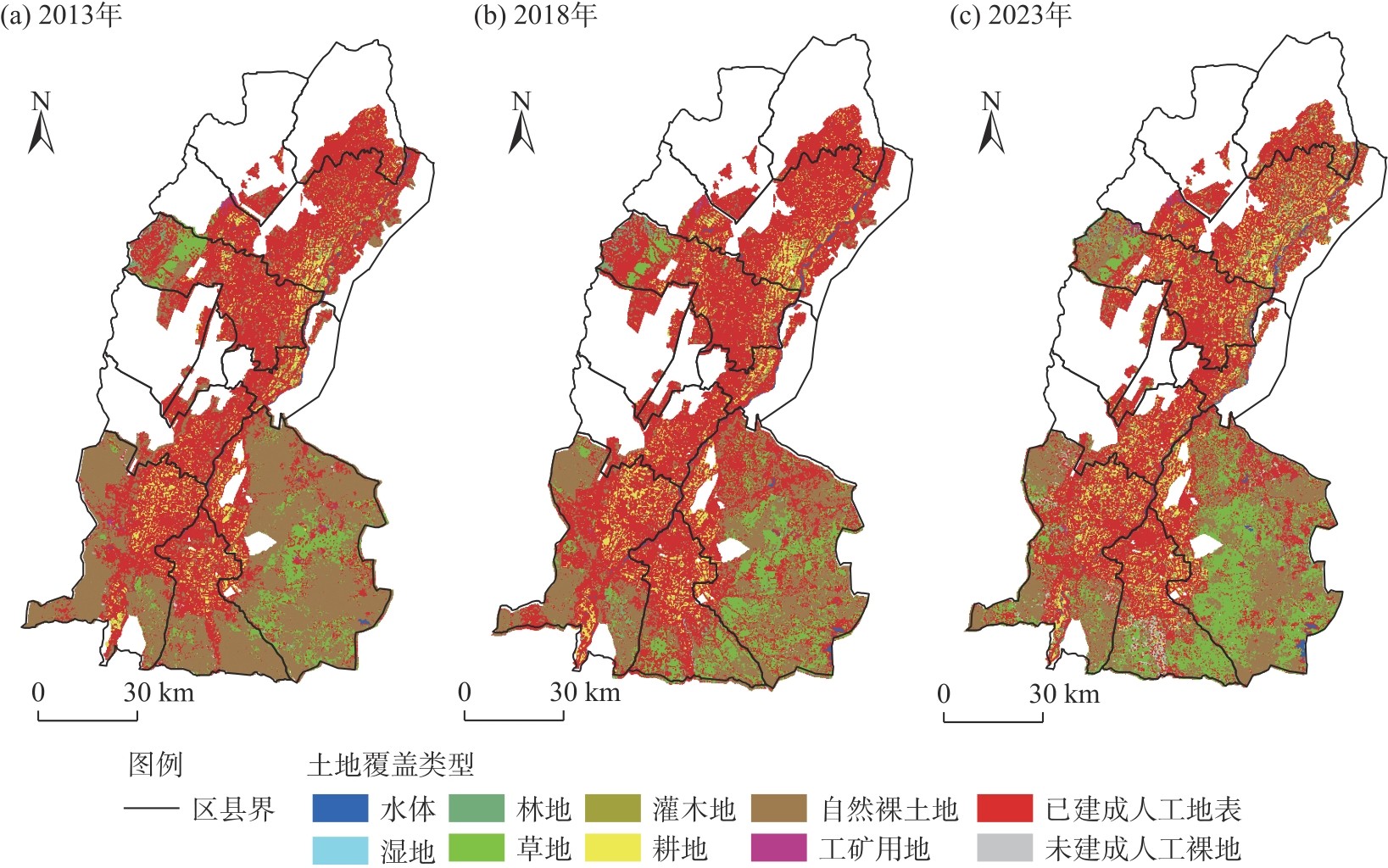
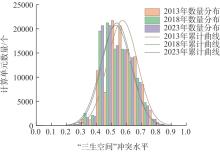
Fig. 4
Statistics of the spatial conflict conjecture index of rural “production-living-ecological spaces” in the Yinchuan metropolitan coordinating region from 2013 to 2023"
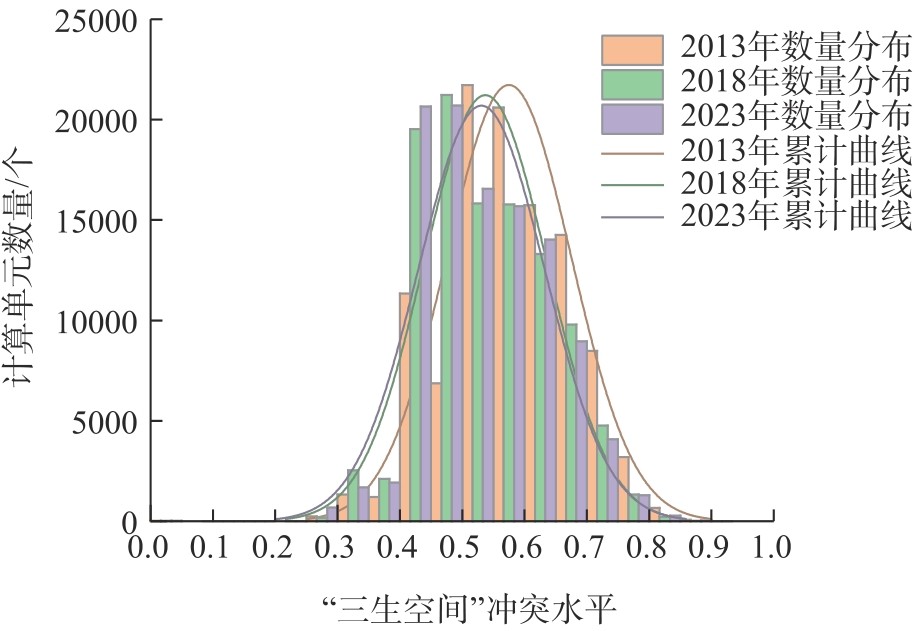
Fig. 5
Distribution patterns and its changes of the spatial conflict conjecture index of rural “production-living-ecological spaces” in the Yinchuan metropolitan coordinating region from 2013 to 2023"
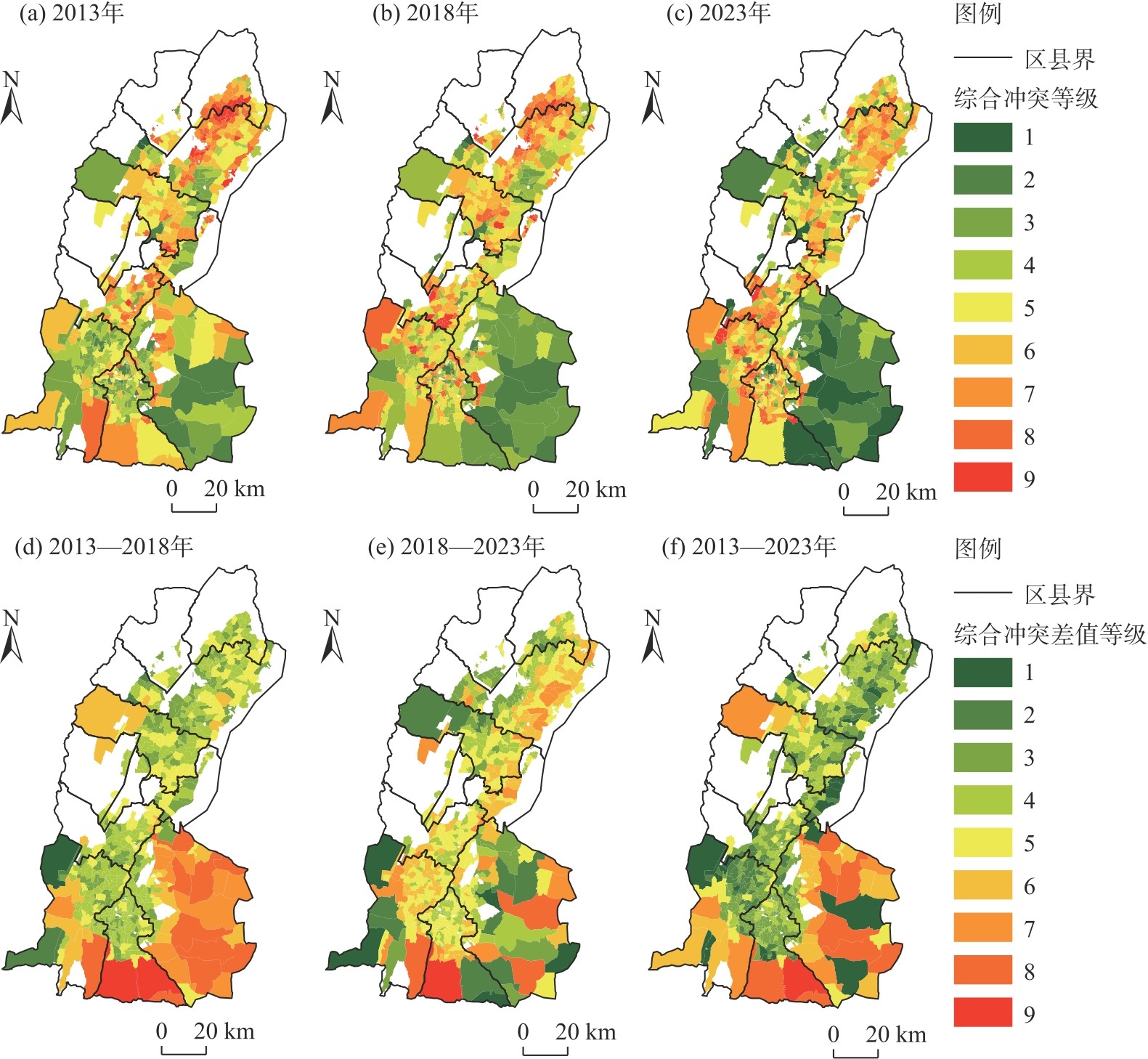
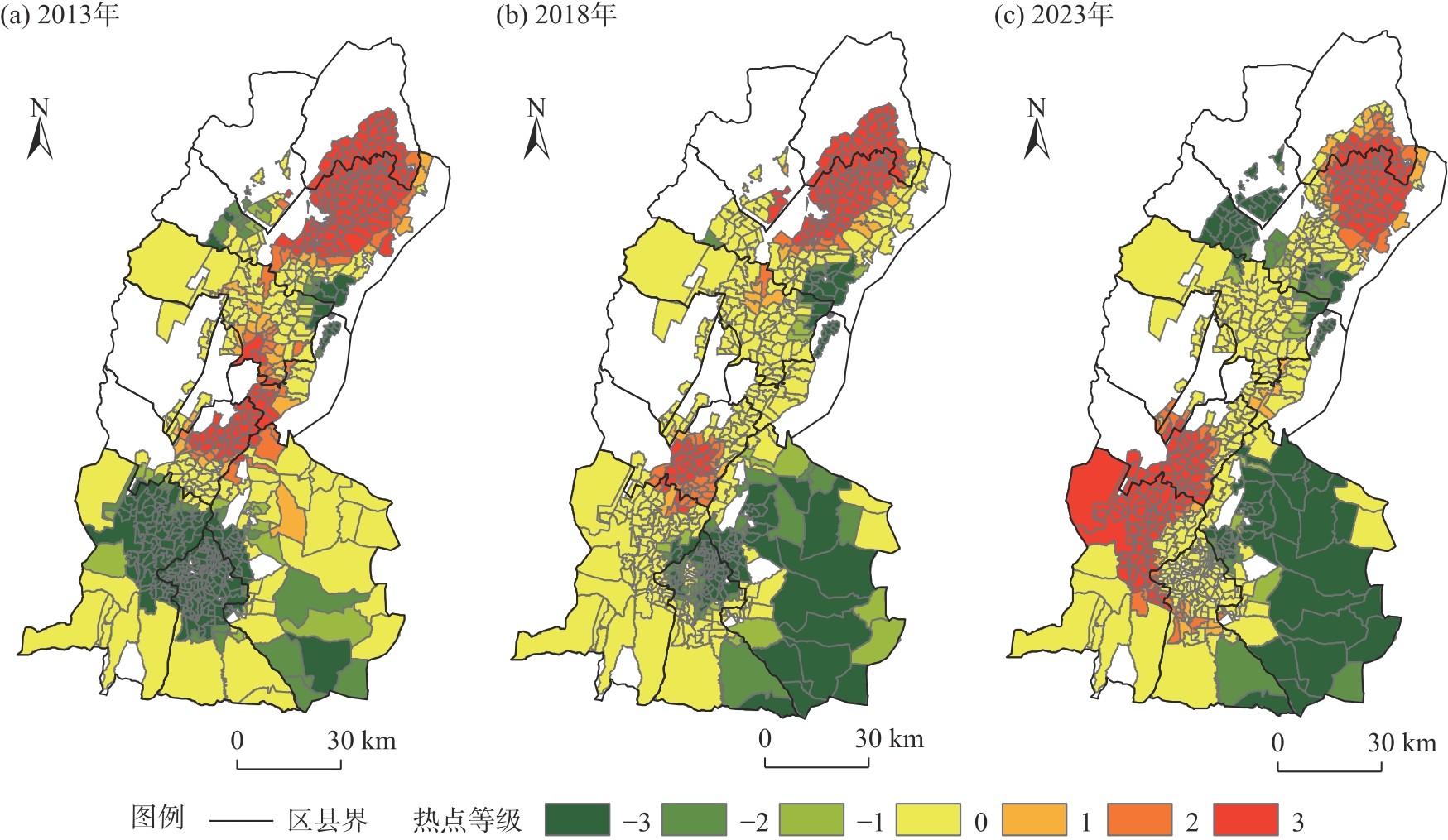
Fig. 6
Hotspot analysis of the spatial conflict conjecture index of rural “production-living-ecological spaces” in the Yinchuan metropolitan coordinating region from 2013 to 2023"
Tab. 3
Explanatory variables"
| 一级指标 | 二级指标 | 具体指标 | 变量阐释 |
|---|---|---|---|
| 自然本底条件 | 地形地势 | 地形起伏(A1)/m | 村域内海拔的最大、最小值差[ |
| 平均海拔(A2)/m | 村域内海拔平均值[ | ||
| 平均坡度(A3)/(°) | 村域内坡度平均值[ | ||
| 气候条件 | 平均气温(A4)/℃ | 村域内气温平均值[ | |
| 日照小时(A5)/h | 村域内月平均日照小时 | ||
| 平均降水量(A6)/mm | 村域内月平均降水总量[ | ||
| 交通区位条件 | 地理区位 | 距离中心城市距离(B1)/km | 乡村质心与都市圈中心城市质心的直线距离[ |
| 距离地级城市距离(B2)/km | 乡村质心与都市圈地级市质心的直线距离[ | ||
| 交通便利度 | 高等级道路密度(B3)/m·km-2 | 村域内国道、省道等道路网络密度[ | |
| 低等级道路密度(B4)/m·km-2 | 村域内县道、乡道网络密度[ | ||
| 产业发展环境 | 经济发展水平 | 县域平均GDP(C1)/元 | 县域平均生产总值[ |
| 产业结构现状 | 第一产业占比(C2)/% | 县域第一产业占总GDP的比值[ | |
| 第二产业占比(C3)/% | 县域第二产业占总GDP的比值[ | ||
| 第三产业占比(C4)/% | 县域第三产业占总GDP的比值[ | ||
| 社会经济环境 | 人口规模 | 年末人口密度(D1)/人·km-2 | 村域内年末人口密度[ |
| 民族融合水平 | 少数民族人口占比(D2)/% | 县域少数民族人口占总人口的比值 | |
| 政府支撑力度 | 地方财政一般预算支出(D3)/元 | 县域财政一般预算支出[ | |
| 城乡居民生活水平差异 | 城乡居民人均可支配收入比(D4)/% | 县域乡村人均可支配收入与城市的比值 | |
| 城乡居民人均生活消费支出比(D5)/% | 县域乡村人均生活消费支出与城市的比值 |
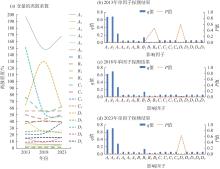
Fig. 7
Discrete coefficients and single factor detection results of influencing factors from 2013 to 2023"
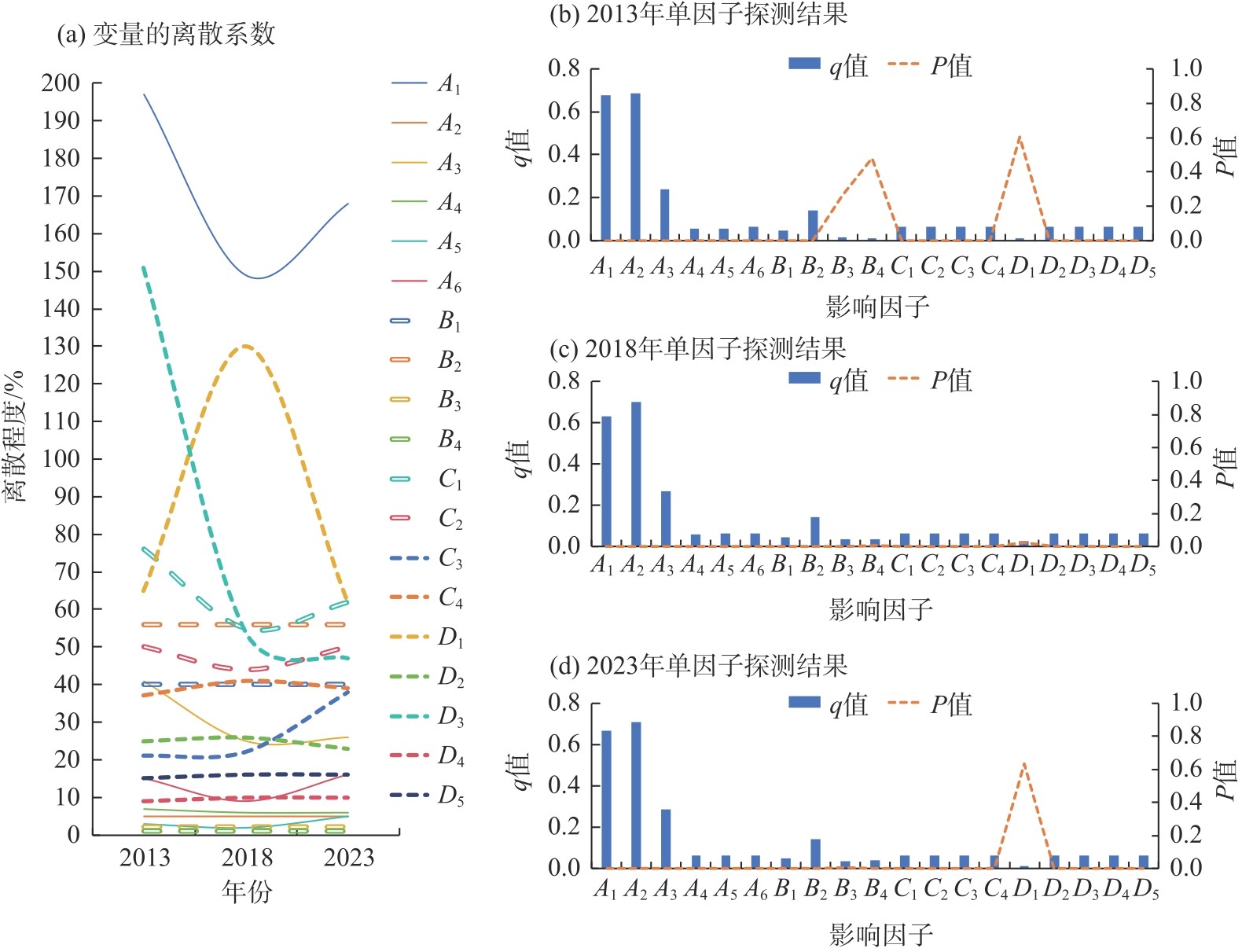
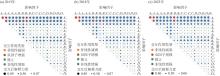
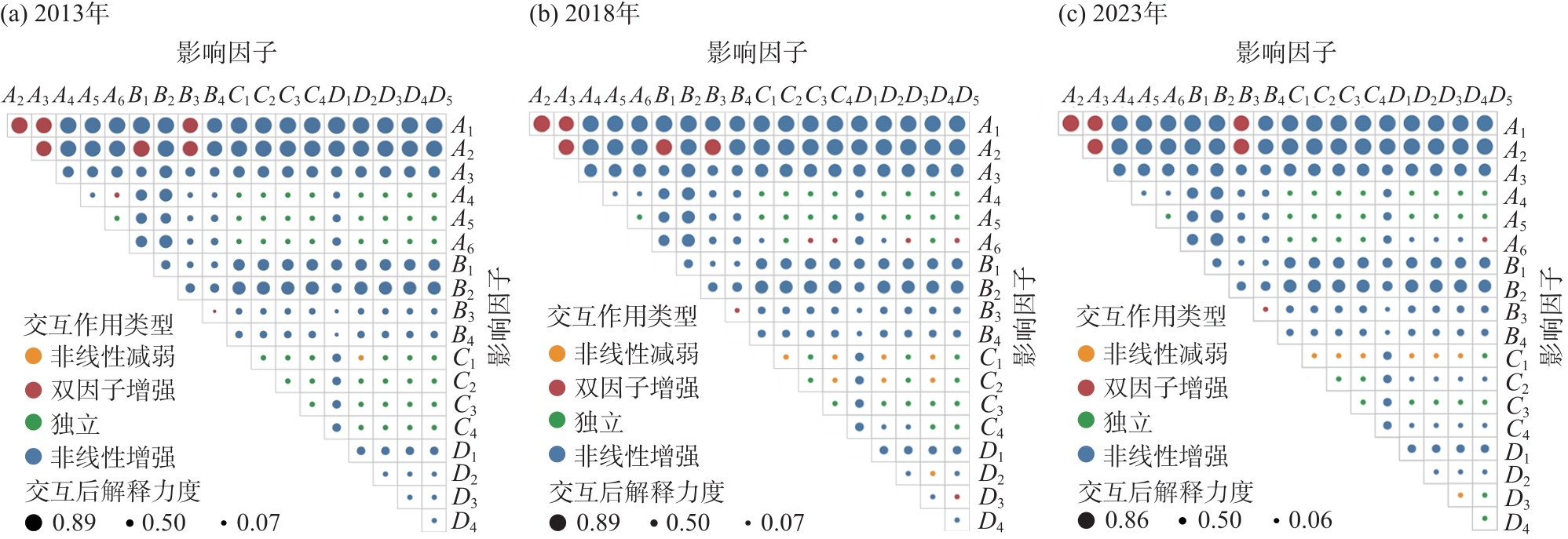
Fig. 8
Interactive detection results of influencing factors from 2013 to 2023"
| [1] |
黄安, 许月卿, 卢龙辉, 等. “生产-生活-生态”空间识别与优化研究进展[J]. 地理科学进展, 2020, 39(3): 503-518.
doi: 10.18306/dlkxjz.2020.03.014 |
|
[Huang An, Xu Yueqing, Lu Longhui, et al. Research progress of the identification and optimization of production-living-ecological spaces[J]. Progress in Geography, 2020, 39(3): 503-518.]
doi: 10.18306/dlkxjz.2020.03.014 |
|
| [2] |
邹利林, 刘彦随, 王永生. 中国土地利用冲突研究进展[J]. 地理科学进展, 2020, 39(2): 298-309.
doi: 10.18306/dlkxjz.2020.02.011 |
|
[Zou Lilin, Liu Yansui, Wang Yongsheng. Research progress and prospect of land-use conflicts in China[J]. Progress in Geography, 2020, 39(2): 298-309.]
doi: 10.18306/dlkxjz.2020.02.011 |
|
| [3] |
方创琳. 城乡融合发展机理与演进规律的理论解析[J]. 地理学报, 2022, 77(4): 759-776.
doi: 10.11821/dlxb202204001 |
|
[Fang Chuanglin. Theoretical analysis on the mechanism and evolution law of urban-rural integration development[J]. Acta Geographica Sinica, 2022, 77(4): 759-776.]
doi: 10.11821/dlxb202204001 |
|
| [4] |
刘彦随. 中国新时代城乡融合与乡村振兴[J]. 地理学报, 2018, 73(4): 637-650.
doi: 10.11821/dlxb201804004 |
|
[Liu Yansui. Research on the urban-rural integration and rural revitalization in the new era in China[J]. Acta Geographica Sinica, 2018, 73(4): 637-650.]
doi: 10.11821/dlxb201804004 |
|
| [5] | 汪光焘, 叶青, 李芬, 等. 培育现代化都市圈的若干思考[J]. 城市规划学刊, 2019(5): 14-23. |
| [Wang Guangtao, Ye Qing, Li Fen, et al. Some thoughts on cultivating a modern metropolitan area[J]. Urban Planning Forum, 2019(5): 14-23.] | |
| [6] |
田俊峰, 王彬燕, 王士君. 土地利用冲突研究的逻辑主线与内容框架[J]. 资源科学, 2023, 45(3): 465-479.
doi: 10.18402/resci.2023.03.01 |
|
[Tian Junfeng, Wang Binyan, Wang Shijun. The paradigms and main content of land use conflict research[J]. Resources Science, 2023, 45(3): 465-479.]
doi: 10.18402/resci.2023.03.01 |
|
| [7] | 翟端强. 城市群国土空间冲突识别、归因与消解[J]. 城市规划, 2024, 48(4): 71-84. |
| [Zhai Duanqiang. Identification, attribution, and resolution of territorial space conflict in urban agglomerations[J]. City Planning Review, 2024, 48(4): 71-84.] | |
| [8] | 周国华, 彭佳捷. 空间冲突的演变特征及影响效应——以长株潭城市群为例[J]. 地理科学进展, 2012, 31(6): 717-723. |
|
[Zhou Guohua, Peng Jiajie. The evolution characteristics and influence effect of spatial conflict: A case study of Changsha-Zhuzhou-Xiangtan urban agglomeration[J]. Progress in Geography, 2012, 31(6): 717-723.]
doi: 10.11820/dlkxjz.2012.06.007 |
|
| [9] |
蒙吉军, 江颂, 拉巴卓玛, 等. 基于景观格局的黑河中游土地利用冲突时空分析[J]. 地理科学, 2020, 40(9): 1553-1562.
doi: 10.13249/j.cnki.sgs.2020.09.017 |
|
[Meng Jijun, Jiang Song, Laba Zhuoma, et al. The spatial and temporal analysis of land use conflict in the middle reaches of the Heihe River based on landscape pattern[J]. Scientia Geographica Sinica, 2020, 40(9): 1553-1562.]
doi: 10.13249/j.cnki.sgs.2020.09.017 |
|
| [10] |
冀正欣, 许月卿, 孙丹峰, 等. 土地系统科学支撑“三生”空间识别与管控——衔接逻辑及实现路径[J]. 资源科学, 2025, 47(1): 14-25.
doi: 10.18402/resci.2025.01.02 |
|
[Ji Zhengxin, Xu Yueqing, Sun Danfeng, et al. The identification and management of production-living-ecological space from the perspective of land system science: Connection logic and realization path[J]. Resources Science, 2025, 47(1): 14-25.]
doi: 10.18402/resci.2025.01.02 |
|
| [11] | Pérez-Soba M, Petit S, Jones L, et al. Land use functions: A multifunctionality approach to assess the impact of land use changes on landuse sustainability[M]. Berlin Heidelberg: Springer, 2008: 76-106. |
| [12] | Kleemann J, Struve B, Spyra M. Conflicts in urban peripheries in Europe[J]. Land Use Policy, 2023, 133: 106849, doi: 10.1016/j.landusepol.2023.106849. |
| [13] |
Winemiller K O, McIntyre P B, Castello L, et al. Balancing hydropower and biodiversity in the Amazon, Congo, and Mekong[J]. Science, 2016, 351(6269): 128-129.
doi: 10.1126/science.aac7082 pmid: 26744397 |
| [14] | 张令达, 侯全华, 段亚琼. 生态文明背景下三生空间研究: 内涵、进展与对策[J]. 生态学报, 2024, 44(1): 47-59. |
| [Zhang Lingda, Hou Quanhua, Duan Yaqiong. A literature review on production-living-ecological spaces in the context of ecological civilization: Connotation, problems and countermeasures[J]. Acta Ecologica Sinica, 2024, 44(1): 47-59.] | |
| [15] |
王成, 唐宁. 重庆市乡村三生空间功能耦合协调的时空特征与格局演化[J]. 地理研究, 2018, 37(6): 1100-1114.
doi: 10.11821/dlyj201806004 |
| [Wang Cheng, Tang Ning. Spatio-temporal characteristics and evolution of rural production-living-ecological space function coupling coordination in Chongqing municipality[J]. Geographical Research, 2018, 37(6): 1100-1114.] | |
| [16] | 倪维秋, 夏源, 赵宁宁. 乡村地域“三生空间”功能演化与耦合协调度研究——以黑龙江省为例[J]. 中国土地科学, 2022, 36(9): 111-119. |
| [Ni Weiqiu, Xia Yuan, Zhao Ningning. Functional evolution and coupling coordination measurement of production-living-ecological space in rural areas: Taking Heilongjiang Province as an example[J]. China Land Sciences, 2022, 36(9): 111-119.] | |
| [17] | 黄勇, 刘浩然, 李旭, 等. 城乡互动视角下村镇聚落发展规律与驱动因素研究——以重庆市永川区为例[J]. 西部人居环境学刊, 2023, 38(6): 115-121. |
| [Huang Yong, Liu Haoran, Li Xu, et al. Research on evolution law and driving factors of rural settlements from the perspective of urban-rural interaction: A case study of Yongchuan District in Chongqing[J]. Journal of Human Settlements in West China, 2023, 38(6): 115-121.] | |
| [18] | 田健, 宿荣, 曾穗平. 大运河天津段沿岸乡村“三生”脆弱性评价与韧性重构策略[J]. 规划师, 2022, 38(10): 117-123. |
| [Tian Jian, Su Rong, Zeng Suiping. Vulnerability assessment and resilience reconstruction of rural production-living-ecological areas along the Grand Canal, Tianjin section[J]. Planners, 2022, 38(10): 117-123.] | |
| [19] | 杨政琨, 张雪松, 雷自耕, 等. 鄂北低丘岗地乡村三生空间功能耦合协调度时空变化研究——以湖北省广水市长岭镇为例[J]. 长江流域资源与环境, 2024, 33(6): 1354-1368. |
| [Yang Zhengkun, Zhang Xuesong, Lei Zigeng, et al. Spatial-temporal variation of the coupling coordination degree for rural production-living-ecology spatial functions in the low hilly area of northern Hubei Province: Take Changling Town, Guangshui City, Hubei Province as an example[J]. Resources and Environment in the Yangtze Basin, 2024, 33(6): 1354-1368.] | |
| [20] | 张新鼎, 崔文刚, 韩会庆, 等. 基于“三生”适宜性的典型喀斯特乡村土地利用冲突识别及分析[J]. 水土保持研究, 2023, 30(4): 412-422. |
| [Zhang Xinding, Cui Wengang, Han Huiqing, et al. Identification and analysis of land use conflicts in typical karst villages based on ‘production-living-ecology’ suitability[J]. Research of Soil and Water Conservation, 2023, 30(4): 412-422.] | |
| [21] | 赵旭, 汤峰, 张蓬涛, 等. 基于CLUE-S模型的县域生产-生活-生态空间冲突动态模拟及特征分析[J]. 生态学报, 2019, 39(16): 5897-5908. |
| [Zhao Xu, Tang Feng, Zhang Pengtao, et al. Dynamic simulation and characteristic analysis of county production-living-ecological spatial conflicts based on CLUE-S model[J]. Acta Ecologica Sinica, 2019, 39(16): 5897-5908.] | |
| [22] | 赵瑞, 刘学敏. 京津冀都市圈“三生”空间时空格局演变及其驱动力研究[J]. 生态经济, 2021, 37(4): 201-208. |
| [Zhao Rui, Liu Xuemin. Analysis on spatial-temporal changes and driving forces of “production-living-ecological” spaces in Beijing-Tianjin-Hebei metropolitan area[J]. Ecological Economy, 2021, 37(4): 201-208.] | |
| [23] |
周德, 徐建春, 王莉. 环杭州湾城市群土地利用的空间冲突与复杂性[J]. 地理研究, 2015, 34(9): 1630-1642.
doi: 10.11821/dlyj201509003 |
| [Zhou De, Xu Jianchun, Wang Li. Land use spatial conflicts and complexity: A case study of the urban agglomeration around Hangzhou Bay, China[J]. Geographical Research, 2015, 34(9): 1630-1642.] | |
| [24] | 王志炜, 魏宇, 李申, 等. 胶东半岛三生空间的时空演变与冲突测度研究[J]. 环境工程技术学报, 2023, 13(1): 386-393. |
| [Wang Zhiwei, Wei Yu, Li Shen, et al. Spatio-temporal evolution and conflict measurement of ecological-production-living spaces in Jiaodong Peninsula[J]. Journal of Environmental Engineering Technology, 2023, 13(1): 386-393.] | |
| [25] | 谭洁, 范思毓, 余德, 等. 洞庭湖生态经济区“三生”空间冲突特征与预测[J/OL]. 环境科学. [2025-06-07]. https://doi.org/10.13227/j.hjkx.202502145. |
| [Tan Jie, Fan Siyu, Yu De, et al. Characteristics and prediction of “production-living-ecology” space conflict in the Dongting Lake Eco-Economic Zone[J/OL]. Environmental Science. [2025-06-07]. https://doi.org/10.13227/j.hjkx.202502145.] | |
| [26] |
孔冬艳, 陈会广, 吴孔森. 中国“三生空间”演变特征、生态环境效应及其影响因素[J]. 自然资源学报, 2021, 36(5): 1116-1135.
doi: 10.31497/zrzyxb.20210503 |
|
[Kong Dongyan, Chen Huiguang, Wu Kongsen. The evolution of “production-living-ecological” space, eco-environmental effects and its influencing factors in China[J]. Journal of Natural Resources, 2021, 36(5): 1116-1135.]
doi: 10.31497/zrzyxb.20210503 |
|
| [27] |
徐建斌, 曹小曙. 宁夏小流域尺度水土资源耦合特征及影响因素[J]. 干旱区地理, 2025, 48(9): 1531-1540.
doi: 10.12118/j.issn.1000-6060.2024.611 |
|
[Xu Jianbin, Cao Xiaoshu. Coupling characteristics and influencing factors of water and soil resources at the sub-basin scale in Ningxia[J]. Arid Land Geography, 2025, 48(9): 1531-1540.]
doi: 10.12118/j.issn.1000-6060.2024.611 |
|
| [28] |
张晓东, 马风华, 赵志鹏, 等. 宁夏中部荒漠草原防沙治沙区NDVI时空演化特征及其对气候因素的响应[J]. 干旱区地理, 2025, 48(10): 1804-1814.
doi: 10.12118/j.issn.1000-6060.2024.782 |
|
[Zhang Xiaodong, Ma Fenghua, Zhao Zhipeng, et al. Spatio-temporal evolution characteristics of NDVI and its response to climate factors of desertification prevention and control zone in the desert grasslands of central Ningxia[J]. Arid Land Geography, 2025, 48(10): 1804-1814.]
doi: 10.12118/j.issn.1000-6060.2024.782 |
|
| [29] | 冯丽媛, 米文宝, 马国庆. 基于CA-Markov模型的宁夏沿黄生态经济带土地利用变化及模拟研究[J]. 水土保持通报, 2019, 39(5): 218-222, 230, 2. |
| [Feng Liyuan, Mi Wenbao, Ma Guoqing. A study of land use change and simulation of a Ningxia Eco-Economic Belt along Yellow River based on CA-Markov model[J]. Bulletin of Soil and Water Conservation, 2019, 39(5): 218-222, 230, 2.] | |
| [30] |
李瑾, 文琦, 杨骁. 基于资源环境承载力的干旱区乡村振兴路径研究——以宁夏为例[J]. 干旱区地理, 2022, 45(1): 287-297.
doi: 10.12118/j.issn.1000–6060.2021.063 |
|
[Li Jin, Wen Qi, Yang Xiao. Rural revitalization path based on the resources and environment carrying capacity in arid area: A case of Ningxia Hui Autonomous Region[J]. Arid Land Geography, 2022, 45(1): 287-297.]
doi: 10.12118/j.issn.1000–6060.2021.063 |
|
| [31] |
马彩虹, 安斯文, 滑雨琪, 等. 宁夏沿黄经济带生态用地格局演变及其驱动机制[J]. 经济地理, 2022, 42(6): 179-187.
doi: 10.15957/j.cnki.jjdl.2022.06.018 |
|
[Ma Caihong, An Siwen, Hua Yuqi, et al. Evolution and driving mechanism of ecological land use along the Yellow Economic Belt in Ningxia[J]. Economic Geography, 2022, 42(6): 179-187.]
doi: 10.15957/j.cnki.jjdl.2022.06.018 |
|
| [32] |
廖李红, 戴文远, 陈娟, 等. 平潭岛快速城市化进程中三生空间冲突分析[J]. 资源科学, 2017, 39(10): 1823-1833.
doi: 10.18402/resci.2017.10.03 |
|
[Liao Lihong, Dai Wenyuan, Chen Juan, et al. Spatial conflict between ecological-production-living spaces on Pingtan Island during rapid urbanization[J]. Resources Science, 2017, 39(10): 1823-1833.]
doi: 10.18402/resci.2017.10.03 |
|
| [33] | 宋复蓉, 曾向阳, 陈勇. 矿粮复合区“三生”空间冲突诊断及演化特征分析——以大冶市陈贵镇为例[J]. 水土保持研究, 2024, 31(2): 401-412, 421. |
| [Song Furong, Zeng Xiangyang, Chen Yong. Diagnosis and optimization of ‘production-living-ecology’space conflict in the mine-grain mixed zone: An example of Chengui Town, Daye City[J]. Research of Soil and Water Conservation, 2024, 31(2): 401-412, 421.] | |
| [34] | 武燕, 吴映梅, 李琛, 等. 基于风险-质量的高原湖泊流域生态分区构建——以滇池流域为例[J]. 生态学报, 2024, 44(3): 1052-1066. |
| [Wu Yan, Wu Yingmei, Li Chen, et al. Construction of ecological zoning of plateau lake basin based on spatial conflict and eco-environmental quality: A case of Dianchi Lake Basin[J]. Acta Ecologica Sinica, 2024, 44(3): 1052-1066.] | |
| [35] |
Wang J F, Zhang T L, Fu B J. A measure of spatial stratified heterogeneity[J]. Ecological Indicators, 2016, 67: 250-256.
doi: 10.1016/j.ecolind.2016.02.052 |
| [36] |
尹君锋, 宋长青, 石培基, 等. 耦合视角下甘肃省县域乡村“三生”功能协调度的时空跃迁特征与影响因素[J]. 地理研究, 2024, 43(4): 874-892.
doi: 10.11821/dlyj020230643 |
| [Yin Junfeng, Song Changqing, Shi Peiji, et al. Spatial and temporal transition characteristics and influencing factors of “production-living-ecological” functions of rural areas at county level in Gansu Province from the perspective of coupling[J]. Geographical Research, 2024, 43(4): 874-892.] | |
| [37] |
陈万旭, 李江风, 曾杰, 等. 中国土地利用变化生态环境效应的空间分异性与形成机理[J]. 地理研究, 2019, 38(9): 2173-2187.
doi: 10.11821/dlyj020180659 |
| [Chen Wanxu, Li Jiangfeng, Zeng Jie, et al. Spatial heterogeneity and formation mechanism of eco-environmental effect of land use change in China[J]. Geographical Research, 2019, 38(9): 2173-2187.] | |
| [38] | Liu D, Li F, Qiu M, et al. An integrated framework for measuring sustainable rural development towards the SDGs[J]. Land Use Policy, 2024, 147: 107339, doi: 10.1016/j.landusepol.2024.107339. |
| [39] |
杨燕, 胡书玲, 王坤, 等. 少数民族旅游村寨的三生空间演变及驱动机制——以肇兴侗寨为例[J]. 经济地理, 2023, 43(12): 222-230.
doi: 10.15957/j.cnki.jjdl.2023.12.022 |
| [Yang Yan, Hu Shuling, Wang Kun, et al. Evolution and driving mechanism of “production-living-ecological” space in ethnic tourism village: A case study of Dong Village in Zhaoxing Town[J]. Economic Geography, 2023, 43(12): 222-230.] | |
| [40] |
武志平, 姜民, 付建新. 黄河“几”字弯都市圈城镇化高质量发展时空分异及驱动力[J]. 干旱区地理, 2025, 48(7): 1279-1292.
doi: 10.12118/j.issn.1000-6060.2024.501 |
|
[Wu Zhiping, Jiang Min, Fu Jianxin. Spatial and temporal differences and driving forces for high-quality development of urbanization in the Jiziwan metropolitan area of the Yellow River[J]. Arid Land Geography, 2025, 48(7): 1279-1292.]
doi: 10.12118/j.issn.1000-6060.2024.501 |
| [1] | LUO Lei,LIU Chuansheng,HU Jiangling,WANG Xin-yuan,LU Llei,ZHAO Yan-chuang,LI Li,JI Xin-yang,YAN Hui,WANG Yue. Dynamic evolution of landscape pattern and ecological health assessment of Tianshan Natural Heritage Site in Xinjiang [J]. 干旱区地理, 2019, 42(1): 195-205. |
|
||

