Arid Land Geography ›› 2026, Vol. 49 ›› Issue (2): 343-355.doi: 10.12118/j.issn.1000-6060.2025.100
• Climatology and Hydrology • Previous Articles Next Articles
WANG Shengjie( ), ZHANG Qinghong(), SANG Mingjian
Received:2025-02-27
Revised:2025-04-23
Online:2026-02-25
Published:2026-02-27
Contact:
ZHANG Qinghong
E-mail:wsj12252025@163.com;zhqh@xjufe.edu.cn
WANG Shengjie, ZHANG Qinghong, SANG Mingjian. Prediction and application of urban PM2.5 concentration in arid zones based on improved deep learning models[J].Arid Land Geography, 2026, 49(2): 343-355.
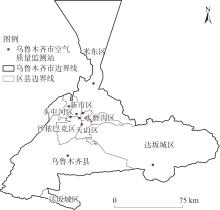
Fig. 1
Distribution of air quality monitoring stations in Urumqi City"
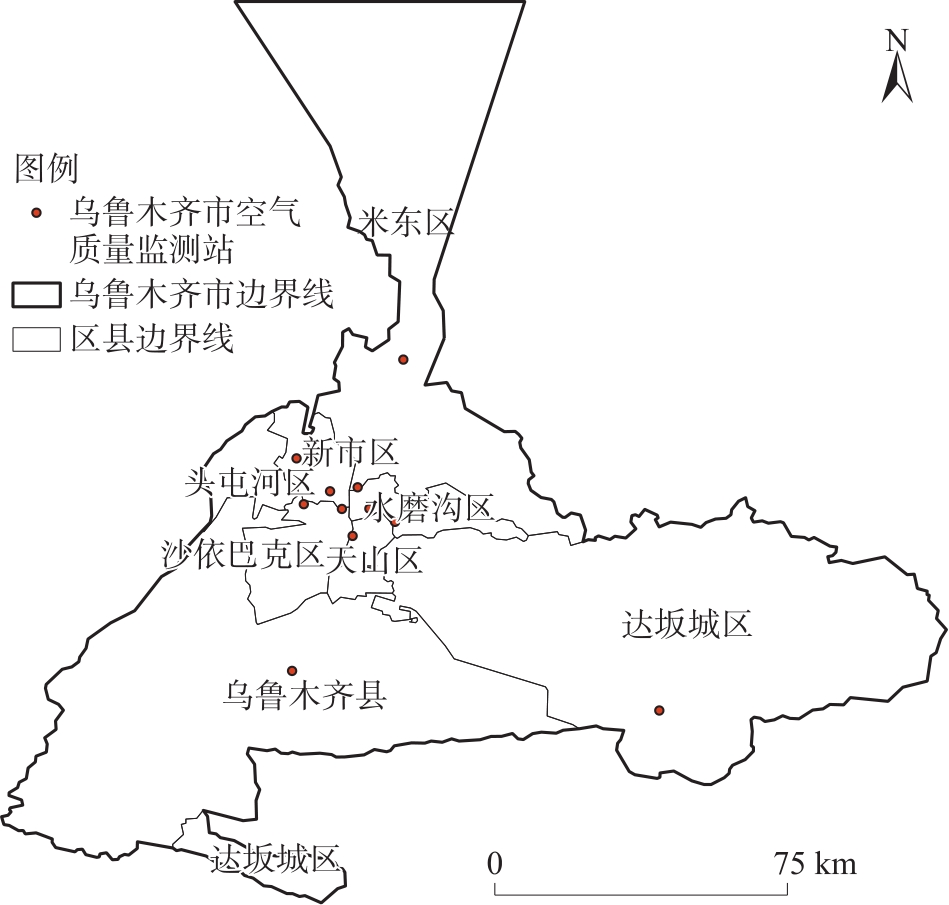
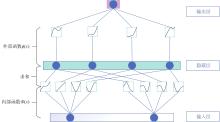
Fig. 2
KAN network structure"
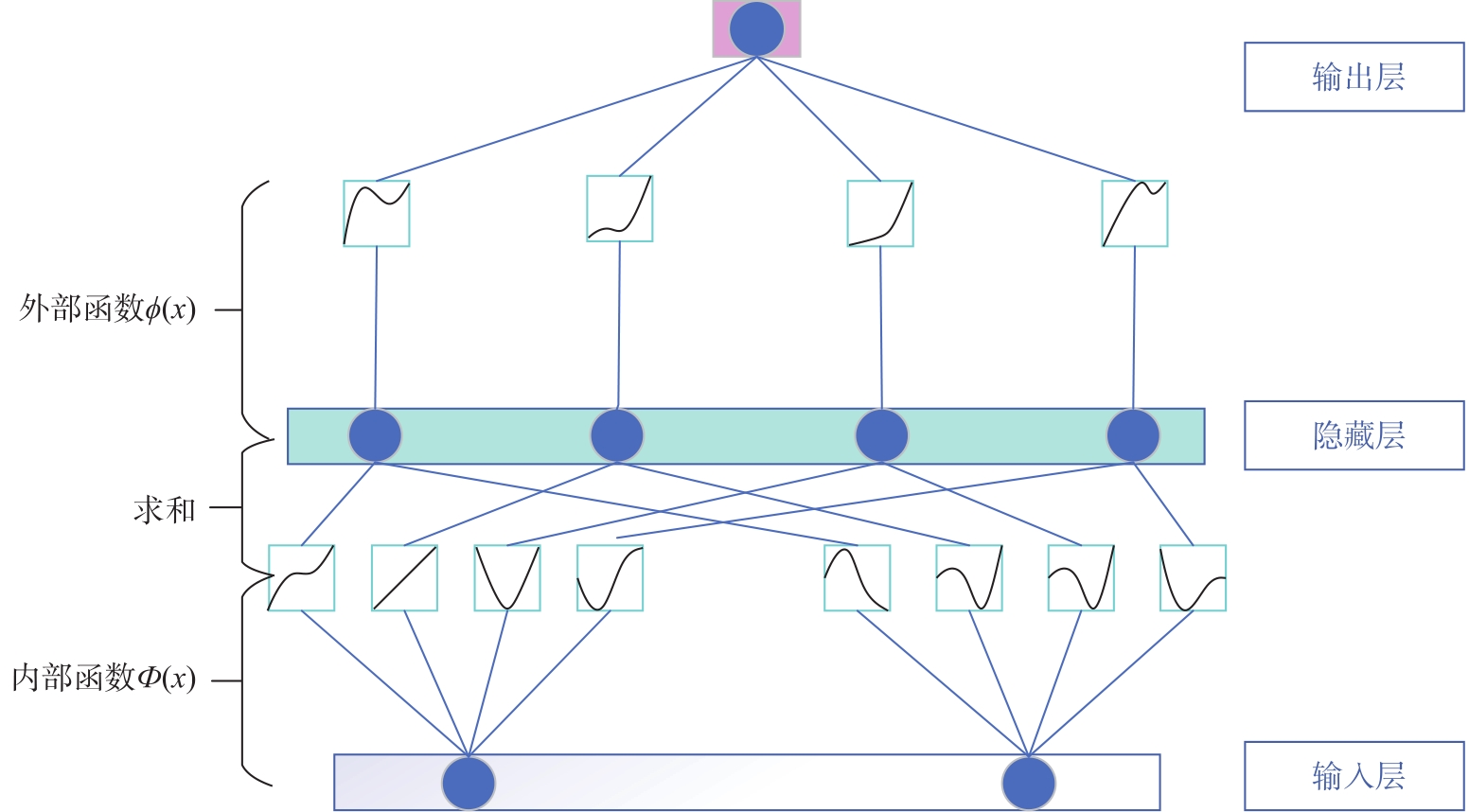
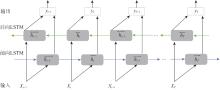
Fig. 3
BiLSTM model structure"
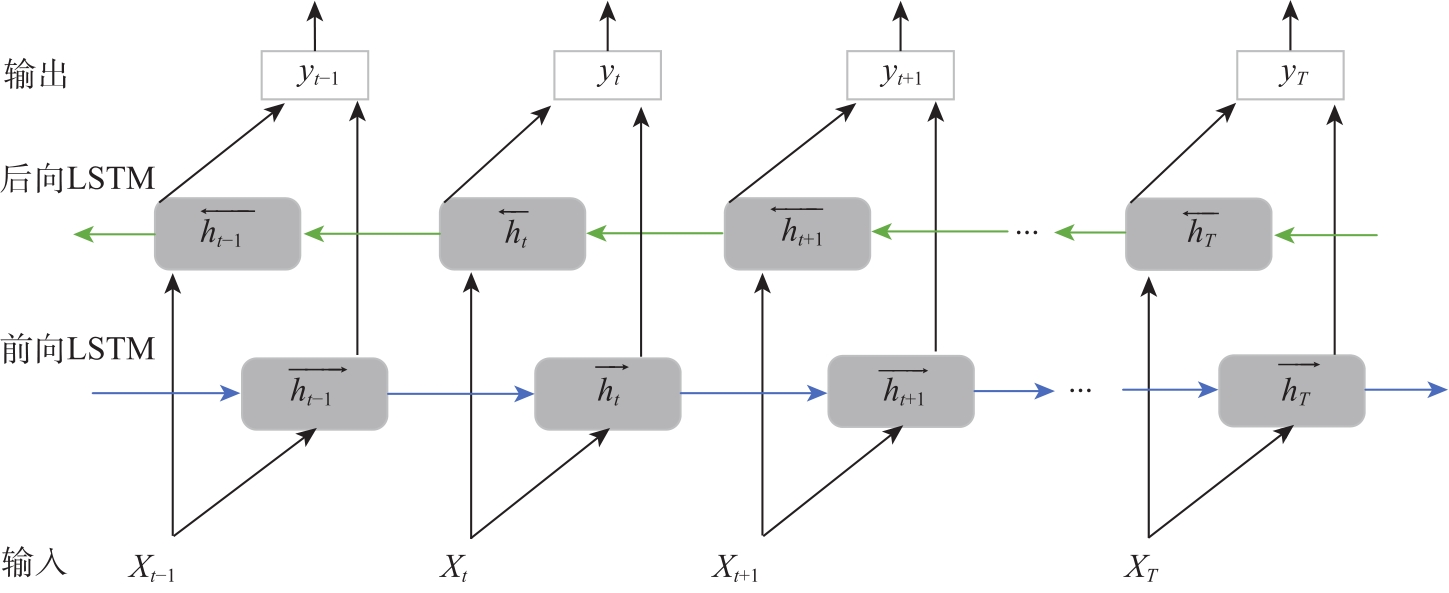
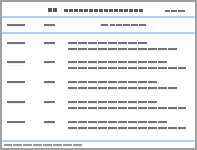
Tab. 1
Descriptive statistical analysis of the datas"
| 统计指标 | PM2.5/μg·m-3 | AQI | PM10/μg·m-3 | O3/μg·m-3 | NO2/μg·m-3 | CO2/μg·m-3 | CO/μg·m-3 | TEMP/℃ | SLP/hPa | WDSP/m·s-1 | PRCP/mm | DEWP/℃ |
|---|---|---|---|---|---|---|---|---|---|---|---|---|
| 总样本 | 1277 | 1277 | 1277 | 1277 | 1277 | 1277 | 1277 | 1253 | 1253 | 1253 | 1253 | 1253 |
| 平均值 | 41.97 | 75.73 | 78.58 | 62.55 | 34.67 | 6.59 | 0.75 | 47.58 | 1020.81 | 4.78 | 0.28 | 27.00 |
| 标准差 | 44.56 | 51.14 | 66.02 | 25.13 | 17.83 | 1.68 | 0.46 | 25.30 | 12.85 | 28.16 | 4.89 | 16.22 |
| 最小值 | 4.90 | 18.52 | 10.28 | 15.83 | 7.01 | 3.25 | 0.26 | -11.10 | 995.20 | 1.50 | 0.00 | -16.80 |
| 下四分位数 | 14.04 | 42.61 | 39.05 | 39.41 | 21.64 | 5.43 | 0.42 | 25.30 | 1010.20 | 3.20 | 0.00 | 14.00 |
| 中位数 | 20.91 | 55.26 | 58.27 | 64.99 | 30.16 | 6.33 | 0.54 | 50.60 | 1020.10 | 3.90 | 0.00 | 27.60 |
| 上四分位数 | 54.14 | 91.28 | 95.78 | 82.77 | 43.99 | 7.41 | 0.94 | 70.60 | 1030.30 | 4.60 | 0.00 | 40.30 |
| 最大值 | 316.68 | 343.68 | 1190.53 | 136.39 | 91.89 | 14.80 | 2.58 | 90.20 | 1059.60 | 999.90 | 99.99 | 59.80 |
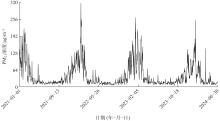
Fig. 4
Change in PM2.5 concentration"
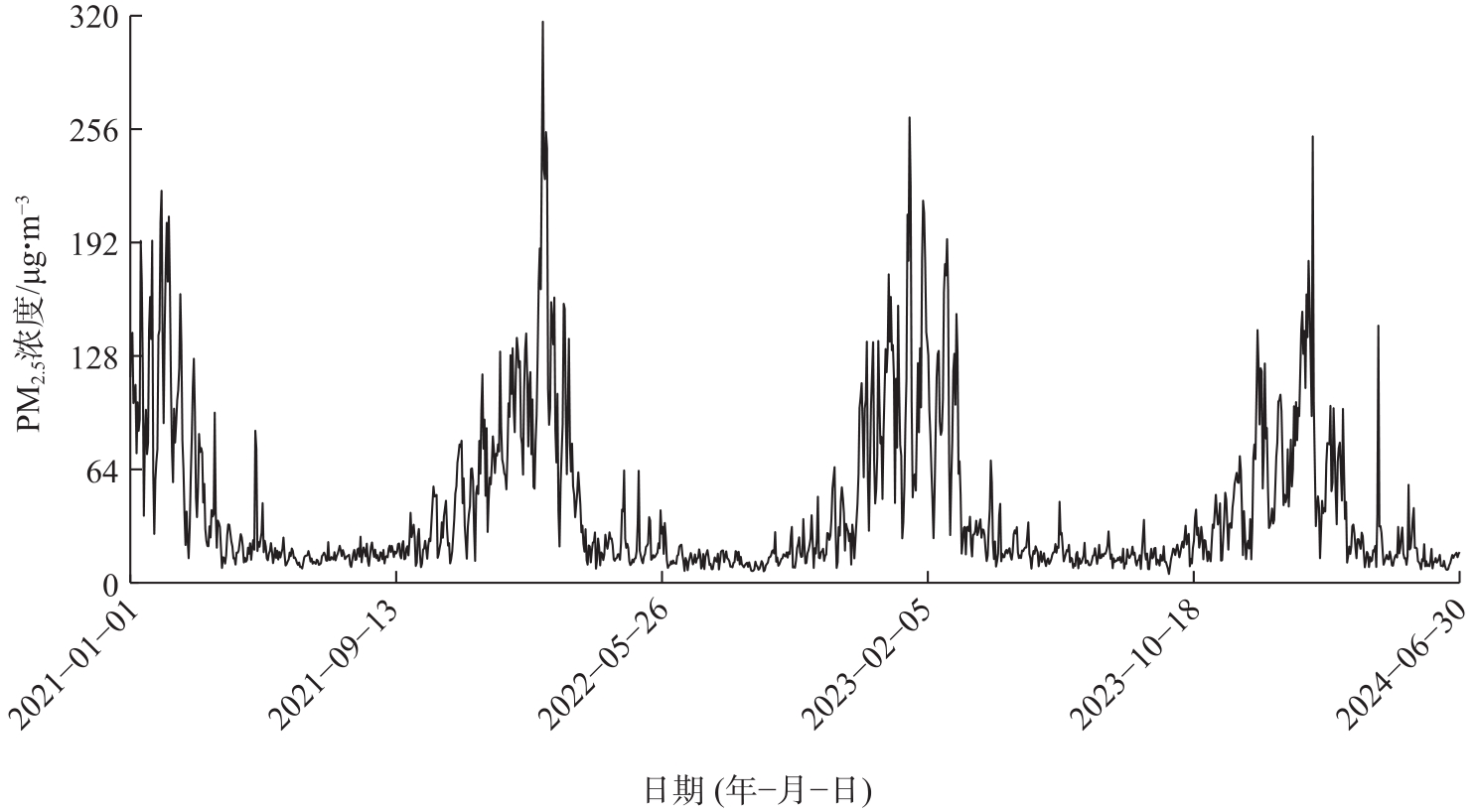
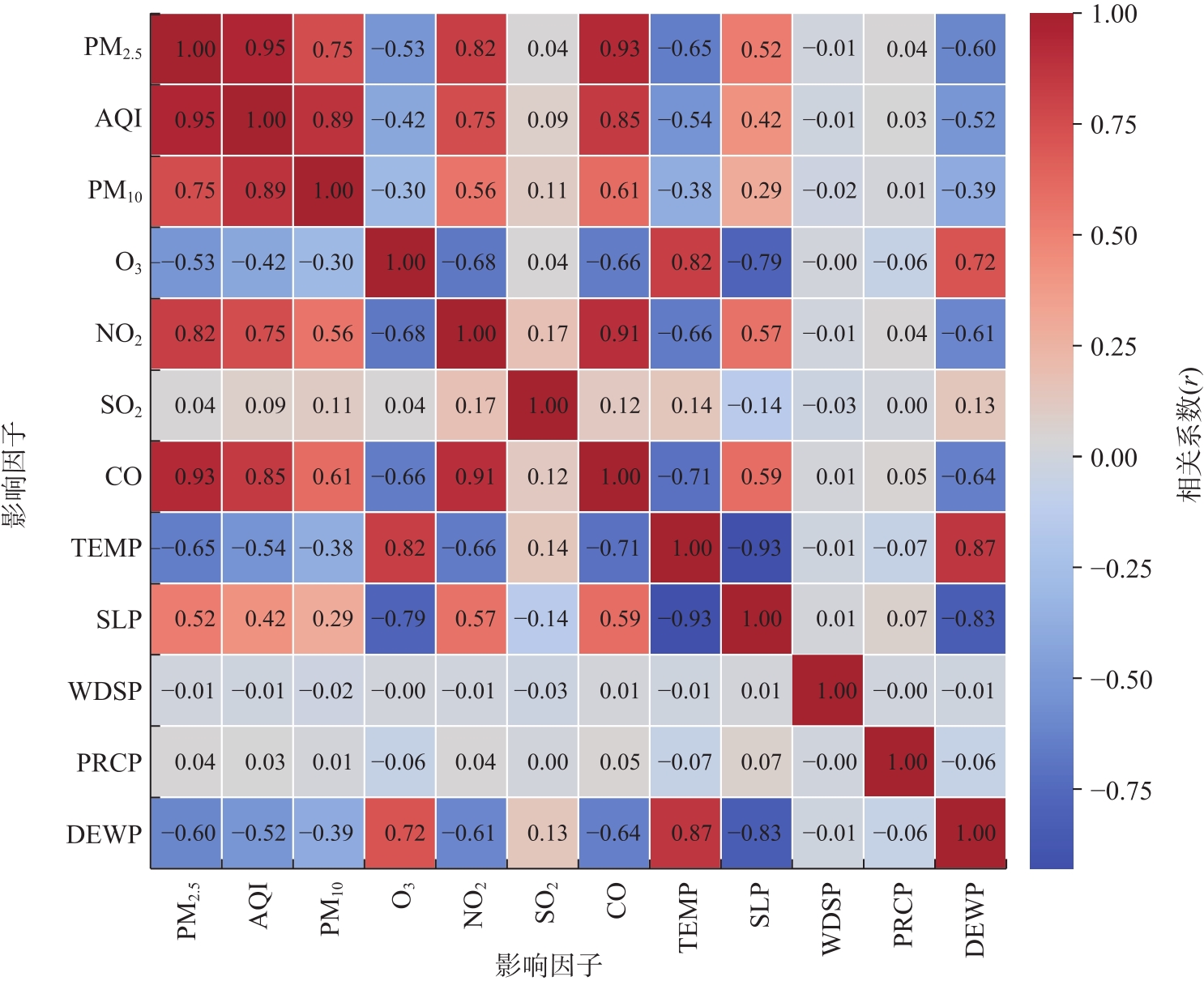
Fig. 5
Heat map analysis"
Tab. 2
Statistical test"
| 影响因子 | PM2.5 | AQI | PM10 | O3 | NO2 | SO2 | CO | TEMP | SLP | WDSP | PRCP | DEWP |
|---|---|---|---|---|---|---|---|---|---|---|---|---|
| PM2.5 | 1.000 | |||||||||||
| AQI | 0.950** | 1.000 | ||||||||||
| PM10 | 0.752** | 0.886** | 1.000 | |||||||||
| O3 | -0.529** | -0.420** | -0.299** | 1.000 | ||||||||
| NO2 | 0.824** | 0.754** | 0.556** | -0.678** | 1.000 | |||||||
| SO2 | 0.041 | 0.088** | 0.110** | 0.039 | 0.171** | 1.000 | ||||||
| CO | 0.933** | 0.847** | 0.607** | 0.657** | 0.907** | 0.119** | 1.000 | |||||
| TEMP | -0.647** | -0.540** | -0.376** | 0.822** | -0.663** | 0.139** | -0.714** | 1.000 | ||||
| SLP | 0.524** | 0.424** | 0.289** | -0.787** | 0.569** | -0.141** | 0.595** | -0.930** | 1.000 | |||
| WDSP | -0.006 | -0.010 | -0.021 | -0.001 | -0.008 | -0.028 | 0.007 | -0.011 | 0.011 | 1.000 | ||
| PRCP | 0.037 | 0.031 | 0.012 | -0.063* | 0.043 | 0.001 | 0.047 | -0.069* | 0.066* | -0.003 | 1.000 | |
| DEWP | -0.602** | -0.524** | -0.390** | 0.715** | -0.609** | 0.135** | -0.639** | 0.872** | -0.835** | -0.010 | -0.063* | 1.000 |
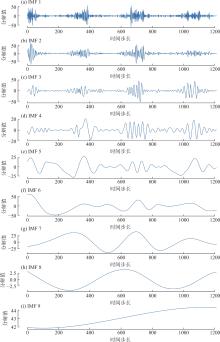
Fig. 6
Resultsof CEEMDAN decompositions"
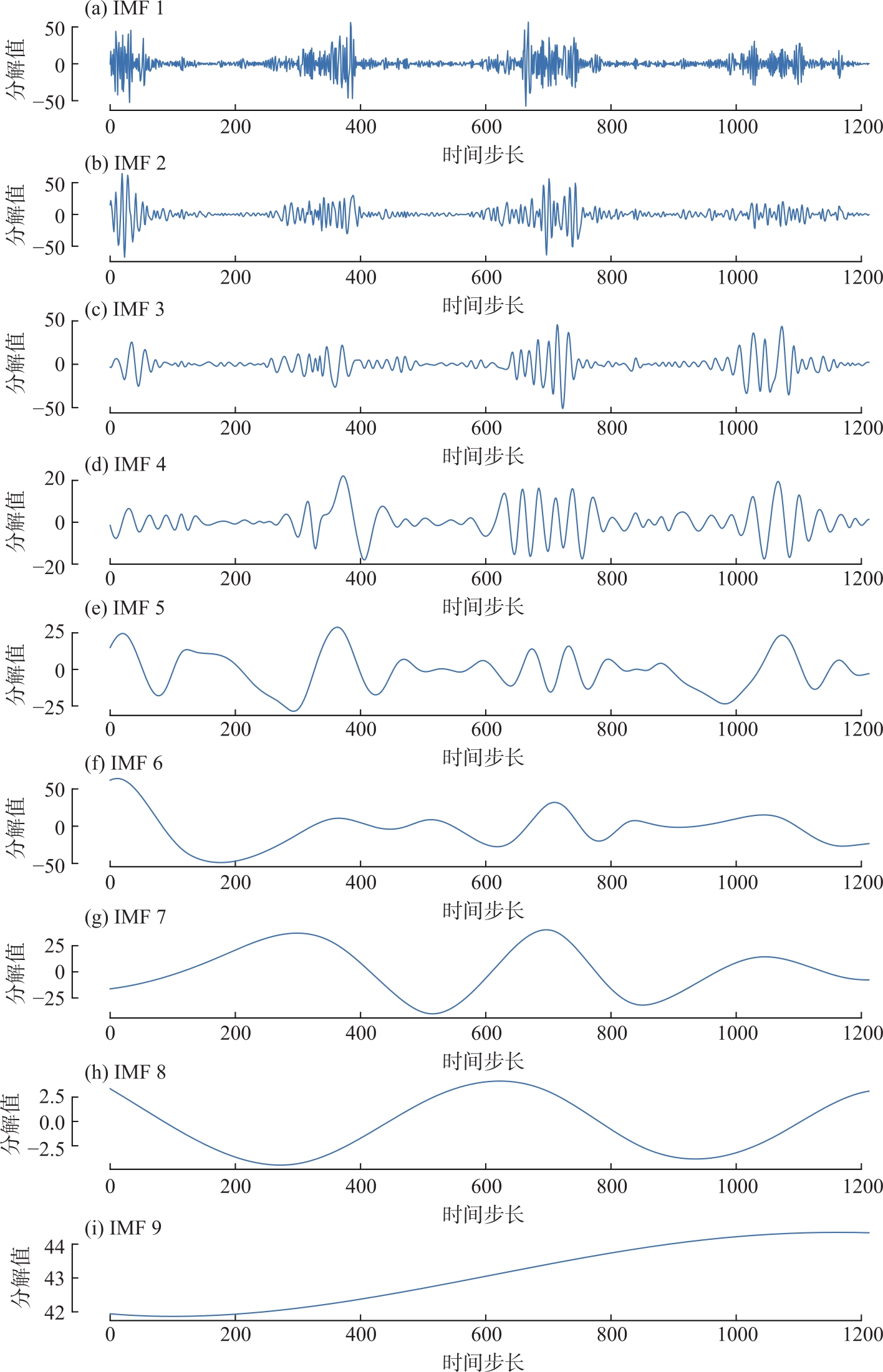
Fig. 7
Five fold cross-validation chart"
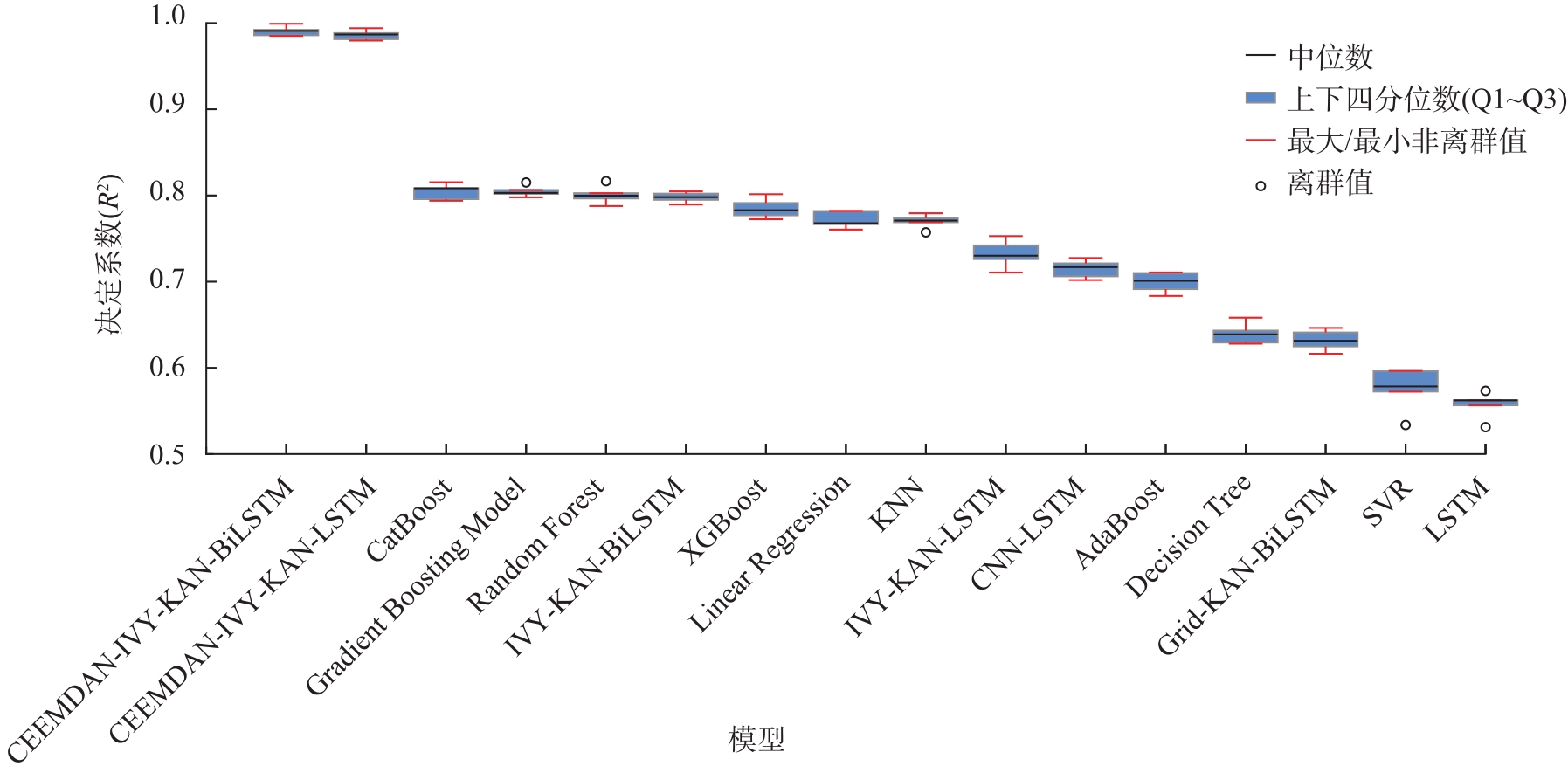
Fig. 8
Taylor diagram of performance evaluation indicators"
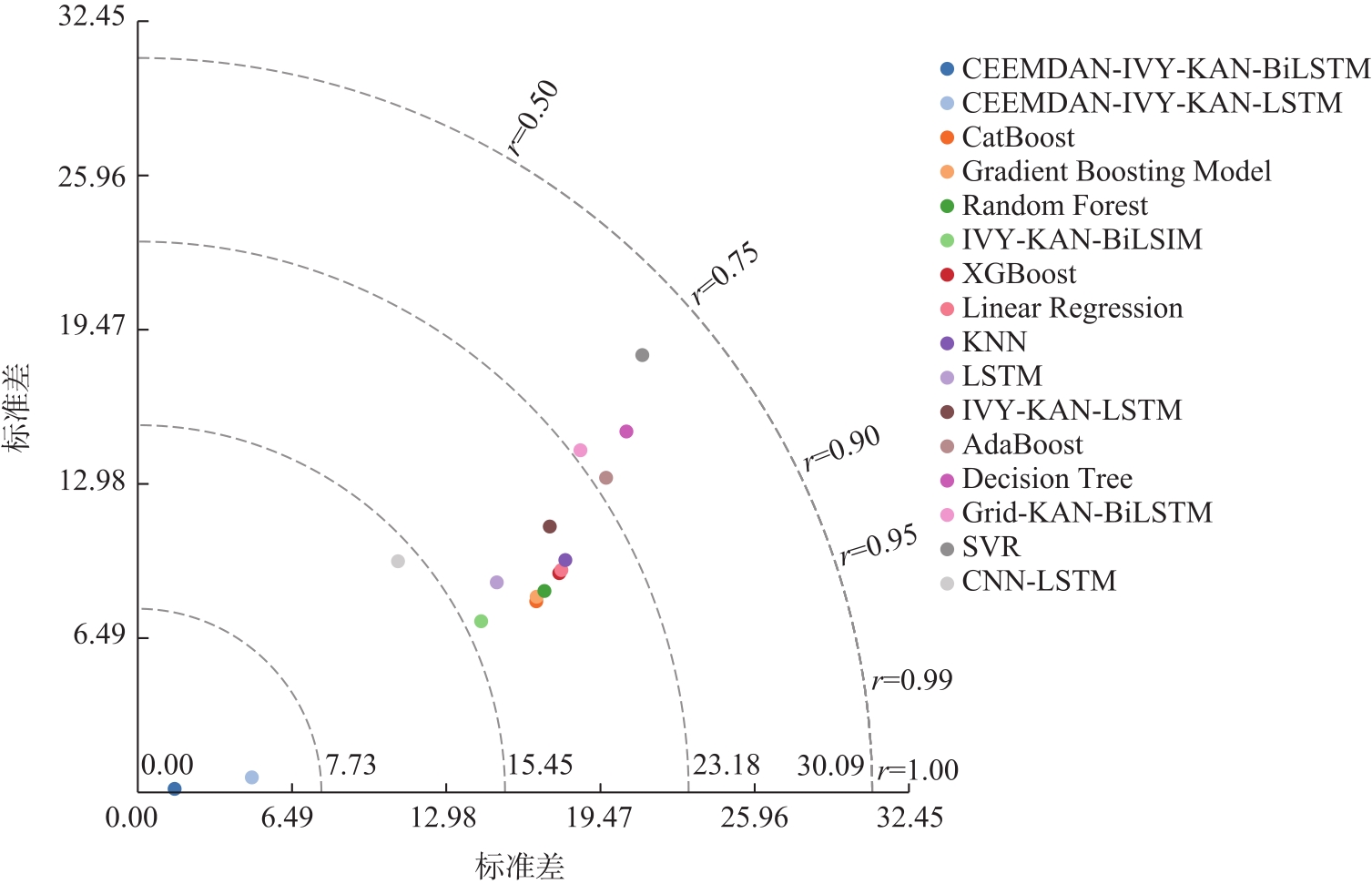
Tab. 3
Indicators for evaluating the performance of different models"
| 模型 | R2 | MAE | RMSE |
|---|---|---|---|
| CEEMDAN-IVY-KAN-BiLSTM(本文模型) | 0.991 | 1.391 | 1.881 |
| CEEMDAN-IVY-KAN-LSTM* | 0.983 | 3.064 | 4.846 |
| CatBoost | 0.813 | 10.244 | 19.710 |
| Gradient Boosting Model | 0.806 | 9.860 | 19.902 |
| Random Forest | 0.803 | 9.436 | 19.306 |
| IVY-KAN-BiLSTM* | 0.801 | 10.697 | 16.961 |
| XGBoost | 0.787 | 11.803 | 19.159 |
| Linear Regression | 0.784 | 10.227 | 19.278 |
| KNN | 0.772 | 10.857 | 19.350 |
| IVY-KAN-LSTM * | 0.745 | 9.770 | 16.797 |
| CNN-LSTM | 0.706 | 11.051 | 21.711 |
| AdaBoost | 0.689 | 19.307 | 20.876 |
| Decision Tree | 0.647 | 13.315 | 28.083 |
| Grid-KAN-BiLSTM* | 0.626 | 16.333 | 22.935 |
| SVR | 0.571 | 14.764 | 26.950 |
| LSTM | 0.559 | 9.702 | 16.067 |
| [1] | 时雨, 武迪, 依里帕·依力哈木, 等. 乌鲁木齐市呼吸系统疾病空气质量健康指数的构建[J]. 环境与职业医学, 2024, 41(3): 276-281. |
| [Shi Yu, Wu Di, Yilihamu Yilipa, et al. Construction of air quality health index for respiratory diseases in Urumqi[J]. Journal of Environmental and Occupational Medicine, 2024, 41(3): 276-281.] | |
| [2] | 于志翔, 于晓晶, 李霞, 等. 基于中国高分辨率数据集(CHAP)的近20 a新疆地区PM2.5时空变化特征[J]. 干旱区资源与环境, 2025, 39(4): 132-144. |
| [Yu Zhixiang, Yu Xiaojing, Li Xia, et al. Spatiotemporal variations of PM2.5 in Xinjiang during 2000—2022 revealed by the China High Air Pollutants (CHAP) reanalysis dataset[J]. Journal of Arid Land Resources and Environment, 2025, 39(4): 132-144.] | |
| [3] |
闫劲烨, 马正权, 孙萱萱, 等. 2015—2023年“乌-昌-石”城市群PM2.5与PM10时空变化及潜在源分析[J]. 干旱区地理, 2025, 48(3): 405-420.
doi: 10.12118/j.issn.1000-6060.2024.249 |
|
[Yan Jinye, Ma Zhengquan, Sun Xuanxuan, et al. Spatiotemporal variations and potential sources of PM2.5and PM10inthe “Urumqi-Changji-Shihezi” urban agglomeration from 2015 to 2023[J]. Arid Land Geography, 2025, 48(3): 405-420.]
doi: 10.12118/j.issn.1000-6060.2024.249 |
|
| [4] |
马正权, 闫劲烨, 帕丽达·牙合甫, 等. 乌鲁木齐市和喀什市近地面O3变化特征及潜在源研究[J]. 干旱区研究, 2024, 41(12): 2004-2014.
doi: 10.13866/j.azr.2024.12.03 |
|
[Ma Zhengquan, Yan Jinye, Yahufu Palida, et al. Characteristics and potential sources of surface O3 variation in Urumqiand Kashgar[J]. Arid Zone Research, 2024, 41(12): 2004-2014.]
doi: 10.13866/j.azr.2024.12.03 |
|
| [5] | 梅承志, 李斌, 何友江, 等. 2015—2023年天山北坡区域PM2.5与O3-8 h变化趋势及影响因素分析[J]. 环境科学学报, 2025, 45(1): 388-399. |
| [Mei Chengzhi, Li Bin, He Youjiang, et al. Variation trends and influencing factors of PM2.5 and O3-8 h on the north slope of Tianshan Mountain during 2015—2023[J]. Acta Scientiae Circumstantiae, 2025, 45(1): 388-399.] | |
| [6] | 王嘉敏, 杨文柱, 焦燕, 等. 内蒙古沿黄流域城市群PM2.5区域输送及源解析[J]. 中国环境科学, 2025, 45(10): 5338-5356. |
| [Wang Jiamin, Yang Wenzhu, Jiao Yan, et al. Regional transport and source analysis of PM2.5 in urban agglomerations along the Yellow River Basin in Inner Mongolia[J]. China Environmental Science, 2025, 45(10): 5338-5356.] | |
| [7] | 潘梦瑶, 任瑛, 王思源, 等. 基于梯度提升算法和SHAP的石家庄PM2.5和臭氧浓度预测及影响因素分析[J]. 环境科学学报, 2024, 44(7): 402-409. |
| [Pan Mengyao, Ren Ying, Wang Siyuan, et al. Prediction of PM2.5 and ozone concentration in Shijiazhuang and analysis of influencing factors based on gradient boosting algorithm and SHAP[J]. Acta Scientiae Circumstantiae, 2024, 44(7): 402-409.] | |
| [8] | 杨国亮, 余华声, 黄聪. 基于优化组合模型的PM2.5浓度预测[J]. 计算机工程与设计, 2023, 44(10): 3132-3137. |
| [Yang Guoliang, Yu Huasheng, Huang Cong. PM2.5 concentration prediction based on optimization combination model[J]. Computer Engineering and Design, 2023, 44(10): 3132-3137.] | |
| [9] | 康俊锋, 黄烈星, 张春艳, 等. 多机器学习模型下逐小时PM2.5预测及对比分析[J]. 中国环境科学, 2020, 40(5): 1895-1905. |
| [Kang Junfeng, Huang Liexing, Zhang Chunyan, et al. Hourly PM2.5 prediction and its comparative analysis under multi-machine learning model[J]. China Environmental Science, 2020, 40(5): 1895-1905.] | |
| [10] |
Bi J Z, Knowland K E, Keller C A, et al. Combining machine learning and numerical simulation for high-resolution PM2.5 concentration forecast[J]. Environmental Science & Technology, 2022, 56(3): 1544-1556.
doi: 10.1021/acs.est.1c05578 |
| [11] | 江雨燕, 傅杰, 甘如美江, 等. 改进灰狼算法优化GBDT在PM2.5预测中的应用[J]. 安全与环境学报, 2024, 24(4): 1569-1580. |
| [Jiang Yuyan, Fu Jie, Gan Rumeijiang, et al. Application of improved Gray Wolf Algorithm to optimize GBDT in PM2.5 prediction[J]. Journal of Safety and Environment, 2024, 24(4): 1569-1580.] | |
| [12] | Zhou S, Wang W, Zhu L, et al. Deep-learning architecture for PM2.5concentration prediction: A review[J]. Environmental Science and Ecotechnology, 2024: 100400, doi: 10.1016/j.ese.2024.100400. |
| [13] | 朱菊香, 谷卫, 罗丹悦, 等. 基于注意力机制的CNN-ILSTM地铁站PM2.5预测建模[J]. 中国测试, 2024, 50(7): 53-62. |
| [Zhu Juxiang, Gu Wei, Luo Danyue, et al. Prediction modeling of PM2.5 in subway station based on attention mechanism and CNN-ILSTM[J]. China Measurement & Test, 2024, 50(7): 53-62.] | |
| [14] | 彭豪杰, 周杨, 胡校飞, 等. 基于深度学习与随机森林的PM2.5浓度预测模型[J]. 遥感学报, 2023, 27(2): 430-440. |
| [Peng Haojie, Zhou Yang, Hu Xiaofei, et al. A PM2.5 prediction model based on deep learning and random forest[J]. Journal of Remote Sensing, 2023, 27(2): 430-440.] | |
| [15] | 范昕炜, 宣泉森. 基于神经网络的PM2.5质量浓度预测模型[J]. 安全与环境学报, 2022, 22(6): 3499-3507. |
| [Fan Xinwei, Xuan Quansen. Prediction model of PM2.5 mass concentration based on neural network[J]. Journal of Safety and Environment, 2022, 22(6): 3499-3507.] | |
| [16] | 刘恩海, 付英健, 张智, 等. 联合Transformer注意力机制的PM2.5浓度预测网络研究[J]. 安全与环境学报, 2023, 23(10): 3760-3768. |
| [Liu Enhai, Fu Yingjian, Zhang Zhi, et al. PM2.5 recurrent prediction network combined with transformer attention mechanism[J]. Journal of Safety and Environment, 2023, 23(10): 3760-3768.] | |
| [17] | 顾阔, 焦瑞莉, 薄宇, 等. 基于复合LSTM模型的PM2.5浓度预测[J]. 中国环境监测, 2023, 39(1): 170-180. |
| [Gu Kuo, Jiao Ruili, Bo Yu, et al. PM2.5 concentration prediction based on thecomposite LSTM model[J]. Environmental Monitoring in China, 2023, 39(1): 170-180.] | |
| [18] | Shi P, Fang X, Ni J, et al. An Improved attention-based integrated deep neural network for PM2.5 concentration prediction[J]. Applied Sciences, 2021, 11(9): 4001, doi: 10.3390/app11094001. |
| [19] | Lin M D, Liu P Y, Huang C W, et al. The application of strategy based on LSTM for the short-term prediction of PM2.5 in city[J]. Science of the Total Environment, 2024, 906: 167892, doi: 10.1016/j.scitotenv.2023.167892. |
| [20] | 杨长春, 聂倩倩. 面向PM2.5预测的时间序列分解与机器学习融合模型[J]. 安全与环境学报, 2023, 23(12): 4600-4608. |
| [Yang Changchun, Nie Qianqian. Fusion model of time series decomposition andmachine learning for PM2.5 forecasting[J]. Journal of Safety and Environment, 2023, 23(12): 4600-4608.] | |
| [21] |
魏疆, 赵彩欣, 王国华, 等. 乌鲁木齐市城区大气PM2.5中水溶性离子组分特征及来源解析[J]. 干旱区地理, 2025, 48(4): 623-631.
doi: 10.12118/j.issn.1000-6060.2024.358 |
|
[Wei Jiang, Zhao Caixin, Wang Guohua, et al. Characteristics and sources of water-soluble ion components in PM2.5 in the urban area of Urumqi City[J]. Arid Land Geography, 2025, 48(4): 623-631.]
doi: 10.12118/j.issn.1000-6060.2024.358 |
|
| [22] |
魏疆, 宋丹丹, 赵丽莉, 等. 乌鲁木齐市PM2.5中碳组分污染特征及来源解析[J]. 干旱区研究, 2024, 41(8): 1323-1330.
doi: 10.13866/j.azr.2024.08.06 |
|
[Wei Jiang, Song Dandan, Zhao Lili, et al. Analysis of carbon component pollution characteristics and sources of PM2.5 in Urumqi City[J]. Arid Zone Research, 2024, 41(8): 1323-1330.]
doi: 10.13866/j.azr.2024.08.06 |
|
| [23] | Torres M E, Colominas M A, Schlotthauer G, et al. A complete ensemble empirical mode decomposition with adaptive noise[C]// IEEE International Conference on Acoustics, Speech and Signal Processing (ICASSP), May 22-27, 2011, Prague, Czech Republic. New York: IEEE Signal Processing Society, 2011: 4144-4147. |
| [24] | Ghasemi M, Zare M, Trojovský P, et al. Optimization based on the smart behavior of plants with its engineering applications: Ivy algorithm[J]. Knowledge-Based Systems, 2024, 295: 111850, doi: 10.1016/j.knosys.2024.111850. |
| [25] | Liu Z, Wang Y, Vaidya S, et al. Kan: Kolmogorovarnold networks[J]. arXiv Preprint arXiv: 2404.19756, 2024, doi: 10.48550/arXiv.2404.19756. |
| [26] | 谢琪, 夏飞, 袁博. 基于CEEMDAN-SE-BiLSTM模型的西安市PM2.5浓度预测[J]. 环境工程, 2024, 42(8): 105-115. |
| [Xie Qi, Xia Fei, Yuan Bo. Prediction of PM2.5 concentration in Xi’an based on CEEMDAN-SE-BiLSTM model[J]. Environmental Engineering, 2024, 42(8): 105-115.] | |
| [27] | 张纯曦, 阿丽亚·拜都热拉, 刘丽, 等. 乌鲁木齐市PM2.5分布特征及其预测模型研究[J]. 石河子大学学报(自然科学版), 2020, 38(5): 648-654. |
| [Zhang Chunxi, Baidurela Aliya, Liu Li, et al. Temporal and spatial distribution characteristicsand prediction model of PM2.5 in Urumqi[J]. Journal of Shihezi University (Natural Science), 2020, 38(5): 648-654.] | |
| [28] | 张士杰, 窦燕. 基于XGBoost与SHAP模型的特征分析在PM2.5浓度预测中的应用[J]. 赤峰学院学报(自然科学版), 2022, 38(12): 10-17. |
| [Zhang Shijie, Dou Yan. Application of feature analysis based on XGBoost and SHAP models in PM2.5 concentration prediction[J]. Journal of Chifeng University (Natural Science Edition), 2022, 38(12): 10-17.] | |
| [29] | 丁成亮, 郑洪波. 基于改进机器学习的PM2.5浓度预测模型研究[J]. 大连理工大学学报, 2024, 64(4): 353-360. |
| [Ding Chengliang, Zheng Hongbo. Study of PM2.5 concentration prediction modelbased on improved machine learning[J]. Journal of Dalian University of Technology, 2024, 64(4): 353-360.] | |
| [30] | 李明明, 王小兰, 岳江, 等. 融合EOF分解及CNN-LSTM神经网络的PM2.5预测[J]. 环境科学, 2025, 46(2): 715-726. |
| [Li Mingming, Wang Xiaolan, Yue Jiang, et al. PM2.5 prediction based on EOF decomposition and CNN-LSTM neural network[J]. Environmental Science, 2025, 46(2): 715-726.] |
| [1] | GUO Jiali, MA Yonggang, PAN Heng, LI Na, SUN Changning, SUN Qian, ZHOU Wenchang, DANG Yuxuan. Comparative analysis of satellite monitoring of soil salinization in Ebinur Lake during spring and summer [J]. Arid Land Geography, 2025, 48(12): 2143-2157. |
| [2] | YUAN Panli,WANG Chuanjian,ZHAO Qingzhan,WANG Xuewen,REN Yuanyuan,YANG Qiyuan. Dynamic monitoring of land-use/land-cover change in cold and arid region based on deep learning: A case study of Mosuowan reclamation area in Xinjiang [J]. Arid Land Geography, 2021, 44(6): 1717-1728. |
| [3] |
LU Wen-lu, LIU Zhi-feng, HE Chun-yang, XIA Pei.
A new method for detecting urban construction land based on Sentinel-1A synthetic aperture radar data and fully convolutional network [J]. Arid Land Geography, 2020, 43(3): 750-760. |
|
||

