Arid Land Geography ›› 2025, Vol. 48 ›› Issue (10): 1815-1827.doi: 10.12118/j.issn.1000-6060.2024.722
• Ecology and Environment • Previous Articles Next Articles
WANG Chao( ), HE Youjun(), HAN Lili
Received:2024-11-27
Revised:2025-01-17
Online:2025-10-25
Published:2025-10-27
Contact:
HE Youjun
E-mail:wanngch@163.com;heyoujun@caf.ac.cn
WANG Chao, HE Youjun, HAN Lili. Spatial mismatch pattern and its influencing factors between the Grain for Green Project and vegetation restoration in the Loess Plateau[J].Arid Land Geography, 2025, 48(10): 1815-1827.
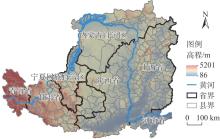
Fig. 1
Schematic diagram of the study area"
Tab. 1
Data sources and usages"
| 数据类型 | 数据名称 | 数据描述 | 数据来源 | 用途 |
|---|---|---|---|---|
| 土壤数据 | 土壤类型 | 数据类型为栅格格式,空间分辨率为1 km×1 km,利用ArcGIS 10.7将数据重采样为90 m×90 m | 资源环境科学与数据中心( | 构建相似生境单元 |
| DEM数据 | 高程、坡度、坡向 | 数据类型为栅格格式,空间分辨率为90 m×90 m | 中国科学院地理空间数据云( | |
| 遥感产品 | 土地利用 | 数据类型为栅格格式,利用ArcGIS 10.7将数据重采样为90 m×90 m | 武汉大学CLCD数据集( | 计算退耕还林政策强度 |
| EVI | 数据类型为栅格格式,时间分辨率为16 d合成产品,空间分辨率为250 m×250 m,利用ArcGIS 10.7将数据重采样为90 m×90 m | Google Earth Engine | 计算植被恢复潜力实现度 | |
| FVC | 数据类型为栅格格式,时间分辨率为30 d合成产品,空间分辨率为250 m×250 m,利用ArcGIS 10.7将数据重采样为90 m×90 m | 地球资源数据云( | 稳健性分析 | |
| 气象数据 | 年平均气温、年累计降水量 | 数据类型为TXT格式,时间分辨率为日值,空间分辨率为全国752个站点,利用R平台将数据转为栅格格式,利用ArcGIS 10.7对气象数据进行插值,并重采样至90 m×90 m | 国家气象科学数据中心 ( | 空间错配指数影响因素分析 |
| 社会经济数据 | 农村人口压力 | 农村人口数量占区域总人口的比重 | 2000—2022年《中国县域统计年鉴》、各省份《统计年鉴》 | |
| 农业产业结构 | 农业产值与地区生产总值的比重 | |||
| 乡村经济水平 | 农村居民人均可支配收入占人均GDP的比重 |
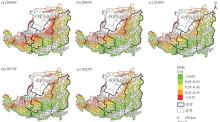
Fig. 2
Distributions of enhanced vegetation index (EVI) changes in the Loess Plateau from 2000 to 2022"
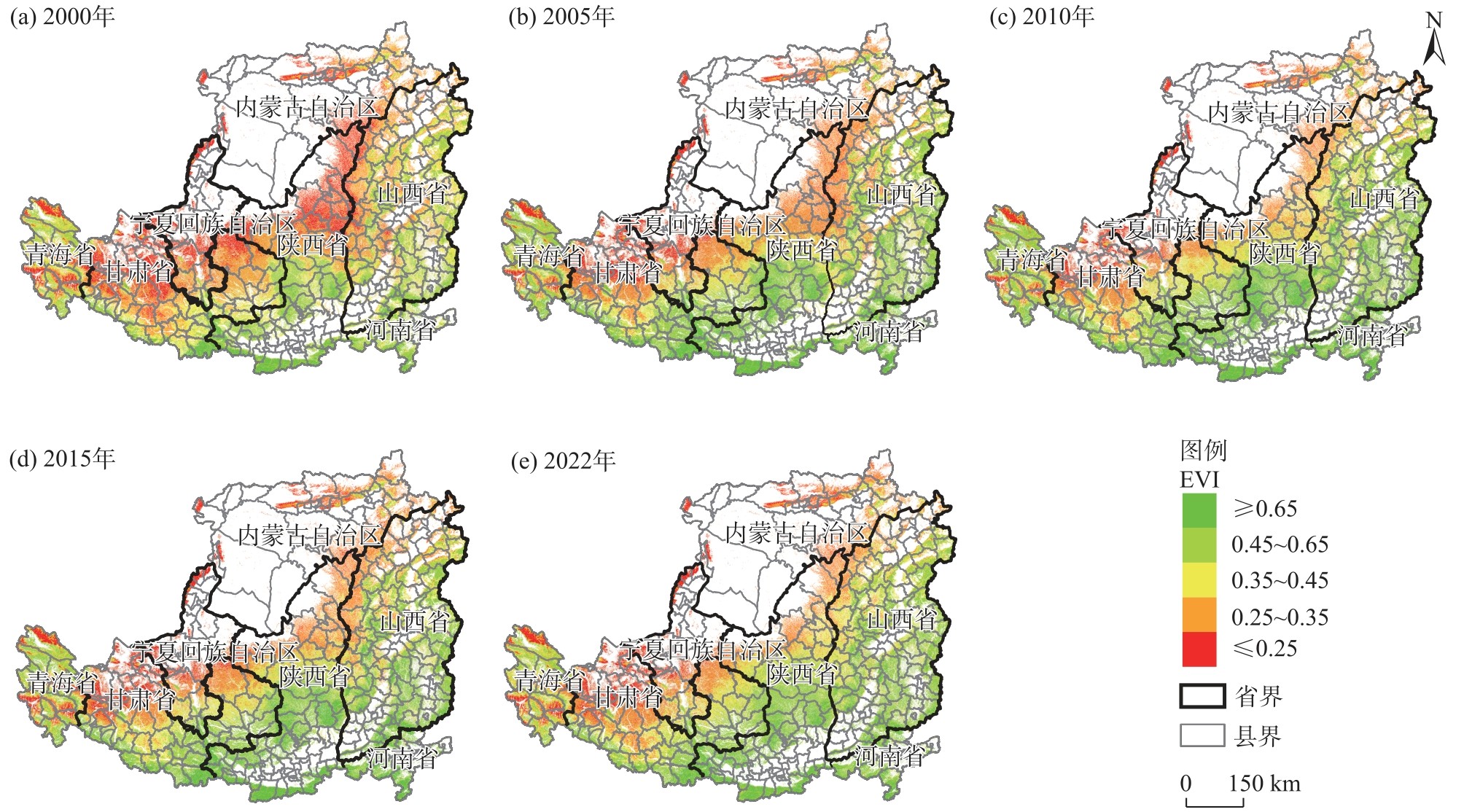
Fig. 3
Distribution of vegetation restoration potential (VRP) in the Loess Plateau"
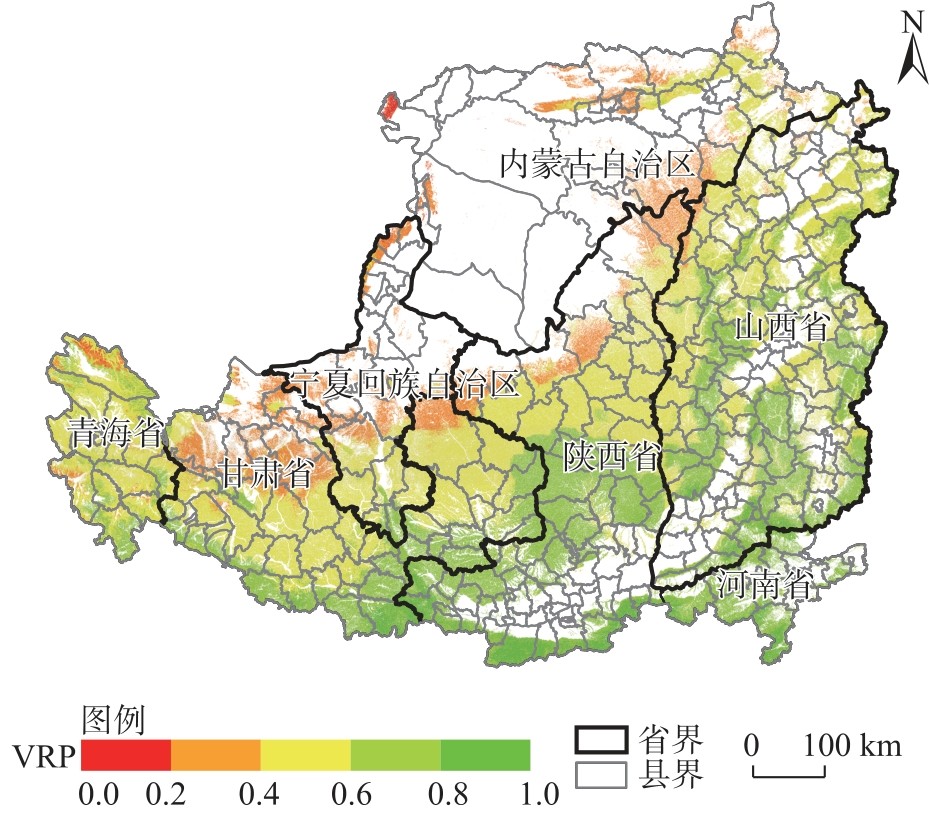
Fig. 4
Distributions of vegetation restoration potential realization degree (VRPRD) changes in the Loess Plateau from 2000 to 2022"

Fig. 5
Distributions of spatial mismatch index (SMI) changes in the Loess Plateau from 2000 to 2022"
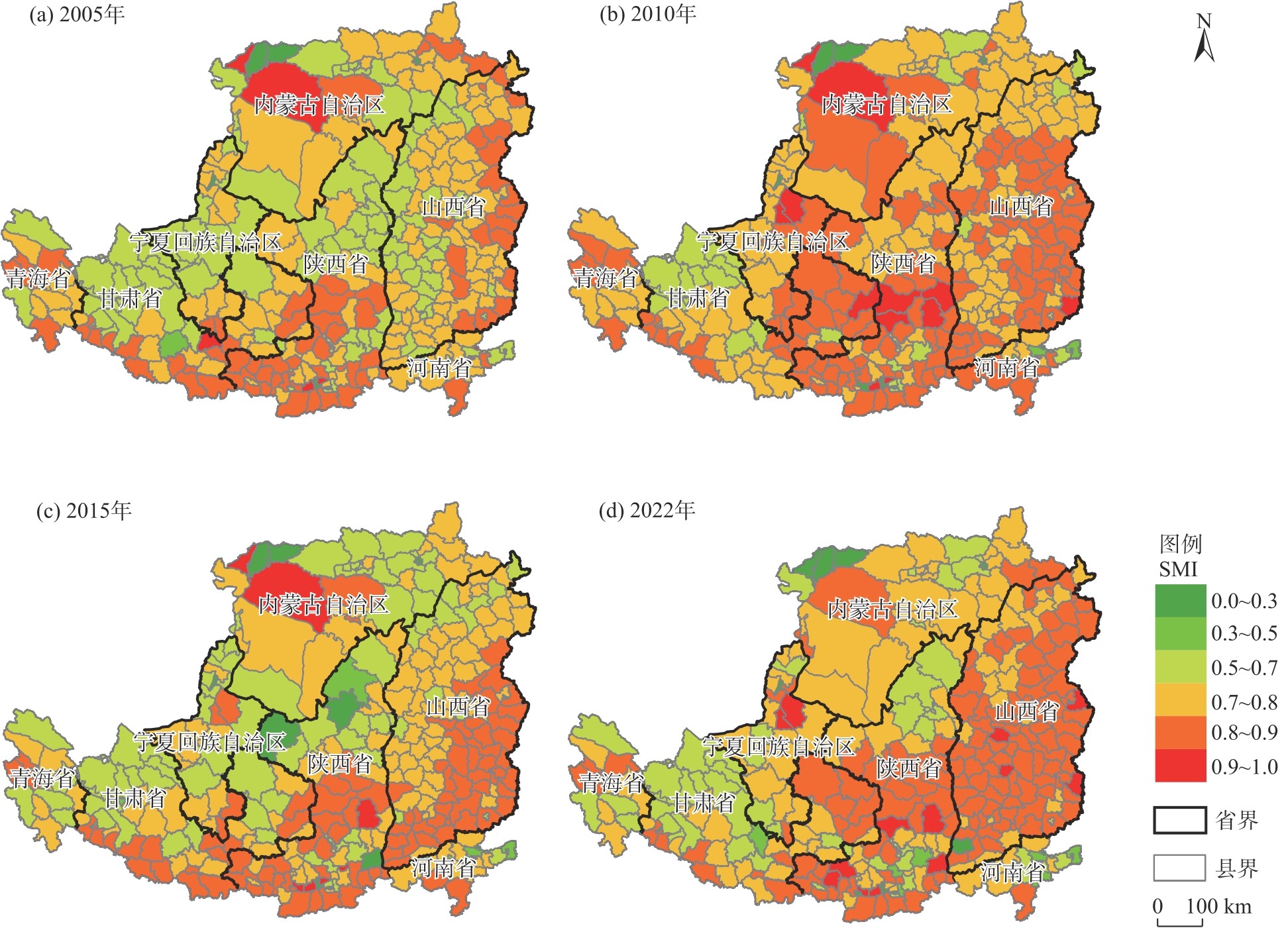
Fig. 6
Spatial distribution characteristics of SMI in the Loess Plateau"
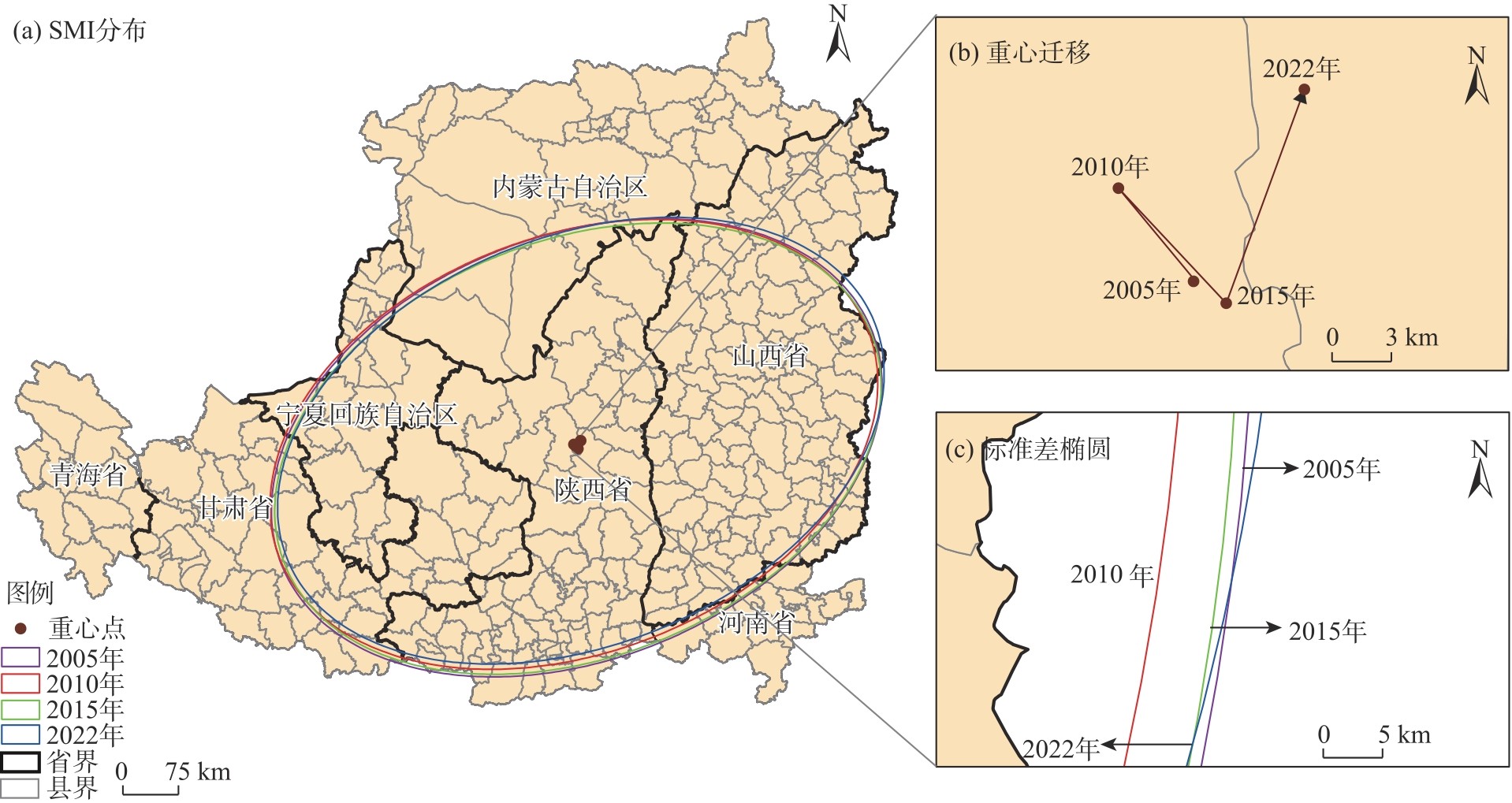
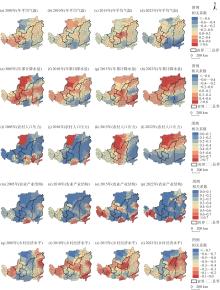
Fig. 7
Spatial distributions of correlation coefficients of each influencing factor"

Tab. 2
Multicollinearity variance inflation factor (VIF) tests"
| 变量 | 2005年 | 2010年 | 2015年 | 2022年 |
|---|---|---|---|---|
| 年平均气温 | 1.42 | 2.16 | 1.22 | 1.43 |
| 年累计降水量 | 1.25 | 2.17 | 1.18 | 1.64 |
| 农村人口压力 | 1.41 | 1.34 | 1.35 | 1.40 |
| 农业产业结构 | 2.02 | 2.11 | 1.75 | 1.33 |
| 乡村经济水平 | 1.54 | 1.74 | 1.38 | 1.09 |
Tab. 3
Correlation test results of different spatial mismatch index (SMI)"
| 年份 | 2005年 | 2010年 | 2015年 | 2022年 |
|---|---|---|---|---|
| 相关系数 | 0.71 | 0.72 | 0.79 | 0.83 |
| 常数项 | 0.44 | 0.45 | 0.37 | 0.26 |
| 决定系数(R2) | 0.84 | 0.79 | 0.84 | 0.90 |
| P值 | 0.00 | 0.00 | 0.00 | 0.00 |
| [1] | 刘希朝, 李效顺, 蒋冬梅. 基于土地利用变化的黄河流域景观格局及生态风险评估[J]. 农业工程学报, 2021, 37(4): 265-274. |
| [Liu Xizhao, Li Xiaoshun, Jiang Dongmei. Landscape pattern identification and ecological risk assessment using land-use change in the Yellow River Basin[J]. Transactions of the Chinese Society of Agricultural Engineering, 2021, 37(4): 265-274.] | |
| [2] | 于航, 金磊, 谭炳香, 等. 黄土高原退耕还林生态服务权衡协同分析——以安塞县为例[J]. 生态学杂志, 2023, 42(3): 544-551. |
|
[Yu Hang, Jin Lei, Tan Bingxiang, et al. Trade-off and synergy analysis of ecological services of grain for green program in Loess Plateau: A case study of Ansai County[J]. Chinese Journal of Ecology, 2023, 42(3): 544-551.]
doi: DOI: 10.13292/j.1000-4890.202303.015 |
|
| [3] |
董洁芳, 张凯莉, 屈学书, 等. 黄河流域城市生态福利绩效测算及驱动因素研究[J]. 干旱区地理, 2023, 46(5): 834-845.
doi: 10.12118/j.issn.1000-6060.2022.383 |
|
[Dong Jiefang, Zhang Kaili, Qu Xueshu, et al. Measurement and influencing factors of ecological well-being performance of cities in Yellow River Basin[J]. Arid Land Geography, 2023, 46(5): 834-845.]
doi: 10.12118/j.issn.1000-6060.2022.383 |
|
| [4] |
邵全琴, 刘树超, 宁佳, 等. 2000—2019年中国重大生态工程生态效益遥感评估[J]. 地理学报, 2022, 77(9): 2133-2153.
doi: 10.11821/dlxb202209001 |
|
[Shao Quanqin, Liu Shuchao, Ning Jia, et al. Assessment of ecological benefits of key national ecological projects in China in 2000—2019 using remote sensing[J]. Acta Geographica Sinica, 2022, 77(9): 2133-2153.]
doi: 10.11821/dlxb202209001 |
|
| [5] | 王丹丹, 吴普特, 赵西宁. 黄土高原退耕还林(草)效益评价研究进展[J]. 西北林学院学报, 2010, 25(3): 223-228. |
| [Wang Dandan, Wu Pute, Zhao Xining. Benefit evaluation of conversion of cropland to forest project in the Loess Plateau: A review[J]. Journal of Northwest Forestry University, 2010, 25(3): 223-228.] | |
| [6] | 周德成, 赵淑清, 朱超. 退耕还林工程对黄土高原土地利用/覆被变化的影响——以陕西省安塞县为例[J]. 自然资源学报, 2011, 26(11): 1866-1878. |
|
[Zhou Decheng, Zhao Shuqing, Zhu Chao. Impacts of the sloping land conversion program on the land use/cover change in the Loess Plateau: A case study in Ansai County of Shaanxi Province, China[J]. Journal of Natural Resources, 2011, 26(11): 1866-1878.]
doi: 10.11849/zrzyxb.2011.11.006 |
|
| [7] |
赵安周, 张安兵, 刘海新, 等. 退耕还林(草)工程实施前后黄土高原植被覆盖时空变化分析[J]. 自然资源学报, 2017, 32(3): 449-460.
doi: 10.11849/zrzyxb.20160411 |
|
[Zhao Anzhou, Zhang Anbin, Liu Haixin, et al. Spatiotemporal variation of vegetation coverage before and after implementation of grain for green project in the Loess Plateau[J]. Journal of Natural Resources, 2017, 32(3): 449-460.]
doi: 10.11849/zrzyxb.20160411 |
|
| [8] | 喻丹, 董晓华, 彭涛, 等. 基于减沙效益和经济效益的流域退耕还林方案优化[J]. 农业工程学报, 2023, 39(13): 260-270. |
| [Yu Dan, Dong Xiaohua, Peng Tao, et al. Optimization of grain for green program based on sediment reduction and economic benefits[J]. Transactions of the Chinese Society of Agricultural Engineering, 2023, 39(13): 260-270.] | |
| [9] | 安黎, 冯健. “空间错配”视角下城中村流动人口职住关系研究——以北京市挂甲屯村、皮村为例[J]. 城市发展研究, 2020, 27(12): 123-131. |
| [An Li, Feng Jian. Study on the jobs-housing relationship of the transient population in urban villages from the perspective of spatia mismatch: A case study of Guajiatun and Picun, Beijing[J]. Urban Development Studies, 2020, 27(12): 123-131.] | |
| [10] | 杨莉莉, 王健, 吴群. 工业用地空间错配对长三角城市群产业分工的影响研究[J]. 中国土地科学, 2023, 37(12): 104-114. |
| [Yang Lili, Wang Jian, Wu Qun. Study on the impact of spatial mismatch of industrial land on industrial division of labor in urban agglomeration of the Yangtze River Delta[J]. China Land Science, 2023, 37(12): 104-114.] | |
| [11] |
程开明, 于静涵. 中国城市资源空间错配: 特征测度与时空演进[J]. 地理科学, 2023, 43(4): 617-628.
doi: 10.13249/j.cnki.sgs.2023.04.005 |
|
[Cheng Kaiming, Yu Jinghan. Resource spatial misallocation of cities in China: Characteristic measurement and spatio-temporal evolution[J]. Scientia Geographica Sinica, 2023, 43(4): 617-628.]
doi: 10.13249/j.cnki.sgs.2023.04.005 |
|
| [12] | Li M, Ren X, Zhou L, et al. Spatial mismatch between pollutant emission and environmental quality in China: A case study of NOx[J]. Atmospheric Pollution Research, 2016, 7(2): 294-302. |
| [13] | Yang X, Feng Z, Chen Y. Study on the spatio-temporal patterns of urban air pollution and its spatial mismatch with air pollutant emissions in the Yellow River Basin, China[J]. Environmental Research Communications, 2023, 5(5): 055008, doi: 10.1088/2515-7620/acd0f4. |
| [14] |
王怡菲, 姚顺波, 邓元杰. 渭河流域水土流失治理效率的时空格局演化与影响因素[J]. 地理科学, 2019, 39(5): 836-846.
doi: 10.13249/j.cnki.sgs.2019.05.015 |
|
[Wang Yifei, Yao Shunbo, Deng Yuanjie. Spatio-temporal pattern evolution and influencing factors of governance efficiency of soil and water loss in the Weihe River Catchment[J]. Scientia Geographica Sinica, 2019, 39(5): 836-846.]
doi: 10.13249/j.cnki.sgs.2019.05.015 |
|
| [15] | Ning J, Zhang D, Yu Q. Quantifying the efficiency of soil conservation and optimized strategies: A case study in a hotspot of afforestation in the Loess Plateau[J]. Land Degradation & Development, 2021, 32(3): 1114-1126. |
| [16] | Xu X, Zhang D. Comparing the long-term effects of artificial and natural vegetation restoration strategies: A case study of Wuqi and its adjacent counties in northern China[J]. Land Degradation & Development, 2021, 32(14): 3930-3945. |
| [17] |
张道军. 植被恢复“潜力-实现”视角下生态政策效果评价的理论初探、模型构建及应用[J]. 地理研究, 2023, 42(12): 3099-3114.
doi: 10.11821/dlyj020230215 |
| [Zhang Daojun. Theoretical exploration, model construction and application of ecological policy effect evaluation from the “potential-realization” perspective of vegetation restoration[J]. Geographical Research, 2023, 42(12): 3099-3114.] | |
| [18] | 成佩昆, 胡守庚, 孙涛, 等. 陕西省退耕还林工程对植被恢复的效应——基于PCSE修正的面板数据模型[J]. 干旱区研究, 2018, 35(6): 1477-1486. |
| [Cheng Peikun, Hu Shougeng, Sun Tao, et al. Effect of grain for green project on vegetation regeneration in Shaanxi Province: Based on PCSE panel data model[J]. Arid Zone Research, 2018, 35(6): 1477-1486.] | |
| [19] | 杨彩云, 王世曦, 杨春艳, 等. 川藏铁路沿线植被覆盖度时空变化特征分析[J]. 干旱区资源与环境, 2021, 35(3): 174-182. |
| [Yang Caiyun, Wang Shixi, Yang Chunyan, et al. Spatial-temporal variation characteristics of vegetation coverage alono Sichuan-Tibet railway[J]. Journal of Arid Land Resources and Environment, 2021, 35(3): 174-182.] | |
| [20] |
贾一越, 齐璇璇, 黄蕊, 等. 山西省植被覆盖度的时空变化及驱动因子[J]. 应用生态学报, 2024, 35(4): 1073-1082.
doi: 10.13287/j.1001-9332.202403.023 |
| [Jia Yiyue, Qi Xuanxuan, Huang Rui, et al. Spatiotemporal variation and driving factors of vegetation coverage in Shanxi Province, China[J]. Chinese Journal of Applied Ecology, 2024, 35(4): 1073-1082.] | |
| [21] |
王若茹, 李小马, 甘德欣, 等. 湖南省2002—2020年植被动态演变特征及影响因子[J]. 应用生态学报, 2024, 35(5): 1312-1320.
doi: 10.13287/j.1001-9332.202405.023 |
|
[Wang Ruoru, Li Xiaoma, Gan Dexin, et al. Characteristics and drivers of vegetation temporal dynamics in Hunan Province of China during 2002—2020[J]. Chinese Journal of Applied Ecology, 2024, 35(5): 1312-1320.]
doi: 10.13287/j.1001-9332.202405.023 |
|
| [22] |
李雅倩, 杨建华, 夏皓斌, 等. 2000—2022年伊犁河流域植被时空变化特征[J]. 干旱区地理, 2024, 47(5): 741-752.
doi: 10.12118/j.issn.1000-6060.2023.480 |
|
[Li Yaqian, Yang Jianhua, Xia Haobin, et al. Spatiotemporal variations of vegetation in the lli River Basin from 2000 to 2022[J]. Arid Land Geography, 2024, 47(5): 741-752.]
doi: 10.12118/j.issn.1000-6060.2023.480 |
|
| [23] | Zhu A, Lu G, Liu J, et al. Spatial prediction based on Third Law of Geography[J]. Annals of GIS, 2018, 24(4): 225-240. |
| [24] | Zhang D, Xu X, Yao S, et al. A novel similar habitat potential model based on sliding-window technique for vegetation restoration potential mapping[J]. Land Degradation & Development, 2020, 31(6): 760-772. |
| [25] | 易浪, 任志远, 张翀, 等. 黄土高原植被覆盖变化与气候和人类活动的关系[J]. 资源科学, 2014, 36(1): 166-174. |
| [Yi Lang, Ren Zhiyuan, Zhang Chong, et al. Vegetation cover, climate and human activities on the Loess Plateau[J]. Resources Science, 2014, 36(1): 166-174.] | |
| [26] | Tobler W R. A computer movie simulating urban growth in the Detroit region[J]. Economic Geography, 1970, 46(Suppl. 1): 234-240. |
| [27] | Bisson M, Fornaciai A, Coli A, et al. The vegetation resilience after fire (VRAF) index: Development, implementation and an illustration from central Italy[J]. International Journal of Applied Earth Observation and Geoinformation, 2008, 10(3): 312-329. |
| [28] | 顾朝军, 穆兴民, 高鹏, 等. 1961—2014年黄土高原地区降水和气温时间变化特征研究[J]. 干旱区资源与环境, 2017, 31(3): 136-143. |
| [Gu Chaojun, Mu Xingmin, Gao Peng, et al. Characteristics of temporal variation in precipitation and temperature in the Loess Plateau from 1961 to 2014[J]. Journal of Arid Land Resources and Environment, 2017, 31(3): 136-143.] | |
| [29] | 余琦殷, 宋超. 基于MODIS数据的白芨滩自然保护区人工植被恢复区植被指数研究[J]. 福建农林大学学报(自然科学版), 2023, 52(6): 837-845. |
| [Yu Qiyin, Song Chao. Vegetation index of artificial vegetation restoration area in Baijitan Nature Reserve based on MODIS data[J]. Journal of Fujian Agriculture and Forestry University (Natural Science Edition), 2023, 52(6): 837-845.] | |
| [30] | 靳峰, 戈文艳, 秦伟, 等. 甘肃省植被时空变化及其未来发展潜力[J]. 中国水土保持科学(中英文), 2023, 21(1): 110-118. |
| [Jin Feng, Ge Wenyan, Qin Wei, et al. Spatiotemporal variation of vegetation and its future development potential in Gansu Province[J]. Science of Soil and Water Conservation, 2023, 21(1): 110-118.] | |
| [31] | Li J, Ning J, Song J, et al. Analysis of the spatial mismatch pattern of net carbon in agriculture and its influencing factors[J]. Environmental Impact Assessment Review, 2024, 106: 107522, doi: 10.1016/j.eiar.2024.107522. |
| [32] |
卢新海, 李佳, 刘超, 等. 中国城市土地绿色利用效率驱动因素及空间分异[J]. 地理科学, 2022, 42(4): 611-621.
doi: 10.13249/j.cnki.sgs.2022.04.006 |
|
[Lu Xinhai, Li Jia, Liu Chao, et al. Driving factors and spatial differentiation of urban land green use efficiency in China[J]. Scientia Geographica Sinica, 2022, 42(4): 611-621.]
doi: 10.13249/j.cnki.sgs.2022.04.006 |
|
| [33] |
Mganga K Z, Musimba N K, Nyariki D M. Combining sustainable land management technologies to combat land degradation and improve rural livelihoods in semi-arid lands in Kenya[J]. Environmental Management, 2015, 56(6): 1538-1548.
doi: 10.1007/s00267-015-0579-9 pmid: 26178534 |
| [34] | 李婷, 吕一河, 任艳姣, 等. 黄土高原植被恢复成效及影响因素[J]. 生态学报, 2020, 40(23): 8593-8605. |
| [Li Ting, Lü Yihe, Ren Yanjiao, et al. Gauging the effectiveness of vegetation restoration and the influence factors in the Loess Plateau[J]. Acta Ecologica Sinica, 2020, 40(23): 8593-8605.] | |
| [35] | Zhang D, Jia Q, Xu X, et al. Assessing the coordination of ecological and agricultural goals during ecological restoration efforts: A case study of Wuqi County, northwest China[J]. Land Use Policy, 2019, 82: 550-562. |
| [36] |
孙锐, 陈少辉, 苏红波. 黄土高原不同生态类型NDVI时空变化及其对气候变化响应[J]. 地理研究, 2020, 39(5): 1200-1214.
doi: 10.11821/dlyj020190399 |
| [Sun Rui, Chen Shaohui, Su Hongbo. Spatiotemporal variation of NDVI in different ecotypes on the Loess Plateau and its response to climate change[J]. Geographical Research, 2020, 39(5): 1200-1214.] | |
| [37] | 谢佩君, 宋小燕, 孙文义, 等. 基于GEE的黄土高原植被绿度线推移变化研究[J]. 中国环境科学, 2023, 43(12): 6518-6529. |
| [Xie Peijun, Song Xiaoyan, Sun Wenyi, et al. Research on the shift change of vegetation greenness line in the Loess Plateau based on GEE[J]. China Environmental Science, 2023, 43(12): 6518-6529.] | |
| [38] | 柴文雯, 贾夏, 赵永华, 等. 黄土高原人类活动强度与植被覆盖的时空关联[J]. 生态学报, 2024, 44(15): 6708-6721. |
| [Cai Wenwen, Jia Xia, Zhao Yonghua, et al. Spatio-temporal correlation between human activity intensity and vegetation cover on the Loess Plateau[J]. Acta Ecologica Sinica, 2024, 44(15): 6708-6721.] | |
| [39] | 王一, 郝利娜, 许强, 等. 2001—2019年黄土高原植被覆盖度时空演化特征及地理因子解析[J]. 生态学报, 2023, 43(6): 2397-2407. |
| [Wang Yi, Hao Lina, Xu Qiang, et al. Spatio-temporal variations of vegetation coverage and its geographical factors analysis on the Loess Plateau from 2001 to 2019[J]. Acta Ecologica Sinica, 2023, 43(6): 2397-2407.] |
|
||