Arid Land Geography ›› 2026, Vol. 49 ›› Issue (11): 2293-2303.doi: 10.12118/j.issn.1000-6060.2025.797
• Vegetation and Pedology • Previous Articles Next Articles
CUI Mengmeng1,2,3( ), LI Xinhu2,4,5, WANG Hongchao2,4,5, LIU Weiyang1,2,3()
Received:2025-12-08
Revised:2026-02-11
Online:2026-11-25
Published:2026-11-13
Contact:
LIU Weiyang
E-mail:10757232040@stumail.taru.edu.cn;lwyzky@163.com
CUI Mengmeng, LI Xinhu, WANG Hongchao, LIU Weiyang. Effect of NaCl content on soil water characteristic curve of sandy soil over the full suction range and model modification[J].Arid Land Geography, 2026, 49(11): 2293-2303.
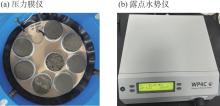
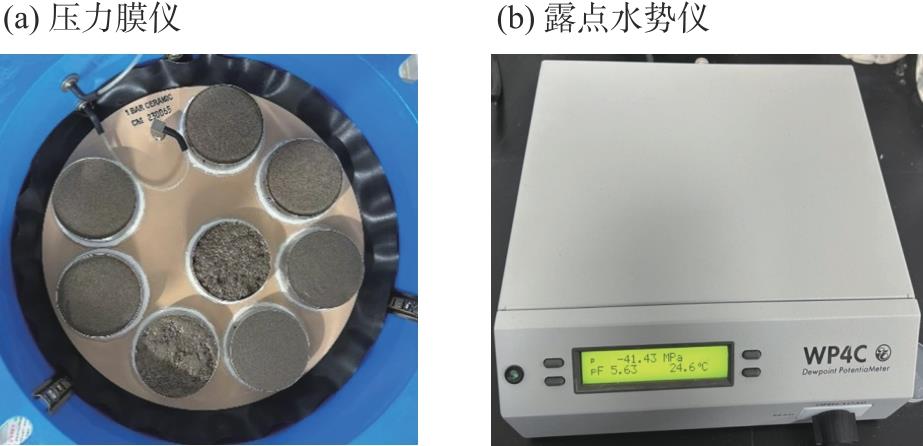
Fig. 1
Experiment setup"
Tab. 1
Selected method for measuring suction force"
| 方法 | 适用对象 | 吸力范围/MPa | 文献 |
|---|---|---|---|
| 压力膜仪 | 控制基质吸力 | 0~1.5 | [ |
| 露点水势仪 | 测定总吸力 | 0~300 | [ |
Tab. 2
Physical meaning of model parameters and boundary constraints"
| 参数 | van Genuchten模型 | Brooks-Corey模型 | Fredlund-Xing模型 |
|---|---|---|---|
| θr/cm3·cm-3 | 0.0001~0.01 | 0.0001~0.01 | 0.0001~0.01 |
| α/cm-1 | 0.01~0.5 | - | - |
| n | 1.2~5.0 | - | - |
| hz/cm | - | 5~100 | - |
| λ | - | 0.1~1.0 | - |
| a/cm | - | - | 0.1~1.0 |
| b | - | - | 1.0~3.0 |
| c | - | - | 0.3~2.0 |
Tab. 3
Comparison of calculated values of osmotic potential at 20 ℃ for different NaCl concentrations"
| NaCl浓度/g·L-1 | NaCl浓度/mol·L-1 | 渗透势/MPa | ||
|---|---|---|---|---|
| 式(2)~(3) | Lang[ | Marine等[ | ||
| 0 | 0.0000 | 0.000 | 0.000 | 0.000 |
| 5 | 0.0856 | 0.417 | 0.390 | 0.388 |
| 10 | 0.1711 | 0.834 | 0.778 | 0.778 |
| 30 | 0.5134 | 2.502 | 2.330 | 2.380 |
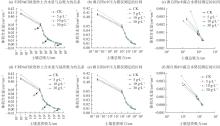
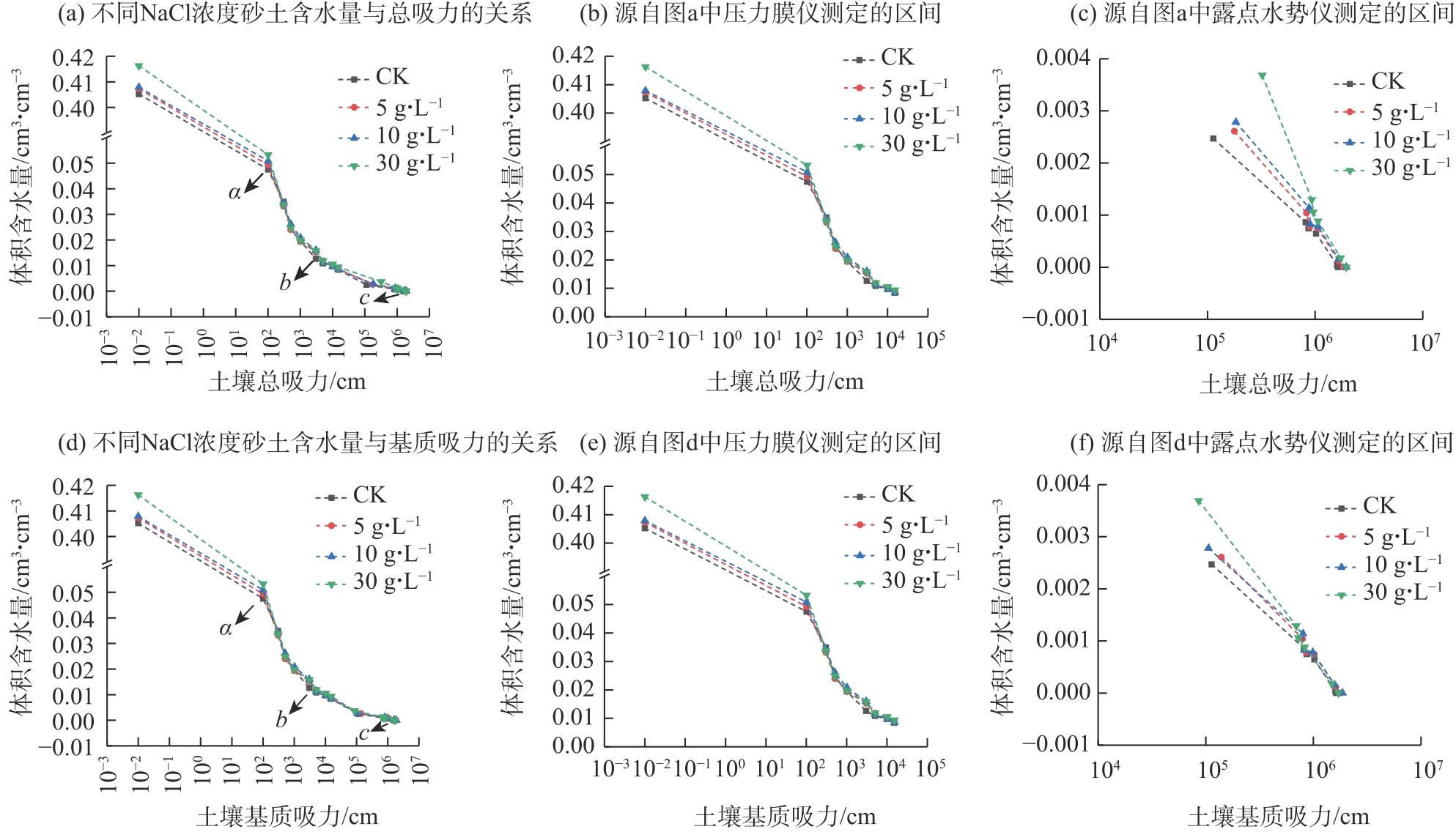
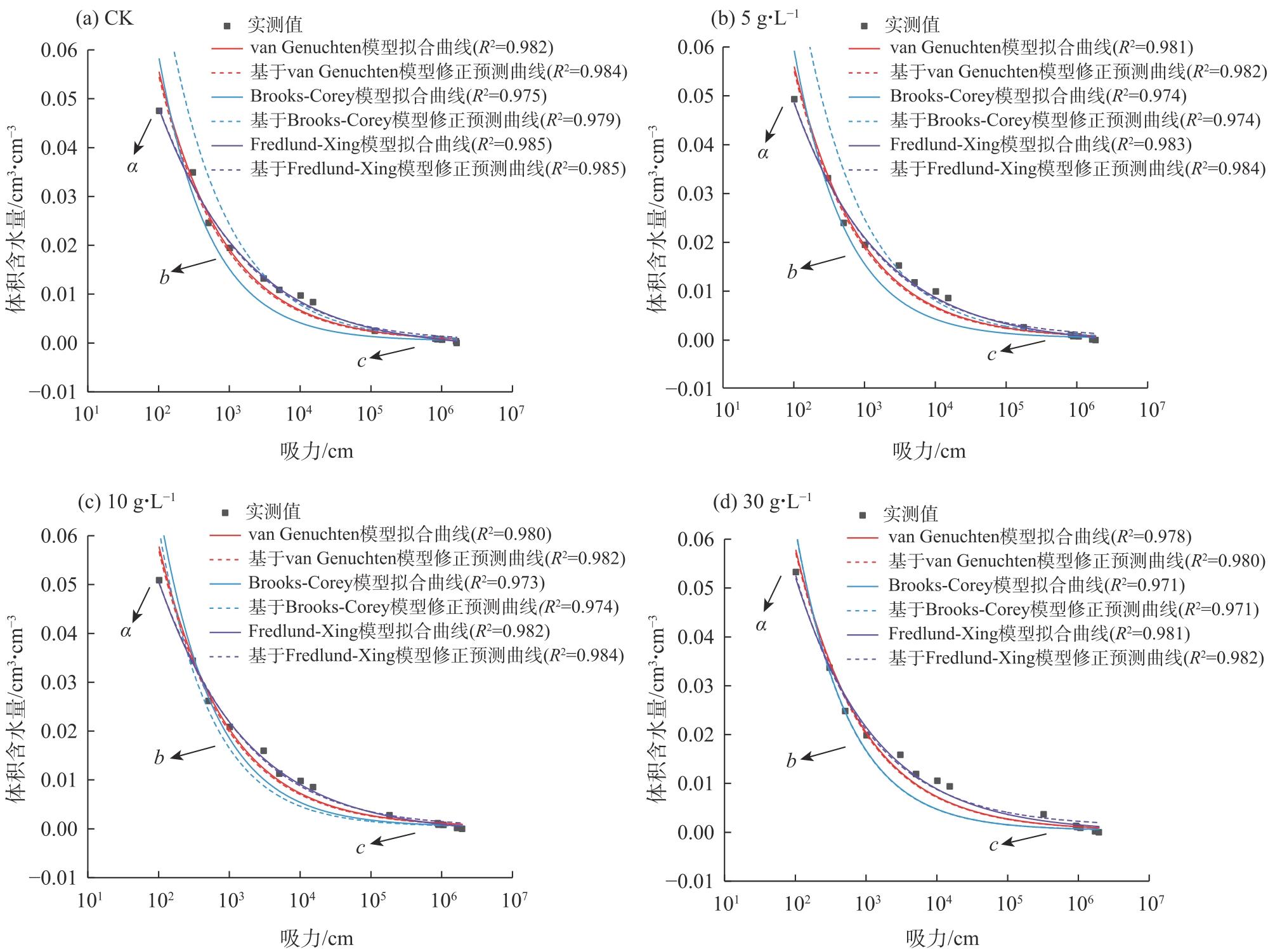
Fig. 2
Soil water characteristic curves for different NaCl concentrations"
Tab. 4
Relevant parameter values of the water retention model under different salinity concentration conditions"
| 持水模型 | 参数 | CK | 5 g·L-1 | 10 g·L-1 | 30 g·L-1 |
|---|---|---|---|---|---|
| van Genuchten | θs/cm3·cm-3 | 0.405 | 0.407 | 0.408 | 0.416 |
| θr/cm3·cm-3 | 0.0003 | 0.0004 | 0.0004 | 0.0005 | |
| α/cm-1 | 0.28 | 0.26 | 0.24 | 0.20 | |
| n | 1.8 | 1.7 | 1.6 | 1.4 | |
| R2 | 0.982 | 0.981 | 0.980 | 0.978 | |
| RMSE | 0.0019 | 0.0020 | 0.0021 | 0.0022 | |
| Brooks-Corey | θs/cm3·cm-3 | 0.405 | 0.407 | 0.408 | 0.416 |
| θr/cm3·cm-3 | 0.0004 | 0.0005 | 0.0005 | 0.0006 | |
| hz/cm | 25 | 28 | 32 | 38 | |
| λ | 0.35 | 0.33 | 0.31 | 0.28 | |
| R2 | 0.975 | 0.974 | 0.973 | 0.971 | |
| RMSE | 0.0024 | 0.0025 | 0.0026 | 0.0027 | |
| Fredlund-Xing | θs/cm3·cm-3 | 0.405 | 0.407 | 0.408 | 0.416 |
| θr/cm3·cm-3 | 0.0005 | 0.0006 | 0.0006 | 0.0007 | |
| a/cm | 0.35 | 0.32 | 0.28 | 0.22 | |
| b | 1.5 | 1.4 | 1.3 | 1.1 | |
| c | 0.6 | 0.6 | 0.6 | 0.6 | |
| R2 | 0.985 | 0.984 | 0.983 | 0.981 | |
| RMSE | 0.0017 | 0.0018 | 0.0019 | 0.0020 |
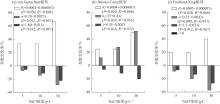
Fig. 3
Relationship between the parameters of the water retention model and NaCl concentration"
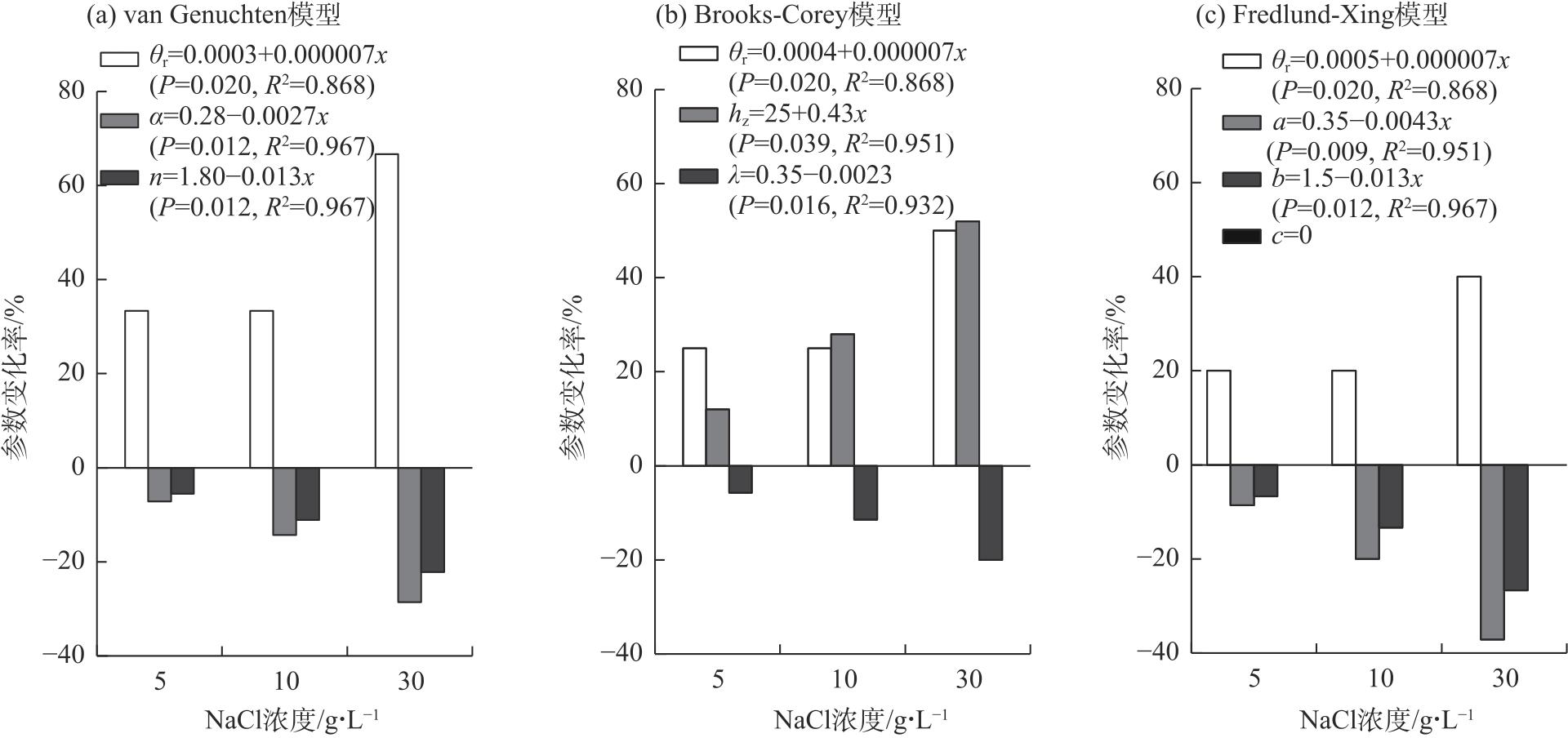
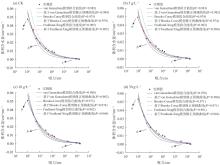
Fig. 4
Modification of model testing"
| [1] | 陈俊英, 柴红阳, Leionid Gillerman, 等. 再生水水质对斥水和亲水土壤水分特征曲线的影响[J]. 农业工程学报, 2018, 34(11): 121-127. |
| [Chen Junying, Chai Hongyang, Leionid Gillerman, et al. Impact of treated waste water quality on repellent and wettable soil water characteristic curve[J]. Transactions of the Chinese Society of Agricultural Engineering, 2018, 34(11): 121-127.] | |
| [2] |
成龙, 吴波, 贾晓红, 等. 基于连续观测数据的毛乌素沙地生长季土壤水分动态及其对降雨的响应[J]. 干旱区地理, 2024, 47(4): 648-661.
doi: 10.12118/j.issn.1000-6060.2023.276 |
|
[Cheng Long, Wu Bo, Jia Xiaohong, et al. Dynamic change of soil moisture and its response to rainfall during the growing season in Mu Us Sandy Land based on continuous observation data[J]. Arid Land Geography, 2024, 47(4): 648-661.]
doi: 10.12118/j.issn.1000-6060.2023.276 |
|
| [3] | 夏天, 田军仓. 基于黏粒量的土壤水分特征曲线预测模型[J]. 灌溉排水学报, 2021, 40(3): 9-14. |
| [Xia Tian, Tian Juncang. Using clay content to estimate soil water characteristic curve[J]. Journal of Irrigation and Drainage, 2021, 40(3): 9-14.] | |
| [4] |
Zhou W H, Yuen K V, Tan F. Estimation of soil-water characteristic curve and relative permeability for granular soils with different initial dry densities[J]. Engineering Geology, 2014, 179: 1-9.
doi: 10.1016/j.enggeo.2014.06.013 |
| [5] | 高惠嫣, 杨路华. 不同质地土壤的水分特征曲线参数分析[J]. 河北农业大学学报, 2012, 35(5): 129-132. |
| [Gao Huiyan, Yang Luhua. Analysis of parameters on soil water characteristic curves of different soil texture[J]. Journal of Hebei Agricultural University, 2012, 35(5): 129-132.] | |
| [6] | 孙枭沁, 房凯, 费远航, 等. 施加生物质炭对盐渍土土壤结构和水力特性的影响[J]. 农业机械学报, 2019, 50(2): 242-249. |
| [Sun Xiaoqin, Fang Kai, Fei Yuanhang, et al. Structure and hydraulic characteristics of saline soil improved by applying biochar based on Micro-CT scanning[J]. Transactions of the Chinese Society for Agricultural Machinery, 2019, 50(2): 242-249.] | |
| [7] | 洪成, 尹殿胜, 陈俊英, 等. 容重对黏壤土土壤水分特征曲线的影响[J]. 节水灌溉, 2018, 34(10): 5-8. |
| [Hong Cheng, Yin Diansheng, Chen Junying, et al. Impact of bulk density on soil water characteristic curve of clay loam[J]. Water Saving Irrigation, 2018, 34(10): 5-8.] | |
| [8] | 舒凯民, 樊贵盛. 基于质地的土壤水分特征曲线参数非线性预测[J]. 人民黄河, 2016, 38(7): 138-141. |
| [Shu Kaimin, Fan Guisheng. The nonlinear prediction of soil water characteristic curve parameters based on the soil texture[J]. Yellow River, 2016, 38(7): 138-141.] | |
| [9] | 魏永霞, 王鹤, 吴昱, 等. 生物炭对不同坡度坡耕地土壤水动力学参数的影响[J]. 农业机械学报, 2019, 50(3): 231-240. |
| [Wei Yongxia, Wang He, Wu Yu, et al. Effect of biochar on soil hydrodynamic parameters under different slopes[J]. Transactions of the Chinese Society for Agricultural Machinery, 2019, 50(3): 231-240.] | |
| [10] | Li G Y, Zhan L T, Hu Z, et al. Effects of particle gradation and geometry on the pore characteristics and water retention curves of granular soils: A combined DEM and PNM investigation[J]. Granular Matter, 2021, 23(1): 9, doi: 10.1007/s10035-020-01063-5. |
| [11] |
张鹏飞, 贾小旭, 赵春雷, 等. 初始容重对土壤水分特征曲线的影响[J]. 干旱区研究, 2022, 39(4): 1174-1180.
doi: 10.13866/j.azr.2022.04.18 |
|
[Zhang Pengfei, Jia Xiaoxu, Zhao Chunlei, et al. Effect of initial bulk density on soil water characteristic curve[J]. Arid Zone Research, 2022, 39(4): 1174-1180.]
doi: 10.13866/j.azr.2022.04.18 |
|
| [12] | Katarzyna N, Žiga M, Arjen V D, et al. Saline soils worldwide: Identifying the most promising areas for saline agriculture[J]. Journal of Arid Environments, 2022, 203: 104775, doi: 10.1016/j.jaridenv.2022.104775. |
| [13] | Liu Y X, Yan M Y, Lan H Y. Regulation of trichome formation by phytohormones and cytoskeleton genes in Salsola ferganica, an annual desert halophyte[J]. Plant Science, 2025, 362: 112861, doi: 10.1016/j.plantsci.2025.112861. |
| [14] |
李昊辰, 胡广录, 王涛, 等. 黑河中游砂壤地农田不同灌溉模式土壤水分动态模拟[J]. 干旱区研究, 2025, 42(7): 1333-1347.
doi: 10.13866/j.azr.2025.07.16 |
|
[Li Haochen, Hu Guanglu, Wang Tao, et al. Soil moisture under different irrigation patterns in sandy loam farmland in the middle reaches of the Heihe River dynamic simulation[J]. Arid Zone Research, 2025, 42(7): 1333-1347.]
doi: 10.13866/j.azr.2025.07.16 |
|
| [15] | 谭霄, 伍靖伟, 李大成, 等. 盐分对土壤水分特征曲线的影响[J]. 灌溉排水学报, 2014, 33(4): 228-232. |
| [Tan Xiao, Wu Jingwei, Li Dacheng, et al. Effects of salinity on soil water characteristic curve[J]. Journal of Irrigation and Drainage, 2014, 33(4): 228-232.] | |
| [16] | 王丽琴, 李红丽, 董智, 等. 黄河三角洲盐碱地造林对土壤水分特性的影响[J]. 中国水土保持科学, 2014, 12(1): 38-45. |
| [Wang Liqin, Li Hongli, Dong Zhi, et al. Effect of afforestation on soil moisture characteristics of saline-alkali soil in the Yellow River Delta[J]. Science of Soil and Water Conservation, 2014, 12(1): 38-45.] | |
| [17] |
Xing X G, Kang D G, Ma X Y. Differences in loam water retention and shrinkage behavior: Effects of various types and concentrations of salt ions[J]. Soil and Tillage Research, 2017, 167: 61-72.
doi: 10.1016/j.still.2016.11.005 |
| [18] | 许尊秋, 陈阳, 毛晓敏. 钠吸附比和盐分浓度对新疆典型砂壤土物理性质的影响[J]. 农业工程学报, 2022, 38(20): 86-95. |
| [Xu Zunqiu, Chen Yang, Mao Xiaomin. Influences of salt adsorption ratio and salt concentration on the physical properties of typical sandy loam in Xinjiang[J]. Transactions of the Chinese Society of Agricultural Engineering, 2022, 38(20): 86-95.] | |
| [19] | 孙德安, 张谨绎, 宋国森. 氯盐渍土土-水特征曲线的试验研究[J]. 岩土力学, 2013, 34(4): 955-960. |
| [Sun De’an, Zhang Jinyi, Song Guosen. Experimental study of soil-water characteristic curve of chlorine saline soil[J]. Rock and Soil Mechanics, 2013, 34(4): 955-960.] | |
| [20] | Dong B Q, Diao H Q, Ren H B, et al. Chloride-ion-triggered microcapsule for self-suppression of capillary suction in cement paste[J]. Cement and Concrete Composites, 2023, 141: 105144, doi: 10.1016/j.cemconcomp.2023.105144. |
| [21] | He Y, Chen Y G, Ye W M, et al. Influence of salt concentration on volume shrinkage and water retention characteristics of compacted GMZ bentonite[J]. Environmental Earth Sciences, 2016, 75(6): 535, doi: 10.1007/s12665-015-5228-3. |
| [22] | 张悦, 叶为民, 王琼, 等. 含盐遗址重塑土的吸力测定及土水特征曲线拟合[J]. 岩土工程学报, 2019, 41(9): 1661-1669. |
| [Zhang Yue, Ye Weimin, Wang Qiong, et al. Suction measurement and SWRC modelling for reconstituted salt-laden soils in earthen heritages[J]. Chinese Journal of Geotechnical Engineering, 2019, 41(9): 1661-1669.] | |
| [23] |
Schelle H, Heise L, Jänicke K, et al. Water retention characteristics of soils over the whole moisture range: A comparison of laboratory methods[J]. European Journal of Soil Science, 2013, 64(6): 814-821.
doi: 10.1111/ejss.2013.64.issue-6 |
| [24] | Hu S J, Zhang C, Lu N. Quantifying coupling effects between soil matric potential and osmotic potential[J]. Water Resources Research, 2023, 59(2): e2022WR033779, doi: 10.1029/2022wr033779. |
| [25] | Wang L Y, Zhou F X, He M Y, et al. Contribution of osmotic suction to suction stress for unsaturated saline clay and its suction stress characteristic curve[J]. Journal of Geotechnical and Geoenvironmental Engineering, 2025, 151(1): 04024143, doi: 10.1061/jggefk.gteng-12813. |
| [26] | Wang H C, Li X H, Li J L, et al. Impact of salt precipitation on evaporation resistance under different soil textures[J]. Environmental Earth Sciences, 2024, 84(1): 12, doi: 10.1007/s12665-024-12014-1. |
| [27] | 王红兰, 唐翔宇, 鲜青松, 等. 紫色土水分特征曲线室内测定方法的对比[J]. 水科学进展, 2016, 27(2): 240-248. |
| [Wang Honglan, Tang Xiangyu, Xian Qingsong, et al. Comparison of laboratory methods for determining water retention curves in purple soil[J]. Advances in Water Science, 2016, 27(2): 240-248.] | |
| [28] | Campbell G S. Soil physics with basic[M]. New York: Elsevier, 1985: 1-150. |
| [29] |
Fujimaki H, Shimano T, Inoue M, et al. Effect of a salt crust on evaporation from a bare saline soil[J]. Vadose Zone Journal, 2006, 5(4): 1246-1256.
doi: 10.2136/vzj2005.0144 |
| [30] |
Lang A R G. Osmotic coefficients and water potentials of sodium chloride solutions from 0 to 40 ℃[J]. Australian Journal of Chemistry, 1967, 20(9): 2017-2023.
doi: 10.1071/CH9672017 |
| [31] |
Marine I W, Fritz S J. Osmotic model to explain anomalous hydraulic heads[J]. Water Resources Research, 1981, 17(1): 73-82.
doi: 10.1029/WR017i001p00073 |
| [32] |
van Genuchten M T. A closed-form equation for predicting the hydraulic conductivity of unsaturated soils[J]. Soil Science Society of America Journal, 1980, 44(5): 892-898.
doi: 10.2136/sssaj1980.03615995004400050002x |
| [33] | Brooks R, Corey T. Hydraulic properties of porous media[M]. Colorado: Colorado State University, 1964: 24-37. |
| [34] |
Fredlund D G, Xing A Q. Equations for the soil-water characteristic curve[J]. Canadian Geotechnical Journal, 1994, 31(4): 521-532.
doi: 10.1139/t94-061 |
| [35] |
赵建文, 李金麟, 王圣杰. 祁连山土壤水分时空变化特征及主要驱动因素分析[J]. 干旱区地理, 2025, 48(8): 1480-1491.
doi: 10.12118/j.issn.1000-6060.2024.664 |
|
[Zhao Jianwen, Li Jinlin, Wang Shengjie. Characteristics of spatial and temporal variation of soil moisture and analysis of main driving factors in the Qilian Mountains[J]. Arid Land Geography, 2025, 48(8): 1480-1491.]
doi: 10.12118/j.issn.1000-6060.2024.664 |
|
| [36] | 廖海, 栗现文, 陈俊英, 等. 原状盐渍土不同盐分含量对土壤水分特征曲线的影响[J]. 节水灌溉, 2021, 46(1): 7-13. |
| [Liao Hai, Li Xianwen, Chen Junying, et al. Effects of different salt contents of undisturbed saline soil on soil moisture characteristic curves[J]. Water Saving Irrigation, 2021, 46(1): 7-13.] | |
| [37] |
Gao H B, Shao M G. Effects of temperature changes on soil hydraulic properties[J]. Soil and Tillage Research, 2015, 153: 145-154.
doi: 10.1016/j.still.2015.05.003 |
| [38] | 李保国, 任图生, 张佳宝. 土壤物理学研究的现状、挑战与任务[J]. 土壤学报, 2008, 45(5): 810-816. |
| [Li Baoguo, Ren Tusheng, Zhang Jiabao. Current status, challenges, and missions in soil physics[J]. Acta Pedologica Sinica, 2008, 45(5): 810-816.] | |
| [39] | 王晓洋, 陈效民, 李孝良. 不同盐渍化程度滨海盐土的饱和导水率[J]. 江苏农业科学, 2011, 39(4): 446-448. |
| [Wang Xiaoyang, Chen Xiaomin, Li Xiaoliang. Saturated water conductivity of coastal saline soils with different degrees of salinization[J]. Jiangsu Agricultural Sciences, 2011, 39(4): 446-448.] | |
| [40] | 程金杰. 不同盐分类型土壤蒸发模拟研究[D]. 泰安: 山东农业大学, 2023. |
| [Cheng Jinjie. Simulation of soil evaporation for different salt types[D]. Tai’an: Shandong Agricultural University, 2023.] | |
| [41] | 于浕. 土壤水分特征曲线Gardner模型参数的预报模型研究[D]. 太原: 太原理工大学, 2017. |
| [Yu Jin. Study on prediction model of Gardner model parameters of soil moisture characteristic curve[D]. Taiyuan: Taiyuan University of Technology, 2017.] | |
| [42] | 胡传旺, 王辉, 武芸, 等. NaCl溶液处理亚热带土壤水分特征曲线差异与模型优选[J]. 农业机械学报, 2018, 49(4): 290-296. |
| [Hu Chuanwang, Wang Hui, Wu Yun, et al. Difference of soil water characteristic curves of subtropical soils with NaCl solutions treatments and models optimization[J]. Transactions of the Chinese Society for Agricultural Machinery, 2018, 49(4): 290-296.] | |
| [43] |
Shokri-Kuehni S M S, Rad M N, Webb C, et al. Impact of type of salt and ambient conditions on saline water evaporation from porous media[J]. Advances in Water Resources, 2017, 105: 154-161.
doi: 10.1016/j.advwatres.2017.05.004 |
| [44] | Lu N. Generalized soil water retention equation for adsorption and capillarity[J]. Journal of Geotechnical and Geoenvironmental Engineering, 2016, 142(10): 04016051, doi: 10.1061/(ASCE)GT.1943-5606.0001524. |
| [45] | Zhang X, Zuo Y T, Wang T J, et al. Salinity effects on soil structure and hydraulic properties: Implications for pedotransfer functions in coastal areas[J]. Land, 2024, 13(12): 2077, doi: 10.3390/land13122077. |
| [46] | Ding X, Xu Q, Jie F L, et al. Construction and application of soil-water characteristic curve model considering water mineralization degree[J]. Agriculture, 2025, 15(23): 2470, doi: 10.3390/agriculture15232470. |
| [1] | DAI Yunhao,GUAN Yao,ZHANG Qinkai,SUN Junjie,HE Xinghong. Remote sensing monitoring and temporal and spatial characteristics of soil salinization in Aral Reclamation Area [J]. Arid Land Geography, 2022, 45(4): 1176-1185. |
| [2] | DING Xin-yuan, ZHOU Zhi-bin, LEI Jia-qiang, WANG Yong-dong, LU Jing-jing, LI Xiao-juan. Analysis and comparison of models for soil water characteristic curves of Tarim Desert Highway Shelterbelt [J]. , 2015, 38(5): 985-993. |
| [3] | WANG Zhong-yuan,WANG Yu-gang,XIE Jiang-bo,LI Yan. Differentiating the soil inorganic CO2 flux of saline and alkaline soils [J]. , 2013, 36(4): 655-661. |
|
||