Arid Land Geography ›› 2025, Vol. 48 ›› Issue (11): 1939-1950.doi: 10.12118/j.issn.1000-6060.2024.753
• Hydrology and Water Resoures • Previous Articles Next Articles
DAI Wenyuan1,2( ), ZHANG Qinghua1, SHI Quan1, ZHANG Zhichao1, ZHANG Ruiping1, ZHENG Zhixiang2, ZHANG Rui3
Received:2024-12-10
Revised:2025-01-15
Online:2025-11-25
Published:2025-11-26
DAI Wenyuan, ZHANG Qinghua, SHI Quan, ZHANG Zhichao, ZHANG Ruiping, ZHENG Zhixiang, ZHANG Rui. Synergistic driving mechanisms of water ecological security in the Gansu section of the Yellow River Basin from 2003 to 2022[J].Arid Land Geography, 2025, 48(11): 1939-1950.
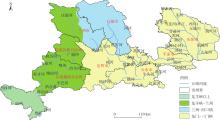
Fig. 1
Schematic diagram of the study area"

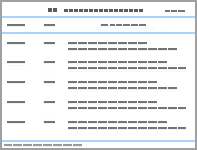
Tab. 1
Indicator system for watershed eco-hydrological security evaluation"
| 综合 指数 | 一级 指标 | 二级 指标 | 三级指标 |
|---|---|---|---|
| 流域水生态安全评价 指标体系 | 经济 系统 | 经济子系统 | 三产比重/% |
| 一产比重/% | |||
| 火电增加值比重/% | |||
| 国有规模以上工业增加值占比/% | |||
| 人均GDP/元·人-1 | |||
| 农田灌溉用水量占比/% | |||
| 社会 系统 | 社会子系统 | 城镇化率/% | |
| 人口密度/人·km-2 | |||
| 粮食产量/104 t | |||
| 大型水库年末蓄水总量/108 m3 | |||
| 地表水资源供水量/108 m3 | |||
| 地下水资源供水量/108 m3 | |||
| 自然 复合 生态 系统 | 资源子系统 | 年径流量变化/108 m3 | |
| 入境水量/108 m3 | |||
| 出境水量/108 m3 | |||
| 河川基流量/108 m3 | |||
| 地表水资源量/108 m3 | |||
| 地下水资源量占比/% | |||
| 环境子系统 | 耕地面积比/% | ||
| 单位面积牲畜头数/104头·km-2 | |||
| 年降雨量变化/108 m3 | |||
| 产水系数/% | |||
| 径污比/% | |||
| 单位面积废污水排放量/108 t·km-2 | |||
| 生态子系统 | 林牧渔灌溉面积占比/% | ||
| 雨污回用量/108 m3 | |||
| 林牧渔用水量占比/% | |||
| 生态环境用水量占比/% | |||
| 耗水率/% | |||
| 节水灌溉面积/0.67×103 hm2 |
Tab. 2
Weight of evaluation indicators for water ecological security in the river basin"
| 指标 | 信息 熵值 | 信息效 用值 | 权重 系数/% | 排序 | 指标 | 信息 熵值 | 信息效 用值 | 权重 系数/% | 排序 |
|---|---|---|---|---|---|---|---|---|---|
| 三产比重 | 0.9836 | 0.0164 | 0.66 | 29 | 河川基流量 | 0.9178 | 0.0822 | 3.30 | 13 |
| 一产比重 | 0.9784 | 0.0216 | 0.87 | 24 | 地表水资源量 | 0.9195 | 0.0805 | 3.23 | 14 |
| 火电增加值比重 | 0.9829 | 0.0171 | 0.69 | 28 | 地下水资源量占比 | 0.9663 | 0.0337 | 1.35 | 21 |
| 国有规模以上工业增加值占比 | 0.9670 | 0.0330 | 1.33 | 22 | 耕地面积比 | 0.9575 | 0.0425 | 1.71 | 19 |
| 人均GDP | 0.9475 | 0.0525 | 2.11 | 17 | 单位面积牲畜头数 | 0.9816 | 0.0184 | 0.74 | 26 |
| 农田灌溉用水量占比 | 0.8740 | 0.1260 | 5.05 | 6 | 年降雨量变化 | 0.9818 | 0.0182 | 0.73 | 27 |
| 城镇化率 | 0.9532 | 0.0468 | 1.88 | 18 | 产水系数 | 0.8917 | 0.1083 | 4.34 | 8 |
| 人口密度 | 0.9234 | 0.0766 | 3.08 | 15 | 径污比 | 0.6657 | 0.3343 | 13.41 | 1 |
| 粮食产量 | 0.9022 | 0.0978 | 3.92 | 9 | 单位面积废污水排放量 | 0.9755 | 0.0245 | 0.98 | 23 |
| 大型水库年末蓄水总量 | 0.7294 | 0.2706 | 10.86 | 2 | 林牧渔灌溉面积占比 | 0.8806 | 0.1194 | 4.79 | 7 |
| 地表水资源供水量 | 0.9291 | 0.0709 | 2.84 | 16 | 雨污回用量 | 0.8591 | 0.1409 | 5.65 | 5 |
| 地下水资源供水量 | 0.9149 | 0.0851 | 3.41 | 12 | 林牧渔用水量占比 | 0.8285 | 0.1715 | 6.88 | 3 |
| 年径流量变化 | 0.9626 | 0.0374 | 1.50 | 20 | 生态环境用水量占比 | 0.9051 | 0.0949 | 3.81 | 10 |
| 入境水量 | 0.8507 | 0.1493 | 5.99 | 4 | 耗水率 | 0.9783 | 0.0217 | 0.87 | 25 |
| 出境水量 | 0.9849 | 0.0151 | 0.61 | 30 | 节水灌溉面积 | 0.9148 | 0.0852 | 3.42 | 11 |
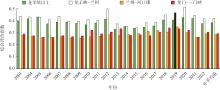
Fig. 2
Evaluation results of water ecological security"
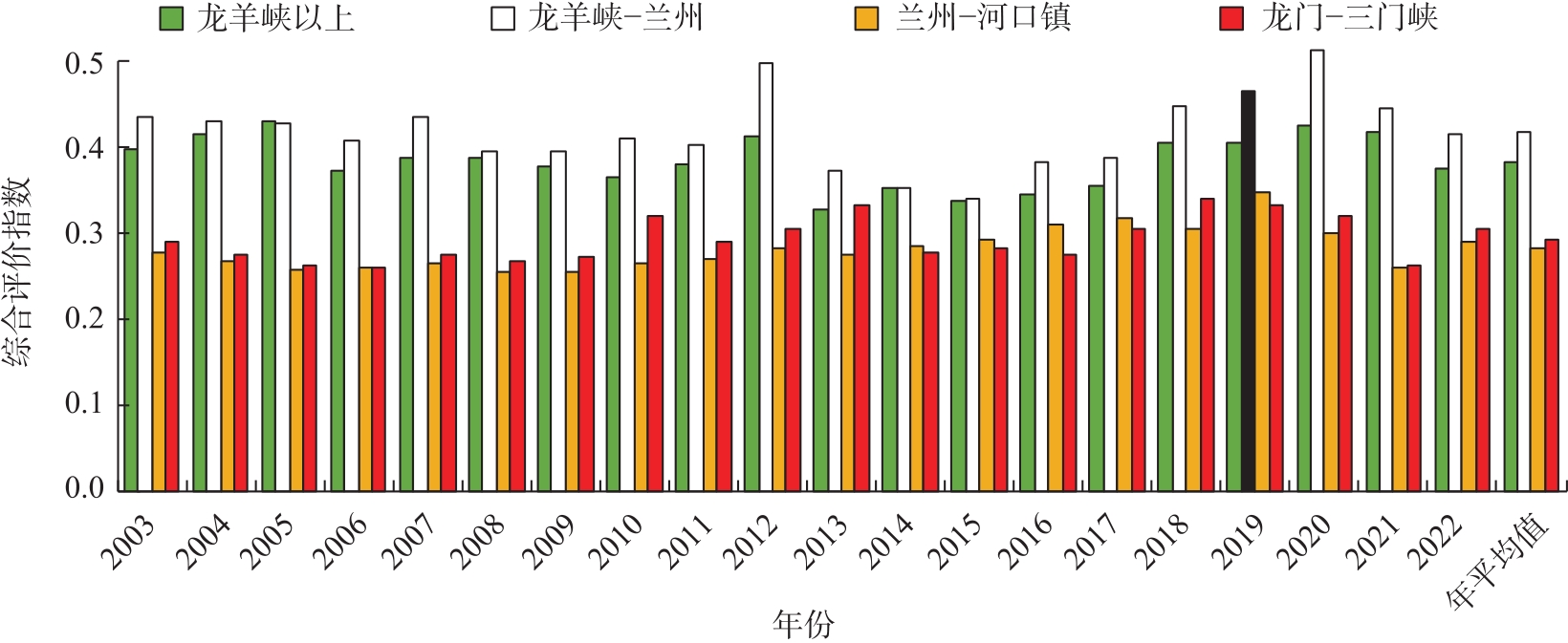
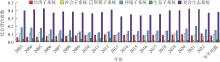
Fig. 3
Fuzzy comprehensive evaluation of water ecological security in the section above Longyangxia"
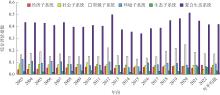
Fig. 4
Fuzzy comprehensive evaluation of water ecological security in the section from Longyangxia to Lanzhou"
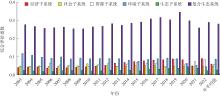
Fig. 5
Fuzzy comprehensive evaluation of water ecological security in the section from Lanzhou to Hekou Town"

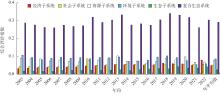
Fig. 6
Fuzzy comprehensive evaluation of water ecological security in the section from Longmen to Sanmenxia"
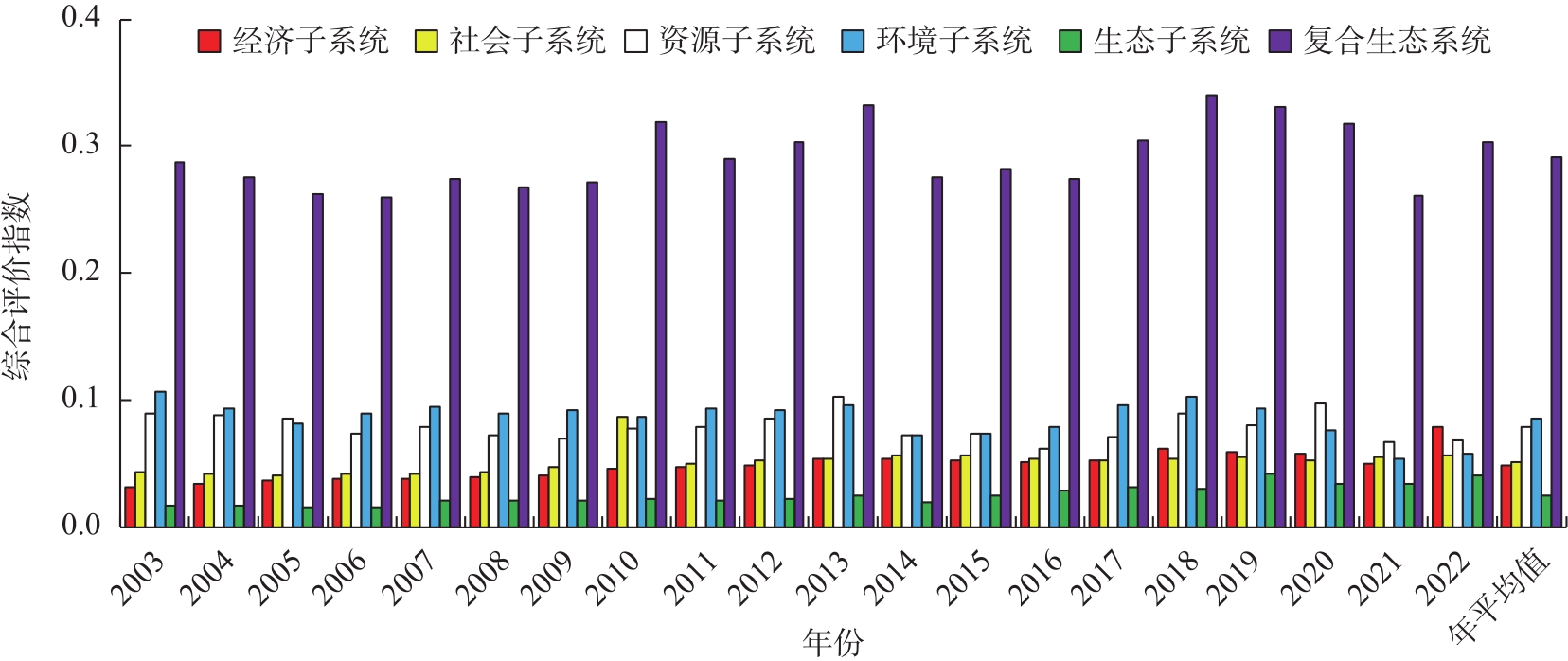
Tab. 3
Coupling degrees and coupling coordination degrees of water ecological security in the Gansu section of the Yellow River Basin"
| 年份 | 耦合度 | 综合协调指数 | 耦合协调度 |
|---|---|---|---|
| 2003 | 0.981 | 0.349 | 0.585 |
| 2004 | 0.976 | 0.346 | 0.581 |
| 2005 | 0.969 | 0.343 | 0.577 |
| 2006 | 0.979 | 0.324 | 0.564 |
| 2007 | 0.977 | 0.339 | 0.576 |
| 2008 | 0.980 | 0.325 | 0.564 |
| 2009 | 0.982 | 0.324 | 0.564 |
| 2010 | 0.987 | 0.339 | 0.579 |
| 2011 | 0.986 | 0.334 | 0.574 |
| 2012 | 0.974 | 0.373 | 0.603 |
| 2013 | 0.994 | 0.325 | 0.569 |
| 2014 | 0.993 | 0.316 | 0.560 |
| 2015 | 0.997 | 0.312 | 0.557 |
| 2016 | 0.993 | 0.327 | 0.570 |
| 2017 | 0.995 | 0.340 | 0.582 |
| 2018 | 0.989 | 0.373 | 0.608 |
| 2019 | 0.991 | 0.386 | 0.618 |
| 2020 | 0.976 | 0.387 | 0.615 |
| 2021 | 0.969 | 0.346 | 0.579 |
| 2022 | 0.989 | 0.345 | 0.584 |
| 年均值 | 0.986 | 0.343 | 0.581 |
Tab. 4
Coupling degrees and coupling coordination degrees of water ecological security in the upstream of Longyangxia and Longyangxia-Lanzhou"
| 年份 | 龙羊峡以上 | 龙羊峡-兰州 | |||||
|---|---|---|---|---|---|---|---|
| 耦合度 | 综合协调指数 | 耦合协调度 | 耦合度 | 综合协调指数 | 耦合协调度 | ||
| 2003 | 0.718 | 0.080 | 0.239 | 0.781 | 0.087 | 0.260 | |
| 2004 | 0.736 | 0.083 | 0.247 | 0.778 | 0.086 | 0.258 | |
| 2005 | 0.748 | 0.086 | 0.253 | 0.770 | 0.085 | 0.256 | |
| 2006 | 0.745 | 0.074 | 0.236 | 0.804 | 0.081 | 0.256 | |
| 2007 | 0.775 | 0.077 | 0.245 | 0.826 | 0.087 | 0.267 | |
| 2008 | 0.792 | 0.077 | 0.247 | 0.857 | 0.079 | 0.260 | |
| 2009 | 0.775 | 0.075 | 0.241 | 0.870 | 0.079 | 0.262 | |
| 2010 | 0.821 | 0.073 | 0.245 | 0.872 | 0.082 | 0.267 | |
| 2011 | 0.813 | 0.076 | 0.248 | 0.882 | 0.080 | 0.266 | |
| 2012 | 0.796 | 0.082 | 0.256 | 0.811 | 0.099 | 0.284 | |
| 2013 | 0.605 | 0.065 | 0.198 | 0.800 | 0.074 | 0.243 | |
| 2014 | 0.660 | 0.070 | 0.215 | 0.806 | 0.070 | 0.238 | |
| 2015 | 0.673 | 0.067 | 0.212 | 0.870 | 0.068 | 0.242 | |
| 2016 | 0.671 | 0.069 | 0.215 | 0.863 | 0.076 | 0.257 | |
| 2017 | 0.669 | 0.071 | 0.218 | 0.867 | 0.077 | 0.259 | |
| 2018 | 0.716 | 0.081 | 0.241 | 0.829 | 0.089 | 0.272 | |
| 2019 | 0.775 | 0.081 | 0.250 | 0.787 | 0.093 | 0.270 | |
| 2020 | 0.755 | 0.085 | 0.253 | 0.837 | 0.102 | 0.292 | |
| 2021 | 0.686 | 0.083 | 0.239 | 0.893 | 0.089 | 0.282 | |
| 2022 | 0.667 | 0.075 | 0.223 | 0.885 | 0.083 | 0.270 | |
| 年均值 | 0.759 | 0.076 | 0.241 | 0.852 | 0.083 | 0.266 | |
Tab. 5
Coupling degrees and coupling coordination degrees of water ecological security in the Lanzhou-Hekou Town and Longmen-Sanmenxia"
| 年份 | 兰州-河口镇 | 龙门-三门峡 | |||||
|---|---|---|---|---|---|---|---|
| 耦合度 | 综合协调指数 | 耦合协调度 | 耦合度 | 综合协调指数 | 耦合协调度 | ||
| 2003 | 0.868 | 0.055 | 0.219 | 0.812 | 0.058 | 0.216 | |
| 2004 | 0.876 | 0.053 | 0.216 | 0.831 | 0.055 | 0.214 | |
| 2005 | 0.881 | 0.051 | 0.212 | 0.849 | 0.052 | 0.211 | |
| 2006 | 0.880 | 0.052 | 0.214 | 0.851 | 0.052 | 0.210 | |
| 2007 | 0.892 | 0.053 | 0.217 | 0.869 | 0.055 | 0.218 | |
| 2008 | 0.919 | 0.051 | 0.216 | 0.891 | 0.053 | 0.218 | |
| 2009 | 0.912 | 0.051 | 0.215 | 0.889 | 0.054 | 0.220 | |
| 2010 | 0.906 | 0.053 | 0.219 | 0.888 | 0.064 | 0.238 | |
| 2011 | 0.909 | 0.054 | 0.221 | 0.891 | 0.058 | 0.227 | |
| 2012 | 0.927 | 0.056 | 0.229 | 0.894 | 0.061 | 0.233 | |
| 2013 | 0.924 | 0.055 | 0.225 | 0.891 | 0.066 | 0.243 | |
| 2014 | 0.933 | 0.057 | 0.230 | 0.913 | 0.055 | 0.224 | |
| 2015 | 0.913 | 0.058 | 0.230 | 0.931 | 0.056 | 0.229 | |
| 2016 | 0.945 | 0.062 | 0.241 | 0.952 | 0.055 | 0.229 | |
| 2017 | 0.940 | 0.063 | 0.243 | 0.935 | 0.061 | 0.239 | |
| 2018 | 0.931 | 0.061 | 0.238 | 0.920 | 0.068 | 0.250 | |
| 2019 | 0.939 | 0.069 | 0.255 | 0.962 | 0.066 | 0.252 | |
| 2020 | 0.971 | 0.060 | 0.240 | 0.939 | 0.064 | 0.244 | |
| 2021 | 0.975 | 0.052 | 0.225 | 0.977 | 0.052 | 0.226 | |
| 2022 | 0.889 | 0.058 | 0.227 | 0.976 | 0.061 | 0.243 | |
| 年均值 | 0.936 | 0.056 | 0.229 | 0.918 | 0.058 | 0.231 | |
| [1] | 李丽莉, 邹松兵, 靳娟, 等. 近20 a黄河流域甘肃段用水变化分析[J]. 兰州大学学报(自然科学版), 2024, 60(4): 450-455. |
| [Li Lili, Zou Songbing, Jin Juan, et al. Analysis of changes in water use in Gansu section of the Yellow River in recent 20 years[J]. Journal of Lanzhou University (Natural Sciences Edition), 2024, 60(4): 450-455. ] | |
| [2] | 罗鹏, 谈存峰, 齐婷婷. 基于PSR模型的黄河流域甘肃段生态系统健康评价及预测[J]. 水土保持通报, 2024, 44(3): 180-189. |
| [Luo Peng, Tan Cunfeng, Qi Tingting. Evaluation and prediction of ecosystem health in Gansu section of Yellow River Basin based on PSR model[J]. Bulletin of Soil and Water Conservation, 2024, 44(3): 180-189. ] | |
| [3] | 张帆, 尹萌, 张金霞. 基于熵权TOPSIS的黄河流域甘肃段水资源承载力评价[J]. 人民黄河, 2024, 46(4): 79-85. |
| [Zhang Fan, Yin Meng, Zhang Jinxia. Comprehensive evaluation of water resources carrying capacity in the Gansu section of the Yellow River Basin based on entropy-weight-TOPSIS model[J]. Yellow River, 2024, 46(4): 79-85. ] | |
| [4] | 石福媛. 基于水文变异的黄河干流甘肃段生态流量确定与保障措施研究[D]. 兰州: 兰州理工大学, 2023. |
| [Shi Fuyuan. Research on the determination of ecological flow and safeguard measures in the Gansu section of the main stream of the Yellow River based on hydrological variation[D]. Lanzhou: Lanzhou University of Technology, 2023. ] | |
| [5] |
董晓媛, 胥德泽, 施小斌, 等. 黄河流域甘肃段生态敏感性评价研究——以广河县为例[J]. 干旱区地理, 2024, 47(4): 599-611.
doi: 10.12118/j.issn.1000-6060.2023.222 |
|
[Dong Xiaoyuan, Xu Deze, Shi Xiaobin, et al. Ecological sensitivity evaluation of the Gansu section of the Yellow River: A case study of Guanghe County[J]. Arid Land Geography, 2024, 47(4): 599-611. ]
doi: 10.12118/j.issn.1000-6060.2023.222 |
|
| [6] | 杨调调. 泾河流域甘肃段农村人居环境治理效果及影响因素研究[D]. 兰州: 甘肃农业大学, 2023. |
| [Yang Diaodiao. Research on the effect and influencing factors of rural human settlement environment governance in the Jinghe River Basin in Gansu Province[D]. Lanzhou: Gansu Agricultural University, 2023. ] | |
| [7] | 田云, 刘俊艳, 白爽, 等. 近20年黄河流域甘肃段植被覆盖度变化与驱动因素分析[J]. 农业机械学报, 2024, 55(7): 365-372, 404. |
| [Tian Yun, Liu Junyan, Bai Shuang, et al. Fractional vegetation cover change and driving factors in Gansu section of Yellow River Basin[J]. Transactions of the Chinese Society for Agricultural Machinery, 2024, 55(7): 365-372, 404. ] | |
| [8] | 孙静, 刘学录, 王淑媛, 等. 黄河流域甘肃段高质量发展水平演变及驱动力分析[J]. 国土与自然资源研究, 2023(3): 33-37. |
| [Sun Jing, Liu Xuelu, Wang Shuyuan, et al. Evaluation of high-quality development level and its driving forces in Gansu section of the Yellow River Basin[J]. Territory and Natural Resources Study, 2023(3): 33-37. ] | |
| [9] | 张奥妮, 张佳伟, 张成鹏. 流域水生态安全方面的法律保障研究——以长江南京、苏州段流域为例[J]. 水上安全, 2023(6): 13-15. |
| [Zhang Aoni, Zhang Jiawei, Zhang Chengpeng. Research on legal safeguards for water ecological security in river basins: A case study of the Nanjing and Suzhou sections of the Yangtze River[J]. Maritime Safety, 2023(6): 13-15. ] | |
| [10] | 车小磊. 水利部水生态安全保障人才创新团队为水生态安全提供坚实科技支撑[J]. 中国水利, 2022(7): 22-27. |
| [Che Xiaolei. The Innovative talent team for water ecological security assurance of the ministry of water resources provides solid scientific and technological support for water ecological security[J]. China Water Resources, 2022(7): 22-27. ] | |
| [11] | 李淑梅, 李峰. 东营市水生态安全与水资源集约利用策略分析[J]. 胜利油田党校学报, 2023, 36(5): 54-58. |
| [Li Shumei, Li Feng. Analysis of water ecological security and intensive utilization strategy of water resources in Dongying[J]. Journal of the Party School of Shengli Oilfield, 2023, 36(5): 54-58. ] | |
| [12] | 王弈雪. 太湖流域水生态安全长效机制研究[D]. 南京: 东南大学, 2022. |
| [Wang Yixue. Study on long-term mechanism of water ecological security Taihu Lake Basin[D]. Nanjing: Southeast University, 2022. ] | |
| [13] |
凌虹, 朱晓晓, 巫丹, 等. 基于生态功能定位的太湖流域水生态安全评估[J]. 生态环境学报, 2024, 33(3): 418-427.
doi: 10.16258/j.cnki.1674-5906.2024.03.010 |
| [Ling Hong, Zhu Xiaoxiao, Wu Dan, et al. Assessing water ecological security in the Taihu Lake Basin through ecological function localization[J]. Ecology and Environmental Sciences, 2024, 33(3): 418-427. ] | |
| [14] | 唐小婧. 浑河流域水生态安全状况与安全驱动机制分析[J]. 水土保持应用技术, 2024(1): 26-28. |
| [Tang Xiaojing. Analysis of water ecological security status and security driving mechanism in Hunhe River Basin[J]. Technology of Soil and Water Conservation, 2024(1): 26-28. ] | |
| [15] | 赵争争. 渭河流域(陕西段)水生态安全评价及调控对策[D]. 西安: 长安大学, 2022. |
| [Zhao Zhengzheng. Evaluation of water ecological security and regulation countermeasures of the Weihe River Basin (Shaanxi section)[D]. Xi’an: Chang’an University, 2022. ] | |
| [16] | 马亚丽, 张芮, 孙栋元, 等. 黄河流域甘肃段地表干湿时空变化及驱动因子分析[J]. 水土保持研究, 2023, 30(2): 135-141. |
| [Ma Yali, Zhang Rui, Sun Dongyuan, et al. Spatiotemporal variation and driving factors of surface wetness index in Gansu section of Yellow River Basin[J]. Research of Soil and Water Conservation, 2023, 30(2): 135-141. ] | |
| [17] | 邓洋阳, 刘寒, 叶爱山. 江苏省水生态安全与粮食安全协同提升路径研究[J]. 黑龙江粮食, 2023(9): 104-106. |
| [Deng Yangyang, Liu Han, Ye Aishan. Research on the coordinated improvement path of water ecological security and food security in Jiangsu Province[J]. Heilongjiang Grain, 2023(9): 104-106. ] | |
| [18] | 张丽丽. 和田河流域“水-生态”安全及协调关系研究[D]. 石河子: 石河子大学, 2022. |
| [Zhang Lili. Study on “water-ecology” security and coordination in Hetian River Basin[D]. Shihezi: Shihezi University, 2022. ] | |
| [19] | 李华, 蔡永立. 基于ANP-PRS-SENCE框架的崇明岛生态安全评价[J]. 地理与地理信息科学, 2009, 25(3): 90-94. |
| [Li Hua, Cai Yongli. A study of ecological security evaluation of Chongming Island based on the frame of ANP-PRS-SENCE[J]. Geography and Geo-Information Science, 2009, 25(3): 90-94. ] | |
| [20] | 张康洁, 于法稳, 李福夺. 中国农村信息化、农业产业化与乡村生态化耦合协调发展[J]. 中国人口·资源与环境, 2023, 33(6): 182-195. |
| [Zhang Kangjie, Yu Fawen, Li Fuduo. Coupling coordinated development of rural informatization, agricultural industrialization, and rural ecologicalization in China[J]. China Population, Resources and Environment, 2023, 33(6): 182-195. ] | |
| [21] |
Cui L, Zhao Y H, Liu J C, et al. Landscape ecological risk assessment in Qinling Mountain[J]. Geological Journal, 2018, 53: 342-351.
doi: 10.1002/gj.v53.S1 |
| [22] | Hong Q, Meng Q B, Wang P, et al. Regional aquatic ecological security assessment in Jinan, China[J]. Aquatic Ecosystem Health & Management, 2010, 13(3): 319-327. |
| [23] |
戴文渊, 郭武, 郑志祥, 等. 石羊河流域水生态安全影响因子及驱动机制研究[J]. 干旱区研究, 2022, 39(5): 1555-1563.
doi: 10.13866/j.azr.2022.05.20 |
|
[Dai Wenyuan, Guo Wu, Zheng Zhixiang, et al. Water ecological security influence factor and driving mechanism research in arid inland basin: Taking Shiyang River Basin as an example[J]. Arid Zone Research, 2022, 39(5): 1555-1563. ]
doi: 10.13866/j.azr.2022.05.20 |
|
| [24] |
戴文渊, 陈年来, 李金霞, 等. 河西内陆河流域水生态安全评价研究[J]. 干旱区地理, 2021, 44(1): 89-98.
doi: 10.12118/j.issn.1000–6060.2021.01.10 |
|
[Dai Wenyuan, Chen Nianlai, Li Jinxia, et al. Evaluation of water ecological security in Hexi Inland River Basin[J]. Arid Land Geography, 2021, 44(1): 89-98. ]
doi: 10.12118/j.issn.1000–6060.2021.01.10 |
|
| [25] | Xu W J, Chen W G, Zhang X P, et al. Study on urban water ecological security assessment[J]. Applied Mechanics and Materials, 2013, 295: 829-832. |
| [26] | 刘志方. 长江中游地区生态环境质量与城市化水平耦合研究[D]. 武汉: 华中师范大学, 2016. |
| [Liu Zhifang. The coupling research of eco-environmental quality and urbanization level in area of middle of Yangtze River[D]. Wuhan: Central China Normal University, 2016. ] | |
| [27] |
戴文渊, 玛久草, 陈亦晨, 等. 黄河流域甘肃段水生态安全驱动力分析及动态演变[J]. 干旱区研究, 2024, 41(10): 1662-1671.
doi: 10.13866/j.azr.2024.10.05 |
|
[Dai Wenyuan, Ma Jiucao, Chen Yichen, et al. Analysis of driving forces and dynamic evolution of water ecological security in the Gansu section of the Yellow River Basin[J]. Arid Zone Research, 2024, 41(10): 1662-1671. ]
doi: 10.13866/j.azr.2024.10.05 |
|
| [28] | 陈永泰, 郭悦, 曾恩钰, 等. 基于复杂系统管理范式的太湖饮用水安全治理研究[J]. 管理世界, 2022, 38(3): 226-240. |
| [Chen Yongtai, Guo Yue, Zeng Enyu, et al. The study of Taihu drinking water safety governance with a complex systems management paradigm[J]. Journal of Management World, 2022, 38(3): 226-240. ] | |
| [29] | 段恬媛. 湖库型饮用水水源地水安全评价及风险评估[D]. 成都: 西南交通大学, 2021. |
| [Duan Tianyuan. Water safety assessment and risk assessment of lake-reservoir drinking water sources[D]. Chengdu: Southwest Jiaotong University, 2021. ] | |
| [30] | 王毅勇, 周超凡, 黄榕, 等. 基于DPSIR-熵权的陕西省水生态安全评价及障碍诊断分析[J]. 环境科学, 2025, 46(7): 4335-4348. |
| [Wang Yiyong, Zhou Chaofan, Huang Rong, et al. Evaluation of water ecological security and analysis of barriers in Shaanxi Province based on DPSIR-entropy right[J]. Environmental Science, 2025, 46(7): 4335-4348. ] |
| [1] | DONG Xiaoyuan, XU Deze, SHI Xiaobin, DU Sen. Ecological sensitivity evaluation of the Gansu section of the Yellow River: A case study of Guanghe County [J]. Arid Land Geography, 2024, 47(4): 599-611. |
| [2] | LIU Honghong, LIU Shufang. Spatiotemporal evolution and obstacle identification of complex ecosystem resilience in the Qilian Mountain area [J]. Arid Land Geography, 2024, 47(2): 237-247. |
| [3] | NING Lei,LIAN Hua,NIU Yue,SHENG Shuangqing,GAO Zeyu. Identification, classification and factors of contraction of urban development: A case of Gansu section of the Yellow River Basin [J]. Arid Land Geography, 2023, 46(3): 492-504. |
| [4] | ZHANG Zhongfu. Spatial division and sustainable development and utilization strategy of geological relics in Gansu section of the Yellow River Basin [J]. Arid Land Geography, 2022, 45(4): 1235-1243. |
| [5] | DAI Wenyuan,CHEN Nianlai,LI Jinxia,ZHANG Rui. Evaluation of water ecological security in Hexi inland river basin [J]. Arid Land Geography, 2021, 44(1): 89-98. |
|
||

