Arid Land Geography ›› 2026, Vol. 49 ›› Issue (3): 631-642.doi: 10.12118/j.issn.1000-6060.2025.117
• Regional Development • Previous Articles
GAO Junjie1,2( ), ZHONG Juntao3(), MA Yongjie1,2, CHEN Yinghui1,2
Received:2025-03-06
Revised:2025-04-18
Online:2026-03-25
Published:2026-03-24
Contact:
ZHONG Juntao
E-mail:gaojunjie0301@163.com;zhongjuntao88@163.com
GAO Junjie, ZHONG Juntao, MA Yongjie, CHEN Yinghui. Coupling coordination of farm household modernization and livelihood stability in Qinghai Lake National Park[J].Arid Land Geography, 2026, 49(3): 631-642.
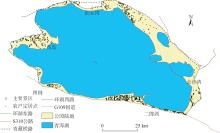
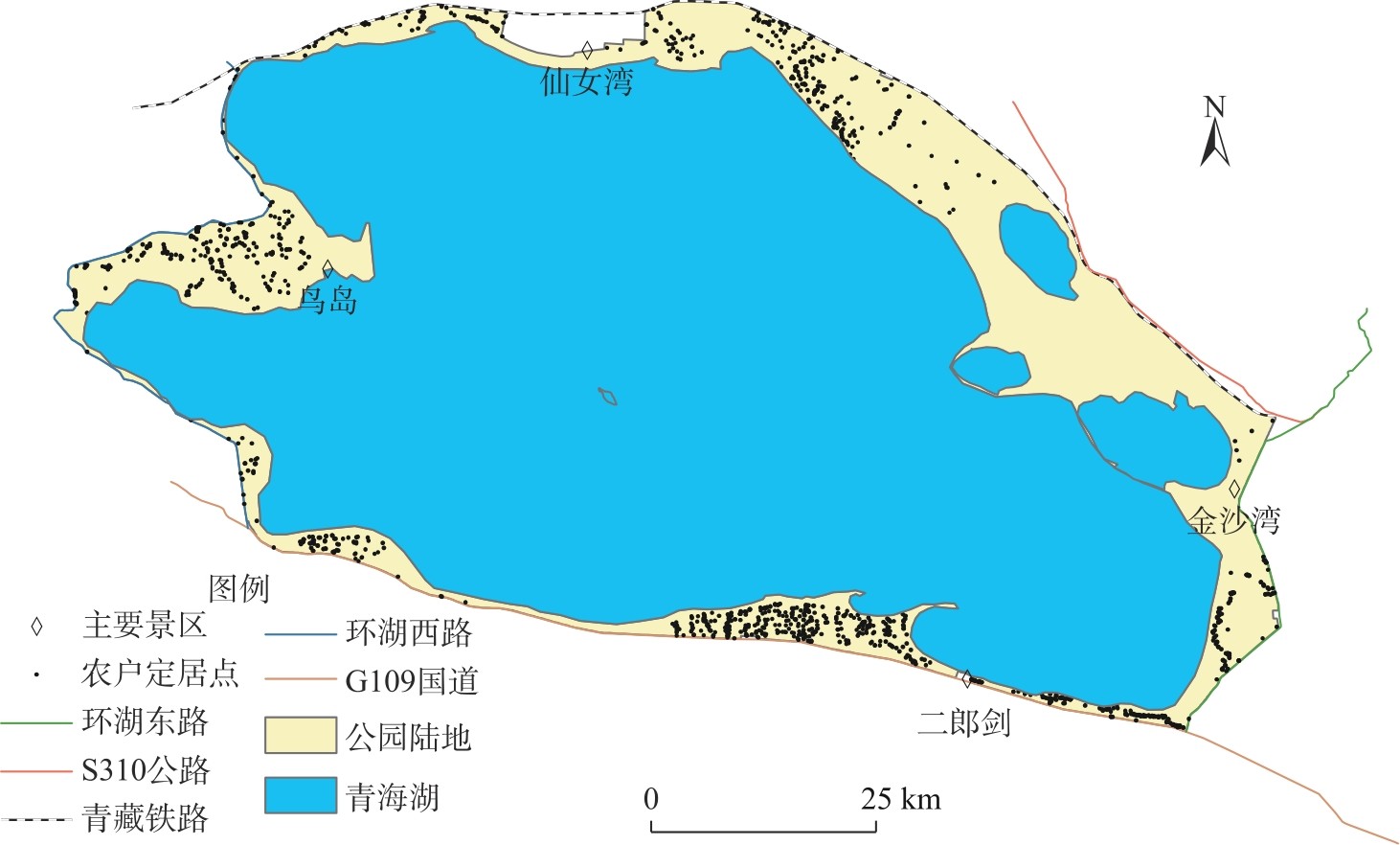
Fig. 1
Overview of the study area and research sites"

Tab. 1
Classification and descriptive statistics of farm household livelihood types"
| 统计量 | 农牧业主导型 | 服务业主导型 | 政府兜底型 | 务工主导型 |
|---|---|---|---|---|
| 收入来源占比 | 种植及畜牧业≥60% | 旅游、经商等服务性活动≥60% | 政府补助≥90% | 务工活动≥90% |
| 样本户数 | 1172 | 380 | 123 | 139 |
| 户均人口数 | 4.21 | 3.97 | 3.43 | 3.72 |
| 户均劳动力数 | 2.30 | 2.36 | 2.10 | 2.19 |
Tab. 2
Evaluation indicator system of farm household modernization"
| 维度 | 指标层 | 指标说明 | 属性 | 权重 |
|---|---|---|---|---|
| 生产现代化 | 产业组织化程度/个 | 参与合作社数量 | + | 0.117 |
| 劳动力素质/a | 劳动力人均受教育年限 | + | 0.123 | |
| 机械化程度/台 | 拥有农业机械数量 | + | 0.076 | |
| 劳动生产率/元·人-1 | 家庭总收入与劳动力数量的比值 | + | 0.102 | |
| 非农产业水平/% | 第二、三产业收入占家庭总收入比重 | + | 0.114 | |
| 生计渠道数量/种 | 收入渠道数 | + | 0.043 | |
| 土地产出率/104元·hm-2 | 单位土地面积的农业产值 | + | 0.079 | |
| 农业保险深度 | 农业保险保额占农产品产值比重/% | + | 0.064 | |
| 生活现代化 | 供水便利度 | 据用水来源赋值:自来水=1;井水=0.75;泉水=0.5;河湖水=0.25;取水困难=0 | + | 0.007 |
| 住房条件 | 据住房结构赋值:砖混=1;砖木=0.75;土木=0.5;土坯、彩钢=0.25 | + | 0.011 | |
| 卫生设施水平 | 据厕所类型赋值:马桶=1;旱厕=0.75;露天厕所=0.5;开放式厕所=0.25 | + | 0.030 | |
| 家电保有量/台 | 大型家电数量 | + | 0.029 | |
| 家庭出行能力 | 据交通工具种类及数量赋值:轿车=1;农用车=0.75;摩托车=0.5;自行车=0.25 | + | 0.029 | |
| 恩格尔系数/% | 食物支出占家庭总支出比重 | - | 0.043 | |
| 教育文娱消费水平/% | 教育文娱支出占家庭总支出比重 | + | 0.041 | |
| 生态现代化 | 草场质量 | 据草场质量赋值:优秀=1;良好=0.75;差=0.5;较差=0.25;极差=0 | + | 0.067 |
| 生态保护意识 | 据环保意识赋值:优秀=1;良好=0.75;差=0.5;较差=0.25;极差=0 | + | 0.006 | |
| 轮牧实施情况 | 据季节性轮牧实施情况赋值:是=1;否=0 | + | 0.019 |
Tab. 3
Assessment of farm household modernization"
| 现代化指标 | 农牧业主导型 | 服务业主导型 | 政府兜底型 | 务工主导型 | 研究区总体 |
|---|---|---|---|---|---|
| 产业组织化程度 | 0.038 | 0.042 | 0.028 | 0.017 | 0.036 |
| 劳动力素质 | 0.044 | 0.063 | 0.041 | 0.058 | 0.049 |
| 机械化程度 | 0.001 | 0.001 | 0.000 | 0.000 | 0.001 |
| 劳动生产率 | 0.026 | 0.024 | 0.009 | 0.012 | 0.024 |
| 非农产业水平 | 0.006 | 0.045 | 0.011 | 0.078 | 0.020 |
| 生计渠道数量 | 0.015 | 0.021 | 0.000 | 0.016 | 0.015 |
| 土地产出率 | 0.011 | 0.004 | 0.004 | 0.002 | 0.008 |
| 农业保险深度 | 0.018 | 0.019 | 0.017 | 0.015 | 0.018 |
| 供水便利度 | 0.006 | 0.006 | 0.005 | 0.006 | 0.006 |
| 住房条件 | 0.008 | 0.009 | 0.008 | 0.009 | 0.008 |
| 卫生设施水平 | 0.010 | 0.012 | 0.009 | 0.010 | 0.010 |
| 家电保有量 | 0.009 | 0.008 | 0.007 | 0.004 | 0.008 |
| 家庭出行能力 | 0.007 | 0.006 | 0.005 | 0.004 | 0.007 |
| 恩格尔系数 | 0.009 | 0.010 | 0.011 | 0.012 | 0.009 |
| 教育文娱消费水平 | 0.005 | 0.005 | 0.005 | 0.004 | 0.005 |
| 草场质量 | 0.042 | 0.046 | 0.040 | 0.041 | 0.042 |
| 生态保护意识 | 0.005 | 0.005 | 0.005 | 0.004 | 0.005 |
| 轮牧实施情况 | 0.018 | 0.018 | 0.018 | 0.017 | 0.018 |
| 现代化指数 | 0.274 | 0.344 | 0.223 | 0.309 | 0.288 |
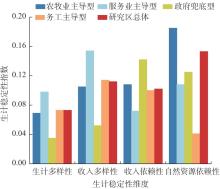
Fig. 2
Livelihood stability assessment of different farm household types"
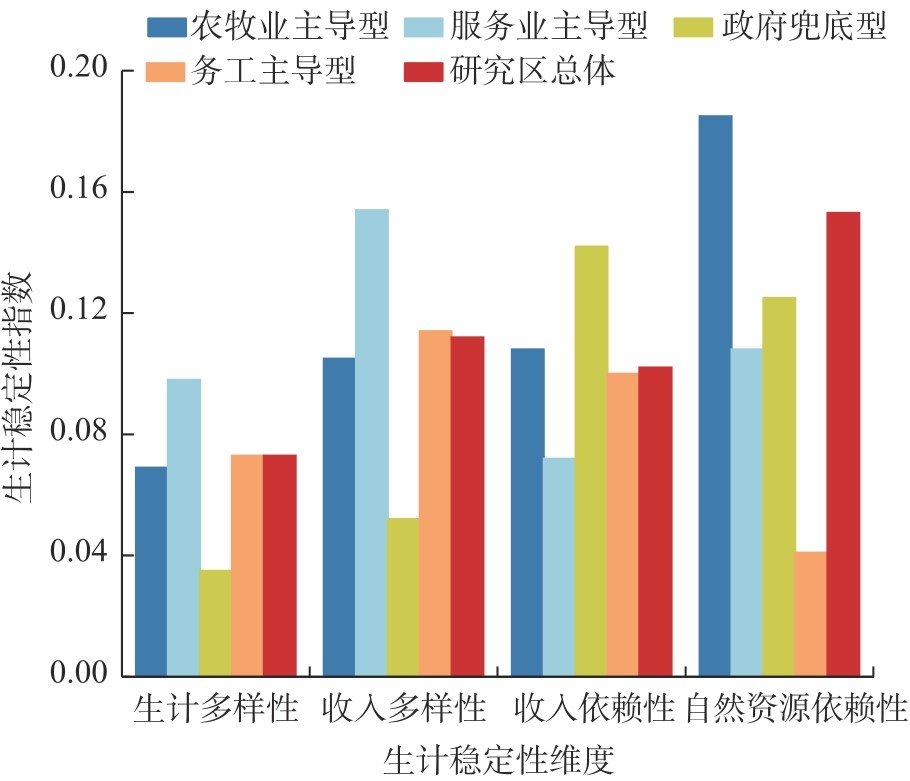
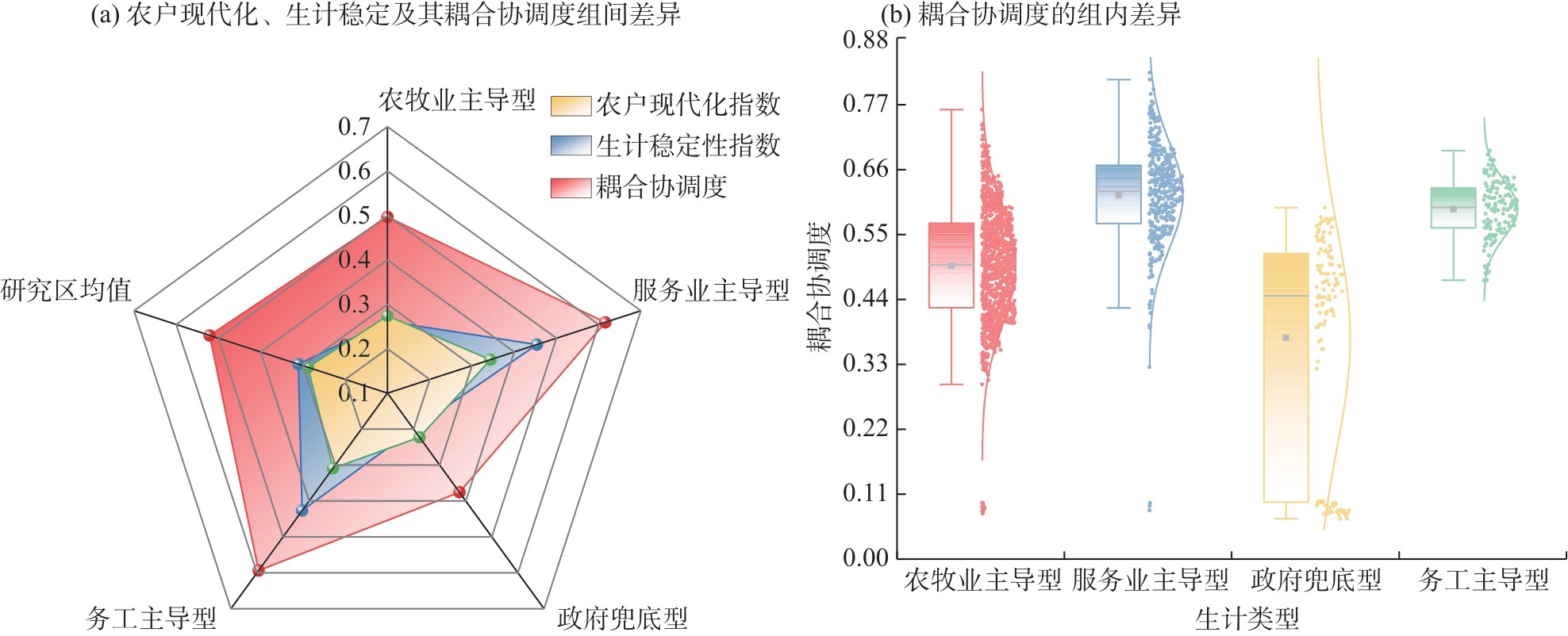
Fig. 3
Intergroup and intragroup differences in farm household modernization, livelihood stability, and their coupling coordination degree"
Tab. 4
Coupling coordination status between farm household modernization and livelihood stability"
| 生计类型 | 农户现代化 | 生计稳定性 | 耦合协调度 | 耦合协调阶段 | 相对发展阶段 |
|---|---|---|---|---|---|
| 农牧业主导型 | 0.274 | 0.262 | 0.497 | 中度协调 | 同步发展型 |
| 服务业主导型 | 0.344 | 0.454 | 0.616 | 高度协调 | 现代化滞后型 |
| 政府兜底型 | 0.223 | 0.200 | 0.376 | 初级协调 | 同步发展型 |
| 务工主导型 | 0.309 | 0.427 | 0.594 | 中度协调 | 现代化滞后型 |
| 研究区总体 | 0.288 | 0.311 | 0.521 | 中度协调 | 同步发展型 |
Fig. 4
Spatial heterogeneity characteristics of coupling coordination development"
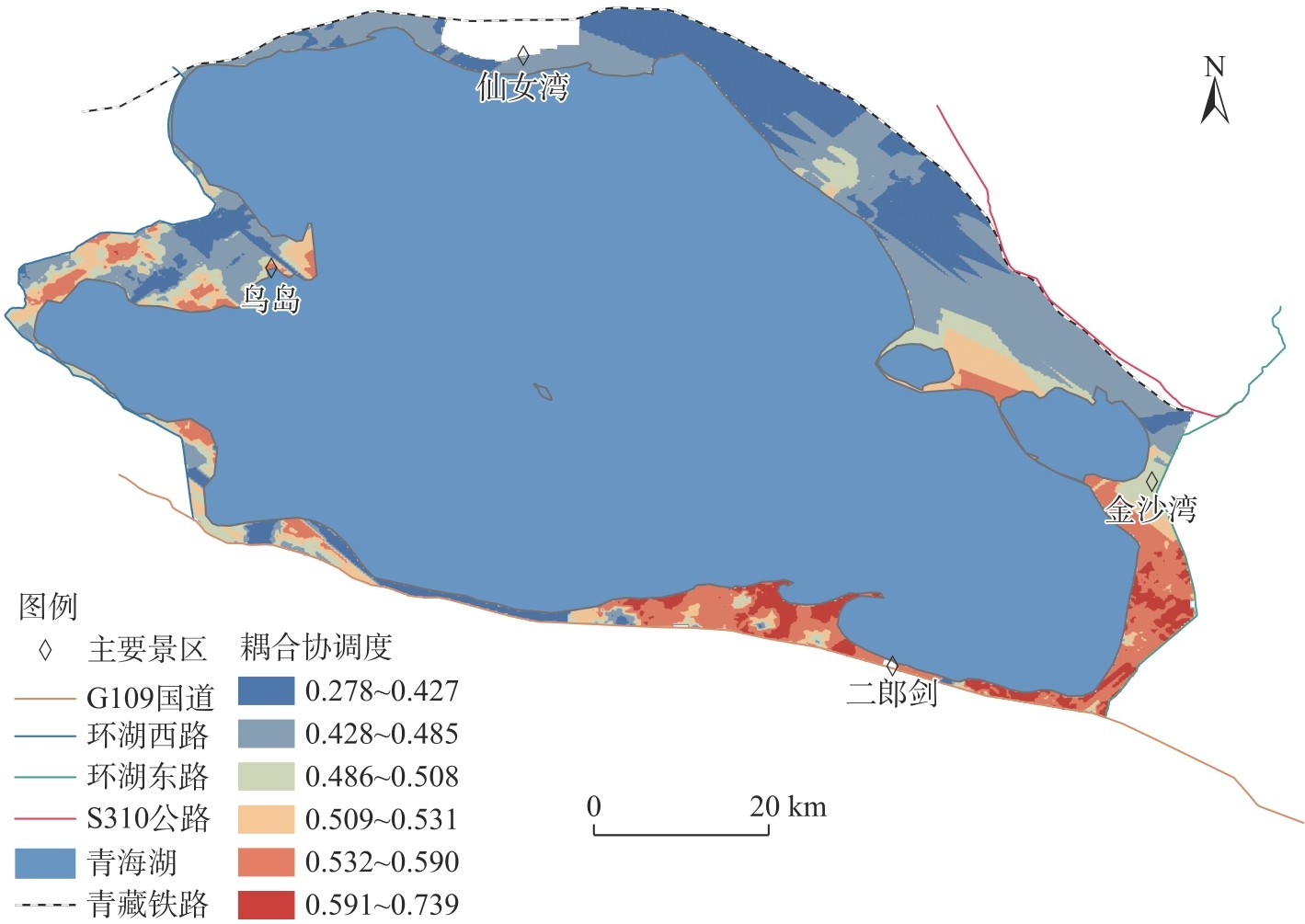
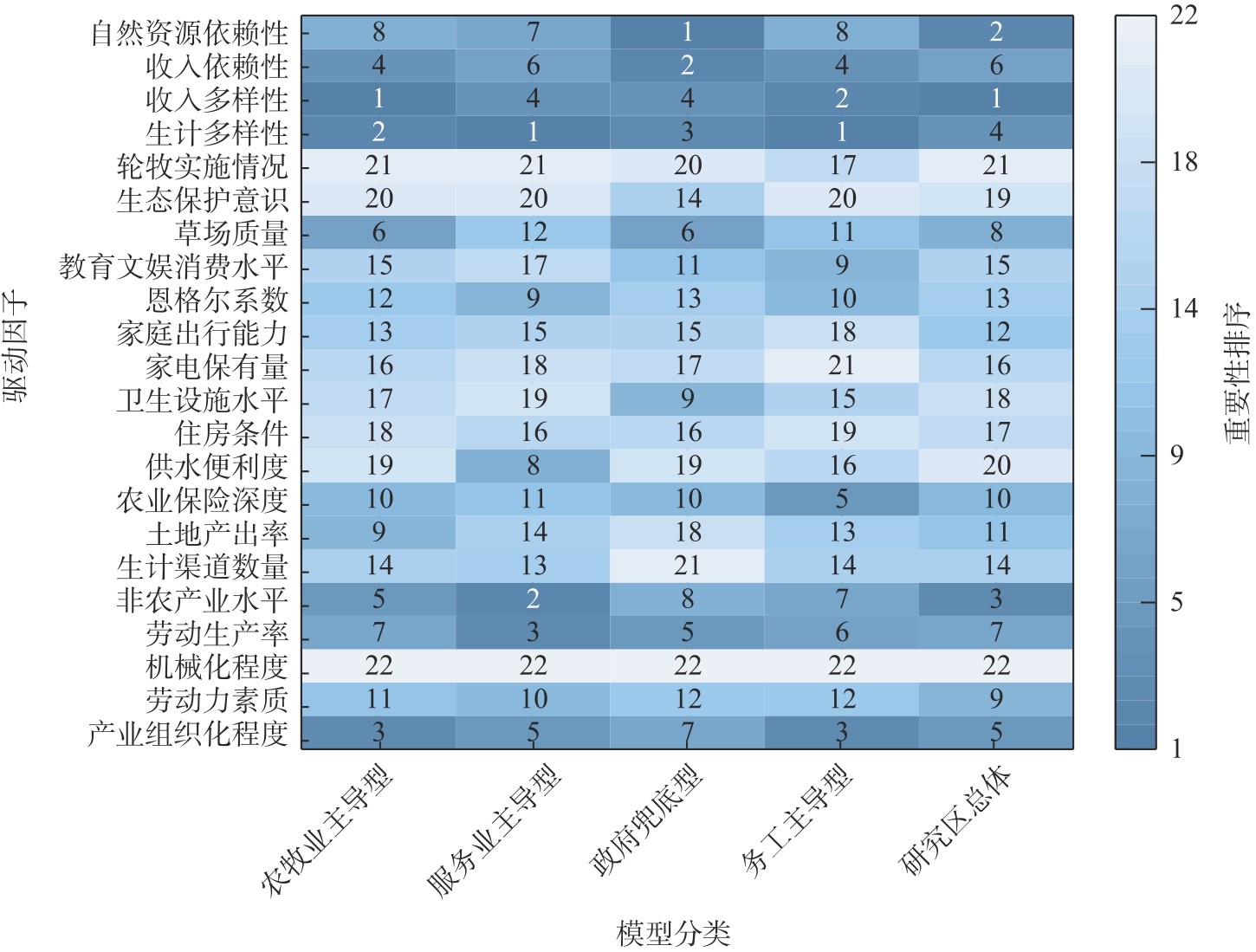
Fig. 5
Ranking of driving factors’ importance for coupling coordination development"
| [1] |
周国华, 龙花楼, 林万龙, 等. 新时代“三农”问题和乡村振兴的理论思考与实践发展[J]. 自然资源学报, 2023, 38(8): 1919-1940.
doi: 10.31497/zrzyxb.20230801 |
|
[Zhou Guohua, Long Hualou, Lin Wanlong, et al. Theoretical debates and practical development of the “three rural issues” and rural revitalization in the new era[J]. Journal of Natural Resources, 2023, 38(8): 1919-1940.]
doi: 10.31497/zrzyxb.20230801 |
|
| [2] | 周升强, 赵凯. 北方农牧交错区农牧民生计资本与生计稳定性的耦合协调分析——以宁夏盐池县与内蒙古鄂托克旗为例[J]. 干旱区资源与环境, 2022, 36(2): 9-15. |
| [Zhou Shengqiang, Zhao Kai. Coupling coordination of capital and livelihood stability of farmers and herdsmen in northern agro-pastoral ecotone in northern China[J]. Journal of Arid Land Resources and Environment, 2022, 36(2): 9-15.] | |
| [3] | Zhu Q Y, Wang Z J, Umer M. The suitability of developing ecotourism in the Shanxi area of Taihangshan National Park, a candidate area for national parks in China[J]. Sustainability, 2025, 17(3): 841, doi: 10.3390/su17030841. |
| [4] | 邓金钱. 新型农村集体经济赋能脱贫户生计转型: 优势、机制与进路[J]. 中国人口·资源与环境, 2023, 33(2): 143-152. |
| [Deng Jinqian. New rural collective economy enabling poverty-free households’ livelihood transformation: Advantages, mechanisms, and approaches[J]. China Population, Resources and Environment, 2023, 33(2): 143-152.] | |
| [5] | 杨婕妤, 陈强强, 崔秀娟. 农牧交错区农牧民生计韧性差异化提升对策研究——以天祝藏族自治县为例[J]. 干旱区资源与环境, 2024, 38(10): 53-62. |
| [Yang Jieyu, Chen Qiangqiang, Cui Xiujuan. Differentiated improvement of livelihood resilience of farmers and herdsmen in the agricultural-pastoral ecotone: A case of Tianzhu Tibetan Autonomous County, China[J]. Journal of Arid Land Resources and Environment, 2024, 38(10): 53-62.] | |
| [6] | 陈俞全, 韩潇, 聂凤英. 自然灾害对我国农户生计多样化的影响研究[J]. 中国农业资源与区划, 2024, 45(10): 37-50. |
| [Chen Yuquan, Han Xiao, Nie Fengying. The impact of natural disaster on livelihood diversification strategies of rural households in China[J]. Chinese Journal of Agricultural Resources and Regional Planning, 2024, 45(10): 37-50.] | |
| [7] | Phiri A T, Zhao X H, Chen Q H. Revitalizing smallholder farming in Africa: Insights from China’s science and technology backyard model[J]. Research on World Agricultural Economy, 2024, 5(2): 1-13. |
| [8] | Asante B O, Ma W L, Prah S, et al. Promoting the adoption of climate-smart agricultural technologies among maize farmers in Ghana: Using digital advisory services[J]. Mitigation and Adaptation Strategies for Global Change, 2024, 29(3): 19, doi: 10.1007/s11027-024-10116-6. |
| [9] | Abdulai A R, Oklikah D O, Abdulai A S J, et al. State policies and smallholders politics in Ghana’s agriculture ‘modernization’paradigm: A policy review[J]. SN Social Sciences, 2024, 4(11): 202, doi: 10.1007/s43545-024-01004-6. |
| [10] |
李小建, 朱瑞明. 农区现代化进程中的农户地理研究[J]. 经济地理, 2023, 43(7): 1-11.
doi: 10.15957/j.cnki.jjdl.2023.07.001 |
|
[Li Xiaojian, Zhu Ruiming. Geography of rural households in the process of rural modernization[J]. Economic Geography, 2023, 43(7): 1-11.]
doi: 10.15957/j.cnki.jjdl.2023.07.001 |
|
| [11] | 匡远配, 彭云, 李姗姗. 新时代中国农业农村现代化的多重逻辑、基本特征及实现路径[J]. 中国农村经济, 2024(12): 2-22. |
| [Kuang Yuanpei, Peng Yun, Li Shanshan. The multiple logics, basic characteristics, and realization paths of China’s agricultural and rural modernization in the new era[J]. Chinese Rural Economy, 2024(12): 2-22.] | |
| [12] |
刘玉洁, 吕硕, 陈洁, 等. 青藏高原农业现代化时空分异及其驱动机制[J]. 地理学报, 2022, 77(1): 214-227.
doi: 10.11821/dlxb202201015 |
|
[Liu Yujie, Lü Shuo, Chen Jie, et al. Spatio-temporal differentiation of agricultural modernization and its driving mechanism on the Qinghai-Tibet Plateau[J]. Acta Geographica Sinica, 2022, 77(1): 214-227.]
doi: 10.11821/dlxb202201015 |
|
| [13] | 张文宣. 小农户生产现代化的理论分析与经验证实[J]. 经济问题, 2020(9): 92-99. |
| [Zhang Wenxuan. Organic connection between small farmer production and modern agricultural development: Theoretical logic and case studies[J]. On Economic Problems, 2020(9): 92-99.] | |
| [14] | 王伟龙, 邓鹏程. 乡村振兴战略下农户家庭农业现代化经营的困境、难点及对策研究[J]. 宏观经济研究, 2024(6): 103-113. |
| [Wang Weilong, Deng Pengcheng. Study on dilemmas, difficulties and countermeasures of farmers’ family agricultural modernization operation under rural revitalization strategy[J]. Macroeconomics, 2024(6): 103-113.] | |
| [15] | 张军以, 王腊春. 乡村振兴视域下的小农户振兴解析[J]. 人文地理, 2020, 35(6): 66-75. |
| [Zhang Junyi, Wang Lachun. Analysis of small peasant household revitalization from the perspective of the rural revitalization strategy[J]. Human Geography, 2020, 35(6): 66-75.] | |
| [16] | 吴孔森, 杨新军, 尹莎. 环境变化影响下农户生计选择与可持续性研究——以民勤绿洲社区为例[J]. 经济地理, 2016, 36(9): 141-149. |
| [Wu Kongsen, Yang Xinjun, Yin Sha. Farmers’ livelihood choice and sustainability under the influence of environmental change: A case study of Minqin oasis community in Gansu Province[J]. Economic Geography, 2016, 36(9): 141-149.] | |
| [17] | Li X, Xu S, Hu Y C. Understanding the rural livelihood stability system: The eco-migration in Huanjiang County, China[J]. Sustainability, 2020, 12(16): 6374, doi: 10.3390/su12166374. |
| [18] | 王银, 叶文丽, 吴孔森, 等. 稳定性视角下黄土高原生态系统与生计系统的冲突与耦合——以陕西省佳县为例[J]. 生态学报, 2024, 44(5): 1868-1880. |
| [Wang Yin, Ye Wenli, Wu Kongsen, et al. Conflict and coupling between ecosystem and livelihood system on the Loess Plateau from the perspective of stability: A case of Jia County, Shaanxi Province[J]. Acta Ecologica Sinica, 2024, 44(5): 1868-1880.] | |
| [19] | Aoxi Y, Ye J Q, Wang Y H. Coupling and coordination relationship between livelihood capital and livelihood stability of farmers in different agricultural regions[J]. Land, 2022, 11(11): 2049, doi: 10.3390/land11112049. |
| [20] |
Habib N, Ariyawardana A, Aziz A A. The influence and impact of livelihood capitals on livelihood diversification strategies in developing countries: A systematic literature review[J]. Environmental Science and Pollution Research, 2023, 30(27): 69882-69898.
doi: 10.1007/s11356-023-27638-2 |
| [21] |
王淑佳, 孔伟, 任亮, 等. 国内耦合协调度模型的误区及修正[J]. 自然资源学报, 2021, 36(3): 793-810.
doi: 10.31497/zrzyxb.20210319 |
|
[Wang Shujia, Kong Wei, Ren Liang, et al. Research on misuses and modification of coupling coordination degree model in China[J]. Journal of Natural Resources, 2021, 36(3): 793-810.]
doi: 10.31497/zrzyxb.20210319 |
|
| [22] |
徐爽, 胡业翠. 农户生计资本与生计稳定性耦合协调分析——以广西金桥村移民安置区为例[J]. 经济地理, 2018, 38(3): 142-148, 164.
doi: 10.15957/j.cnki.jjdl.2018.03.018 |
|
[Xu Shuang, Hu Yecui. Coupling coordination analysis of capital and livelihood stability of farmers: A case study of the resettlement area of Jinqiao Village in Guangxi[J]. Economic Geography, 2018, 38(3): 142-148, 164.]
doi: 10.15957/j.cnki.jjdl.2018.03.018 |
|
| [23] | Liu Z X, Sun J H, Li Y, et al. Exploring the sustainability of farmers’ livelihood-land use systems from a coupled coordination perspective[J]. Frontiers in Sustainable Food Systems, 2024, 8: 1511505, doi: 10.3389/fsufs.2024.1511505. |
| [24] |
刘庆芳, 杨定, 杨振山, 等. 青藏高原国家公园群人文生态系统耦合协调评价及障碍因子识别[J]. 地理学报, 2023, 78(5): 1119-1135.
doi: 10.11821/dlxb202305005 |
|
[Liu Qingfang, Yang Ding, Yang Zhenshan, et al. Evaluation of coupling coordination and identification of obstaclefactors of human ecosystem in Qinghai-Tibet Plateau National Park cluster[J]. Acta Geographica Sinica, 2023, 78(5): 1119-1135.]
doi: 10.11821/dlxb202305005 |
|
| [25] | Zhang Z F, Cong Z T, Gao B, et al. The water level change and its attribution of the Qinghai Lake from 1960 to 2020[J]. Journal of Hydrology: Regional Studies, 2024, 52: 101688, doi: 10.1016/j.ejrh.2024.101688. |
| [26] | 马勇洁, 仲俊涛, 米文宝, 等. 青海湖国家公园不同类型牧户生计韧性评价[J]. 长江流域资源与环境, 2025, 34(3): 682-692. |
| [Ma Yongjie, Zhong Juntao, Mi Wenbao, et al. Assessment of livelihood resilience among various herder groups within Qinghai Lake National Park[J]. Resources and Environment in the Yangtze Basin, 2025, 34(3): 682-692.] | |
| [27] |
Xiao Y, Xiao Q, Zhang J D. Balancing the international benefits and risks associated with implementation of ecological policy on the Qinghai-Xizang Plateau, China[J]. Gondwana Research, 2023, 115: 183-190.
doi: 10.1016/j.gr.2022.10.006 |
| [28] |
夏兴, 乔家君, 徐洋, 等. 农户多维相对贫困与生计多样性的耦合关系——以安徽省阜南县为例[J]. 经济地理, 2023, 43(4): 164-173.
doi: 10.15957/j.cnki.jjdl.2023.04.017 |
|
[Xia Xing, Qiao Jiajun, Xu Yang, et al. Coupling relationship between multidimensional relative poverty and livelihood diversity of farming households: A case of Funan County in Anhui Province, China[J]. Economic Geography, 2023, 43(4): 164-173.]
doi: 10.15957/j.cnki.jjdl.2023.04.017 |
|
| [29] |
翟彬, 王宇阁, 朱芳芳, 等. 生计策略下黄河流域农户生计韧性差异及其影响因素——以河南省为例[J]. 经济地理, 2024, 44(2): 156-165.
doi: 10.15957/j.cnki.jjdl.2024.02.016 |
| [Zhai Bin, Wang Yuge, Zhu Fangfang, et al. Differences in livelihood resilience of farm households in the Yellow River Basin under the background of livelihood strategies and its influencing factors: Taking Henan Province as an example[J]. Economic Geography, 2024, 44(2): 156-165.] | |
| [30] | 王晓毅, 罗静. 共同富裕、乡村振兴与小农户现代化[J]. 北京工业大学学报(社会科学版), 2022, 22(3): 64-74. |
| [Wang Xiaoyi, Luo Jing. Common prosperity, rural revitalization and small holder modernization[J]. Journal of Beijing University of Technology (Social Sciences Edition), 2022, 22(3): 64-74.] | |
| [31] | Aruldoss M, Lakshmi T M, Venkatesan V P. A survey on multi criteria decision making methods and its applications[J]. American Journal of Information Systems, 2013, 1(1): 31-43. |
| [32] |
曹佳琳, 刘艳芳, 赵金梅, 等. 宁夏城市建设用地节约集约利用与高质量发展耦合协调研究[J]. 干旱区地理, 2024, 47(5): 872-884.
doi: 10.12118/j.issn.1000-6060.2023.562 |
|
[Cao Jialin, Liu Yanfang, Zhao Jinmei, et al. Coupling and coordination of economical and intensive utilization of urban construction land and high-quality development in Ningxia[J]. Arid Land Geography, 2024, 47(5): 872-884.]
doi: 10.12118/j.issn.1000-6060.2023.562 |
|
| [33] |
周闯, 郑旭刚, 杨苘菲. 新型城镇化与乡村振兴的共同演化及其市民化效应[J]. 地理研究, 2024, 43(12): 3265-3288.
doi: 10.11821/dlyj020240177 |
| [Zhou Chuang, Zheng Xugang, Yang Qingfei. Coevolution of new urbanization and rural revitalization and its citizenization effect[J]. Geographical Research, 2024, 43(12): 3265-3288.] | |
| [34] |
王金伟, 王启翔, 冯凌. 中国数字经济与旅游业高质量发展的协调格局及驱动机制[J]. 地理科学, 2024, 44(1): 130-139.
doi: 10.13249/j.cnki.sgs.20221571 |
|
[Wang Jinwei, Wang Qixiang, Feng Ling. Coordination pattern and driving mechanism of digital economy and high-quality tourism development in China[J]. Scientia Geographica Sinica, 2024, 44(1): 130-139.]
doi: 10.13249/j.cnki.sgs.20221571 |
|
| [35] |
Breiman L. Random forests[J]. Machine learning, 2001, 45: 5-32.
doi: 10.1023/A:1010933404324 |
| [36] |
刘卫东, 唐志鹏, 夏炎, 等. 中国碳强度关键影响因子的机器学习识别及其演进[J]. 地理学报, 2019, 74(12): 2592-2603.
doi: 10.11821/dlxb201912012 |
|
[Liu Weidong, Tang Zhipeng, Xia Yan, et al. Identifying the key factors influencing Chinese carbon intensity using machine learning, the random forest algorithm, and evolutionary analysis[J]. Acta Geographica Sinica, 2019, 74(12): 2592-2603.]
doi: 10.11821/dlxb201912012 |
|
| [37] | 朱楠, 陈维茹. 我国西部地区人民生活现代化: 评判、预测与实现路径[J]. 管理学刊, 2022, 35(2): 28-42. |
| [Zhu Nan, Chen Weiru. Modernization of people’s life in western China: Evaluation, judgment and implementation path[J]. Journal of Management, 2022, 35(2): 28-42.] | |
| [38] |
刘玒玒, 刘书芳. 祁连山地区复合生态系统韧性时空演化及障碍因子识别[J]. 干旱区地理, 2024, 47(2): 237-247.
doi: 10.12118/j.issn.1000-6060.2023.214 |
|
[Liu Honghong, Liu Shufang. Spatiotemporal evolution and obstacle identification of complex ecosystem resilience in the Qilian Mountain area[J]. Arid Land Geography, 2024, 47(2): 237-247.]
doi: 10.12118/j.issn.1000-6060.2023.214 |
|
| [39] |
安晓宁, 辛岭. 中国农业现代化发展的时空特征与区域非均衡性[J]. 资源科学, 2020, 42(9): 1801-1815.
doi: 10.18402/resci.2020.09.14 |
|
[An Xiaoning, Xin Ling. The spatiotemporal characteristics and regional nonequilibrium of agricultural modernization development in China[J]. Resources Science, 2020, 42(9): 1801-1815.]
doi: 10.18402/resci.2020.09.14 |
|
| [40] |
孙彦, 赵雪雁. 山区农户的生计干预效率及其影响因素——以陇南山区为例[J]. 地理研究, 2023, 42(7): 1874-1891.
doi: 10.11821/dlyj020220867 |
| [Sun Yan, Zhao Xueyan. Efficiency and influencing factors of livelihood interventions of farming households in mountainous areas: A case study of Longnan mountainous areas[J]. Geographical Research, 2023, 42(7): 1874-1891.] | |
| [41] |
刘佳, 赵青华, 王慧. 乡村旅游发展促进农村可持续生计的空间效应及机制[J]. 自然资源学报, 2023, 38(2): 490-510.
doi: 10.31497/zrzyxb.20230214 |
|
[Liu Jia, Zhao Qinghua, Wang Hui. Study on the spatial effect and mechanism of rural tourism development promoting rural sustainable livelihood[J]. Journal of Natural Resources, 2023, 38(2): 490-510.]
doi: 10.31497/zrzyxb.20230214 |
|
||

