干旱区地理 ›› 2026, Vol. 49 ›› Issue (4): 697-712.doi: 10.12118/j.issn.1000-6060.2025.590 cstr: 32274.14.ALG2025590
关靖云( ), 孙之阳, 徐晓亮(), 程乙峰, 宋贝贝, 房瑞莹
收稿日期:2025-09-24
修回日期:2025-10-09
出版日期:2026-04-25
发布日期:2026-04-28
通讯作者:
徐晓亮(1980-),男,博士,教授,主要从事旅游地理等方面的研究. E-mail: xuxiaoliang@xjufe.edu.cn作者简介:关靖云(1991-),男,博士,副教授,主要从事旅游经济与区域可持续发展等方面的研究. E-mail: guanjingyun@xjufe.edu.cn
基金资助:
GUAN Jingyun(), SUN Zhiyang, XU Xiaoliang(), CHENG Yifeng, SONG Beibei, FANG Ruiying
Received:2025-09-24
Revised:2025-10-09
Published:2026-04-25
Online:2026-04-28
摘要:
中国新疆与中亚五国作为典型干旱区和丝绸之路旅游文化带,其旅游气候舒适度时空变化及未来风险亟待系统评估。基于高分辨率格点气象数据和CMIP6多模式模拟结果,系统分析了1960—2100年度假气候指数(Holiday climate index,HCI)的时空演变。结果表明:(1) HCI整体呈上升趋势,区域和季节差异显著,山区增幅较大,部分干旱盆地略有下降;SSP585情景下未来HCI增幅及不确定性均高于SSP245情景。(2) HCI年内变化呈“单峰型”与“双峰型”2类模式,未来气候变暖将导致部分区域夏季舒适性下降,高排放情景下远期(2071—2100年)夏季HCI甚至低于历史基准期(1985—2014年),导致旅游适宜窗口收窄。(3) HCI空间分布呈现明显纬度地带性与垂直分异,高值区集中于低海拔、低纬度区域,未来高值区范围进一步扩展,但夏季高舒适区(HCI>90)受极端高温影响出现缩减。(4) 旅游气候舒适期显著延长,高排放情景下增幅更大但波动增强;空间上呈低纬度、低海拔地区舒适期高,而高纬度、高海拔地区偏低的格局,高海拔山区远期增幅显著。研究结果可为区域旅游业气候适应与可持续发展提供科学依据。
关靖云, 孙之阳, 徐晓亮, 程乙峰, 宋贝贝, 房瑞莹. 气候变化背景下中国新疆与中亚五国旅游气候舒适度时空演变分析[J]. 干旱区地理, 2026, 49(4): 697-712.
GUAN Jingyun, SUN Zhiyang, XU Xiaoliang, CHENG Yifeng, SONG Beibei, FANG Ruiying. Spatiotemporal evolution of tourism climate comfort in Xinjiang, China and five Central Asian countries under climate change[J]. Arid Land Geography, 2026, 49(4): 697-712.
图1
研究区示意图 注:基于自然资源部标准地图服务网站审图号为GS(2020)4393号的标准地图制作,底图边界无修改。下同。"
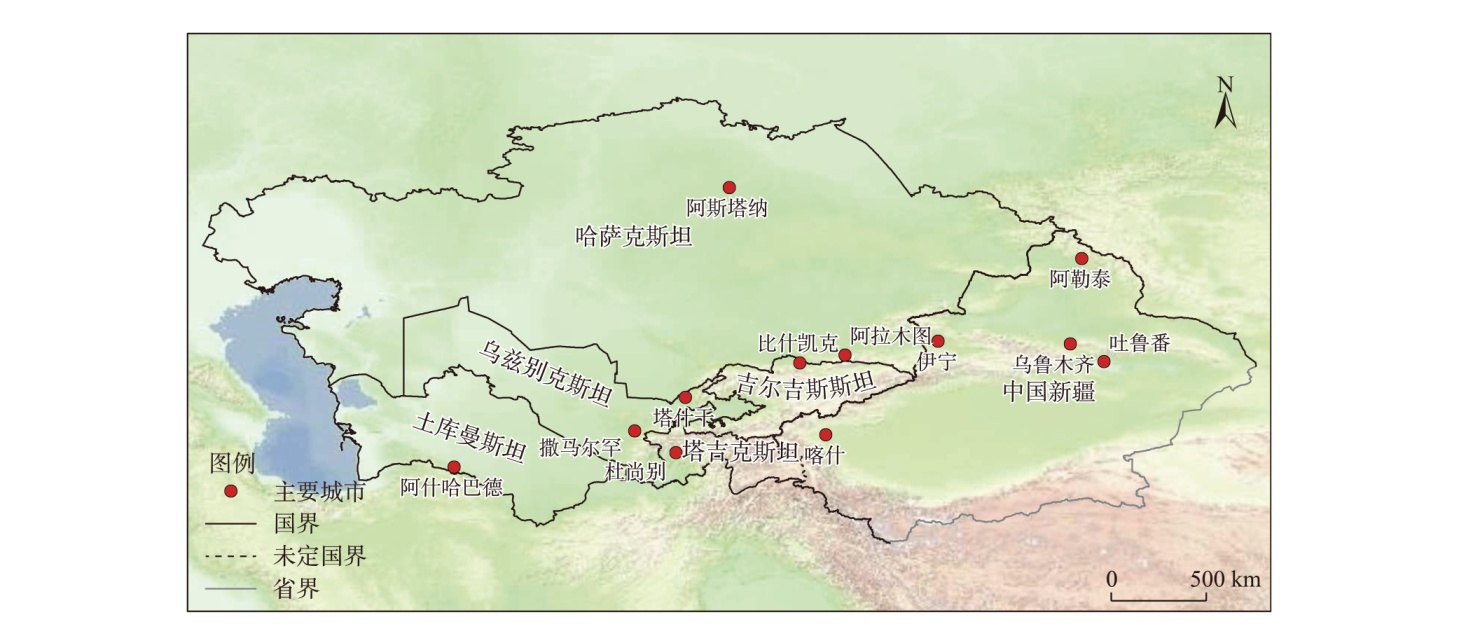

表1
所用全球气候模式信息"
| 模式名称 | 所属国家(地区) | 模式所属机构 | 分辨率(纬度×经度) |
|---|---|---|---|
| ACCESS-CM2 | 澳大利亚 | CSIRO | 1.25°×1.875° |
| ACCESS-ESM1-5 | 澳大利亚 | CSIRO | 1.25°×1.875° |
| BCC-CSM2 | 中国 | BCC | 1.125°×1.125° |
| CanESM5 | 加拿大 | CCCma | 2.8°×2.8° |
| INM-CM5-0 | 俄罗斯 | INM RAS | 2.0°×1.5° |
| IPSL-CM6A-LR | 法国 | IPSL | 1.25°×2.5° |
| NorESM2-LM | 挪威 | NCC | 2.5°×1.9° |
| NorESM2-MM | 挪威 | NCC | 1.25°×0.9° |
表2
各气象要素的阈值分等标准"
| 等级分类 | 有效温度/℃ | 云量覆盖率/% | 风速/km·h-1 | 日降水量/mm |
|---|---|---|---|---|
| 10 | 23~25 | 11~20 | 1~9 | 0.00 |
| 9 | 20~22、26 | 1~10、21~30 | 10~19 | 0.01~2.99 |
| 8 | 27~28 | 0、31~40 | 0、20~29 | 3.00~5.99 |
| 7 | 18~19、29~30 | 41~50 | - | - |
| 6 | 15~17、31~32 | 51~60 | 30~39 | - |
| 5 | 11~14、33~34 | 61~70 | - | 6.00~8.99 |
| 4 | 7~10、35~36 | 71~80 | - | - |
| 3 | 0~6 | 81~90 | 40~49 | - |
| 2 | -5~-1、37~39 | 90~99 | - | 9.00~12.00 |
| 1 | ≤-6 | 100 | - | - |
| 0 | ≥39 | - | 50~70 | 12.01~25.00 |
| -1 | - | - | - | >25.00 |
| -10 | >70 |
表3
HCI体感分级标准"
| HCI分值区间 | 评分描述 |
|---|---|
| 90~100 | 理想 |
| 80~89 | 优异 |
| 70~79 | 优良 |
| 60~69 | 良好 |
| 50~59 | 可接受 |
| 30~49 | 临界 |
| 10~29 | 难以接受 |
| 0~9 | 危险 |
图2
不同区域HCI的年际变化 注:HCI为度假气候指数。下同。"
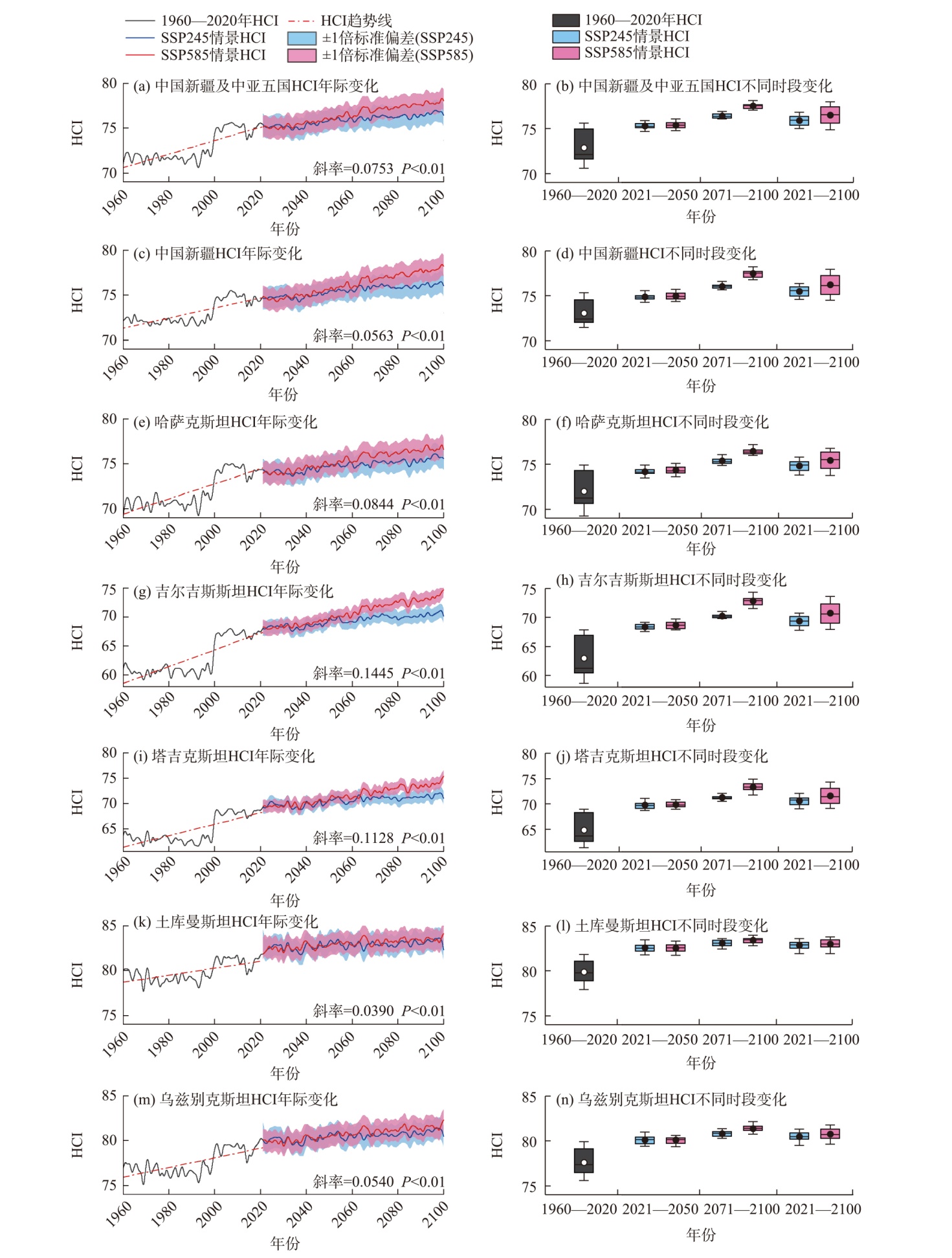
图3
不同区域HCI的年内变化"
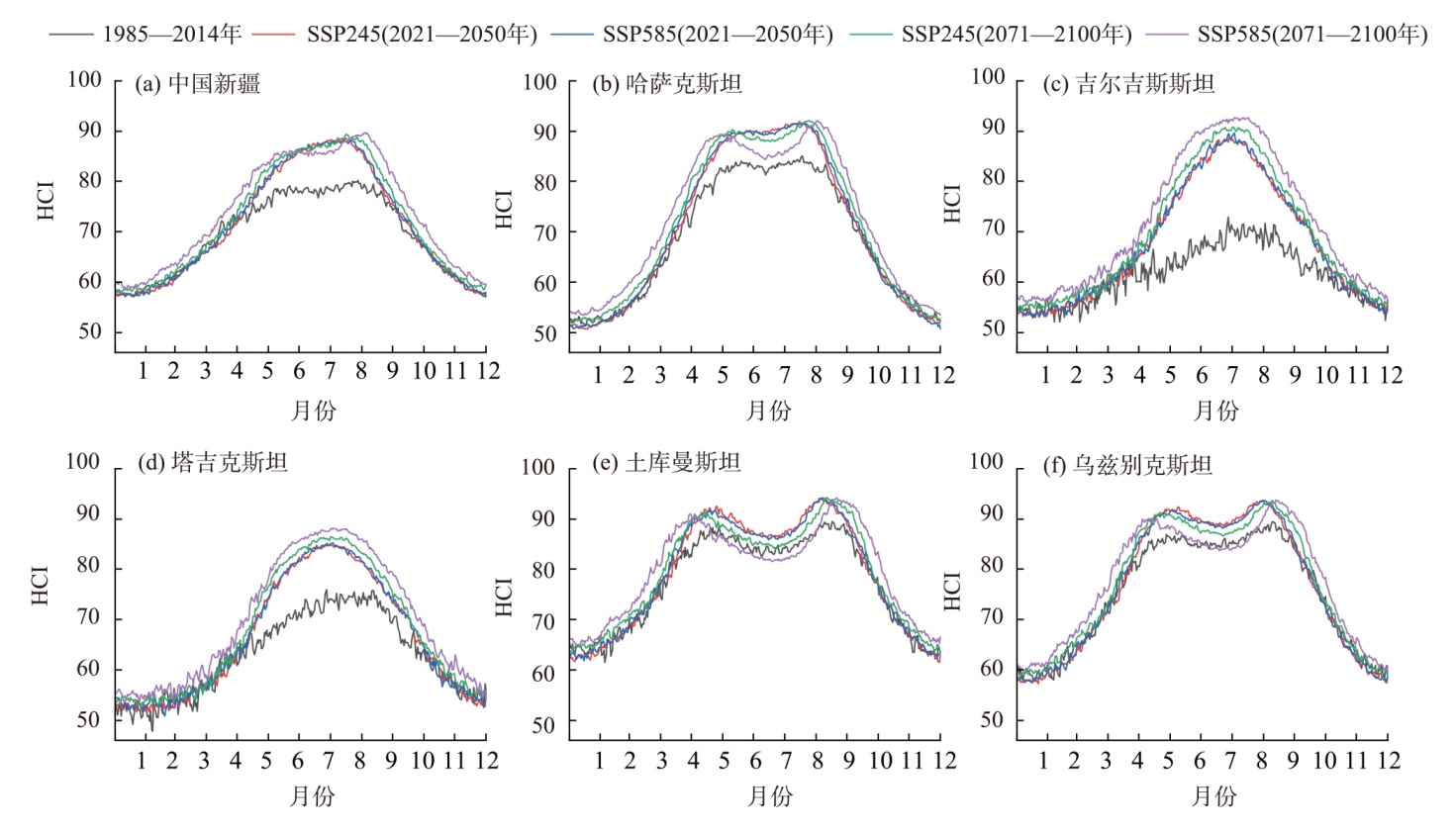
图4
1960—2020年HCI的空间格局及变化趋势"
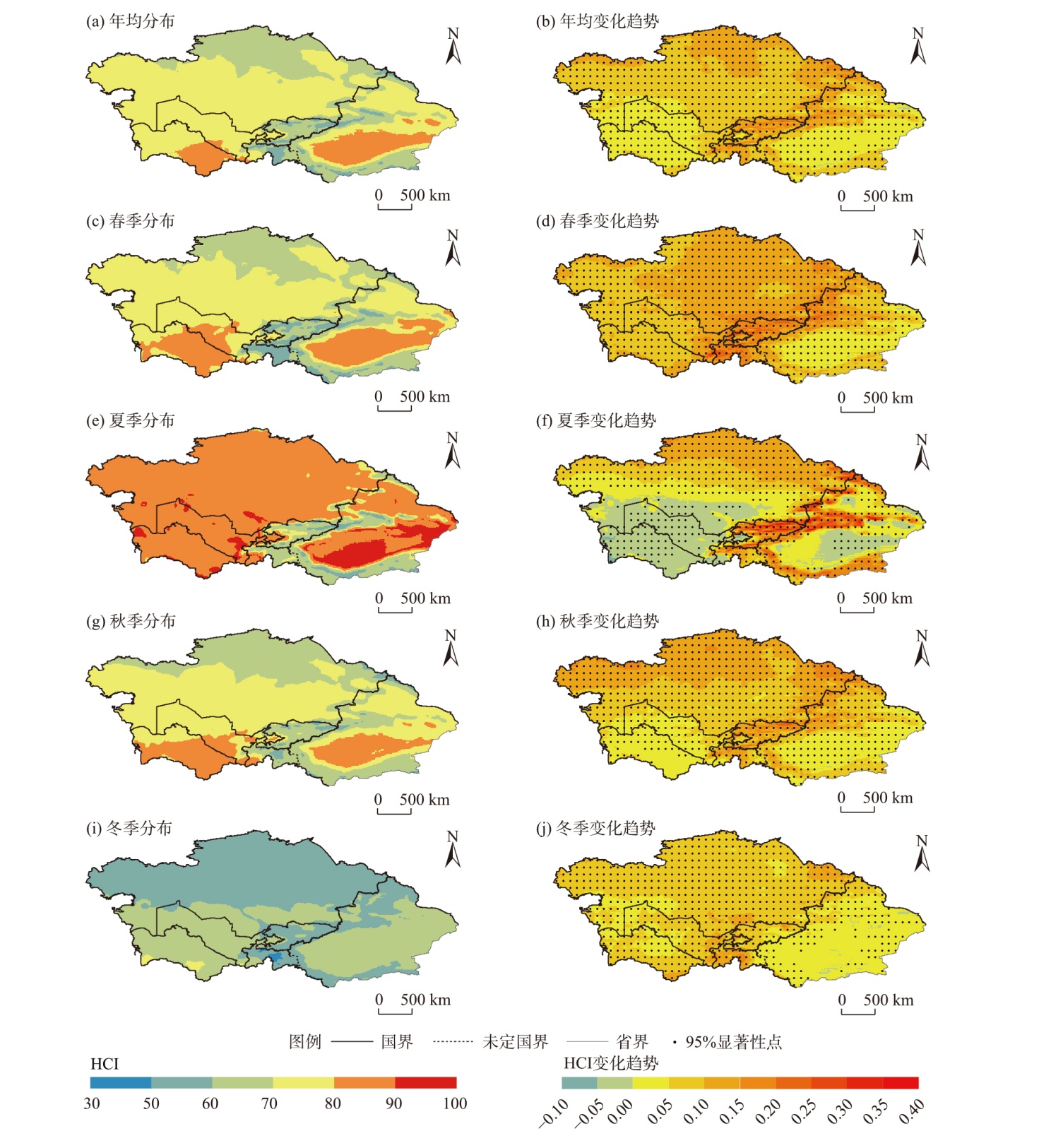
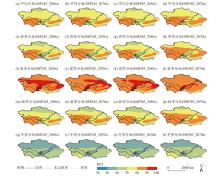
图5
不同气候变化情景下HCI的空间分布"
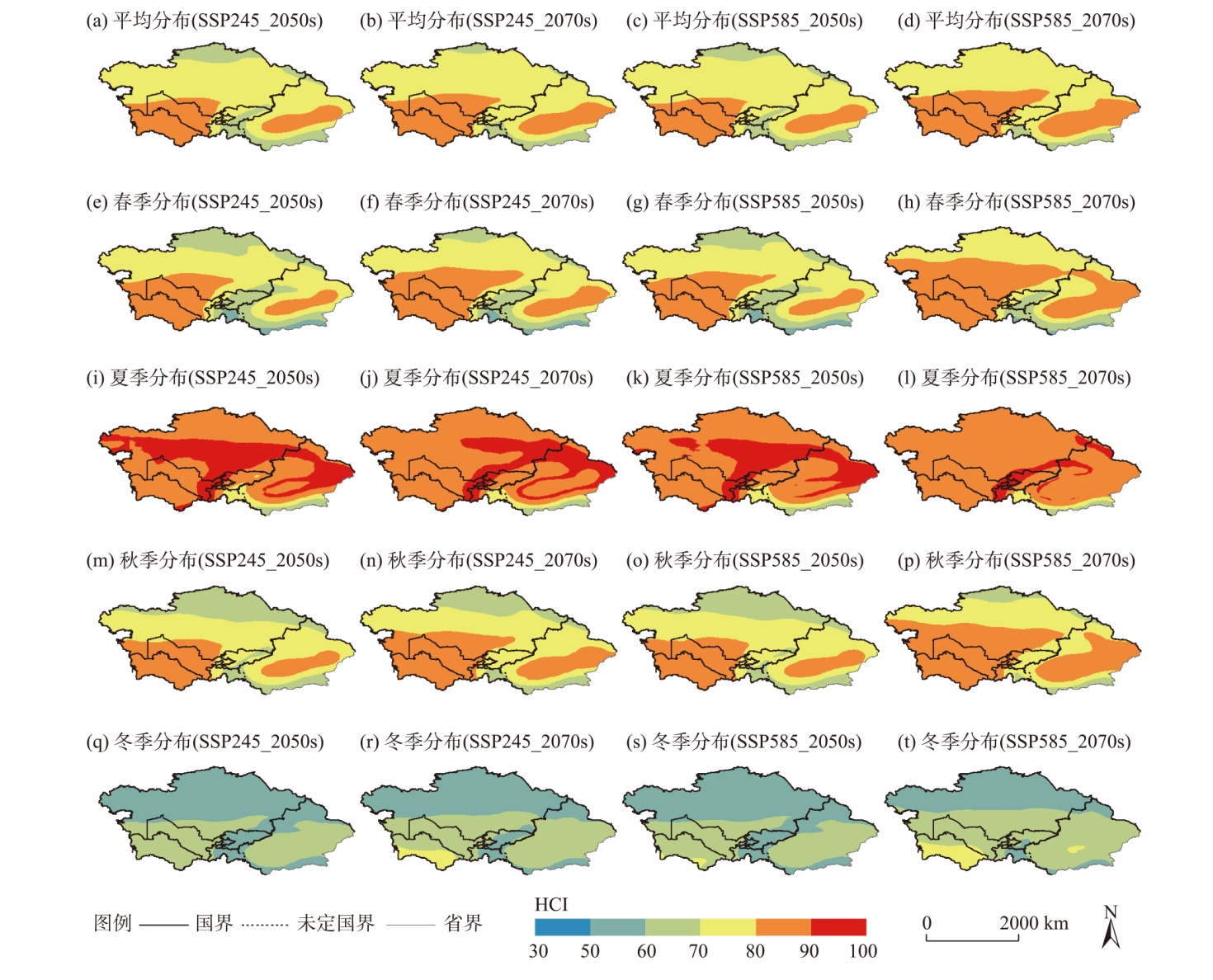
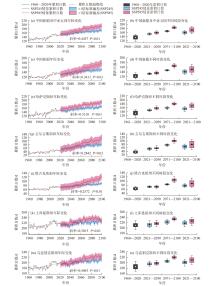
图6
旅游气候舒适期(HCI>80)累积日数年际变化"
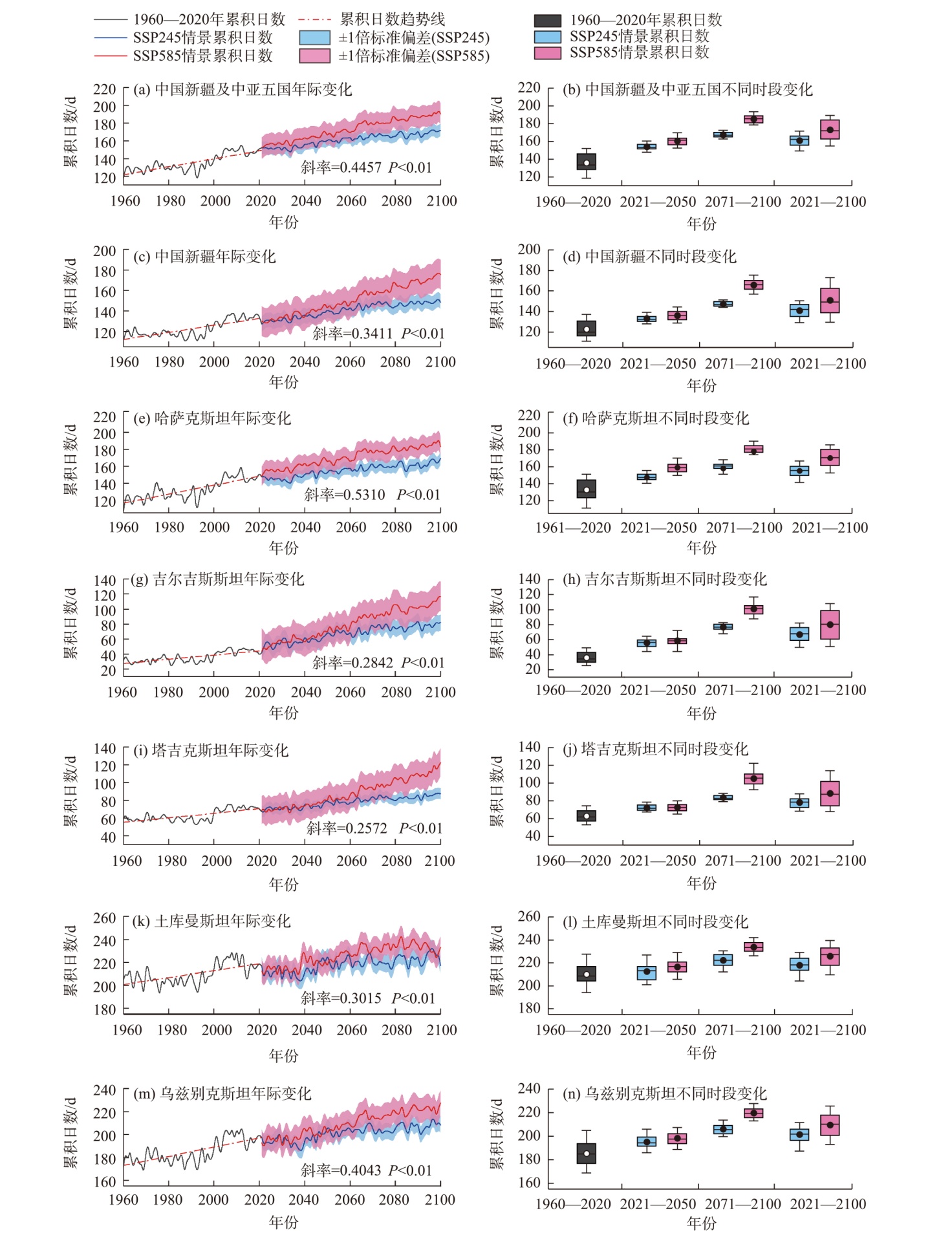
图7
1960—2020年旅游气候舒适期(HCI>80)累积日数的空间变化"
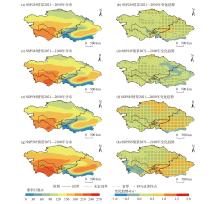
图8
不同气候变化情景下旅游气候舒适期(HCI>80)累积日数空间变化"
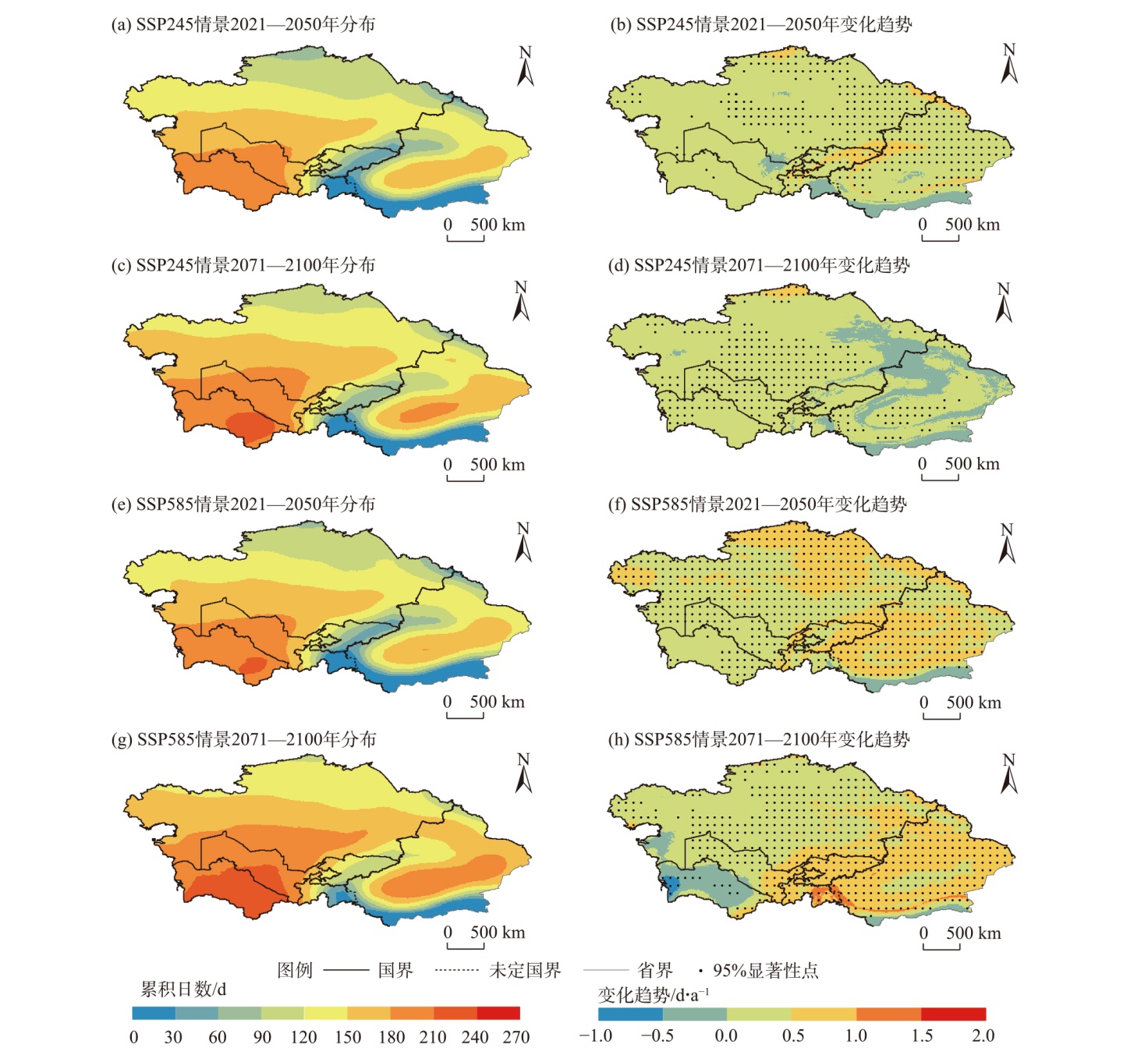
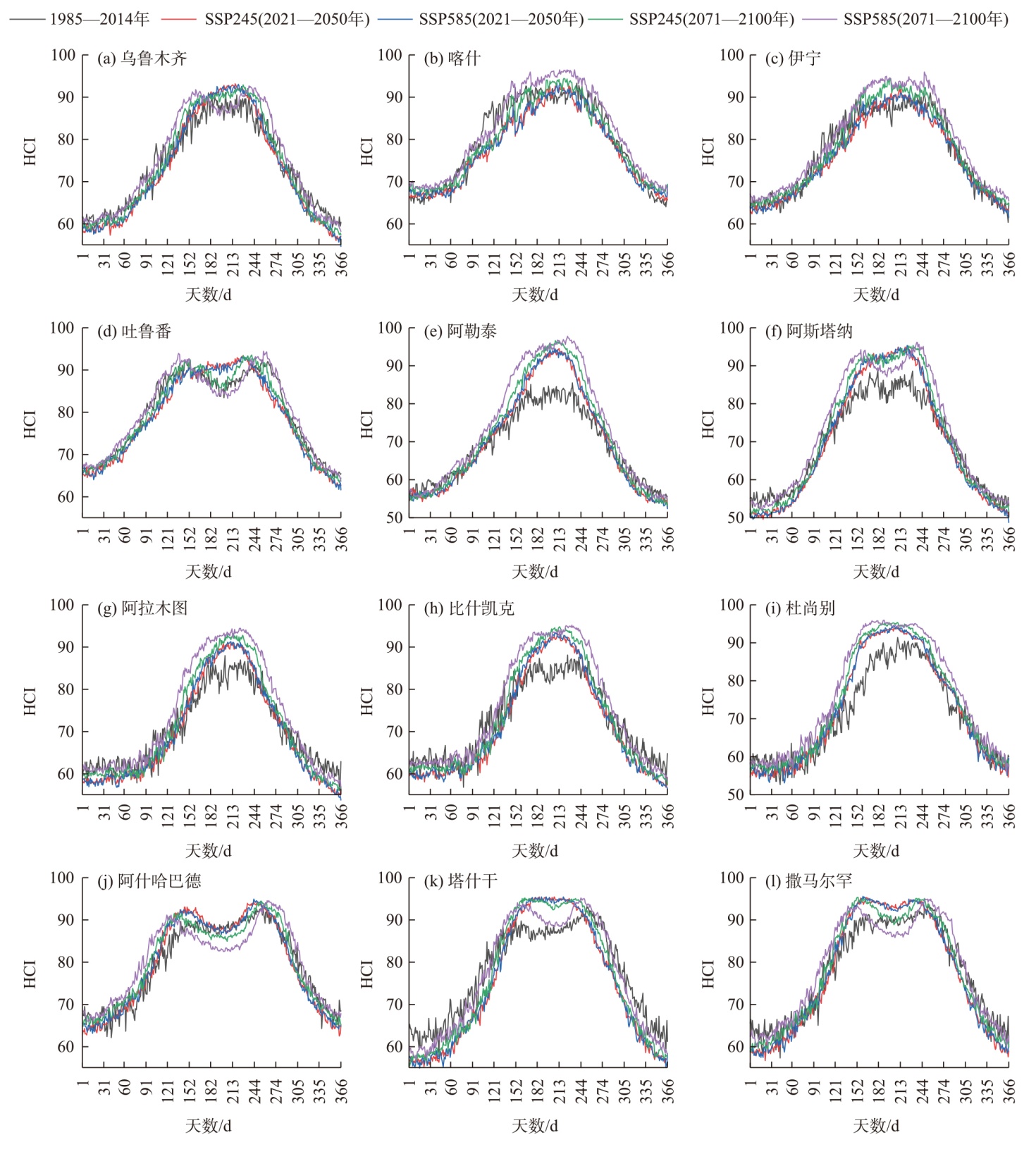
图9
主要旅游城市HCI年内变化"
| [1] | 宋瑞, 保继刚, 魏小安, 等. 旅游强国建设与旅游业高质量发展[J]. 旅游学刊, 2024, 39(7): 16-27. |
| [Song Rui, Bao Jigang, Wei Xiaoan, et al. Construction of the strong tourism country and high-quality development of tourism[J]. Tourism Tribune, 2024, 39(7): 16-27.] | |
| [2] | World Travel & Tourism Council. Economic impact research 2025[R]. London: World Travel & Tourism Council, 2025. |
| [3] |
Dogru T, Marchio E A, Bulut U, et al. Climate change: Vulnerability and resilience of tourism and the entire economy[J]. Tourism Management, 2019, 72: 292-305.
doi: 10.1016/j.tourman.2018.12.010 |
| [4] |
Martín M B G. Weather, climate and tourism a geographical perspective[J]. Annals of Tourism Research, 2005, 32(3): 571-591.
doi: 10.1016/j.annals.2004.08.004 |
| [5] |
贾妮娅·叶力肯, 侯建楠, 刘思博. 近30 a新疆地州市旅游气候舒适度时空特征分析[J]. 干旱区地理, 2025, 48(2): 212-222.
doi: 10.12118/j.issn.1000-6060.2024.086 |
|
[Yeliken Jianiya, Hou Jiannan, Liu Sibo. Spatio-temporal characterization of tourism climate comfort in Xinjiang prefectures and cities in the last 30 years[J]. Arid Land Geography, 2025, 48(2): 212-222.]
doi: 10.12118/j.issn.1000-6060.2024.086 |
|
| [6] |
Gössling S, Scott D, Hall C M, et al. Consumer behaviour and demand response of tourists to climate change[J]. Annals of Tourism Research, 2012, 39(1): 36-58.
doi: 10.1016/j.annals.2011.11.002 |
| [7] |
Rutty M, Hewer M, Knowles N, et al. Tourism & climate change in North America: Regional state of knowledge[J]. Journal of Sustainable Tourism, 2024, 32(9): 1924-1947.
doi: 10.1080/09669582.2022.2127742 |
| [8] | IPCC. Climate change 2021: The physical science basis[M]. Cambridge: Cambridge University Press, 2023. |
| [9] |
Scott D. Tourism and the climate crisis[J]. Journal of Sustainable Tourism, 2024, 32(9): 1709-1724.
doi: 10.1080/09669582.2024.2391911 |
| [10] | 关靖云, 李东, 徐晓亮, 等. 近40年新疆旅游气候舒适期的时空格局及其演变研究[J]. 西南大学学报(自然科学版), 2022, 44(6): 185-197. |
| [Guan Jingyun, Li Dong, Xu Xiaoliang, et al. Spatialtemporal pattern and evolution of tourism climate comfort period in Xinjiang in recent 40 years[J]. Journal of Southwest University (Natural Science Edition), 2022, 44(6): 185-197.] | |
| [11] |
Fallah B, Didovets I, Rostami M, et al. Climate change impacts on Central Asia: Trends, extremes and future projections[J]. International Journal of Climatology, 2024, 44(10): 3191-3213.
doi: 10.1002/joc.v44.10 |
| [12] |
Qiu Y, Feng J M, Yan Z W, et al. High-resolution dynamical downscaling for regional climate projection in Central Asia based on bias-corrected multiple GCMs[J]. Climate Dynamics, 2022, 58(3): 777-791.
doi: 10.1007/s00382-021-05934-2 |
| [13] | 陈熠瑶, 杨丽敏, 王玮. 合作之路越走越宽中国中亚旅游“双向奔赴”[N]. 中国旅游报, 2025-06-20(001). |
| [Chen Yiyao, Yang Limin, Wang Wei. The road of cooperation is wider and wider: China-central tourism’s “Two-way Journey”[N]. China Tourism News, 2025-06-20(001).] | |
| [14] | 邓浩. 中国对中亚外交: 进展、经验与未来方向[J]. 国际问题研究, 2022(4): 100-116, 141-142. |
| [Deng Hao. China’s diplomacy in Central Asia: Progress, experience and future directions[J]. International Studies, 2022(4): 100-116, 141-142.] | |
| [15] | 曾向红, 王子寒. “三大倡议”与新时期中国的中亚外交[J]. 国际展望, 2024, 16(1): 75-96, 160. |
| [Zeng Xianghong, Wang Zihan. The “Three Major Initiatives” and China’s Central Asia diplomacy in the New Era[J]. Global Review, 2024, 16(1): 75-96, 160.] | |
| [16] | 孙根年, 马丽君. 西安旅游气候舒适度与客流量年内变化相关性分析[J]. 旅游学刊, 2007, 22(7): 34-39. |
| [Sun Gennian, Ma Lijun. An analysis of tourist climate comfortable degree and yearly variation of tourist traffic in Xi’an[J]. Tourism Tribune, 2007, 22(7): 34-39.] | |
| [17] | 朱妮娜, 曾刚, 史正燕, 等. 旅游气候舒适度的模型改进及时空演化[J]. 旅游科学, 2023, 37(4): 144-160. |
| [Zhu Nina, Zeng Gang, Shi Zhengyan, et al. Model modification and spatiotemporal evolution of the comfortability degree of tourism climate[J]. Tourism Science, 2023, 37(4): 144-160.] | |
| [18] | Zhao J Y, Wang S J. Spatio-temporal evolution and prediction of tourism comprehensive climate comfort in Henan Province, China[J]. Atmosphere, 2021, 12(7): 823, doi: 10.3390/atmos12070823. |
| [19] |
Mieczkowski Z. The tourism climatic index: A method of evaluating world climates for Tourism[J]. Canadian Geographer/Le Géographe Canadien, 1985, 29(3): 220-233.
doi: 10.1111/cag.1985.29.issue-3 |
| [20] |
Höppe P. The physiological equivalent temperature: A universal index for the biometeorological assessment of the thermal environment[J]. International Journal of Biometeorology, 1999, 43(2): 71-75.
pmid: 10552310 |
| [21] |
Blazejczyk K, Epstein Y, Jendritzky G, et al. Comparison of UTCI to selected thermal indices[J]. International Journal of Biometeorology, 2012, 56(3): 515-535.
doi: 10.1007/s00484-011-0453-2 pmid: 21614619 |
| [22] | 马丽君, 孙根年, 王洁洁. 中国东部沿海沿边城市旅游气候舒适度评价[J]. 地理科学进展, 2009, 28(5): 713-722. |
|
[Ma Lijun, Sun Gennian, Wang Jiejie. Evaluation of tourism climate comfortableness of coastal cities in the eastern China[J]. Progress in Geography, 2009, 28(5): 713-722.]
doi: 10.11820/dlkxjz.2009.05.009 |
|
| [23] |
Rutty M, Scott D. Thermal range of coastal tourism resort microclimates[J]. Tourism Geographies, 2014, 16(3): 346-363.
doi: 10.1080/14616688.2014.932833 |
| [24] |
De Freitas C R, Scott D, McBoyle G. A second generation climate index for tourism (CIT): Specification and verification[J]. International Journal of Biometeorology, 2008, 52(5): 399-407.
doi: 10.1007/s00484-007-0134-3 pmid: 18097690 |
| [25] | Tartarini F, Schiavon S. Pythermal comfort: A Python package for thermal comfort research[J]. SoftwareX, 2020, 12: 100578, doi: 10.1016/j.softx.2020.100578. |
| [26] | 孙美淑, 李山. 气候舒适度评价的经验模型: 回顾与展望[J]. 旅游学刊, 2015, 30(12): 19-34. |
| [Sun Meishu, Li Shan. Empirical indices evaluating climate comfortableness: Review and prospect[J]. Tourism Tribune, 2015, 30(12): 19-34.] | |
| [27] | 蔚丹丹, 李山, 张粮锋, 等. 旅游气候舒适性评价: 模型优化与中国案例[J]. 旅游学刊, 2021, 36(5): 14-28. |
| [Wei Dandan, Li Shan, Zhang Liangfeng, et al. Evaluate tourism climate using modified holiday climate index in China[J]. Tourism Tribune, 2021, 36(5): 14-28.] | |
| [28] | Scott D, Rutty M, Amelung B, et al. An inter-comparison of the holiday climate index (HCI) and the tourism climate index (TCI) in Europe[J]. Atmosphere, 2016, 7(6): 80, doi: 10.3390/atmos7060080. |
| [29] |
Kholmatjanov B M, Abdulakhatov E I, Begmatov S U, et al. Bioclimatic conditions of the classic tourist route Tashkent-Samarkand-Bukhara-Khiva in Uzbekistan[J]. WSEAS Transactions on Environment and Development, 2023, 19: 1255-1275.
doi: 10.37394/232015 |
| [30] |
Guan J Y, Yao J Q, Li M Y, et al. Historical changes and projected trends of extreme climate events in Xinjiang, China[J]. Climate Dynamics, 2022, 59(5): 1753-1774.
doi: 10.1007/s00382-021-06067-2 |
| [31] | 周悦, 鲁瑞洁, 黄梦真. 伊犁河流域多时间尺度气象干旱时空特征[J/OL]. 干旱区地理. [2025-10-10]. https://link.cnki.net/urlid/65.1103.X.202509-30.1434.002. |
| [Zhou Yue, Lu Ruijie, Huang Mengzhen. Spatiotemporal characteristics of multi-scale meteorological drought in the Ili River Basin[J/OL]. Arid Land Geography. [2025-10-10]. https://link.cnki.net/urlid/65.1103.X.202509-30.1434.002. ] | |
| [32] |
Yan Y C, Xu Y Y, Yue S P. A high-spatial-resolution dataset of human thermal stress indices over South and East Asia[J]. Scientific Data, 2021, 8(1): 229, doi: 10.1038/s41597-021-01010-w.
pmid: 34471140 |
| [33] | 蒋文好, 陈活泼. CMIP6模式对亚洲中高纬区极端温度变化的模拟及预估[J]. 大气科学学报, 2021, 44(4): 592-603. |
| [Jiang Wenhao, Chen Huopo. Assessment and projection of changes in temperature extremes over the mid-high latitudes of Asia based on CMIP6 models[J]. Transactions Atmospheric Sciences, 2021, 44(4): 592-603.] | |
| [34] | 古再丽努尔·亚森, 张京朋, 赵天保. CMIP6多模式对21世纪中亚极端降水未来变化预估[J]. 气候与环境研究, 2023, 28(3): 286-302. |
| [Yasen Guzailinuer, Zhang Jingpeng, Zhao Tianbao. CMIP6 model-projected future changes in extreme precipitation over Central Asia in the 21st century[J]. Climate and Environment Research, 2023, 28(3): 286-302.] | |
| [35] | Yao J Q, Chen Y N, Chen J, et al. Intensification of extreme precipitation in arid Central Asia[J]. Journal of Hydrology, 2021, 598: 125760, doi: 10.1016/j.jhydrol.2020.125760. |
| [36] |
Peng D D, Zhou T J, Zhang L X, et al. Observationally constrained projection of the reduced intensification of extreme climate events in Central Asia from 0.5 ℃ less global warming[J]. Climate Dynamics, 2020, 54(1-2): 543-560.
doi: 10.1007/s00382-019-05014-6 |
| [37] |
Yu D D, Matthews L, Scott D, et al. Climate suitability for tourism in China in an era of climate change: A multiscale analysis using holiday climate index[J]. Current Issues in Tourism, 2022, 25(14): 2269-2284.
doi: 10.1080/13683500.2021.1956442 |
| [38] |
Matthews L, Scott D, Andrey J. Development of a data-driven weather index for beach parks tourism[J]. International Journal of Biometeorology, 2021, 65(5): 749-762.
doi: 10.1007/s00484-019-01799-7 |
| [39] |
Sen P K. Estimates of the regression coefficient based on Kendall’s Tau[J]. Journal of the American Statistical Association, 1968, 63(324): 1379-1389.
doi: 10.1080/01621459.1968.10480934 |
| [40] |
Mann H B. Non-parametric test against trend[J]. Econometrica, 1945, 13(3): 245-259.
doi: 10.2307/1907187 |
| [41] |
闫昕旸, 张强, 张文波, 等. 泛中亚干旱区气候变化特征分析[J]. 干旱区研究, 2021, 38(1): 1-11.
doi: 10.13866/j.azr.2021.01.01 |
|
[Yan Xinyang, Zhang Qiang, Zhang Wenbo, et al. Analysis of climate characteristics in the Pan-Central-Asia arid region[J]. Arid Zone Research, 2021, 38(1): 1-11.]
doi: 10.13866/j.azr.2021.01.01 |
|
| [42] | 阿帕尔·肉孜, 叶尔克江·霍依哈孜, 高培, 等. 新疆近50 a气候的变化特征[J]. 南京信息工程大学学报(自然科学版), 2014, 6(4): 356-362. |
| [Rouzi Apaer, Huoyihazi Yeerkejiang, Gao Pei, et al. Climatic change characteristics of Xinjiang during recent 50 years[J]. Journal of Nanjing University of Information Science and Technology: Natural Science Edition, 2014, 6(4): 356-362.] | |
| [43] |
Mountain Research Initiative Edw Working Group. Elevation-dependent warming in mountain regions of the world[J]. Nature Climate Change, 2015, 5(5): 424-430.
doi: 10.1038/nclimate2563 |
| [44] | 周波涛, 钱进. IPCC AR6报告解读: 极端天气气候事件变化[J]. 气候变化研究进展, 2021, 17(6): 713-718. |
| [Zhou Botao, Qian Jin. Changes of weather and climate extremes in the IPCC AR6[J]. Climate Change Research, 2021, 17(6): 713-718.] | |
| [45] |
Becken S, Wilson J. The impacts of weather on tourist travel[J]. Tourism Geographies, 2013, 15(4): 620-639.
doi: 10.1080/14616688.2012.762541 |
| [46] |
Li R, Chi X L. Thermal comfort and tourism climate changes in the Qinghai-Tibet Plateau in the last 50 years[J]. Theoretical and Applied Climatology, 2014, 117(3): 613-624.
doi: 10.1007/s00704-013-1027-5 |
| [47] | IPCC. Climate Change 2022: Impacts, adaptation and vulnerability[M]. Cambridge: Cambridge University Press, 2023. |
| [48] | Gossling S, Balas M, Mayer M, et al. A review of tourism and climate change mitigation: The scales, scopes, stakeholders and strategies of carbon management[J]. Tourism Management, 2023, 95: 104681, doi: 10.1016/j.tourman.2022.104681. |
| [49] |
陈亚宁, 李稚, 方功焕, 等. 气候变化对中亚天山山区水资源影响研究[J]. 地理学报, 2017, 72(1): 18-26.
doi: 10.11821/dlxb201701002 |
|
[Chen Yaning, Li Zhi, Fang Gonghuan, et al. Impact of climate change on water resources in the Tianshan Mountains, Central Asia[J]. Acta Geographica Sinica, 2017, 72(1): 18-26.]
doi: 10.11821/dlxb201701002 |
| [1] | 卢雅焱, 封甜, 杨兆萍, 韩芳, 贾莹莹. 中国省域新质生产力与旅游高质量发展适配度时空演变及障碍因子研究[J]. 干旱区地理, 2026, 49(4): 643-655. |
| [2] | 陈文宣, 陈钰, 王生隆. 黄河流域农业碳排放时空演化特征及其影响因素分析[J]. 干旱区地理, 2026, 49(4): 713-726. |
| [3] | 朱怡婷, 梁桂仙, 周春山, 辛龙, 李金雪. 新疆文旅新质生产力发展时空演变特征与驱动因素[J]. 干旱区地理, 2026, 49(1): 128-139. |
| [4] | 于志翔, 于晓晶, 陈诗永, 李霞, 梅桢. 2000—2023年天山北坡城市群冬季大气污染事件时空演变特征[J]. 干旱区地理, 2026, 49(1): 35-46. |
| [5] | 石卓达, 杨宏伟. 旅游经济高质量发展测度及影响因素分析——以新疆为例[J]. 干旱区地理, 2025, 48(7): 1233-1242. |
| [6] | 苗颖凤, 原野, 周正伟, 赵嘉瑜, 郭宇茜. 汾渭平原农作物种植结构时空格局演变特征研究[J]. 干旱区地理, 2025, 48(6): 995-1005. |
| [7] | 贾妮娅·叶力肯, 侯建楠, 刘思博. 近30 a新疆地州市旅游气候舒适度时空特征分析[J]. 干旱区地理, 2025, 48(2): 212-222. |
| [8] | 王彦闻, 杨欢, 涂佩玥, 丁昊, 荆莹, 何超. 天山北坡经济带城市扩张对生境质量的影响[J]. 干旱区地理, 2025, 48(12): 2232-2246. |
| [9] | 王生霞, 李茂兰, 刘芮廷. 旅游业效率与城镇化耦合协调度的时空演变及障碍因素分析——以“一带一路”核心段为例[J]. 干旱区地理, 2025, 48(11): 2053-2061. |
| [10] | 张晓东, 马风华, 赵志鹏, 武丹, 马玉学, 吉卫波, 公亮. 宁夏中部荒漠草原防沙治沙区NDVI时空演化特征及其对气候因素的响应[J]. 干旱区地理, 2025, 48(10): 1804-1814. |
| [11] | 马晓敏, 张志斌, 郭倩倩, 赵学伟, 张宁. 2000—2020年兰州市人口时空格局演变及驱动因素分析[J]. 干旱区地理, 2025, 48(1): 168-178. |
| [12] | 周镕基, 骆丽庄, 吴思斌. 中国新世纪水稻生产负外部性评估及时空演变研究[J]. 干旱区地理, 2024, 47(5): 830-840. |
| [13] | 张明斗, 任衍婷, 周亮. 黄河流域城市生态韧性时空演变特征及影响因素分析[J]. 干旱区地理, 2024, 47(3): 445-454. |
| [14] | 高亚苗, 陈浩楠, 王芳, 南雄雄, 陈红翔, 李文慧. 宁夏典型粮食作物生产水足迹时空演变及节水潜力评价[J]. 干旱区地理, 2024, 47(12): 2005-2016. |
| [15] | 任洪杰, 李辉尚. 中国乡村生态韧性时空演变特征及影响因素探究[J]. 干旱区地理, 2024, 47(11): 1915-1923. |
|
||